


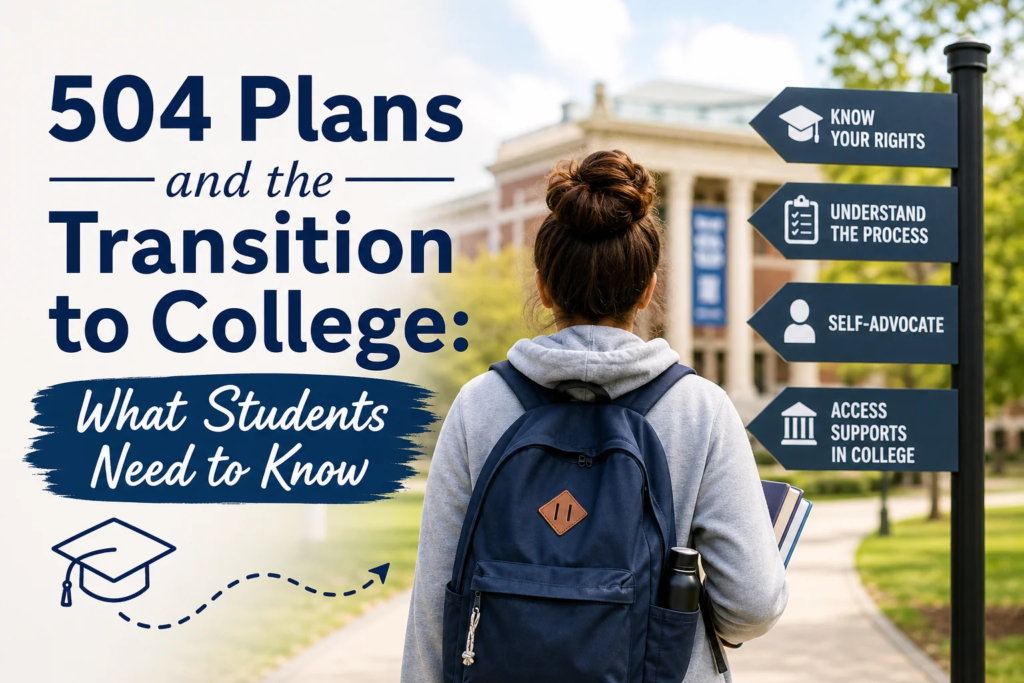
College can feel like a thrilling leap—new classes, new friends, new freedom, and a campus full of possibilities. But for students who relied on a 504 Plan in high school, that leap can also bring a big question:
Will my accommodations follow me to college?
The short answer: not automatically.
That surprises many students and families. In high school, a 504 Plan may have provided extended test time, preferential seating, assistive technology, reduced-distraction testing, attendance flexibility, or other supports. But once a student graduates and enters college, the rules change. The student—not the parent, counselor, or high school team—becomes responsible for requesting disability accommodations.
That’s why understanding 504 Plans and the Transition to College: What Students Need to Know is so important. The shift from high school to college is not just academic. It is legal, practical, emotional, and personal. Students who understand the process early are far more likely to advocate confidently, avoid unnecessary stress, and succeed in their first year.
This guide breaks down what changes, what stays the same, how to request accommodations, what documentation colleges may require, and how students can prepare before they ever step into their first lecture hall.
Understanding 504 Plans and the Transition to College: What Students Need to Know
A 504 Plan is a formal plan developed under Section 504 of the Rehabilitation Act of 1973, a federal civil rights law that protects students with disabilities from discrimination in schools that receive federal funding.
In K–12 education, a 504 Plan helps ensure that students with disabilities have equal access to learning. It does not typically change what students are expected to learn, but it can change how they access instruction, testing, assignments, and school activities.
Common high school 504 accommodations include:
- Extended time on tests
- Reduced-distraction testing environment
- Permission to use assistive technology
- Preferential seating
- Breaks during class or exams
- Access to teacher notes or slides
- Modified attendance policies
- Elevator access
- Permission to record lectures
- Support for medical conditions such as diabetes, epilepsy, anxiety, ADHD, or chronic illness
When discussing 504 Plans and the Transition to College: What Students Need to Know, the most important starting point is this:
A high school 504 Plan does not automatically transfer to college.
Colleges still have legal obligations under Section 504 and the Americans with Disabilities Act, commonly called the ADA. However, the process is different. In college, students must usually register with the campus disability services office, provide documentation, and request accommodations for each semester or course.
High School vs. College: What Changes?
One of the biggest challenges in the transition from a 504 Plan to college accommodations is that many students expect the same system to continue. But high school and college operate under different models.
In high school, the school often identifies students who need support. In college, the student must self-identify.
In high school, parents are usually deeply involved. In college, privacy laws give students control over their educational information.
In high school, teachers may be told to follow a student’s 504 Plan. In college, students usually deliver accommodation letters or approve electronic notices to professors.
Here is a quick comparison:
| Area | High School 504 Plan | College Disability Accommodations |
|---|---|---|
| Main law | Section 504, IDEA may also apply for some students | Section 504 and ADA |
| Who initiates support? | School team, parents, counselors, teachers | Student |
| Parent role | Active participant | Limited unless student gives written permission |
| Documentation | School often evaluates or accepts existing records | Student may need current documentation |
| Plan transfer | 504 Plan is implemented by school | High school plan does not automatically transfer |
| Academic expectations | Some supports may be more structured | Students must meet essential course requirements |
| Teacher/professor role | Teachers are informed and expected to implement plan | Professors provide approved reasonable accommodations |
| Student responsibility | Shared with parents and school | Mostly student-driven |
| Privacy | Parents often have access | FERPA protects student records |
| Goal | Free appropriate public education, equal access | Equal access, not guaranteed success |
This difference is at the heart of 504 Plans and the Transition to College: What Students Need to Know. College accommodations are about access, not modification of essential standards.
The Legal Shift: From Entitlement to Access
In K–12 schools, students with disabilities are supported in an environment where schools have an obligation to provide access and, in some cases, specialized instruction. For students with Individualized Education Programs, or IEPs, the Individuals with Disabilities Education Act also applies.
But in college, IDEA no longer applies.
That means students do not receive an IEP in college. Students may receive accommodations under Section 504 and the ADA, but colleges are not required to provide the same level of individualized support that high schools often provide.
This is where many families misunderstand 504 Plans and the Transition to College: What Students Need to Know. A college is not required to:
- Modify essential course requirements
- Lower academic standards
- Provide personal tutors as an accommodation
- Monitor whether students attend class or complete homework
- Communicate regularly with parents
- Provide the exact accommodations listed in a high school 504 Plan
- Guarantee that a student passes a class
However, colleges are generally required to provide reasonable accommodations that give qualified students with disabilities equal access.
Examples may include:
- Extended time on exams
- Accessible housing
- Note-taking support
- Assistive technology
- Accessible course materials
- Reduced-distraction testing
- Permission to record lectures
- Priority registration
- Flexibility with attendance when disability-related and reasonable
- Interpreting or captioning services
- Accessible transportation on campus
The phrase “reasonable accommodation” matters. If an accommodation would fundamentally alter a course, lower academic standards, or create an undue burden, the college may deny it or suggest an alternative.
Why the Transition Can Be Difficult for Students
The move from a high school 504 Plan to college disability accommodations can be difficult because it happens during a major life transition. Students are adjusting to independence, harder coursework, social changes, and new routines.
For students with ADHD, anxiety, depression, autism, dyslexia, chronic illness, mobility disabilities, sensory impairments, or medical conditions, the shift can feel especially intense.
Common challenges include:
- Not knowing accommodations do not transfer automatically
- Waiting too long to contact disability services
- Feeling embarrassed to ask for help
- Not having updated documentation
- Assuming professors will know what to do
- Struggling to explain disability-related needs
- Missing deadlines for housing or testing accommodations
- Not understanding the difference between accommodations and modifications
- Losing parent support before self-advocacy skills are fully developed
A strong understanding of 504 Plans and the Transition to College: What Students Need to Know can prevent many of these problems.
The Student’s New Role: Self-Advocacy Is Essential
In college, self-advocacy becomes one of the most important success skills.
Self-advocacy means being able to:
- Understand your disability
- Explain how it affects learning or campus life
- Know what accommodations help you
- Ask for support clearly and respectfully
- Follow procedures and deadlines
- Communicate with professors
- Speak up when accommodations are not working
This does not mean students have to handle everything alone. Disability services offices exist to help. Advisors, counselors, mentors, and family members can still provide support. But the student must usually take the lead.
For many students, this is empowering. Instead of being the subject of meetings led by adults, they become the decision-maker. That independence is a major part of 504 Plans and the Transition to College: What Students Need to Know.
When Should Students Start Preparing?
Ideally, students should begin preparing for the transition during junior or senior year of high school. Waiting until the first week of college can create delays, especially if documentation is incomplete or housing accommodations are needed.
Recommended Timeline for Transition Planning
| Timeframe | What Students Should Do |
|---|---|
| Junior year of high school | Learn about your disability, review your 504 Plan, practice self-advocacy |
| Spring of junior year | Research colleges’ disability services websites |
| Summer before senior year | Ask what documentation each college requires |
| Fall of senior year | Discuss accommodations during campus visits or virtual info sessions |
| After acceptance | Contact disability services office before committing if accommodations are critical |
| After enrollment deposit | Submit documentation and accommodation request forms |
| Summer before college | Attend orientation, confirm approved accommodations, plan medication/healthcare needs |
| First week of semester | Meet professors, confirm testing arrangements, learn campus support systems |
| Throughout semester | Monitor what works, request adjustments if needed |
Students researching 504 Plans and the Transition to College: What Students Need to Know should treat accommodation planning as part of college readiness—not as an afterthought.
How to Request College Accommodations
Every college has its own process, but most follow a similar pattern.
Step 1: Find the Disability Services Office
The office may be called:
- Disability Services
- Accessibility Services
- Student Accessibility Resources
- Office of Accessible Education
- Academic Accommodations Office
- Accessibility and Disability Resources
The name varies, but the purpose is similar: to coordinate accommodations for students with disabilities.
Step 2: Review Documentation Requirements
Colleges often list documentation guidelines online. Requirements vary depending on the disability and requested accommodations.
Documentation may include:
- High school 504 Plan
- Psychoeducational evaluation
- Neuropsychological evaluation
- Medical records
- Letter from a licensed physician, psychologist, therapist, or specialist
- Diagnosis and functional impact statement
- History of accommodations
- Recent testing data, especially for learning disabilities or ADHD
A high school 504 Plan can be helpful, but it may not be enough by itself. This is a critical point in 504 Plans and the Transition to College: What Students Need to Know.
Step 3: Submit an Accommodation Request
Students usually complete an online form explaining:
- Their disability
- How it affects them academically or physically
- What accommodations they used before
- What accommodations they are requesting in college
- Why those accommodations are needed
Step 4: Meet With a Disability Services Coordinator
Many colleges require an intake meeting. This is not something to fear. It is usually a conversation about the student’s needs, documentation, classes, and campus life.
Students should be prepared to answer:
- What accommodations helped in high school?
- What situations are hardest for you?
- What barriers do you expect in college?
- Do you need housing, dining, testing, technology, or classroom accommodations?
- Are there medical or safety concerns the college should understand?
Step 5: Receive Accommodation Letters
Once accommodations are approved, the student may receive letters to share with professors. Some colleges send these electronically; others ask students to deliver them.
Step 6: Communicate With Professors
Students do not have to disclose private medical details to professors. They only need to discuss approved accommodations and logistics.
For example:
“Hi Professor Lee, I’m registered with Accessibility Services and have approved testing accommodations. I wanted to check how you prefer to coordinate exams this semester.”
This kind of communication is a practical piece of 504 Plans and the Transition to College: What Students Need to Know.
What Documentation Do Colleges Usually Want?
Documentation can be one of the biggest hurdles in the transition from a 504 Plan to college. Requirements differ by institution, but most colleges want evidence that:
- The student has a disability.
- The disability substantially limits one or more major life activities.
- The requested accommodations are connected to the disability.
Common Documentation by Disability Type
| Disability/Condition | Possible Documentation |
|---|---|
| ADHD | Evaluation from psychologist, psychiatrist, physician, or neuropsychologist; history of accommodations |
| Learning disability | Psychoeducational or neuropsychological evaluation with achievement and processing data |
| Anxiety/depression | Letter from licensed therapist, psychologist, psychiatrist, or physician |
| Autism spectrum disorder | Diagnostic evaluation, clinical report, or provider letter |
| Chronic illness | Medical documentation from treating physician or specialist |
| Mobility impairment | Physician documentation, physical therapy records, mobility assessment |
| Visual impairment | Report from ophthalmologist, optometrist, or low-vision specialist |
| Hearing impairment | Audiology report or medical documentation |
| Diabetes or epilepsy | Medical provider letter describing condition and functional impact |
| Temporary injury | Medical note explaining limitations and expected duration |
Students should contact the college directly because some institutions accept older documentation while others ask for more recent evaluations.
A useful strategy: Before paying for expensive testing, ask the college what it requires.
That simple step can save time, money, and frustration.
What Accommodations Are Common in College?
College accommodations vary based on individual needs. A student does not receive accommodations simply because they had them before; they receive accommodations because they are reasonable and supported by documentation.
Examples of College Accommodations
| Need Area | Possible College Accommodation |
|---|---|
| Testing | Extended time, reduced-distraction room, breaks, assistive technology |
| Reading | Accessible digital texts, screen readers, audiobooks |
| Writing | Speech-to-text software, computer use for exams |
| Note-taking | Peer notes, lecture slides, recording permission, smart pen |
| Attendance | Reasonable flexibility when disability-related and course-appropriate |
| Housing | Single room, accessible room, emotional support animal review, climate control |
| Dining | Meal plan adjustments, allergen information, special dietary access |
| Mobility | Accessible classrooms, transportation assistance, elevator access |
| Communication | Captioning, interpreters, FM systems |
| Registration | Priority registration to manage medical schedules or accessible routes |
This is an important part of 504 Plans and the Transition to College: What Students Need to Know: accommodations are individualized. Two students with the same diagnosis may need very different supports.
Accommodations vs. Modifications: A Crucial Difference
Students and parents often use the words “accommodation” and “modification” interchangeably, but in college they mean very different things.
An accommodation changes access.
A modification changes the essential requirement.
Colleges are generally required to provide reasonable accommodations, but they are not required to modify essential academic standards.
Accommodation or Modification?
| Request | Likely Accommodation or Modification? | Explanation |
|---|---|---|
| Extended time on exams | Accommodation | Changes testing conditions, not content |
| Taking exam in reduced-distraction setting | Accommodation | Provides equal access |
| Audio version of textbook | Accommodation | Changes format, not academic expectation |
| Waiving all exams in a course | Likely modification | May remove essential assessment |
| Substituting a required math course | Depends | May be considered if not essential to program |
| Excusing unlimited absences | Likely modification | May fundamentally alter course participation |
| Deadline flexibility for disability-related episodes | Accommodation if reasonable | Must be considered case-by-case |
| Lower grading standard | Modification | Colleges do not have to lower academic expectations |
Understanding this distinction is central to 504 Plans and the Transition to College: What Students Need to Know.
Case Study 1: Maya and ADHD Testing Accommodations
Maya had a 504 Plan throughout high school for ADHD. Her accommodations included extended time, a quiet testing room, and permission to use a planner during school check-ins. She assumed her college would automatically receive her 504 Plan after graduation.
During her first biology exam, she ran out of time and failed. Afterward, she contacted the disability services office. They explained that she needed to submit documentation and complete an intake meeting before accommodations could be approved.
Fortunately, Maya had a recent evaluation from her senior year. Within two weeks, she was approved for time-and-a-half testing and a reduced-distraction testing environment. Her grades improved, but she wished she had registered before classes began.
Analysis
Maya’s story highlights one of the most common issues in 504 Plans and the Transition to College: What Students Need to Know: accommodations are not retroactive in most cases. If a student takes an exam before registering with disability services, the college usually will not erase or change the grade simply because accommodations would have helped.
The takeaway: start early.
Case Study 2: Jordan and Chronic Illness Attendance Flexibility
Jordan has Crohn’s disease and had a high school 504 Plan that allowed bathroom access, flexible deadlines during flare-ups, and excused absences for medical appointments. In college, Jordan registered with accessibility services during the summer.
The disability coordinator approved bathroom access, some deadline flexibility, and a process for communicating disability-related absences. However, one lab science course required in-person participation because students had to complete supervised experiments.
The college worked with Jordan and the professor to create a reasonable plan: Jordan could make up two labs if flare-ups occurred, but missing more than that might require taking an incomplete or retaking the course.
Analysis
Jordan’s situation shows that college accommodations must be balanced with essential course requirements. In conversations about 504 Plans and the Transition to College: What Students Need to Know, students often ask whether colleges must excuse absences. The answer is: sometimes, but not always.
Attendance flexibility depends on the course structure, learning outcomes, and whether participation is essential.
Case Study 3: Elena and Housing Accommodations for Anxiety
Elena had anxiety and panic attacks in high school. Her 504 Plan allowed breaks during class and access to a counselor when needed. When she enrolled at a university, she requested a single dorm room because shared sleeping spaces intensified her panic symptoms.
The housing office initially told her single rooms were limited. Elena then contacted disability services, submitted documentation from her therapist, and explained the functional impact of her anxiety. After review, the college approved a single room as a disability-related housing accommodation.
Analysis
Elena’s case demonstrates that college accommodations extend beyond classrooms. A major part of 504 Plans and the Transition to College: What Students Need to Know is understanding that accessibility may involve housing, dining, transportation, campus events, and emergency planning—not just exams.
Students with housing-related needs should apply early because deadlines may come months before move-in.
Case Study 4: Marcus and Dyslexia in a Fast-Paced Major
Marcus had dyslexia and used audiobooks, extended testing time, and writing support in high school. He entered college as a business major and registered with disability services before orientation.
He was approved for accessible textbooks, text-to-speech software, extended exam time, and use of a laptop for essay exams. But Marcus also discovered that accommodations alone were not enough. College reading loads were heavier than expected.
He added weekly academic coaching, joined a study group, and learned to preview reading assignments before lectures. By sophomore year, he had a system that worked.
Analysis
Marcus’s experience is a reminder that 504 Plans and the Transition to College: What Students Need to Know is not only about formal accommodations. Students also need strategies, routines, technology skills, and campus support. Accommodations open the door, but habits help students walk through it.
What Parents Need to Know
Parents often play a huge role in managing high school 504 Plans. They attend meetings, email teachers, gather documents, and monitor progress. In college, that role changes.
Because of FERPA, the Family Educational Rights and Privacy Act, parents generally do not have automatic access to college records once the student enrolls, even if the student is under 18 or the parent pays tuition.
Students can sign releases allowing parents to communicate with certain offices, but colleges still usually expect the student to lead.
Parents can help by:
- Encouraging the student to contact disability services
- Practicing self-advocacy conversations at home
- Helping organize documentation
- Creating a medication and healthcare plan
- Teaching students to schedule appointments
- Encouraging problem-solving instead of taking over
- Discussing when and how to ask for help
A healthy parent role in 504 Plans and the Transition to College: What Students Need to Know is supportive, not controlling.
Questions Students Should Ask Before Choosing a College
Not all disability services offices operate exactly the same way. Some colleges offer robust accessibility support, while others provide basic accommodations but fewer coaching or learning resources.
Students should ask questions before enrolling.
Questions for Disability Services
| Topic | Questions to Ask |
|---|---|
| Documentation | What documentation do you require for my disability? |
| Timing | When should I submit my request? |
| Testing | How are extended-time exams scheduled? |
| Housing | What are the deadlines for disability-related housing requests? |
| Assistive technology | What tools are available to students? |
| Note-taking | Do you provide note-taking support or lecture recording options? |
| Temporary conditions | Do you support temporary injuries or medical episodes? |
| Appeals | What happens if an accommodation request is denied? |
| Communication | Do students or staff notify professors? |
| Support services | Do you offer coaching, tutoring, or executive function support? |
A smart approach to 504 Plans and the Transition to College: What Students Need to Know is to compare accessibility services the same way students compare majors, dorms, scholarships, or campus culture.
Red Flags to Watch For
Most colleges take accessibility seriously, but students should pay attention to how offices communicate.
Potential red flags include:
- Vague answers about documentation
- No clear accommodation request process
- Long delays without explanation
- Staff who discourage students from applying
- No appeal process
- Confusion about housing or testing accommodations
- Professors who refuse approved accommodations
- Lack of accessible campus routes or facilities
If a concern arises, students should document communication and follow the college’s grievance or appeal procedures. Students can also seek guidance from disability rights organizations or legal advocates if necessary.
How Professors Fit Into the Process
Professors are not usually responsible for deciding whether a student qualifies for accommodations. That is the role of disability services.
Once accommodations are approved, professors are generally responsible for implementing them in their courses. However, there may be discussion if an accommodation conflicts with essential course requirements.
For example, if a student has an accommodation for occasional deadline flexibility, the professor may still set reasonable limits. If the course involves group projects, labs, or clinical work, flexibility may require careful planning.
Students should communicate early and professionally.
A helpful email template:
Dear Professor Smith,
I am enrolled in your English 101 course this semester. I am registered with Accessibility Services and have approved accommodations. I wanted to introduce myself and ask how you prefer to coordinate any accommodation-related logistics, especially for exams and assignment planning.
Thank you,
Jordan
This simple step can make 504 Plans and the Transition to College: What Students Need to Know feel much more manageable.
What If a Professor Refuses an Accommodation?
Occasionally, a professor may misunderstand or resist an approved accommodation. Students should not argue alone or disclose more personal information than necessary.
Instead, students should:
- Stay calm and keep written records.
- Contact disability services immediately.
- Forward relevant emails or messages.
- Ask the office to clarify the accommodation with the professor.
- Follow the college’s complaint or grievance process if needed.
A professor may raise legitimate questions about whether an accommodation changes an essential requirement, but they should not simply ignore an official accommodation letter.
This is another practical piece of 504 Plans and the Transition to College: What Students Need to Know: students need to know where to go when something breaks down.
The Role of Assistive Technology
Assistive technology can be a game-changer in college. Many students used supports in high school without knowing what tools were available. College is a great time to build a personalized technology toolkit.
Helpful tools may include:
- Text-to-speech software
- Speech-to-text software
- Smart pens
- Digital planners
- Audiobook platforms
- Screen readers
- Noise-canceling headphones
- Time-management apps
- Mind-mapping software
- Captioning tools
- Recording apps approved by the college
- PDF annotation tools
Students should ask disability services whether the college provides training. Technology only helps if the student knows how to use it before the pressure of exams and deadlines hits.
In planning for 504 Plans and the Transition to College: What Students Need to Know, students should practice with technology during the summer before college.
Building a Personal Accommodation File
Every student transitioning from a 504 Plan to college should create a digital accommodation file.
This file can include:
- High school 504 Plan
- Evaluation reports
- Medical documentation
- Provider letters
- List of past accommodations
- College accommodation approval letters
- Emails from disability services
- Housing accommodation approvals
- Medication list
- Emergency contacts
- Insurance information
- Copies of appeal or grievance procedures
Keep the file in a secure cloud folder and a backup location. Organization reduces stress when deadlines are tight.
This may sound simple, but it is one of the most practical strategies in 504 Plans and the Transition to College: What Students Need to Know.
Social and Emotional Adjustment Matters Too
The transition to college is not just about disability paperwork. Students are also learning how to live with roommates, manage sleep, eat regularly, handle stress, navigate relationships, and make independent choices.
Students who had strong high school support may feel alone at first. That does not mean they are failing. It means they are adjusting.
Support systems can include:
- Campus counseling center
- Academic advising
- Disability services
- Peer mentoring programs
- Cultural or identity-based student groups
- Faith or spiritual communities
- Health services
- Tutoring center
- Writing center
- Faculty office hours
- Resident assistants
- Student clubs
When discussing 504 Plans and the Transition to College: What Students Need to Know, it is important to remember that success is not only about accommodations. Belonging, wellness, and connection matter too.
A Practical College Transition Checklist
Here is a step-by-step checklist students can use.
Before College Begins
- Review your high school 504 Plan.
- Identify which accommodations were actually helpful.
- Gather disability documentation.
- Check each college’s documentation requirements.
- Contact disability services after admission.
- Submit accommodation forms early.
- Ask about housing and dining deadlines.
- Learn how testing accommodations are scheduled.
- Practice emailing professors or staff.
- Set up medication refills and healthcare providers.
- Learn your insurance information.
- Create a digital accommodation file.
- Try assistive technology before classes start.
During the First Semester
- Send accommodation letters early.
- Meet with professors during office hours if needed.
- Schedule accommodated exams before deadlines.
- Use tutoring and writing centers before you are overwhelmed.
- Track symptoms, workload, and stress patterns.
- Ask for adjustments if accommodations are not working.
- Keep copies of important emails.
- Build routines for sleep, meals, study time, and medication.
This checklist captures the heart of 504 Plans and the Transition to College: What Students Need to Know: preparation creates freedom.
Common Mistakes Students Make
Even capable students can stumble during the transition. Here are common mistakes and how to avoid them.
| Mistake | Why It Creates Problems | Better Approach |
|---|---|---|
| Waiting until after failing an exam | Accommodations may not apply retroactively | Register before classes start |
| Assuming the 504 Plan transfers | College has a separate process | Contact disability services directly |
| Letting parents handle everything | College expects student self-advocacy | Practice leading conversations |
| Not reading emails from disability services | Missed deadlines or incomplete forms | Check college email daily |
| Avoiding professors | Confusion about logistics | Send accommodation letters early |
| Not using approved accommodations | Stress and poor performance may increase | Use supports consistently |
| Waiting too long to ask for help | Problems become harder to fix | Reach out at first signs of trouble |
| Not updating documentation | Requests may be delayed | Confirm requirements early |
Avoiding these mistakes can make 504 Plans and the Transition to College: What Students Need to Know far less stressful.
What If a College Denies an Accommodation?
A denial does not always mean the conversation is over. Sometimes a college denies a request because documentation is incomplete, the request is not clearly connected to the disability, or the accommodation would fundamentally alter a course.
Students can ask:
- Why was the request denied?
- What documentation is missing?
- Is there an alternative accommodation?
- Can I appeal the decision?
- Who reviews appeals?
- Can my provider submit additional information?
Students should keep communication respectful and documented. If necessary, they can use the college’s grievance procedure.
A student may not always receive the exact accommodation requested, but they should be part of an interactive process. That interactive process is a key principle in 504 Plans and the Transition to College: What Students Need to Know.
How Students Can Build Confidence Before College
The best time to practice self-advocacy is before college starts.
Students can begin by:
- Attending their final high school 504 meeting and speaking for themselves
- Explaining their accommodations in their own words
- Scheduling their own doctor or therapy appointments
- Refilling prescriptions with guidance
- Emailing teachers with questions
- Practicing how to describe their learning needs
- Managing a calendar
- Learning to track deadlines
- Asking for help without waiting for a crisis
Families can role-play common situations:
- “How would you email disability services?”
- “What would you say if a professor forgot your accommodation?”
- “How would you explain why reduced-distraction testing helps you?”
- “What would you do if your medication was running low?”
Confidence grows through practice. That is one of the most hopeful truths about 504 Plans and the Transition to College: What Students Need to Know.
The Bigger Picture: Accommodations Are Not an Advantage
Some students hesitate to use accommodations because they worry it means they are “cheating” or receiving special treatment.
That is not true.
Accommodations are designed to remove disability-related barriers. They do not guarantee an easy path. They do not replace studying, effort, or responsibility. They simply help students access the same educational opportunities as their peers.
A student with dyslexia using text-to-speech is still responsible for understanding the material. A student with ADHD using extended time is still responsible for knowing the content. A student with a chronic illness receiving attendance flexibility is still responsible for meeting course outcomes.
Understanding this can reduce shame and increase confidence.
The most empowering message in 504 Plans and the Transition to College: What Students Need to Know is this: asking for access is not weakness. It is wisdom.
FAQs About 504 Plans and the Transition to College: What Students Need to Know
1. Does my high school 504 Plan automatically transfer to college?
No. Your 504 Plan does not automatically transfer. You must contact your college’s disability services or accessibility office, submit required documentation, and request accommodations through the college’s process.
2. Can my parents request college accommodations for me?
Usually, the student must initiate the process. Parents can help you prepare, but colleges generally expect students to communicate directly. Due to FERPA, parents may not have access to your records unless you provide written permission.
3. Will I get the same accommodations I had in high school?
Not always. Your high school 504 Plan may help show your history of accommodations, but the college decides what is reasonable based on your documentation, disability-related needs, and course requirements.
4. When should I contact disability services?
As early as possible after you are admitted or decide to enroll. If you need housing, dining, transportation, or complex medical accommodations, contact the office months before classes begin.
5. Can a college deny an accommodation?
Yes, a college may deny an accommodation if it is not supported by documentation, is not disability-related, creates an undue burden, or fundamentally alters an essential course or program requirement. However, the college may offer alternative accommodations.
6. Do I have to tell professors my diagnosis?
No. You generally do not need to disclose your diagnosis to professors. You only need to share your official accommodation letter and discuss how approved accommodations will be implemented.
7. Are colleges required to provide tutoring as a 504 accommodation?
Not usually as a disability accommodation. Many colleges offer tutoring to all students, but they are generally not required to provide personal tutoring as an accommodation. They may provide access-related supports, such as assistive technology or note-taking accommodations.
8. Can I request accommodations after the semester starts?
Yes, but it is better to request them early. Accommodations usually begin after approval and are typically not applied retroactively to past exams, assignments, or grades.
Conclusion: Step Into College Prepared, Confident, and Empowered
The transition from high school to college is a major milestone. For students with disabilities, it brings new responsibilities—but also new opportunities to grow, advocate, and take ownership of success.
The most important lessons about 504 Plans and the Transition to College: What Students Need to Know are clear:
- Your high school 504 Plan does not automatically follow you.
- You must register with your college’s disability services office.
- Documentation matters, so gather it early.
- College accommodations provide access, not lowered standards.
- Self-advocacy is essential.
- Parents can support, but students must lead.
- Accommodations are not an unfair advantage—they are a tool for equal opportunity.
College is not about proving you can do everything alone. It is about learning how to use the right resources, ask smart questions, and build a life that supports your strengths.
If you are a student preparing for this transition, start now. Send the email. Gather the documents. Ask the questions. Practice speaking up.
Your 504 Plan may not transfer automatically—but your self-knowledge, resilience, and determination absolutely can.


The PsyForU Editorial Collective is the research and editorial team of PsyForU Research International. The collective prepares educational, psychological, mental-health-awareness, inclusion, neurodiversity, and research-methodology content for students, parents, educators, researchers, and general readers. PsyForU content is intended for awareness, education, and capacity-building and should not be treated as clinical diagnosis, therapy, medical advice, legal advice, or emergency mental-health support.