


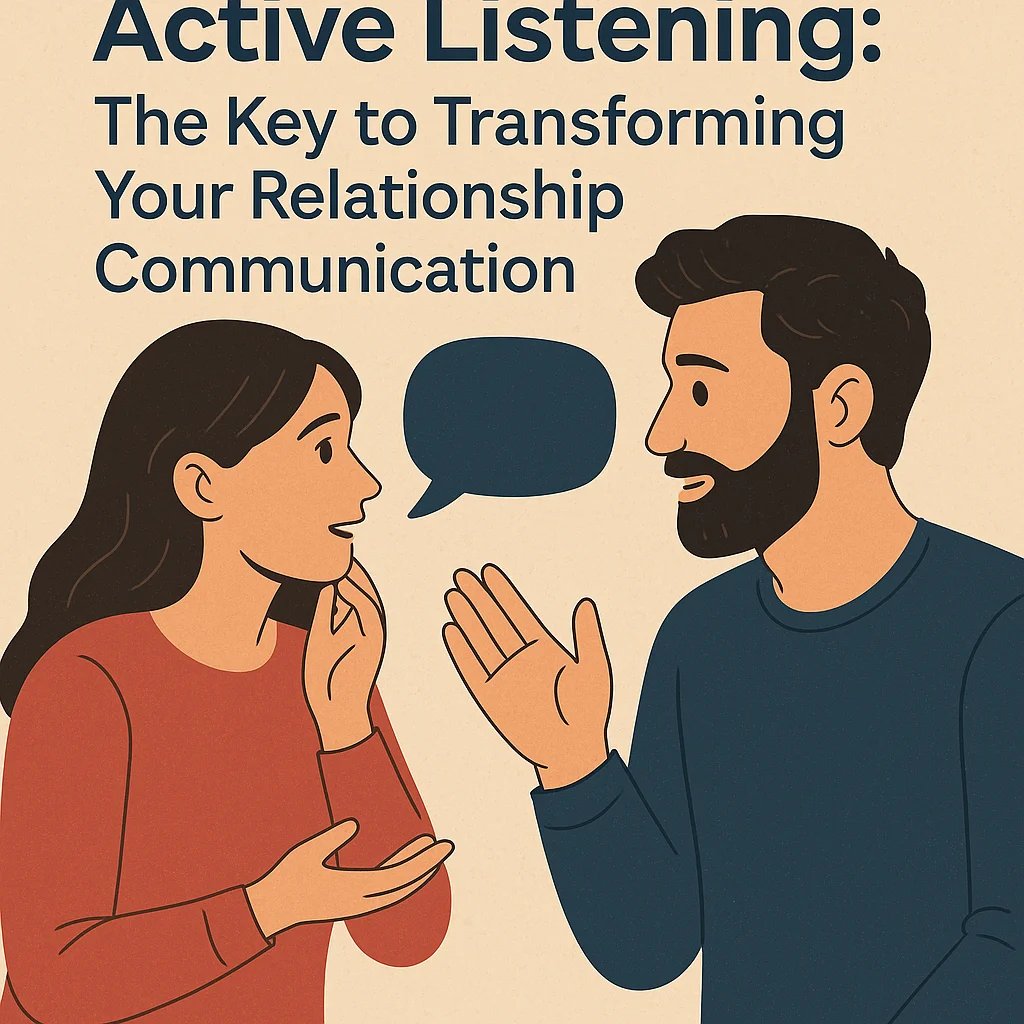
Essential Guide to Active Listening: The Key to Transforming Your Relationship Communication
Introduction: The Moment That Changes Everything
Most relationship arguments do not begin with cruelty. They begin with misunderstanding.
One person says, “You never make time for me,” and the other hears, “You are a failure.” One partner says, “I need help,” and the other hears criticism. A parent asks, “Where were you?” and a teenager hears control instead of concern. Before long, two people who genuinely care about each other are defending, interrupting, withdrawing, or trying to “win” a conversation that was never supposed to become a battle.
That is why Active Listening: The Key to Transforming Your Relationship Communication is more than a communication technique. It is a relationship skill that can turn tension into trust, defensiveness into openness, and everyday conversations into moments of real connection.
Active listening is not simply staying quiet while someone else talks. It is the intentional practice of listening to understand, not just to respond. It means paying attention to words, emotions, body language, timing, context, and the deeper need behind what is being said.
In healthy relationships, people do not always agree. They do not magically avoid conflict. But they know how to make each other feel heard. And feeling heard is one of the most powerful emotional experiences in any relationship.
This in-depth guide explores Active Listening: The Key to Transforming Your Relationship Communication from every angle: what it means, why it works, how to practice it, how to use it during conflict, and how real couples, families, and teams can apply it in daily life.
What Is Active Listening?
Active listening is the practice of giving someone your full attention with the goal of understanding their message, emotions, and needs before responding.
It involves more than hearing words. It includes:
- Maintaining presence
- Asking thoughtful questions
- Reflecting back what you heard
- Validating emotions
- Avoiding premature advice
- Not interrupting
- Listening for meaning beneath the surface
At its heart, active listening in relationship communication says: “You matter enough for me to slow down and understand you.”
That simple shift can completely change the emotional climate of a conversation.
Passive Listening vs. Active Listening
Many people believe they are listening because they are physically present. But being in the room is not the same as being emotionally available.
| Type of Listening | What It Looks Like | Impact on Relationship |
|---|---|---|
| Passive listening | Nodding while distracted, waiting to speak | The other person may feel ignored |
| Defensive listening | Hearing every comment as criticism | Conflict escalates quickly |
| Selective listening | Noticing only parts that support your view | Misunderstanding increases |
| Fix-it listening | Jumping into advice too soon | The speaker may feel dismissed |
| Active listening | Seeking to understand before responding | Trust, safety, and clarity improve |
This is why many relationship experts consider Active Listening: The Key to Transforming Your Relationship Communication a foundational skill. Without it, even loving people can feel emotionally distant.
Why Active Listening Matters So Much in Relationships
Communication problems are rarely just about words. They are about what people experience beneath the words.
When someone feels unheard, they may begin to think:
- “My feelings do not matter.”
- “They always twist what I say.”
- “I cannot be honest without starting a fight.”
- “There is no point in talking.”
Over time, these thoughts create emotional distance. People stop sharing honestly. They become sarcastic, guarded, resentful, or silent.
Active listening interrupts this pattern.
When practiced consistently, active listening for better relationship communication can help people feel emotionally safe enough to speak honestly. And emotional safety is the ground where intimacy grows.
The Hidden Message Behind Most Conversations
In relationships, the spoken message is often only part of the message.
For example:
| Spoken Words | Possible Deeper Meaning |
|---|---|
| “You are always on your phone.” | “I miss your attention.” |
| “You never help around here.” | “I feel unsupported.” |
| “Why didn’t you tell me?” | “I want to feel included.” |
| “Fine, do whatever you want.” | “I feel hurt and powerless.” |
| “You don’t care.” | “I need reassurance.” |
Active listening helps you hear the deeper meaning without immediately reacting to the surface-level accusation.
That is one reason Active Listening: The Key to Transforming Your Relationship Communication is so effective. It helps people move from blame to understanding.
The Psychology Behind Active Listening
Human beings are wired to protect themselves from emotional threat. In difficult conversations, the brain can interpret criticism, rejection, or contempt as danger. When this happens, people often shift into fight, flight, freeze, or appease responses.
That may look like:
- Raising your voice
- Shutting down
- Becoming sarcastic
- Changing the subject
- Overexplaining
- Saying yes just to end the conversation
- Attacking back
Active listening helps calm this defensive cycle.
When someone feels genuinely heard, their nervous system often relaxes. They become less focused on protecting themselves and more capable of collaborating.
Active Listening Creates Emotional Regulation
A calm listener can help regulate a tense conversation.
This does not mean absorbing disrespect or ignoring your own needs. It means choosing a response that lowers emotional heat rather than adding fuel.
For example:
Instead of saying:
“You are being dramatic.”
Try:
“I can see this really hurt you. Help me understand what felt most upsetting.”
Instead of saying:
“That is not what happened.”
Try:
“I remember it differently, but I want to understand how it felt from your side.”
These responses do not require immediate agreement. They simply keep the conversation open.
That is the practical beauty of Active Listening: The Key to Transforming Your Relationship Communication: it allows honesty without emotional warfare.
The Core Principles of Active Listening
Active listening is not complicated, but it does require discipline. Most people struggle not because they do not care, but because they are used to preparing their defense while the other person is still talking.
Here are the core principles.
1. Listen to Understand, Not to Win
Many conversations become competitions. Each person is trying to prove their version of reality.
Active listening changes the goal.
The goal becomes:
- “What are they trying to tell me?”
- “What emotion is underneath this?”
- “What need is not being met?”
- “What can I learn before I respond?”
When the goal changes, the conversation changes.
2. Give Full Attention
Full attention is rare in modern relationships. Phones, stress, work notifications, and mental overload make deep listening difficult.
But attention communicates value.
Simple actions matter:
- Put your phone down
- Turn toward the person
- Make appropriate eye contact
- Pause background distractions
- Avoid multitasking
- Notice your facial expression
You do not have to be perfect. You just have to be present.
3. Reflect Before Responding
Reflection means repeating or summarizing what you heard in your own words.
Example:
“So what I’m hearing is that when I came home late and didn’t text, you felt unimportant and worried. Is that right?”
Reflection prevents misinterpretation. It also gives the speaker a chance to clarify.
This is one of the most important tools in active listening techniques for couples and families.
4. Validate the Emotion
Validation does not mean agreement. It means acknowledging that the other person’s feelings make sense from their perspective.
Example:
“I can understand why that felt disappointing.”
You are not saying, “I did everything wrong.”
You are saying, “Your feelings are real enough for me to respect them.”
5. Ask Open-Ended Questions
Open-ended questions invite depth.
Instead of:
“Are you mad?”
Ask:
“What felt hardest about that for you?”
Instead of:
“Do you want me to fix it?”
Ask:
“What would feel supportive right now?”
Good questions help people feel explored, not interrogated.
The Active Listening Skills Table
Use this table as a practical reference.
| Skill | What to Do | Example Phrase | Why It Works |
|---|---|---|---|
| Presence | Stop multitasking and focus | “I’m here. I’m listening.” | Communicates respect |
| Reflection | Repeat the meaning back | “You felt left out when I made the plan without you.” | Reduces misunderstanding |
| Validation | Acknowledge feelings | “That makes sense.” | Lowers defensiveness |
| Curiosity | Ask open questions | “Can you tell me more about that?” | Encourages honesty |
| Patience | Let silence happen | “Take your time.” | Creates emotional safety |
| Clarification | Check accuracy | “Did I understand that correctly?” | Prevents assumptions |
| Empathy | Imagine their experience | “That sounds lonely.” | Builds emotional connection |
| Repair | Own your impact | “I see how my words came across harshly.” | Restores trust |
This table captures why Active Listening: The Key to Transforming Your Relationship Communication is not one skill but a collection of small, intentional behaviors.
The Listening Ladder: From Reaction to Connection
A helpful way to understand active listening is to imagine a ladder. At the bottom is reactive communication. At the top is connected communication.
| Level | Listening Style | Common Thought | Relationship Result |
|---|---|---|---|
| 1 | Ignoring | “This is not important.” | Disconnection |
| 2 | Pretending | “I’ll nod until it ends.” | Frustration |
| 3 | Defensive | “I need to protect myself.” | Escalation |
| 4 | Selective | “I only hear what affects me.” | Confusion |
| 5 | Attentive | “I’m paying attention.” | Improved understanding |
| 6 | Reflective | “Let me check if I understood.” | Clarity |
| 7 | Empathic | “I want to understand your inner world.” | Trust and intimacy |
The goal is not to live at level seven every second. That is unrealistic. The goal is to notice when you have dropped into defensiveness and climb back toward curiosity.
This is where Active Listening: The Key to Transforming Your Relationship Communication becomes a daily practice, not a one-time trick.
Common Barriers to Active Listening
Even people with good intentions struggle to listen well. Understanding the barriers makes it easier to overcome them.
| Barrier | What It Sounds Like Internally | Better Response |
|---|---|---|
| Defensiveness | “They are blaming me.” | “Let me understand before I explain.” |
| Impatience | “Get to the point.” | “This matters to them, so I can slow down.” |
| Assumptions | “I already know what they mean.” | “Let me ask instead of assume.” |
| Ego | “I need to be right.” | “Connection matters more than winning.” |
| Emotional flooding | “I cannot handle this.” | “I need a short break so I can listen well.” |
| Distraction | “I’m half here.” | “Let me put this away and focus.” |
| Fixing | “I know the solution.” | “Do they want advice or empathy?” |
One of the most overlooked parts of active listening for relationship conflict is self-awareness. You cannot listen deeply if you do not notice what is happening inside you.
Case Study 1: The Couple Stuck in the Same Argument
Background
Maya and Daniel had been together for seven years. Their most repeated argument was about household responsibilities. Maya felt exhausted and unsupported. Daniel felt criticized and unappreciated.
Their conversations usually sounded like this:
Maya: “I do everything around here.”
Daniel: “That is not true. I helped yesterday.”
Maya: “You only help when I ask.”
Daniel: “Nothing I do is ever good enough.”
The argument always ended with Maya crying and Daniel leaving the room.
Active Listening Intervention
During a calmer conversation, Daniel practiced active listening instead of defending himself.
Maya said:
“I feel like I carry the mental load. Even when you help, I have to tell you what needs to be done.”
Daniel responded:
“So it is not only about the chores themselves. It is that you feel responsible for noticing, planning, and reminding. That makes you feel alone. Did I get that right?”
Maya softened immediately.
She replied:
“Yes. That is exactly it. I do not want to be your manager. I want us to feel like partners.”
Daniel then said:
“I can see why that would feel exhausting. I was hearing it as ‘you never do anything,’ but you are saying you want me to take more initiative.”
Outcome
The couple created a shared weekly planning routine. Instead of “helping,” Daniel took ownership of specific tasks from start to finish.
Analysis
This case shows why Active Listening: The Key to Transforming Your Relationship Communication is so powerful. The conflict was not really about dishes or laundry. It was about partnership, recognition, and emotional labor.
By listening for the deeper meaning, Daniel moved from defensiveness to collaboration. Maya felt understood, which made problem-solving possible.
Case Study 2: The Parent and Teenager Who Could Not Talk
Background
A father, Marcus, was worried about his 16-year-old daughter, Alina. Her grades had dropped, and she spent more time alone in her room. Whenever Marcus asked questions, Alina snapped back.
Their conversations often went like this:
Marcus: “Why are your grades slipping?”
Alina: “I don’t know.”
Marcus: “You need to take this seriously.”
Alina: “You don’t understand anything.”
Marcus believed he was being responsible. Alina experienced his concern as pressure.
Active Listening Intervention
One evening, Marcus changed his approach.
Instead of starting with grades, he said:
“I realize I have been asking a lot of questions and probably making you feel judged. I want to understand what life has been feeling like for you lately.”
Alina shrugged but did not leave.
Marcus continued:
“I’m not here to lecture. I just want to listen for a few minutes.”
After a pause, Alina said:
“I’m tired all the time. I feel like everyone expects me to know what I’m doing, and I don’t.”
Marcus reflected:
“So it feels like pressure is coming from everywhere, and you are scared because you do not feel as confident as people think you are.”
Alina began to cry.
Outcome
The conversation led to a discussion about anxiety, school pressure, and social stress. Marcus helped Alina meet with a counselor and communicate with her teachers.
Analysis
This case demonstrates the importance of active listening in family relationship communication. Marcus did not abandon boundaries or expectations. But he created emotional safety before addressing performance.
When teenagers feel heard, they are often more willing to accept guidance. Active listening helped Marcus move from interrogation to connection.
Case Study 3: The Partners Rebuilding After Broken Trust
Background
Leah and Jordan were rebuilding after a breach of trust involving hidden financial debt. Leah felt betrayed. Jordan felt ashamed and overwhelmed.
Their conversations often became painful.
Leah: “How could you hide this from me?”
Jordan: “I know I messed up. Can we stop talking about it?”
Leah: “You just want me to get over it.”
Jordan: “I can’t keep being punished forever.”
Both were hurting. Neither felt heard.
Active Listening Intervention
With guidance, they created a structured listening practice.
Rules:
- One person speaks for five minutes.
- The listener cannot interrupt.
- The listener reflects back what they heard.
- The speaker confirms or clarifies.
- Only then can the listener respond.
Leah said:
“The hardest part is not just the money. It is that I thought we were making decisions together, but you were living a separate reality.”
Jordan reflected:
“You feel like the secrecy damaged our partnership. It makes you question what was real and whether you can feel safe with me.”
Leah said:
“Yes. I need you to understand that trust is not rebuilt by one apology.”
Jordan replied:
“I hear that. I have been wanting the shame to go away quickly, but your trust needs consistency over time.”
Outcome
They created a transparency plan, scheduled weekly financial check-ins, and agreed on emotional repair conversations without rushing forgiveness.
Analysis
This case highlights Active Listening: The Key to Transforming Your Relationship Communication in high-stakes situations. When trust is broken, solutions alone are not enough. The injured person often needs repeated acknowledgment of the emotional impact.
Active listening does not erase betrayal, but it creates a path for accountability and repair.
Case Study 4: Workplace Relationship Communication
Background
Although this article focuses heavily on personal relationships, active listening also transforms professional relationships.
Priya managed a small marketing team. One employee, James, had become quiet in meetings. Priya assumed he was disengaged.
Instead of confronting him with criticism, she scheduled a one-on-one conversation.
Active Listening Intervention
Priya asked:
“I’ve noticed you have been quieter lately. I do not want to assume why. How have you been experiencing the team dynamic?”
James explained that he felt his ideas were often interrupted or credited to others.
Priya reflected:
“You are saying that it is not a lack of ideas. It is that speaking up has started to feel pointless because you do not feel heard or recognized.”
James nodded.
Outcome
Priya changed meeting protocols. Team members were asked to let people finish, and idea ownership was acknowledged more clearly.
Analysis
This workplace example reinforces that active listening skills for relationship communication apply anywhere humans need trust. Whether in romance, parenting, friendship, or leadership, people engage more fully when they feel heard.
Active Listening During Conflict
It is easy to listen when the conversation is calm. The real test comes when emotions rise.
During conflict, active listening does not mean surrendering your perspective. It means slowing the conversation enough that both perspectives can be understood.
The Conflict Listening Formula
Use this four-step formula:
- Pause
- Reflect
- Validate
- Respond
Example:
Partner says:
“You embarrassed me in front of your friends.”
Instead of:
“You are too sensitive.”
Try:
“Let me pause because I do not want to dismiss you. You felt embarrassed by what I said at dinner. I can understand why that would hurt. I did not intend it that way, but I want to talk about it.”
This response does three important things:
- It lowers defensiveness.
- It acknowledges emotional impact.
- It leaves room for your perspective later.
That is the essence of Active Listening: The Key to Transforming Your Relationship Communication.
What Active Listening Is Not
Active listening is sometimes misunderstood. Let’s clarify what it does not mean.
It Is Not Agreeing With Everything
You can understand someone without agreeing.
Example:
“I understand that you felt ignored when I left early. I also want to explain why I needed to go.”
Understanding comes before explanation, not instead of explanation.
It Is Not Becoming a Doormat
Active listening does not require tolerating insults, manipulation, or emotional abuse.
You can say:
“I want to listen, but I cannot continue if I am being yelled at. Let’s take a break and come back.”
Boundaries and active listening can coexist.
It Is Not Therapy
Active listening is therapeutic, but it is not a substitute for professional help when relationships involve trauma, abuse, addiction, severe betrayal, or ongoing emotional harm.
It Is Not a Script to Control Someone
The goal is not to sound emotionally intelligent while secretly trying to win. People can feel the difference between genuine curiosity and polished manipulation.
True active listening for healthy relationships requires sincerity.
The Language of Active Listening: Phrases That Work
Sometimes people want to listen better but do not know what to say. Here are practical phrases you can use.
When Someone Is Upset
- “I can see this matters a lot to you.”
- “Help me understand what hurt the most.”
- “I’m listening. Take your time.”
- “That sounds really painful.”
- “I do not want to jump in too quickly. Tell me more.”
When You Feel Defensive
- “I notice I’m getting defensive, but I still want to understand.”
- “Can I take a breath and hear that again?”
- “I want to respond carefully, not react.”
- “Part of me wants to explain, but first I want to make sure I understand.”
When You Need Clarity
- “When you say you felt unsupported, what did that look like for you?”
- “Can you give me an example?”
- “What would have felt better in that moment?”
- “Did I understand you correctly?”
When You Want to Validate
- “That makes sense.”
- “I can understand why you felt that way.”
- “I see why that mattered.”
- “Your reaction makes more sense to me now.”
These phrases support Active Listening: The Key to Transforming Your Relationship Communication because they help conversations feel less like debates and more like discovery.
A Practical Active Listening Framework: H.E.A.R.T.
To make active listening easier to remember, use the H.E.A.R.T. framework.
| Letter | Meaning | Practice |
|---|---|---|
| H | Hold attention | Put distractions away and face the speaker |
| E | Explore emotion | Listen for feelings beneath the words |
| A | Ask, don’t assume | Use open-ended questions |
| R | Reflect meaning | Summarize what you heard |
| T | Take thoughtful action | Respond with care, accountability, or support |
This framework turns active listening in relationship communication into a practical habit.
Example Using H.E.A.R.T.
Speaker:
“You have been so distant lately.”
Listener:
- Hold attention: Put phone down.
- Explore emotion: Notice sadness behind the complaint.
- Ask: “What has felt distant to you?”
- Reflect: “You miss feeling close to me at night after work.”
- Take action: “Let’s protect 20 minutes tonight with no screens.”
Small? Yes. Powerful? Absolutely.
Active Listening and Emotional Intimacy
Emotional intimacy is built through repeated moments of being seen, heard, and accepted.
Grand gestures can be wonderful, but intimacy often grows in ordinary conversations:
- “How was your day?”
- “What are you worried about?”
- “What do you need from me?”
- “What has been on your mind?”
- “How are we doing?”
When these questions are met with distracted responses, intimacy weakens. When they are met with active listening, intimacy deepens.
This is why Active Listening: The Key to Transforming Your Relationship Communication belongs at the center of any strong relationship. It helps partners become emotionally accessible to each other.
Emotional Intimacy Listening Checklist
Ask yourself:
| Question | Yes/No |
|---|---|
| Do I make time to listen without multitasking? | |
| Do I ask about feelings, not just facts? | |
| Do I reflect back what I hear? | |
| Do I validate before giving advice? | |
| Do I notice when my partner needs comfort rather than solutions? | |
| Do I apologize when I misunderstand? | |
| Do I make it safe for the other person to be honest? |
If you answered “no” to several, do not treat it as failure. Treat it as a map for growth.
The Role of Body Language in Active Listening
Words matter, but body language often speaks first.
You can say, “I’m listening,” while your crossed arms, eye-rolling, or distracted glances say, “I want this conversation to end.”
Supportive Body Language
- Turning toward the speaker
- Relaxed posture
- Soft eye contact
- Nodding naturally
- Uncrossed arms
- Calm facial expression
- Leaning slightly forward
- Respecting personal space
Unsupportive Body Language
- Looking at your phone
- Sighing dramatically
- Rolling your eyes
- Smirking
- Walking away mid-sentence
- Pointing aggressively
- Folding arms tightly
- Staring blankly without response
In active listening for couples communication, body language can either invite honesty or shut it down.
Active Listening in Digital Communication
Modern relationships do not happen only face to face. Couples, friends, family members, and coworkers communicate through texts, voice notes, emails, and video calls.
Digital communication creates unique challenges because tone is easier to misread.
Common Digital Misunderstandings
| Digital Behavior | Possible Interpretation |
|---|---|
| Short replies | “They are mad at me.” |
| Delayed response | “They do not care.” |
| No emoji or warmth | “They are being cold.” |
| Long message | “They are attacking me.” |
| Read receipt without reply | “They are ignoring me.” |
Active listening can help here too.
How to Practice Active Listening Over Text
Instead of replying:
“You’re overthinking.”
Try:
“I hear that my short reply came across cold. I was rushing, but I understand why it felt dismissive.”
Instead of:
“Calm down.”
Try:
“I can tell this feels important. I want to respond properly. Can we talk tonight?”
Digital active listening is an essential part of Active Listening: The Key to Transforming Your Relationship Communication because so many modern conflicts begin on screens.
How to Build an Active Listening Habit
Active listening is like physical fitness. You do not become strong by reading about exercise once. You build strength through repetition.
The 10-Minute Daily Listening Ritual
Try this with a partner, child, friend, or family member.
- Set aside 10 minutes.
- One person speaks for five minutes.
- The listener does not interrupt.
- The listener summarizes what they heard.
- The speaker clarifies if needed.
- Switch roles.
Use prompts such as:
- “Something I felt today was…”
- “Something I need more of is…”
- “Something I appreciated was…”
- “Something I have been carrying silently is…”
- “Something I want us to understand better is…”
This simple ritual strengthens active listening for stronger relationships over time.
The 7-Day Active Listening Challenge
If you want to practice immediately, try this one-week challenge.
| Day | Practice | Goal |
|---|---|---|
| Day 1 | Put your phone away during one conversation | Build presence |
| Day 2 | Reflect back before responding | Improve accuracy |
| Day 3 | Ask three open-ended questions | Increase curiosity |
| Day 4 | Validate one emotion without giving advice | Build emotional safety |
| Day 5 | Notice your defensiveness and pause | Improve self-regulation |
| Day 6 | Have a 10-minute listening ritual | Deepen connection |
| Day 7 | Ask, “What helps you feel heard by me?” | Personalize your approach |
By the end of seven days, you will likely notice something important: active listening changes not only how others feel with you, but also how you feel with yourself. You become calmer, more intentional, and less reactive.
That is why Active Listening: The Key to Transforming Your Relationship Communication is such a meaningful practice.
Advanced Active Listening: Listening for Needs
Once you understand the basics, the next level is listening for needs.
People often express needs through complaints.
| Complaint | Possible Need |
|---|---|
| “You never listen.” | Attention |
| “You are always busy.” | Connection |
| “You don’t appreciate me.” | Recognition |
| “You make decisions without me.” | Inclusion |
| “I can’t count on you.” | Reliability |
| “You only care about yourself.” | Consideration |
| “You shut down whenever I talk.” | Emotional availability |
When you hear a complaint, ask:
“What need is trying to be expressed here?”
This question can transform conflict.
Instead of reacting to “You never listen,” you might say:
“It sounds like you need my full attention, not half-listening while I do something else.”
This approach captures the deepest promise of Active Listening: The Key to Transforming Your Relationship Communication: it helps people translate pain into needs.
How Active Listening Supports Apologies
A weak apology often sounds like:
“I’m sorry you feel that way.”
A stronger apology includes active listening.
It sounds like:
“I hear that when I joked about that in front of your friends, you felt embarrassed and exposed. I understand why that hurt. I am sorry I put you in that position.”
Notice the difference. The second apology shows understanding of impact.
Anatomy of a Listening-Based Apology
| Part | Example |
|---|---|
| Acknowledge the event | “When I interrupted you during dinner…” |
| Reflect the impact | “…you felt dismissed and small.” |
| Validate the emotion | “I understand why that hurt.” |
| Take responsibility | “I should have let you finish.” |
| Commit to change | “Next time, I will pause and listen before jumping in.” |
Apologies become more healing when they include active listening. Without listening, apologies can feel rushed, shallow, or self-protective.
Active Listening and Boundaries
Some people avoid active listening because they fear it will trap them in endless emotional conversations. But healthy listening includes healthy limits.
You can be compassionate and boundaried.
Examples:
- “I want to hear you, and I have about 20 minutes right now.”
- “This conversation matters. I am too tired to do it well tonight. Can we talk tomorrow morning?”
- “I can listen if we both speak respectfully.”
- “I hear that you are angry. I will not stay in the conversation if I am being insulted.”
- “I want to understand, but I also need a chance to share my perspective.”
Boundaries protect the quality of listening.
In fact, active listening and healthy relationship communication work best when both people feel safe, respected, and emotionally responsible.
Measuring Progress: How Do You Know Active Listening Is Working?
Progress may not look dramatic at first. You may still have disagreements. You may still get triggered. But there will be signs of improvement.
Signs Active Listening Is Improving Your Relationship
| Sign | What It Means |
|---|---|
| Arguments de-escalate faster | Emotional safety is increasing |
| People clarify instead of assuming | Trust is improving |
| Apologies become more specific | Accountability is growing |
| Vulnerability increases | Connection feels safer |
| Less stonewalling or withdrawal | Conversations feel less threatening |
| More “That’s what I meant” moments | Understanding is improving |
| Problems become shared challenges | Teamwork is returning |
The success of Active Listening: The Key to Transforming Your Relationship Communication is not measured by never fighting. It is measured by how safely and respectfully you return to each other after tension.
Long-Tail Keyword Variations for Contextual Use
Here are natural keyword variations related to the focus keyword:
- Active Listening: The Key to Transforming Your Relationship Communication
- active listening in relationship communication
- active listening for couples communication
- how active listening improves relationships
- active listening techniques for healthy relationships
- active listening skills for couples
- active listening for better communication in marriage
- active listening exercises for relationships
- active listening during conflict
- active listening for emotional intimacy
- how to listen better in a relationship
- relationship communication skills for couples
- active listening and conflict resolution
- active listening for trust building
- active listening for family communication
Using variations helps keep the content natural while reinforcing the core theme: Active Listening: The Key to Transforming Your Relationship Communication.
Mistakes to Avoid When Practicing Active Listening
Even with good intentions, people can misuse active listening. Here are common mistakes.
1. Parroting Without Emotion
Repeating someone’s words robotically can feel awkward or fake.
Instead of:
“You are sad because I was late.”
Try:
“You felt unimportant when I was late, especially because it has happened before.”
Go for meaning, not mechanical repetition.
2. Turning Reflection Into Debate
Avoid saying:
“So you think I’m a terrible person?”
That is not reflection. That is defensiveness disguised as listening.
Try:
“You felt hurt by what I did, and you need me to take it seriously.”
3. Validating Too Quickly
If you rush to say, “That makes sense,” before you truly understand, it may sound dismissive.
Slow down. Ask one more question.
4. Listening Only to Respond Perfectly
Do not focus so much on technique that you stop being human. Active listening is not a performance. It is a posture of respect.
5. Expecting Immediate Results
If your relationship has a long history of conflict, one good conversation may not erase old patterns. Consistency matters.
The practice of Active Listening: The Key to Transforming Your Relationship Communication becomes more powerful over time.
When Active Listening Is Not Enough
Active listening is transformative, but it is not a cure-all.
You may need outside support if your relationship includes:
- Emotional, physical, or sexual abuse
- Ongoing manipulation or coercive control
- Addiction that is harming the relationship
- Repeated betrayal without accountability
- Severe communication breakdown
- Untreated mental health crises
- Fear of speaking honestly
- Chronic contempt or humiliation
In these cases, active listening may still be useful, but safety and professional guidance come first.
Healthy communication cannot thrive where one person is afraid of the other.
Conclusion: Listening Is Love in Action
At its core, Active Listening: The Key to Transforming Your Relationship Communication is about choosing connection over reaction.
It is the moment you put down your phone.
The breath you take before defending yourself.
The question you ask instead of the assumption you make.
The reflection that says, “I want to get this right.”
The validation that says, “Your feelings matter to me.”
The repair that says, “Our relationship is more important than my pride.”
Active listening will not make every conversation easy. It will not eliminate conflict or guarantee perfect understanding. But it will give you a better way through the hard moments.
If you want to transform your relationship communication, start small. In your next meaningful conversation, do three things:
- Pause before responding.
- Reflect what you heard.
- Validate the emotion before offering your view.
Those simple steps can change the direction of a conversation. Repeated over time, they can change the direction of a relationship.
Because people do not only need to be loved.
They need to feel heard.
And that is why Active Listening: The Key to Transforming Your Relationship Communication remains one of the most essential, proven, and powerful relationship skills you can practice.
FAQs About Active Listening and Relationship Communication
1. What is active listening in a relationship?
Active listening in a relationship means listening with full attention, curiosity, and empathy. It involves reflecting back what you heard, validating emotions, asking thoughtful questions, and responding with care. It helps both people feel understood rather than judged or dismissed.
2. Why is active listening important for couples?
Active listening helps couples reduce defensiveness, resolve conflict more respectfully, and build emotional intimacy. When partners feel heard, they are more likely to be honest, cooperative, and affectionate. That is why Active Listening: The Key to Transforming Your Relationship Communication is so valuable for couples.
3. Does active listening mean I have to agree?
No. Active listening does not mean agreement. It means you are making a genuine effort to understand the other person’s perspective before sharing your own. You can validate someone’s feelings while still seeing the situation differently.
4. How can I practice active listening during an argument?
Start by pausing. Then reflect what the other person said: “You felt hurt when I didn’t call.” Next, validate the feeling: “I understand why that upset you.” After that, ask a clarifying question or share your perspective calmly. The key is to understand before defending.
5. What if my partner does not practice active listening back?
Begin by modeling the behavior consistently. You can also make a direct request, such as, “It would help me if you could repeat what you heard before responding.” If communication remains one-sided or harmful, couples counseling or professional support may be helpful.
6. Can active listening save a struggling relationship?
Active listening can significantly improve many struggling relationships, especially when both people are willing to practice it. However, it cannot fix every issue alone. Relationships involving abuse, repeated betrayal, or serious emotional harm may require professional help and stronger boundaries.
7. How long does it take to become good at active listening?
You can improve immediately by using simple tools like pausing, reflecting, and validating. However, becoming naturally skilled takes consistent practice. The more you use active listening in daily conversations, the more automatic and authentic it becomes.

