

What makes people commit crimes, and how can we stop them from doing it again? The study of criminal behavior is very complex. It looks into the psychological and sociological reasons behind criminal actions.
Criminal profiling and forensic psychology are key in this field. They give us important information about why and how criminals act.
By studying criminal behavior analysis closely, we can better understand the criminal justice system. This knowledge helps law enforcement and crime prevention efforts.
Key Takeaways
- Understanding the psychological factors behind criminal actions is key for stopping crimes.
- Criminal profiling is vital for catching and stopping criminals.
- Forensic psychology offers deep insights into what drives criminals.
- Studying criminal behavior helps create better law enforcement strategies.
- Knowing a lot about criminal behavior is essential for a better criminal justice system.
Understanding Criminal Behavior Analysis
Criminal behavior analysis is key in modern criminology. It helps law enforcement understand and predict criminal actions. This field studies criminal behavior to find patterns, motives, and future actions.
Definition and Scope of Criminal Behavior Analysis
Criminal behavior analysis studies criminal actions and the people who commit them. It uses many techniques to understand why people commit crimes.
This field looks at all kinds of crimes, like violent and property crimes. By studying criminals and their crimes, analysts create profiles. These profiles help in investigations and prevention.
Importance in Criminal Justice System
Criminal behavior analysis is very important in the criminal justice system. It gives law enforcement insights into criminal behavior and motives. This helps them create better strategies for preventing and stopping crimes.
This analysis also helps in investigations. It helps find suspects, understand how they operate, and predict their future actions.
Key Benefits of Criminal Behavior Analysis
- Enhanced crime prevention strategies
- Improved investigation techniques
- Better understanding of criminal motivations
- More effective law enforcement interventions
| Aspect | Description | Benefit |
|---|---|---|
| Crime Prevention | Analyzing criminal behavior to predict and prevent future crimes | Reduced crime rates |
| Investigation | Using behavioral analysis to aid in criminal investigations | Improved clearance rates |
| Law Enforcement Strategies | Developing targeted strategies based on criminal behavior analysis | More effective policing |
Historical Perspective on Criminal Behavior
The study of criminal behavior has grown from many fields like psychology, sociology, and biology. This mix of disciplines has greatly improved our grasp of why people commit crimes.
Early Theories of Criminality
Early ideas about crime were often wrong or oversimplified. For example, the Lombrosian theory said criminals were born with certain physical signs. Though this idea is now mostly rejected, it started criminology as we know it today.
“The born criminal was a distinct anthropological type, and the characteristics of this type were the result of atavistic regression.” – Cesare Lombroso
Other early views focused on how environment and society affect crime. The Chicago School, for instance, showed how cities and social problems lead to more crime.
| Theory | Key Proponents | Main Tenets |
|---|---|---|
| Lombrosian Theory | Cesare Lombroso | Criminals are born with identifiable physical traits |
| Chicago School | Robert Park, Ernest Burgess | Urbanization and social disorganization contribute to crime |
Evolution of Criminal Behavior Analysis over Time
Our study of criminal behavior has changed a lot, thanks to new insights in psychology, sociology, and tech. Today, we understand crime in a more detailed way.
- Advances in psychological profiling
- Increased use of statistical analysis and data modeling
- Integration of biological and neurological factors
As we learn more about crime, our methods for studying and stopping it also improve. Looking back at how we’ve studied crime helps us see how far we’ve come in justice.
The Psychological Aspects of Criminal Behavior
The study of why people commit crimes is complex. It’s key for making justice systems better and stopping crimes before they happen.
Role of Mental Health in Criminality
Mental health is a big factor in why people commit crimes. Different mental health issues can make someone more likely to break the law. Studies show that some mental health problems can lead to criminal behavior.
Key mental health factors include:
- Personality disorders
- Mood disorders
- Psychotic disorders
Forensic psychology uses psychology to help solve legal problems. By looking at the mental health of criminals, experts can understand why they act out.
Behavioral Patterns of Offenders
People who commit crimes often have certain habits. These habits can help predict if they’ll commit more crimes. They might act the same way every time or react in certain ways to things.
Common behavioral patterns seen in offenders include:
- Aggressive behavior
- Manipulative behavior
- Impulsive behavior
By studying these habits, police and psychologists can make criminal profiles. These profiles help solve crimes and stop them from happening. Criminal behavior analysis is a big help in this work, letting experts figure out who might commit crimes and why.
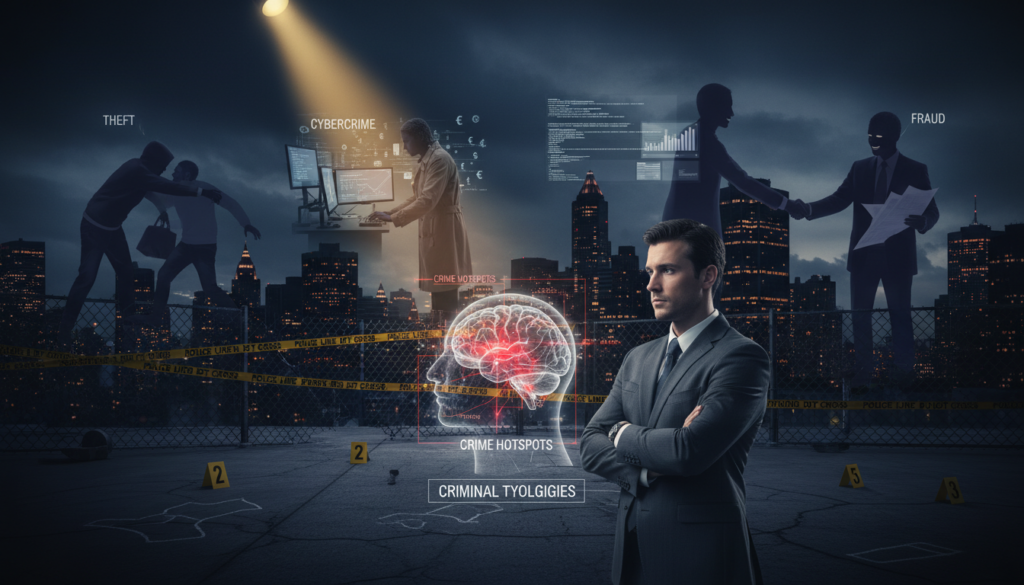
Types of Criminal Behavior
Criminal behavior comes in many forms, each with its own traits and reasons. It’s key for experts and law enforcement to grasp these differences. This helps them create better ways to stop and solve crimes.
Violent Crimes
Violent crimes involve harm or threats of harm to others. Examples include:
- Murder and non-negligent manslaughter
- Aggravated assault
- Robbery
- Rape and other forms of sexual assault
These crimes stem from various causes like domestic disputes, gang violence, and mental health issues. To solve them, it’s vital to understand the criminal psychology at play.

Property Crimes
Property crimes involve theft or damage without violence. Examples are:
- Burglary
- Larceny-theft
- Motor vehicle theft
- Arson
These crimes are often driven by money or a desire to disrupt. Knowing how property crimes work helps police find and tackle trouble spots.
White-Collar Crimes
White-collar crimes are non-violent, money-driven crimes by professionals or businesspeople. Examples include:
- Embezzlement
- Fraud
- Insider trading
- Identity theft
These crimes need special skills to solve, thanks to their complex financial nature. Studying criminology is key to figuring out these crimes and stopping them.
In summary, the many types of criminal behavior pose big challenges. By knowing the reasons and patterns behind criminal behavior patterns, we can fight crime more effectively.
Methodologies in Criminal Behavior Analysis
Criminal behavior analysis uses many methods to understand crime. It combines both qualitative and quantitative approaches. This helps researchers and law enforcement to understand the motives and behaviors of criminals.
Qualitative vs. Quantitative Analysis
Qualitative analysis looks at non-numerical data like interviews and case studies. It gives deep insights into why people commit crimes. Quantitative analysis, on the other hand, uses numbers to find trends in crime data.
Choosing between these methods depends on the research goals. Using both can give a full picture of criminal behavior.
Data Collection Techniques
Good criminal behavior analysis needs strong data collection. Here are some key methods:
- Interviews and Surveys: Getting direct info from offenders, victims, or witnesses.
- Crime Scene Investigation: Collecting evidence from crime scenes.
- Review of Official Records: Looking at police reports and court documents.
- Observational Studies: Watching criminal behavior in real or controlled settings.
Each method helps us understand crime better. This knowledge helps in creating better prevention and intervention plans.
| Methodology | Description | Advantages |
|---|---|---|
| Qualitative Analysis | In-depth examination of non-numerical data | Provides rich, contextual insights into criminal behavior |
| Quantitative Analysis | Statistical analysis of numerical data | Identifies trends and patterns across large datasets |
| Interviews and Surveys | Gathering information directly from individuals | Offers firsthand insights into criminal behavior and motivations |
Profiling Criminal Behavior
Criminal profiling, or offender profiling, is a way law enforcement creates a mental picture of the criminal. They look at evidence and how the criminal acts to guess their traits.
Defining Criminal Profiling
Criminal profiling mixes psychology, criminology, and forensic science. It looks at the crime scene and the criminal’s actions. This helps guess who the offender might be.
Key aspects of criminal profiling include:
- Analyzing the crime scene and evidence
- Understanding the behavioral patterns of the offender
- Creating a profile that includes demographic characteristics, personality traits, and possible reasons for the crime
Techniques Used in Profiling
Profilers use different methods to make a good profile. These include:
- Inductive Reasoning: Making guesses based on what they see.
- Deductive Reasoning: Drawing conclusions from broad ideas.
- Abductive Reasoning: Making guesses to explain what they’ve seen.
By using these methods, profilers make a detailed profile. This helps police solve tough cases. Criminal profiling is a key tool in solving crimes.
Factors Influencing Criminal Behavior
Criminal behavior is influenced by many factors. These include environmental and socioeconomic elements. Knowing these factors helps us create better ways to stop and solve crimes.
Environmental Influences
Where someone grows up and lives affects their chance of committing a crime. For example, being exposed to violence, living in poor conditions, and not having good education can increase the risk of criminal behavior.
Key environmental factors include:
- Family dynamics and upbringing
- Peer influences and social networks
- Availability of substances and firearms
- Quality of local infrastructure and community resources
Lawrence Cohen, a criminologist, says, “The chance of criminal behavior depends on the environment.”
“The routine activities of individuals and the structure of their daily lives can either increase or decrease the likelihood of criminal victimization and offending.”
Socioeconomic Factors
Socioeconomic factors also play a big role in criminal behavior. Hardship, unemployment, and social inequality can push people to crime. This is often seen as a way to survive or fight against unfairness. Studies show that poor areas have more crime.
Socioeconomic factors that influence criminal behavior include:
- Economic inequality and poverty
- Unemployment and underemployment
- Lack of access to education and job training
- Social exclusion and marginalization
Robert Merton’s strain theory says, “Socioeconomic factors can cause strain. This leads people to crime as a way to achieve their goals or ease their strain.”
Understanding how environment and socioeconomic factors work together helps us. We can then make plans to lower crime rates.
Crime Scene Analysis
Examining a crime scene carefully is key to understanding a crime. It involves a detailed look at the scene to find evidence and figure out what happened. This helps investigators understand the crime better.
Significance of Crime Scene Investigation
Crime scene investigation is very important. It gives valuable clues about the criminal’s actions and why they did it. Without a careful look at the scene, solving the crime is much harder.
Critical aspects of crime scene investigation include:
- Collecting physical evidence
- Recording the scene
- Studying the evidence
To do a good job, investigators need help from many fields. This includes forensic science, psychology, and law enforcement.
Techniques Used in Crime Scene Analysis
Many methods are used to analyze a crime scene. These include:
| Technique | Description | Application |
|---|---|---|
| Forensic Photography | Taking detailed pictures of the crime scene | Recording evidence and the scene’s context |
| Fingerprint Analysis | Matching fingerprints found at the scene with known ones | Finding suspects |
| DNA Analysis | Examining DNA samples from the crime scene | Connecting suspects to the crime |
These methods, among others, are vital in reconstructing a crime and understanding the criminal’s actions.
By using these techniques and knowing about criminal behavior and forensic psychology, investigators can get a deeper understanding of the crime and the criminal.
The Role of Law Enforcement in Criminal Behavior Analysis
Law enforcement and behavioral analysts work together to improve criminal behavior analysis. This teamwork helps understand criminal actions better. It leads to better ways to stop and solve crimes.
Collaboration with Behavioral Analysts
Law enforcement teams up with behavioral analysts to study criminal actions. They share data and insights to make detailed profiles of criminals. This way, they can understand why and how crimes happen.
Key aspects of this collaboration include:
- Joint training programs to enhance understanding of behavioral analysis techniques
- Regular consultation to discuss ongoing cases and share expertise
- Development of integrated databases to store and analyze criminal behavior data
Use of Technology in Crime Analysis
Technology has changed crime analysis, giving law enforcement new tools. Advanced software and data analytics help find patterns in crimes. Tools like GIS and predictive analytics forecast where crimes might happen.
The benefits of technology in crime analysis include:
- Enhanced data collection and analysis capabilities
- Improved accuracy in predicting criminal behavior
- Increased efficiency in investigations through automation and streamlined processes
By using new tech and working with analysts, law enforcement gets better at analyzing crimes. This teamwork helps solve crimes and prevent future ones.
Ethical Considerations in Criminal Behavior Analysis
Ethical issues are key in studying criminal behavior. They affect both public safety and personal freedoms. It’s important to understand and predict crimes without stepping on individual rights.
Balancing Public Safety and Individual Rights
The main aim of studying criminal behavior is to keep people safe. But, this must be done without hurting personal freedoms. Law enforcement and psychologists have to find a fine line.
For example, profiling can sometimes wrongly target people. It’s vital to use profiling based on solid evidence. We must always think about its ethical side.
Ethical Dilemmas in Profiling
Profiling, a big part of studying criminal behavior, raises tough questions. Profilers must watch out for bias and how their work affects people and communities.
The table below shows some big ethical issues in profiling:
| Ethical Consideration | Description | Potential Impact |
|---|---|---|
| Bias in Profiling | The risk of personal or systemic biases in profiling | Misidentification of suspects, wrongful accusations |
| Privacy Concerns | Using personal data in profiling without consent | Infringement on individual privacy rights |
| Accuracy and Reliability | The challenge of making sure profiles are right and reliable | Failure to catch real offenders, justice miscarried |
To tackle these issues, sticking to strict methodological standards and constant ethical checks are key. This way, studying criminal behavior can grow while respecting both safety and rights.
As the field grows, dealing with these ethical matters will stay critical. By balancing safety needs with protecting rights, criminal behavior analysis can be a powerful tool for justice.
Case Studies in Criminal Behavior Analysis
Researchers and investigators have learned a lot from notable cases. These studies help us understand the complex nature of criminal actions. They also improve how we investigate crimes.
Notable Cases and Their Analysis
High-profile cases have greatly helped the field of criminal behavior analysis. For example, the BTK Killer (Dennis Rader) case shows the importance of knowing the psychological side of crime. Rader lived a double life, shocking everyone with his normal family life and his crimes.
The Golden State Killer (Joseph James DeAngelo) case also stands out. He was caught thanks to DNA analysis and genetic genealogy. This case shows how technology helps solve crimes and can crack cold cases.
- The BTK Killer case shows the depth of criminal profiling and the need for constant investigation.
- The Golden State Killer case proves the strength of DNA analysis and genetic genealogy in finding suspects.
Lessons Learned from Case Studies
Studying these cases has taught us a lot. Important lessons include:
- Understanding the psychological reasons behind crimes.
- Using new technologies like DNA analysis and digital forensics.
- Working together between law enforcement and behavioral analysts.
These lessons have made criminal behavior analysis better. They help investigators solve tough cases and stop crimes before they happen.
Future Trends in Criminal Behavior Analysis
The field of criminal behavior analysis is on the verge of a big change. This change comes from new technology and better data analysis. It’s important to know how these trends will change the field.

Advances in Technology and Data Analytics
Technology and data analysis are key to the future of criminal behavior analysis. Big data and predictive analytics help us understand and predict crimes. Police use these tools to look at social media, financial records, and more to stop crimes before they happen.
These advanced tools help analysts in many ways:
- They find patterns and connections we couldn’t see before.
- They help predict where crimes might happen.
- They make investigations more efficient by focusing on the most important leads.
The Growing Role of Artificial Intelligence
Artificial intelligence (AI) is also changing criminal behavior analysis. AI can quickly and accurately analyze huge amounts of data. This is great for spotting complex patterns and predicting crimes.
AI is used in several ways:
- It creates models to forecast crimes based on past data.
- It helps in creating detailed profiles of suspects by analyzing their behavior.
- It automates simple tasks, so humans can work on harder tasks.
Experts say AI is a big step towards better law enforcement.
“The use of AI and machine learning in criminal justice is not just about improving efficiency; it’s about making it possible to predict and prevent crimes.”
Potential Challenges and Considerations
While new technologies bring many benefits, there are also challenges and ethical issues. Concerns include data privacy, AI bias, and misuse of these tools. These are important to address.
To tackle these issues, we need to:
- Protect individual data with strong privacy measures.
- Check AI for bias and make sure it’s clear and explainable.
- Set clear rules and laws for using these technologies in justice.
Conclusion: The Significance of Criminal Behavior Analysis
Criminal behavior analysis is key to the criminal justice system’s success. It helps law enforcement understand and prevent crimes. This knowledge leads to better strategies for solving crimes.
Key Takeaways
Studying criminal behavior requires a team effort from psychology, sociology, and criminology. This guide shows how vital it is for understanding why and how crimes happen. It helps us see patterns in criminal behavior.
Future Directions
Technology is changing fast, and so is criminal behavior analysis. New tools like data analytics and artificial intelligence will make investigations better. This will help keep our communities safer.
As technology grows, so will the importance of criminal behavior analysis. It will keep playing a big role in keeping us safe from crime.
FAQ
What is criminal behavior analysis?
How does criminal profiling aid in investigations?
What are the different types of criminal behavior?
How do environmental influences affect criminal behavior?
What is the role of forensic psychology in criminal behavior analysis?
How is technology used in crime analysis?
What are the ethical considerations in criminal behavior analysis?
How do socioeconomic factors influence criminal behavior?
What is the significance of crime scene analysis?
What are the future trends in criminal behavior analysis?

