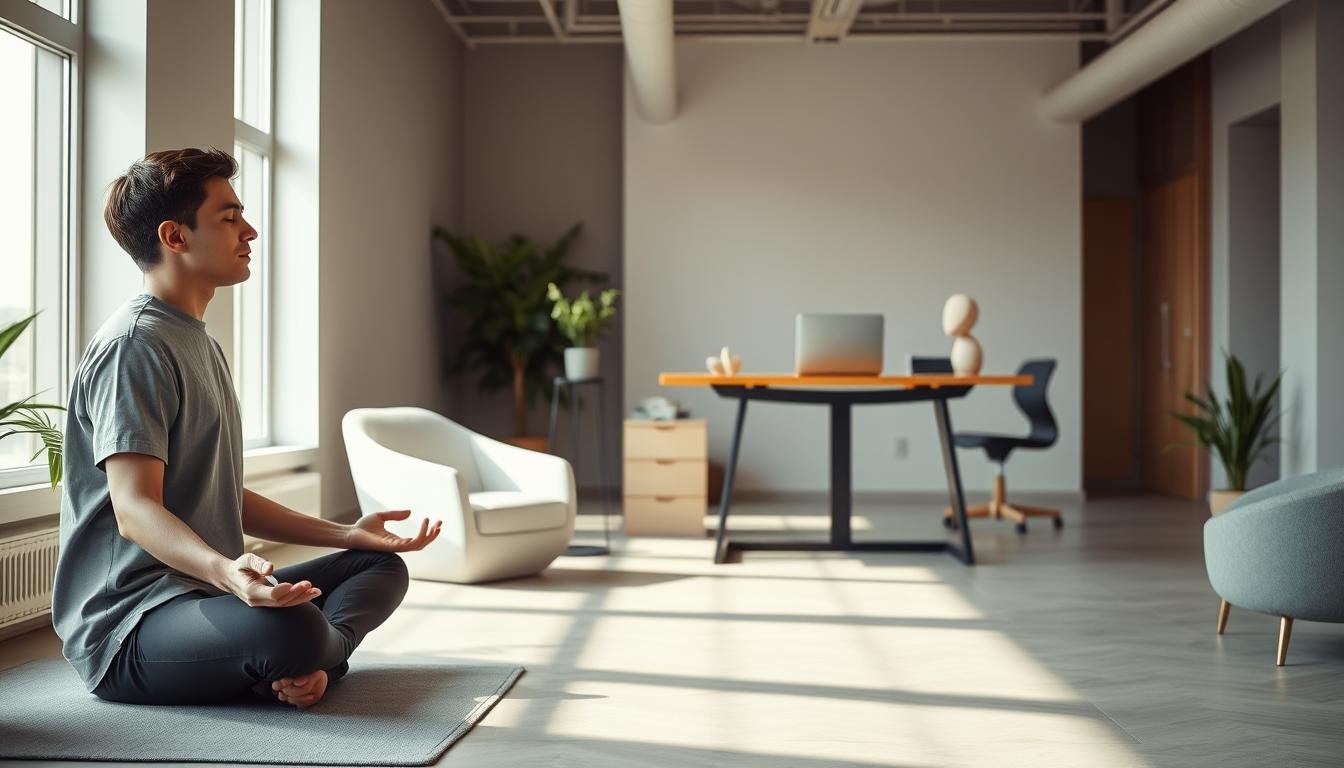
Can you really cut down on stress at work without stepping away from your desk? This is a big question for millions of Americans. They face a lot of pressure in today’s work world.
About 6.8 million adults in the U.S. deal with anxiety disorders. The modern job scene, with its constant emails and tasks, makes things worse. Technology is meant to help, but it also adds to our stress.
Now, workplaces need quick fixes, not long therapy sessions. Evidence-based techniques based on cognitive-behavioral therapy can help fast. These quick methods fit into busy workdays without taking too much time.
This article connects science with quick, easy-to-use strategies for busy people. We look at methods backed by health experts that work in your work space. By mixing science with real-world use, we find effective ways to manage stress.
Key Takeaways
- Over 6.8 million American adults experience anxiety disorders, with workplace environments intensifying symptoms through constant technological demands and connectivity pressures
- Evidence-based micro-interventions rooted in cognitive-behavioral principles can deliver measurable psychological relief in minutes, making them ideal for professional settings
- Modern work culture creates a paradox where efficiency tools simultaneously generate cognitive overload and trigger stress responses in employees
- Rapid-response techniques bridge clinical research with practical workplace application, respecting professional boundaries while addressing mental health needs
- Quick intervention strategies offer viable alternatives to extended therapeutic processes for time-constrained professionals seeking immediate support
Why Workplace Anxiety Hits When You’re Least Prepared
Workplaces can turn normal stress into overwhelming anxiety. They mix high-stakes deadlines, social interactions, and constant checks on performance. These elements often hit hard during presentations, meetings, or big decision times when you need to stay calm.
Workplace anxiety is sudden and hard to control. Our body’s stress system is set up for physical threats. But, office stress triggers these systems with psychological pressures instead.
The Physiology of Work Stress
Work stress activates your nervous system quickly. Stress hormones like cortisol rush through your body in seconds. Cortisol levels spike during high-pressure work situations, preparing your body for action that offices rarely need.
Work stress can affect your mind and decision-making. Your heart rate goes up, breathing gets shallower, and blood flow changes. These changes happen whether it’s a tough client or an email from your boss.

Work stress can cause more than just momentary discomfort. It can lead to neck and shoulder tension, trembling hands, and digestive problems. These issues come from long-term stress.
Stress changes how your brain works. The part of your brain that thinks logically becomes less active. The fear center takes over, making it hard to find the right words in stressful meetings.
When Normal Stress Becomes Anxiety
Not all work stress is anxiety. Some stress can actually help you perform better. But, when stress becomes too much, it turns into anxiety.
The difference between good stress and bad anxiety is how it affects you. Good stress motivates you to do well. Anxiety keeps you up all night worrying about things that might not happen. Knowing when to seek help is key.
| Characteristic | Normal Work Stress | Workplace Anxiety |
|---|---|---|
| Duration | Temporary, linked to specific events | Persistent, extends beyond triggering situation |
| Performance Impact | Enhances focus and motivation | Impairs concentration and decision-making |
| Physical Symptoms | Mild, manageable tension | Intense symptoms including rapid heartbeat, sweating, trembling |
| Cognitive Effects | Sharpened awareness | Racing thoughts, catastrophic thinking patterns |
| Recovery Time | Quick return to baseline after event | Extended recovery period, anticipatory worry |
Many work situations can turn stress into anxiety. Deadlines, performance reviews, and conflicts with coworkers can all trigger anxiety. It’s important to know when to take action.
Studies show that working too long can make you less productive. This is because your mind gets tired and stressed. It’s important to take breaks and practice mental wellness.
Why Quick Interventions Matter More Than Long Solutions
Workplaces need quick solutions, not long-term therapy. Anxiety episodes don’t wait for convenient scheduling or private spaces. You need fast ways to calm down, not slow progress.
Quick methods can interrupt anxiety in minutes. Techniques like breathing, physical grounding, and changing your thinking can help. These methods are not a replacement for therapy but are essential for immediate relief.
Working long hours doesn’t help you do more. It shows that too much stress is bad. Mental wellness practices need to be quick and easy to fit into busy days. They should be something you can do in a coffee break or between meetings.
Quick fixes build confidence by showing immediate results. When you calm down during a stressful moment, you learn to trust yourself. This self-confidence helps you handle future stress better.
Being able to handle stress on your own is important. Workplaces often can’t provide immediate help during anxiety attacks. Having tools you can use yourself gives you control over your stress.
Using quick stress relief techniques often can change how your brain responds to stress. Each time you calm down, you strengthen your brain’s ability to manage emotions. These small practices can lead to big improvements in managing anxiety over time.
The Science Behind Quick Anxiety Relief
Modern neuroscience has shown that certain psychological techniques can stop anxiety fast. These methods work by directly affecting the brain’s circuits and processes that cause anxiety. They don’t just distract or rely on willpower, but tackle the root causes of anxiety in both mind and body.
Studies from health institutions show that cognitive behavioral therapy tools can really help with anxiety. They focus on how we interpret situations, not the situations themselves. This understanding is key to managing anxiety.
How CBT Micro-Skills Rewire Your Stress Response
CBT micro-skills are short, focused ways to apply cognitive-behavioral ideas. They aim to break the cycle of anxious thoughts and feelings. By targeting one part of this cycle, they can affect the whole anxiety response.
Automatic thoughts are quick, often unconscious interpretations we make. During stress, these thoughts often contain cognitive distortions. For example, “I’m going to fail this presentation and lose my job.”
Thoughts and physical feelings like a racing heart are linked. Anxious thoughts can make our body feel stressed, and this stress can make us think more anxiously. CBT micro-skills help break this cycle by changing how we think and feel.

Challenging a negative thought with facts is not just being positive. It uses the brain’s rational thinking areas to calm down the threat response. This change happens quickly, which is why these techniques work fast.
The Neuroscience of Fast Interventions
Specific anxiety coping strategies change brain activity, helping with emotional control. The amygdala acts as our alarm system, starting the fight-or-flight response before we even realize danger.
When we’re anxious, the amygdala overreacts, flooding us with stress hormones. At the same time, it limits our ability to think clearly. This is why anxiety feels so overwhelming.
Research shows that controlled breathing can calm the body almost instantly. It does this by activating the parasympathetic nervous system, which lowers heart rate and stress hormones. These changes happen in just a minute or two.
Sensory grounding exercises work by focusing on what we feel right now. They use different parts of the brain, helping us shift from worry to the present moment. This happens quickly.
Cognitive reappraisal changes how we see a situation, affecting our emotions. Studies show it works fast by changing brain activity. This shows how quickly we can change our emotional response.
Why These Tools Work Right When Stress Spikes
These anxiety coping strategies work well because they target the right brain and thinking processes. They don’t aim to improve overall well-being but tackle immediate anxiety. This is why they’re so effective.
These methods are simple and don’t need much thinking, even when we’re very stressed. They use easy patterns that don’t require a lot of mental effort.
They also make it easier to use more complex thinking techniques later. A short breathing exercise can calm the body enough to think more clearly. This makes it possible to use other strategies that wouldn’t work when we’re too anxious.
The idea of neuroplasticity explains how these brief interventions can lead to lasting changes. Each time we use these tools, we strengthen the brain’s ability to manage stress. Over time, this makes anxiety less frequent and less intense.
These tools are effective because they directly address the biological and psychological causes of anxiety. Cognitive behavioral therapy research has proven their effectiveness through studies and brain imaging. They offer quick, reliable ways to manage stress and improve performance and well-being.
The 90-Second Breathing Reset
When anxiety hits during meetings or presentations, breathing exercises can calm you down in 90 seconds. These techniques engage the parasympathetic nervous system, which counters the fight-or-flight response. They also control oxygen and carbon dioxide levels in the blood, stopping hyperventilation that worsens panic.
Deep breathing exercises stimulate the vagus nerve, releasing calming neurotransmitters. This reduces heart rate, lowers blood pressure, and cuts down cortisol production.
Studies show that breathing patterns can change the autonomic nervous system right away. These structured techniques distract from anxiety by focusing the mind and calming the body.
Step 1: Master Box Breathing in Under a Minute
Box breathing, or square breathing, is a simple four-part pattern. It’s known for helping Navy SEALs manage stress in tough situations.
This method involves four phases, each lasting four seconds. Start by exhaling fully to empty your lungs. Then follow this sequence:
- Inhale slowly through the nose for 4 counts, filling your lungs fully from bottom to top
- Hold the breath for 4 counts, keeping your lungs full without strain
- Exhale slowly through the mouth for 4 counts, releasing air steadily and completely
- Hold empty for 4 counts before starting the next cycle
Do three to five full cycles for the best effect. The equal timing creates a meditative rhythm that keeps you focused on the present. This pattern helps prevent your mind from wandering to anxiety triggers.
Box breathing is great for anticipatory anxiety before presentations, tough conversations, or stressful meetings. The counting helps keep your mind off worries.
Step 2: Use the 4-7-8 Method for Panic Moments
The 4-7-8 breathing method, developed by Dr. Andrew Weil, calms the nervous system quickly. It works faster than box breathing for acute anxiety because of its extended exhalation phase.
Keep your tongue against the ridge of tissue behind your upper front teeth during the exercise. This tongue placement enhances the calming effect by creating subtle pressure points. Follow these steps:
- Exhale completely through the mouth with a whooshing sound, emptying your lungs fully
- Close the mouth and inhale quietly through the nose for 4 counts
- Hold the breath for 7 counts, maintaining calm and focus
- Exhale completely through the mouth for 8 counts, making an audible whoosh
Start with four cycles and increase to eight with practice. The 4-7-8 pattern maximizes carbon dioxide retention during the hold phase, then releases tension during the prolonged exhalation.
This method is best for panic attacks or when anxiety symptoms get worse fast. The extended breath hold stops hyperventilation, and the long exhalation signals safety to the nervous system.
Step 3: Practice Diaphragmatic Breathing at Your Desk
Diaphragmatic breathing, or belly breathing, addresses the root cause of anxious breathing. It reverses the shallow, rapid breaths that come with stress.
The diaphragm is a dome-shaped muscle under the lungs. When it works right, it flattens during inhalation, expanding the lungs and raising the abdomen. This allows for maximum lung capacity with minimal effort.
To practice diaphragmatic breathing at work, sit upright with feet flat on the floor. Place one hand on your chest and the other on your abdomen just below the ribcage. Breathe in slowly through the nose for a count of four, directing the breath to push the lower hand outward while the upper hand remains relatively steady.
The abdomen should expand noticeably with each inhalation. Exhale slowly through pursed lips for a count of six, feeling the lower hand sink inward as the diaphragm rises. This extended exhalation ratio promotes deeper relaxation than equal-length breathing.
How to Do It Without Drawing Attention
Professional environments often require discretion when using relaxation techniques. These breathing methods can be modified for invisible execution during meetings, calls, or public work situations.
For box breathing, eliminate audible exhalations by breathing through the nose for both inhalation and exhalation phases. Maintain normal posture without closing eyes or adopting obvious meditation positions. Count silently using mental visualization instead of finger counting.
The 4-7-8 method presents challenges for discreet use due to its audible exhalation component. Adapt by reducing the whooshing sound to a quiet sigh or practicing it during bathroom breaks, brief walks, or other private moments. Or, modify to silent nose breathing while maintaining the count ratio.
Diaphragmatic breathing offers the most subtlety because external observers cannot detect abdominal movement beneath professional attire. Practice maintaining a neutral facial expression and steady eye contact while engaging the diaphragm. Coordinate breathing with natural conversation pauses or listening moments.
Strategic timing enhances discretion. Implement breathing protocols during activities that provide natural cover: while reviewing documents, during others’ presentations, while walking between meetings, or during routine computer work.
When to Use Each Breathing Technique
Selecting the right breathing method depends on anxiety intensity, available time, privacy level, and individual response patterns. Understanding these distinctions allows for strategic deployment of the most effective intervention for each situation.
| Technique | Best For | Time Required | Privacy Needed |
|---|---|---|---|
| Box Breathing | Moderate anxiety, pre-event preparation, general stress reduction | 60-90 seconds | Can be done in public settings |
| 4-7-8 Method | Acute anxiety, panic symptoms, rapid escalation situations | 2-3 minutes | Requires semi-private space |
| Diaphragmatic Breathing | Sustained stress, background anxiety, preventive practice | 3-5 minutes | Fully discreet in any setting |
Box breathing is the best general-purpose technique for workplace anxiety management. Its balanced structure works for both prevention and intervention, and its ease of concealment makes it applicable in virtually any professional situation.
Use the 4-7-8 method when anxiety intensity reaches higher levels or when panic symptoms begin emerging. The aggressive parasympathetic activation provided by this pattern interrupts escalation more effectively than gentler approaches. Reserve this technique for moments when brief privacy is accessible.
Diaphragmatic breathing is best as a foundational practice for long-term anxiety management. Regular practice retrains default breathing patterns, reducing baseline anxiety levels over time. This method also works effectively during extended stressful periods like lengthy meetings or demanding project phases.
Individual response varies based on personal physiology and anxiety presentation. Experiment with each technique during low-stress periods to identify which produces the strongest calming response. Some individuals respond more dramatically to the rhythm of box breathing, while others find the asymmetrical pattern of 4-7-8 more effective.
Create a personal breathing protocol by testing each method across different anxiety scenarios. Document which technique produces the fastest relief, which provides the longest-lasting calm, and which feels most comfortable to execute in your specific workplace environment. This empirical approach builds a customized anxiety response system based on actual effectiveness.
Grounding Techniques You Can Do Without Anyone Noticing
Grounding is a way to help people feel calm when they’re really anxious. It helps them focus on what’s happening right now, like what they see, hear, and feel. This helps stop their mind from racing with worries.
These techniques are based on mindfulness and being in the moment. They help people feel real again when they feel like they’re floating away. You can do them anywhere, without anyone noticing.
What’s great about these exercises is that you can do them without anyone knowing. You can stay calm at work without anyone noticing. This is important because people worry about looking stressed or not being able to handle things.
Step 1: The 5-4-3-2-1 Sensory Method
The 5-4-3-2-1 method helps you focus on your surroundings. It’s about noticing five things you see, four things you touch, three things you hear, two things you smell, and one thing you taste. This helps distract you from your worries and brings you back to the present.
Start by naming five things you see around you. Then, move on to touching four things, hearing three, smelling two, and tasting one. This process helps you stay focused on what’s real right now.
This method works because it uses your senses to fight off worries. Your brain can’t think about worries and notice the world around you at the same time. This is how grounding helps you feel more grounded.
What to Look For, Touch, and Hear
Look for things in your space that you can easily see. Think about the pattern on your desk or the color of your monitor. Or look out the window at nature.
Touching things can be as simple as running your thumb over your notebook or feeling your pen. These small touches help you feel more connected to your body.
Listen to the sounds around you. It could be the air conditioning, typing, or voices from down the hall. Focusing on these sounds helps you stay in the moment.
Smelling and tasting might be harder at work, but they’re not impossible. Notice the smell of your coffee or the scent of papers. Even small smells can help you feel more present.
Step 2: Physical Grounding Through Feet and Hands
Physical grounding helps you feel more connected to your body when you’re anxious. It involves paying attention to how your body touches the world. This can help you feel more grounded.
Start by noticing your feet on the floor. Feel the pressure and the temperature. This simple act helps you feel more connected to your body.
Hand-based grounding works in a similar way. Press your palms on your thighs or curl your fingers to feel your nails. Even squeezing your fingers can help you feel more present.
The Desk Press Technique
The desk press technique uses pressure to help you feel more grounded. It looks like you’re just adjusting your posture, but it’s actually a calming exercise. Place your palms on your desk and press down for a few seconds.
This creates a sense of stability and helps you feel more connected to your body. It’s a simple way to ground yourself when you’re feeling anxious.
You can also press your feet on the floor or your back against your chair. These actions help remind your body that you’re stable and present. They’re easy to do without anyone noticing, making them perfect for meetings or when you’re working.
Do this whenever you feel anxious. The more you practice, the easier it becomes. Over time, you’ll find it helps you feel more grounded and calm.
Step 3: Mental Grounding With Object Focus
Mental grounding involves focusing on an object to calm your mind. It’s about choosing something to look at and really noticing it. This helps distract you from your worries and brings you back to the present.
Choose something on your desk or nearby. It could be a pen, a plant, or even a coffee mug. The important thing is to really look at it.
Start by noticing basic things like color and shape. Then, look for more details like shadows or textures. Describe what you see in your mind. The more you focus on the object, the more you distract yourself from worries.
This method uses your brain’s ability to focus to fight off anxiety. It’s based on mindfulness and cognitive behavioral therapy. By focusing on an object, you engage your brain in a way that makes it hard to worry.
Advanced practitioners might imagine the object’s history or how it was made. This makes the exercise even more effective. It turns a simple object into a focus point that can keep your mind occupied for a while.
Object focus is great for meetings or phone calls because it’s discreet. You can keep your eyes on the person talking while you focus on the object. This makes it a versatile tool for managing anxiety at work.
The three grounding techniques we’ve talked about are a powerful way to handle anxiety without anyone noticing. Each one has its own benefits, depending on how you feel and what you need. The 5-4-3-2-1 method is structured, physical grounding gives you feedback, and object focus keeps your mind busy.
Practice these techniques when you’re calm so you can use them when you’re anxious. The more you practice, the better you’ll get at using them. Grounding becomes more effective as you get more comfortable with it.
Thought Reframing: Catch and Correct Anxiety Spirals
Thought reframing changes how we face challenges at work. It stops anxiety spirals before they overwhelm us. This method shows that our emotional responses come from how we interpret events, not the events themselves.
Studies show anxious thoughts are just interpretations, not facts. Yet, we often accept them as true without questioning. By recognizing these distortions, we can correct them and reduce anxiety quickly.
This three-step process is based on cognitive therapy for work. It helps us become aware, question, and replace negative thoughts with balanced ones. This way, we can manage our emotions without ignoring real concerns.
Step 1: Identify Your Anxiety Trigger Thoughts
Learning to catch anxious thoughts is key to thought reframing. These thoughts often happen so fast we don’t notice them until we feel anxious. By paying attention to our thoughts, we can spot them early.
Start by noticing physical signs of anxiety at work. When you feel tense or your heart races, ask yourself what thought triggered it. Often, it’s a negative prediction or fear of judgment.
It’s important to distinguish between helpful problem-solving thoughts and unproductive worries. Problem-solving thoughts lead to action, while worries are stuck in negative loops. Writing down anxious thoughts helps us focus on them later.
Common Workplace Anxiety Thoughts
There are common patterns in workplace anxiety. For example, catastrophizing predicts the worst outcome without considering probability. Mind-reading assumes others judge us harshly without evidence. Fortune-telling predicts negative outcomes with certainty.
Other patterns include all-or-nothing thinking, which sees success or failure as absolute, and personalization, which blames oneself for uncontrollable situations. Recognizing these patterns helps us target them for change.
Step 2: Challenge the Catastrophe
Once we identify anxious thoughts, we challenge them. This involves questioning their validity using Socratic methods. It’s not about ignoring concerns but examining them objectively.
Challenging anxious thoughts makes us more flexible in our thinking. Instead of fighting or suppressing thoughts, we examine them. This often reveals that anxious predictions are not based on reality, reducing our emotional response.
Research shows that questioning anxious thoughts can reduce anxiety symptoms quickly. This happens because our minds adjust to new information, calming down as a result.
Questions to Ask Your Anxious Mind
Specific questions can help dismantle anxious thoughts. Start by asking for evidence: “What concrete evidence supports this thought? What evidence contradicts it?” This forces us to look at facts, not just feelings.
Perspective questions can also help. Ask yourself, “What would I tell a trusted colleague in this situation?” This often reveals more balanced views than our initial thoughts.
Probability questions challenge fortune-telling thoughts. Ask, “What’s the actual likelihood of this worst-case outcome? What’s more likely to happen?” This helps us see things more realistically.
Step 3: Replace With Evidence-Based Thoughts
The final step is to replace anxious thoughts with balanced ones. This involves creating new mental narratives that are realistic and supportive. These thoughts should feel believable and not overly positive.
Effective alternative thoughts acknowledge uncertainty and focus on what we can control. They consider multiple possibilities, not just one negative scenario. This approach is different from superficial positive thinking.
With practice, replacing anxious thoughts becomes easier. Research shows that our brains adapt to new thinking patterns over time. This makes it easier to manage anxiety in the future.
Reframe Examples for Work Scenarios
| Workplace Situation | Anxious Thought | Reframed Thought |
|---|---|---|
| Receiving critical feedback | “This proves I’m terrible at my job and will get fired” | “This feedback identifies specific improvements I can make; most colleagues receive constructive criticism regularly” |
| Making a presentation | “Everyone will notice I’m nervous and think I’m incompetent” | “Some nervousness is normal; my content is solid and most audiences focus on information” |
| Missing a deadline | “This mistake will ruin my reputation permanently” | “This setback is frustrating, but I can communicate proactively and develop a recovery plan” |
| Colleague seems distant | “They’re angry with me and I’ve damaged this relationship” | “I don’t know why they seem distant; it could relate to factors completely unrelated to me” |
These examples show how reframing transforms negative thinking into more balanced views. Notice how the new thoughts are realistic and consider multiple factors. This approach is more effective than simple reassurance.
Using this three-step process can help manage anxiety at work. It’s a systematic way to identify, challenge, and replace anxious thoughts. With practice, it becomes automatic, helping us handle stress more effectively.
The Worry Window: Schedule Your Stress
The worry window method helps you manage stress better. It lets you deal with worries in a set time, not all day. This way, you can focus on work without stress.
Worrying helps you solve problems and prepare for the future. By setting aside time for worries, you can handle them better. This makes you feel less anxious and more in control.
“The irony of worry postponement is that by giving yourself permission to worry later, you often find you don’t need to worry as much when that time arrives.”
This method is great for work, where distractions can hurt your productivity. It lets you worry without letting it take over your day.
How to Set Up Your 15-Minute Worry Window
To start a worry window, plan carefully and stick to it. It’s like setting a safe space for your worries.
Select a consistent daily time that fits your schedule. Mid-afternoon works well for many. Avoid it before bed to help you relax.
Start with 15 minutes to avoid feeling overwhelmed. This time lets you process worries without getting lost in them.
Choose a special place for your worry time. This could be a chair in a conference room or a bench outside. It helps you focus on the task at hand.
The following table outlines essential components for establishing your mental health wellness routine:
| Component | Specification | Purpose | Example |
|---|---|---|---|
| Time Selection | 15-30 minutes daily | Creates predictable worry container | 3:00 PM – 3:15 PM |
| Location | Consistent physical space | Establishes environmental cue | Empty conference room or private outdoor area |
| Frequency | Same time every workday | Builds reliable mental pattern | Monday through Friday at identical time |
| Tools | Notebook and pen | Facilitates worry documentation | Dedicated worry journal |
Sticking to your worry window schedule helps it become a trusted routine. It teaches your mind to save worries for later, reducing stress during the day.
Postponing Anxiety Until the Designated Time
Learning to delay worries is key to this method. It’s different from just distracting yourself. When worries pop up outside your worry window, acknowledge them but don’t get caught up.
Start by noticing worry thoughts as they come up. Just noticing them is the first step. Don’t judge yourself or try to push them away.
Then, acknowledge the worry briefly. This helps you avoid feeling like you’re dismissing your thoughts. A simple “I’ve noted this” is enough.
Next, focus on what you’re doing now. Tell yourself you’ll deal with worries later. This approach is more effective than just trying to ignore them.
What to Tell Yourself When Worries Intrude
Using specific phrases helps you manage worries better. These phrases become tools for handling intrusive thoughts during the day.
Use this structure: “I notice I’m worrying about [situation]. I’ll address this during my worry window at [time]. Right now, I’m focusing on [current task].” This helps in several ways.
- Validates the worry as legitimate
- Establishes a specific time for worries
- Redirects attention to immediate tasks
- Reinforces the trust that concerns will be addressed
For example: “I notice I’m worrying about tomorrow’s presentation. I’ll address this during my worry window at 3:00 PM. Right now, I’m focusing on completing this report.” Being specific makes your promise to yourself more effective.
What to Actually Do During Your Worry Window
Use your worry window for structured thinking, not just daydreaming. This makes the time more useful for anxiety relief.
Start by reviewing postponed worries from the day. Write them down in a notebook. This helps you see them more clearly and manage them better.
For worries you can control, solve the problem. Break it down into smaller parts and plan how to tackle each one. This turns anxiety into action.
For worries you can’t control, accept them. Recognize you can’t change them. This stops you from wasting time on things you can’t fix.
Check if each worry is really worth your time. Often, worries seem urgent but lose importance when you focus on them later. Crossing off worries that aren’t urgent helps you see how often they’re not as big a deal as they seem.
End your worry window with a clear ritual. This could be closing your notebook, leaving the spot, or taking deep breaths. It signals to your mind that it’s time to move on from worrying.
This structured way of dealing with worries turns them into a manageable part of your day. It helps you stay focused and productive.
Immediate Anxiety Relief When Panic Strikes
When anxiety turns into panic, the body reacts quickly. Panic attacks are different from regular anxiety because they start suddenly and feel very intense. They also cause scary physical symptoms.
Understanding panic attacks as temporary events helps professionals handle them better. Panic episodes usually last ten to thirty minutes. Using proven techniques can make them less intense and shorter.
Workplaces make panic attacks harder because they need you to stay calm. You might feel like you can’t show your true feelings. This can make panic worse or slow down help.
Recognizing the Early Warning Signs of a Panic Attack
Spotting panic early is key to managing it. The first signs, before panic gets bad, are the best time to act. Learning to notice these signs helps a lot.
Early signs include a faster heartbeat, shallow breathing, and tingling in your fingers or toes. You might also feel stomach discomfort or temperature changes. These signs can start so quietly you might not even notice them until panic gets worse.
Other signs include feeling like things aren’t real, being very alert to your body, and worrying about losing control. You might also see things differently, like everything looking narrow or feeling very sensitive to light and sound.
| Physical Warning Signs | Cognitive Warning Signs | Perceptual Warning Signs |
|---|---|---|
| Increased heart rate | Intrusive catastrophic thoughts | Derealization or unreality |
| Shallow breathing | Fear of losing control | Depersonalization |
| Peripheral tingling | Hypervigilance to symptoms | Visual narrowing or distortion |
| Stomach discomfort | Concentration difficulties | Sound sensitivity |
| Temperature fluctuations | Urgent escape thoughts | Time distortion |
Getting to know these signs takes practice when you’re calm. Professionals can do short body scans to get used to their panic signs. This helps them see panic as something they can handle.
The STOP Method: Four Steps to Interrupt Panic
The STOP method is a way to manage panic attacks. It helps calm you down by using your brain’s calming parts. Each step helps in different ways to lessen panic.
This method is different from trying to fight panic or distract yourself. Fighting panic makes it worse. The STOP method teaches you to respond calmly, which helps over time.
S: Stop What You’re Doing
The first step is to stop what you’re doing. This helps you focus on calming down. It tells your body there’s no real danger.
In work, this might mean stepping out of a meeting or pausing a presentation. Even if you can’t leave, just stopping is helpful. Stopping is important, even if you can’t leave.
Stopping also stops you from doing things you might regret later. It helps you avoid making mistakes because of panic.
T: Take a Breath
Deep breathing helps calm down. Panic makes you breathe too fast, which can make you dizzy. Taking slow, deep breaths helps calm down.
The 4-7-8 breathing method is good for panic. Breathe in for four counts, hold for seven, and breathe out for eight. Doing this a few times can really help.
If breathing worries you, try box breathing. Breathe in for four counts, out for four, and keep it steady. This slows down your breathing and helps calm down.
Instead of fighting panic, just observe it. Panic makes you want to escape, but fighting it makes it worse. Observing helps calm down.
Describe what’s happening without judgment. Say “my heart is racing” instead of “I’m having a heart attack.” This helps your brain calm down. Labeling symptoms helps them feel less scary.
Notice your thoughts but don’t believe them. Panic makes you think the worst. Observing your thoughts helps you not get caught up in them. This is from acceptance and commitment therapy.
P: Proceed With Intention
The last step is to make choices based on what’s important to you. This helps you not let panic control you. If you always run away from panic, your brain will think it’s always dangerous.
Being intentional doesn’t mean ignoring your needs. If you need to take a break, that’s okay. The key is making choices that help you in the long run, not just to get rid of symptoms.
In work, this might mean going back to a meeting after calming down, or continuing a presentation in a different way. Each time you do this, you get stronger and panic becomes less intense. Your brain learns that panic doesn’t mean you’re in danger.
Recovery Actions After the Peak Passes
After panic, you need to take care of yourself. Panic attacks use up a lot of energy and can leave you feeling drained. It’s important to understand this is normal.
Getting your body back to normal is important. A short walk can help use up adrenaline. Drinking water helps with dehydration. Eating a little protein and carbs can help with blood sugar and brain chemicals.
Thinking about panic in a way that helps you is important. Be kind to yourself and think about what worked. Learning from panic attacks helps you get better at handling them.
When to go back to work depends on how you feel and what needs to be done. Some people can go back to work quickly, while others need more time. It’s okay to take it slow and do what you need to do.
Long-term, tracking panic attacks helps you learn what triggers them. Keeping a log of panic attacks can help you see patterns and what works. This information is useful when talking to a mental health professional.
Body-Based Calming: Progressive Muscle Relaxation in 3 Minutes
Progressive muscle relaxation is based on a key discovery from nearly a century ago. It shows that your body can’t be tense and relaxed at the same time. This idea is the basis for a top stress reduction technique for managing workplace anxiety.
Physician Edmund Jacobson found this method in the 1920s. He noticed that anxiety often shows up as muscle tension in the body.
This method helps you learn to release tension patterns you’ve carried for years. Traditional versions take 20-30 minutes. But, shorter versions can reduce anxiety in just 3-5 minutes by focusing on key areas.
Body-based interventions are easy to use. They don’t need mental effort like other strategies do. They offer concrete actions to stop anxiety’s effects.
These techniques are great when anxious thoughts overwhelm you. Or when other methods don’t help enough.
“The cultivation of physical relaxation serves as an antidote to the tensions of modern life, providing a path to peace even in stressful times.”
The Desk-Friendly Tension Release Sequence
This method lets you relax while sitting in an office chair without drawing attention. It targets areas where stress builds up. Each step involves tensing a muscle group, holding for 5-7 seconds, and then releasing.
This sequence takes about three minutes. You can do it during breaks, before big meetings, or when you feel stressed. Doing it regularly makes it more effective.
Most stress is in the upper body for many professionals. Shoulders, neck, and jaw often tighten without us realizing it. These stress reduction techniques help release tension in these areas.
Shoulder releases start by lifting your shoulders to your ears. Hold for seven seconds, then drop them. This trains your body to relax.
For neck tension, tilt your head to one shoulder while resisting with your hand. Hold for five seconds, then release. Repeat on the other side. Slow neck rotations can follow if you’re alone.
Jaw releases are very effective for anxiety. Press your tongue against the roof of your mouth and clench your jaw. Hold for six seconds, then release. Many find immediate relief from jaw releases.
Lower Body: Legs and Feet Under the Desk
Lower body calming exercises are discreet. They’re great for meetings or calls when you can’t move your upper body. These exercises help manage stress without anyone noticing.
Start by pressing your feet into the floor and tensing your legs. Hold for seven seconds, then release. This makes your legs feel heavy and relaxed. Foot pressure and muscle release help you feel grounded and calm.
For alternating leg tension, extend one leg under the desk and tense it. Hold for five seconds, then release. Repeat with the other leg. This keeps your lower body relaxed without anyone noticing.
Simple ankle circles and toe flexes help during long sitting periods. They prevent tension from building up. This is a preventive way to manage anxiety at work.
The Hand Squeeze Technique for Instant Relief
This quick method gives fast relief and can be done in seconds. It involves squeezing your hands hard, then releasing. Hand-based interventions are among the fastest ways to calm down.
To do it, make tight fists with both hands. Squeeze as hard as you can, engaging all muscles. Hold for eight to ten seconds while breathing normally. This is important to avoid increasing stress.
Release suddenly and let your hands go limp. Notice the warmth and sensation in your hands. This helps your body learn to relax faster.
The hand squeeze is useful for emergencies and regular use. Doing it during breaks or private moments can help you relax throughout the day. It’s simple enough to use even when you’re very anxious.
Strategic Releases You Can Do in Meetings
Managing anxiety in meetings needs special strategies. Traditional stress reduction techniques might not work well in meetings. But, there are discreet ways to release tension while staying engaged.
Subtle toe clenching is invisible and effective. Curl your toes tightly, hold for five seconds, then release. Do this throughout the meeting to keep anxiety in check without drawing attention.
Isometric leg presses are also discreet. Press your feet into the floor or your knees together. Hold for six to eight seconds, then release. This keeps your lower body relaxed without anyone noticing.
| Technique | Visibility Level | Effectiveness | Best Context |
|---|---|---|---|
| Toe Clenching | Completely Hidden | Moderate Relief | Formal presentations, client meetings |
| Isometric Leg Press | Invisible | High Relief | Seated meetings, phone conferences |
| Hand Squeeze | Low (under table) | Very High Relief | Strategy sessions, reviews |
| Controlled Breathing | Minimal | Moderate to High | All meeting contexts |
Controlled breathing with muscle releases is a powerful combo. Tense during inhalation, hold, then release during exhalation. This approach boosts relaxation more than either technique alone.
Being strategic in meetings lets you use more relaxation techniques when needed. Sitting in certain spots or taking brief breaks can help. This way, you can release more tension without anyone noticing.
Success in managing anxiety in meetings comes from practice. Rehearse these techniques when you’re not stressed. This builds confidence and muscle memory for when you need it most.
Cognitive Defusion: Creating Distance From Anxious Thoughts
When anxious thoughts grip your mind at work, changing how you see them might help. Cognitive defusion is a new way to deal with anxiety. It doesn’t challenge thoughts but helps you see them as temporary events, not truths.
This idea comes from Acceptance and Commitment Therapy. It talks about cognitive fusion and cognitive defusion. Fusion means getting caught up in thoughts, seeing them as real. Defusion creates space, letting you watch thoughts without acting on them.
These methods are great when you’re stressed and can’t think clearly. They’re easier than trying to change thoughts. The goal is to lessen thoughts’ control over you.
The “I’m Having the Thought That…” Technique
This method changes how you see anxious thoughts. Instead of “I’m going to fail,” say “I’m having the thought that I’m going to fail.” This small change makes a big difference in how you feel.
It works by turning statements into observations of thoughts. Adding “I’m having the thought that…” makes you see thoughts as separate from reality.
Try this by picking an anxious thought. Say it normally, then with the defusion prefix. Notice how the second feels less urgent.
How This Simple Phrase Reduces Thought Power
This technique works on several levels. It creates grammatical distance between you and your thoughts. It also makes you less likely to act on thoughts as if they’re commands.
Studies show it makes anxious thoughts less intense. The thought is there, but it doesn’t control you as much. You can see the concern without getting caught up in it.
Consider these changes:
- Original thought: “Everyone thinks I’m incompetent” → Defused version: “I’m noticing the thought that everyone thinks I’m incompetent”
- Original thought: “This mistake will ruin my career” → Defused version: “I’m having the thought that this mistake will ruin my career”
- Original thought: “I can’t handle this workload” → Defused version: “I notice I’m thinking I can’t handle this workload”
Visualizing Thoughts as Clouds Passing By
Visualizing thoughts as clouds is a powerful technique. It shows thoughts are temporary. Imagine anxious thoughts as clouds drifting by without trying to stop them.
Find a quiet moment at your desk. Close your eyes or look down. When an anxious thought comes, see it as a cloud on your mental sky.
Watch the cloud move across your mind. Notice how it fades away without effort. Some clouds move fast; others linger.
Other visualizations work too:
- Leaves on a stream: Picture each anxious thought written on a leaf floating down a gentle stream
- Conveyor belt: Imagine thoughts appearing on items moving past you on a factory conveyor belt
- Ticker tape: Visualize thoughts scrolling across a news ticker at the bottom of your mental screen
The key is to observe thoughts without getting caught up. Acknowledge their presence but don’t analyze them. This reduces their power to trigger emotions or actions.
Naming the Anxiety Story You Tell Yourself
Your mind creates anxiety stories that pop up in different situations. These stories seem new and urgent but are actually familiar patterns. Naming them helps you see them as habits, not threats.
When you notice a familiar anxiety story, label it: “Ah, this is my ‘I’m not good enough’ story again” or “There’s the ‘something terrible will happen’ narrative.” Naming it creates distance. It makes the story less powerful by recognizing it as a repeated event.
This technique works because naming activates your observing self. You move from being in the story to recognizing it as a story. This position gives you freedom to choose how to respond.
Common Anxiety Narratives at Work
Workplace anxiety often follows certain story patterns. Recognizing these patterns helps you spot them faster when they happen to you.
| Anxiety Narrative | Typical Thoughts | Name to Use |
|---|---|---|
| Impostor Syndrome Story | “I don’t actually deserve this position; they’ll discover I’m a fraud” | “The impostor story” |
| Catastrophic Failure Prediction | “This one mistake will destroy everything I’ve built” | “The catastrophe story” |
| Rejection and Criticism Theme | “Everyone is judging me negatively; they all think I’m incompetent” | “The rejection story” |
| Perfectionism Demand | “If this isn’t perfect, it’s worthless; I can’t accept anything less than flawless” | “The perfectionism story” |
When you recognize one of these patterns, name it right away. Naming it interrupts the usual anxiety response. You might say, “Oh, there’s my impostor story again,” like greeting a familiar friend.
These cognitive defusion techniques work alongside other methods. Some situations need you to challenge thoughts; others benefit from creating distance. Being good at both helps you handle workplace anxiety better.
Natural Calming Remedies You Can Keep at Your Desk
Using natural calming remedies at work can make your space better for your mind. These remedies work by affecting your brain and body in real ways. They use smells and chemicals to help you relax.
These remedies might not work as well as medicine, but they have big advantages. They don’t have side effects, are easy to get, and you can use them while working. They’re best when used with other ways to manage anxiety.
If you have serious anxiety, talk to a doctor. These remedies can help, but they’re not a full solution. They can be used along with other methods to help you feel better.
Aromatherapy: Lavender and Peppermint for Instant Calm
Smells can affect how we feel by reaching our brain directly. This is why some smells can make us feel calm right away.
Lavender oil has been shown to help with anxiety. It works by affecting brain chemicals in a way that’s similar to some medicines. But it’s much milder.
Peppermint oil works in a different way. It makes you feel cool, which can help stop anxiety. Studies show it can also help you focus better when you’re stressed.
- Personal inhalers: Small devices that let you breathe in essential oils at your desk
- Diluted oil application: Mix a few drops of essential oil with a carrier oil and put it on your skin during breaks
- USB diffusers: Small devices that spread out the scent of essential oils in your area without bothering others
- Scented tissues: Put a few drops of essential oil on a tissue in your desk drawer for quick use when you’re stressed
Remember, some people might not like strong smells. Always think about how your scent might affect others at work.
It’s best to use aromatherapy for short periods. Take a few deep breaths when you feel anxious. This lets your brain process the scent without getting used to it too quickly.
Herbal Teas That Support Relaxation
Herbal teas are a good choice instead of coffee or tea with caffeine. They have calming effects and can be comforting. Drinking tea can also give you a break from worrying.
Drinking tea when you’re stressed can help without making you sleepy. The herbs in the tea work in ways that are different from medicine. They can help you feel calmer over time.
Chamomile, Passionflower, and L-Theanine
Chamomile tea has a compound called apigenin that can calm you down. It works like some medicines but is safer. Studies show it can help people with anxiety.
To make chamomile tea, steep 1-2 teaspoons of dried flowers in hot water for 5-10 minutes. It starts to work in 30-45 minutes. Most people can drink it without problems, but those with ragweed allergies should be careful.
Passionflower tea also helps with anxiety. It has compounds that increase GABA in the brain, which makes you feel relaxed. It’s best to drink it 60-90 minutes before you need to relax.
Passionflower tea is made by steeping 1 teaspoon of dried herb in water for 7-10 minutes. Important: It can interact with some medicines and blood thinners, so talk to a doctor before using it.
L-theanine is an amino acid in green tea that helps you relax without making you sleepy. It makes your brain waves calm and changes brain chemicals. Studies show it can reduce stress and anxiety.
Green tea naturally has 20-30mg of L-theanine per cup. Supplements with 100-200mg work better. To get the most L-theanine, steep green tea for 3-5 minutes.
| Herbal Preparation | Active Compounds | Onset Time | Optimal Dosing |
|---|---|---|---|
| Chamomile Tea | Apigenin (GABA receptor binding) | 30-45 minutes | 1-2 teaspoons dried flowers, steeped 5-10 minutes |
| Passionflower Tea | Flavonoids (GABA enhancement) | 60-90 minutes | 1 teaspoon dried herb, steeped 7-10 minutes |
| Green Tea (L-theanine) | L-theanine (alpha wave increase) | 20-30 minutes | 1 tea bag or 1 teaspoon leaves, steeped 3-5 minutes |
Many people keep different herbal teas at their desk. Switching between them helps you not get used to any one. Chamomile is good for evening anxiety, and L-theanine is great for midday calm.
Temperature Therapy: Cold Water and Ice Techniques
Using cold water or ice can calm you down quickly. It works by activating a natural response in your body. This response can slow your heart rate and make you feel calmer.
These methods are great for sudden anxiety attacks. They provide a physical sensation that distracts you from your worries. They also help calm your body down.
There are simple ways to use cold water or ice at work:
- Cold water face splash: Splash cold water on your face, focusing on your eyes and forehead, to calm down
- Ice cube hold: Hold an ice cube in your hand to feel the cold and focus on it
- Cold water consumption: Drink ice water slowly to activate cold receptors in your mouth
- Pulse point application: Use cold compresses or ice packs on your wrists, neck, or behind your ears
The best way to use cold water or ice is to touch your face, like your forehead, eyes, and cheeks. Water that’s between 50-59°F (10-15°C) works best. You’ll start to feel the effects in 15-30 seconds and your heart rate might slow down by 10-25 beats per minute.
Using cold water or ice with breathing exercises can make you feel even calmer. Try using cold water or ice while you’re breathing deeply. This combination can help you relax more than either one alone.
These methods need no special equipment. You can use a water fountain, a fridge with ice, or even a cold water bottle. They’re easy to use and can help you feel better when you’re stressed at work.
Building Your Personal Anxiety Toolkit
Managing stress at work needs more than just knowing about it. It’s about creating a plan that fits your anxiety. Different people react to anxiety in different ways. So, it’s important to find the right tools for you.
Some people feel anxious in their minds, with racing thoughts and worries. Others feel it in their bodies, with a fast heartbeat and tight muscles. Knowing how you feel helps you choose the right tools.
Building your toolkit is a hands-on process. You try different techniques and see what works best for you. This way, you can find the right tools for your specific needs.
Identifying Which Tools Work Best for Your Anxiety Type
Start by matching techniques to your anxiety type. For body-focused anxiety, like a fast heartbeat, try breathing exercises. These can help calm your body quickly.
For mind-focused anxiety, like constant worries, try changing your thoughts. Use techniques like thought reframing to help manage your worries.
For feeling disconnected, try grounding techniques. These can help you feel more connected to the present moment.
| Anxiety Presentation | Primary Symptoms | Recommended Techniques | Response Timeframe |
|---|---|---|---|
| Somatic-Focused | Rapid heartbeat, muscle tension, breathing changes | Box breathing, 4-7-8 method, progressive muscle relaxation | 60-90 seconds |
| Cognitive-Dominant | Racing thoughts, catastrophizing, rumination | Thought reframing, worry window, cognitive defusion | 2-5 minutes |
| Panic Episodes | Sudden intense fear, sense of losing control | STOP method, grounding techniques, temperature therapy | 3-7 minutes |
| Dissociative States | Feeling disconnected, derealization, numbness | 5-4-3-2-1 sensory grounding, physical anchoring | 1-3 minutes |
Track your anxiety to find what works best for you. This helps you know which techniques to use when you need them most.
Creating a Quick Reference Cheat Sheet
Make a quick guide to help you during stressful times. Use small cards or phone screens with simple steps. This way, you can quickly find what you need without getting overwhelmed.
Keep your guide simple and focused. In stressful moments, you can’t handle too much information. Stick to the basics and follow simple steps.
Put your guide where you can easily find it. Keep it on your phone or in your wallet. This way, you can access it whenever you need it.
What to Include on Your Emergency Card
Your emergency card should have clear steps for a few key techniques. For body-focused anxiety, include steps like breathing exercises. This helps you stay calm without getting distracted.
Use reminders to help manage your thoughts during anxiety. Say things like “Anxiety is uncomfortable but not dangerous.” This helps you stay focused and calm.
Practicing Before You Need Them
Practice your techniques when you’re calm. This way, you can use them effectively when you’re stressed. Trying new techniques when you’re already anxious won’t work.
Practice a little every day. This builds your skills without taking up too much time. Just a few minutes a day can make a big difference.
Practice at the same time every day. This makes it a habit. Try practicing in the morning or evening when you’re not stressed.
The 5-Minute Daily Practice Plan
Start with a minute of box breathing to calm down. Then, spend a minute just noticing your thoughts. This helps you manage your worries better.
Next, do the 5-4-3-2-1 grounding sequence for two minutes. This keeps you grounded in the present. End with a minute of mental rehearsal. Imagine yourself handling anxiety well. This builds your confidence and skills.
When to Escalate: Knowing Your Limits
Knowing when to ask for help with anxiety is not a sign of failure. It shows you understand when you need professional help. The tools and quick fixes in this article can help with everyday stress and mild anxiety. But, they work best as part of a bigger plan that includes seeing a professional when needed.
Seeing a mental health expert early can stop anxiety from getting worse. This approach is based on proven methods like cognitive behavioral therapy. Knowing when to seek help depends on how long symptoms last, how much they affect your life, and if self-help works.
Signs Your Anxiety Needs Professional Support
There are signs that show you need professional help for your anxiety. Long-lasting anxiety that doesn’t get better with self-help is one. If you try relaxation techniques and they don’t help much, it’s time to get help.
Signs like missing work, not being able to do your job well, or avoiding important tasks are big red flags. Physical problems like chest pain or headaches that won’t go away also need medical attention.
If you’re thinking about harming yourself or feeling hopeless, you need help right away. These feelings can mean you have depression or other serious issues that need treatment.
Feeling like you can’t do things anymore or avoiding social situations is another sign. It means anxiety is controlling your life in ways that are not okay.
Panic attacks and constant worry about having more attacks can be helped by therapy. Therapy can teach you to manage these feelings. Using drugs or alcohol to try to feel better is a sign you need professional help too.
How to Talk to HR or Management About Accommodations
Talking about your mental health at work can be scary. But, the Americans with Disabilities Act (ADA) protects you. It says employers must make reasonable changes to help you do your job.
When asking for help, focus on how it will make you better at your job. For example, asking for a quiet place to work can help you focus better. Flexible hours can help you work when you’re most alert.
| Accommodation Type | Specific Examples | Performance Benefits |
|---|---|---|
| Environmental Modifications | Quiet workspace, noise-canceling headphones, adjustable lighting, private office or cubicle | Reduced sensory overload, improved focus, decreased anxiety triggers throughout workday |
| Schedule Flexibility | Modified start times, flexible breaks, telework options, compressed workweeks | Attendance at therapy appointments, energy management, reduced commute stress |
| Task Modifications | Written instructions, extended deadlines for complex projects, reduced cold-calling requirements | Clear expectations, manageable workload pacing, reduced acute anxiety triggers |
| Communication Adjustments | Advance notice for meetings, written agendas, one-on-one check-ins instead of group settings | Preparation time for anxiety management, predictability, comfortable communication channels |
Start by talking to HR or your manager about what you need. You can share as much or as little as you want. Having a doctor’s note can help prove you need these changes without sharing too much.
Working together, you and your employer can find solutions. Be ready with ideas based on what you know about your job and your anxiety. This shows you’re proactive and helps find the best solutions.
Finding a Therapist Who Specializes in CBT and Workplace Anxiety
Finding the right therapist takes some work. Use insurance directories to find therapists who specialize in anxiety and workplace stress. These directories show if a therapist is licensed and if they accept your insurance.
Professional organizations can also help find therapists. The Anxiety and Depression Association of America (ADAA) and the Association for Behavioral and Cognitive Therapies (ABCT) have directories. They help you find therapists who know about cognitive behavioral therapy.
Look for therapists with special training in anxiety treatments. They should know about cognitive behavioral therapy and other proven methods. Board certification or fellowship in anxiety treatment shows they’re experts.
Therapists who know about workplace anxiety are very helpful. They understand the challenges you face at work. Talking to a few therapists can help you find the right one.
Cognitive behavioral therapy for anxiety usually lasts 12-20 sessions. Sessions are usually once or twice a week and last 45-60 minutes. You’ll learn about anxiety, practice skills, and gradually face things that scare you.
Homework is a big part of therapy. It helps you practice what you learn and builds confidence. Mood tracking tools help you and your therapist see how you’re doing.
Therapists work with your schedule, even if it means evening or online sessions. They want to make it easy for you to get help. This way, you can manage your anxiety and do well at work.
Combining therapy with self-help tools is the best way to manage anxiety. A therapist can help you use the techniques from this article better. This combination is key to keeping your mental health strong and doing well at work.
Conclusion
Workplace anxiety can be tackled with a solid plan. The methods shared here are not just quick fixes. They are a deep dive into mental health, helping you take back control when stress hits.
Each technique has its own role in your toolkit. Breathing exercises calm your body. Cognitive reframing changes negative thoughts. Grounding stops panic in its tracks. Together, they offer strong relief from anxiety, fitting different situations.
Using these methods regularly makes them second nature. Studies show that doing them often strengthens your brain’s emotional control. This means you can handle stress better, even when you’re most tired.
It’s key to keep trying different things. Everyone’s anxiety is unique, so what works for one might not work for another. Keep track of what helps you most. Then, adjust your plan as needed. Adding mindfulness meditation can also help you stay calm longer.
If anxiety doesn’t go away, getting help from a pro is smart. A therapist can teach you more about managing your mind. They can also help you find the root of your stress at work.
Learning to manage anxiety pays off in many ways. It makes you better at making decisions, talking to others, and dealing with tough times. These skills are valuable for your career and personal life.
FAQ
How quickly can these anxiety relief techniques actually work?
FAQ
How quickly can these anxiety relief techniques actually work?
FAQ
How quickly can these anxiety relief techniques actually work?
Can I use these techniques discreetly during meetings or while others are around?
FAQ
How quickly can these anxiety relief techniques actually work?
FAQ
How quickly can these anxiety relief techniques actually work?
What’s the difference between normal work stress and anxiety that needs intervention?
FAQ
How quickly can these anxiety relief techniques actually work?
FAQ
How quickly can these anxiety relief techniques actually work?
How does box breathing actually reduce anxiety at a physiological level?
FAQ
How quickly can these anxiety relief techniques actually work?
FAQ
How quickly can these anxiety relief techniques actually work?
What if I try these techniques and they don’t work for me?
FAQ
How quickly can these anxiety relief techniques actually work?
FAQ
How quickly can these anxiety relief techniques actually work?
FAQ
How quickly can these anxiety relief techniques actually work?
How does the 5-4-3-2-1 grounding technique interrupt anxiety?
FAQ
How quickly can these anxiety relief techniques actually work?
FAQ
How quickly can these anxiety relief techniques actually work?
Can I use these techniques alongside anxiety medication?
FAQ
How quickly can these anxiety relief techniques actually work?
FAQ
How quickly can these anxiety relief techniques actually work?
What is cognitive defusion and how is it different from thought reframing?
FAQ
How quickly can these anxiety relief techniques actually work?
FAQ
How quickly can these anxiety relief techniques actually work?
How do I know if my workplace anxiety requires professional help versus self-management?
FAQ
How quickly can these anxiety relief techniques actually work?
FAQ
How quickly can these anxiety relief techniques actually work?
Why does the worry window technique work when it seems counterintuitive to schedule worry time?
FAQ
How quickly can these anxiety relief techniques actually work?
FAQ
How quickly can these anxiety relief techniques actually work?
Can aromatherapy really reduce anxiety or is it just a placebo effect?
FAQ
How quickly can these anxiety relief techniques actually work?
FAQ
How quickly can these anxiety relief techniques actually work?
How does progressive muscle relaxation reduce anxiety if the problem is in my thoughts, not my muscles?
FAQ
How quickly can these anxiety relief techniques actually work?
FAQ
How quickly can these anxiety relief techniques actually work?
What should I do if I experience a panic attack during an important meeting or presentation?
FAQ
How quickly can these anxiety relief techniques actually work?
FAQ
How quickly can these anxiety relief techniques actually work?
How long does it take to see results from practicing these techniques regularly?
FAQ
How quickly can these anxiety relief techniques actually work?
FAQ
How quickly can these anxiety relief techniques actually work?
Is it normal to feel more anxious when first trying breathing techniques?
FAQ
How quickly can these anxiety relief techniques actually work?
FAQ
How quickly can these anxiety relief techniques actually work?
Can I practice these techniques preventatively before anxiety situations, or only during anxiety episodes?
FAQ
How quickly can these anxiety relief techniques actually work?
FAQ
How quickly can these anxiety relief techniques actually work?
About the Author