


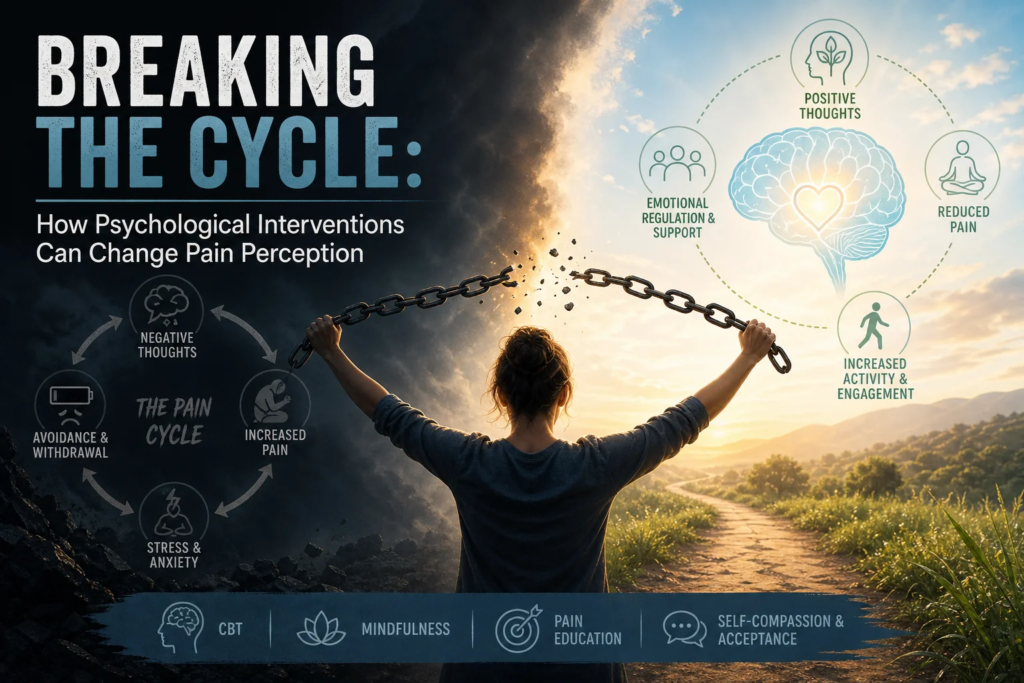
Pain is never “just in your head”—but your head is always involved.
That sentence can feel confusing, even insulting, if you’ve lived with persistent pain. Many people with chronic pain have spent years trying to prove that their pain is real, only to be told to “relax,” “think positive,” or “stop stressing.” But modern pain science tells a much more respectful and empowering story: pain is a real biological experience shaped by the nervous system, emotions, attention, memory, expectations, sleep, stress, and context.
This is where Breaking the Cycle: How Psychological Interventions Can Change Pain Perception becomes more than a catchy phrase. It describes a practical, evidence-informed approach to helping the brain and body step out of the loop that keeps pain amplified.
Psychological interventions do not magically erase injury, inflammation, or disease. They also do not suggest that pain is imaginary. Instead, they work with the brain’s pain-processing systems to reduce threat, calm sensitized neural circuits, improve coping, restore movement confidence, and help people reclaim meaningful lives.
In this article, we’ll explore Breaking the Cycle: How Psychological Interventions Can Change Pain Perception from the inside out: the science, the strategies, the real-world case examples, and the actionable steps that can help people relate to pain differently—and often feel it differently too.
Understanding the Pain Cycle: Why Pain Can Become Self-Reinforcing
To understand Breaking the Cycle: How Psychological Interventions Can Change Pain Perception, we first need to understand the cycle itself.
Pain is designed to protect us. If you touch a hot pan, pain tells you to pull away. If you sprain your ankle, pain encourages rest while tissue heals. Acute pain is usually helpful.
Chronic pain is different. When pain lasts beyond normal healing time—often defined as longer than three months—the nervous system can become more sensitive. The “alarm system” may continue ringing even when the original danger has decreased or changed. This process is sometimes called central sensitization.
A simplified pain cycle often looks like this:
| Stage of the Cycle | What Happens | How It Can Intensify Pain |
|---|---|---|
| Pain signal | The body sends danger information to the brain | The brain evaluates whether protection is needed |
| Threat interpretation | The brain asks, “Is this dangerous?” | Fear and uncertainty increase alarm |
| Emotional response | Anxiety, frustration, anger, or sadness arise | Stress chemicals can heighten sensitivity |
| Protective behavior | Avoiding movement, social withdrawal, guarding | Muscles stiffen; confidence decreases |
| Reduced function | Less activity, poor sleep, isolation | The brain receives more “danger” cues |
| Increased pain perception | Pain feels stronger or more constant | The cycle repeats |
The heart of Breaking the Cycle: How Psychological Interventions Can Change Pain Perception is interrupting this loop at multiple points. Instead of fighting pain only at the tissue level, psychological approaches help reduce the brain’s perceived need to protect.
Pain Is Real—and Perception Is Powerful
The word “perception” sometimes causes confusion. If pain perception can change, does that mean pain is fake?
Absolutely not.
Pain perception means the final experience produced by the nervous system after processing signals from the body, memories, emotions, beliefs, attention, and environment. Two people can have similar tissue damage and vastly different pain experiences. One person may feel mild discomfort; another may feel severe pain. Both experiences are real.
Think of pain like sound. A smoke alarm can be quiet, loud, or hypersensitive. If it goes off every time you make toast, the alarm is real—but it may be overprotective. Psychological interventions help recalibrate the alarm.
That is the essence of Breaking the Cycle: How Psychological Interventions Can Change Pain Perception: not denying pain, but changing the conditions that keep the nervous system on high alert.
The Science Behind Psychological Pain Interventions
Modern neuroscience has shown that pain is produced by a network of brain regions, including areas involved in sensation, emotion, attention, memory, and decision-making.
Psychological interventions influence pain through several pathways:
| Psychological Target | Nervous System Effect | Possible Pain Outcome |
|---|---|---|
| Reducing fear | Lowers threat response | Less pain amplification |
| Improving mood | Reduces stress-related sensitivity | Better coping and function |
| Shifting attention | Decreases pain salience | Pain becomes less dominant |
| Changing beliefs | Reduces catastrophizing | More movement confidence |
| Relaxing the body | Lowers muscle tension and arousal | Less secondary pain |
| Building acceptance | Reduces struggle and avoidance | More meaningful activity |
| Restoring agency | Increases self-efficacy | Lower distress and disability |
In clinical terms, Breaking the Cycle: How Psychological Interventions Can Change Pain Perception often means teaching the nervous system that pain does not always equal danger. When the brain feels safer, it may turn down the volume.
Cognitive Behavioral Therapy: Changing the Pain Conversation
Cognitive Behavioral Therapy, or CBT, is one of the most studied psychological interventions for chronic pain. CBT does not tell people to “think pain away.” Instead, it helps people identify patterns of thought, emotion, and behavior that may be worsening suffering.
For example, a person with back pain may think:
- “If I bend, I’ll damage my spine.”
- “This pain will never improve.”
- “I can’t do anything until the pain is gone.”
These thoughts are understandable. But they can increase fear, muscle guarding, avoidance, and distress—all of which can intensify pain perception.
CBT helps replace rigid fear-based thoughts with more balanced ones:
- “Bending feels uncomfortable, but that doesn’t always mean damage.”
- “I can build tolerance gradually.”
- “I can take small steps even if pain is present.”
This is a practical example of Breaking the Cycle: How Psychological Interventions Can Change Pain Perception because the intervention targets the brain’s interpretation of danger.
CBT Tools Commonly Used for Pain
| CBT Tool | What It Does | Example |
|---|---|---|
| Thought tracking | Identifies pain-related beliefs | “Pain means harm” |
| Cognitive restructuring | Builds more flexible thinking | “Pain means my system is sensitive today” |
| Activity pacing | Prevents boom-and-bust cycles | Walking 10 minutes daily instead of 60 minutes once |
| Relaxation training | Calms physiological arousal | Diaphragmatic breathing |
| Behavioral activation | Rebuilds rewarding routines | Scheduling social time or hobbies |
| Problem-solving | Reduces helplessness | Planning work breaks or flare strategies |
CBT is not about forced optimism. It is about helping the brain stop interpreting every painful sensation as a catastrophe.
Case Study 1: Maria and the Fear-Avoidance Loop
Background:
Maria, a 42-year-old teacher, developed lower back pain after lifting boxes during a move. Her scan showed mild disc changes, which her doctor explained were common for her age. But Maria became terrified of bending, twisting, or exercising. She stopped gardening, avoided stairs, and slept poorly.
Intervention:
Maria worked with a pain psychologist using CBT and graded exposure. She learned that pain does not always equal tissue damage. She practiced small, safe movements, beginning with gentle hip hinges and short walks. She also tracked thoughts like “I’ll end up paralyzed” and replaced them with evidence-based alternatives.
Outcome:
After 12 weeks, Maria still had occasional pain, but it no longer controlled her life. She returned to gardening in short sessions and reported less fear, better sleep, and fewer flare-ups.
Analysis:
Maria’s story demonstrates Breaking the Cycle: How Psychological Interventions Can Change Pain Perception in action. Her pain improved not because she ignored it, but because her brain learned that movement was not necessarily dangerous. Reducing fear reduced the nervous system’s need to protect.
Acceptance and Commitment Therapy: Living Fully Without Waiting for Pain to Vanish
Acceptance and Commitment Therapy, or ACT, takes a slightly different approach. Rather than focusing mainly on changing thoughts, ACT helps people change their relationship with thoughts and sensations.
In chronic pain, many people naturally think, “I’ll live my life once the pain is gone.” The problem is that life becomes smaller while waiting. ACT asks a powerful question:
What matters enough that you are willing to make room for discomfort?
This does not mean giving up. It means refusing to let pain be the sole decision-maker.
ACT supports Breaking the Cycle: How Psychological Interventions Can Change Pain Perception by reducing the struggle against pain. When people stop constantly fighting every sensation, the emotional load often decreases. Pain may still exist, but suffering can shrink.
Core ACT Skills for Pain
| ACT Skill | Meaning | Pain Application |
|---|---|---|
| Acceptance | Making space for unpleasant sensations | Noticing pain without panic |
| Cognitive defusion | Seeing thoughts as thoughts | “I’m having the thought that I can’t cope” |
| Values clarification | Identifying what matters | Family, creativity, service, independence |
| Committed action | Taking values-based steps | Attending a child’s event with pacing |
| Present-moment awareness | Grounding in now | Reducing future-focused fear |
| Self-as-context | Seeing yourself as more than pain | “Pain is present, but it is not all of me” |
ACT is especially helpful when pain cannot be completely eliminated. It offers a way to live wider, not smaller.
Mindfulness: Training Attention to Change the Pain Experience
Mindfulness is often misunderstood as simply “relaxing.” While relaxation may happen, mindfulness is really attention training. It teaches people to notice sensations, thoughts, and emotions without automatically reacting.
When pain appears, the mind often adds layers:
- “Why is this happening?”
- “What if it gets worse?”
- “I can’t stand this.”
- “My day is ruined.”
Mindfulness helps separate raw sensation from the mental story surrounding it. This distinction matters. The sensation may be unpleasant, but the fear, resistance, and rumination can multiply suffering.
In the context of Breaking the Cycle: How Psychological Interventions Can Change Pain Perception, mindfulness can reduce the brain’s tendency to lock onto pain as the most important signal in the room.
A Simple Mindfulness Practice for Pain
Try this for two minutes:
- Sit comfortably and notice your breathing.
- Bring attention to the area of pain gently, without forcing.
- Describe the sensation neutrally: warm, tight, pulsing, sharp, dull, moving, still.
- Notice thoughts that arise and label them: planning, worrying, judging, remembering.
- Return to the breath.
- Ask: “Can I allow this moment to be here without adding a fight?”
This practice is not meant to make pain disappear instantly. It trains the nervous system over time.
Pain Neuroscience Education: Knowledge as Medicine
One of the most powerful psychological tools is education. Pain neuroscience education teaches people how pain works, why pain can persist, and how the nervous system can change.
For many patients, learning that persistent pain may involve sensitivity rather than ongoing damage is life-changing. It reduces fear and creates hope.
Pain neuroscience education supports Breaking the Cycle: How Psychological Interventions Can Change Pain Perception because understanding reduces threat. When the brain understands pain differently, it may produce pain differently.
Important messages often include:
- Pain is real.
- Pain is produced by the brain in response to perceived threat.
- Tissue damage and pain are related, but not identical.
- The nervous system can become sensitized.
- Sensitization can improve.
- Safe movement, sleep, stress reduction, and emotional support matter.
- Recovery often means retraining, not just repairing.
Education alone may not be enough, but it creates the foundation for change.
Hypnosis and Guided Imagery: Using Imagination to Influence Pain Pathways
Clinical hypnosis is not stage magic. It is a focused state of attention combined with therapeutic suggestion. For pain, hypnosis may involve imagery, relaxation, altered sensation, or suggestions for comfort and control.
Guided imagery works similarly by inviting the brain to create sensory experiences that compete with or soften pain signals. For example, a person may imagine warmth spreading through a painful joint or picture pain as a volume dial that can be gently lowered.
These techniques show another dimension of Breaking the Cycle: How Psychological Interventions Can Change Pain Perception: the brain’s imaginative systems can influence bodily experience.
Research suggests hypnosis may help with conditions such as procedural pain, irritable bowel syndrome, headache, and some chronic pain syndromes. It tends to work best when delivered by trained clinicians and practiced consistently.
Biofeedback: Seeing the Body’s Stress Response in Real Time
Biofeedback uses sensors to show physiological signals such as muscle tension, heart rate variability, skin temperature, or breathing patterns. People can then learn to influence these signals.
For someone with chronic neck pain, biofeedback may reveal that shoulder muscles remain tense even during rest. For someone with migraines, temperature or heart rate variability training may help regulate stress responses.
Biofeedback contributes to Breaking the Cycle: How Psychological Interventions Can Change Pain Perception by making invisible body patterns visible. Once people can see how stress affects their body, they can learn to change it.
Common Biofeedback Targets
| Biofeedback Type | Measures | Often Used For |
|---|---|---|
| EMG biofeedback | Muscle tension | Neck pain, jaw pain, tension headaches |
| Heart rate variability | Autonomic flexibility | Stress-related pain, anxiety, fibromyalgia |
| Thermal biofeedback | Skin temperature | Migraine, circulation-related symptoms |
| Respiratory biofeedback | Breathing rhythm | Panic, tension, chronic pain flares |
| Neurofeedback | Brainwave patterns | Emerging use in pain and attention regulation |
Biofeedback can be empowering because it gives immediate evidence that the body is trainable.
Case Study 2: Jamal and Post-Surgical Pain Sensitization
Background:
Jamal, a 55-year-old construction supervisor, had knee surgery after an injury. The operation healed well, but pain persisted long after the expected recovery period. He became frustrated and angry, believing something had been missed. He stopped walking for exercise and became increasingly depressed.
Intervention:
Jamal’s care team included a physical therapist and pain psychologist. He received pain neuroscience education, CBT, and relaxation training. Biofeedback showed that his body remained in a high-arousal state during pain flares. He learned paced walking, breathing techniques, and how to challenge thoughts like “My knee is ruined.”
Outcome:
Over four months, Jamal increased his walking tolerance and reduced pain-related distress. His pain did not vanish entirely, but it became less intense and less frightening.
Analysis:
Jamal’s recovery highlights Breaking the Cycle: How Psychological Interventions Can Change Pain Perception because the key shift was not only physical strengthening. It was changing the meaning of pain from “damage” to “sensitivity,” which lowered fear and improved function.
Emotional Trauma, Stress, and Pain: The Body Keeps Score in More Ways Than One
Pain and emotional stress are deeply connected. This does not mean emotional trauma “causes” all pain. But trauma, chronic stress, grief, or unresolved emotional conflict can keep the nervous system in a state of vigilance.
When the brain expects danger, pain thresholds may drop. Muscles may tighten. Sleep may worsen. Inflammation-related processes may be influenced by stress. The person may feel trapped in a body that never relaxes.
Trauma-informed therapy can be crucial for Breaking the Cycle: How Psychological Interventions Can Change Pain Perception, especially when pain flares are linked to emotional triggers, unsafe relationships, or past experiences.
Helpful approaches may include:
- Trauma-focused CBT
- EMDR with appropriately trained clinicians
- Somatic therapies
- Compassion-focused therapy
- Emotion regulation skills
- Grounding and safety-building techniques
A trauma-informed approach never says, “Your pain is just emotional.” Instead, it asks, “How has your nervous system learned to protect you, and how can we help it feel safer now?”
The Role of Sleep, Mood, and Relationships
Pain rarely travels alone. It often brings insomnia, irritability, isolation, financial stress, relationship strain, and loss of identity. These factors feed pain perception.
For example:
- Poor sleep lowers pain tolerance.
- Depression reduces motivation and increases pain focus.
- Anxiety increases threat monitoring.
- Isolation removes positive distraction and support.
- Conflict increases stress physiology.
That is why Breaking the Cycle: How Psychological Interventions Can Change Pain Perception often requires a whole-life approach. Pain treatment is not only about symptom reduction. It is about restoring the conditions under which the nervous system can settle.
Pain Amplifiers vs. Pain Soothers
| Pain Amplifiers | Pain Soothers |
|---|---|
| Catastrophic thinking | Balanced self-talk |
| Poor sleep | Consistent sleep routine |
| Fear of movement | Graded exposure |
| Social isolation | Supportive connection |
| Overactivity then collapse | Pacing |
| Constant body scanning | Flexible attention |
| Stress overload | Relaxation and boundaries |
| Hopelessness | Values-based goals |
Small changes in these areas can produce meaningful shifts over time.
Graded Exposure: Teaching the Brain That Movement Can Be Safe
Many people with chronic pain avoid activities that trigger symptoms. This makes sense in the short term, but long-term avoidance can make the brain more protective.
Graded exposure involves gradually reintroducing feared movements or activities in a planned, safe way. It is not “pushing through” recklessly. It is teaching the nervous system through repeated evidence.
For example, someone afraid of lifting may begin by lifting a light object from waist height, then progress slowly. The goal is not to prove pain will never occur. The goal is to prove that discomfort can be safe and manageable.
This method is central to Breaking the Cycle: How Psychological Interventions Can Change Pain Perception because it changes the brain through experience, not just explanation.
A Practical Framework for Breaking the Pain Cycle
The following framework combines several psychological approaches into a practical roadmap.
The 5-Step Pain Perception Reset
| Step | Goal | Practice |
|---|---|---|
| 1. Understand | Reduce fear through education | Learn how pain and sensitization work |
| 2. Notice | Identify personal pain triggers | Track sleep, stress, thoughts, activity |
| 3. Regulate | Calm the nervous system | Breathing, relaxation, mindfulness |
| 4. Re-engage | Restore meaningful activity | Pacing, graded exposure, values-based action |
| 5. Reinforce | Build long-term confidence | Celebrate progress, adjust setbacks, stay consistent |
This framework captures Breaking the Cycle: How Psychological Interventions Can Change Pain Perception in everyday language: understand pain, calm threat, move wisely, and rebuild life.
A Simple “Pain Cycle Interruption” Chart
Here is a practical way to visualize the process:
| Old Cycle | Intervention | New Cycle |
|---|---|---|
| Pain appears | Pause and breathe | Nervous system receives safety cue |
| “Something is wrong” | Use balanced self-talk | Threat decreases |
| Avoid all movement | Choose gentle paced movement | Confidence grows |
| Focus on pain all day | Shift attention intentionally | Pain becomes less dominant |
| Flare means failure | Use flare plan | Setbacks feel manageable |
| Life shrinks | Take values-based action | Life expands again |
This is the real promise of Breaking the Cycle: How Psychological Interventions Can Change Pain Perception: the person becomes an active participant in reshaping the pain experience.
Case Study 3: Elena and Fibromyalgia
Background:
Elena, a 36-year-old graphic designer, lived with fibromyalgia symptoms for six years. She experienced widespread pain, fatigue, brain fog, and unpredictable flares. She had tried medications and supplements with limited relief. She felt ashamed when others implied she was exaggerating.
Intervention:
Elena joined an interdisciplinary pain program. Her treatment included ACT, mindfulness, sleep coaching, gentle movement, and group therapy. She learned to pace work tasks, practice self-compassion, and stop measuring success only by pain intensity.
Outcome:
After six months, Elena still had fibromyalgia, but her quality of life improved significantly. She worked more consistently, reconnected with friends, and had fewer severe flares. Her relationship with pain changed from fear and resentment to curiosity and management.
Analysis:
Elena’s case illustrates Breaking the Cycle: How Psychological Interventions Can Change Pain Perception because the goal was not a simplistic cure. The goal was nervous system regulation, reduced shame, better pacing, and a richer life despite symptoms.
Why Psychological Interventions Are Sometimes Misunderstood
Many people resist psychological pain care at first—and for good reason. They may have been dismissed by clinicians, family members, or employers. So when someone suggests therapy, it can sound like, “We don’t believe you.”
Healthcare professionals must communicate carefully. The message should be:
- Your pain is real.
- Your body and brain are both involved.
- Psychological care is not a last resort.
- These methods can change nervous system processing.
- You deserve comprehensive treatment.
When explained respectfully, Breaking the Cycle: How Psychological Interventions Can Change Pain Perception becomes empowering rather than invalidating.
Common Mistakes That Keep the Pain Cycle Going
Even motivated people can accidentally reinforce pain. Here are some common traps:
1. Waiting for Zero Pain Before Living
If life is postponed until pain disappears completely, pain gains control. Psychological interventions help people resume meaningful activities gradually and safely.
2. Doing Too Much on Good Days
The “boom-and-bust” pattern is common: overdo activity when pain is low, crash afterward, then fear movement again. Pacing helps stabilize the nervous system.
3. Treating Every Flare as Damage
Flares can happen because of stress, poor sleep, weather changes, hormones, overactivity, underactivity, or emotional strain. A flare is information, not always injury.
4. Constantly Scanning the Body
Frequent monitoring can increase pain salience. Mindfulness teaches awareness without obsession.
5. Using Relaxation Only During Crisis
Relaxation works best as training, not emergency rescue. Daily practice builds nervous system flexibility.
Avoiding these mistakes is a major part of Breaking the Cycle: How Psychological Interventions Can Change Pain Perception.
What an Integrated Pain Treatment Plan May Look Like
Psychological interventions often work best when combined with medical care, physical therapy, lifestyle changes, and social support.
A comprehensive plan may include:
| Treatment Area | Examples |
|---|---|
| Medical care | Diagnosis, medication review, inflammatory disease management |
| Physical rehabilitation | Strengthening, mobility, graded exposure |
| Psychological care | CBT, ACT, mindfulness, trauma-informed therapy |
| Sleep support | Sleep hygiene, CBT-I, routine stabilization |
| Lifestyle | Gentle exercise, nutrition, stress management |
| Social support | Family education, support groups, workplace accommodations |
| Self-management | Flare plans, pacing, values-based goals |
This integrated approach reflects the best version of Breaking the Cycle: How Psychological Interventions Can Change Pain Perception: not mind over matter, but mind and body working together.
How to Start: Actionable Steps for Patients
If you live with persistent pain, here are practical ways to begin.
1. Learn About Pain Science
Start with credible books, clinicians, or pain education resources. Understanding pain reduces fear.
2. Track Patterns Without Obsessing
For one or two weeks, gently note sleep, stress, movement, mood, and flares. Look for patterns, not perfection.
3. Build a Flare Plan
Write down what helps during pain spikes: heat, breathing, stretching, medication as prescribed, supportive messages, reduced demands, or contacting a clinician.
4. Practice Daily Nervous System Regulation
Try five minutes of slow breathing, mindfulness, or progressive muscle relaxation each day.
5. Reintroduce One Meaningful Activity
Choose something small and values-based: a short walk, calling a friend, cooking a simple meal, or spending 10 minutes on a hobby.
6. Seek a Pain-Informed Therapist
Look for someone experienced in chronic pain, health psychology, CBT, ACT, trauma-informed care, or behavioral medicine.
The journey of Breaking the Cycle: How Psychological Interventions Can Change Pain Perception often begins with one small act of reclaiming agency.
How Clinicians Can Communicate Without Invalidating Patients
Clinicians play a huge role in whether patients accept psychological pain care. Language matters.
Instead of saying:
“Your pain is psychological.”
Try:
“Your pain is real, and your nervous system has become highly protective. Psychological tools can help calm that system and reduce the burden of pain.”
Instead of:
“You need to stop focusing on it.”
Try:
“Pain naturally captures attention. We can train attention so pain has less control over your day.”
Instead of:
“Nothing is wrong.”
Try:
“Your tests don’t show dangerous damage, which is good news. But your pain system is still active, and we can treat that.”
Good communication turns Breaking the Cycle: How Psychological Interventions Can Change Pain Perception into a collaborative process.
The Future of Psychological Pain Care
The future of pain treatment is likely to be more personalized, integrated, and technology-supported. Digital CBT programs, virtual reality exposure therapy, app-based mindfulness training, wearable biofeedback devices, and AI-assisted symptom tracking may make psychological pain tools more accessible.
However, technology should not replace human validation. Chronic pain is deeply personal. People need to be believed, supported, and guided.
The future of Breaking the Cycle: How Psychological Interventions Can Change Pain Perception lies in combining neuroscience, compassion, and practical self-management.
Key Takeaways
- Pain is real, even when psychological factors influence it.
- Chronic pain often involves a sensitized nervous system.
- Thoughts, emotions, attention, sleep, stress, and behavior can amplify or reduce pain perception.
- CBT, ACT, mindfulness, hypnosis, biofeedback, trauma-informed therapy, and pain neuroscience education can all help.
- Psychological interventions work best when integrated with medical and physical care.
- The goal is not to blame the patient—it is to restore agency, reduce threat, and expand life.
At its core, Breaking the Cycle: How Psychological Interventions Can Change Pain Perception is a message of hope: the nervous system can learn, adapt, and change.
Conclusion: Reclaiming Life from Pain
Pain can shrink a person’s world. It can make the body feel unsafe, the future uncertain, and ordinary activities impossible. But persistent pain is not always a life sentence of helplessness.
Psychological interventions offer a powerful path forward. They help people understand pain, reduce fear, regulate the nervous system, re-engage with movement, and reconnect with what matters. They do not deny biology—they work with it.
Breaking the Cycle: How Psychological Interventions Can Change Pain Perception is ultimately about changing the conversation between the brain and body. Instead of “danger, danger, danger,” the message becomes, “I am learning safety. I can respond differently. I can live again.”
If you are living with chronic pain, start small. Learn one calming skill. Challenge one fear-based thought. Take one values-based step. Ask for support from professionals who understand pain science.
You may not control every sensation, but you can influence the system that shapes your experience. And that influence can be life-changing.
1. Does using psychological therapy mean my pain is imaginary?
No. Pain is real. Psychological therapy helps change how the nervous system processes pain signals. Breaking the Cycle: How Psychological Interventions Can Change Pain Perception is about reducing pain amplification, not denying physical experience.
2. Which psychological intervention is best for chronic pain?
There is no single best option for everyone. CBT is helpful for changing pain-related thoughts and behaviors. ACT is useful for acceptance and values-based living. Mindfulness helps with attention and reactivity. Biofeedback helps regulate body responses. A pain-informed clinician can help match the approach to your needs.
3. How long does it take to notice improvement?
Some people notice changes within a few sessions, especially in fear, coping, or sleep. Deeper changes in pain perception and function often take weeks to months of consistent practice. Progress is usually gradual rather than instant.
4. Can psychological interventions replace medication or physical therapy?
Sometimes they reduce reliance on other treatments, but they are often most effective as part of a comprehensive plan. Always consult qualified healthcare professionals before changing medication or treatment.
5. What if my pain gets worse when I move?
Increased pain during movement does not always mean damage, but it should be approached carefully. Graded exposure and pacing can help you rebuild tolerance safely. Work with a clinician if you are unsure what movements are appropriate.
6. Is mindfulness safe for everyone with pain?
Mindfulness is helpful for many people, but some trauma survivors may initially find body-focused practices uncomfortable. In that case, grounding, eyes-open mindfulness, or trauma-informed therapy may be better starting points.
7. Can stress really make pain worse?
Yes. Stress can increase muscle tension, disrupt sleep, heighten inflammation-related processes, and make the nervous system more sensitive. Stress management is a key part of Breaking the Cycle: How Psychological Interventions Can Change Pain Perception.
8. What is the first step I should take today?
Choose one small action: practice slow breathing for three minutes, write a flare plan, schedule an appointment with a pain-informed therapist, or gently reintroduce a meaningful activity. Small steps repeated consistently can retrain the pain system over time.


The PsyForU Editorial Collective is the research and editorial team of PsyForU Research International. The collective prepares educational, psychological, mental-health-awareness, inclusion, neurodiversity, and research-methodology content for students, parents, educators, researchers, and general readers. PsyForU content is intended for awareness, education, and capacity-building and should not be treated as clinical diagnosis, therapy, medical advice, legal advice, or emergency mental-health support.