


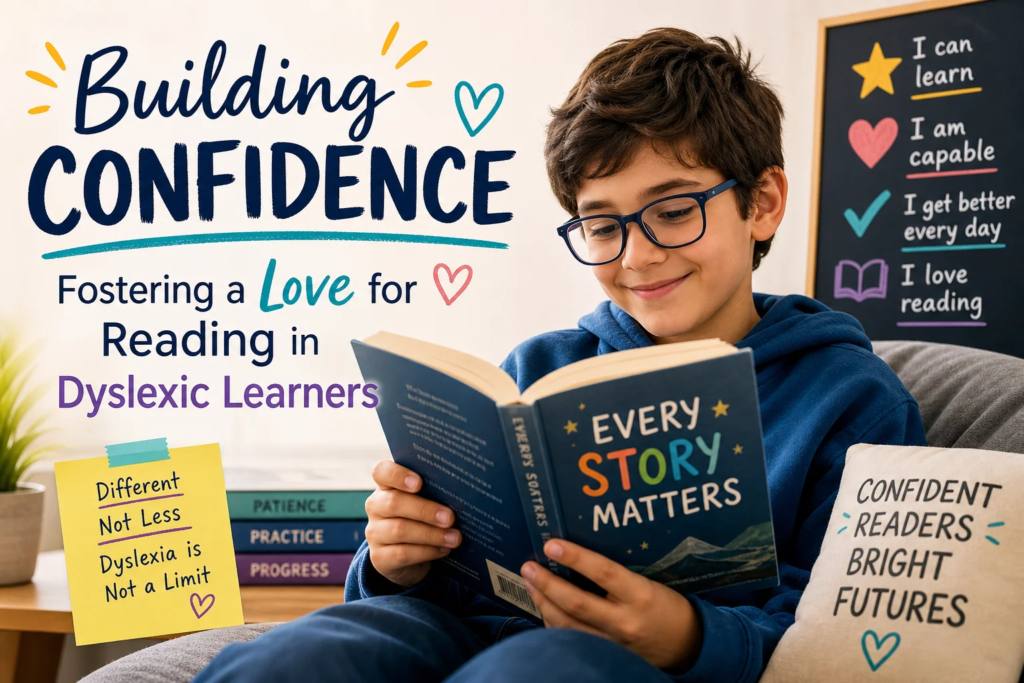
The Ultimate Guide to Building Confidence: Fostering a Love for Reading in Dyslexic Learners
Introduction: When Reading Feels Like Climbing a Mountain
For many children, reading is introduced as a doorway to imagination, independence, and discovery. But for dyslexic learners, that doorway can feel locked, heavy, and surrounded by pressure. A page of text may not look inviting; it may look overwhelming. Words may blur, shift, or refuse to “stick.” Reading aloud may feel like being asked to perform a difficult task in front of an audience.
That is why Building Confidence: Fostering a Love for Reading in Dyslexic Learners is not simply an educational goal. It is an emotional one.
A dyslexic learner who believes, “I’m bad at reading,” may begin avoiding books long before they have had the chance to experience the joy of stories, knowledge, humor, and self-expression. The real challenge is not only helping dyslexic learners decode words. It is helping them believe that reading can belong to them too.
The good news? Confidence can be built. Reading enjoyment can be nurtured. With the right strategies, environment, tools, and encouragement, dyslexic learners can grow into curious, capable, and even passionate readers.
This in-depth guide explores Building Confidence: Fostering a Love for Reading in Dyslexic Learners through practical strategies, real-world case studies, classroom and home approaches, assistive technology, emotional support, and motivation-based methods that make reading feel less like a test and more like an adventure.
Understanding Dyslexia: More Than “Reading Backwards”
Before we discuss building reading confidence in dyslexic learners, it is important to understand what dyslexia actually is.
Dyslexia is a language-based learning difference that affects reading, spelling, decoding, phonological processing, and sometimes writing fluency. It is not connected to intelligence. Many dyslexic learners are creative, insightful, verbally strong, inventive, and excellent problem-solvers.
Yet because traditional reading instruction often depends heavily on fast decoding, spelling accuracy, and fluent oral reading, dyslexic learners may experience repeated frustration.
Common Signs of Dyslexia
| Area | Possible Signs |
|---|---|
| Decoding | Difficulty sounding out unfamiliar words |
| Fluency | Slow, effortful reading |
| Spelling | Inconsistent spelling, even with familiar words |
| Memory | Trouble remembering sight words or letter patterns |
| Sequencing | Mixing up order of letters, sounds, or steps |
| Writing | Difficulty organizing thoughts on paper |
| Confidence | Avoiding reading, saying “I’m stupid,” or becoming anxious |
One of the most important truths in Building Confidence: Fostering a Love for Reading in Dyslexic Learners is this: dyslexic learners do not need lower expectations. They need different pathways.
They need structured instruction, emotional safety, access to engaging books, and adults who recognize that reading struggles do not define their potential.
Why Confidence Comes Before Reading Enjoyment
A child rarely falls in love with something that repeatedly makes them feel embarrassed.
For dyslexic learners, reading can become associated with red marks, public mistakes, slow progress, and comparison with peers. Over time, this can create what educators sometimes call a “failure cycle.”
The learner struggles.
They feel ashamed.
They avoid reading.
They get less practice.
The gap widens.
Their confidence drops further.
The goal of Building Confidence: Fostering a Love for Reading in Dyslexic Learners is to interrupt that cycle and replace it with a confidence loop.
The Confidence Loop for Dyslexic Readers
| Step | What Happens | Adult Role |
|---|---|---|
| Safety | Learner feels accepted and not judged | Reduce pressure and shame |
| Success | Learner experiences achievable wins | Use appropriate texts and support |
| Practice | Learner reads more often | Keep sessions short and positive |
| Identity | Learner begins to think, “I can do this” | Praise effort, strategy, and growth |
| Enjoyment | Learner connects reading with pleasure | Offer choice and meaningful books |
This confidence loop is at the heart of fostering a love for reading in dyslexic students. Skills matter, but belief matters too.
The Emotional Side of Dyslexia
Reading difficulties are visible in schoolwork, but the emotional effects often stay hidden.
A dyslexic learner may laugh off mistakes, act uninterested, become disruptive, or refuse to participate. Underneath, they may feel fear, embarrassment, or exhaustion. If adults focus only on performance, they may miss the emotional load the child is carrying.
Common Emotional Experiences
Dyslexic learners may experience:
- Anxiety before reading aloud
- Shame when comparing themselves to classmates
- Frustration from working harder but progressing slower
- Avoidance of homework or books
- Low self-esteem
- Fear of being seen as lazy or unintelligent
- Anger when support feels babyish or inconsistent
A major part of Building Confidence: Fostering a Love for Reading in Dyslexic Learners is helping children separate reading difficulty from self-worth.
A powerful message to repeat often is:
“Your brain learns differently. That does not mean it learns less.”
This statement may sound simple, but for a dyslexic child who has internalized failure, it can be transformative.
Start With Strengths, Not Struggles
Too often, dyslexic learners are introduced through what they cannot do: cannot spell accurately, cannot read quickly, cannot decode grade-level passages, cannot finish worksheets on time.
But confidence grows when learners are also seen for what they can do.
Many dyslexic learners show strengths in:
- Big-picture thinking
- Storytelling
- Spatial reasoning
- Creativity
- Empathy
- Problem-solving
- Oral discussion
- Visual thinking
- Entrepreneurship
- Hands-on learning
A child who struggles to read a paragraph may be able to explain a complex science concept aloud. Another may invent vivid stories but freeze when asked to write them down. Another may understand character motivation deeply but read slowly.
In Building Confidence: Fostering a Love for Reading in Dyslexic Learners, strengths are not side notes. They are bridges.
When we connect reading to a learner’s strengths, reading becomes more meaningful.
For example:
- A visual thinker may enjoy graphic novels.
- A storyteller may love audiobooks and oral retelling.
- A hands-on learner may connect with nonfiction about building, animals, sports, or experiments.
- A socially aware learner may enjoy books with strong characters and emotional themes.
Reading confidence grows faster when dyslexic learners feel known.
Structured Literacy: The Skill Foundation That Supports Confidence
Love of reading is not built by motivation alone. Dyslexic learners also need explicit, systematic instruction that helps them understand how written language works.
Structured literacy approaches are often recommended for dyslexic learners because they teach reading in a clear, organized, cumulative way.
Key Features of Structured Literacy
| Feature | What It Means | Why It Helps Dyslexic Learners |
|---|---|---|
| Explicit instruction | Skills are directly taught, not guessed | Reduces confusion |
| Systematic sequence | Concepts build step by step | Prevents gaps |
| Phonological awareness | Focus on sounds in spoken language | Supports decoding |
| Phonics | Letter-sound relationships are taught clearly | Builds word-reading skills |
| Multisensory practice | Uses sight, sound, touch, and movement | Strengthens memory |
| Cumulative review | Previously learned skills are revisited | Promotes retention |
| Morphology | Teaches prefixes, suffixes, roots | Helps with vocabulary and spelling |
Structured literacy is not the opposite of joyful reading. It is one of the foundations that makes joyful reading possible.
When learners understand the code, even gradually, the page becomes less mysterious. And when the page becomes less mysterious, confidence has room to grow.
This is essential to Building Confidence: Fostering a Love for Reading in Dyslexic Learners because emotional encouragement without skill support can feel empty. Dyslexic learners need both: “You can do this” and “Here is how.”
Make Reading Feel Safe
If reading has become a source of stress, safety must come before speed.
A dyslexia-friendly reading environment reduces shame and increases willingness to try. This matters at home, in classrooms, tutoring sessions, and libraries.
Ways to Create Reading Safety
-
Do not force public reading without preparation.
Reading aloud unexpectedly can be terrifying for dyslexic learners.
-
Offer preview time.
Let the student practice a passage before reading it aloud.
-
Normalize different reading tools.
Audiobooks, overlays, text-to-speech, and decodable texts should not be treated as “cheating.”
-
Use private correction.
Avoid correcting every mistake in front of peers.
-
Celebrate strategy use.
Praise learners for breaking words apart, rereading, asking for help, or using assistive tools.
-
Keep sessions short and successful.
Ten positive minutes are often better than forty frustrated ones.
- Let learners stop before they shut down.
Emotional overload can block learning.
In the journey of Building Confidence: Fostering a Love for Reading in Dyslexic Learners, safety is not softness. It is smart instruction.
Choice Is a Confidence Builder
Many struggling readers have had reading choices made for them: intervention passages, leveled texts, fluency drills, worksheets, and assigned books. While skill practice is necessary, dyslexic learners also need the dignity of choice.
Choice increases ownership. Ownership increases motivation.
Reading Choices That Matter
Let dyslexic learners choose:
- Topics
- Formats
- Reading location
- Audiobook or print
- Graphic novel or chapter book
- Partner reading or independent reading
- Fiction or nonfiction
- Short articles, magazines, comics, or poetry
- Books above decoding level through audio support
A learner who “hates reading” may actually hate being forced to read books that feel inaccessible or irrelevant.
One key to fostering reading motivation in dyslexic learners is expanding the definition of reading. Reading can include listening to an audiobook while following the text. It can include exploring a comic. It can include reading sports statistics, recipes, game instructions, song lyrics, or subtitles.
If the goal is love, choice is not optional.
Decodable Texts and High-Interest Books: Learners Need Both
There is sometimes tension between decodable readers and authentic literature. Dyslexic learners benefit from both, but each serves a different purpose.
Decodable Texts vs. High-Interest Books
| Type of Text | Purpose | Example Use |
|---|---|---|
| Decodable texts | Practice specific phonics patterns | Skill-building with controlled words |
| High-interest books | Build motivation and knowledge | Choice reading, read-alouds, audiobooks |
| Graphic novels | Support comprehension through visuals | Independent or shared reading |
| Audiobooks | Provide access to rich language | Grade-level content and enjoyment |
| Short-form texts | Reduce overwhelm | Articles, poems, jokes, instructions |
Decodable texts help dyslexic learners experience accuracy and success. High-interest books help them experience curiosity and pleasure.
The balance is crucial in Building Confidence: Fostering a Love for Reading in Dyslexic Learners. A child should not spend all reading time in controlled practice, nor should they be handed books they cannot decode independently and told to “try harder.”
They need skill-building and soul-feeding.
The Power of Audiobooks
Audiobooks are one of the most effective tools for helping dyslexic children enjoy books.
Some adults worry that listening is not “real reading.” But audiobooks can build vocabulary, comprehension, background knowledge, imagination, and literary engagement. For dyslexic learners, they provide access to stories and information that decoding difficulties might otherwise block.
Benefits of Audiobooks for Dyslexic Learners
- Allows access to age-appropriate content
- Reduces fatigue from decoding
- Builds vocabulary and language patterns
- Supports comprehension
- Encourages independent exploration
- Helps learners participate in class discussions
- Models fluent reading
- Rebuilds positive associations with books
A child who cannot yet decode a 300-page novel may still be ready to understand it, discuss it, and love it.
Audiobooks are not a shortcut around learning. They are a bridge toward belonging.
For many families, audiobooks are a turning point in Building Confidence: Fostering a Love for Reading in Dyslexic Learners because they allow children to finally say, “I love that book,” instead of “I can’t read that.”
Assistive Technology: Tools That Build Independence
Assistive technology can be life-changing for dyslexic learners. It helps reduce barriers so students can focus on meaning, ideas, and expression.
Helpful Tools for Dyslexic Readers
| Tool | How It Helps |
|---|---|
| Text-to-speech | Reads digital text aloud |
| Speech-to-text | Allows learners to dictate writing |
| Audiobook platforms | Provides access to literature and textbooks |
| Dyslexia-friendly fonts | May improve readability for some learners |
| Colored overlays/backgrounds | Can reduce visual stress for some students |
| Digital highlighting | Supports tracking and comprehension |
| Word prediction | Helps with spelling and writing fluency |
| Reading pens | Scan and read printed words aloud |
| Annotation apps | Help organize thoughts while reading |
The purpose of technology is not to remove challenge. It is to remove unnecessary barriers.
In confidence-building reading strategies for dyslexia, assistive technology should be introduced as empowerment, not remediation.
Instead of saying, “You need this because you can’t read well,” try:
“This tool helps your brain access information more efficiently, just like glasses help eyes focus.”
That language preserves dignity.
Multisensory Reading Activities That Feel Engaging
Dyslexic learners often benefit from multisensory instruction because it connects visual, auditory, kinesthetic, and tactile pathways.
But multisensory does not have to mean childish. It can be age-appropriate, creative, and fun.
Multisensory Reading Ideas
| Activity | Skill Supported | Example |
|---|---|---|
| Sand or textured writing | Letter formation and sound connection | Trace “sh” while saying /sh/ |
| Sound tapping | Phonemic awareness | Tap each sound in “ship” |
| Word building with tiles | Decoding and spelling | Build “play,” then change to “stay” |
| Air writing | Memory and motor connection | Write tricky words in the air |
| Color coding | Morphology and syllables | Highlight prefixes, roots, suffixes |
| Movement games | Sound-symbol learning | Jump to the correct vowel sound |
| Rhythm and clapping | Syllable awareness | Clap syllables in vocabulary words |
Multisensory work supports Building Confidence: Fostering a Love for Reading in Dyslexic Learners because it gives students more than one way to learn. When one pathway is difficult, another can help.
Case Study 1: Maya, the “Reluctant Reader” Who Loved Stories
Maya was eight years old and described by her parents as “bright but allergic to books.” She loved making up elaborate stories with dragons, secret doors, and magical animals. But when asked to read, she became tearful or silly.
Her teacher noticed that Maya had difficulty decoding unfamiliar words and often guessed based on the first letter. A dyslexia screening led to more targeted support.
Intervention Plan
Maya’s support team introduced:
- Structured literacy lessons four times a week
- Short decodable books aligned with her phonics instruction
- Daily parent read-aloud time
- Audiobooks for high-interest fantasy stories
- A “story creator” notebook where Maya dictated ideas
- Praise focused on effort and strategy, not speed
After three months, Maya still read below grade level, but something important changed: she stopped saying, “I hate books.” She began asking for audiobook sequels and proudly read short decodable books to her younger brother.
Analysis
Maya’s case shows why Building Confidence: Fostering a Love for Reading in Dyslexic Learners requires separating decoding skill from story enjoyment. If Maya had only received phonics drills, she might have continued seeing reading as work. If she had only received audiobooks, her decoding gaps might have remained. The combination helped her build skill and preserve her love of stories.
Parents as Confidence Coaches
Parents play a powerful role in Building Confidence: Fostering a Love for Reading in Dyslexic Learners. Not by becoming full-time tutors, but by becoming steady sources of encouragement, advocacy, and reading joy.
Home should not feel like an extension of school pressure. It should be a place where reading becomes warmer, more flexible, and more connected to the child’s interests.
What Parents Can Do
- Read aloud daily, even to older children
- Listen to audiobooks together in the car
- Visit libraries without forcing difficult books
- Celebrate small wins
- Avoid comparing siblings
- Ask about the story, not just the words
- Use humor and patience
- Advocate for school support
- Learn about dyslexia
- Protect the child’s self-esteem
Helpful Parent Phrases
| Instead of Saying | Try Saying |
|---|---|
| “You know this word!” | “Let’s look at the parts together.” |
| “Try harder.” | “Let’s try a different strategy.” |
| “Your sister can read this.” | “Everyone’s brain learns differently.” |
| “Sound it out” for every word | “What pattern do you recognize?” |
| “That was wrong.” | “Good attempt. Let’s check it.” |
A parent’s tone can either deepen shame or build resilience. In dyslexia-friendly reading confidence, the emotional climate matters as much as the reading material.
Teachers as Architects of Belonging
Teachers have enormous influence over how dyslexic learners see themselves. A classroom can either magnify reading struggles or protect students from unnecessary shame.
The best classrooms for Building Confidence: Fostering a Love for Reading in Dyslexic Learners combine high expectations with accessible support.
Dyslexia-Friendly Classroom Practices
- Provide notes or outlines before lessons
- Allow extra time for reading and writing tasks
- Offer audiobooks and text-to-speech
- Avoid cold-calling students to read aloud
- Use explicit vocabulary instruction
- Teach morphology and word structure
- Allow oral responses when appropriate
- Provide accessible fonts and spacing
- Use graphic organizers
- Celebrate different types of intelligence
- Create a classroom library with varied formats
A dyslexic learner should not feel like an exception in the room. Supports should be normalized so that using them does not feel embarrassing.
The Role of Libraries and Book Access
Libraries can be magical for dyslexic learners—but only if they feel welcoming rather than intimidating.
A library full of dense chapter books may overwhelm a child who struggles to decode. But a library with audiobooks, graphic novels, high-interest nonfiction, dyslexia-friendly formats, and supportive librarians can open doors.
Dyslexia-Friendly Library Features
| Feature | Why It Matters |
|---|---|
| Audiobook access | Makes stories accessible |
| Graphic novel section | Supports visual comprehension |
| High-low books | High interest, lower reading difficulty |
| Series books | Builds familiarity and confidence |
| Comfortable reading spaces | Reduces pressure |
| Book recommendation cards | Helps learners choose independently |
| Nonfiction variety | Connects reading to passions |
For Building Confidence: Fostering a Love for Reading in Dyslexic Learners, access matters. A child cannot fall in love with books they cannot comfortably enter.
Case Study 2: Leo, the Teen Who Rediscovered Reading Through Choice
Leo was fourteen and had spent years avoiding reading. He was funny, articulate, and fascinated by music production, but he rarely completed assigned novels. His teachers assumed he was unmotivated.
A learning specialist discovered that Leo had dyslexia and had been hiding his reading difficulties for years. He could understand complex themes in class discussions but struggled to read long passages quickly.
Intervention Plan
Leo received:
- Access to audiobook versions of assigned novels
- Permission to use text-to-speech for articles
- Short, targeted structured literacy intervention
- Independent reading choices connected to music, biographies, and social justice
- Private alternatives to reading aloud
- A project option using audio reflection instead of only written response
Within a semester, Leo completed his first assigned novel through audio and print together. He also chose to read a musician’s memoir independently.
Analysis
Leo’s experience highlights a critical point in Building Confidence: Fostering a Love for Reading in Dyslexic Learners: older dyslexic students may have years of shame layered over their reading struggles. Giving them choice, privacy, and assistive tools can help rebuild trust. Leo did not lack intelligence or curiosity. He lacked access.
High-Low Books: Respecting Age and Reading Level
One challenge in fostering a love of reading for dyslexic students is finding books that match both interest and readability.
A ten-year-old reading at a second-grade level usually does not want books written for six-year-olds. A teenager struggling with decoding does not want babyish content. This is where high-low books are valuable.
High-low means high interest, lower readability. These books feature age-appropriate themes with accessible vocabulary, shorter chapters, supportive formatting, and fast-paced plots.
Why High-Low Books Work
- Respect emotional maturity
- Reduce reading fatigue
- Build fluency through achievable text
- Offer real storylines
- Support independent reading
- Help learners experience completion
Finishing a book matters. For a dyslexic learner who has abandoned many books, reaching the last page can feel like a victory.
That victory is central to Building Confidence: Fostering a Love for Reading in Dyslexic Learners.
Reading Aloud: A Gift, Not a Crutch
Some adults stop reading aloud once children can technically read on their own. For dyslexic learners, continuing read-alouds can be incredibly beneficial.
Reading aloud exposes students to complex language, rich vocabulary, expressive fluency, and advanced ideas without requiring them to decode every word.
Benefits of Read-Alouds
- Builds listening comprehension
- Strengthens vocabulary
- Models expression and pacing
- Creates positive emotional connections
- Encourages discussion
- Makes challenging texts accessible
- Supports family bonding
Reading aloud is not babying a dyslexic child. It is feeding their language brain.
In Building Confidence: Fostering a Love for Reading in Dyslexic Learners, read-alouds remind children that stories are enjoyable even when decoding is hard.
Praise That Actually Builds Confidence
Not all praise works equally well. Generic praise like “Good job” may feel nice but does not always help learners understand what they did successfully.
Dyslexic learners benefit from specific, process-based praise.
Confidence-Building Praise Examples
| Situation | Helpful Praise |
|---|---|
| Child decodes a hard word | “You broke that word into parts and checked the sounds.” |
| Child keeps trying | “You stayed with it even when it was tricky.” |
| Child uses a tool | “You used text-to-speech wisely to understand the passage.” |
| Child self-corrects | “You noticed that didn’t make sense and fixed it.” |
| Child chooses a book | “You picked something that interests you—that’s what readers do.” |
| Child reads slowly | “You read carefully and focused on meaning.” |
The best praise supports identity:
“You are becoming the kind of reader who uses strategies.”
That identity shift is a major part of Building Confidence: Fostering a Love for Reading in Dyslexic Learners.
Avoiding the Most Common Mistakes
Even well-meaning adults can accidentally damage reading confidence.
Mistakes to Avoid
-
Equating reading speed with intelligence
Slow reading does not mean slow thinking.
-
Making every book a lesson
Sometimes reading should simply be enjoyable.
-
Correcting too much
Constant interruption can destroy flow and confidence.
-
Withholding audiobooks
Access to content should not depend only on decoding level.
-
Using shame as motivation
Embarrassment may produce compliance, but it rarely creates love.
-
Ignoring strengths
Dyslexic learners need to be known beyond their difficulties.
-
Waiting too long to intervene
Early support can prevent years of frustration.
- Assuming avoidance equals laziness
Avoidance often signals stress, fatigue, or fear.
Avoiding these mistakes is essential in Building Confidence: Fostering a Love for Reading in Dyslexic Learners because confidence is easier to protect than repair.
Case Study 3: Amira, a Multilingual Dyslexic Learner
Amira was ten and spoke Arabic at home and English at school. She was warm, curious, and excellent at oral storytelling. However, she struggled with English reading and spelling. At first, her difficulties were attributed only to learning English as an additional language.
After careful assessment, educators realized Amira showed signs of dyslexia in phonological processing and decoding, beyond typical second-language development.
Intervention Plan
Her school provided:
- Structured literacy intervention in English
- Respect for her home language and cultural identity
- Visual vocabulary supports
- Audiobooks in English and Arabic when available
- Family communication in clear, supportive language
- Opportunities to share oral stories
- Books featuring bilingual characters and diverse cultures
Amira began to see reading not as a rejection of her home language, but as another way to access stories. Her confidence improved when her bilingual identity was treated as a strength.
Analysis
Amira’s case reminds us that Building Confidence: Fostering a Love for Reading in Dyslexic Learners must be culturally responsive. Multilingual dyslexic learners may be misunderstood if adults assume all reading difficulty comes from language learning. Proper assessment, family partnership, and respect for identity are essential.
Motivation: The Missing Ingredient in Many Reading Plans
Many reading interventions focus on skill but overlook motivation. Yet motivation determines whether students want to keep engaging.
For dyslexic learners, motivation often grows when reading feels:
- Relevant
- Achievable
- Social
- Meaningful
- Connected to identity
- Supported by tools
- Free from humiliation
Motivation Builders
| Motivation Strategy | How to Use It |
|---|---|
| Interest surveys | Ask what the learner enjoys outside school |
| Book tasting | Let students sample many books briefly |
| Reading buddies | Pair students supportively |
| Goal setting | Use personal, achievable goals |
| Choice boards | Offer different response options |
| Creative responses | Let students draw, build, record, or act |
| Series reading | Encourage familiar characters and worlds |
| Reading celebrations | Celebrate completion and effort |
Motivation is not a bonus. It is fuel.
Without motivation, reading practice feels like punishment. With motivation, practice becomes purposeful.
This is why Building Confidence: Fostering a Love for Reading in Dyslexic Learners must include emotional engagement, not just instructional technique.
The Importance of Representation
Dyslexic learners need to see people like themselves succeeding.
Books featuring characters with dyslexia or learning differences can reduce isolation. Biographies of successful dyslexic thinkers, artists, scientists, entrepreneurs, and athletes can also inspire learners.
Representation says:
“You are not the only one. Your story is not over.”
When learners discover that many accomplished people have dyslexia, they may begin to reinterpret their own struggles.
Instead of “I’m broken,” they may think, “My brain works differently, and I can learn how to use it.”
That mindset is powerful in Building Confidence: Fostering a Love for Reading in Dyslexic Learners.
Building a Dyslexia-Friendly Reading Routine
Consistency helps, but routines should be realistic. Long, exhausting reading sessions can backfire.
A strong routine includes skill practice, enjoyable reading, and emotional success.
Sample Weekly Reading Routine
| Day | Skill Practice | Enjoyment Reading | Confidence Focus |
|---|---|---|---|
| Monday | 10 minutes phonics review | Audiobook chapter | Praise strategy use |
| Tuesday | Word building | Graphic novel | Discuss favorite part |
| Wednesday | Decodable text | Parent read-aloud | Celebrate accuracy |
| Thursday | Morphology game | Choice article | Connect to interest |
| Friday | Fluency reread | Audiobook + print | Notice progress |
| Saturday | No formal drill | Library/bookstore visit | Let learner choose |
| Sunday | Light review | Family reading time | Keep it relaxed |
The best routine for Building Confidence: Fostering a Love for Reading in Dyslexic Learners is predictable but not rigid. It should create momentum without creating dread.
Reading Comprehension: Dyslexic Learners Often Understand More Than They Can Decode
Some dyslexic learners have strong listening comprehension but weaker decoding. This means they may understand complex ideas when text is read aloud but struggle to access the same ideas independently in print.
It is important not to confuse decoding difficulty with poor comprehension.
Ways to Support Comprehension
- Preview key vocabulary
- Use audiobooks alongside print
- Provide background knowledge
- Use visual organizers
- Pause for discussion
- Ask open-ended questions
- Encourage mental imagery
- Let students respond orally
- Teach summarizing explicitly
- Use sticky notes or digital annotations
A dyslexic learner’s thinking may be far ahead of their reading fluency. Supporting comprehension protects intellectual growth while decoding skills develop.
This is a cornerstone of Building Confidence: Fostering a Love for Reading in Dyslexic Learners.
Fluency Without Pressure
Fluency is important, but fluency practice must be handled carefully. If students feel rushed, timed, or publicly compared, confidence can suffer.
Supportive Fluency Practices
- Repeated reading of short passages
- Echo reading with an adult
- Choral reading in a group
- Paired reading
- Reader’s theater with practice time
- Audiobook shadow reading
- Recording and listening privately
- Tracking personal progress rather than class rankings
Fluency should feel like building rhythm, not racing.
In Building Confidence: Fostering a Love for Reading in Dyslexic Learners, the goal is not to make every student the fastest reader. The goal is to help each learner read with increasing accuracy, expression, understanding, and self-belief.
Writing and Spelling: Connected but Not the Same as Reading Love
Dyslexic learners often struggle with spelling and written expression. These difficulties can spill over into reading confidence because students may assume all literacy tasks are impossible.
It helps to separate skills.
A student may love listening to novels but hate spelling tests. They may understand a story deeply but struggle to write a summary. They may have brilliant ideas but need speech-to-text to express them.
Supportive Writing Tools
- Speech-to-text
- Graphic organizers
- Word banks
- Spelling dictionaries
- Predictive text
- Sentence starters
- Oral rehearsal before writing
- Reduced copying
- Alternative project formats
Protecting reading motivation sometimes means reducing writing barriers. If every reading assignment ends with a difficult writing task, the learner may begin avoiding reading itself.
This is another practical piece of Building Confidence: Fostering a Love for Reading in Dyslexic Learners.
Case Study 4: A Whole-Class Approach That Helped Everyone
A fourth-grade teacher noticed that several students avoided independent reading, including two diagnosed dyslexic learners. Instead of singling them out, she redesigned her classroom reading culture.
Classroom Changes
She added:
- Audiobook stations
- Graphic novels and high-low books
- Choice reading time
- Book talks from students
- Read-alouds above grade level
- Private reading conferences
- Flexible response options
- Explicit lessons on how different brains learn
- A “tools are normal” classroom policy
After several months, the dyslexic learners participated more willingly, but so did many other students. The entire class began using a wider variety of reading formats.
Analysis
This case shows that Building Confidence: Fostering a Love for Reading in Dyslexic Learners does not require isolating students. Universal design benefits everyone. When supports are normalized, dyslexic learners are less likely to feel different or deficient.
How to Measure Progress Beyond Test Scores
Standard reading assessments matter, but they do not capture the whole picture.
If we are serious about Building Confidence: Fostering a Love for Reading in Dyslexic Learners, we must measure emotional and behavioral growth too.
Signs of Growing Reading Confidence
| Indicator | What It Might Look Like |
|---|---|
| Reduced avoidance | Learner starts reading without arguing |
| Increased choice | Learner selects books or topics |
| Better persistence | Learner tries tricky words longer |
| Tool independence | Learner uses audiobooks or text-to-speech appropriately |
| Positive identity | Learner says, “I’m getting better” |
| More discussion | Learner talks about books or ideas |
| Completion | Learner finishes more texts |
| Risk-taking | Learner attempts new genres or harder material |
A dyslexic learner’s first major victory may not be a higher score. It may be picking up a book voluntarily.
That moment matters.
Building Partnerships: Parents, Teachers, Specialists, and Learners
The strongest support happens when adults work together.
A dyslexic learner should not have to carry messages between home, school, tutors, and specialists. Collaboration reduces confusion and helps everyone reinforce the same goals.
Strong Partnership Questions
Parents can ask:
- What reading skills are being targeted right now?
- What strategies should we use at home?
- Which books or formats are best for my child?
- How can we support confidence, not just homework?
- Are audiobooks or assistive tools available?
- How will progress be measured?
- What accommodations are in place?
Teachers can ask:
- What does the child enjoy outside school?
- What reading experiences have been frustrating?
- Which supports work best at home?
- How does the child respond emotionally to reading?
- What strengths should we build on?
Most importantly, include the learner.
Ask:
“What helps reading feel easier?”
“What makes reading stressful?”
“What kinds of books would you like to try?”
“What do you wish adults understood?”
Learner voice is central to Building Confidence: Fostering a Love for Reading in Dyslexic Learners.
Long-Tail Keyword Variations for Contextual Use
For SEO and content planning, related long-tail variations include:
- Building reading confidence in dyslexic learners
- Fostering a love of reading for dyslexic students
- Helping dyslexic children enjoy books
- Confidence-building reading strategies for dyslexia
- Dyslexia-friendly reading motivation strategies
- How to encourage dyslexic learners to read
- Reading confidence activities for dyslexic children
- Supporting reluctant dyslexic readers at home
- Best reading tools for dyslexic learners
- How audiobooks help dyslexic students love reading
- Structured literacy and reading confidence
- Dyslexia-friendly classroom reading strategies
These variations all connect naturally to Building Confidence: Fostering a Love for Reading in Dyslexic Learners and help broaden the conversation without relying on repetitive phrasing.
Practical Action Plan: 10 Steps to Start Today
If you are a parent, teacher, tutor, or caregiver, you do not need to do everything at once. Start with small, consistent changes.
10 Actionable Steps
-
Talk openly and positively about dyslexia.
Explain that dyslexia is a learning difference, not a lack of intelligence.
-
Choose one accessible reading tool.
Try audiobooks, text-to-speech, or paired reading.
-
Offer real book choices.
Include graphic novels, nonfiction, comics, and high-low books.
-
Keep reading practice short.
Aim for consistency without exhaustion.
-
Use structured literacy support.
Make sure instruction is explicit and systematic.
-
Avoid public reading pressure.
Give preparation time or alternatives.
-
Celebrate effort and strategy.
Praise what the learner did to solve the problem.
-
Read aloud regularly.
Keep rich stories alive, regardless of decoding level.
-
Track confidence signs.
Notice willingness, persistence, and book talk.
- Build a team.
Collaborate with teachers, specialists, and the learner.
These steps support Building Confidence: Fostering a Love for Reading in Dyslexic Learners in a way that is practical, compassionate, and sustainable.
Conclusion: Confidence Is the Bridge to Reading Joy
Reading can be difficult for dyslexic learners, but difficulty does not have to become defeat. With the right support, dyslexic learners can build skills, develop resilience, and discover that books are not closed doors—they are invitations.
The heart of Building Confidence: Fostering a Love for Reading in Dyslexic Learners is simple but powerful: children learn best when they feel safe, capable, understood, and inspired.
They need structured literacy to crack the code.
They need audiobooks and assistive tools to access ideas.
They need choice to develop ownership.
They need adults who protect their dignity.
They need stories that speak to their interests.
They need praise that recognizes effort, strategy, and growth.
Most of all, they need to know that struggling with reading does not make them less intelligent, less creative, or less worthy.
A dyslexic learner may not take the same path into reading as other children. But with patience, evidence-based support, and genuine encouragement, they can still arrive at a place where books feel exciting, meaningful, and theirs.
And the moment a child who once said, “I hate reading,” begins to say, “Can we read one more chapter?”—that is more than progress.
That is confidence becoming joy.
FAQs About Building Confidence: Fostering a Love for Reading in Dyslexic Learners
1. Can dyslexic learners really learn to love reading?
Yes. Dyslexic learners can absolutely develop a love for reading, especially when they receive appropriate instruction, accessible formats, emotional support, and books connected to their interests. The path may look different, but reading enjoyment is possible.
2. Are audiobooks helpful or do they prevent dyslexic children from learning to read?
Audiobooks are helpful. They do not replace reading instruction, but they provide access to stories, vocabulary, knowledge, and enjoyment. When paired with structured literacy, audiobooks can support both confidence and comprehension.
3. What type of reading instruction works best for dyslexic learners?
Many dyslexic learners benefit from structured literacy, which is explicit, systematic, cumulative, and often multisensory. It teaches phonological awareness, phonics, decoding, spelling patterns, syllables, morphology, and comprehension strategies in a clear sequence.
4. How can parents help without turning home into a stressful tutoring session?
Parents can read aloud, listen to audiobooks together, offer book choices, celebrate effort, and keep practice short. Home support should feel encouraging and manageable. If reading time regularly ends in tears, the routine may need adjustment.
5. Should dyslexic students be asked to read aloud in class?
They should not be forced to read aloud unexpectedly. Some dyslexic learners can read aloud successfully with preparation, supportive passages, or partner practice. Cold-calling can create anxiety and damage confidence.
6. What books are best for dyslexic learners?
The best books are accessible, interesting, and respectful of the learner’s age. Good options include decodable books for skill practice, high-low books, graphic novels, audiobooks, nonfiction, series books, and books connected to personal interests.
7. How do I motivate a dyslexic child who says they hate reading?
Start by believing the feeling is real. “I hate reading” often means “Reading makes me feel unsuccessful.” Reduce pressure, offer audiobooks, provide choices, choose high-interest topics, use shorter texts, and celebrate small wins. Rebuild trust before expecting enthusiasm.
8. Is slow reading always a problem?
Not always. Many dyslexic learners read slowly because decoding requires more effort. Fluency can improve with support, but speed should not be treated as the only sign of success. Accuracy, comprehension, stamina, and confidence matter too.
9. How can teachers create a dyslexia-friendly classroom?
Teachers can normalize assistive tools, avoid public embarrassment, provide explicit instruction, offer audiobooks, include graphic novels and high-low books, allow flexible responses, and create a classroom culture where different learning styles are respected.
10. What is the most important takeaway?
The most important takeaway is that Building Confidence: Fostering a Love for Reading in Dyslexic Learners requires both skill support and emotional support. Dyslexic learners need effective instruction, but they also need dignity, choice, encouragement, and access to the joy of books.

