


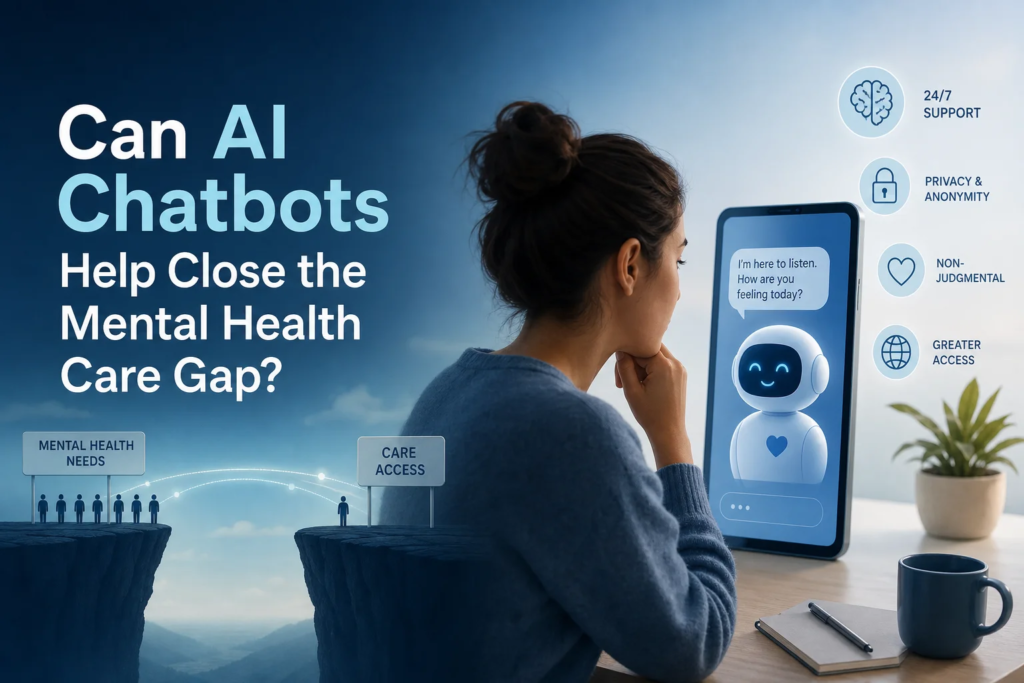
Mental health care is facing a painful paradox: more people are openly asking for help than ever before, yet too many cannot get it when they need it.
A college student waits three months for a counseling appointment. A new parent struggles with postpartum anxiety at 2 a.m. A rural worker has no nearby therapist. A teenager wants support but fears being judged. A burned-out employee knows they need help but cannot afford weekly sessions.
This is the mental health care gap: the distance between people who need support and people who can actually access it.
So, Can AI Chatbots Help Close the Mental Health Care Gap? It is one of the most important questions in digital health today. The answer is not a simple yes or no. AI chatbots are not therapists, and they should not replace trained clinicians. But when designed responsibly, they can offer immediate, low-cost, stigma-reducing support that may help millions of people take the first step toward care.
This article explores Can AI Chatbots Help Close the Mental Health Care Gap? from every angle: access, quality, ethics, risks, real-world case studies, and what the future could look like if humans and technology work together.
The Mental Health Care Gap: Why the Problem Is So Urgent
Before asking Can AI Chatbots Help Close the Mental Health Care Gap?, we need to understand the size of the gap itself.
Across many countries, demand for mental health support has risen sharply. Anxiety, depression, loneliness, trauma, burnout, and substance-related challenges are increasingly common. At the same time, health systems are struggling with therapist shortages, long waitlists, high costs, insurance barriers, and uneven access.
The result is predictable but devastating: people often reach out only when their symptoms have already become severe.
Common Barriers to Mental Health Care
| Barrier | What It Looks Like in Real Life | How It Affects People |
|---|---|---|
| Cost | Therapy sessions may be expensive or poorly covered by insurance | People delay or avoid care |
| Waitlists | Appointments may take weeks or months | Symptoms can worsen while waiting |
| Location | Rural or underserved areas may lack clinicians | People have limited or no local options |
| Stigma | Fear of judgment from family, workplace, or community | People suffer silently |
| Cultural mismatch | Lack of providers who understand language, identity, or background | People feel unseen or misunderstood |
| Time constraints | Work, caregiving, school, or transportation barriers | Care becomes difficult to maintain |
| Crisis-only systems | Help often arrives only after conditions escalate | Prevention is neglected |
This is where digital tools enter the conversation. Can AI Chatbots Help Close the Mental Health Care Gap? Possibly—but only if they are viewed as one part of a broader care ecosystem.
What Are AI Mental Health Chatbots?
AI mental health chatbots are digital tools designed to communicate with users through text or voice. Some are simple rule-based programs that follow scripted pathways. Others use natural language processing and machine learning to respond more flexibly.
They may help users:
- Track mood
- Practice breathing exercises
- Reframe negative thoughts
- Learn coping skills
- Journal emotions
- Identify stress patterns
- Access psychoeducation
- Prepare for therapy
- Find crisis or professional resources
Many AI chatbots draw from evidence-informed approaches such as cognitive behavioral therapy, acceptance and commitment therapy, mindfulness, motivational interviewing, or dialectical behavior therapy skills.
Still, it is important to be clear: most AI chatbots are not licensed mental health professionals. They do not truly “understand” a person in the human sense. They generate responses based on patterns, training data, scripts, and programmed safety guidelines.
That distinction matters when asking Can AI Chatbots Help Close the Mental Health Care Gap? The strongest argument is not that chatbots can replace therapists. It is that they may extend support to people who otherwise receive none.
Can AI Chatbots Help Close the Mental Health Care Gap? A Balanced Answer
The short answer: yes, AI chatbots can help close parts of the mental health care gap—but they cannot close it alone.
They are most useful for early support, low-intensity needs, emotional check-ins, psychoeducation, and helping people navigate toward professional care. They are least appropriate as a sole source of support for severe depression, active suicidal thoughts, psychosis, complex trauma, domestic violence, eating disorders, or situations requiring clinical diagnosis and treatment.
Where Chatbots May Help Most
| Need | How AI Chatbots Can Help | Human Support Still Needed? |
|---|---|---|
| Mild stress or anxiety | Offer coping exercises, grounding, journaling prompts | Sometimes |
| Therapy waitlists | Provide support while users wait for an appointment | Yes |
| After-hours support | Available at night, weekends, holidays | Sometimes |
| Stigma reduction | Private, low-pressure first step | Often |
| Skill practice | Reinforce CBT, mindfulness, emotional regulation | Helpful |
| Care navigation | Suggest resources, hotlines, or clinician options | Yes |
| Crisis situations | Can detect risk and direct to emergency resources | Absolutely |
So when we ask Can AI Chatbots Help Close the Mental Health Care Gap?, the best answer is: they can help narrow it, especially at the front door of care. But they should be integrated with human services, not positioned as a cheap substitute for them.
Why AI Chatbots Are So Appealing in Mental Health Care
The popularity of AI mental health tools is not accidental. They respond to real pain points in the system.
1. They Are Available 24/7
Mental distress does not follow office hours. Anxiety can spike at midnight. Grief can hit during a lunch break. Panic can rise on a Sunday morning.
One of the strongest reasons people ask Can AI Chatbots Help Close the Mental Health Care Gap? is that chatbots are always available. That immediacy can matter. Even a brief supportive interaction may help someone pause, breathe, reflect, or avoid harmful impulsive behavior.
2. They Reduce the Fear of Being Judged
Many people hesitate to speak openly with another person. They may feel embarrassed, ashamed, or afraid of being misunderstood. A chatbot can feel like a lower-stakes place to start.
This does not mean chatbot conversations are emotionally equivalent to human relationships. But for someone who has never told anyone, “I am not okay,” typing it into a private app may be a meaningful first step.
3. They Can Be Scaled
A therapist can only see a limited number of clients per week. A chatbot can interact with thousands—or millions—of users simultaneously.
That scalability is central to the question Can AI Chatbots Help Close the Mental Health Care Gap? If used responsibly, AI tools can extend basic support far beyond what current systems can provide.
4. They Can Reinforce Skills Between Sessions
For people already in therapy, chatbots may help maintain progress. A user can practice grounding techniques, track mood, or review coping strategies between appointments.
In this sense, AI does not compete with therapy. It can become a digital companion that supports continuity.
5. They May Improve Early Intervention
Many people wait until symptoms are severe before seeking help. AI chatbots may make it easier to engage earlier. They can ask gentle questions, normalize common struggles, and encourage users to seek professional support when appropriate.
Early intervention is one of the most promising answers to Can AI Chatbots Help Close the Mental Health Care Gap?
The Human Side: What People Actually Need From Mental Health Support
Technology conversations often focus on features: algorithms, personalization, data, response accuracy. But mental health care is deeply human.
People need to feel:
- Heard
- Safe
- Respected
- Understood
- Not judged
- Not rushed
- Not reduced to symptoms
- Hopeful that change is possible
This is where AI chatbots face their greatest limitation. A chatbot can simulate empathy, but it does not experience care, concern, or responsibility the way a human clinician does. It cannot read subtle body language. It cannot sit with someone through silence. It cannot fully understand cultural nuance, family history, spiritual beliefs, or complex trauma.
So, Can AI Chatbots Help Close the Mental Health Care Gap? Yes, if they support human-centered care. No, if they are used to replace the human connection that many people urgently need.
Case Study 1: Woebot and CBT-Based Digital Support
Woebot is one of the best-known mental health chatbots. It was designed to deliver conversational support based largely on cognitive behavioral therapy principles. Users interact with the chatbot through brief daily conversations, mood check-ins, and exercises that help identify unhelpful thought patterns.
Woebot’s early research attracted attention because it suggested that some users experienced reduced symptoms of anxiety and depression after engaging with the tool. Its conversational design made mental health skills feel less clinical and more approachable.
Why This Case Matters
Woebot is relevant to Can AI Chatbots Help Close the Mental Health Care Gap? because it shows how structured psychological techniques can be delivered in a scalable format. For people with mild to moderate distress, a chatbot may help introduce practical skills before they ever enter a therapist’s office.
Key Takeaway
Woebot demonstrates that AI-supported tools can make evidence-informed mental health education more accessible. However, it also highlights the importance of clear boundaries: chatbots should not overstate their abilities or claim to replace professional therapy.
Case Study 2: Wysa and Workplace Mental Health Support
Wysa is another prominent AI mental health platform. It combines AI-guided conversations with self-help tools and, in some versions, access to human coaches or therapists. It has been used by individuals, employers, insurers, and health organizations.
In workplace settings, Wysa aims to support employees dealing with stress, burnout, sleep problems, and anxiety. Employees may be more willing to use a confidential digital tool than to contact HR or formally request mental health services.
Why This Case Matters
Wysa is important to the question Can AI Chatbots Help Close the Mental Health Care Gap? because many adults spend most of their waking hours at work, yet workplace mental health resources are often underused. A chatbot may act as a private entry point into support.
Brief Analysis
The Wysa model suggests that AI chatbots may be especially helpful when paired with escalation pathways. If a user needs more than self-guided support, the platform can help direct them toward human care. This blended model is likely more responsible than relying on AI alone.
Key Takeaway
AI chatbots can make mental health support more approachable in workplaces, but trust depends on privacy, transparency, and clear separation from employer surveillance.
Case Study 3: Limbic Access and Mental Health Triage
Limbic Access is used in some health care settings to support mental health referral and triage. Rather than acting mainly as an emotional companion, it helps collect information from patients and guide them toward appropriate services.
In systems with long waitlists, triage matters. If everyone enters the same queue, urgent cases may not receive timely attention. AI-assisted triage tools can gather symptom information, risk indicators, and user needs before a clinician reviews the case.
Why This Case Matters
This case directly addresses Can AI Chatbots Help Close the Mental Health Care Gap? because access is not only about emotional support. It is also about getting people to the right level of care faster.
Brief Analysis
AI triage tools may reduce administrative burden, improve referral quality, and help clinicians prioritize care. But they must be carefully monitored for bias, accuracy, and safety. A poorly designed triage system could miss risk or disadvantage certain populations.
Key Takeaway
AI chatbots may be most powerful when they handle repetitive intake tasks, freeing clinicians to spend more time on complex human care.
Case Study 4: The Trevor Project and AI-Supported Crisis Training
The Trevor Project, which supports LGBTQ+ young people in crisis, has used AI and simulation tools to train crisis counselors. Instead of replacing counselors, AI helps create realistic practice conversations so humans can improve their skills.
This is a slightly different angle on Can AI Chatbots Help Close the Mental Health Care Gap? Here, AI is not the frontline helper. It is a training tool that strengthens the human workforce.
Why This Case Matters
Mental health systems do not just need more apps. They need more trained, confident, culturally competent helpers. AI simulations can help volunteers and professionals practice difficult conversations in a safe environment.
Brief Analysis
This use case shows a mature approach to AI in mental health: not “AI instead of people,” but “AI helping people help better.”
Key Takeaway
AI chatbots and simulations may close the care gap indirectly by improving training, supervision, and readiness among human support providers.
Benefits of AI Chatbots in Mental Health Care
To answer Can AI Chatbots Help Close the Mental Health Care Gap? fairly, we need to look at the strongest benefits.
Benefit 1: Immediate Support
A person can open an app and begin a conversation within seconds. That is powerful in a system where people often wait weeks for help.
Benefit 2: Lower Cost
Many chatbot tools are free or lower cost than traditional therapy. This does not solve financial inequality, but it can reduce one barrier.
Benefit 3: Consistency
A chatbot can deliver the same exercise repeatedly without fatigue. It can remind users to practice skills, track patterns, and revisit goals.
Benefit 4: Anonymity
For people who fear stigma, anonymity can encourage honesty.
Benefit 5: Prevention and Maintenance
Chatbots can support mental wellness before problems become severe. They may also help users maintain progress after therapy ends.
Benefit 6: Data-Driven Insights
Mood tracking and repeated check-ins can reveal patterns. For example, a user may notice anxiety spikes before work meetings or depressive symptoms worsen after poor sleep.
Benefit 7: Support for Underserved Communities
In areas with few clinicians, digital tools can provide at least some support. But this requires internet access, language accessibility, and culturally responsive design.
Risks and Limitations: The Other Side of the Question
The conversation around Can AI Chatbots Help Close the Mental Health Care Gap? must include risks. Mental health is too important for hype.
Risk 1: Crisis Mismanagement
If a user expresses suicidal thoughts, self-harm urges, abuse, or psychosis, the chatbot must respond safely. It should encourage immediate human help, crisis lines, emergency services, or trusted contacts.
A chatbot that gives vague reassurance in a crisis can be dangerous.
Risk 2: False Empathy
AI can sound warm and caring, but it does not care in a human way. Some users may develop emotional dependence on a tool that cannot truly reciprocate or take responsibility.
Risk 3: Privacy Concerns
Mental health data is deeply sensitive. Users may disclose trauma, substance use, relationship issues, sexuality, or suicidal thoughts. Companies must be transparent about data storage, sharing, security, and deletion.
Risk 4: Bias and Cultural Blind Spots
AI systems may perform differently across languages, cultures, identities, and dialects. If training data is limited or biased, responses may be less helpful—or even harmful—for marginalized users.
Risk 5: Over-Reliance by Health Systems
Perhaps the biggest danger is not that individuals will use chatbots. It is that institutions may use AI as an excuse not to invest in therapists, community care, crisis services, housing support, or prevention.
When asking Can AI Chatbots Help Close the Mental Health Care Gap?, we must also ask: who benefits, who is protected, and who might be left with only an app when they deserve a person?
AI Chatbots vs. Human Therapists: What Each Does Best
AI chatbots and human therapists are often compared as if they are competitors. A better comparison is to ask what each is best suited for.
| Function | AI Chatbot | Human Therapist |
|---|---|---|
| 24/7 availability | Strong | Limited |
| Cost accessibility | Often strong | Variable |
| Emotional depth | Limited | Strong |
| Diagnosis | Not appropriate for most chatbots | Appropriate when licensed |
| Crisis judgment | Limited, must escalate | Stronger clinical responsibility |
| Skill practice | Strong | Strong |
| Personalized treatment planning | Limited | Strong |
| Cultural nuance | Variable | Depends on clinician |
| Long-term therapeutic relationship | Weak | Strong |
| Administrative triage | Strong potential | Useful but time-consuming |
| Accountability | Limited | Professional and ethical standards |
This table helps clarify Can AI Chatbots Help Close the Mental Health Care Gap? They can fill some gaps, but not all. The future is not AI versus therapists. The future is AI plus therapists, if built with ethics and care.
Where AI Chatbots Fit Best in the Mental Health Care Journey
The mental health care journey is not one moment. It includes awareness, first steps, assessment, treatment, maintenance, and crisis support.
Mental Health Journey and AI’s Role
| Stage | User Need | Chatbot Role | Best Practice |
|---|---|---|---|
| Early awareness | “Something feels wrong” | Normalize, educate, screen gently | Encourage professional care if symptoms persist |
| Mild distress | “I need coping tools” | Breathing, journaling, CBT exercises | Monitor for worsening symptoms |
| Waiting for therapy | “I need support now” | Daily check-ins, emotional support | Provide crisis resources |
| During therapy | “I need help between sessions” | Practice skills, track mood | Coordinate with therapist if user consents |
| After therapy | “I want to maintain progress” | Relapse prevention, reminders | Recommend follow-up when needed |
| Crisis | “I may hurt myself or someone else” | Immediate escalation guidance | Direct to emergency support, not chatbot-only care |
This layered approach gives a practical answer to Can AI Chatbots Help Close the Mental Health Care Gap? They are most valuable when matched to the right stage and risk level.
The Ethics of AI Mental Health Chatbots
Ethics should not be an afterthought. If AI chatbots are going to support vulnerable people, they must meet high standards.
Essential Ethical Principles
-
Transparency
Users should know they are interacting with AI, not a human therapist. -
Safety
Chatbots should have strong crisis detection and escalation pathways. -
Privacy
Sensitive data must be protected, minimized, and not misused. -
Clinical oversight
Mental health experts should be involved in design, testing, and monitoring. -
Equity
Tools should be tested across diverse populations and languages. -
Accountability
Companies should be responsible for harmful failures, misleading claims, or unsafe design. - Human backup
Users should know how to reach real people when needed.
If these principles are ignored, the answer to Can AI Chatbots Help Close the Mental Health Care Gap? becomes far less optimistic.
What Makes a Mental Health Chatbot Trustworthy?
Not all chatbots are created equal. Some are carefully designed with clinical input. Others are little more than generic conversation tools with a wellness label.
Here is a practical checklist.
| Trust Factor | What to Look For |
|---|---|
| Clear identity | It states that it is AI and not a therapist |
| Evidence base | Uses established methods like CBT or mindfulness |
| Clinical input | Designed or reviewed by licensed professionals |
| Crisis protocol | Provides immediate emergency resources when risk appears |
| Privacy policy | Clear, readable, and specific about mental health data |
| Data control | Allows users to delete or manage personal information |
| No exaggerated claims | Does not promise cures or guaranteed outcomes |
| Cultural sensitivity | Supports diverse identities, languages, and experiences |
| Human escalation | Offers pathways to human care |
| Ongoing evaluation | Updates safety and quality based on evidence |
A trustworthy chatbot does not pretend to be more than it is. That humility is essential to Can AI Chatbots Help Close the Mental Health Care Gap?
Can AI Chatbots Help Close the Mental Health Care Gap? The Role of Personalization
Personalization is one of AI’s biggest promises. A chatbot can remember a user’s goals, preferred coping strategies, stress triggers, and mood patterns. It might notice that the user reports worse anxiety on Sundays or better sleep after evening walks.
Personalization can make support feel more relevant. But it also raises privacy concerns. The more a chatbot knows, the more carefully that information must be protected.
The ideal version of personalization is user-controlled. People should decide what the chatbot remembers, what it forgets, and whether information can be shared with clinicians.
So again, Can AI Chatbots Help Close the Mental Health Care Gap? Yes, especially when personalization helps users feel supported. But not if personalization becomes surveillance.
The Importance of Cultural Competence
Mental health is shaped by culture, language, religion, family expectations, immigration history, racism, discrimination, gender identity, disability, and economic stress. A chatbot that gives generic advice may miss what matters most.
For example:
- “Set boundaries with your parents” may be complicated in collectivist family systems.
- “Take a mental health day” may be unrealistic for hourly workers.
- “Talk to a trusted adult” may be unsafe for LGBTQ+ youth in rejecting homes.
- “Call emergency services” may feel risky for communities with traumatic experiences of policing.
This is why Can AI Chatbots Help Close the Mental Health Care Gap? must include cultural safety. Closing the gap is not only about reaching more people. It is about reaching people well.
The Role of AI Chatbots in Rural and Underserved Communities
Rural areas often face severe shortages of mental health providers. Transportation can be difficult, privacy can be limited, and stigma may be intense in small communities.
AI chatbots can offer private, immediate support without travel. They can also help users decide when teletherapy, primary care, or crisis services are needed.
However, digital access is not universal. Some communities lack reliable broadband, private devices, or digital literacy. Therefore, AI tools should complement—not replace—investment in local services.
In rural settings, Can AI Chatbots Help Close the Mental Health Care Gap? Yes, but only if paired with broader infrastructure: telehealth, community health workers, school counselors, primary care integration, and crisis response.
How AI Chatbots Could Support Therapists Instead of Replacing Them
Therapists are also under pressure. Burnout, paperwork, high caseloads, and administrative demands reduce the time clinicians can spend on direct care.
AI tools may help by:
- Collecting intake information
- Tracking symptoms between sessions
- Summarizing user-reported patterns
- Providing homework reminders
- Offering psychoeducation
- Supporting measurement-based care
- Helping clients practice skills
Used carefully, this could make therapy more efficient and personalized. But clinicians should remain in control of clinical decisions.
This is one of the most hopeful answers to Can AI Chatbots Help Close the Mental Health Care Gap? AI could reduce friction in the system so human professionals can focus on what humans do best.
What Users Should Know Before Trying an AI Mental Health Chatbot
If you are considering using one, keep these points in mind.
Use Chatbots For:
- Stress management
- Journaling
- Breathing exercises
- Mood tracking
- Learning coping skills
- Reflecting on thoughts
- Support between therapy sessions
- Preparing to talk to a professional
Do Not Rely on Chatbots Alone For:
- Suicidal thoughts
- Self-harm urges
- Abuse or immediate danger
- Psychosis or hallucinations
- Severe depression
- Complex trauma
- Eating disorders
- Medication decisions
- Diagnosis
If you are in immediate danger or may harm yourself or someone else, contact emergency services or a crisis hotline in your country right away. In the U.S. and Canada, call or text 988 for crisis support.
This safety boundary is crucial to any honest discussion of Can AI Chatbots Help Close the Mental Health Care Gap?
What Health Systems Should Do Next
AI chatbots should not be dropped into mental health care without planning. Health systems, employers, schools, and governments need clear standards.
Recommended Actions
-
Evaluate evidence before adoption
Choose tools with research, clinical input, and safety testing. -
Demand privacy protections
Mental health data should not be exploited for advertising or unrelated profiling. -
Require crisis escalation
Any tool used in mental health settings must respond appropriately to high-risk language. -
Integrate with human care
Chatbots should help users reach professionals when needed. -
Measure outcomes
Track whether tools actually improve access, engagement, symptoms, and satisfaction. -
Protect equity
Test tools with diverse populations and correct unequal performance. - Avoid substitution ethics
Do not offer AI as the only option to people who need human care.
If these steps are followed, the answer to Can AI Chatbots Help Close the Mental Health Care Gap? becomes more promising.
Future Possibilities: What Comes Next?
The next generation of AI mental health tools may become more adaptive, multilingual, voice-enabled, and integrated with wearable devices. A chatbot might notice sleep disruption, reduced activity, or increased stress language and suggest a check-in before symptoms worsen.
Future tools may also support:
- Multilingual counseling preparation
- Personalized relapse prevention plans
- Digital peer support moderation
- Clinician dashboards
- School mental health screening
- Primary care behavioral health integration
- Low-intensity support in public health programs
But the future depends on choices made now. If companies prioritize engagement over safety, trust will collapse. If health systems use AI to cut costs while ignoring human need, the gap may widen. If policymakers demand accountability, AI could become a powerful public health ally.
That is why Can AI Chatbots Help Close the Mental Health Care Gap? is not just a technology question. It is a values question.
Long-Tail Keyword Variations for Contextual SEO
Here are natural variations related to the focus keyword Can AI Chatbots Help Close the Mental Health Care Gap? that fit the topic:
| Keyword Variation | Context |
|---|---|
| can AI chatbots improve access to mental health care | Access-focused articles |
| AI chatbots for mental health support | General informational content |
| digital mental health tools for therapy gaps | Health system and policy content |
| can AI therapy chatbots reduce waitlists | Service delivery discussions |
| benefits of AI chatbots in mental health care | Educational content |
| risks of AI mental health chatbots | Ethics and safety content |
| AI chatbots for anxiety and depression support | Condition-specific searches |
| chatbot mental health care for underserved communities | Equity-focused content |
| AI mental health support between therapy sessions | Patient and clinician resources |
| future of AI in mental health care | Innovation-focused content |
These variations help answer the broader search intent behind Can AI Chatbots Help Close the Mental Health Care Gap? without sounding repetitive.
Practical Framework: The “Bridge, Not Replacement” Model
The most useful way to think about AI chatbots is as a bridge.
They can bridge:
- The gap between distress and first support
- The gap between screening and referral
- The gap between therapy sessions
- The gap between relapse risk and early action
- The gap between overwhelmed systems and basic guidance
But they should not replace:
- Licensed therapy
- Psychiatric care
- Crisis intervention
- Human empathy
- Community support
- Social policy
- Affordable health care
This bridge model provides the clearest answer to Can AI Chatbots Help Close the Mental Health Care Gap? Yes—when they help people cross into better care, not when they become a dead end.
Conclusion: Can AI Chatbots Help Close the Mental Health Care Gap?
So, Can AI Chatbots Help Close the Mental Health Care Gap? Yes, they can help—but the word “help” matters.
AI chatbots can make mental health support more immediate, affordable, private, and scalable. They can teach coping skills, support people on waitlists, assist therapists, improve triage, and encourage earlier help-seeking. Real-world examples like Woebot, Wysa, Limbic Access, and AI-supported crisis training show that this is not science fiction. It is already happening.
But AI chatbots are not a cure for broken systems. They cannot replace the healing power of human relationships, clinical judgment, cultural understanding, or crisis care. They must be safe, transparent, evidence-informed, privacy-protective, and connected to human support.
The most hopeful future is not one where people are handed an app instead of care. It is one where technology opens more doors, reduces waiting, supports clinicians, and helps people feel less alone while they find the right help.
If we build and use these tools wisely, Can AI Chatbots Help Close the Mental Health Care Gap? becomes more than a question. It becomes a call to action: use innovation not to replace compassion, but to extend it.
1. Can AI Chatbots Help Close the Mental Health Care Gap for people who cannot afford therapy?
Yes, AI chatbots can provide low-cost or free support such as mood tracking, coping exercises, and mental health education. However, they are not a full replacement for therapy, especially for severe or complex conditions. They are best used as an accessible first step or supplementary support.
2. Are AI mental health chatbots safe to use?
Some are safer than others. A trustworthy chatbot should be transparent that it is not a therapist, protect user privacy, use evidence-informed techniques, and provide crisis resources. If you are experiencing suicidal thoughts or immediate danger, contact emergency services or a crisis hotline rather than relying on a chatbot.
3. Can AI chatbots replace human therapists?
No. AI chatbots can support mental wellness, teach coping skills, and help users reflect, but they cannot replace human empathy, clinical diagnosis, therapeutic relationships, or professional responsibility. The best use of AI is to complement human care.
4. How can AI chatbots help therapists?
AI chatbots can help with intake, symptom tracking, homework reminders, psychoeducation, and between-session support. This may reduce administrative burden and give therapists better insight into client patterns, but clinical decisions should remain with qualified professionals.
5. What are the biggest risks of AI chatbots in mental health?
The biggest risks include privacy violations, inaccurate or harmful advice, crisis mismanagement, cultural bias, emotional overdependence, and health systems using chatbots as a substitute for real care. Strong regulation, clinical oversight, and ethical design are essential.
6. Can AI chatbots help with anxiety and depression?
They may help some people manage mild to moderate anxiety or depressive symptoms by offering CBT-style exercises, mindfulness tools, journaling, and mood tracking. But if symptoms are severe, persistent, or include thoughts of self-harm, professional support is necessary.
7. Can AI Chatbots Help Close the Mental Health Care Gap in rural communities?
Yes, they may help by offering private, immediate support where providers are scarce. However, rural communities also need broadband access, telehealth services, local clinicians, crisis response, and community-based support. AI is one tool, not the whole solution.
8. What should I look for before using an AI mental health chatbot?
Look for clear privacy policies, clinical input, crisis protocols, evidence-informed methods, transparency that it is AI, and options for connecting with human support. Avoid tools that promise guaranteed cures or pretend to be a licensed therapist.

