


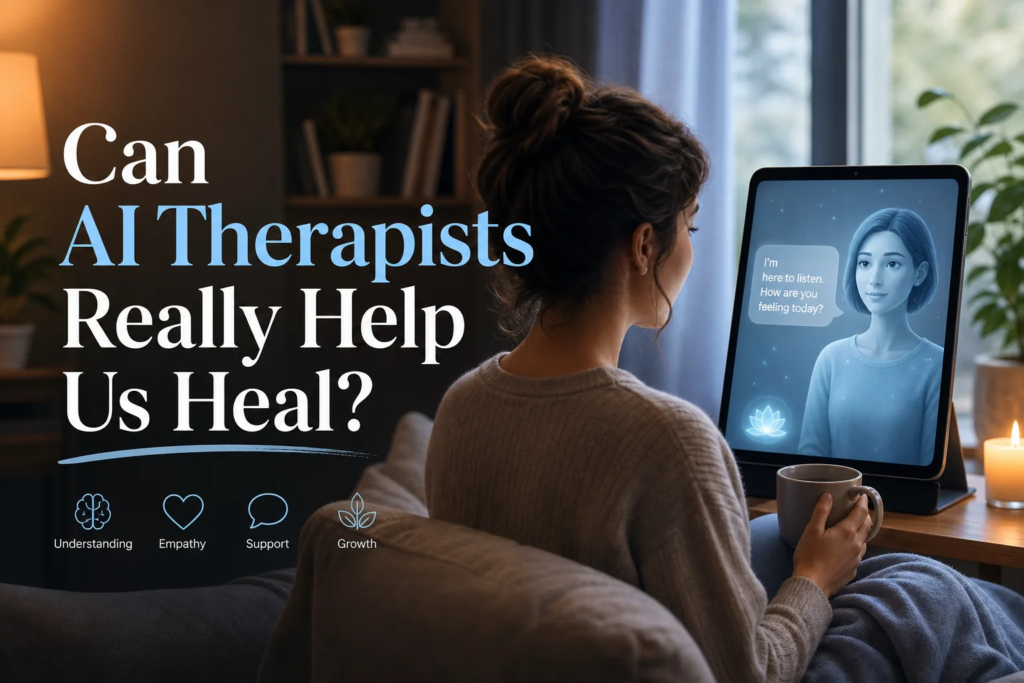
A person wakes at 2:13 a.m. with a racing heart. Their mind is looping through old regrets, fresh anxieties, and tomorrow’s impossible to-do list. A human therapist is not available at that hour. Friends are asleep. The emergency room feels too extreme. So they open an app and type: “I can’t calm down. Help.”
Within seconds, an AI mental health chatbot responds with grounding exercises, reflective questions, and a reminder to breathe. It doesn’t judge. It doesn’t sigh. It doesn’t rush. For the next 15 minutes, the person feels less alone.
That moment captures one of the biggest questions in modern mental health: Can AI Therapists Really Help Us Heal?
The answer is not a simple yes or no. AI therapists, therapy chatbots, and digital mental health tools are already helping many people manage stress, track moods, practice cognitive behavioral therapy techniques, and access support when traditional therapy is unavailable. But healing is not just symptom management. Healing involves trust, safety, human connection, ethical care, and sometimes medical intervention.
So, Can AI Therapists Really Help Us Heal? They can help—sometimes meaningfully—but they are not magic, and they are not a replacement for every kind of human care. The real opportunity is not choosing between humans and machines. It is learning how AI can support, extend, and improve mental health care without pretending to be something it is not.
Let’s explore where AI therapists shine, where they fall short, and what their rise means for the future of emotional healing.
What Do We Mean by “AI Therapists”?
Before asking Can AI Therapists Really Help Us Heal?, we need to define what an AI therapist actually is.
An AI therapist is usually not a licensed therapist. It is a software system designed to simulate aspects of therapeutic conversation or mental health support. These tools may use natural language processing, machine learning, scripted clinical frameworks, mood tracking, or large language models to interact with users.
Some AI therapy tools are simple and structured. They guide users through exercises like journaling, breathing, gratitude lists, or cognitive reframing. Others feel more conversational and respond dynamically to emotional language.
Common Types of AI Mental Health Tools
| Type of AI Tool | What It Does | Best For | Major Limitation |
|---|---|---|---|
| CBT chatbots | Guide users through cognitive behavioral therapy exercises | Anxiety, stress, negative thoughts | May miss complex trauma or crisis signals |
| Mood tracking apps | Track emotions, sleep, habits, triggers | Self-awareness and relapse prevention | Requires consistent user input |
| AI journaling tools | Prompt reflection and emotional processing | Daily emotional clarity | Not a substitute for therapeutic interpretation |
| Digital coaching apps | Offer motivation, coping tools, goal-setting | Mild stress and productivity challenges | May oversimplify deeper issues |
| Therapist-support AI | Helps clinicians summarize notes or monitor progress | Improving care efficiency | Privacy and accuracy concerns |
| Crisis-detection tools | Identify risk signals and suggest emergency resources | Safety triage | False positives or missed risk can be serious |
When people ask, Can AI Therapists Really Help Us Heal?, they are often asking several questions at once:
- Can a chatbot reduce anxiety?
- Can AI replace a therapist?
- Can digital tools understand grief, trauma, or depression?
- Can AI provide safe mental health support?
- Can technology create real emotional change?
The answer depends on the person, the problem, the tool, and the level of care required.
Why AI Therapy Is Growing So Quickly
The interest in AI therapy did not appear out of nowhere. It grew from a real and painful gap in mental health care.
Millions of people need help but cannot access it. Therapy can be expensive. Waitlists can stretch for months. In rural areas, qualified providers may be scarce. Some people fear stigma. Others have had poor experiences with therapists and hesitate to try again.
AI therapy tools promise something powerful: immediate, private, affordable support.
That promise is why the question Can AI Therapists Really Help Us Heal? matters so much. If these tools work even moderately well for certain people, they could reduce suffering on a large scale.
Why People Turn to AI Mental Health Support
| Reason | Why It Matters |
|---|---|
| Availability | AI tools can be accessed 24/7 |
| Cost | Many apps are cheaper than weekly therapy |
| Privacy | Users may feel safer opening up anonymously |
| Convenience | Support is available from home or phone |
| Low pressure | No need to schedule, commute, or speak aloud |
| Early intervention | People may seek help before problems worsen |
For someone with mild anxiety, insomnia, loneliness, or stress, an AI therapist may be the first step toward emotional self-care. For someone in crisis, however, AI must be treated very differently. Immediate human support is essential in emergencies.
Can AI Therapists Really Help Us Heal Emotionally?
The most honest answer is: AI therapists can support healing, but they do not heal us by themselves.
Healing is an active process. It requires awareness, emotional regulation, new behaviors, supportive relationships, and often professional guidance. AI can assist with some of these steps.
For example, AI can help users:
- Identify thought patterns
- Practice grounding techniques
- Track mood changes
- Build healthier routines
- Reflect on difficult emotions
- Prepare for human therapy sessions
- Learn coping skills between appointments
This is where AI therapists help us heal in a practical sense. They can create small moments of insight and regulation. Those small moments matter.
But healing also involves being deeply seen by another person. A skilled human therapist notices body language, silence, contradiction, avoidance, dissociation, and emotional nuance. They build a relationship over time. They hold ethical responsibility. They can coordinate care with physicians, psychiatrists, or family systems when needed.
AI can imitate empathy, but it does not experience empathy. It can generate supportive language, but it does not truly care. That distinction is important.
So, Can AI Therapists Really Help Us Heal? Yes, when used as tools. No, if we expect them to replace the full depth of human healing relationships.
The Science Behind AI Therapy: What Evidence Suggests
Research on digital mental health tools is growing. Some studies suggest that AI-guided interventions, especially those based on cognitive behavioral therapy, can reduce symptoms of anxiety and depression for certain users.
CBT is particularly suited to digital delivery because it is structured. It often involves identifying automatic thoughts, challenging distortions, and practicing new behaviors. An AI chatbot can guide users through these steps in a consistent way.
However, the evidence is still evolving. Many studies are small, short-term, or focused on specific populations. Not all AI therapy tools are clinically validated. Some wellness apps make bold claims without strong research behind them.
What Current Evidence Generally Supports
| Area | Evidence Strength | What AI May Help With |
|---|---|---|
| Mild to moderate anxiety | Moderate | Coping skills, reframing thoughts, relaxation |
| Mild depression symptoms | Moderate | Behavioral activation, mood tracking, journaling |
| Stress management | Stronger for structured tools | Breathing, planning, resilience exercises |
| Severe mental illness | Limited | May support monitoring but not replace care |
| Trauma therapy | Limited and sensitive | May assist grounding, but human care is usually needed |
| Crisis intervention | Not sufficient alone | Should redirect to emergency human support |
The evidence points to a balanced answer to Can AI Therapists Really Help Us Heal? AI can help with accessible, structured, skills-based support. But for severe, complex, or high-risk mental health conditions, AI should be part of a broader care system—not the system itself.
Case Study 1: Woebot and CBT-Based Support
Woebot is one of the best-known AI mental health chatbots. It was designed to use principles from cognitive behavioral therapy and conversational support to help users manage mood, stress, and anxious thoughts.
In early research involving college students, users who interacted with the chatbot over a short period reported reductions in symptoms of depression compared with certain control groups. The tool did not claim to be a human therapist. Instead, it functioned as a guided self-help companion.
Why This Case Matters
Woebot shows that the question Can AI Therapists Really Help Us Heal? should not be framed only around replacement. The more useful question is: Can AI help people practice therapeutic skills consistently?
For many users, the value of a CBT chatbot is not that it understands their entire life story. It is that it helps interrupt a spiral. It asks, “What evidence supports this thought?” or “Is there another way to view this situation?” That kind of prompt can be surprisingly powerful in the right moment.
Brief Analysis
This case is relevant because it demonstrates AI’s strength in structured therapeutic techniques. It also highlights the limitation: symptom reduction is not the same as deep psychotherapy. AI can assist with coping and reflection, but complex emotional healing often requires human support.
Case Study 2: Wysa and Workplace Mental Health
Wysa is another AI-powered mental health platform that uses chatbot support, self-help exercises, and optional human coaching. It has been used by individuals and organizations to support employee mental wellness.
In workplace settings, tools like Wysa can provide confidential support to employees who may not feel comfortable speaking with HR or managers about stress, burnout, or anxiety. Users can access exercises for sleep, worry, anger, grief, and self-esteem.
Why This Case Matters
Workplace stress is one of the reasons people ask, Can AI Therapists Really Help Us Heal? Many employees experience burnout long before they seek traditional therapy. AI mental health tools can act as an early support layer.
An employee who feels overwhelmed might use an AI chatbot to process a difficult meeting, calm down after criticism, or prepare for a conversation with a supervisor. This may not solve the root organizational problem, but it can reduce emotional escalation and encourage healthier coping.
Brief Analysis
This case shows how AI therapy can scale support in environments where human mental health services are limited. However, it also raises an ethical concern: companies should not use AI wellness tools as a substitute for fair workloads, humane management, or real benefits.
Case Study 3: Limbic and Digital Mental Health Triage
Limbic is a mental health technology company known for AI-supported assessment and triage tools. In some healthcare systems, AI tools have been used to help gather patient information, assess symptoms, and direct people toward appropriate services.
This use of AI is different from a chatbot pretending to be a therapist. It is more like an intelligent intake assistant. It helps organize information before a human clinician becomes involved.
Why This Case Matters
When asking Can AI Therapists Really Help Us Heal?, we should include behind-the-scenes AI. Sometimes the biggest benefit is not the chatbot conversation itself. It is faster access to the right kind of care.
AI triage can help identify whether someone may need low-intensity support, guided self-help, therapy, psychiatric evaluation, or urgent intervention. This can reduce wait times and make strained systems more efficient.
Brief Analysis
This case is relevant because it shows AI’s role in improving mental health infrastructure. Healing is not only about what happens in a session. It is also about whether people can find care before their symptoms worsen.
Case Study 4: AI Support Between Human Therapy Sessions
Consider a realistic composite example.
Maya, 34, is seeing a human therapist for anxiety and unresolved grief. Her sessions are helpful, but her hardest moments happen at night. Her therapist recommends a clinically informed AI journaling app for between-session support.
When Maya feels overwhelmed, she uses the app to identify emotions, write down thoughts, and practice grounding. The AI asks reflective questions such as, “What are you afraid would happen if you allowed yourself to feel this sadness?” and “What would you say to a friend in this situation?”
Maya brings these reflections to therapy. Her therapist helps her notice patterns and connect them to earlier experiences.
Why This Case Matters
This example answers Can AI Therapists Really Help Us Heal? in one of the most promising ways: AI can extend therapy beyond the weekly hour.
Many people leave therapy with insights but struggle to apply them in daily life. AI tools can provide reminders, exercises, and reflection prompts exactly when life becomes emotionally messy.
Brief Analysis
This case highlights the best hybrid model. The AI does not replace Maya’s therapist. It supports the therapeutic process. The human therapist provides depth, safety, interpretation, and relationship. The AI provides availability, structure, and continuity.
Where AI Therapists Are Most Helpful
AI therapists are strongest when the problem is specific, the intervention is structured, and the user is not in immediate danger.
Best Uses for AI Therapy Tools
| Situation | How AI Can Help |
|---|---|
| Mild anxiety | Thought reframing, breathing, exposure planning |
| Everyday stress | Grounding exercises, prioritization, emotional labeling |
| Sleep difficulties | Wind-down routines, worry logs, relaxation scripts |
| Negative self-talk | Cognitive restructuring and self-compassion prompts |
| Therapy homework | Reminders, journaling, habit tracking |
| Emotional check-ins | Mood patterns and trigger awareness |
| Loneliness | Nonjudgmental conversation and encouragement to seek connection |
This is why the phrase Can AI Therapists Really Help Us Heal? deserves a nuanced answer. In small but meaningful ways, AI can help people build emotional skills. These skills can accumulate into real change.
If a person learns to pause before panicking, challenge a harsh inner critic, or notice a recurring trigger, that matters. Healing is often built from repeated small acts of self-understanding.
Where AI Therapists Can Fall Short
The limitations are just as important as the benefits.
AI therapists can produce responses that sound confident but are inaccurate, generic, or inappropriate. They may fail to recognize risk. They may misunderstand cultural context. They may overvalidate harmful beliefs. They may give advice that does not fit the person’s actual situation.
Human therapists are trained not only to respond warmly but to assess complexity. They understand diagnosis, trauma responses, attachment patterns, family dynamics, medication interactions, and ethical boundaries. AI does not truly understand any of these in the human sense.
Major Risks and Limitations
| Risk | Why It Matters |
|---|---|
| Crisis mismanagement | AI may not respond adequately to self-harm or suicide risk |
| False empathy | Users may feel understood when the system is only generating text |
| Privacy concerns | Sensitive mental health data may be stored, shared, or analyzed |
| Lack of accountability | It may be unclear who is responsible when harm occurs |
| Bias | AI may reflect cultural, racial, gender, or socioeconomic biases |
| Overdependence | Users may avoid human relationships or professional care |
| Generic advice | Complex problems may receive oversimplified responses |
So, Can AI Therapists Really Help Us Heal? They can, but only if we are honest about what they cannot do.
The Human Connection Problem
Therapy is not just information. If information alone healed people, psychology books would cure everyone.
A major part of therapy is the therapeutic relationship. This relationship provides safety, attunement, repair, challenge, and trust. A good therapist does not simply say comforting things. They notice what is unsaid. They help clients tolerate discomfort. They challenge avoidance. They remember history. They adapt.
AI can simulate some features of this relationship. It can remember user preferences, respond warmly, and provide continuity. But it does not have lived presence. It does not feel concern. It does not experience moral responsibility.
For some users, that may not matter in the short term. In fact, some people disclose more easily to AI because they do not fear judgment. But for deeper healing, especially from relational wounds, human connection often remains essential.
That is one reason the question Can AI Therapists Really Help Us Heal? should not become “Can AI replace human therapists?” The better question is: How can AI support healing while preserving human connection?
Privacy: The Quiet Issue That Should Not Be Ignored
Mental health conversations are among the most sensitive forms of personal data. When someone tells an AI therapist about trauma, sexuality, addiction, self-harm, family conflict, or intrusive thoughts, that information must be protected.
Not every mental health app follows the same privacy standards. Some may collect usage data, share information with third parties, or use conversations to improve models. Even anonymized data can sometimes be vulnerable if mishandled.
Before using an AI therapy tool, users should ask:
- Who owns the data?
- Is the app compliant with relevant health privacy laws?
- Are conversations encrypted?
- Can data be deleted?
- Is human review involved?
- Is the tool intended for therapy, coaching, or wellness?
- What happens if crisis language is detected?
The question Can AI Therapists Really Help Us Heal? cannot be separated from trust. People cannot heal safely if their most vulnerable words become exploitable data.
AI Therapists and Crisis Situations
This point deserves clarity: AI therapy tools should not be relied upon as the only source of help during a crisis.
If someone is at immediate risk of harming themselves or someone else, they need emergency support from a human crisis service, emergency number, hospital, or trusted person nearby.
AI can provide crisis resources. It can encourage users to contact help. It can sometimes detect warning signs. But crisis care requires urgency, accountability, and human intervention.
When Human Help Is Essential
| Situation | Recommended Action |
|---|---|
| Suicidal intent or plan | Contact emergency services or a crisis hotline immediately |
| Self-harm risk | Reach out to crisis support, therapist, doctor, or trusted person |
| Psychosis or severe disorientation | Seek urgent medical care |
| Abuse or immediate danger | Contact emergency services or a local safety organization |
| Severe withdrawal or substance crisis | Seek medical support immediately |
| Inability to function | Contact a healthcare professional as soon as possible |
AI may be a bridge to care. It should not be the only lifeline.
Can AI Therapy Help People Who Avoid Traditional Therapy?
Yes, and this is one of the strongest arguments in favor of AI mental health tools.
Many people avoid therapy because they are embarrassed, skeptical, financially strained, or unsure whether their problems are “serious enough.” AI can lower the threshold for seeking help.
Someone might start with a chatbot and eventually realize they need a human therapist. Another person might use AI tools to learn emotional vocabulary before entering therapy. Someone else may use AI support during a long waitlist period.
In this sense, AI therapists can help us heal by making the first step less intimidating.
The “Stepping-Stone” Model
| Stage | User Need | AI Role |
|---|---|---|
| Awareness | “Something feels wrong.” | Mood tracking and reflection |
| Early coping | “I need tools.” | CBT exercises and grounding |
| Decision point | “Do I need therapy?” | Education and encouragement |
| Active therapy | “I need support between sessions.” | Journaling and homework |
| Maintenance | “I want to stay well.” | Habit tracking and relapse prevention |
This model makes the answer to Can AI Therapists Really Help Us Heal? more practical. AI may not be the destination. It may be the doorway.
The Role of AI in Expanding Access
Access is one of the most compelling reasons to take AI therapy seriously.
Traditional therapy is limited by geography, cost, insurance, scheduling, stigma, language, and clinician shortages. AI tools can reduce some of these barriers. A person in a remote town, a night-shift worker, or someone unable to afford weekly sessions may still access basic support.
That does not mean AI support is equal to therapy. But imperfect support may be better than no support—if it is safe, transparent, and appropriately designed.
The global mental health gap is enormous. There are not enough clinicians to meet demand. If AI can provide low-intensity support to people with mild needs, clinicians may have more capacity for complex cases.
So, Can AI Therapists Really Help Us Heal? On a population level, they may help by widening the front door to mental health care.
What Makes a Good AI Therapist Tool?
Not all AI therapy apps are created equal. Some are carefully designed with clinical input. Others are little more than chatbots with soothing language.
A trustworthy AI mental health tool should be transparent, evidence-informed, privacy-conscious, and clear about its limitations.
Checklist for Choosing an AI Therapy Tool
| Feature | Why It Matters |
|---|---|
| Clinical oversight | Mental health experts helped design the tool |
| Clear disclaimers | Users know it is not a licensed human therapist |
| Crisis protocols | The tool redirects high-risk users to urgent help |
| Privacy protections | Sensitive conversations are safeguarded |
| Evidence-based methods | Uses CBT, DBT skills, mindfulness, or validated approaches |
| Data control | Users can access or delete personal data |
| Bias testing | Developers evaluate fairness and safety |
| Human escalation | Option to connect with real support when needed |
If a tool claims it can treat everything, replace therapy, or guarantee healing, be cautious. Responsible AI tools do not overpromise.
AI Therapists vs. Human Therapists: A Balanced Comparison
The debate often becomes polarized. Some people imagine AI therapists as revolutionary healers. Others dismiss them as dangerous machines. Reality sits in the middle.
AI Therapists and Human Therapists Compared
| Factor | AI Therapist | Human Therapist |
|---|---|---|
| Availability | 24/7 | Limited by schedule |
| Cost | Often lower | Often higher |
| Emotional presence | Simulated | Real relational presence |
| Crisis accountability | Limited | Professional responsibility |
| Personalization | Data-driven but imperfect | Deep contextual understanding |
| Ethics | Depends on company design | Governed by licensure and professional codes |
| Best use | Skills, support, tracking | Deep healing, diagnosis, complex care |
| Limitations | No true empathy or clinical judgment | Access, cost, availability |
The best future may not be AI versus humans. It may be AI plus humans.
When people ask, Can AI Therapists Really Help Us Heal?, the most promising answer is found in collaboration. AI can handle reminders, exercises, journaling prompts, and basic psychoeducation. Human therapists can focus on relationship, insight, diagnosis, trauma work, and ethical care.
The Future: Hybrid Mental Health Care
Imagine a mental health system where AI helps with intake, scheduling, symptom monitoring, between-session support, and personalized exercises. Human therapists remain central, but they are supported by better tools.
A therapist might review mood trends before a session. A client might complete reflective exercises during the week. AI might detect that sleep is worsening and prompt the client to discuss it with their clinician. The therapist might use AI-generated summaries but verify them carefully.
This hybrid model could make therapy more continuous. Instead of one isolated hour per week, care could become an ongoing support system.
Possible Future Uses
| Future Use | Potential Benefit |
|---|---|
| Personalized coping plans | Tools adapt to user patterns |
| Early relapse detection | Mood and behavior changes trigger alerts |
| Multilingual support | More people access mental health tools |
| Therapist documentation help | Clinicians spend less time on paperwork |
| Skills practice simulations | Users rehearse difficult conversations |
| Preventive mental health care | Support begins before crisis |
The future of AI therapists helping us heal will depend on design choices made now. If companies prioritize profit over safety, harm is likely. If clinicians, ethicists, patients, and technologists collaborate, AI could become a meaningful support layer in mental health care.
Ethical Questions We Must Answer
AI therapy raises difficult ethical questions.
Who is responsible if an AI gives harmful advice? Should children use AI therapists? Can users form unhealthy attachments to chatbots? Should AI pretend to have emotions? How should systems handle abuse disclosures? Can companies monetize mental health data?
These questions are not side issues. They are central to whether AI therapy can be trusted.
Key Ethical Principles for AI Therapy
-
Transparency
Users should know they are interacting with AI, not a human. -
Safety
Crisis detection and escalation must be built in. -
Privacy
Mental health data should receive the highest protection. -
Clinical responsibility
Tools should be developed with qualified mental health professionals. -
Human dignity
AI should support human agency, not manipulate dependency. - Equity
Tools should work across cultures, languages, and identities.
If we want to answer Can AI Therapists Really Help Us Heal? with confidence, these ethical foundations must be non-negotiable.
The Emotional Paradox: Why People Open Up to Machines
One fascinating aspect of AI therapy is that some people feel safer talking to a machine than to a person.
Why? Because AI does not visibly react. It does not interrupt. It does not gossip. It does not appear disappointed. For users who carry shame, this can feel liberating.
A person may reveal thoughts to an AI therapist that they have never said aloud. That disclosure can be the beginning of healing. Naming pain is often powerful.
But there is a paradox. The same lack of human judgment also means a lack of human accountability. AI may receive a confession, but it cannot truly witness it. It may respond with compassion-like language, but it cannot share moral presence.
That is why Can AI Therapists Really Help Us Heal? is such a layered question. AI can help people start talking. Human relationships often help them fully process what those words mean.
Practical Ways to Use AI Therapy Safely
If you are curious about AI mental health tools, use them wisely.
Helpful Uses
- Use AI for journaling prompts.
- Practice CBT thought records.
- Track mood, sleep, and triggers.
- Prepare topics for therapy.
- Use grounding exercises during stress.
- Ask for psychoeducation about emotions.
- Create coping plans for predictable challenges.
Avoid Using AI As Your Only Support If:
- You are in crisis.
- You have active suicidal thoughts.
- You are experiencing hallucinations or delusions.
- You are in an abusive situation.
- You have severe depression or trauma symptoms.
- You need diagnosis, medication, or legal documentation.
- The advice feels unsafe or extreme.
AI can be a helpful companion, but it should not become your entire support system.
Long-Tail Keyword Variations Readers Search For
People interested in this topic often search for phrases like:
- Can AI therapy help us heal emotionally?
- Are AI therapists effective for anxiety?
- Can AI therapists replace human therapists?
- Is AI therapy safe for depression?
- How do AI mental health chatbots work?
- Benefits and risks of AI therapists
- AI therapist vs human therapist
- Can AI chatbots provide real emotional support?
- Are AI therapists good for mental health?
- Can AI Therapists Really Help Us Heal? in the future of therapy
These variations show that the public is not just curious about technology. People are searching for hope, relief, and trustworthy guidance.
Conclusion: So, Can AI Therapists Really Help Us Heal?
Can AI Therapists Really Help Us Heal? Yes—but not in the way a human therapist, loving relationship, medical team, or supportive community can.
AI therapists can help us pause, reflect, breathe, reframe, track, learn, and cope. They can offer support at midnight, during waitlists, between therapy sessions, or in moments when shame makes human conversation feel impossible. They can make mental health tools more accessible and less intimidating.
But AI cannot truly love, witness, diagnose, or ethically hold responsibility the way a trained human professional can. It cannot replace the healing power of safe relationships. It cannot manage serious crises alone. It cannot understand your life with the depth of a person who sits with you, remembers you, challenges you, and cares about what happens next.
The best answer is not blind optimism or fearful rejection. It is wise integration.
Use AI therapy tools as supports, not saviors. Let them help you build awareness, practice skills, and take the next step. But when pain is deep, risk is high, or healing requires real relationship, reach for human help.
The future of mental health may not be humans versus machines. It may be humans supported by machines—and people finally getting help sooner, more often, and with less shame.
That is a future worth building carefully.
1. Can AI Therapists Really Help Us Heal from anxiety?
AI therapists can help many people manage mild to moderate anxiety through breathing exercises, thought reframing, exposure planning, and grounding techniques. However, severe anxiety, panic disorder, trauma-related anxiety, or anxiety with suicidal thoughts should involve a licensed mental health professional.
2. Can AI therapists replace human therapists?
No. AI therapists can support mental health, but they should not fully replace human therapists. Human therapists provide clinical judgment, ethical responsibility, emotional presence, diagnosis, and deeper relational healing that AI cannot truly offer.
3. Is AI therapy safe?
AI therapy can be safe when the tool is well-designed, privacy-conscious, clinically informed, and clear about its limits. It is less safe when users rely on it during crises or when apps make exaggerated claims. Always check privacy policies and crisis support options.
4. Can AI therapy help with depression?
AI therapy tools may help with mild depressive symptoms by encouraging behavioral activation, journaling, mood tracking, and self-compassion. But moderate to severe depression requires professional care, especially if there are thoughts of self-harm or hopelessness.
5. What are the biggest risks of AI therapists?
The biggest risks include poor crisis response, privacy concerns, inaccurate advice, emotional overdependence, bias, and users delaying professional treatment. AI therapists should be used as support tools, not as the only source of care.
6. Are conversations with AI therapists private?
It depends on the platform. Some tools have strong privacy protections, while others may collect, store, or share data. Before using an AI therapist, read the privacy policy and check whether you can delete your data.
7. Who should avoid relying only on AI therapy?
People experiencing suicidal thoughts, psychosis, abuse, severe trauma symptoms, addiction crises, or major functional impairment should not rely only on AI therapy. In these cases, human professional support is essential.
8. What is the best way to use AI therapy?
The best way is to use AI therapy for skill-building, journaling, mood tracking, and support between human therapy sessions. Think of it as a mental health assistant—not a complete replacement for professional care.

