


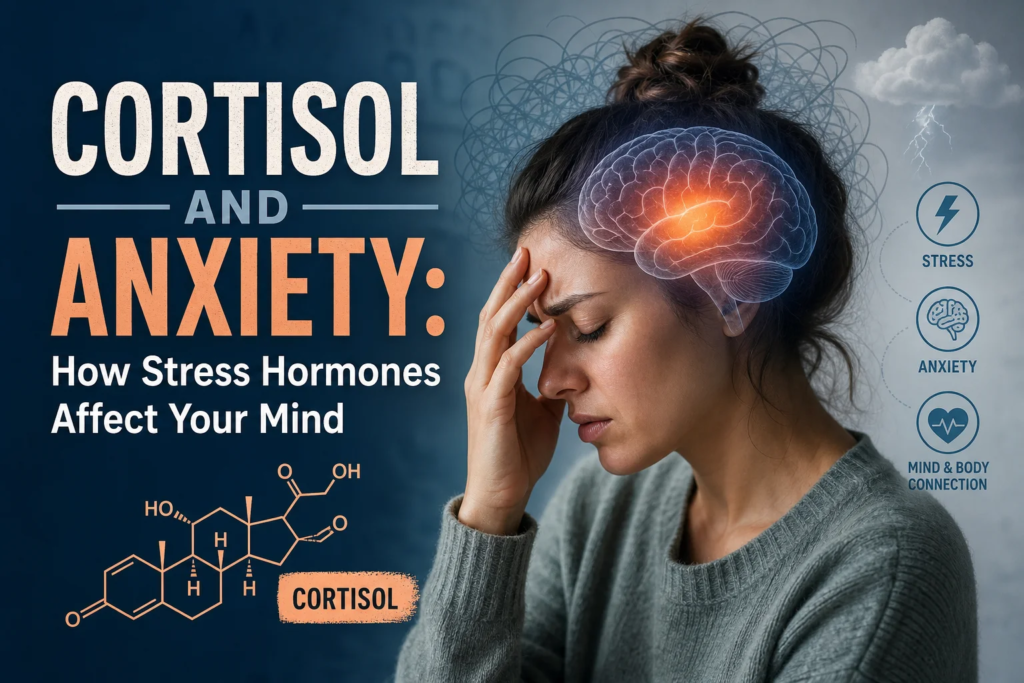
You know that feeling: your heart races, your thoughts speed up, your stomach tightens, and even a harmless email can feel like a threat. It is tempting to call it “just anxiety,” but beneath that experience is a powerful biological system designed to keep you alive.
That system is driven in part by cortisol, one of the body’s primary stress hormones.
Understanding Cortisol and Anxiety: How Stress Hormones Affect Your Mind can change the way you relate to stress. Instead of seeing anxiety as a personal weakness or mysterious emotional storm, you begin to see it as a mind-body signal. Your brain, nervous system, hormones, sleep, blood sugar, memories, and habits are all talking to each other.
The good news? Once you understand the cortisol-anxiety connection, you can work with your biology instead of fighting against it.
This in-depth guide explores Cortisol and Anxiety: How Stress Hormones Affect Your Mind, why stress hormones can make anxious thoughts feel more intense, how chronic stress reshapes mental patterns, and what practical steps can help you feel calmer, clearer, and more resilient.
Important note: This article is for educational purposes and is not a substitute for medical advice. If anxiety is severe, persistent, or interfering with your life, consider speaking with a licensed mental health professional or healthcare provider.
What Is Cortisol?
Cortisol is often called the “stress hormone,” but that nickname is a little unfair. Cortisol is not bad. In fact, you need it to survive.
Produced by the adrenal glands, cortisol helps regulate:
- Energy levels
- Blood pressure
- Blood sugar
- Immune response
- Inflammation
- Sleep-wake cycles
- Memory and attention
- The body’s response to stress
In healthy amounts, cortisol helps you wake up in the morning, focus during challenges, and respond quickly when something demands your attention.
The problem begins when cortisol stays elevated too often or spikes repeatedly without enough recovery. That is where the connection between cortisol and anxiety becomes especially important.
When people search for Cortisol and Anxiety: How Stress Hormones Affect Your Mind, they are often trying to understand why their thoughts feel out of control even when nothing obviously dangerous is happening. The answer lies partly in how cortisol changes brain activity.
The Stress Response: Your Body’s Internal Alarm System
To understand Cortisol and Anxiety: How Stress Hormones Affect Your Mind, it helps to look at the body’s stress response.
When your brain detects a threat, whether real or perceived, it activates the hypothalamic-pituitary-adrenal axis, commonly known as the HPA axis.
Here is the simplified process:
| Step | What Happens | Why It Matters |
|---|---|---|
| 1. Threat detected | The brain notices possible danger | This could be a predator, a deadline, conflict, or even an anxious thought |
| 2. Hypothalamus activates | It signals the pituitary gland | Your body prepares for action |
| 3. Pituitary gland responds | It releases ACTH | ACTH tells the adrenal glands to act |
| 4. Adrenal glands release cortisol | Cortisol enters the bloodstream | Energy, alertness, and vigilance increase |
| 5. Body prepares for survival | Heart rate, blood sugar, and attention shift | You become ready to fight, flee, freeze, or solve the problem |
This system is brilliant when the threat is short-term. If you need to slam the brakes to avoid a car accident, cortisol and adrenaline help you react quickly.
But modern life often activates the same system for non-physical threats: bills, social pressure, overwork, uncertainty, relationship tension, health worries, or endless notifications.
That is why Cortisol and Anxiety: How Stress Hormones Affect Your Mind is so relevant today. Many people are living with a survival system that rarely gets the message: “You are safe now.”
Cortisol’s Daily Rhythm: Why Timing Matters
Cortisol naturally follows a daily rhythm. It is usually highest in the morning and gradually declines throughout the day, reaching its lowest levels at night.
This rhythm helps you feel awake during the day and sleepy at night.
| Time of Day | Normal Cortisol Pattern | How You May Feel |
|---|---|---|
| Early morning | Cortisol rises sharply | More alert, ready to start the day |
| Midday | Cortisol begins to decline | Steady energy and focus |
| Late afternoon | Lower than morning | Energy may dip slightly |
| Evening | Cortisol should be low | Relaxed, winding down |
| Night | Lowest levels | Sleepy, restorative rest |
Problems can happen when this rhythm becomes disrupted.
For example:
- Cortisol may be too high at night, making it hard to sleep.
- Cortisol may spike early due to morning anxiety.
- Chronic stress may flatten the rhythm, leading to fatigue.
- Poor sleep can increase next-day cortisol and anxiety.
This is a key part of Cortisol and Anxiety: How Stress Hormones Affect Your Mind: anxiety is not only about thoughts. It is also about timing, sleep, hormones, and nervous system recovery.
How Cortisol Affects the Brain
Cortisol has a direct impact on several brain regions involved in anxiety.
1. The Amygdala: Your Threat Detector
The amygdala scans for danger. When cortisol is elevated, the amygdala can become more reactive. This means you may interpret neutral events as threatening.
A delayed text becomes rejection.
A work email becomes criticism.
A physical sensation becomes a health scare.
This is one of the most important lessons in Cortisol and Anxiety: How Stress Hormones Affect Your Mind: high cortisol can make the world feel more dangerous than it actually is.
2. The Prefrontal Cortex: Your Rational Control Center
The prefrontal cortex helps with planning, decision-making, impulse control, and perspective.
When stress hormones are high, the prefrontal cortex may become less effective. That is why it can be difficult to “just think logically” during anxiety.
You may know intellectually that you are safe, but your body does not believe it yet.
3. The Hippocampus: Memory and Context
The hippocampus helps you distinguish between past and present. Chronic cortisol exposure may affect hippocampal function, making it harder to place fears in context.
For example, someone who experienced workplace humiliation in the past may feel intense anxiety before every meeting, even if their current workplace is supportive.
The cortisol-anxiety cycle can keep old alarms active in new situations.
Cortisol and Anxiety: How Stress Hormones Affect Your Mind in Everyday Life
The phrase Cortisol and Anxiety: How Stress Hormones Affect Your Mind sounds scientific, but its effects are deeply personal.
You may notice cortisol-related anxiety as:
- Racing thoughts in the morning
- Trouble falling asleep
- Feeling “wired but tired”
- Irritability over small issues
- Difficulty concentrating
- Increased worry after caffeine
- Muscle tension
- Digestive discomfort
- Panic sensations
- Feeling emotionally reactive
- Overthinking conversations
- Needing constant reassurance
Cortisol does not create every form of anxiety by itself, but it can amplify anxious patterns. It turns up the volume on threat detection, body sensations, and mental urgency.
Acute Stress vs. Chronic Stress
Not all stress is harmful. Short bursts of stress can improve performance and focus. The real concern is chronic stress without recovery.
| Type of Stress | Cortisol Pattern | Possible Mental Effect |
|---|---|---|
| Acute stress | Temporary cortisol spike | Increased focus, energy, quick response |
| Recovered stress | Cortisol rises then returns to baseline | Healthy adaptation |
| Chronic stress | Repeated or prolonged elevation | Anxiety, sleep problems, irritability, fatigue |
| Burnout pattern | Dysregulated cortisol rhythm | Exhaustion, brain fog, low motivation |
Acute stress says, “Handle this challenge.”
Chronic stress says, “Stay on alert all the time.”
That ongoing alertness is central to Cortisol and Anxiety: How Stress Hormones Affect Your Mind. Anxiety often becomes persistent when the nervous system does not get enough signals of safety and recovery.
Why Anxiety Can Feel Worse in the Morning
Many people wake up anxious and wonder, “Why am I panicking before anything has even happened?”
One reason is the cortisol awakening response. Cortisol naturally rises in the first 30 to 45 minutes after waking. For some people, especially those under chronic stress, this rise feels intense.
Morning anxiety may include:
- A racing heart
- Dread about the day
- Nausea
- Urgency to check messages
- Catastrophic thoughts
- Restlessness
This does not mean something is wrong with you. It may mean your stress system is starting the day too aggressively.
In the context of Cortisol and Anxiety: How Stress Hormones Affect Your Mind, morning anxiety is a clear example of how biology can shape emotion before conscious thinking even begins.
The Cortisol-Anxiety Loop
Cortisol and anxiety can feed each other.
- Stress increases cortisol.
- Cortisol increases alertness and threat sensitivity.
- Threat sensitivity increases anxious thoughts.
- Anxious thoughts signal more danger to the body.
- The body releases more stress hormones.
This loop can make anxiety feel self-sustaining.
Here is a simple chart:
| Trigger | Body Response | Mind Response | Result |
|---|---|---|---|
| Work deadline | Cortisol rises | “I can’t handle this” | More stress |
| Social uncertainty | Heart rate increases | “They must be upset with me” | Reassurance seeking |
| Poor sleep | Cortisol rhythm disrupted | “Something is wrong” | More worry |
| Caffeine | Physical arousal increases | “Am I having a panic attack?” | Anxiety spike |
| Conflict | Stress hormones rise | “This relationship is unsafe” | Emotional reactivity |
Breaking this cycle requires both mental and physical strategies. That is why Cortisol and Anxiety: How Stress Hormones Affect Your Mind should never be reduced to “think positive.” The body must be included.
Case Study 1: The High-Performing Manager With Morning Dread
Profile:
“Rachel,” a 38-year-old marketing manager, was successful, organized, and respected at work. But every morning she woke up with a tight chest and a sense of dread. She checked email before getting out of bed and often skipped breakfast. By 10 a.m., she had already consumed two coffees and felt shaky.
She believed her anxiety meant she was not strong enough for leadership.
What was happening:
Rachel’s cortisol was likely rising naturally in the morning, but her habits intensified the stress response. Immediate email checking exposed her brain to demands before she had established a sense of control. Caffeine on an empty stomach increased physical arousal, which her mind interpreted as anxiety.
Changes she made:
- Delayed email for 30 minutes after waking
- Ate a protein-rich breakfast
- Swapped her second coffee for herbal tea
- Practiced five minutes of slow breathing before work
- Scheduled her hardest task after planning, not immediately after waking
Outcome:
Within several weeks, Rachel reported less morning dread and fewer anxious spirals.
Analysis:
This case illustrates Cortisol and Anxiety: How Stress Hormones Affect Your Mind because Rachel’s anxiety was not only psychological. Her morning routine was repeatedly telling her body, “Danger starts now.” Small changes helped retrain her stress system.
Case Study 2: The College Student With Panic Before Exams
Profile:
“Daniel,” a 21-year-old student, experienced panic symptoms before exams: sweating, a pounding heart, dizziness, and fear of blanking out. He studied hard but slept only five hours a night during exam weeks.
What was happening:
Daniel’s body associated exams with threat. Sleep deprivation increased stress sensitivity, while pressure to perform activated cortisol and adrenaline. His physical symptoms scared him, creating a panic loop.
Changes he made:
- Stopped all-night study sessions
- Used spaced repetition instead of cramming
- Practiced mock exams under timed conditions
- Learned to label panic symptoms as “stress energy”
- Used breathing techniques before entering the exam room
Outcome:
His symptoms did not disappear completely, but they became manageable. His confidence improved because he no longer feared the sensations as much.
Analysis:
Daniel’s story shows how Cortisol and Anxiety: How Stress Hormones Affect Your Mind applies to performance pressure. Cortisol can sharpen focus in moderation, but when paired with sleep loss and fear of symptoms, it can push the mind into panic.
Case Study 3: The New Parent Who Could Not Relax
Profile:
“Maya,” a 33-year-old new parent, felt constantly on edge after having her first baby. Even when the baby slept, Maya could not rest. She listened for every sound and felt guilty if she took time for herself.
What was happening:
Parenthood naturally increases vigilance. Sleep disruption, hormonal shifts, responsibility, and reduced personal recovery time can all affect stress hormones. Maya’s nervous system had adapted to constant monitoring.
Changes she made:
- Created shared night duties with her partner
- Took short daylight walks
- Accepted help from family twice a week
- Practiced “safe rest” periods while another adult watched the baby
- Spoke with her doctor about postpartum anxiety
Outcome:
With support and treatment, Maya gradually felt less hypervigilant.
Analysis:
This case highlights Cortisol and Anxiety: How Stress Hormones Affect Your Mind in a caregiving context. Anxiety can be intensified by real responsibility and lack of rest. Support is not a luxury; it is biological recovery.
Can High Cortisol Cause Anxiety?
High cortisol can contribute to anxiety, but the relationship is not always simple.
Anxiety may be influenced by:
- Genetics
- Trauma history
- Current stress
- Sleep quality
- Medical conditions
- Substance use
- Caffeine intake
- Blood sugar instability
- Hormonal changes
- Learned thought patterns
- Social environment
Cortisol is one major piece of the puzzle.
Some people with anxiety may have elevated cortisol. Others may have a disrupted rhythm rather than consistently high levels. In long-term burnout, cortisol patterns may become blunted or irregular.
So, when discussing Cortisol and Anxiety: How Stress Hormones Affect Your Mind, the best question is not always, “Is my cortisol high?” A better question is, “Is my stress system regulated?”
Signs Your Stress System May Be Overactivated
You cannot diagnose cortisol imbalance based only on symptoms, but certain patterns may suggest chronic stress activation.
| Possible Sign | What It May Indicate |
|---|---|
| Waking with dread | Strong morning stress response |
| Afternoon crashes | Energy regulation issues |
| Anxiety after caffeine | Sensitivity to stimulation |
| Trouble falling asleep | Evening cortisol or rumination |
| Frequent irritability | Nervous system overload |
| Craving sugar or salt | Stress-related appetite shifts |
| Brain fog | Poor recovery or sleep disruption |
| Muscle tension | Chronic fight-or-flight activation |
| Digestive issues | Stress-gut connection |
| Feeling unable to relax | Hypervigilance |
If these symptoms are persistent, it may be worth discussing them with a healthcare provider.
The Sleep-Cortisol-Anxiety Triangle
Sleep may be the most underrated factor in Cortisol and Anxiety: How Stress Hormones Affect Your Mind.
Poor sleep can increase cortisol the next day. Elevated cortisol can make sleep harder. Anxiety can interfere with both.
This creates a triangle:
| Problem | Effect on Cortisol | Effect on Anxiety |
|---|---|---|
| Short sleep | May increase stress hormone activity | More emotional reactivity |
| Irregular sleep schedule | Disrupts circadian rhythm | More morning anxiety |
| Late-night screen use | Delays melatonin, stimulates alertness | More rumination |
| Nighttime worrying | Keeps body activated | Harder to fall asleep |
| Alcohol before bed | Disrupts sleep quality | More next-day anxiety |
Improving sleep is not always easy, especially for people with anxiety. But even small changes can help regulate cortisol rhythms.
Helpful steps include:
- Wake up at a consistent time
- Get morning sunlight
- Reduce bright light at night
- Avoid intense work right before bed
- Keep caffeine earlier in the day
- Create a wind-down ritual
- Write worries down before bedtime
Sleep teaches the nervous system that it is safe to recover.
Blood Sugar, Cortisol, and Anxiety
Blood sugar swings can mimic or worsen anxiety symptoms. When blood sugar drops, the body may release cortisol and adrenaline to help restore energy. This can cause shakiness, sweating, irritability, and a racing heart.
Many people mistake these sensations for pure anxiety.
A more stable eating pattern may help some people reduce stress-related anxiety.
| Habit | Potential Benefit |
|---|---|
| Eating protein at breakfast | Supports steadier energy |
| Avoiding excessive sugar alone | Reduces blood sugar spikes and crashes |
| Pairing carbs with protein/fat | Slows glucose absorption |
| Staying hydrated | Supports physical regulation |
| Limiting caffeine on an empty stomach | Reduces jitteriness |
This is another overlooked part of Cortisol and Anxiety: How Stress Hormones Affect Your Mind. Sometimes calming the mind starts with feeding the body consistently.
Caffeine: Friend, Foe, or Trigger?
Caffeine increases alertness, but it can also increase physical sensations that resemble anxiety: faster heart rate, restlessness, stomach discomfort, and racing thoughts.
For some people, caffeine is harmless in moderation. For others, especially those prone to panic, it can be a major trigger.
If you are exploring Cortisol and Anxiety: How Stress Hormones Affect Your Mind, consider tracking your caffeine response.
Ask yourself:
- Do I feel more anxious after coffee?
- Do I drink caffeine before eating?
- Do I rely on caffeine after poor sleep?
- Does caffeine affect my sleep?
- Do I feel calmer on lower-caffeine days?
You may not need to eliminate caffeine completely. But adjusting timing and dosage can make a noticeable difference.
Exercise and Cortisol: The Dose Matters
Exercise is one of the best tools for anxiety regulation, but intensity matters.
Moderate exercise can reduce stress, improve mood, support sleep, and help metabolize stress hormones. However, excessive high-intensity training without recovery can add more stress to an already overloaded system.
| Exercise Type | Potential Effect |
|---|---|
| Walking | Calming, accessible, supports cortisol rhythm |
| Strength training | Builds resilience and confidence |
| Yoga or stretching | Activates relaxation pathways |
| High-intensity intervals | Useful in moderation, may be overstimulating for some |
| Outdoor movement | Adds benefits of sunlight and nature |
For people learning about Cortisol and Anxiety: How Stress Hormones Affect Your Mind, the goal is not punishment. The goal is regulation.
A 20-minute walk can be more therapeutic than an exhausting workout if your nervous system is already overwhelmed.
The Gut-Brain-Stress Connection
The gut and brain communicate constantly through nerves, hormones, immune signals, and the microbiome. Stress can affect digestion, and digestive discomfort can increase anxiety.
Cortisol may influence gut motility, inflammation, and sensitivity. That is why anxiety often comes with nausea, bloating, cramps, or changes in appetite.
This connection deepens our understanding of Cortisol and Anxiety: How Stress Hormones Affect Your Mind. Your mind is not floating separately from your body. Emotional distress can show up in the gut, muscles, heart, skin, and immune system.
Supportive habits include:
- Eating slowly
- Maintaining regular meals
- Staying hydrated
- Managing caffeine and alcohol
- Including fiber-rich foods if tolerated
- Seeking medical advice for persistent digestive symptoms
Trauma, Cortisol, and Hypervigilance
For people with trauma histories, the stress system may become especially sensitive. The brain learns from past danger and may stay alert to prevent future harm.
This can lead to hypervigilance, emotional flashbacks, exaggerated startle responses, and difficulty trusting safety.
In trauma-related anxiety, the concept of Cortisol and Anxiety: How Stress Hormones Affect Your Mind becomes even more complex. It is not just about daily stress; it is about a nervous system shaped by experience.
Trauma-informed therapy may help by teaching the body and brain to recognize present safety. Approaches may include cognitive behavioral therapy, EMDR, somatic therapies, mindfulness-based strategies, and other evidence-informed treatments.
The key message: trauma responses are adaptations, not character flaws.
How to Lower Stress Hormone Overload Naturally
You cannot control cortisol directly like a light switch, but you can influence the systems that regulate it.
1. Use Slow Breathing
Slow breathing signals safety to the nervous system.
Try this:
- Inhale for 4 seconds
- Exhale for 6 seconds
- Repeat for 3 to 5 minutes
Longer exhales can help shift the body toward a calmer state.
2. Get Morning Light
Morning sunlight helps regulate circadian rhythm, which supports healthy cortisol timing.
Even 5 to 15 minutes outdoors can help, depending on weather and light exposure.
3. Build Recovery Breaks Into the Day
Waiting until vacation to recover is not enough. Your nervous system needs daily signals of safety.
Examples:
- A quiet lunch without scrolling
- A short walk
- Stretching between meetings
- Listening to calming music
- Taking three slow breaths before replying to a stressful message
4. Reduce “Threat Stacking”
Threat stacking happens when multiple stress inputs pile up: poor sleep, caffeine, skipped meals, intense work, conflict, and doomscrolling.
You may not be able to remove all stress, but you can reduce unnecessary stress inputs.
5. Practice Cognitive Reframing
Cortisol may make anxious thoughts feel urgent. Reframing helps restore perspective.
Instead of: “I can’t handle this.”
Try: “This is stressful, but I can take the next step.”
Instead of: “Something is wrong with me.”
Try: “My stress system is activated. I can help it settle.”
This approach is central to Cortisol and Anxiety: How Stress Hormones Affect Your Mind because it respects both biology and mindset.
Practical Cortisol-Calming Toolkit
Here is a quick-reference table of strategies.
| Strategy | Best Time to Use | Why It Helps |
|---|---|---|
| Morning sunlight | Within 1 hour of waking | Supports cortisol rhythm |
| Protein breakfast | Morning | Stabilizes energy |
| Slow breathing | During anxiety spikes | Signals safety |
| Walking | Morning or afternoon | Burns stress energy gently |
| Journaling | Evening or during worry | Externalizes thoughts |
| Caffeine boundaries | Before noon for many people | Protects sleep and reduces jitters |
| Digital sunset | 30-60 minutes before bed | Reduces stimulation |
| Social support | During chronic stress | Lowers perceived threat |
| Therapy | Persistent anxiety | Builds long-term regulation skills |
When to Consider Cortisol Testing
Some people wonder whether they should test cortisol levels. Cortisol can be measured through blood, saliva, or urine, depending on the clinical question.
Testing may be considered if a healthcare provider suspects conditions such as Cushing’s syndrome, Addison’s disease, adrenal disorders, or other endocrine issues.
However, routine cortisol testing is not always necessary for everyday anxiety. Cortisol changes throughout the day, and results can be difficult to interpret without medical context.
If you are concerned about Cortisol and Anxiety: How Stress Hormones Affect Your Mind, speak with a qualified professional rather than relying on at-home interpretations alone.
Seek medical advice if you have symptoms such as:
- Unexplained weight changes
- Severe fatigue
- Muscle weakness
- Easy bruising
- Very high or low blood pressure
- Fainting
- Persistent panic attacks
- Depression or thoughts of self-harm
The Mindset Shift: Anxiety Is a Signal, Not an Enemy
One of the most empowering insights from Cortisol and Anxiety: How Stress Hormones Affect Your Mind is this: anxiety is information.
It may be telling you:
- You need rest
- You need boundaries
- You need support
- You need nourishment
- You need safety
- You need to process old pain
- You need to reduce overload
- You need professional care
Anxiety becomes more frightening when we treat it as an enemy. It becomes more workable when we treat it as a signal from a body trying to protect us.
That does not mean anxiety is always accurate. The alarm can be too loud. But the alarm is still trying to help.
Cortisol and Anxiety: How Stress Hormones Affect Your Mind at Work
Work is one of the most common sources of chronic cortisol activation.
Common workplace stressors include:
- Unclear expectations
- High workload
- Lack of control
- Conflict with colleagues
- Fear of criticism
- Job insecurity
- Constant notifications
- No recovery between tasks
To reduce workplace anxiety, try:
- Starting the day with planning instead of reacting
- Turning off non-essential notifications
- Taking microbreaks between meetings
- Clarifying priorities with managers
- Using written task lists to reduce mental load
- Setting communication boundaries when possible
In workplace settings, Cortisol and Anxiety: How Stress Hormones Affect Your Mind is not just a personal wellness topic. It is also a leadership issue. Healthy work cultures reduce unnecessary threat signals.
Cortisol and Anxiety in Relationships
Relationship stress can strongly activate cortisol because humans are wired for connection. Conflict, rejection, abandonment fears, or emotional uncertainty can feel threatening to the nervous system.
Signs of cortisol-driven relationship anxiety may include:
- Overanalyzing messages
- Feeling panicked during conflict
- Needing immediate reassurance
- Shutting down emotionally
- Becoming defensive quickly
- Feeling unable to sleep after an argument
Helpful practices include:
- Pausing before responding during conflict
- Naming your body state: “I’m activated right now”
- Returning to hard conversations after calming down
- Practicing secure communication
- Seeking couples therapy when patterns repeat
Understanding Cortisol and Anxiety: How Stress Hormones Affect Your Mind can make relationships more compassionate. Sometimes the argument is not just about the topic. It is about two nervous systems trying to feel safe.
The Role of Therapy and Professional Support
Self-care matters, but it is not always enough. Therapy can help you understand and change the patterns that keep anxiety alive.
Evidence-informed approaches for anxiety may include:
- Cognitive behavioral therapy
- Acceptance and commitment therapy
- Exposure therapy
- Mindfulness-based cognitive therapy
- EMDR for trauma-related symptoms
- Somatic and body-based therapies
- Medication when appropriate
A therapist can help you identify triggers, challenge anxious beliefs, build coping skills, and gradually teach your nervous system that discomfort is not always danger.
In the bigger picture of Cortisol and Anxiety: How Stress Hormones Affect Your Mind, professional support can help bridge the gap between knowing what to do and actually feeling safe enough to do it.
Common Myths About Cortisol and Anxiety
Myth 1: Cortisol is always bad.
Cortisol is essential. The goal is not zero cortisol. The goal is healthy regulation.
Myth 2: Anxiety is purely mental.
Anxiety involves thoughts, but also hormones, nerves, muscles, breathing, digestion, and memory.
Myth 3: You can fix cortisol with one supplement.
No supplement replaces sleep, nutrition, movement, emotional support, and medical care when needed.
Myth 4: Calm people have no stress.
Resilient people still experience stress. They recover more effectively.
Myth 5: If you understand anxiety, it should disappear.
Understanding helps, but the nervous system learns through repeated safety experiences, not logic alone.
These myths matter because Cortisol and Anxiety: How Stress Hormones Affect Your Mind is often oversimplified online. Real healing is usually gradual, practical, and personalized.
A 7-Day Reset Plan for Cortisol and Anxiety
Here is a simple plan to begin regulating your stress system.
| Day | Focus | Action |
|---|---|---|
| Day 1 | Awareness | Track anxiety, sleep, caffeine, meals, and stress triggers |
| Day 2 | Morning rhythm | Get sunlight and delay phone checking for 20 minutes |
| Day 3 | Blood sugar | Eat a balanced breakfast with protein |
| Day 4 | Breathing | Practice slow breathing for 5 minutes twice |
| Day 5 | Movement | Take a 20-minute walk |
| Day 6 | Evening calm | Create a 30-minute screen-light wind-down |
| Day 7 | Reflection | Notice what helped and choose two habits to continue |
This plan will not solve every anxiety issue in one week, but it can create momentum. Small signals of safety, repeated consistently, can shift the stress response over time.
Conclusion: Your Stress System Can Learn Safety Again
Cortisol and Anxiety: How Stress Hormones Affect Your Mind is more than a scientific topic. It is a practical roadmap for understanding why anxiety feels so real, so physical, and sometimes so hard to control.
Cortisol helps you respond to challenges, but when stress becomes chronic, it can make your brain more threat-sensitive, disrupt sleep, intensify worry, and keep your body stuck in survival mode.
The hopeful truth is that your nervous system is adaptable.
You can support healthier cortisol patterns through sleep, sunlight, balanced meals, movement, breathing, boundaries, therapy, connection, and recovery. You do not need to “defeat” anxiety overnight. You can begin by sending your body small, consistent messages of safety.
Start with one habit. Take one walk. Breathe through one anxious moment. Delay one stressful notification. Ask for one form of support.
Your mind is not broken. Your body is trying to protect you. And with patience, practice, and the right tools, it can learn to feel safe again.
1. Can cortisol directly cause anxiety?
Cortisol can contribute to anxiety by increasing alertness, threat sensitivity, and physical arousal. However, anxiety usually has multiple causes, including genetics, life stress, trauma, sleep, health conditions, and thought patterns.
2. How do I know if my cortisol is high?
Symptoms such as morning anxiety, poor sleep, irritability, fatigue, and feeling wired but tired may suggest stress system dysregulation, but they do not prove high cortisol. A healthcare provider can determine whether testing is appropriate.
3. Why is my anxiety worse in the morning?
Morning anxiety may be related to the cortisol awakening response, poor sleep, blood sugar changes, or immediate exposure to stressors like phone notifications. A calmer morning routine can help reduce the intensity.
4. What lowers cortisol naturally?
Helpful strategies include consistent sleep, morning sunlight, moderate exercise, slow breathing, balanced meals, social support, relaxation practices, and reducing unnecessary stress inputs. Professional therapy can also support long-term regulation.
5. Does caffeine increase cortisol and anxiety?
Caffeine can increase alertness and may worsen anxiety symptoms in sensitive people. It can also interfere with sleep, which may affect cortisol regulation. Reducing caffeine or drinking it after food may help.
6. Is exercise good or bad for cortisol?
Exercise is generally beneficial for stress regulation. Moderate movement, walking, yoga, and strength training can help anxiety. However, excessive intense exercise without recovery may add stress for some people.
7. Can therapy help with cortisol-related anxiety?
Yes. Therapy can help reduce anxiety triggers, change fear-based thought patterns, process trauma, and teach the nervous system new responses. While therapy does not “control cortisol” directly, it can improve overall stress regulation.
8. What is the fastest way to calm stress hormones during anxiety?
Try slow breathing with a longer exhale, grounding through your senses, relaxing your shoulders and jaw, taking a short walk, or reminding yourself: “This is my stress response. It will pass.” If panic or anxiety is frequent, seek professional support.

