


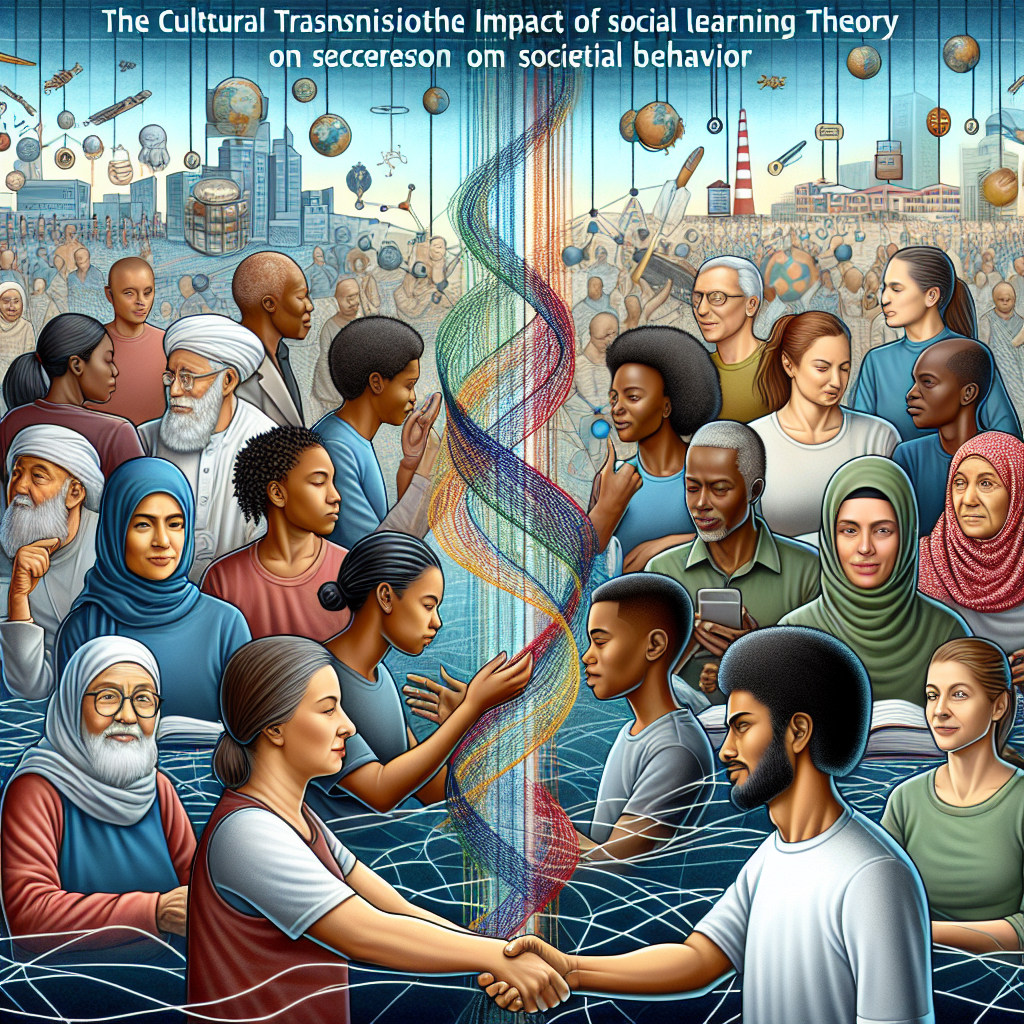
Unraveling Cultural Transmission: The Ultimate Impact of Social Learning Theory on Societal Behavior
Introduction
In a world interconnected more than ever, understanding how cultural transmission shapes societal behavior is vital. The way we learn from one another—through observation, imitation, and modeling—has profound implications on everything from social norms to economic behaviors. This article dives deep into Cultural Transmission: The Impact of Social Learning Theory on Societal Behavior, exploring how social learning shapes our interactions, beliefs, and communities.
Social learning theory, first proposed by Albert Bandura, emphasizes that much of what we learn occurs in a social context rather than through direct experience. This article will shed light on the mechanics of social learning and its rippling effects through society.
The Foundation of Social Learning Theory
Understanding the Basics
At its core, social learning theory posits that individuals learn behaviors, values, and norms by observing others. This theory underscores several key components:
- Attention: A learner must pay attention to the model demonstrating the behavior.
- Retention: The learner must remember the behavior that was observed.
- Reproduction: The learner must be able to reproduce the behavior.
- Motivation: The desire to replicate the behavior, often influenced by the observed consequences.
This framework provides an essential lens through which we can view education, parenting, and even criminal behavior.
Case Study: Bandura’s Bobo Doll Experiment
Albert Bandura’s Bobo Doll experiment in the 1960s remains a seminal study in demonstrating social learning. Children were shown a video of an adult behaving aggressively toward a Bobo doll. When given a chance to interact with the doll afterward, those children were more likely to exhibit similar aggressive behaviors.
Relevance: This experiment illustrates how observational learning notably affects children’s behavior and lays the foundation for understanding cultural transmission’s complexities.
How Cultural Transmission Shapes Societal Norms
The Role of Media
In an age dominated by screens, media plays an essential role in cultural transmission. Social learning occurs not only among peers but also through media representations of behaviors, norms, and values.
- Example: When popular television shows portray certain lifestyles as desirable, viewers may emulate behaviors they see, thereby reflecting the media’s influence on social norms and expectations.
Here’s an illustrative table that presents various media types and their societal impacts:
| Media Type | Type of Content | Societal Impact |
|---|---|---|
| Television | Family dynamics | Normalization of specific family structures |
| Social Media | Trends and influencers | Rapid spread of fashion and lifestyle trends |
| News Media | Coverage of social issues | Shaping public perception and behavior towards issues |
The Role of Peer Groups
Peer influence is another critical facet of cultural transmission. A child’s behavior in a social setting often reflects group norms rather than individual choices.
- Example: In adolescent friendships, peer pressure can lead to both positive behaviors—such as academic achievement—and negative ones, such as delinquency.
Through peer influence, behaviors are swiftly transmitted, demonstrating how cultural norms arise within social clusters.
The Interplay Between Culture and Environment
Culture’s Influence on Behavior
Cultural context can often dictate which behaviors are learned or modeled. For example, collectivist cultures—where group harmony is prioritized—may promote different behaviors than individualist societies that prioritize personal achievement.
- Case Study: The shift in attitudes towards smoking across different countries exemplifies cultural influence. As health campaigns successfully altered perceptions in places like the United States, the cultural acceptability of smoking declined significantly.
Environment and Availability
Social learning also relies on environmental factors. For instance, if individuals are surrounded by peers who engage in healthy eating, they’re more likely to adopt similar dietary habits.
Chart: Environmental Influences on Behavior Adoption
| Environment Type | Behavior Adoption |
|---|---|
| Urban Areas | Acceptance of diverse lifestyles |
| Rural Areas | Traditional cultural norms |
| Family Settings | Reinforcement of familial behaviors |
The Impact of Cultural Transmission on Economic Behavior
Imitation in Economic Practices
Social learning influences not just social behaviors but economic choices as well. Behavioral economics examines how cultural trends can impact spending, saving, and even investment behaviors.
- Case Study: The 2008 financial crisis saw a cascade of mimetic behaviors in consumer spending. As concerns about economic stability spread, individuals began saving rather than spending, demonstrating how collective behavior can pivot based on social observation.
The impact is profound; cultural trends around spending can lead to significant economic outcomes.
Bridging the Gap: Social Learning and Educational Settings
Learning Through Observation in Schools
In educational settings, social learning theory plays a vital role. Students observe both teachers and fellow classmates, profoundly influencing their academic and social behaviors.
- Example: Peer tutoring programs often harness social learning, enabling students to model behaviors for one another, leading to both academic and social skill enhancement.
Table: Educational Models Utilizing Social Learning Theory
| Model | Description | Benefits |
|---|---|---|
| Peer Tutoring | Students teach each other | Enhances understanding and retention |
| Cooperative Learning | Group projects where students rely on teamwork | Promotes social skills and collaboration |
The Dynamics of Cultural Transmission in Diverse Societies
Cultural Integration
As societies become increasingly multicultural, the dynamics of cultural transmission also evolve. Individuals draw from various cultural contexts, leading to hybrid behaviors.
- Case Study: The United States is a melting pot of cultural influences, leading to unique societal behaviors. The adoption of diverse culinary traditions is an example of cultural integration enriching societal practices.
Cultural Conflicts
While hybrid behaviors can enhance societal dynamics, they can also lead to cultural conflicts. Social learning theory explains how diverging cultural norms can create tensions between groups.
- Example: In urban environments, clashes may arise between contrasting cultural perspectives, showcasing the necessity for dialogue and understanding in culturally diverse settings.
Diagram: Cultural Interaction Dynamics
| plaintext +————————-+ |
Cultural A | ↗ | |
|---|---|---|---|
| +————–> | |||
| Cultural B | |||
| (Hybrid Behavior) |
+———————–+
Conclusion
Cultural transmission, underpinned by social learning theory, profoundly shapes societal behavior. From the norms we adopt to our economic choices, understanding this process is essential for fostering healthier communities and adapting to cultural changes. As we embrace the influence of one another, acknowledging the complexities and opportunities inherent in cultural transmission is vital for individual and societal growth.
The actionable insights derived from this exploration suggest that by consciously modeling positive behaviors and engaging in open cultural dialogues, we can create a more cohesive society that values diversity and inclusivity.
FAQs
1. What is cultural transmission?
Cultural transmission refers to the process through which cultural norms, values, and behaviors are passed from one individual to another, often through observation and imitation.
2. How does social learning theory differ from direct learning?
Social learning theory emphasizes learning through observing others, whereas direct learning involves experiential learning and personal trial-and-error.
3. What are some real-life applications of social learning theory?
Real-life applications include education systems, therapeutic settings, and public health campaigns, where modeling behaviors positively influences individuals.
4. Can cultural transmission occur without social learning?
Cultural transmission primarily relies on social learning processes, though some elements, like genetic predispositions or environmental factors, may also play a role.
5. How can understanding cultural transmission help in diverse workplaces?
Understanding cultural transmission can foster inclusivity and encourage positive behaviors that respect diverse perspectives, enhancing collaboration and productivity in the workplace.
By investigating and championing the principles surrounding Cultural Transmission: The Impact of Social Learning Theory on Societal Behavior, we can harness its vast potential for positive societal change. Let us commit to being aware of the influences around us and strive to lead by example.


The PsyForU Editorial Collective is the research and editorial team of PsyForU Research International. The collective prepares educational, psychological, mental-health-awareness, inclusion, neurodiversity, and research-methodology content for students, parents, educators, researchers, and general readers. PsyForU content is intended for awareness, education, and capacity-building and should not be treated as clinical diagnosis, therapy, medical advice, legal advice, or emergency mental-health support.