


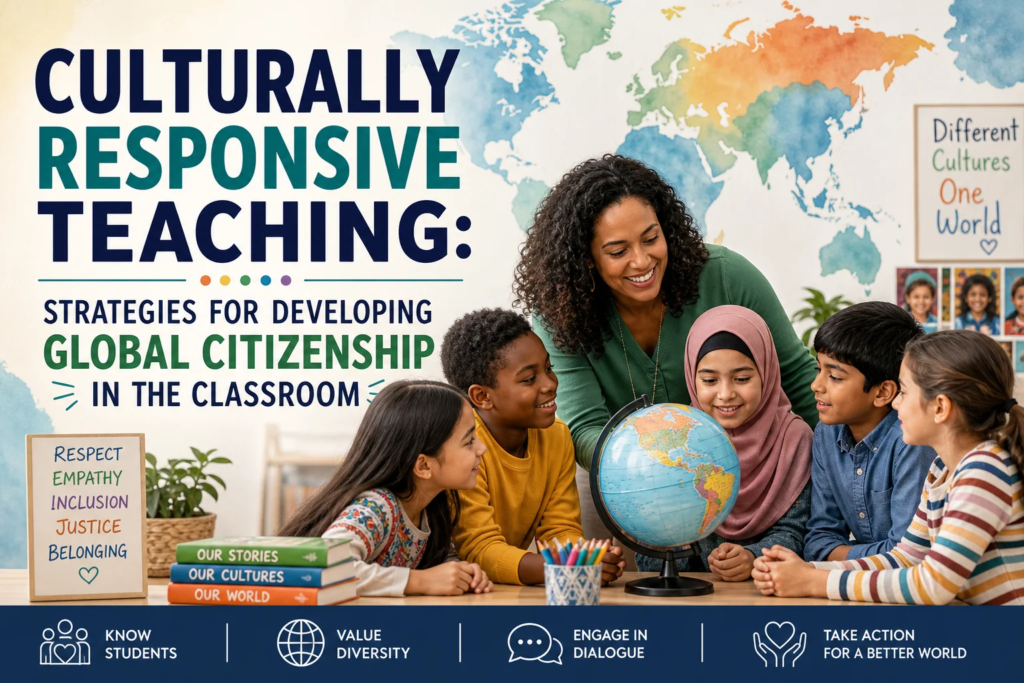
Introduction: Why Global Citizenship Begins With Belonging
A student walks into class carrying more than a backpack. They bring language, family stories, cultural traditions, community values, lived experiences, questions about identity, and hopes for the future. Too often, traditional schooling asks students to leave parts of themselves at the classroom door. But the most powerful learning happens when students are invited to bring their full selves into the room.
That is where Culturally Responsive Teaching: Strategies for Developing Global Citizenship in the Classroom becomes essential.
In a world shaped by migration, climate change, digital connection, economic interdependence, and social justice movements, students need more than academic knowledge. They need empathy, critical thinking, intercultural communication, ethical awareness, and the ability to collaborate across differences. These are not “extra” skills. They are survival skills for the 21st century.
Culturally Responsive Teaching: Strategies for Developing Global Citizenship in the Classroom is about helping students understand who they are, respect who others are, and recognize their responsibility to the wider world. It connects identity with inquiry, culture with curriculum, and classroom learning with real-world action.
At its best, culturally responsive teaching does not simply celebrate diversity with food festivals or heritage months. It transforms how educators design lessons, build relationships, assess learning, and prepare students to participate meaningfully in a diverse democracy and interconnected planet.
This article explores practical, research-informed, and classroom-tested approaches to Culturally Responsive Teaching: Strategies for Developing Global Citizenship in the Classroom, with case studies, tables, and actionable ideas teachers can use immediately.
What Is Culturally Responsive Teaching?
Culturally responsive teaching is an educational approach that recognizes students’ cultural backgrounds as assets rather than obstacles. It uses students’ identities, languages, experiences, and community knowledge as bridges to academic learning.
In simple terms, culturally responsive teaching asks:
- Who are my students?
- What cultural strengths do they bring?
- Whose voices are centered in the curriculum?
- Who feels seen, heard, and valued?
- How can learning help students understand and improve the world?
When connected to global citizenship, culturally responsive teaching becomes even more powerful. Culturally Responsive Teaching: Strategies for Developing Global Citizenship in the Classroom helps students move from self-awareness to social awareness, and from classroom learning to responsible action.
Key Principles of Culturally Responsive Teaching
| Principle | What It Means | Classroom Example |
|---|---|---|
| Cultural affirmation | Students’ identities are respected and valued | Including texts by authors from students’ communities |
| High expectations | All students are challenged academically | Using rigorous tasks with appropriate scaffolds |
| Critical consciousness | Students examine power, fairness, and justice | Analyzing whose perspectives are missing in history |
| Relationship-centered learning | Trust is foundational | Learning student names, stories, and interests |
| Asset-based instruction | Students’ backgrounds are strengths | Using multilingual skills as learning resources |
| Real-world connection | Learning links to life beyond school | Designing projects about local and global issues |
These principles are the foundation of culturally responsive teaching for global citizenship because students cannot become thoughtful global citizens if they first learn that their own identity does not matter.
What Is Global Citizenship in the Classroom?
Global citizenship is not about replacing local or national identity. Instead, it helps students understand that they belong to multiple communities: family, neighborhood, nation, and world.
A global citizen:
- Respects cultural differences
- Understands global systems and interdependence
- Thinks critically about injustice
- Communicates across cultures
- Takes responsible action
- Values human dignity
- Recognizes environmental responsibility
In schools, global citizenship education should not be limited to social studies. It belongs in literature, science, mathematics, art, language learning, technology, and even physical education.
For example:
- In science, students can study climate change impacts in different regions.
- In math, they can analyze global income inequality data.
- In literature, they can read novels from multiple cultural perspectives.
- In art, they can explore how communities express resistance, memory, and hope.
- In technology, they can examine digital citizenship and media bias.
This is why Culturally Responsive Teaching: Strategies for Developing Global Citizenship in the Classroom is not a single lesson plan. It is a mindset and a framework for designing meaningful education.
Why Culturally Responsive Teaching and Global Citizenship Belong Together
Culturally responsive teaching and global citizenship education are often discussed separately, but they are deeply connected.
Culturally responsive teaching begins with students’ identities. Global citizenship expands outward to include the identities and experiences of others. Together, they create a learning environment where students can ask:
- Who am I?
- Who are we?
- How are we connected?
- What responsibilities do we have to one another?
- How can we act with courage and compassion?
Without cultural responsiveness, global citizenship can become shallow. Students may learn about “other cultures” in ways that feel distant, stereotypical, or exotic. Without global citizenship, culturally responsive teaching can become limited to representation without action.
The strongest approach combines both.
The Connection at a Glance
| Culturally Responsive Teaching | Global Citizenship Education | Combined Impact |
|---|---|---|
| Centers student identity | Builds global awareness | Students understand self and others |
| Uses culture as an asset | Encourages intercultural respect | Students value diverse perspectives |
| Promotes critical thinking | Examines global issues | Students analyze injustice locally and globally |
| Builds belonging | Builds responsibility | Students feel empowered to contribute |
| Connects learning to life | Connects local and global realities | Students see themselves as change agents |
This is the heart of Culturally Responsive Teaching: Strategies for Developing Global Citizenship in the Classroom: students learn that their voices matter and that their choices affect others.
Strategy 1: Build a Classroom Culture of Belonging First
Before students can engage deeply with complex global issues, they need to feel emotionally and intellectually safe. Belonging is not a decorative classroom poster. It is a daily practice.
Students are more likely to participate, take academic risks, and consider unfamiliar perspectives when they feel respected. A culturally responsive classroom begins with intentional relationship-building.
Practical Ways to Build Belonging
- Pronounce students’ names correctly and consistently.
- Invite students to share identity stories in ways that feel safe.
- Use community circles or check-ins.
- Create classroom agreements collaboratively.
- Display multilingual and multicultural materials.
- Avoid putting students on the spot as “representatives” of a group.
- Learn about local community histories.
- Communicate with families in accessible and respectful ways.
A powerful first-week activity is the “identity map.” Students create a visual map of words, symbols, languages, places, interests, values, and communities that shape who they are. Then, rather than using the activity as a one-time icebreaker, teachers return to these maps throughout the year as connections emerge in literature, history, science, or current events.
This is a simple but effective example of Culturally Responsive Teaching: Strategies for Developing Global Citizenship in the Classroom because it helps students see identity as complex, layered, and connected to larger social realities.
Strategy 2: Audit the Curriculum for Representation and Perspective
One of the most important steps in culturally responsive global learning is examining whose knowledge counts.
A curriculum may include “diverse” content but still center only one worldview. For example, a history unit on exploration might celebrate European explorers while ignoring Indigenous perspectives. A literature course may include authors of color but only during units on oppression. A global studies class may discuss poverty in other countries without exploring resilience, innovation, or local leadership.
A culturally responsive curriculum asks deeper questions.
Curriculum Audit Questions
| Question | Why It Matters |
|---|---|
| Whose voices are centered? | Students notice who is treated as important |
| Whose voices are missing? | Absence teaches as much as presence |
| Are cultures shown as dynamic or static? | Avoids stereotypes and simplistic portrayals |
| Are communities shown only through struggle? | Prevents deficit-based narratives |
| Do students see people like themselves as thinkers and leaders? | Builds academic identity |
| Are global issues connected to local realities? | Makes learning relevant and actionable |
A strong curriculum for Culturally Responsive Teaching: Strategies for Developing Global Citizenship in the Classroom includes mirrors, windows, and doors. Mirrors help students see themselves. Windows help them understand others. Doors invite them to step into action.
Strategy 3: Teach Culture as Dynamic, Not Decorative
One common mistake in multicultural education is reducing culture to food, clothing, holidays, and flags. These can be meaningful entry points, but they are not enough.
Culture includes communication styles, concepts of family, relationships with land, spiritual traditions, humor, conflict resolution, storytelling, values, migration histories, and ideas about success.
When educators teach culture as dynamic, students learn that no community is one-dimensional. They also learn to avoid stereotypes.
For example, instead of asking students to create a poster about “Japanese culture,” a teacher might ask:
- How do different generations in Japan think about tradition and technology?
- How has urbanization changed family life?
- How do Japanese artists respond to environmental concerns?
- What similarities and differences exist between youth culture in Japan and our community?
This approach reflects culturally responsive teaching strategies for developing global citizenship because it promotes complexity, curiosity, and respect.
Strategy 4: Use Inquiry-Based Learning Around Global Questions
Global citizenship grows when students investigate meaningful questions rather than memorize isolated facts.
Inquiry-based learning encourages students to ask questions, examine evidence, compare perspectives, and develop informed conclusions. It works especially well with culturally responsive teaching because students can connect big questions to their own lives.
Examples of Global Inquiry Questions
| Subject | Inquiry Question |
|---|---|
| English Language Arts | How do stories help communities preserve memory? |
| Science | Who is most affected by climate change, and why? |
| Math | What can data reveal about global inequality? |
| Social Studies | How do borders shape identity and opportunity? |
| Art | How do artists challenge injustice? |
| Technology | How does social media connect and divide people? |
| Health | Why do health outcomes differ across communities? |
Inquiry turns Culturally Responsive Teaching: Strategies for Developing Global Citizenship in the Classroom into active learning. Students are not passive recipients of information. They become researchers, thinkers, and problem-solvers.
Strategy 5: Connect Local Issues to Global Systems
One of the best ways to make global citizenship meaningful is to begin locally.
Students may feel overwhelmed by global challenges like climate change, migration, war, poverty, or discrimination. But when they see how these issues connect to their own community, learning becomes more concrete.
For instance:
- A local water quality issue can connect to global conversations about environmental justice.
- A neighborhood food desert can connect to global food systems.
- A family migration story can connect to refugee policy and human rights.
- A local labor issue can connect to global supply chains.
- A school recycling program can connect to sustainability movements worldwide.
This local-global connection is central to Culturally Responsive Teaching: Strategies for Developing Global Citizenship in the Classroom because it shows students that global citizenship is not abstract. It begins where they are.
Local-to-Global Planning Chart
| Local Topic | Global Connection | Student Action |
|---|---|---|
| School lunch waste | Food insecurity and sustainability | Conduct waste audit and propose solutions |
| Community air quality | Climate justice | Map pollution sources and write policy letters |
| Family languages | Language preservation | Create multilingual storytelling project |
| Local housing costs | Urbanization and inequality | Interview community members and analyze data |
| School dress codes | Identity and cultural expression | Facilitate student forum and policy review |
Case Study 1: A Middle School Climate Justice Project
At a diverse urban middle school, eighth-grade science and social studies teachers collaborated on a unit about climate change. Instead of teaching climate change only as a scientific concept, they framed it through the question: “Why are some communities more vulnerable to climate change than others?”
Students studied greenhouse gases, rising sea levels, heat islands, and extreme weather. They also examined maps showing how low-income communities and communities of color often experience higher pollution levels and less access to green space.
Students interviewed family members about changes they had noticed in local weather patterns. Some students shared stories of relatives affected by hurricanes in Puerto Rico, flooding in Bangladesh, drought in Somalia, and wildfires in California. The classroom became a space where personal knowledge deepened scientific understanding.
For their final project, students created climate justice action proposals. One group designed a plan for more trees around the school. Another produced multilingual infographics about heat safety. A third wrote letters to city officials requesting safer cooling centers.
Analysis
This case demonstrates Culturally Responsive Teaching: Strategies for Developing Global Citizenship in the Classroom because it connects science, identity, community knowledge, and civic action. Students learned that climate change is not only an environmental issue but also a justice issue. They also saw themselves as capable contributors to local and global solutions.
Strategy 6: Use Multilingualism as a Superpower
Language is one of the most powerful cultural resources students bring to school. Yet multilingual students are often treated as if their home languages are barriers rather than assets.
A culturally responsive global citizenship classroom values multilingualism as intellectual strength.
Teachers can:
- Invite students to use home languages during brainstorming.
- Provide bilingual glossaries.
- Encourage translanguaging when appropriate.
- Include texts in multiple languages.
- Invite families to contribute oral histories or cultural knowledge.
- Compare how different languages express certain concepts.
- Teach students about language rights and linguistic diversity.
For example, in a unit about human rights, students might investigate which rights are protected in different languages and how translation shapes meaning. In literature, students might compare poems written in Spanish, Arabic, Mandarin, or Yoruba with English translations.
This approach supports Culturally Responsive Teaching: Strategies for Developing Global Citizenship in the Classroom because language becomes a bridge to identity, empathy, and global awareness.
Strategy 7: Teach Students to Analyze Bias and Single Stories
Author Chimamanda Ngozi Adichie famously warned about “the danger of a single story.” In classrooms, single stories appear when entire countries, cultures, or communities are presented through one narrow narrative.
For example:
- Africa is shown only through poverty.
- Indigenous peoples are discussed only in the past tense.
- Immigrants are framed only as struggling newcomers.
- Muslim communities are associated only with conflict.
- Rural communities are portrayed as backward.
- Wealthy nations are presented as always advanced or benevolent.
Global citizenship requires students to question these narratives.
Bias Analysis Questions for Students
- Who created this source?
- What perspective is included?
- What perspective is missing?
- What words or images shape my emotions?
- Is this community shown with dignity and complexity?
- What historical context do I need?
- How might someone from that community respond?
Teaching students to analyze bias is an essential part of Culturally Responsive Teaching: Strategies for Developing Global Citizenship in the Classroom because it helps them become thoughtful consumers of media, history, and public debate.
Case Study 2: Reframing a World Literature Unit
A high school English teacher noticed that her “global literature” unit included powerful books, but most of them focused on war, trauma, or oppression. Students were learning about suffering around the world, but not enough about joy, creativity, humor, family, resistance, or everyday life.
She redesigned the unit around the theme “How do people create meaning in changing worlds?”
Students read short stories, poems, and essays from Nigeria, Korea, Mexico, Palestine, India, Haiti, and the United States. The teacher paired texts about hardship with texts about celebration, love, music, and community. Students also selected independent reading books by authors from cultures connected to their own backgrounds or interests.
For the final assignment, students created a “global literary conversation,” connecting three authors across regions and explaining how each explored identity, change, and belonging.
Analysis
This case shows culturally responsive teaching for global citizenship because it avoids reducing communities to pain. Students encountered global voices as complex, creative, and fully human. The redesigned unit supported empathy without pity and analysis without stereotyping.
Strategy 8: Create Structured Opportunities for Dialogue
Global citizenship depends on the ability to talk across differences. However, meaningful dialogue does not happen automatically. Teachers must structure it carefully.
Students need norms, sentence stems, listening skills, and reflection routines.
Dialogue Norms That Support Global Citizenship
| Norm | Student-Friendly Meaning |
|---|---|
| Listen to understand | Don’t just wait to reply |
| Speak from “I” | Share your experience without claiming everyone’s |
| Ask before assuming | Curiosity is better than judgment |
| Disagree with care | Challenge ideas, not people |
| Notice power | Who speaks most? Who is interrupted? |
| Make room | Step up if quiet, step back if dominant |
Dialogue is especially important in Culturally Responsive Teaching: Strategies for Developing Global Citizenship in the Classroom because students need practice discussing identity, culture, justice, and global issues respectfully.
Useful dialogue formats include:
- Socratic seminars
- Restorative circles
- Philosophical chairs
- Fishbowl discussions
- Structured academic controversy
- Peer interviews
- Community panels
The goal is not to force agreement. The goal is to build understanding, humility, and skillful communication.
Strategy 9: Design Assessments That Value Multiple Ways of Showing Knowledge
Traditional assessments often privilege one narrow way of demonstrating intelligence: written responses in standardized academic English under time pressure. While academic writing is important, culturally responsive assessment gives students multiple pathways to show deep understanding.
Students might demonstrate learning through:
- Research essays
- Oral presentations
- Podcasts
- Visual art
- Digital storytelling
- Community interviews
- Data dashboards
- Policy proposals
- Multilingual projects
- Public exhibitions
This does not mean lowering expectations. It means widening the doors to rigorous thinking.
Assessment Options for Global Citizenship Projects
| Product | Skills Demonstrated | Example |
|---|---|---|
| Podcast | Research, speaking, storytelling | Interviewing immigrants about belonging |
| Data visualization | Quantitative reasoning | Mapping water access disparities |
| Policy brief | Argumentation, evidence | Proposing school sustainability changes |
| Documentary | Media literacy, collaboration | Exploring local cultural histories |
| Multilingual poem | Language, identity, creativity | Writing about home and migration |
| Public exhibition | Civic communication | Presenting solutions to community members |
Assessment is a crucial element of Culturally Responsive Teaching: Strategies for Developing Global Citizenship in the Classroom because what teachers assess tells students what the school values.
Strategy 10: Include Families and Communities as Knowledge Partners
Families and communities are not just support systems for school. They are sources of knowledge.
Culturally responsive global citizenship education becomes stronger when teachers invite community expertise into the curriculum.
This might include:
- Family oral history projects
- Community walking tours
- Guest speakers from local organizations
- Interviews with elders
- Partnerships with cultural centers
- Collaboration with environmental groups
- Student-led community research
- Local business or labor history projects
A teacher does not need to know everything about every culture represented in the classroom. In fact, assuming the role of expert can be risky. Instead, teachers can become facilitators who respectfully connect classroom learning with community knowledge.
This is a powerful form of Culturally Responsive Teaching: Strategies for Developing Global Citizenship in the Classroom because students learn that knowledge lives not only in textbooks but also in neighborhoods, families, languages, traditions, and lived experience.
Case Study 3: Family History and Migration Mapping
In a fifth-grade classroom, students were studying migration. The teacher wanted to avoid presenting migration only through maps and textbook definitions. She invited students to explore migration as a human experience, while making participation flexible for students whose family histories involved trauma, displacement, adoption, or limited information.
Students could choose one of several options:
- Interview a family member about a move.
- Research a historical migration.
- Write about moving schools or neighborhoods.
- Create a fictional story based on research.
- Map the journey of a food, song, or tradition.
The class created a large “movement map” showing personal, historical, and cultural journeys. Students discussed reasons people move: safety, work, education, family, climate, conflict, curiosity, and hope.
Analysis
This example of Culturally Responsive Teaching: Strategies for Developing Global Citizenship in the Classroom honored student identity while avoiding pressure to disclose sensitive family stories. It connected personal experience to global patterns and helped students develop empathy for migrants and refugees.
Strategy 11: Teach Critical Hope, Not Despair
Global citizenship education often deals with difficult topics: racism, war, poverty, climate crisis, colonization, human rights violations, and inequality. Students need honesty, but they also need hope.
Critical hope is different from shallow optimism. It does not say, “Everything will be fine.” It says, “The world has real problems, and people have always worked to change them.”
Teachers can build critical hope by including examples of:
- Youth activism
- Community organizing
- Scientific innovation
- Indigenous environmental leadership
- Peacebuilding movements
- Human rights campaigns
- Mutual aid networks
- Artists and writers who inspire change
When teaching global challenges, pair problems with people working on solutions. This keeps students from feeling helpless.
A classroom committed to Culturally Responsive Teaching: Strategies for Developing Global Citizenship in the Classroom helps students understand injustice while also recognizing agency.
Strategy 12: Use Technology to Build Authentic Global Connections
Technology can expand students’ worlds, but only when used thoughtfully. Watching videos about another country is not the same as building meaningful intercultural understanding.
Teachers can use technology for:
- Virtual exchanges with classrooms in other regions
- Collaborative online projects
- Digital museum visits
- International guest speakers
- Global data exploration
- Student blogs or digital portfolios
- Media literacy investigations
However, digital global learning must include preparation. Students need to learn respectful communication, privacy, consent, and cultural humility.
For example, before a virtual exchange, students can research the partner community, generate thoughtful questions, and discuss what makes a question respectful or intrusive. Afterward, they can reflect on what surprised them, what assumptions changed, and what they still want to understand.
This is a modern application of Culturally Responsive Teaching: Strategies for Developing Global Citizenship in the Classroom because it blends digital citizenship with intercultural learning.
Case Study 4: A Virtual Exchange Between Classrooms
A rural classroom in the United States partnered with a classroom in Kenya for a shared project on water. Rather than beginning with assumptions about scarcity, both classes investigated water access, usage, conservation, and cultural practices in their own communities.
Students exchanged short videos showing local water sources, family conservation habits, and community concerns. The U.S. students discussed agricultural water use and drought. The Kenyan students discussed rainfall patterns, water storage, and local innovation.
Together, students compared data and created posters titled “Water Challenges, Water Wisdom.” They learned that both communities had knowledge to share.
Analysis
This case highlights culturally responsive global learning because it avoided a charity mindset. Students did not study another community as helpless. Instead, they engaged in mutual learning. This is exactly what Culturally Responsive Teaching: Strategies for Developing Global Citizenship in the Classroom should do: promote dignity, reciprocity, and shared problem-solving.
Strategy 13: Move From Celebration to Transformation
Celebrating diversity matters. Students should experience joy, music, art, language, and cultural pride in school. But celebration alone is not enough.
Transformational culturally responsive teaching changes power relationships in the classroom. It asks students not only to appreciate culture but also to examine fairness and participate in change.
From Surface-Level to Transformational Practice
| Surface-Level Practice | Transformational Practice |
|---|---|
| International food day | Study food systems, labor, migration, and family traditions |
| Cultural dress day | Discuss identity, stereotypes, and self-expression |
| Famous heroes poster | Examine movements, communities, and collective action |
| Holiday lesson | Explore history, meaning, variation, and lived practice |
| Diversity quote on wall | Build daily routines for equity and student voice |
This distinction is vital to Culturally Responsive Teaching: Strategies for Developing Global Citizenship in the Classroom because global citizenship requires more than appreciation. It requires understanding, responsibility, and action.
Strategy 14: Support Teacher Self-Reflection and Cultural Humility
Teachers cannot practice culturally responsive teaching effectively without examining their own identities, assumptions, and biases.
Cultural humility means recognizing that we are always learning. It requires educators to ask:
- What cultural norms shape my teaching?
- Which behaviors do I interpret negatively, and why?
- Do I mistake difference for deficiency?
- Whose communication styles do I reward?
- Which students do I call on most?
- How do my materials represent the world?
- When have I avoided difficult conversations?
This reflection is not about guilt. It is about professional growth.
A teacher committed to Culturally Responsive Teaching: Strategies for Developing Global Citizenship in the Classroom models the same openness, curiosity, and accountability expected from students.
Strategy 15: Build Student Agency Through Action Projects
Global citizenship becomes real when students move from learning to action. Action projects help students apply knowledge to authentic problems.
Effective action projects should be:
- Student-centered
- Research-based
- Connected to community needs
- Realistic in scope
- Collaborative
- Reflective
- Ethically designed
Examples include:
- Creating multilingual public health materials
- Designing a school composting system
- Hosting a community storytelling night
- Producing a podcast on local immigrant experiences
- Advocating for accessible playground equipment
- Creating an anti-bias media campaign
- Developing a student guide to sustainable fashion
- Partnering with local elders to preserve oral histories
Action Project Planning Template
| Step | Guiding Question |
|---|---|
| Identify issue | What problem matters to us and our community? |
| Research | What do we need to understand before acting? |
| Listen | Who is affected, and what do they say they need? |
| Plan | What action is realistic and respectful? |
| Act | How will we implement our idea? |
| Reflect | What changed in our thinking and community? |
| Share | How can others learn from our work? |
Action projects are among the most effective global citizenship classroom strategies because they teach students that knowledge carries responsibility.
Common Challenges and How to Address Them
Implementing Culturally Responsive Teaching: Strategies for Developing Global Citizenship in the Classroom can feel challenging, especially in schools with limited time, rigid curriculum requirements, or political tension. But teachers do not have to transform everything overnight.
Challenge 1: “I don’t have enough time.”
Start by revising existing lessons rather than adding new units. Replace one text, add one missing perspective, or connect one topic to a global issue.
Challenge 2: “I’m afraid of saying the wrong thing.”
Mistakes happen. Cultural humility means being willing to listen, apologize, learn, and adjust. Avoiding the work entirely causes more harm.
Challenge 3: “My curriculum is standardized.”
Even within required standards, teachers can choose examples, questions, texts, discussion formats, and assessment options that support culturally responsive global citizenship.
Challenge 4: “Families may disagree.”
Communicate clearly. Emphasize that the goal is not political indoctrination but respect, critical thinking, empathy, and preparation for a diverse world.
Challenge 5: “Students may make insensitive comments.”
Treat these moments as learning opportunities. Set norms early, interrupt harm, ask reflective questions, and guide students toward more accurate and respectful understanding.
A Practical Framework for Implementation
Teachers can begin with a simple four-part framework: identity, perspective, connection, and action.
| Stage | Teacher Focus | Student Experience |
|---|---|---|
| Identity | Who are my students? | I feel seen and valued |
| Perspective | Whose voices are included? | I learn from multiple viewpoints |
| Connection | How does this relate locally and globally? | I understand interdependence |
| Action | What can we do with this learning? | I contribute meaningfully |
This framework makes Culturally Responsive Teaching: Strategies for Developing Global Citizenship in the Classroom manageable. It can guide a single lesson, a unit, or an entire school year.
Sample Lesson Flow: Culturally Responsive Global Citizenship in Action
Here is a sample structure for a unit on water justice.
Unit Question
Who has access to clean water, and what responsibilities do communities have to protect it?
Lesson Sequence
| Lesson | Activity | Culturally Responsive Element | Global Citizenship Element |
|---|---|---|---|
| 1 | Students share water memories or local observations | Connects to lived experience | Begins with local awareness |
| 2 | Study water cycle and pollution science | Builds academic knowledge | Shows environmental systems |
| 3 | Analyze global water access data | Uses evidence | Develops global awareness |
| 4 | Read stories from affected communities | Centers human voices | Builds empathy |
| 5 | Investigate local water concerns | Community-based learning | Connects local and global |
| 6 | Design action project | Student agency | Civic responsibility |
| 7 | Present findings publicly | Authentic audience | Meaningful participation |
This type of unit embodies Culturally Responsive Teaching: Strategies for Developing Global Citizenship in the Classroom because it blends identity, science, justice, and action.
Long-Tail Keyword Variations for Contextual SEO
Educators, curriculum writers, and school leaders often search for related terms when looking for guidance. Natural variations of the focus keyword include:
- culturally responsive teaching for global citizenship
- culturally responsive global education strategies
- global citizenship classroom strategies
- culturally responsive pedagogy for diverse classrooms
- teaching global citizenship through culturally responsive practices
- culturally responsive lesson plans for global learning
- equity-based global citizenship education
- culturally responsive teaching strategies for multicultural classrooms
- developing global citizens in diverse classrooms
- culturally responsive education and intercultural learning
Using these variations naturally supports readability while reinforcing the central theme of Culturally Responsive Teaching: Strategies for Developing Global Citizenship in the Classroom.
The Role of School Leaders
Teachers play a crucial role, but they cannot do this work alone. School leaders must create conditions where culturally responsive global citizenship can thrive.
Administrators can support the work by:
- Providing professional development on culturally responsive pedagogy
- Auditing curriculum materials
- Supporting multilingual family engagement
- Encouraging interdisciplinary projects
- Protecting time for collaboration
- Hiring diverse staff
- Building partnerships with community organizations
- Reviewing discipline policies for bias
- Supporting student voice in decision-making
When school systems commit to Culturally Responsive Teaching: Strategies for Developing Global Citizenship in the Classroom, the work becomes more sustainable and equitable.
Measuring Success: What Should Teachers Look For?
Success is not measured only by test scores. A culturally responsive global citizenship classroom produces academic, social, and civic growth.
Teachers might look for evidence that students:
- Use more respectful language about cultures and identities
- Ask deeper questions
- Recognize bias and stereotypes
- Connect local issues to global systems
- Demonstrate empathy without pity
- Use evidence to support claims
- Collaborate across differences
- Take informed action
- Reflect on their own assumptions
- See themselves as capable learners and contributors
Indicators of Growth
| Area | Early Sign | Stronger Sign |
|---|---|---|
| Identity | Students share personal connections | Students analyze how identity shapes perspective |
| Perspective | Students notice differences | Students compare viewpoints with nuance |
| Critical thinking | Students identify unfairness | Students examine systems and causes |
| Communication | Students participate | Students listen, question, and build on ideas |
| Action | Students express concern | Students design informed responses |
These indicators help teachers assess the deeper goals of Culturally Responsive Teaching: Strategies for Developing Global Citizenship in the Classroom.
Conclusion: Teaching Students to Belong, Think, and Act
The classroom is one of the first places where young people learn what kind of world they live in and what kind of world they can help create.
If students experience a classroom where their names are respected, their languages are valued, their stories matter, and their questions are taken seriously, they learn belonging. If they encounter multiple perspectives, examine injustice, challenge stereotypes, and connect local realities to global systems, they learn critical understanding. If they research, collaborate, speak up, and take action, they learn citizenship.
That is the promise of Culturally Responsive Teaching: Strategies for Developing Global Citizenship in the Classroom.
This work does not require perfection. It requires intention. Start with one lesson, one text, one conversation, one community connection, or one student question. Over time, those choices build classrooms where students do more than prepare for the world. They begin shaping it.
The ultimate goal of Culturally Responsive Teaching: Strategies for Developing Global Citizenship in the Classroom is not simply to help students learn about diversity. It is to help them practice dignity, justice, curiosity, courage, and responsibility every day.
And that kind of education can change lives.
1. What is the main goal of culturally responsive teaching?
The main goal is to make learning more meaningful, equitable, and effective by connecting instruction to students’ cultural identities, experiences, languages, and communities. When connected to global citizenship, it also helps students understand diverse perspectives and take responsible action in the world.
2. How does culturally responsive teaching support global citizenship?
Culturally responsive teaching supports global citizenship by helping students value their own identities while learning to respect others. It builds empathy, critical thinking, intercultural communication, and awareness of local and global issues.
3. Is culturally responsive teaching only for diverse classrooms?
No. Every classroom benefits from culturally responsive teaching. Even in classrooms that appear culturally similar, students have different family histories, identities, beliefs, languages, and experiences. All students need preparation for living in a diverse, interconnected world.
4. What is an easy way to start using culturally responsive global citizenship strategies?
Start by auditing one lesson. Ask: Whose voices are included? Whose are missing? How can students connect this topic to their lives? What global connection or real-world action could be added? Small changes can make a big difference.
5. How can teachers avoid stereotypes when teaching about cultures?
Teach cultures as complex, changing, and diverse. Use multiple sources, include voices from within the community being studied, avoid generalizations, and show people experiencing joy, creativity, leadership, struggle, and everyday life.
6. Can culturally responsive teaching work with standardized curriculum?
Yes. Teachers can still use required standards while choosing more inclusive texts, examples, discussion questions, projects, and assessments. Culturally responsive teaching is not always about adding more content; often, it is about teaching required content more thoughtfully.
7. Why is student action important in global citizenship education?
Action helps students see themselves as capable contributors. It turns learning into responsibility. Whether students create awareness campaigns, conduct research, or propose solutions, action projects help them practice democratic participation and ethical leadership.


The PsyForU Editorial Collective is the research and editorial team of PsyForU Research International. The collective prepares educational, psychological, mental-health-awareness, inclusion, neurodiversity, and research-methodology content for students, parents, educators, researchers, and general readers. PsyForU content is intended for awareness, education, and capacity-building and should not be treated as clinical diagnosis, therapy, medical advice, legal advice, or emergency mental-health support.