


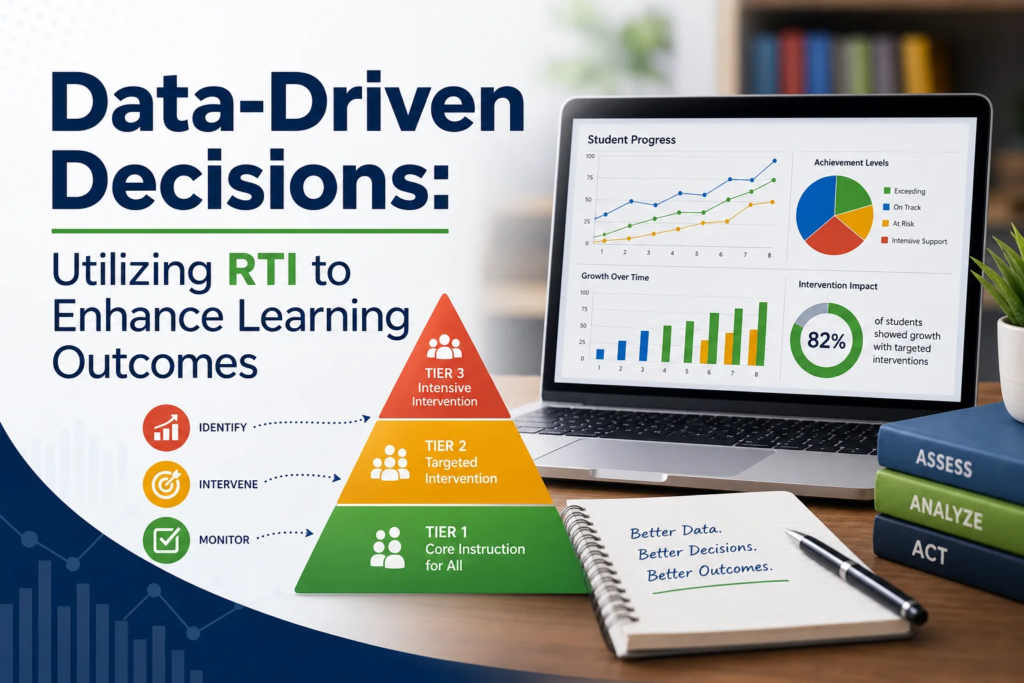
Introduction: When Data Becomes the Difference Between Struggle and Success
Every educator has seen it: a student who works hard but still falls behind, a classroom where several learners seem to miss the same foundational skill, or a child whose behavior suddenly changes without an obvious reason. In the past, schools often waited until failure became severe before responding. Today, that approach is no longer enough.
This is where Data-Driven Decisions: Utilizing RTI to Enhance Learning Outcomes becomes more than an educational strategy—it becomes a lifeline.
Response to Intervention, commonly known as RTI, gives schools a structured way to identify student needs early, provide targeted support, monitor progress, and adjust instruction before small gaps become long-term barriers. But RTI is only as strong as the data behind it. Without accurate, timely, and meaningful data, interventions become guesswork. With data, they become purposeful action.
At its best, Data-Driven Decisions: Utilizing RTI to Enhance Learning Outcomes empowers teachers, interventionists, administrators, and families to work from the same evidence-based roadmap. Instead of asking, “Why is this student failing?” schools begin asking, “What does the data tell us, and what support should we provide next?”
That shift changes everything.
Understanding RTI: A Framework Built for Early Support
RTI is a multi-tiered system of support designed to help students academically, behaviorally, and socially. It operates on a simple but powerful idea: students should receive help as soon as they show signs of struggle—not months or years later.
The RTI model typically includes three tiers:
| RTI Tier | Level of Support | Who Receives It? | Common Examples |
|---|---|---|---|
| Tier 1 | Universal instruction | All students | Core classroom teaching, universal screening, differentiated instruction |
| Tier 2 | Targeted intervention | Students needing additional help | Small-group instruction, skill-focused lessons, frequent progress monitoring |
| Tier 3 | Intensive intervention | Students with significant or persistent needs | Individualized support, frequent assessment, specialized intervention plans |
The purpose of RTI is not to label students. It is to respond to learning needs with precision.
That is why Data-Driven Decisions: Utilizing RTI to Enhance Learning Outcomes is so important. RTI without data can become a series of well-intentioned but disconnected interventions. Data turns RTI into a coherent system.
Why Data-Driven Decision-Making Matters in RTI
Data-driven decision-making means using evidence—not assumptions—to guide instruction and intervention. In an RTI framework, data helps educators answer critical questions:
- Which students need additional support?
- What specific skills are they missing?
- Is the intervention working?
- Should support be intensified, changed, or reduced?
- Are classroom-wide instructional adjustments needed?
The strength of Data-Driven Decisions: Utilizing RTI to Enhance Learning Outcomes is that it helps educators move beyond general impressions. A teacher might feel that a student “struggles with reading,” but data can reveal whether the issue is phonemic awareness, decoding, fluency, vocabulary, comprehension, or stamina.
That level of clarity matters.
A vague problem leads to a vague solution. A precise problem leads to a targeted response.
The Core Data Sources That Make RTI Work
Schools often collect large amounts of data, but not all data is equally useful. Effective RTI depends on choosing data that is timely, actionable, and connected to instruction.
Key Data Sources in RTI
| Data Type | Purpose | Example | How It Supports RTI |
|---|---|---|---|
| Universal Screening | Identify students at risk | Beginning-of-year reading assessment | Helps determine who may need Tier 2 support |
| Diagnostic Assessment | Pinpoint specific skill gaps | Phonics inventory or math skills test | Identifies what intervention should target |
| Progress Monitoring | Track student growth | Weekly fluency checks | Shows whether intervention is working |
| Formative Assessment | Guide daily instruction | Exit tickets, quizzes, classwork | Helps teachers adjust lessons quickly |
| Summative Assessment | Evaluate overall learning | Unit tests, benchmark exams | Provides broader achievement trends |
| Behavior Data | Track patterns and triggers | Office referrals, attendance, observation notes | Supports behavioral and social-emotional interventions |
When schools use these data sources together, Data-Driven Decisions: Utilizing RTI to Enhance Learning Outcomes becomes a complete process rather than a single assessment event.
Moving from Data Collection to Data Action
Many schools collect data. Fewer schools use it well.
The difference between collecting data and acting on data is the difference between having a map and actually following it. Teachers may administer screeners, input scores, and review dashboards, but if the data does not lead to instructional change, the system stalls.
A strong approach to Data-Driven Decisions: Utilizing RTI to Enhance Learning Outcomes includes four essential steps:
- Collect relevant data
- Analyze patterns and root causes
- Select targeted interventions
- Monitor progress and adjust support
This cycle should be ongoing. RTI is not a one-time placement decision. It is a continuous improvement process.
The RTI Decision-Making Cycle
The RTI process works best when educators follow a consistent cycle.
| Step | Guiding Question | Example Action |
|---|---|---|
| Identify | Who needs support? | Review universal screening data |
| Diagnose | What is the specific need? | Analyze skill-level assessment results |
| Intervene | What support will address the need? | Assign small-group decoding intervention |
| Monitor | Is the student improving? | Track weekly progress data |
| Adjust | What should change next? | Increase intensity, change strategy, or fade support |
This cycle is the heart of Data-Driven Decisions: Utilizing RTI to Enhance Learning Outcomes. It keeps the focus on student growth, not paperwork.
Tier 1: Using Data to Strengthen Core Instruction
Tier 1 is the foundation of RTI. It includes the instruction all students receive in the general education classroom. If many students are struggling with the same concept, the first question should not be, “Which students need intervention?” It should be, “What does this tell us about core instruction?”
This is one of the most overlooked insights in Data-Driven Decisions: Utilizing RTI to Enhance Learning Outcomes. RTI is not only about pulling students into small groups. It is also about improving classroom teaching.
For example, if 45% of third graders score below benchmark in multiplication fluency, the issue may not be individual student weakness. It may indicate that Tier 1 instruction needs reteaching, more practice opportunities, or different instructional strategies.
Tier 1 Data Questions
- Are at least 80% of students meeting expectations with core instruction?
- Which standards show the weakest performance?
- Are gaps consistent across classrooms or concentrated in specific groups?
- Do students need reteaching, enrichment, or differentiated practice?
When schools use data to strengthen Tier 1, fewer students require Tier 2 and Tier 3 support. That makes Data-Driven Decisions: Utilizing RTI to Enhance Learning Outcomes both efficient and equitable.
Tier 2: Targeted Support That Responds to Specific Needs
Tier 2 intervention is for students who need more than universal instruction but do not yet require the most intensive support. These interventions are usually delivered in small groups and focus on specific skills.
Data is essential here because students should not be grouped simply because they have similar overall scores. They should be grouped because they share similar instructional needs.
For example, five students may all score below benchmark in reading. But one may struggle with decoding, another with fluency, and another with comprehension. Putting them in the same intervention group may be convenient, but it is not effective.
That is why Data-Driven Decisions: Utilizing RTI to Enhance Learning Outcomes requires diagnostic precision.
Example Tier 2 Grouping
| Student Need | Intervention Focus | Progress Measure |
|---|---|---|
| Decoding multisyllabic words | Explicit phonics and word analysis | Weekly decoding probe |
| Low reading fluency | Repeated reading and phrasing practice | Words correct per minute |
| Weak comprehension | Main idea, inference, summarization | Short comprehension checks |
| Math fact fluency | Strategy-based fact practice | Timed and untimed fluency tasks |
| Fraction concepts | Visual models and number lines | Skill-specific exit tickets |
Tier 2 works best when interventions are focused, time-bound, and frequently reviewed.
Tier 3: Intensive Intervention Guided by Frequent Data
Tier 3 is the most intensive level of RTI support. Students receiving Tier 3 intervention often need individualized instruction, smaller group sizes, more frequent sessions, and closer monitoring.
In Tier 3, data should be collected more often because instructional decisions need to happen quickly. Waiting six or eight weeks to discover that an intervention is not working can cost valuable learning time.
A powerful principle of Data-Driven Decisions: Utilizing RTI to Enhance Learning Outcomes is this: the more intensive the need, the more responsive the system must be.
Tier 3 data may include:
- Weekly or twice-weekly progress monitoring
- Error analysis
- Behavior observations
- Attendance patterns
- Work samples
- Intervention fidelity checks
- Family input
- Student self-reflection
Intensive support does not mean doing “more of the same.” It means doing something more targeted, more explicit, and more responsive to the student’s data.
Case Study 1: Elementary Reading Growth Through Data-Driven RTI
The Challenge
At Maple Ridge Elementary, second-grade reading data revealed that 38% of students were below benchmark in reading fluency by midyear. Teachers initially believed the main issue was comprehension, because students struggled to answer questions after reading.
However, a closer look told a different story.
Universal screening showed low fluency scores, but diagnostic assessments revealed that many students were still decoding word-by-word. Their comprehension suffered because they were using so much mental energy to read the words.
The RTI Response
Using Data-Driven Decisions: Utilizing RTI to Enhance Learning Outcomes, the school formed targeted Tier 2 groups based on specific needs:
| Group | Primary Need | Intervention |
|---|---|---|
| Group A | Short vowel decoding | Explicit phonics review |
| Group B | Multisyllabic word reading | Syllable division practice |
| Group C | Fluency and expression | Repeated reading with feedback |
| Group D | Comprehension strategies | Retelling and questioning |
Progress was monitored weekly. After six weeks, 71% of students in Tier 2 showed measurable growth, and 43% moved back to Tier 1 support only.
Brief Analysis
This case demonstrates why Data-Driven Decisions: Utilizing RTI to Enhance Learning Outcomes matters. If the school had relied on surface-level observations, students would have received comprehension practice without addressing decoding and fluency gaps. Data helped educators treat the cause, not just the symptom.
Case Study 2: Middle School Math Intervention with Skill-Level Data
The Challenge
At Jefferson Middle School, seventh-grade math benchmark results showed widespread difficulty with rational numbers. Teachers noticed low performance on fraction, decimal, and percent problems.
Rather than assigning all struggling students to the same intervention, the math team reviewed item-level assessment data.
They discovered three different patterns:
- Some students struggled with fraction equivalence.
- Some understood fractions but could not convert between forms.
- Some could perform procedures but failed word problems.
The RTI Response
The school implemented a six-week Tier 2 intervention block. Students were grouped by skill deficit, not by overall test score.
| Skill Gap | Intervention Strategy | Progress Check |
|---|---|---|
| Fraction equivalence | Visual models and fraction strips | Weekly equivalence task |
| Decimal-percent conversion | Number lines and conversion charts | Short conversion quiz |
| Word problem reasoning | Schema-based problem solving | Constructed-response check |
Teachers met every two weeks to examine progress data and regroup students as needed.
Results
By the end of the cycle:
- 64% of students improved by at least one performance band.
- Students in the word-problem group showed the greatest growth when instruction included visual representation and verbal explanation.
- Teachers revised Tier 1 lessons to include more conceptual modeling before procedures.
Brief Analysis
This example of Data-Driven Decisions: Utilizing RTI to Enhance Learning Outcomes shows that RTI is not just for elementary reading. Middle school math teams can use data to identify misconceptions, create flexible groups, and improve both intervention and core instruction.
Case Study 3: High School Attendance, Behavior, and Academic RTI
The Challenge
At Northview High School, ninth-grade failure rates were rising. Teachers initially attributed the problem to motivation. However, the RTI team reviewed academic grades, attendance records, behavior referrals, and course performance.
The data showed a clear pattern: many failing students had missed more than 10% of school days. Several also had repeated minor behavior referrals during first period.
The issue was not simply academic skill. It was a combination of attendance, engagement, and transition support.
The RTI Response
The school used Data-Driven Decisions: Utilizing RTI to Enhance Learning Outcomes to create a ninth-grade support plan:
- Tier 1: Freshman success lessons on organization, attendance, and study habits
- Tier 2: Check-in/check-out mentoring for students with chronic absenteeism
- Tier 2 academic labs for missing assignments and skill recovery
- Tier 3 individualized plans for students with attendance, behavior, and academic risk factors
The team reviewed data every three weeks.
Results
Within one semester:
| Indicator | Before RTI Plan | After RTI Plan |
|---|---|---|
| Ninth-grade course failures | 29% | 18% |
| Chronic absenteeism | 22% | 15% |
| Repeated minor referrals | 34% | 21% |
| Students passing all core classes | 63% | 76% |
Brief Analysis
This case highlights a crucial point: Data-Driven Decisions: Utilizing RTI to Enhance Learning Outcomes should include more than test scores. Attendance, behavior, and engagement data often explain why students struggle academically. When schools look at the whole learner, interventions become more effective.
What Makes RTI Data Truly Useful?
Not all data improves decision-making. Some data overwhelms teachers without changing outcomes. Useful RTI data has several qualities.
Characteristics of Effective RTI Data
| Quality | Why It Matters | Example |
|---|---|---|
| Timely | Allows quick instructional response | Weekly progress monitoring |
| Specific | Identifies exact skill needs | Decoding vowel teams, not just “reading” |
| Reliable | Supports fair decisions | Consistent assessment conditions |
| Actionable | Leads to clear next steps | Regroup students based on skill mastery |
| Understandable | Can be used by teachers, students, and families | Simple growth charts |
| Connected to instruction | Measures what is being taught | Intervention-aligned probes |
The goal of Data-Driven Decisions: Utilizing RTI to Enhance Learning Outcomes is not to create more spreadsheets. The goal is to create better learning experiences.
The Role of Teacher Collaboration in Data-Driven RTI
RTI works best when teachers do not work in isolation. Collaborative teams allow educators to compare data, share strategies, identify trends, and solve problems together.
A strong RTI data meeting should be focused and practical. It should not become a long discussion of every student without clear decisions.
Sample RTI Data Meeting Protocol
| Time | Task | Guiding Question |
|---|---|---|
| 5 minutes | Review team-wide data | What patterns do we see? |
| 10 minutes | Identify students needing support | Who is not responding to current instruction? |
| 15 minutes | Analyze root causes | What skill or barrier is driving the struggle? |
| 15 minutes | Select or adjust interventions | What will we do next? |
| 5 minutes | Assign responsibilities | Who will do what by when? |
| 5 minutes | Set review date | When will we check progress? |
This kind of structure keeps Data-Driven Decisions: Utilizing RTI to Enhance Learning Outcomes from becoming abstract. It turns data into shared action.
Avoiding Common Mistakes in Data-Driven RTI
Even well-intentioned schools can struggle with RTI implementation. The most common problems usually involve data misuse, inconsistent interventions, or unclear decision rules.
Mistake 1: Using Too Much Data Without Purpose
More data is not always better. Teachers can become overwhelmed by dashboards, benchmark reports, formative checks, and intervention logs. The key is to ask, “What decision will this data help us make?”
Mistake 2: Waiting Too Long to Respond
If data shows a student is not progressing, teams should not wait until the next grading period to act. RTI is built on timely response.
Mistake 3: Confusing Low Scores with Skill Needs
A low reading score does not automatically reveal the cause. Diagnostic data is necessary.
Mistake 4: Ignoring Intervention Fidelity
If an intervention does not work, teams must ask whether it was implemented as intended. Poor results may reflect poor fit, inconsistent delivery, or insufficient time.
Mistake 5: Keeping Families Out of the Process
Families can provide valuable context about attendance, motivation, health, stress, and learning habits. They should be partners in Data-Driven Decisions: Utilizing RTI to Enhance Learning Outcomes.
Building a Culture That Supports Data-Driven RTI
Data-driven RTI is not just a technical process. It is a culture.
Schools that succeed with Data-Driven Decisions: Utilizing RTI to Enhance Learning Outcomes usually share several habits:
- They view data as a tool for support, not blame.
- They protect time for collaboration.
- They train teachers to interpret data accurately.
- They use common decision rules.
- They communicate clearly with families.
- They adjust instruction instead of simply documenting failure.
- They celebrate growth, even when progress is gradual.
A healthy data culture asks, “What can we learn from this?” rather than “Who is responsible for this?”
That distinction matters. Teachers are more likely to engage deeply with data when they feel supported rather than judged.
Student Voice: The Missing Piece in RTI Data
One of the most powerful but underused forms of RTI data is student voice.
Students often know more about their learning barriers than adults realize. They can explain when they feel confused, what strategies help them, what distracts them, and what makes them shut down.
Including students in Data-Driven Decisions: Utilizing RTI to Enhance Learning Outcomes does not mean showing them complicated spreadsheets. It means helping them understand their goals and progress.
For example:
- “You read 52 words correct per minute last week. This week you read 61. What helped?”
- “You solved two-step equations correctly when you used the checklist. Should we keep using it?”
- “Your attendance improved this month. What made mornings easier?”
When students understand their data, they gain ownership. RTI becomes something done with them, not to them.
How Technology Can Strengthen RTI Decision-Making
Technology can make Data-Driven Decisions: Utilizing RTI to Enhance Learning Outcomes more efficient, but it cannot replace professional judgment.
Digital platforms can help schools:
- Track universal screening results
- Monitor progress over time
- Identify students below benchmark
- Generate intervention reports
- Visualize trends by classroom, grade, or subgroup
- Share data across teams
However, technology should serve instruction—not the other way around. A colorful dashboard is only useful if educators know what to do with the information.
Smart Questions to Ask About RTI Technology
| Question | Why It Matters |
|---|---|
| Does the platform show skill-level data? | Teachers need more than overall scores |
| Can progress be monitored frequently? | RTI requires timely adjustment |
| Is the data easy to interpret? | Complex reports may reduce use |
| Does it support collaboration? | Teams need shared visibility |
| Can it protect student privacy? | Ethical data use is essential |
Technology can accelerate Data-Driven Decisions: Utilizing RTI to Enhance Learning Outcomes, but human expertise gives the data meaning.
Equity and RTI: Using Data Responsibly
RTI has tremendous potential to improve equity, but only when data is interpreted carefully.
Schools must ensure that intervention decisions are not influenced by bias, inconsistent expectations, or incomplete information. For example, multilingual learners may be placed in reading intervention when the real issue is language development, not a reading disability. Students with frequent absences may appear academically weak when they have missed critical instruction.
Responsible Data-Driven Decisions: Utilizing RTI to Enhance Learning Outcomes require educators to examine context.
Important equity questions include:
- Are certain student groups overrepresented in Tier 2 or Tier 3?
- Are students receiving culturally responsive instruction?
- Are assessments valid for multilingual learners?
- Are behavior referrals consistent across classrooms?
- Are intervention opportunities available to all students?
- Are families receiving information in accessible language?
Data can reveal inequities, but only if schools are willing to look honestly.
Creating Clear Decision Rules for RTI
One of the best ways to improve RTI is to establish decision rules before reviewing student cases. Decision rules help teams make consistent, fair, and timely choices.
For example:
| Data Pattern | Possible Decision |
|---|---|
| Student meets benchmark after intervention cycle | Return to Tier 1 with monitoring |
| Student shows growth but remains below benchmark | Continue intervention or adjust intensity |
| Student shows little or no growth | Change intervention approach |
| Student regresses despite support | Consider Tier 3 problem-solving |
| Many students struggle with same skill | Strengthen Tier 1 instruction |
Clear decision rules make Data-Driven Decisions: Utilizing RTI to Enhance Learning Outcomes less subjective. They also reduce delays because teams know what actions correspond to specific data patterns.
Long-Tail Keyword Variations for Contextual SEO Use
For schools, consultants, and education writers creating content around this topic, related long-tail variations can help broaden search visibility while keeping language natural.
| Focus Keyword Variation | Natural Use Case |
|---|---|
| Data-driven RTI strategies for student success | Professional development content |
| Using RTI data to improve learning outcomes | School improvement planning |
| RTI progress monitoring for academic growth | Intervention team resources |
| Data-based decision-making in Response to Intervention | Research-based articles |
| How RTI improves student achievement | Parent and community communication |
| RTI intervention planning with student data | Teacher collaboration guides |
| Evidence-based RTI practices for schools | Leadership and coaching materials |
| Data-informed instruction through RTI | Curriculum planning discussions |
These variations support the broader theme of Data-Driven Decisions: Utilizing RTI to Enhance Learning Outcomes without creating repetitive or awkward writing.
A Practical Roadmap for Schools Getting Started
Schools do not need a perfect system to begin. They need a clear process and a willingness to improve.
Here is a practical roadmap for implementing Data-Driven Decisions: Utilizing RTI to Enhance Learning Outcomes.
Step 1: Define the Purpose
Clarify what RTI is meant to accomplish in your school. Is the priority early literacy, math achievement, behavior support, graduation rates, or all of the above?
Step 2: Choose High-Quality Assessments
Select screening and progress-monitoring tools that are valid, reliable, and aligned to your curriculum.
Step 3: Establish Decision Rules
Determine how students move between tiers, how often data is reviewed, and what level of progress is expected.
Step 4: Protect Collaboration Time
RTI requires team discussion. Build data meetings into the schedule.
Step 5: Match Interventions to Needs
Avoid generic support. Use diagnostic data to choose interventions that target specific skills.
Step 6: Monitor Progress Consistently
Decide how often progress will be measured and who will collect the data.
Step 7: Adjust Quickly
If students are not improving, change the plan. Do not wait for failure to deepen.
Step 8: Communicate with Families
Share goals, progress, and next steps in clear language.
This roadmap turns Data-Driven Decisions: Utilizing RTI to Enhance Learning Outcomes into manageable action.
Measuring Success: What Outcomes Should Schools Track?
Success in RTI should be measured through multiple indicators. Test scores matter, but they are not the only sign of progress.
RTI Outcome Indicators
| Area | Possible Measures |
|---|---|
| Academic Growth | Benchmark scores, progress-monitoring trends, mastery checks |
| Behavior | Referral frequency, classroom behavior data, self-regulation goals |
| Attendance | Absenteeism rates, tardies, engagement patterns |
| Intervention Effectiveness | Percentage of students responding to intervention |
| Tier Movement | Students moving from Tier 2 to Tier 1 or Tier 3 to Tier 2 |
| Equity | Representation across tiers by subgroup |
| Student Confidence | Surveys, goal reflection, participation data |
The most meaningful measure of Data-Driven Decisions: Utilizing RTI to Enhance Learning Outcomes is not simply whether data was collected. It is whether students received better support because of it.
The Human Side of Data
It is easy to talk about data as numbers, graphs, and reports. But every data point represents a student.
A fluency score may represent a child who avoids reading aloud because they feel embarrassed. An attendance pattern may reflect transportation challenges. A math benchmark may reveal years of quiet confusion. A behavior referral may signal frustration, anxiety, or a need for connection.
The promise of Data-Driven Decisions: Utilizing RTI to Enhance Learning Outcomes is not that schools become more mechanical. It is that they become more responsive.
Data should sharpen empathy, not replace it.
When educators use data well, they see students more clearly. They notice patterns sooner. They intervene more wisely. They stop asking students to fail repeatedly before help arrives.
That is the real power of data-driven RTI.
Conclusion: Turning Evidence into Opportunity
Data-Driven Decisions: Utilizing RTI to Enhance Learning Outcomes is one of the most powerful approaches schools can use to improve student success. It combines early identification, targeted intervention, progress monitoring, and collaborative problem-solving into a system that responds to real student needs.
The key is not collecting more data. The key is using the right data in the right way.
RTI becomes transformative when educators use evidence to strengthen Tier 1 instruction, design targeted Tier 2 supports, intensify Tier 3 interventions, involve families, listen to students, and adjust quickly when something is not working.
The takeaway is simple: data should lead to action.
When schools commit to Data-Driven Decisions: Utilizing RTI to Enhance Learning Outcomes, they create learning environments where students are not defined by their struggles. They are supported through them. Every assessment, meeting, intervention, and progress check becomes part of a larger promise: we will notice, we will respond, and we will keep going until every learner has a stronger chance to succeed.
1. What does “Data-Driven Decisions: Utilizing RTI to Enhance Learning Outcomes” mean?
It means using student data within the RTI framework to make informed decisions about instruction, intervention, and support. Instead of guessing why students struggle, educators use screening, diagnostic, progress-monitoring, academic, behavior, and attendance data to guide next steps.
2. How often should RTI progress monitoring happen?
It depends on the level of support. Tier 2 students may be monitored every one to two weeks, while Tier 3 students often need weekly or even more frequent monitoring. The more intensive the intervention, the more frequently data should be reviewed.
3. Is RTI only for students with learning disabilities?
No. RTI is designed to support any student who needs additional help. It can also help identify students who may need special education evaluation, but its primary purpose is early intervention and improved learning outcomes for all students.
4. What types of data are most important in RTI?
The most useful RTI data includes universal screening, diagnostic assessments, progress monitoring, formative classroom assessments, attendance data, behavior data, and intervention fidelity records. The best data is specific, timely, and connected to instructional decisions.
5. How can teachers avoid feeling overwhelmed by RTI data?
Teachers can reduce overwhelm by focusing on data that answers clear questions. Schools should use simple protocols, limit unnecessary assessments, provide collaboration time, and ensure every data review leads to a practical instructional decision.
6. What is the biggest mistake schools make with data-driven RTI?
One of the biggest mistakes is collecting data without changing instruction. RTI data should lead to action, such as regrouping students, changing interventions, reteaching a skill, increasing support, or improving Tier 1 instruction.
7. How does RTI improve equity in schools?
RTI can improve equity by identifying student needs early and providing support before failure becomes severe. However, schools must review data carefully to ensure interventions are fair, culturally responsive, and not influenced by bias or incomplete information.
8. Can RTI support behavior and attendance as well as academics?
Yes. RTI can be used for academic, behavioral, attendance, and social-emotional concerns. Many students struggle academically because of behavior, engagement, or attendance barriers, so looking at the whole student often leads to better interventions.


The PsyForU Editorial Collective is the research and editorial team of PsyForU Research International. The collective prepares educational, psychological, mental-health-awareness, inclusion, neurodiversity, and research-methodology content for students, parents, educators, researchers, and general readers. PsyForU content is intended for awareness, education, and capacity-building and should not be treated as clinical diagnosis, therapy, medical advice, legal advice, or emergency mental-health support.