


Did you know that 73% of professionals feel their schedule controls them instead of the other way around? 😱 If you’re nodding in agreement, you’re not alone!
But here’s the good news: You’re about to take back control! 🎯
Weekly planning systems give you clarity on what’s important. They help you make progress on your top priorities. And they keep you focused, even when everything else is vying for your attention!
This guide is your roadmap to creating a personal productivity framework that suits your life. We’re talking about an intentional week design that respects your energy and protects your deep work time! 💪
Whether you’re juggling work schedules or studying for exams while keeping up with your job, this productivity blueprint will change how you manage your time. No more generic advice—just strategies that work, based on science! 🚀
Ready to take back control of your schedule? Let’s get started! ✨
Key Takeaways
- Structured weekly planning systems provide clarity on priorities and help you focus on what truly matters in your professional and personal life
- A productivity blueprint combines proven principles from habit formation, positive psychology, and behavioral economics for maximum effectiveness
- Intentional week design honors your natural energy patterns and protects dedicated time for deep, focused work
- Custom productivity frameworks work better than generic time management tips because they’re tailored to your unique needs and schedule
- Taking control of your schedule reduces stress and increases meaningful progress on your most important goals and projects
1. Why Your Hybrid Work Week Needs a Personal Blueprint
If you’re finding it hard to find your rhythm in the hybrid work model, you’re not alone! 🤝 Thousands of professionals are facing the same challenge. The shift to flexible work brought new possibilities but also new problems.
Think about your typical week. You manage office days, remote days, meetings, and deep work. Without a clear schedule, each week feels like solving a puzzle from scratch! 😓
That’s why you need a personal blueprint. Not just any generic schedule, but one that fits your unique situation. Let’s explore why this is key for your success and sanity! ✨
The Hidden Costs of Unstructured Hybrid Work
Most people don’t realize the “flexibility” in flexible work can be a trap! Without structure, you pay hidden costs that drain your energy and productivity.
The mental switching cost is real and expensive. Every time you switch between home and office without a clear system, your brain needs to recalibrate. You’re constantly asking yourself: “Where should I work today? What meetings do I have? Should I commute or stay home?” These small decisions add up to a huge cognitive load! 🧠
The most common hidden costs include:
- Decision fatigue: Making daily choices about where and when to work depletes your mental energy before you even start your actual tasks
- Context switching exhaustion: Constantly shifting between different environments and work modes without intentional transitions
- Commute time waste: Traveling to the office without maximizing the value of being there in person
- Boundary blur: Work bleeding into personal time because you never established clear start and end points
- Collaboration gaps: Missing important connection opportunities because your schedule doesn’t align with team members
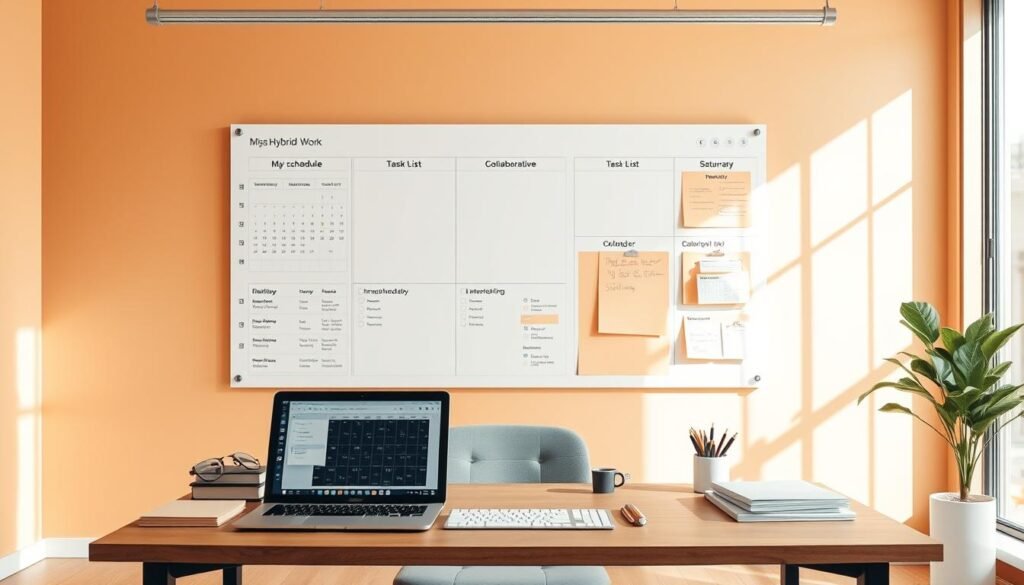
Research shows achieving basic productivity doesn’t need complex formulas or tools. It needs a well-structured program that targets key areas while fitting your schedule and preferences. A weekly work schedule template provides a visual roadmap that helps you allocate time wisely, ensuring important tasks get prioritized! 📊
What Makes a Personal Productivity Framework Different
You’ve probably seen many “perfect hybrid work schedule” articles online, right? They all promise the same thing—but they never quite fit YOUR life. That’s because those one-size-fits-all approaches ignore the most important factor: you’re unique! 💫
A personal productivity framework built around workflow customization honors your individual energy patterns. Some people are morning powerhouses who crush their hardest tasks before lunch. Others hit their creative peak in the afternoon or evening. Your framework should match YOUR natural rhythms, not fight against them!
Here’s what makes personalized frameworks actually work:
- Energy-based scheduling: Tasks align with your natural high and low energy periods throughout the day
- Role flexibility: The system adapts to your specific job requirements and responsibilities
- Life integration: Your framework accounts for personal commitments, not just work demands
- Cognitive preferences: Respects whether you work better with variety or routine, alone or with others
- Growth capacity: The system evolves as your role, skills, and circumstances change
The difference between generic schedules and personalized frameworks is like the difference between buying clothes off the rack versus getting them tailored to fit perfectly. Sure, the generic version might “work,” but the customized approach feels completely different—and delivers exponentially better results! 👔
This isn’t about forcing yourself into someone else’s idea of the perfect schedule. It’s about discovering what works for YOUR brain, YOUR work style, and YOUR unique combination of responsibilities. That’s the power of true workflow customization! 🎯
The Promise of Intentional Week Design
Now for the exciting part—what happens when you actually implement hybrid work schedule optimization! 🌟 The transformation isn’t just about getting more done (though that definitely happens). It’s about fundamentally changing your relationship with work and time.
When you design your week intentionally using a work-life balance strategy, you create something powerful: predictable excellence. You’ll know exactly when you’ll be focusing on deep work, when you’ll be collaborating, and when you’ll be recharging. No more guessing, no more chaos!
Here’s what intentional hybrid work schedule planning delivers:
- Mental clarity: You start each week knowing exactly what goes where, eliminating decision fatigue
- Energy optimization: Your most challenging tasks happen during your peak performance windows
- Sustainable productivity: You build in recovery time, preventing burnout before it starts
- Better boundaries: Clear work hours mean you actually disconnect and enjoy personal time
- Professional growth: Protected time for skill development and strategic thinking becomes non-negotiable
Imagine starting Monday morning with complete confidence about your week. You know which days you’ll be in the office maximizing collaboration. You know which days you’ll be home crushing your most important projects. You’ve already protected time for studying, family, or whatever matters most to you! 💪
The promise isn’t just about productivity metrics—it’s about thriving instead of just surviving. It’s about having energy left at the end of the day. It’s about feeling in control of your time instead of constantly reacting to whatever comes your way.
This section has shown you exactly why creating your personal blueprint isn’t just nice-to-have—it’s absolutely essential for succeeding in today’s hybrid work environment! The hidden costs of unstructured work are too high to ignore. Generic frameworks simply don’t cut it anymore. And the promise of intentional design? It’s transformation that you can feel in every aspect of your professional and personal life! 🚀
Ready to move from theory to action? The next sections will walk you through assessing your current reality and building your customized framework step by step. You’ve got this! 💯
2. Assessing Your Current Workflow Reality
Building a strong productivity system starts with knowing where you are now! 💡 Think of this step as your baseline. It’s like athletes track their performance before starting a new program. You need to know your current patterns to design time management strategies that fit your life!
This diagnostic process uncovers the hidden dynamics of your workday. You’ll find out when you’re most productive, what drains your energy, and how much your commute costs. These insights are the foundation for every decision about your hybrid schedule! 🎯
Tracking Your Energy Patterns Throughout the Week
Your energy levels change throughout the day and week in predictable ways. Understanding these rhythms is a powerful time management technique! Start by creating a “Productivity Heat Map” to see when you’re at your best and when you’re not.
Here’s how to track your energy: For one week, set reminders every two hours during work. When it buzzes, rate your energy level from 1 to 10. Also, note what you’re doing at that moment! 📱
After seven days, you’ll see clear patterns. Maybe you’re a morning person who does well before 11 AM. Or perhaps you don’t fully wake up until after lunch. Some people find their best work time is 7-9 PM—information that changes how they plan their day! 🌅

- Peak Performance Hours: When does your brain feel sharpest and most focused?
- Energy Dips: What times consistently show lower ratings (usually post-lunch and late afternoon)?
- Day-of-Week Patterns: Are Mondays slower? Do you hit your stride on Wednesdays?
- Task-Energy Alignment: Which activities give you energy versus which ones drain you?
- Location Impact: Do you have different energy patterns at home versus the office?
This tracking gives you your personal energy blueprint! You’ll use this data to match your most important work with your peak hours. That’s smart time management in action! 💪
Identifying Context Switching Triggers and Productivity Drains
Context switching is a big productivity killer in hybrid work! Every time you switch tasks, your brain pays a “switching cost.” It can take 15-25 minutes to get back to focus after an interruption! 😮
In a hybrid schedule, you’re always switching contexts. Home to office, deep work to meetings, solo tasks to collaborative projects. Each switch takes a toll on your brain. The average knowledge worker switches contexts every 3 minutes! That’s why you feel exhausted even when you didn’t do much.
Start documenting your context switching triggers this week. Keep a simple log of every time you switch tasks or modes. Look for patterns like these:
- Notification interruptions (email, Slack, Teams messages)
- Unscheduled “quick questions” from colleagues
- Back-to-back meetings with no buffer time
- Physical location changes (commuting creates massive context shifts)
- Moving between different software tools or platforms
- Task hopping due to unclear priorities
For each interruption, note what triggered it and how long it took you to refocus. Was it necessary or could it have been batched? This awareness is the first step toward better time management strategies! 🎯
Many professionals find that their fragmented schedule, not lack of motivation, is their real productivity problem. When you reduce unnecessary context switching, you can do twice as much in the same time!
Calculating Your Commute Math: Time and Energy Costs
Let’s look at some numbers that might surprise you! Your commute costs more than just the time in your car or on the train. When you add preparation time, recovery time, and energy expenditure, the real cost of office days becomes clear! 🚗
Here’s how to calculate your true commute math for better personal organization:
- Direct Transit Time: How many minutes each way? (Most people: 30-60 minutes)
- Preparation Buffer: Extra time needed to get ready and leave (usually 15-30 minutes)
- Arrival Transition: Time to settle in at the office (10-15 minutes)
- Mental Recovery: How long until you’re fully productive after commuting? (20-45 minutes)
- End-of-Day Transition: Wrapping up and preparing to leave (15-20 minutes)
- Post-Commute Recovery: Time needed to decompress at home (20-40 minutes)
Add these up, and a “simple” 45-minute commute actually costs 2.5 to 3.5 hours of your day! That’s why effective time management systems must account for location-based energy costs, not just clock time. ⏰
This table shows the real cost breakdown for different commute lengths:
| Commute Length (One Way) | Daily Time Cost | Weekly Time Cost | Energy Impact Rating |
|---|---|---|---|
| 15-20 minutes | 1.5-2 hours | 6-8 hours | Low-Moderate |
| 30-45 minutes | 2.5-3.5 hours | 10-14 hours | Moderate-High |
| 60+ minutes | 4-5 hours | 16-20 hours | Very High |
| Remote (no commute) | 0.5 hours | 2 hours | Minimal |
These numbers are eye-opening, right?! 👀 Understanding your personal time management system means recognizing that office days require more energy than remote days. This doesn’t mean avoiding the office—it means being strategic about when that investment pays off!
Ask yourself: On which days does the collaboration and connection justify the commute cost? When would that same time be better spent on focused remote work? This is the kind of data-driven thinking that separates effective time management techniques from random scheduling! 🎓
Your assessment is complete when you have: A week’s worth of energy ratings, a list of your top 5-7 context switching triggers, and your calculated commute costs. These three data points form the reality check that makes everything else in your hybrid blueprint possible! You’re building awareness—and awareness is the foundation of all lasting productivity systems! 🏆
3. The Five Core Principles of Hybrid Blueprint Design
Every effective hybrid blueprint is built on five key principles. These principles turn chaotic schedules into productive powerhouses! 🎯 They’re not just random tips you find online. They’re the essential building blocks that hold your system together.
Think of these principles like ingredients in a recipe. You need all five to create something amazing! ✨ When you apply anchor days, protect deep work time, build in recovery periods, establish meeting guardrails, and integrate your planning tools effectively, you’ll create a framework that supports your success.
According to productivity research, a well-rounded program includes different components that work together. Your hybrid work blueprint follows the same logic—each principle reinforces the others to create sustainable results that last!
Principle 1: Anchor Days as Your Weekly Framework
Your anchor days are the tent poles that hold up your entire schedule! 🎪 This principle means designating specific days for specific purposes. It creates consistency that reduces decision fatigue and helps your brain prepare for what’s coming.
Here’s how it works in real life. You might establish “Tuesdays and Thursdays are my office collaboration days” or “Mondays are my deep work powerhouse days at home.” This consistency creates patterns your mind can rely on!
The magic happens when your colleagues and managers also learn your patterns. They’ll automatically know when to schedule that in-person brainstorming session and when you’re unavailable for meetings because you’re crushing focused work! 💪
Anchor days eliminate the daily “where should I work today?” question that drains mental energy before your day even begins. You’ll make this decision once during your weekly planning session, then simply follow your blueprint!
Principle 2: Deep Work Protection and Time Blocking
This principle treats your focused work time as sacred territory that cannot be violated! 🛡️ Deep work protection means using time blocking techniques to create uninterruptible chunks where you can achieve flow state and make real progress on complex tasks.
The best time blocking methods involve scheduling your most cognitively demanding work during your peak energy hours. No meetings allowed! No “quick questions” from colleagues! No email checking every five minutes!
You’ll physically block these periods on your calendar with appointments labeled “Focus Time” or “Deep Work Session.” Most calendar systems even let you automatically decline meeting requests during these protected blocks! 🎉
Strategic task scheduling becomes your superpower here. You’ll match your hardest tasks with your best mental energy, protecting these golden hours from the calendar chaos that destroys productivity for most hybrid workers.
Principle 3: Strategic Recovery Windows
Your brain isn’t a machine that can run at maximum capacity for eight straight hours! 🧠 This principle acknowledges the biological reality of cognitive fatigue and builds intentional recovery periods into your schedule.
Strategic recovery windows include scheduled breaks between high-intensity tasks, transition periods when switching between different work modes, and lower-intensity work blocks that give your prefrontal cortex a chance to recharge.
Think of it like interval training for your mind! You alternate between sprints of focused effort and recovery periods that prevent burnout while maintaining sustainable productivity across your entire week.
These windows might look like a 15-minute walk between meetings, a 30-minute lunch break away from screens, or scheduling administrative tasks after finishing a demanding project. The key is planning them proactively instead of waiting until you’re already exhausted! 💆
Principle 4: Meeting Guardrails and Calendar Boundaries
This principle gives you back control of your calendar by establishing clear boundaries about when meetings can and cannot happen! 📅 Meeting guardrails protect your most productive hours from becoming yet another video call.
Effective guardrails include rules like “no meetings before 10am” (protecting your morning peak performance), “no meetings after 4pm on Fridays” (preserving end-of-week energy), or “Wednesdays are meeting-free days” (creating space for uninterrupted project work).
You’ll also implement intentional scheduling practices like clustering meetings together instead of scattering them throughout your day. This prevents calendar fragmentation where you have 30-minute gaps that aren’t long enough for meaningful work! 🙄
Calendar boundaries work both ways—they protect your focus time while also designating specific windows when you’re available for collaboration. This clarity helps everyone work more effectively together!
Principle 5: Digital-Analog Workflow Integration
Your planning system needs to actually work in real life, not just look pretty in theory! 📱📓 This final principle ensures seamless integration between your planning tools—whether you’re team digital, team paper, or somewhere in between.
The best workflow integration systems capture everything without becoming overwhelming. You might use a digital calendar for time blocking while maintaining a paper notebook for daily task lists. Or you could go fully digital with synchronized tools across all your devices!
What matters most is consistency and accessibility. Your system should work equally well whether you’re at your home desk, in the office, or catching up on tasks during your commute. ✅
Intentional scheduling methods within this principle include establishing a single source of truth for your schedule, creating habits for regular system maintenance, and building backup routines when technology fails (because it always does at the worst possible moment!).
These five principles work together like a symphony—each one supporting the others to create your personal productivity masterpiece! 🎵 When you nail all five, you’ll experience the kind of structured flexibility that makes hybrid work actually feel sustainable instead of constantly overwhelming.
Ready to put these principles into action? The upcoming sections will walk you through exactly how to implement each one step-by-step, transforming these concepts into your personalized hybrid work blueprint! 🚀
4. Design Your Week: Crafting a Personal Hybrid Blueprint Workflow Design Step-by-Step
Let’s get started on designing your hybrid work week! 🎯 This is where you turn principles into your blueprint for productivity. You’re about to make a weekly planning system that fits your life perfectly! 💪
This section is like your construction manual. You have the foundation and principles—now it’s time to build! 🏗️
You don’t need fancy software or expensive planners to start. What you need is clarity, intention, and a willingness to experiment. ✨
Overview of the Seven-Step Blueprint Creation Process
Here’s your roadmap to creating a blueprint for productivity that changes your work week! 🗺️ These seven steps build on each other, creating a complete system for your hybrid schedule. Seeing the full journey helps you understand how each piece connects! 🔗
Here’s what’s coming your way:
- Establish Your Anchor Days Framework – Choose which days are office days and which are remote days. This creates your weekly structure, providing stability and flexibility.
- Map Your Deep Work Blocks – Identify your peak performance hours and protect them. Use time blocking to maximize your cognitive power.
- Design Your Meeting Architecture – Create boundaries to prevent meeting overload. Strategically cluster collaboration time on office days.
- Build Recovery Windows – Schedule strategic breaks and transitions. This prevents burnout and keeps your energy sustainable throughout the week.
- Structure Your Office Days – Optimize your in-person time for collaboration, connection, and high-value face-to-face interactions.
- Optimize Your Remote Days – Use your home workspace for focused, distraction-free deep work. This moves your most important projects forward.
- Integrate Your Planning System – Connect your digital and analog tools into one cohesive weekly planning system that keeps everything aligned.
Each step builds naturally on the previous one! 📈 You’re not just scheduling tasks—you’re designing a work week that respects your energy patterns, supports your productivity, and protects your well-being. That’s the difference between managing your calendar and designing your life! 🌟
Gathering the Tools You’ll Need
Good news—you probably already have most of what you need! 🎉 This isn’t about buying expensive productivity apps or fancy planners. It’s about choosing tools you’ll actually use consistently. The best weekly planning template is the one that fits naturally into your workflow! 📱
Here are the essential tools for your weekly planning process:
- A Calendar System – Choose either Google Calendar, Outlook, Apple Calendar, or a paper planner. Pick ONE primary calendar to avoid confusion!
- Weekly Planning Template – You can use personalized schedule templates from Momentum Planners, a simple spreadsheet, or even a notebook page divided into days.
- Task Management Tool – Options include Todoist, Asana, Trello, Microsoft To Do, or a simple bullet journal. Again, consistency beats complexity!
- Tracking Notebook – A dedicated space for energy tracking, reflection notes, and blueprint adjustments. Digital notes apps work too!
- Time Tracking Tool (Optional) – Apps like Toggl or RescueTime help you understand where your time actually goes versus where you think it goes.
- Color Coding System – Whether digital tags or colored pens, visual differentiation helps you see your week at a glance. 🎨
The Momentum Planners system offers a complete planning approach that works across different time horizons. It connects your daily focus with your monthly vision, keeping your work aligned and moving forward! 🚀
Remember—custom schedule templates should serve you, not constrain you! Start simple and add complexity only when needed. Your goal is a system you’ll use every single week, not something that looks impressive but gathers dust! 💯
Setting Realistic Expectations for Implementation
Let’s get real for a moment! 🙌 Your first week using these weekly planning strategies won’t be perfect—and that’s completely okay. Actually, it’s expected! Building a personal weekly planning system is an iterative process, not a one-and-done event.
Here’s what to expect during your first month:
Week One: The Testing Phase – You’ll experiment with your initial blueprint. Some things will work brilliantly, others won’t. Take notes on what feels right and what feels forced! 📝
Week Two: The Adjustment Phase – You’ll make your first round of tweaks based on Week One feedback. Your blueprint starts feeling more natural, though it’s not yet automatic.
Week Three: The Refinement Phase – The system begins flowing more smoothly. You’re finding your rhythm and identifying remaining friction points to address.
Week Four: The Habituation Phase – Your weekly planning methods start becoming automatic. You’re building the neural pathways that turn conscious effort into habitual practice! 🧠
Most people need 2-3 weeks to dial in their blueprint effectively. Some need a full month. That’s not failure—that’s intelligent customization! 🎯
Also, understand that your blueprint will continue evolving! As your projects change, as seasons shift, as life happens—your system adapts with you. The goal isn’t creating perfection; it’s building a flexible framework that supports your success regardless of circumstances! 💪
You might face disruptions—unexpected meetings, urgent projects, family emergencies. Your personalized schedule templates should accommodate these realities, not crumble under pressure. Build in buffer space and flexibility from the start! 🛡️
The most important expectation? Give yourself permission to experiment! There’s no “perfect” blueprint—only the one that works for YOU. Stay curious, stay flexible, and stay committed to the process even when individual days don’t go as planned! ✨
Ready to dive into Step 1? Let’s establish your anchor days framework and build the foundation of your hybrid work week! 🚀
5. Step 1: Establish Your Anchor Days Framework
Ready to build your weekly foundation? 🏗️ Step 1 is all about creating anchor days. These are the stable days that help you stay productive. Think of them like your weekly fitness schedule, with specific days for specific tasks.
Your anchor days framework is the backbone of your hybrid work routines. Instead of deciding each week where you’ll work, you set predictable patterns. This reduces decision fatigue and boosts your effectiveness. The beauty is in the balance between consistency and flexibility! 🎯
Let’s break down how to build your framework step by step. You’ll learn to pick the best days for team work, protect your deep work time, and add flexibility that works in real life!
Choosing Your Primary Office Collaboration Days
Your office days should be when you add the most value to your team and projects. Start by looking at your calendar from the past month. Identify when team meetings and brainstorming sessions happen. 🏢
These days become your primary office anchor days. Most find mid-week days like Tuesday, Wednesday, or Thursday work best. But your situation might be different, and that’s okay!
Ask yourself these critical questions when selecting office days:
- When does my team schedule recurring meetings and collaborative sessions?
- Which days require face-to-face problem-solving or relationship-building?
- When can I batch multiple in-person commitments to maximize commute efficiency?
- What days align with my manager’s or key stakeholders’ office presence?
The goal is strategic meeting clustering. Group your collaborative work to avoid unnecessary commuting. This creates a flexible workweek structure that respects your time while boosting team connection. Your office days become power collaboration days! 💪
Designating Deep Work Days for Remote Time
Now, let’s protect your focus time by setting specific days for remote deep work. These days are for complex projects and tasks that need uninterrupted concentration. 🏡
Look at your task list and find tasks that need extended focus. If you’re writing reports or analyzing data, you need remote deep work days. These days eliminate commute time and reduce interruptions.
Consider these factors when choosing your deep work anchor days:
- Which days typically have fewer scheduled meetings on your calendar?
- When do you experience your highest energy levels for complex thinking?
- What days allow you to work without frequent team interruptions?
- How can you create predictable patterns that train others to respect your focus time?
Many find Mondays and Fridays work well as remote deep work days. Monday lets you plan and tackle priorities before the week’s chaos. Friday gives you uninterrupted time to complete projects and prepare for the next week. But your optimal configuration depends on your specific hybrid work-life balance needs!
Building Flexibility and Swap Options Into Your System
Here’s where your flexible work design gets smart! 💡 Life doesn’t follow rigid schedules, and neither should your anchor days framework. The key is building intentional flexibility that prevents your system from becoming a constraint.
Create clear personal protocols for when and how you can adjust your anchor days. For example, “I can swap an office day to remote if I have fewer than two in-person meetings scheduled AND I communicate the change to my team by the preceding Friday.” This gives you flexibility while maintaining predictability for others.
Smart flexible schedule management includes these strategies:
- Designate one “flex day” per week that can shift between office and remote based on priorities
- Establish notification timelines—how much advance notice you’ll give when changing locations
- Create backup plans for when unexpected situations require schedule adjustments
- Build buffer capacity by not over-scheduling your anchor days
Remember, flexibility doesn’t mean randomness! Your anchor days provide the stable structure, and your swap protocols provide the controlled flexibility. Together, they create a sustainable system that adapts without collapsing. 🎯
When Team Requirements Conflict with Personal Preferences
What happens when your ideal anchor days clash with team expectations or organizational policies? This is where strategic communication and negotiation skills become essential! 🤝
First, understand the business rationale behind team requirements. If your manager wants everyone in the office on Tuesdays for team collaboration, there’s likely a legitimate reason. Don’t immediately push back—instead, seek to understand the underlying need.
Then present your case using business outcomes, not personal preferences. Instead of saying “I prefer to work from home on Mondays,” try this approach: “I’m committed to being present Tuesday afternoons for our team sessions. Could I work remotely Monday mornings when I tackle our quarterly analysis project? This schedule helps me deliver higher-quality work while maintaining team connection.”
Most reasonable managers appreciate when you’re optimizing for results and team contribution, not just personal convenience. Show how your proposed anchor days framework serves both your productivity and team needs. Come prepared with data about your output patterns and collaboration requirements.
If organizational policies limit your flexibility, work within the constraints creatively. Maybe you can’t change which days you’re in the office, but you can control how you structure your time on those days. Protect morning hours for focused work and schedule meetings in the afternoons. Apply the anchor days principle to your daily schedule instead of your weekly one.
Here’s a comparison of different anchor day configurations based on common work situations:
| Work Situation | Recommended Office Days | Recommended Remote Days | Key Benefits |
|---|---|---|---|
| High collaboration team with frequent meetings | Tuesday, Wednesday, Thursday | Monday, Friday | Maximizes face-time during peak collaboration periods while protecting deep work bookends |
| Independent contributor with monthly team syncs | Wednesday (flex Tuesday) | Monday, Tuesday, Thursday, Friday | Minimizes commute while maintaining team connection and focus time |
| Client-facing role with variable scheduling | Client-dependent (2-3 days) | Remaining days for preparation | Flexibility for client meetings balanced with preparation and follow-up time |
| Mandatory office policy (3 days required) | Monday, Wednesday, Friday | Tuesday, Thursday | Alternating pattern creates rhythm while meeting requirements |
The negotiation process isn’t about getting your way—it’s about finding solutions that serve everyone’s needs. When you approach anchor days conversations with flexibility, business justification, and team-first thinking, you’ll find most organizations are remarkably accommodating! 🌟
Your anchor days framework isn’t a prison—it’s the foundation that makes everything else possible. With this structure in place, you’re ready to build the next layers of your hybrid blueprint: deep work blocks, meeting architecture, and recovery windows. Let’s keep building! 🚀
6. Step 2: Map Your Deep Work Blocks Using Time Blocking Techniques
Now, let’s dive into the game-changing step that sets high performers apart. It’s mapping your deep work blocks. 🎯 This is where the time blocking technique turns into your personal productivity superpower!
Think of this step as building walls around your most valuable work. You’re not just scheduling tasks—you’re creating a system that respects your natural rhythms and keeps your focus sharp.
The beautiful thing? Once you master this step, you’ll never wonder “where did my day go?” again! ✨
Identifying Your Peak Performance Hours
Remember that energy tracking you did earlier? Now it’s time to use those insights! 📊
Your energy patterns show when your brain works best. These aren’t random—they’re your biological goldmine for getting important work done.
Pull out your tracking data and look for patterns. Are you sharpest between 9-11 AM? Does your analytical thinking peak from 2-4 PM? Maybe you’re a rare afternoon warrior whose focus intensifies after lunch!
These peak performance windows are too precious to waste on email or routine administrative tasks. This is where strategic task scheduling becomes critical to your success.
Here’s what to look for in your data:
- Mental clarity peaks: When do complex problems feel manageable?
- Sustained focus windows: Which hours allow you to work for extended periods without mental fatigue?
- Creative thinking moments: When do innovative solutions come easily to you?
- Energy dips: Equally important—when does your brain need lighter tasks or breaks?
Most professionals discover they have 2-3 distinct peak performance windows each day. Your job is to identify yours and protect them fiercely! 🛡️
Create a simple visual map: mark your peak hours in green, moderate energy in yellow, and low energy in red. This becomes your customized time blocking foundation—your personal productivity blueprint.
The 90-Minute Deep Work Block Method
Here’s the magic formula that’s backed by neuroscience: 90 minutes of focused work + 15-20 minute break = sustained productivity without burnout! 🧠
Why 90 minutes? Your brain operates on ultradian rhythms—natural cycles that repeat throughout the day.
Research shows that we can maintain peak concentration for approximately 90 minutes before our mental performance starts declining. Push beyond that without recovery, and you’re working harder while producing less.
Here’s how to implement effective time blocking with the 90-minute method:
- Schedule your first block during your strongest peak window: This is for your most cognitively demanding work—studying for certification exams, writing detailed lesson plans, analyzing assessment data, or creating curriculum materials.
- Set a clear start and end time: “9:00 AM – 10:30 AM: Deep Work – Exam Prep” (not just “morning study time”).
- Choose ONE primary task per block: Multitasking during deep work destroys the entire purpose! Focus means singular attention.
- Build in your recovery break: 15-20 minutes to truly disconnect—walk, stretch, hydrate, or step outside. No email checking!
- Schedule your second block after recovery: If your energy supports it, add another 90-minute session before lunch or in the afternoon.
For most professionals, 2-3 deep work blocks per day is the sweet spot. That’s 3-4.5 hours of truly focused work—which produces more results than 8 hours of scattered, interrupted effort! 💪
This is where you need to get fierce about boundaries! 🔥 Your deep work blocks are sacred territory.
The biggest threat to intentional time blocking? Meeting requests that seem urgent but rarely are. Here’s your protection strategy:
Block your calendar immediately. Don’t wait until next week. As soon as you identify your deep work windows, create recurring calendar appointments titled “Focus Time,” “Deep Work Block,” or “Project Time.”
Mark these blocks as “Busy” in your calendar system. This prevents colleagues from even seeing these times as available when they’re scheduling meetings.
Some professionals go further—they create actual “meetings” with themselves! It sounds silly, but it works. Your coworkers respect “In Meeting” much more than “Available.”
Here’s the communication framework that maintains relationships while protecting your time:
- Proactive transparency: “I block 9-10:30 AM daily for focused project work. I’m available for meetings before 9 or after 11!”
- Suggest alternatives: When someone requests time during your deep work block, offer two other options immediately.
- Emergency protocol: “For urgent matters during my focus blocks, text me or use the ‘urgent’ Slack channel. I’ll respond after 10:30.”
Remember: People respect boundaries you clearly communicate and consistently maintain. Inconsistency trains others that your “blocked time” isn’t really blocked! 🎯
Using Calendar Blocking to Signal Unavailability
Your calendar is a communication tool, not just a personal organizer. Strategic intentional calendar design trains your colleagues to work with your productivity system.
Advanced calendar blocking strategies:
- Block at least one week in advance: This prevents last-minute meeting requests from infiltrating your deep work time.
- Use consistent naming conventions: When colleagues see “Deep Work Block” every Tuesday and Thursday morning, they learn your pattern and stop requesting those times.
- Add context notes: Some calendar systems allow descriptions. Add: “Focused on Project X—available via Slack for urgent matters only.”
- Color-code your blocks: Use red for non-negotiable deep work, yellow for flexible focus time, green for available meeting slots. Visual patterns help others schedule appropriately.
- Create buffer blocks: Add 15-minute “Transition Time” blocks before and after deep work to prevent back-to-back scheduling.
Here’s a pro tip: Review your calendar every Friday afternoon and block out next week’s deep work times before others fill your schedule! ⏰
Task Batching for Maximum Cognitive Efficiency
Context switching is the silent productivity killer that most professionals don’t recognize until they eliminate it. Every time you switch between different types of tasks, your brain needs recovery time to adjust—up to 23 minutes according to research! 😱
Task batching groups similar activities together, minimizing these costly mental transitions.
Instead of answering emails throughout the day (constant interruption mode!), batch them into specific time slots. Try this batching framework:
| Task Category | Batching Schedule | Time Investment |
|---|---|---|
| Email Processing | 9:00 AM, 12:30 PM, 4:00 PM | 15-20 minutes each |
| Administrative Tasks | Tuesday & Thursday, 1:00-2:00 PM | 2 hours weekly |
| Planning & Organization | Friday afternoon, 3:00-4:00 PM | 1 hour weekly |
| Professional Reading | Monday & Wednesday, 8:00-8:30 AM | 1 hour weekly |
Notice the pattern? Similar cognitive activities grouped together, scheduled consistently each week. Your brain learns the routine and operates more efficiently within it! 🚀
Apply batching to everything:
- Communication: Batch emails, phone calls, and Slack responses into dedicated windows
- Administrative work: Expense reports, timesheet updates, form completion—all at once
- Creative tasks: All your writing, design work, or content creation in grouped sessions
- Review activities: Grading papers, reviewing documents, providing feedback—batch by type
The task prioritization framework determines which batches get your peak hours (usually creative or analytical work) and which get lower-energy windows (usually administrative tasks).
Balancing Deep Work with Collaborative Responsibilities
Here’s the hybrid work tension: You need extended focus time AND meaningful team collaboration. The key isn’t choosing one over the other—it’s intentional separation and strategic allocation! 🤝
Your customized time blocking system should honor both needs without compromise.
Try these balancing strategies:
Time-of-day separation: Reserve mornings for deep work when your cognitive capacity is highest. Schedule collaborative meetings and team activities for afternoons when interaction energizes you through the post-lunch slump.
Day-of-week separation: Use your anchor days framework! Maybe Monday, Wednesday, and Friday mornings are protected deep work time, while Tuesday and Thursday are meeting-intensive collaboration days.
Location-based separation: In hybrid work, your office days naturally become collaboration-focused while remote days protect deep work. This alignment creates natural boundaries that everyone understands.
Here’s a balanced weekly pattern many professionals find effective:
- Monday (Remote): 2-3 deep work blocks, minimal meetings, weekly planning
- Tuesday (Office): 1 morning deep work block, afternoon team meetings and collaboration
- Wednesday (Remote): 2-3 deep work blocks, asynchronous communication only
- Thursday (Office): Morning collaboration, afternoon deep work or project teamwork
- Friday (Flexible): 1-2 deep work blocks, administrative batching, weekly review
The magic happens when you communicate your pattern clearly. Send your team a simple message: “I protect Tuesday and Wednesday mornings for deep project work and am fully available for meetings Tuesday/Thursday afternoons. Does this work for our collaboration needs?” 📧
Most colleagues appreciate the clarity! They know exactly when to reach you and when you’re in focus mode. This transparency actually strengthens team relationships because you’re fully present during collaborative time—not distracted by unfinished deep work.
Remember this critical truth: Deep work and collaboration aren’t opposing forces—they’re complementary elements of professional excellence. Your effective time blocking system makes space for both by giving each the dedicated time it deserves.
When you master this balance, something amazing happens: Your deep work sessions produce higher-quality output, and your collaborative meetings become more focused and productive because you’re not mentally juggling unfinished solo work! 🎉
Now you’ve built the foundation of powerful productivity—your anchor days provide the framework, and your deep work blocks fill that framework with protected focus time. You’re creating something remarkable: a weekly schedule that actually works WITH your natural rhythms instead of fighting against them!
7. Step 3: Design Your Meeting Architecture and Guardrails
Let’s turn your calendar into a tool for intentional work design! 🎯 Meetings are key for teamwork, but without structure, they can take over your week. This step is about setting meeting guardrails—your rules that protect your time and energy while allowing teamwork.
Think of it as building a fortress around your productive time. You’re not saying no to teamwork; you’re making sure every meeting is worth your time!
Creating Meeting Guardrails That Protect Your Time
Meeting guardrails are strict rules for meetings. They guide how you accept, schedule, and join meetings. These calendar boundaries make it clear when and how you’re available. They’re the base of effective calendar management in a hybrid work world.
Start by figuring out what really protects your productivity. Maybe mornings are for deep work, or you can’t handle more than three hours of meetings a day. Your guardrails should match your work style and energy.
Here’s the key: write them down! 📝 Vague plans don’t work. Specific, written guardrails become policies you can use when someone asks, “Can we meet at 8 AM tomorrow?”
Establishing No-Meeting Blocks
No-meeting blocks are time on your calendar where meetings don’t happen. Period. 🚫 These blocks give you predictable time for focused work, strategic thinking, or creative projects that need your full attention.
The best way is to block specific times. Maybe Wednesday mornings from 9 AM to noon are meeting-free. Or perhaps you protect the first two hours of every day for deep work, no matter the day.
Mark these blocks on your calendar as “Busy” or “Focus Time” so they’re clear to anyone trying to schedule with you. When someone asks for a meeting during these blocks, offer alternative times that fit within your meeting-friendly windows. Most people will respect your boundaries when you give them good options!
Pro tip: Start with just one no-meeting block a week and add more as you see the benefits. 💪
Setting Maximum Daily Meeting Limits
Decide how many meetings you can handle each day! Too many meetings can make you stressed, less productive, and even lead to burnout. By setting limits, you’re practicing intentional calendar design.
Your limits might be no more than four hours of meetings a day, or a maximum of six meetings. These limits help you think carefully about each meeting request: “Is this meeting worth using one of my limited meeting slots today?”
This also helps balance meeting-heavy office days with meeting-light remote days. Maybe Tuesdays (your office day) can handle five meetings, while Thursdays (your deep work day) should have no more than two.
Track your current meeting load for a week before setting limits. You might be surprised at how many hours you spend in meetings! 😱
Strategic Meeting Clustering on Office Days
Why not make the most of your office days? Strategic meeting clustering means scheduling many meetings on your in-person days. This makes your commute and office time valuable.
This approach uses flexible scheduling techniques to align your meeting-heavy days with your in-person days. When you’re in “collaboration mode” at the office, you’re ready for team interaction. Meeting clustering on these days feels natural and productive!
For example, if Tuesday is your main office day, you might schedule 3-5 meetings that day. This leaves your remote work days (like Wednesday and Thursday) for focused, individual work. Employee schedule templates help clear up these arrangements, reducing scheduling conflicts and ensuring team alignment.
The psychological benefit is huge! 🧠 You enter the office knowing it’s “meeting day,” which helps you bring the right energy and engagement. Your remote days become predictably quieter, allowing for deep concentration that remote work excels at.
Let your team know: “I cluster meetings on Tuesdays and Wednesdays when I’m in the office. For Thursday and Friday meetings, I prefer shorter check-ins or async updates.”
Implementing Buffer Time Between Virtual Meetings
Stop the madness of back-to-back meetings! 🛑 Buffer time is the space between meetings that makes your schedule sustainable and humane. Without buffers, you’re constantly switching between video calls with no time to process or reset.
Research shows that back-to-back video meetings without breaks lead to stress, decreased engagement, and cognitive overload. Effective calendar management needs intentional space between commitments.
Make sure to have at least 10-15 minute buffers between all meetings. This time lets you:
- Capture action items and key takeaways from the previous meeting
- Mentally transition to the next topic and participants
- Take a real break—use the restroom, grab water, stretch! 💧
- Handle urgent messages that came in during the meeting
- Prepare materials or notes for the upcoming meeting
Here’s a powerful technique: Change your default meeting settings! Most calendar apps let you set meetings to 25 minutes (instead of 30) or 50 minutes (instead of 60). This automatically creates buffers without you having to remember to add them manually.
For longer meetings or intense discussions, add 20-30 minute buffers. Your future self will thank you when you’re not exhausted by 3 PM! 🌟
| Meeting Guardrail Type | Example Implementation | Primary Benefit | Best For |
|---|---|---|---|
| No-Meeting Blocks | Monday 9 AM – 12 PM protected for deep work | Guaranteed focus time for complex projects | Individual contributors, creatives, analysts |
| Daily Meeting Limits | Maximum 4 hours or 6 meetings per day | Prevents meeting overload and burnout | Managers, team leads, frequent collaborators |
| Meeting Clustering | Schedule 80% of meetings on office days (Tue/Wed) | Maximizes commute value, protects remote focus time | Hybrid workers with 2-3 office days weekly |
| Mandatory Buffers | 15 minutes between all meetings, 30 for intensive sessions | Reduces fatigue, improves meeting quality | Everyone, specially those with back-to-back meetings |
| Meeting-Free Days | No meetings every Friday | Full day for deep work, project completion, planning | Teams that can consolidate collaboration into 4 days |
Remember, these meeting guardrails aren’t about being hard to reach or unapproachable. They’re about being effective, sustainable, and respectful of everyone’s time—including your own! When you use intentional calendar blocking, you’re showing healthy work habits that benefit your whole team.
Start with one or two guardrails that feel most urgent for your situation. Test them for two weeks, then adjust based on what you learn. Your calendar should work for you, not against you! 🎉
8. Step 4: Build Recovery Windows Into Your Schedule
Working smarter means building recovery windows into your schedule. This protects your mental energy! ⚡ Many professionals work hard without breaks, then feel exhausted by Wednesday. Treating rest as a performance strategy changes how you plan your work-life balance.
Just like athletes need rest days, your hybrid work plan needs recovery periods. Without these breaks, you risk burnout and poor performance. Let’s create a balanced workflow system that keeps your energy up all week! 🚀
Understanding Cognitive Load and Recovery Needs
Your brain isn’t endless! 🧠 Every decision and task drains your mental energy. This is called cognitive load, leading to crashes and burnout.
High-intensity tasks use more energy than routine work. Complex tasks, like problem-solving and creative work, need a lot of mental resources. The mistake is trying to keep going without breaks.
Think of your mental energy like a smartphone battery. Each task drains a bit of your charge. Without breaks, you’ll run out of energy by mid-afternoon! 🔋 Good work-life balance planning includes these breaks.
Scheduling Strategic Breaks Between High-Intensity Tasks
After deep work or intense meetings, your brain needs time to recover! Not just scrolling, but real breaks that help your mind recharge. These breaks are key to work-life integration.
Put these breaks on your calendar as non-negotiable. A good break includes moving your body and taking your mind off work. Even 10-15 minutes of real rest can boost your next work session! 💪
Here are effective break activities for mental recovery:
- Physical movement: Walk outside, stretch, or do desk exercises to boost circulation
- Mindfulness practices: Deep breathing, meditation, or being aware of your surroundings
- Sensory engagement: Listen to music, step into natural light, or enjoy a snack mindfully
- Social connection: Brief, non-work conversation with colleagues or a quick call to a friend
- Creative shift: Doodle, journal, or engage in a different type of thinking
The time to relax is when you don’t have time for it.
This table shows how different recovery window lengths match various work intensity levels:
| Work Intensity Level | Recommended Break Duration | Recovery Activities | Frequency |
|---|---|---|---|
| High-intensity deep work | 15-20 minutes | Walking, stretching, fresh air | After 90-minute blocks |
| Moderate collaboration | 10-15 minutes | Breathing exercises, quick walk | After 60-minute sessions |
| Standard task work | 5-10 minutes | Stand, stretch, hydrate | Every 45-60 minutes |
| Light administrative tasks | 5 minutes | Eye rest, posture check | Hourly micro-breaks |
Transitional Routines Between Different Work Modes
Switching between work types needs intentional transition time! 🔄 Your brain can’t instantly change gears. These micro-transitions are key to work-life integration.
Give yourself 5-10 minutes between big work mode changes. These transitional routines signal to your brain: “We’re shifting to a different type of thinking now!” This prevents mental fog from context switching. Your work-life balance framework should protect these transition periods just like it protects deep work time.
The Five-Minute Reset Between Meetings
Back-to-back meetings are productivity killers! Even with buffer time, use it wisely for recovery. 🎯 This five-minute reset keeps you sharp all day.
Try this proven reset sequence between meetings:
- Breathe deeply for one minute—take 10 slow, intentional breaths to reset your nervous system
- Capture key takeaways for two minutes—write down action items and important decisions from the previous meeting
- Preview the next meeting for two minutes—review the agenda and clarify your goals and contributions
End-of-Day Shutdown Rituals
Your end-of-day shutdown ritual is absolutely critical for work-life balance! 🌅 This consistent routine signals to your brain that work is done. Without it, work thoughts can invade your personal time, preventing real recovery.
Create a shutdown sequence that fits your lifestyle and stick to it. The consistency is more important than the activities. This ritual protects your personal time and helps you disconnect from work demands.
Consider these effective shutdown routine elements:
- Review tomorrow’s priorities and schedule (5 minutes)
- Write down any lingering thoughts or concerns to address tomorrow (3 minutes)
- Close all work applications and browser tabs completely (2 minutes)
- Clear your physical workspace or pack your work bag (3 minutes)
- Change clothes to signal the end of work mode (2 minutes)
- Take a brief transition walk or engage in light exercise (10-15 minutes)
Remember, strategic recovery isn’t slacking off—it’s intelligent performance management! 💪 Elite athletes train intensely AND recover intentionally. Your professional performance needs the same balanced approach. These recovery windows and routines are key to sustained excellence in your hybrid work week!
9. Step 5: Structure Your Office Days for Maximum Impact
Traveling to work should add value through teamwork and connections, not just be like staying home. Office days cost 2-3 hours more than remote days due to prep, travel, and recovery. So, making the most of these days is key! 💼
Your office days are your collaboration capital. They’re when face-to-face talks create value that video calls can’t. Smart planning turns these days into energizing chances! ⚡
Let’s make sure every minute of your commute is worth it in productivity and relationships!
Pre-Commute Planning and Preparation Routines
Stress-free office days start with thinking the night before, not in the morning! 🌙 Morning decisions drain mental energy needed for work. Preparing everything the night before saves your brain.
Make a checklist for the morning to make it automatic. Your evening prep should cover logistics and strategy, so mornings are for action only!
- Pack your bag completely: laptop, chargers, lunch, water bottle, any materials you’ll need
- Choose your outfit: eliminate morning decision fatigue with pre-selected clothes
- Prep breakfast and lunch: nutrition planning prevents energy crashes mid-day
- Review tomorrow’s schedule: know exactly what meetings and tasks await you
- Identify your top 3 priorities: what MUST happen tomorrow for the day to be successful?
- Map your people opportunities: who will be in the office that you should connect with?
Identifying who you’ll see at the office is key for daily routine design! Maybe Sarah from marketing will be there, or your manager for a quick chat. These informal talks often create more value than formal meetings! ☕
Pro tip: Set a recurring reminder for 8 PM the night before office days. This helps you complete your prep routine without forgetting! 📅
Optimizing Office Time for Collaboration and Connection
Office days are your superpower for building relationships and solving problems together! 🤝 Good calendar management means you’ve planned your meetings on these days. This makes them more productive.
Now, use these days for intentional connections:
- Schedule collaborative meetings strategically: brainstorming sessions, project kickoffs, and team discussions work best face-to-face
- Use lunch as networking time: invite colleagues for lunch conversations that build relationships
- Take walking meetings: get movement while discussing ideas in a more creative environment
- Practice desk pop-bys: quick in-person check-ins replace email chains and build rapport
- Block “office hours”: designate 30-60 minutes when colleagues know you’re available for drop-in questions
The office hours strategy is special! It creates structured spontaneity where people can access you without formal meetings. This balance keeps your boundaries while fostering connection. 🎯
Optimizing office days means protecting some time for focus. Don’t schedule meetings all day! Make sure to have at least one 90-minute block for individual work.
Track what activities are most valuable on office days. After a few weeks, you’ll see patterns. Maybe brainstorming sessions or casual talks spark innovation. Focus on what works! 📊
Post-Commute Transition and Energy Recovery
Commuting is draining, both mentally and emotionally! 😴 Whether it’s traffic, crowded transit, or just the time, you arrive home tired. Recognizing this helps you plan recovery.
Build routines into your evening that respect your energy levels. Don’t pretend you’re as fresh after an office day as after a remote day. You’re not, and that’s okay!
Your recovery ritual might include:
- 30-60 minute decompression window: buffer time with no commitments or demands
- Physical transition: change out of work clothes into comfortable attire
- Nourishment break: eat something satisfying to replenish energy
- Mode shift activity: short walk, light exercise, or relaxation practice to signal day’s end
- Quick schedule review: glance at tomorrow to mentally prepare but don’t dive into work
This isn’t luxury or self-indulgence. It’s necessary recovery to prevent burnout and maintain sustainable routines! Protecting this time makes you better at work and home. That’s the power of commute math! 🛡️
If you live with others, tell them about your needs. Explain you need 30 minutes of quiet after office days before you’re fully present. Most people understand once you explain the energy dynamics!
Protecting Personal Time Around Travel Days
Smart daily routine design considers the impact of office days on your time. Your energy doesn’t exist in isolation—what happens Monday affects Tuesday, and Friday’s office day impacts your weekend! 📅
Effective calendar management means setting boundaries around office days that respect your energy budget. Look at how these days fit into your week and what protection they need.
Consider these customized work routines for different scenarios:
| Office Day Pattern | Strategic Protection | Energy Management |
|---|---|---|
| Single office day per week | Keep evening commitments minimal that day | Schedule recovery activities next morning |
| Two consecutive office days | Protect the evening between them completely | Plan lighter work blocks on following remote day |
| Office day before weekend | Avoid early Saturday commitments | Allow extra sleep and slower weekend morning |
| Monday office day | Keep Sunday evening preparation-focused | Avoid demanding Sunday activities |
Track how you feel after different office day patterns for a month. Notice what drains you and what energizes you. Maybe two office days back-to-back feels manageable, or maybe it completely exhausts you. This self-awareness data helps you refine your anchor day schedule! 📈
Work-life integration strategies succeed when you’re honest about your limits. If office days leave you too drained for personal priorities, that’s valuable info! Maybe you need to adjust your anchor day framework or add more recovery windows.
Remember: office days should energize your collaboration while remote days energize your focus! When you structure them wisely with prep, optimization, and recovery, you create a sustainable rhythm. That’s the power of commute math applied wisely! 🎯✨
10. Step 6: Optimize Your Remote Work Days
Transform your remote work days into focused productivity powerhouses with the right framework! 🚀 A solid remote work structure unlocks your full work-from-home power. This step shows you how to design your at-home days for maximum focus and balance!
Your remote days are more than just office days without the commute. They’re chances for deep work and personal productivity! Building systems that protect your focus and maintain healthy boundaries is key. Let’s create a work-life balance strategy that works! 💪
Creating Your Home Workspace for Focused Productivity
Your environment shapes your productivity more than you realize! 🏡 Setting up a dedicated workspace sends powerful signals to your brain that it’s time to focus. Even without a separate office, you can create a productive zone in your home.
Start by choosing a specific location for work. This could be a corner of your dining table, a desk in your bedroom, or a dedicated home office. Make sure to use this space only for work—not for eating dinner, watching TV, or relaxing!
Your workspace needs these essential elements for effective remote work planning:
- Good lighting: Natural light when possible, plus a quality desk lamp for darker hours
- Ergonomic setup: Proper chair height, monitor at eye level, keyboard positioned comfortably
- Minimal distractions: Face away from high-traffic areas, use noise-canceling headphones if needed
- Essential tools within reach: Chargers, notebooks, pens, water bottle, and reference materials
- Visual boundaries: Screen dividers, plants, or bookshelves that separate “work” from “home”
Pro tip: Set up your workspace the night before! 🌙 This simple habit eliminates morning friction and helps you dive straight into productivity mode. Your future self will thank you!
Starting Rituals That Signal Work Mode
Without a commute, you need to create artificial boundaries that signal “work begins now!” ☀️ Your morning ritual becomes the replacement for that drive or train ride to the office. This is where remote work routines become absolutely essential!
Design a consistent morning sequence that prepares your mind and body for focused work. The routine doesn’t need to be complicated—it just needs to be consistent. Your brain learns to associate these actions with entering work mode!
Here’s a powerful starting ritual framework you can customize:
- Wake at a consistent time: Even though you’re home, maintain regular hours
- Get dressed intentionally: Real clothes signal professionalism (goodbye, pajamas!)
- Move your body: 5-10 minute walk, stretching, or quick exercise session
- Prepare your drink of choice: Coffee, tea, water—whatever fuels your morning
- Review daily priorities: Check your calendar and identify your top 3 tasks
- Officially “arrive” at work: Sit down at your workspace and begin!
Some professionals even take a short walk around the block to simulate their commute! 🚶♀️ This physical movement creates a mental transition from “home mode” to “work mode.” Your remote work schedule starts with this intentional beginning!
Ending Rituals That Create Work-Life Balance
This is where most remote workers struggle—knowing when to stop! 🛑 Without physical separation between office and home, work can bleed into every hour of your day. That’s why ending rituals are just as important as starting ones for maintaining work-life balance.
Your shutdown routine signals to your brain that the workday is complete. It creates psychological closure and helps you transition into personal time. This isn’t optional—it’s essential for sustainable remote work organization!
Create a deliberate end-of-day sequence that you follow consistently:
- Review accomplishments: Acknowledge what you completed today (celebrate those wins!)
- Write tomorrow’s priorities: List your top 3 tasks for the next day
- Close all work applications: Shut down email, Slack, project management tools
- Tidy your workspace: Clear your desk, file papers, organize materials
- Physical transition activity: Quick stretch, brief walk, or change of clothes
- Leave your workspace: Physically walk away from your work area
This ritual takes just 10-15 minutes but makes a massive difference in your work-life balance planning! 🎯 You’re teaching your brain that work has boundaries, even when you work from home.
| Ritual Type | Purpose | Example Actions | Time Required |
|---|---|---|---|
| Morning Starting Ritual | Signal work mode begins | Get dressed, review priorities, prepare workspace | 15-20 minutes |
| Mid-Day Reset Ritual | Maintain energy and focus | Lunch away from desk, short walk, breathing exercises | 30-45 minutes |
| Evening Ending Ritual | Create work-life boundaries | Review day, close apps, tidy workspace, physical transition | 10-15 minutes |
| Weekly Review Ritual | Assess and adjust systems | Evaluate what worked, plan improvements, schedule next week | 30 minutes |
Physical Boundaries: Closing the Door on Work
Physical actions create powerful psychological shifts! 🚪 If you have a dedicated office space, closing the door at the end of your workday becomes your most important ritual. This simple action tells your brain “work is finished” more effectively than any mental reminder.
Don’t have a separate room? Create alternative physical boundaries! Cover your computer with a decorative cloth. Put your work materials in a specific drawer or cabinet. Move your laptop to a closet. The goal is making your workspace invisible during personal time.
These physical boundaries support your work-life balance by creating clear separation. Out of sight truly means out of mind! When you can’t see your work setup, you’re less tempted to “just check one more thing” during dinner or before bed. 🌙
Digital Boundaries: Managing After-Hours Communication
Physical boundaries are just the beginning—you also need digital boundaries! 📱 This is critical for sustainable remote work routines. Without clear digital limits, your phone becomes a 24/7 connection to work stress.
Set firm boundaries around work communication outside your designated hours. Decide what’s realistic for your role and company culture, then implement these protective measures:
- Turn off work notifications: Disable email, Slack, and Teams alerts after work hours
- Set communication windows: Establish specific times when you’re available to respond
- Use auto-responders: “I’ve logged off for the day and will respond tomorrow morning!”
- Separate work and personal devices: If possible, keep work apps off your personal phone
- Schedule email checking: Instead of constant monitoring, check at specific times only
If your company culture makes this difficult, have a proactive conversation with your manager! 💬 Explain that you’re implementing boundaries to be more effective during work hours, not less responsive. Frame it as a productivity strategy, not a disengagement tactic.
Remember: the goal isn’t to be unresponsive or unavailable for true emergencies. The goal is protecting your recovery time so you return to work refreshed and ready to perform at your best! 🌟 Strong digital boundaries are essential for any effective work-life balance strategy.
When you optimize your remote work days with these intentional systems—dedicated workspace, starting rituals, ending rituals, and clear boundaries—you unlock the true power of hybrid work! You get focused productivity during work hours AND genuine rest during personal time. That’s the sweet spot where sustainable success lives! 🎯✨
11. Step 7: Integrate Your Digital and Analog Planning System
Let’s combine your digital and analog tools into a digital-analog productivity blend that fits your workflow! 🎯 This step turns everything you’ve built into a planning system that works for your hybrid schedule. It’s about using both screens and paper wisely!
Your digital-analog planning system isn’t about picking one or the other. It’s about building a foundation that captures your commitments and protects your time. This integration brings your entire plan to life! 💪
Choosing Your Planning Tools: Digital, Analog, or Hybrid Approach
The best planning system is the one you’ll actually use consistently! 📱📓 Some people love digital tools, while others prefer paper. The key is finding what works best for you!
Digital tools offer great benefits. You can access your schedule anywhere, update commitments in real-time, and set reminders. Calendar apps sync across devices, and task managers like Todoist or Asana track progress automatically. Plus, you won’t lose information to coffee spills! ☕
Analog tools have their own strengths. Paper planners reduce screen time, improve memory retention, and prevent distractions. Handwriting also boosts information processing!
The digital-analog hybrid planning approach combines the best of both worlds. Many use digital calendars for meetings and blocked work sessions. They keep paper planners for daily tasks and strategic thinking. This digital-analog planning integration uses each medium’s strengths! 🌟
Try different digital-analog planning methods for 2-3 weeks each. Notice what feels natural. Does using your phone feel easier than opening a notebook? Your behavior shows your preference! Pay attention and adapt.
The productivity system that works is always the one that matches your natural habits, not the one that looks impressive on social media.
Intentional Calendar Blocking Strategies
Your calendar is your main planning tool, so use it wisely! 🗓️ This is where your digital-analog workflow becomes visual and actionable. Whether digital or paper, the principles are the same.
Start by blocking your anchor days with their themes. Label them clearly: “Office Day – Collaboration Focus” or “Remote Day – Deep Work Priority.” This shows your weekly structure at a glance. Visual clarity prevents scheduling conflicts with your blueprint! 🎯
Next, block your deep work time, recovery windows, meeting guardrails, and personal commitments. Yes, personal commitments too! Your gym session, exam study time, and family dinner deserve calendar space. When everything has a place, nothing gets forgotten or squeezed out.
Color coding transforms your calendar into a status dashboard. Consider using:
- Green blocks for deep work sessions requiring high focus
- Blue blocks for meetings and collaborative time
- Yellow blocks for recovery windows and breaks
- Red blocks for personal commitments and boundaries
- Purple blocks for administrative tasks and email time
The visual representation helps you see balance at a glance. Too much blue on one day? You might be meeting-heavy without breaks. All green with no yellow? You’re risking burnout without breaks. Adjust as needed! 💚💙💛
Weekly Planning Sessions: Your Blueprint Review Ritual
This is THE MOST IMPORTANT HABIT in your digital-analog planning system! ⭐ Without regular weekly planning sessions, even the best blueprint falls apart. Schedule a recurring 30-60 minute weekly planning session—most people choose Friday afternoon or Sunday evening when they can think clearly about the week ahead.
During this sacred planning time, follow this proven ritual:
- Review the past week: What worked beautifully? What felt challenging? Did you protect your deep work time? Were your anchor days effective? Celebrate wins and identify adjustments! 🎉
- Look ahead at the coming week: What’s already scheduled? What are your top three priorities? Are there any demanding days that need extra support?
- Adjust your blueprint as needed: Swap anchor days if necessary, add recovery windows around intense periods, accommodate special circumstances without guilt.
- Block your calendar intentionally: Add deep work blocks, meeting guardrails, and personal commitments. Make your blueprint visible and protected!
- Identify your top 3-5 goals: What MUST happen this week for you to feel successful? Write them prominently where you’ll see them daily.
- Feel confident and prepared: End your session knowing exactly what your week looks like and feeling ready to execute your plan! 🙌
This weekly ritual is like maintaining your car—regular tune-ups prevent major breakdowns! Your weekly planning template becomes the structure that holds this review process together. Whether digital, paper, or a specialized app, consistency matters more than perfection.
Weekly planning isn’t about controlling every minute. It’s about creating intention so your time serves your goals instead of just reacting to whatever comes your way.
Your planning system should feel supportive, not overwhelming! If it’s too complex, simplify ruthlessly. If it’s not capturing everything important, add structure where needed. The goal is creating a rhythm that helps you thrive, not a rigid system that adds stress to your already busy life! 🎵
Remember that your digital-analog productivity method evolves as you do. What works during exam preparation season might need adjustment during teaching intensive periods. Stay flexible, keep what serves you, and let go of what doesn’t. Your planning system exists to support YOUR life, not the other way around! 💪
12. Implementing and Sustaining Your Personal Productivity System
Now that you’ve designed your system, it’s time to make it a part of your daily routine! 🎉 You’ve thought through your strategy and created a framework. It’s time to bring your personal productivity system to life in your work!
Starting isn’t about being perfect right away. It’s about taking consistent action and making adjustments as needed. Think of the first month as a time to learn what works best for you!
The difference between a plan that fails and one that succeeds? It’s about intentional action and maintaining it over time. Let’s make your blueprint a reality! 💪
Week One: Testing and Adjusting Your Blueprint
Your first week is all about experimenting, not judging yourself! 🔬 Be curious and flexible. This phase shows what really works in real life, not just on paper.
Start Monday by reviewing your blueprint one last time. Print it out or keep it on your screen. Set reminders to check it three times a day: morning, midday, and evening.
Throughout the week, keep a log of adjustments. Note when things go smoothly and when they don’t. Did your deep work block get interrupted? Write it down. Did your day exceed your expectations? Capture that too!
By Friday afternoon, take 30 minutes for your first review. Look at your notes and ask yourself three questions:
- What worked better than expected? These are your wins to protect and replicate!
- What felt unrealistic or challenging? These need adjustment, not abandonment.
- What surprised me? Unexpected insights often reveal hidden opportunities.
Make 1-2 small tweaks for week two. Maybe adjust your deep work block or swap an anchor day. Small changes can lead to big results over time! 🎯
Remember, evolution beats revolution. Your customized productivity system will keep improving as you gather real-world data about your habits and preferences.
Habit Stacking for Professionals: Building Sustainable Routines
Want to make your blueprint automatic? Use habit stacking for professionals! 🥞 This powerful technique attaches new behaviors to existing reliable routines, creating a chain reaction of productivity.
The formula is simple: “After [EXISTING HABIT], I will [NEW HABIT].” Your brain already has strong neural pathways for your current routines. Piggyback your new productivity routines onto these established patterns!
Here are proven stacking combinations for hybrid workers:
- Planning Stack: “Right after my last meeting Friday, I’ll spend 20 minutes planning next week.”
- Priority Stack: “While drinking my morning coffee, I’ll review today’s top three priorities.”
- Review Stack: “When I close my laptop at day’s end, I’ll spend 5 minutes noting tomorrow’s first task.”
- Transition Stack: “After my commute home, I’ll take a 10-minute walk before starting evening activities.”
The key is consistency. Your existing habits are reliable triggers that happen automatically. When you stack new behaviors onto them, you borrow that reliability! ⚡
Consistency is the key to seeing results and maintaining progress over the long term. Dedication paired with regular practice leads to transformative outcomes.
Start with just one or two stacks. Once they become automatic (typically 3-4 weeks), add another. Building sustainable routines happens gradually, not overnight!
Morning Routine Design for Hybrid Workers
Create different morning routines for different day types! ☀️ This differentiation helps your brain quickly shift into the right mode for each work setting.
Office Day Morning Routine: Wake up 15 minutes earlier than remote days. Review who you’ll see and what you’ll accomplish. Pack everything you need the night before. During your commute, mentally transition from home to work mode.
Remote Day Morning Routine: Use your saved commute time intentionally. Set up your workspace with deliberate care. Do a 5-minute focus-setting ritual like reviewing your deep work priority. Start with your most important task while your energy is highest!
The consistency within each routine type creates efficiency. Your brain learns the pattern and automatically prepares for the day ahead. This reduces decision fatigue before your workday even begins! 🧠
Midweek Check-In Practices
Don’t wait until Friday to course-correct! 🔄 Build a Wednesday “pulse check” into your productivity planning rhythm. This midweek checkpoint keeps you agile without requiring daily overhauls.
Block 10-15 minutes Wednesday afternoon. Ask yourself these quick questions:
- Am I on track with this week’s main priorities?
- Do I need to adjust Thursday-Friday plans based on what’s happened?
- What’s working exceptionally well this week?
- What needs immediate attention before week’s end?
This practice catches small problems before they become big ones. It also helps you celebrate mid-week wins, maintaining motivation through Friday! 🎯
Common Blueprint Failures and How to Fix Them
Let’s troubleshoot the most common challenges with productivity systems! 🔧 Knowing these failure patterns helps you recognize and fix them quickly when they appear in your implementation.
Most blueprint breakdowns aren’t about poor design—they’re about predictable obstacles that every hybrid worker faces. The solution isn’t perfection; it’s having a repair strategy ready!
| Failure Pattern | Common Cause | Quick Fix Strategy |
|---|---|---|
| Blueprint abandonment after 2 weeks | Over-ambitious initial design | Simplify to 3 core practices, build from there |
| Constant schedule disruptions | Lack of communicated boundaries | Share your blueprint with team, set expectations |
| Guilt when adjusting plans | Perfectionist mindset | Reframe adjustments as optimization, not failure |
| Energy crashes mid-week | Insufficient recovery windows | Add 30-minute buffer blocks between intense work |
When Anchor Days Don’t Hold
If your carefully chosen anchor days keep getting disrupted, investigate the root cause! 🕵️ Is your team unaware of your schedule? Send a friendly email explaining your typical office/remote pattern and why it helps your productivity.
Are urgent issues constantly arising on your planned remote days? You might need a more flexible anchor system. Consider designating “primary” and “flex” anchor days, where one set is firm and the other can swap as needed.
Sometimes organizational culture doesn’t support rigid schedules. That’s okay! Modify your personal efficiency framework to match reality. Perhaps anchor days become “anchor half-days” or you focus on anchoring specific time blocks instead of full days.
Managing Meeting Creep and Schedule Intrusions
If meetings keep invading your protected deep work time, get proactive with boundaries! 🛡️ When someone requests a meeting during your blocked time, use this response template: “I’m focused on [specific project] during that time, but I’m available [offer 2-3 alternative times].”
Most people respect clear boundaries when you communicate them professionally. The key is consistency—if you protect your boundaries 90% of the time, people learn to work around them!
For truly urgent requests, ask yourself: “Is this worth using my peak productivity hours?” Sometimes the answer is yes. Usually it’s no. Trust your judgment and don’t let false urgency hijack your productivity planner!
Set up calendar blocking visible to others. Use clear titles like “Deep Work – Project X” or “Focus Time – Do Not Schedule.” Visual cues help colleagues understand your availability at a glance. 📅
Handling Unexpected Disruptions
Life happens! 🌪️ Emergency projects, illness, family obligations—your blueprint will face disruptions. The difference between sustainable and abandoned systems is how you respond to chaos.
When major disruptions occur, shift to “minimum viable blueprint” mode. Ask yourself: “What’s the smallest version of my system I can maintain this week?” Maybe you protect just your anchor days but skip the detailed planning session. Perhaps you maintain one deep work block instead of three.
Gracefully adapt during crisis periods, then return to your full blueprint when stability returns. This flexibility prevents the “all-or-nothing” trap where one bad week destroys months of habit building!
Keep a “disruption recovery checklist” for getting back on track:
- Review next week’s calendar and restore key blocks
- Identify your #1 priority for the comeback week
- Schedule your weekly planning session first
- Communicate your renewed boundaries to your team
Monthly and Quarterly Blueprint Reviews
Schedule bigger-picture reviews to keep your personal productivity system aligned with your evolving work life! 📊 These review sessions transform your blueprint from a static plan into a dynamic, responsive system.
Monthly Review (30 minutes): Book this at month’s end as a recurring appointment. Review what’s consistently working and what’s consistently challenging. Look for patterns across four weeks of data.
Make structural adjustments based on your findings. Maybe your anchor days need to shift because team patterns have changed. Perhaps your deep work blocks need different timing now that you’ve discovered your true peak hours. Celebrate your wins—tracking progress maintains motivation! 🎉
Quarterly Review (60-90 minutes): This is your big-picture assessment. Has your role changed? Have your priorities shifted? Does your blueprint serve your current goals and energy patterns?
Major life or work changes require blueprint evolution. A promotion, team restructure, new project, or personal life change might mean your three-month-old blueprint needs significant updates. That’s not failure—that’s intelligent adaptation! 💡
Use your quarterly review to also assess your productivity planning tools. Is your digital calendar working well? Would a different task management app serve you better? Are your analog planning tools meeting your needs?
Remember: your blueprint exists to serve you, not the other way around! Adjust it as often as needed to match your current reality. The goal isn’t rigid adherence—it’s sustainable routines that support both professional success and personal well-being!
You’re building something remarkable here: a customized productivity system that will serve you for years to come. Keep refining, keep adjusting, and keep celebrating every step forward! You’ve got this! 🌟
13. Conclusion
You’ve built a complete personal workflow optimization system from scratch! 🎯 It combines strategic planning with flexible systems that fit your needs as an educator.
The seven steps you’ve learned lay a solid foundation for lasting efficiency. You’ve set anchor days and used digital tools. Each part works together to help you succeed. Your workflow grows with you as your career and exam prep advance! 💪
Start with one thing this week. Choose your anchor days or schedule your first deep work session. These methods become strong with consistent use. Your system will change how you handle work and personal goals! ✨
Intentional design is key to avoiding productivity struggles. You’ve learned how to protect your energy and focus. This makes room for what’s important, like family, exams, or career growth! 🚀
Your personal workflow is ready. The blueprint is there. Now, it’s time for action. Start today, make adjustments as needed, and see your productivity soar! You have everything to create a week that suits you! 🌟
FAQ
How long does it take to create a personal hybrid blueprint that actually works?
What if my manager or team doesn’t support my anchor days schedule?
How do I protect my deep work blocks when urgent issues constantly come up?
Can I create a hybrid blueprint if I don’t have control over my schedule?
What if my remote days and office days have different structures?
How do I balance my certification exam study time within my weekly blueprint?
What’s the difference between time blocking and regular scheduling?
How do I prevent my work-life boundaries from disappearing on remote days?
Can I use this blueprint approach if I’m fully remote or fully in-office?
What if my peak performance hours don’t align with when my team expects me to be available?
How do I convince my team to adopt meeting guardrails and buffer times?
What should I do during my strategic recovery windows?
How do I balance unexpected urgent work with my carefully planned weekly blueprint?

