


The Ultimate Guide to Dyslexia vs. Dysgraphia: What’s the Difference?
Introduction: Why This Difference Matters More Than Most People Realize
A child reads a sentence slowly, guesses at words, and avoids books. Another child understands stories beautifully but freezes when asked to write a paragraph. A teenager can explain a brilliant idea out loud but turns in written work that looks rushed, misspelled, or painfully incomplete.
At first glance, these struggles may look similar. Parents may think, “Is this dyslexia?” Teachers may wonder, “Is this just poor handwriting?” Adults may ask, “Why have I always struggled to get my thoughts onto paper?”
That is exactly why the question Dyslexia vs. Dysgraphia: What’s the Difference? matters.
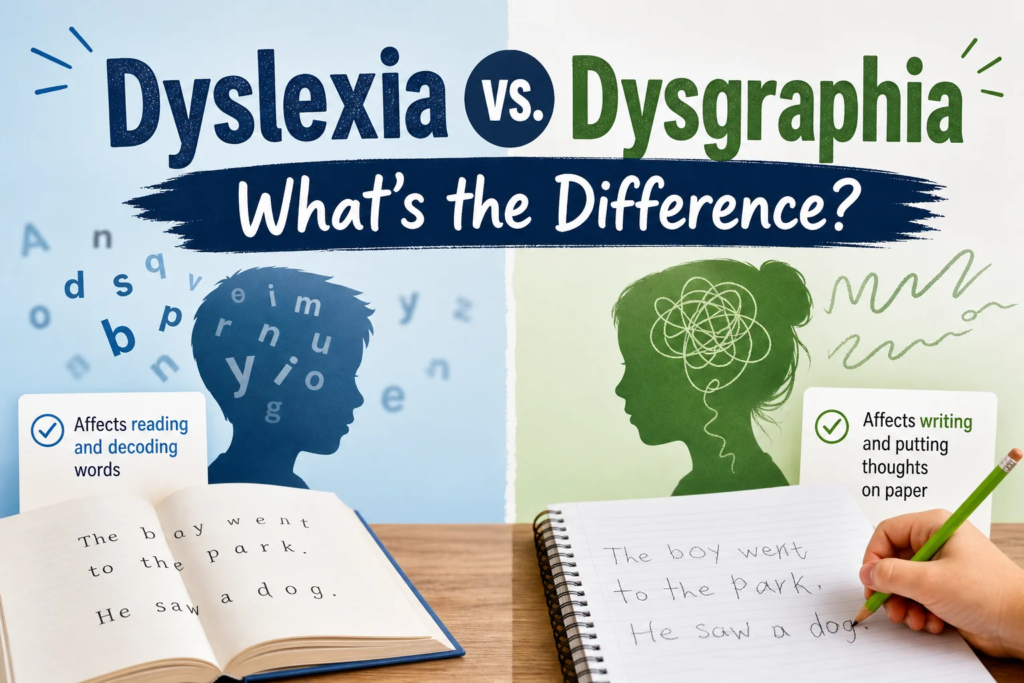
Dyslexia and dysgraphia are both learning differences, and they can overlap. But they are not the same. Dyslexia primarily affects reading, decoding, spelling, and phonological processing. Dysgraphia primarily affects writing, handwriting, spelling, written organization, and the physical or cognitive act of getting ideas onto the page.
Understanding Dyslexia vs. Dysgraphia: What’s the Difference? can change everything: the kind of evaluation a person receives, the accommodations they qualify for, the interventions that help, and perhaps most importantly, how they see themselves.
Because when a child is mislabeled as lazy, careless, or unmotivated, confidence takes a hit. But when we identify the real issue—whether dyslexia, dysgraphia, or both—we can replace frustration with strategy.
This in-depth guide breaks down the difference between dyslexia and dysgraphia, explains how they show up in real life, shares case studies, compares symptoms, and offers practical supports for home, school, and work.
Quick Answer: Dyslexia vs. Dysgraphia: What’s the Difference?
If you want the short version, here it is:
| Learning Difference | Main Area Affected | Common Struggles | What It May Look Like |
|---|---|---|---|
| Dyslexia | Reading and language processing | Decoding, reading fluency, spelling, phonological awareness | Slow reading, guessing words, trouble sounding out words |
| Dysgraphia | Writing and written expression | Handwriting, spelling, sentence structure, written organization, fine motor writing skills | Messy handwriting, slow writing, trouble getting ideas on paper |
So, Dyslexia vs. Dysgraphia: What’s the Difference? Dyslexia is most closely tied to reading and language decoding, while dysgraphia is most closely tied to writing and written output.
But there is a catch: they often overlap. A child with dyslexia may also have spelling and writing difficulties. A child with dysgraphia may read well but still struggle intensely with writing. Some people have both.
What Is Dyslexia?
Dyslexia is a language-based learning difference that primarily affects reading. It often involves difficulty with phonological processing, which means the brain has trouble recognizing and manipulating the sounds in language.
For example, a child with dyslexia may struggle to connect letters with sounds, blend sounds into words, or break words into parts. This can make reading slow, effortful, and exhausting.
Dyslexia is not related to intelligence. Many people with dyslexia are highly creative, insightful, and capable. The challenge is not understanding ideas; it is processing written language efficiently.
Common Signs of Dyslexia
Dyslexia can look different depending on age, instruction, and severity. Common signs include:
- Difficulty sounding out unfamiliar words
- Slow, choppy, or inaccurate reading
- Guessing words based on shape or context
- Trouble recognizing common sight words
- Poor spelling, even with frequent practice
- Avoidance of reading tasks
- Difficulty remembering letter-sound relationships
- Confusing similar-looking words or letters
- Trouble with rhyming or identifying syllables
- Fatigue after reading
When people ask Dyslexia vs. Dysgraphia: What’s the Difference?, one of the clearest clues is whether the main struggle begins with reading. If reading accuracy, decoding, and fluency are the biggest barriers, dyslexia may be involved.
What Is Dysgraphia?
Dysgraphia is a learning difference that affects writing. It can involve handwriting, spelling, grammar, sentence structure, written organization, and the ability to translate thoughts into written language.
Some people with dysgraphia have poor fine motor control, making handwriting physically difficult. Others can write neatly if they go very slowly but cannot keep up with classroom expectations. Some have strong verbal ideas but produce short, disorganized, or incomplete written responses.
Dysgraphia is not simply “bad handwriting.” It can affect the entire writing process.
Common Signs of Dysgraphia
Signs of dysgraphia may include:
- Messy, inconsistent, or hard-to-read handwriting
- Writing that is unusually slow or tiring
- Awkward pencil grip or hand pain while writing
- Difficulty spacing letters and words
- Trouble copying from the board
- Inconsistent letter formation
- Avoidance of writing assignments
- Strong oral answers but weak written work
- Poor punctuation or capitalization
- Difficulty organizing ideas in writing
- Trouble writing complete sentences or paragraphs
In the conversation around Dyslexia vs. Dysgraphia: What’s the Difference?, dysgraphia stands out because the person may understand the material but struggle to express that understanding in writing.
Dyslexia vs. Dysgraphia: What’s the Difference? A Clear Side-by-Side Comparison
The easiest way to understand dyslexia and dysgraphia differences is to compare how each condition affects learning.
| Category | Dyslexia | Dysgraphia |
|---|---|---|
| Primary challenge | Reading | Writing |
| Main academic impact | Decoding, fluency, spelling, reading comprehension | Handwriting, written expression, spelling, organization |
| Common strength | Oral reasoning, creativity, big-picture thinking | Verbal explanation, creativity, visual thinking |
| Physical writing difficulty? | Sometimes, but not always | Often |
| Reading difficulty? | Usually | Not necessarily |
| Spelling difficulty? | Very common | Common |
| Handwriting difficulty? | May occur | Very common |
| Main question to ask | “Can the person read words accurately and fluently?” | “Can the person write clearly, efficiently, and organize ideas on paper?” |
| Helpful supports | Structured literacy, phonics, audiobooks, reading accommodations | Keyboarding, speech-to-text, writing templates, occupational therapy |
The core distinction in Dyslexia vs. Dysgraphia: What’s the Difference? is this: dyslexia affects access to written language through reading, while dysgraphia affects output through writing.
Why Dyslexia and Dysgraphia Are Often Confused
Dyslexia and dysgraphia are frequently confused because both can affect spelling and written schoolwork. A student with dyslexia may spell poorly because they struggle to hear and map sounds in words. A student with dysgraphia may spell poorly because writing demands overload memory, motor skills, and language organization.
From the outside, both students may turn in work with misspellings, incomplete sentences, or messy assignments. But the reason behind the struggle may be different.
Example
Two students write the word “because” incorrectly.
- A student with dyslexia may write “becus” because they are relying on sound and have not stored the correct spelling pattern.
- A student with dysgraphia may know how to spell “because” verbally but write it incorrectly when handwriting because the writing process is too effortful.
That is why the question Dyslexia vs. Dysgraphia: What’s the Difference? is not just academic. It affects intervention. A dyslexic student may need structured phonics and decoding instruction. A dysgraphic student may need handwriting support, occupational therapy, assistive technology, and writing scaffolds.
Reading Disorder vs. Written Expression Disorder
Another way to frame Dyslexia vs. Dysgraphia: What’s the Difference? is to think about input and output.
Reading is input. Writing is output.
Dyslexia makes it harder to take in written language. Dysgraphia makes it harder to produce written language.
| Skill | Related More Strongly to Dyslexia | Related More Strongly to Dysgraphia |
|---|---|---|
| Sounding out words | Yes | Sometimes |
| Reading fluency | Yes | Usually no |
| Reading comprehension | Sometimes affected by decoding | Usually not directly |
| Handwriting | Sometimes | Yes |
| Written organization | Sometimes | Yes |
| Copying notes | Sometimes | Yes |
| Spelling | Yes | Yes |
| Oral storytelling | Often strong | Often strong |
| Written essays | May be difficult | Often difficult |
This reading disorder vs. written expression disorder distinction is useful, but real people do not always fit neatly into boxes. A child may have dyslexia, dysgraphia, ADHD, developmental language disorder, or a combination.
Can Someone Have Both Dyslexia and Dysgraphia?
Yes. A person can absolutely have both dyslexia and dysgraphia.
In fact, the overlap is common because reading, spelling, and writing rely on connected language systems. A student with dyslexia may struggle with spelling and written expression. A student with dysgraphia may struggle with spelling and written fluency. When both are present, schoolwork can feel overwhelming.
Signs Both May Be Present
A student may have both dyslexia and dysgraphia if they show:
- Slow, inaccurate reading
- Significant spelling problems
- Messy or labored handwriting
- Trouble writing sentences or paragraphs
- Avoidance of both reading and writing
- Strong verbal intelligence but weak written performance
- Difficulty completing written assignments on time
In cases like this, Dyslexia vs. Dysgraphia: What’s the Difference? becomes less about choosing one label and more about identifying all areas that need support.
What Causes Dyslexia and Dysgraphia?
Both dyslexia and dysgraphia are neurodevelopmental, meaning they are related to how the brain develops and processes information. They are not caused by laziness, poor parenting, lack of effort, or low intelligence.
Dyslexia Causes and Brain-Based Factors
Dyslexia is often linked to differences in brain networks involved in:
- Phonological processing
- Rapid naming
- Orthographic mapping
- Working memory
- Language processing
- Reading fluency
It also tends to run in families. If a parent or sibling has dyslexia, a child may be more likely to have it.
Dysgraphia Causes and Brain-Based Factors
Dysgraphia can involve differences in:
- Fine motor control
- Visual-motor integration
- Working memory
- Language formulation
- Orthographic coding
- Executive functioning
- Motor planning
For some people, dysgraphia is mostly physical: handwriting is painful, slow, or poorly controlled. For others, it is more language-based: they struggle to organize sentences and paragraphs. Many experience both.
Understanding Dyslexia vs. Dysgraphia: What’s the Difference? requires looking beyond the surface and asking which brain-based skills are being taxed.
Dyslexia vs. Dysgraphia Symptoms by Age
The signs of dyslexia and dysgraphia may change as academic demands increase.
| Age/Stage | Possible Dyslexia Signs | Possible Dysgraphia Signs |
|---|---|---|
| Preschool | Trouble rhyming, delayed speech, difficulty learning letters | Avoids coloring or drawing, awkward grip, trouble tracing |
| Kindergarten–Grade 2 | Difficulty learning letter sounds, slow decoding, guessing words | Poor letter formation, trouble copying, slow handwriting |
| Grades 3–5 | Slow reading, poor spelling, weak fluency | Messy written work, short responses, difficulty writing paragraphs |
| Middle School | Avoids reading, struggles with textbooks, poor note-taking | Trouble organizing essays, hand fatigue, incomplete written work |
| High School | Slow reading load, difficulty with foreign language, test fatigue | Difficulty with timed essays, note-taking, written exams |
| Adulthood | Avoids reading-heavy tasks, slow email processing | Avoids written reports, struggles with forms, prefers verbal communication |
When parents search for Dyslexia vs. Dysgraphia: What’s the Difference?, they are often trying to decode these patterns. The key is to watch where the breakdown happens: reading input, written output, or both.
Case Study 1: Maya, the Strong Speaker Who Couldn’t Get Words on Paper
Maya was a fourth grader with a huge vocabulary and a love of science. During class discussions, she explained concepts clearly. She could describe the water cycle, compare animal habitats, and ask thoughtful questions.
But her written assignments told a different story. Her handwriting was cramped and uneven. She wrote only two or three sentences when classmates wrote full paragraphs. She often cried during homework and said, “My hand can’t keep up with my brain.”
Her teacher initially suspected dyslexia because Maya’s spelling was weak. But Maya read grade-level texts fluently and understood them well. During an evaluation, her reading scores were average to above average. Her handwriting speed, written expression, and visual-motor integration were significantly weaker.
Maya was diagnosed with dysgraphia.
Support Plan
Maya received:
- Keyboarding instruction
- Speech-to-text tools
- Graphic organizers
- Reduced copying demands
- Extra time for writing tasks
- Occupational therapy for handwriting mechanics
Analysis
Maya’s case shows why Dyslexia vs. Dysgraphia: What’s the Difference? matters. Her main barrier was not reading; it was writing. If she had received only reading intervention, her real need would have been missed.
Case Study 2: Leo, the Curious Reader Who Couldn’t Decode
Leo was a second grader who loved listening to stories. He could discuss characters, predict endings, and remember details from read-alouds. But when he had to read independently, he guessed at words.
He read “horse” as “house,” “from” as “for,” and “grin” as “girl.” He avoided books and often complained of stomachaches before reading groups.
His handwriting was age-appropriate, and he could copy sentences from the board. But his spelling was highly phonetic, and he had trouble connecting letters to sounds.
An evaluation showed weaknesses in phonological awareness, decoding, and rapid naming. Leo was diagnosed with dyslexia.
Support Plan
Leo received:
- Structured literacy instruction
- Explicit phonics intervention
- Decodable texts
- Audiobooks for content learning
- Extra time for reading assignments
- Spelling instruction tied to sound patterns
Analysis
Leo’s case illustrates the classic difference between dyslexia and dysgraphia. His writing was not the primary issue. His biggest struggle was decoding written words. For Leo, the answer to Dyslexia vs. Dysgraphia: What’s the Difference? pointed clearly toward dyslexia.
Case Study 3: Jordan, the Teen With Both Dyslexia and Dysgraphia
Jordan was a ninth grader who had always worked harder than classmates. Reading took him twice as long, and writing essays felt impossible. He had excellent ideas in conversation but turned in short, poorly organized papers full of spelling errors.
Teachers described him as bright but inconsistent. His parents said homework took hours every night.
Testing revealed difficulties in decoding, reading fluency, spelling, handwriting speed, and written expression. Jordan had both dyslexia and dysgraphia.
Support Plan
Jordan’s school team created a plan that included:
- Audiobooks and text-to-speech
- Speech-to-text for essays
- Explicit writing instruction
- Graphic organizers
- Reduced copying requirements
- Extra time on tests
- Access to teacher notes
- Structured reading intervention
Analysis
Jordan’s story is important because Dyslexia vs. Dysgraphia: What’s the Difference? is not always either-or. Some learners need support for both reading and writing. When both conditions are present, accommodations should reduce barriers while interventions build skills.
Case Study 4: Elena, an Adult Who Finally Had an Explanation
Elena was a successful project manager. She was articulate, organized in meetings, and excellent at solving problems. But she dreaded writing reports. Emails took too long. She reread messages repeatedly before sending them, worried about spelling mistakes and awkward phrasing.
As a child, she had been told she was careless. In college, she survived by choosing classes with fewer written exams. At work, she compensated by using templates and asking trusted colleagues to proofread important documents.
After her son was evaluated for dyslexia, Elena recognized similar patterns in herself. Adult testing showed a history of dyslexia with persistent spelling and written fluency challenges.
Support Plan
Elena began using:
- Text-to-speech for proofreading
- Grammar and spelling tools
- Dictation software
- Email templates
- Written communication checklists
- More realistic deadlines for writing-heavy projects
Analysis
Elena’s experience shows that the question Dyslexia vs. Dysgraphia: What’s the Difference? is not just for children. Adults may also struggle with reading, spelling, writing, or written fluency—and many have spent years masking their difficulties.
Dyslexia vs. Dysgraphia in Children: What Parents Should Watch For
For parents, the biggest challenge is knowing when a struggle is typical and when it deserves closer attention. Many children reverse letters, spell creatively, or write messily when they are young. But persistent patterns are worth investigating.
Red Flags for Dyslexia
Consider screening for dyslexia if a child:
- Has trouble learning letter sounds
- Cannot rhyme or identify sounds in words
- Guesses while reading
- Reads slowly despite practice
- Avoids reading
- Struggles with spelling
- Has a family history of dyslexia
Red Flags for Dysgraphia
Consider screening for dysgraphia if a child:
- Has unusually messy handwriting
- Writes very slowly
- Complains of hand pain
- Avoids writing
- Has trouble copying
- Leaves large gaps between oral and written performance
- Cannot organize ideas on paper
When thinking about Dyslexia vs. Dysgraphia: What’s the Difference?, parents can ask: “Is my child struggling more to read words, or struggling more to write and express ideas on paper?”
Dyslexia vs. Dysgraphia in the Classroom
Teachers are often the first to notice patterns. A student may participate confidently in discussions but produce very little written work. Another may understand math concepts but fail word problems because reading the problem is difficult.
Here is how dyslexia and dysgraphia may show up in class.
| Classroom Task | Student With Dyslexia May… | Student With Dysgraphia May… |
|---|---|---|
| Reading aloud | Misread words, skip lines, read slowly | Read adequately but dislike written follow-up |
| Copying notes | Struggle if reading from board is hard | Copy slowly, unevenly, or incompletely |
| Spelling test | Misspell based on sound confusion | Know orally but write inconsistently |
| Essay writing | Struggle with spelling and word retrieval | Struggle with handwriting, organization, length |
| Timed test | Need more time to read questions | Need more time to write answers |
| Homework | Avoid reading assignments | Avoid written assignments |
A classroom lens makes Dyslexia vs. Dysgraphia: What’s the Difference? easier to observe. Dyslexia often affects reading access. Dysgraphia often affects written production.
Assessment: How Dyslexia and Dysgraphia Are Diagnosed
A proper evaluation should look at multiple skills, not just grades or handwriting samples. Diagnosis may involve educational psychologists, neuropsychologists, speech-language pathologists, occupational therapists, or specialized educational evaluators.
Areas Commonly Assessed for Dyslexia
A dyslexia evaluation may examine:
- Phonological awareness
- Letter-sound knowledge
- Decoding
- Word recognition
- Reading fluency
- Reading comprehension
- Spelling
- Rapid automatized naming
- Working memory
- Oral language
Areas Commonly Assessed for Dysgraphia
A dysgraphia evaluation may examine:
- Handwriting speed
- Letter formation
- Fine motor skills
- Visual-motor integration
- Spelling
- Sentence writing
- Written expression
- Planning and organization
- Working memory
- Executive functioning
Because dyslexia and dysgraphia can overlap, a strong evaluation should not stop after identifying one issue. If a child has dyslexia but still cannot write effectively after reading support, dysgraphia should also be considered.
Intervention for Dyslexia: What Helps?
Dyslexia responds best to explicit, systematic, structured literacy instruction. This means teaching reading in a clear, sequential way that connects sounds, letters, syllables, spelling patterns, and word meanings.
Helpful Dyslexia Interventions
- Structured literacy programs
- Explicit phonics instruction
- Multisensory reading practice
- Phonemic awareness training
- Decodable readers
- Fluency practice
- Morphology instruction
- Spelling instruction based on patterns
- Audiobooks for access to content
- Text-to-speech tools
A student with dyslexia needs reading instruction that targets the root problem. Simply asking them to read more is usually not enough.
In the bigger picture of Dyslexia vs. Dysgraphia: What’s the Difference?, dyslexia intervention focuses on improving reading accuracy, fluency, and language decoding.
Intervention for Dysgraphia: What Helps?
Dysgraphia support depends on the type of writing difficulty. Some students need occupational therapy for handwriting mechanics. Others need explicit writing instruction, assistive technology, or executive function support.
Helpful Dysgraphia Interventions
- Occupational therapy
- Handwriting instruction
- Keyboarding practice
- Speech-to-text software
- Graphic organizers
- Sentence frames
- Writing checklists
- Reduced copying
- Extra time
- Note-taking support
- Explicit instruction in planning and revising
Dysgraphia intervention should reduce the physical and cognitive load of writing while helping the learner build skills.
When discussing Dyslexia vs. Dysgraphia: What’s the Difference?, dysgraphia intervention focuses less on decoding words and more on producing written language efficiently and clearly.
Assistive Technology for Dyslexia and Dysgraphia
Technology can be life-changing. It does not replace instruction, but it can remove barriers so students can show what they know.
| Tool | Helps Dyslexia | Helps Dysgraphia | Why It Helps |
|---|---|---|---|
| Text-to-speech | Yes | Sometimes | Reads text aloud to reduce decoding load |
| Audiobooks | Yes | Sometimes | Supports access to grade-level content |
| Speech-to-text | Sometimes | Yes | Lets users dictate instead of handwriting |
| Word prediction | Yes | Yes | Supports spelling and writing speed |
| Spell-check/grammar tools | Yes | Yes | Helps with editing and accuracy |
| Graphic organizers | Sometimes | Yes | Supports planning and structure |
| Keyboarding | Sometimes | Yes | Reduces handwriting demands |
| Smart pens | Sometimes | Yes | Supports note-taking |
| Digital worksheets | Yes | Yes | Allows typing, zooming, and audio support |
Assistive technology is not “cheating.” It is access. Glasses help people see. Ramps help people enter buildings. Text-to-speech and speech-to-text help learners access and express knowledge.
Accommodations: What Schools and Workplaces Can Do
Accommodations do not lower expectations. They remove unnecessary barriers.
Common Accommodations for Dyslexia
- Extra time on reading-heavy tests
- Audiobooks
- Text-to-speech
- Reduced reading load when appropriate
- Oral testing options
- Access to notes or outlines
- Avoiding forced reading aloud
- Structured literacy intervention
Common Accommodations for Dysgraphia
- Extra time for written assignments
- Keyboarding instead of handwriting
- Speech-to-text access
- Reduced copying from the board
- Teacher-provided notes
- Alternative ways to demonstrate knowledge
- Graphic organizers
- Shortened written output when content mastery is the goal
In the context of Dyslexia vs. Dysgraphia: What’s the Difference?, accommodations should match the barrier. A student with dyslexia may need help accessing text. A student with dysgraphia may need help producing written work.
Emotional Impact: The Hidden Cost of Misunderstanding
The academic signs are visible. The emotional signs are often quieter.
Students with dyslexia or dysgraphia may feel embarrassed, anxious, or defeated. They may hear, “Try harder,” when they are already trying harder than everyone else. They may avoid reading, writing, school, or work tasks—not because they do not care, but because repeated failure hurts.
Emotional Signs to Watch For
- Homework meltdowns
- School avoidance
- Low self-esteem
- “I’m stupid” comments
- Perfectionism
- Giving up quickly
- Anger during reading or writing tasks
- Avoidance of written communication
A compassionate understanding of Dyslexia vs. Dysgraphia: What’s the Difference? helps adults respond differently. Instead of asking, “Why won’t you do this?” we can ask, “What is making this hard, and what support would help?”
That shift can protect confidence.
Myths About Dyslexia and Dysgraphia
Misunderstandings can delay support. Let’s clear up a few common myths.
| Myth | Reality |
|---|---|
| Dyslexia means seeing letters backward. | Letter reversals can happen, but dyslexia is mainly about language processing and decoding. |
| Dysgraphia is just messy handwriting. | Dysgraphia can affect handwriting, spelling, written organization, and written expression. |
| Smart kids cannot have dyslexia or dysgraphia. | Intelligence and learning differences are separate. Many bright people have both. |
| They will grow out of it. | Skills can improve with support, but the learning difference often remains. |
| More practice is always the answer. | Practice helps only when paired with the right instruction and accommodations. |
| Assistive technology is cheating. | Assistive technology provides access and allows people to show what they know. |
These myths are why Dyslexia vs. Dysgraphia: What’s the Difference? should be part of parent education, teacher training, and workplace awareness.
Dyslexia and Handwriting Problems: Are They Connected?
Many people wonder whether handwriting problems automatically mean dysgraphia. Not always.
A person with dyslexia may have poor handwriting for several reasons. They may avoid writing because spelling is difficult. They may write slowly because they are unsure how to spell words. Their written work may look weak because decoding and spelling consume so much mental energy.
But if handwriting itself is slow, painful, poorly formed, or physically difficult, dysgraphia may be present.
Ask These Questions
- Can the person read better than they write?
- Can they explain ideas verbally but not in writing?
- Is handwriting unusually slow or tiring?
- Are letter formation and spacing inconsistent?
- Does typing improve output significantly?
- Is spelling poor even when reading is strong?
These questions help clarify Dyslexia vs. Dysgraphia: What’s the Difference? in real-world situations.
Spelling: The Overlap Zone
Spelling is one of the biggest reasons dyslexia and dysgraphia are confused.
Both can cause spelling problems, but the source may differ.
| Spelling Challenge | More Typical of Dyslexia | More Typical of Dysgraphia |
|---|---|---|
| Trouble hearing sounds in words | Yes | Sometimes |
| Difficulty mapping sounds to letters | Yes | Sometimes |
| Can spell orally but not while writing | Sometimes | Yes |
| Spelling worsens when handwriting | Sometimes | Yes |
| Spelling improves with typing | Sometimes | Often |
| Spelling errors follow sound confusion | Yes | Sometimes |
| Spelling errors increase with writing length | Sometimes | Yes |
If spelling is the only obvious problem, deeper assessment is important. The evaluator should examine phonological processing, handwriting, written expression, and working memory.
Executive Function and Working Memory
Dyslexia and dysgraphia often involve working memory demands. Working memory is the ability to hold and use information in the mind for a short time.
Reading requires working memory because the brain must hold sounds, words, sentence meaning, and context. Writing requires working memory because the brain must juggle ideas, spelling, grammar, punctuation, handwriting, and organization.
For a student with dysgraphia, writing a sentence may involve thinking:
- What do I want to say?
- How do I start?
- How do I spell this word?
- Where does the capital letter go?
- How do I form the letters?
- Did I leave enough space?
- Does this sentence make sense?
That is a lot.
For a student with dyslexia, reading a sentence may involve thinking:
- What sound does this letter make?
- Is this a familiar word?
- Did I read that correctly?
- What did the sentence mean?
- How does it connect to the next sentence?
Again, a lot.
This is why Dyslexia vs. Dysgraphia: What’s the Difference? is not about effort. It is about cognitive load.
Practical Strategies for Parents
Parents do not need to become reading specialists or occupational therapists overnight. But they can create a supportive environment.
If Dyslexia Is Suspected
- Read aloud often to build vocabulary and comprehension
- Use audiobooks without guilt
- Practice phonemic awareness through word games
- Choose decodable books for reading practice
- Avoid shaming slow reading
- Ask the school for screening or evaluation
- Seek structured literacy support
If Dysgraphia Is Suspected
- Let your child dictate ideas before writing
- Use graphic organizers
- Try typing instead of handwriting
- Break writing assignments into small steps
- Reduce unnecessary copying
- Use pencil grips or adaptive paper if recommended
- Ask about occupational therapy or written expression evaluation
If Both Are Suspected
- Prioritize emotional safety
- Use assistive technology early
- Focus on one skill at a time
- Ask for comprehensive testing
- Celebrate ideas, not just written output
- Build strengths outside academics
At home, the best response to Dyslexia vs. Dysgraphia: What’s the Difference? is curiosity, not blame.
Practical Strategies for Teachers
Teachers can make a major difference by noticing patterns and offering flexible supports.
Classroom Supports for Dyslexia
- Provide reading materials in audio format
- Teach vocabulary explicitly
- Preview new words
- Use structured literacy methods
- Allow extra time
- Avoid surprise oral reading
- Check comprehension orally
Classroom Supports for Dysgraphia
- Allow typed assignments
- Provide copies of notes
- Use graphic organizers
- Grade content separately from handwriting when appropriate
- Offer sentence starters
- Permit oral responses
- Reduce copying tasks
- Break essays into planning, drafting, and revising stages
Universal Design Helps Everyone
Many supports for dyslexia and dysgraphia benefit all students. Graphic organizers, audio options, clear instructions, and flexible response formats make learning more accessible.
Understanding Dyslexia vs. Dysgraphia: What’s the Difference? helps teachers avoid one-size-fits-all solutions.
Practical Strategies for Adults
Adults with dyslexia or dysgraphia often develop clever coping strategies. Still, the right tools can reduce stress and improve performance.
Workplace Supports
- Use dictation software for drafts
- Turn on text-to-speech for proofreading
- Use templates for recurring documents
- Record meetings with permission
- Request agendas in advance
- Use project management tools
- Ask for verbal follow-ups when needed
- Break writing tasks into steps
- Use grammar and spelling software
Adults researching Dyslexia vs. Dysgraphia: What’s the Difference? may feel relief when they realize their challenges have a name. That recognition can lead to better self-advocacy.
How to Talk to a Child About Dyslexia or Dysgraphia
The way adults explain learning differences matters. Children often already know they are struggling. What they need is language that protects dignity.
Try saying:
“You are not lazy. Your brain learns differently. Reading is harder for you right now, so we are going to use tools and teaching that match how your brain works.”
Or:
“Your ideas are strong. Writing them down is the hard part. That does not mean your ideas are weak. It means we need better ways to help you get them out.”
Avoid saying:
- “You just need to try harder.”
- “Your handwriting is terrible.”
- “Why can everyone else do this?”
- “You’re being careless.”
- “This should be easy.”
A healthy conversation about Dyslexia vs. Dysgraphia: What’s the Difference? can help children separate identity from difficulty. They are not the problem. The mismatch between task demands and support is the problem.
Strengths Often Associated With Dyslexia and Dysgraphia
It is important to discuss challenges honestly, but not only challenges. Many people with dyslexia or dysgraphia have remarkable strengths.
Possible Strengths
- Creative thinking
- Verbal reasoning
- Problem-solving
- Big-picture understanding
- Storytelling
- Spatial reasoning
- Empathy
- Persistence
- Entrepreneurial thinking
- Innovative ideas
Of course, not every person has the same strengths. But when children hear only about what is hard, they may overlook what is powerful.
The best answer to Dyslexia vs. Dysgraphia: What’s the Difference? includes both support and strength recognition.
A Decision Guide: Dyslexia, Dysgraphia, or Both?
This simple guide can help you decide what to explore next. It is not a diagnosis, but it can point you in the right direction.
| If You Notice… | Consider Exploring… |
|---|---|
| Slow, inaccurate reading | Dyslexia |
| Trouble sounding out words | Dyslexia |
| Strong listening comprehension but weak reading | Dyslexia |
| Messy, slow, painful handwriting | Dysgraphia |
| Strong oral answers but weak written responses | Dysgraphia |
| Trouble organizing essays | Dysgraphia |
| Poor spelling plus reading difficulty | Dyslexia, possibly dysgraphia |
| Poor spelling plus handwriting difficulty | Dysgraphia, possibly dyslexia |
| Reading and writing are both very difficult | Both dyslexia and dysgraphia |
If the pattern is unclear, request a comprehensive evaluation. Guessing can waste valuable time.
Why Early Identification Is Powerful
Early identification does not label a child negatively. It opens the door to support.
When dyslexia is identified early, children can receive reading intervention before the gap widens. When dysgraphia is identified early, children can learn writing supports before they begin to hate school.
Without support, students may fall into a painful cycle:
- Task is difficult
- Student avoids it
- Skill gap grows
- Adults misinterpret avoidance
- Student feels ashamed
- Motivation drops
With support, the cycle can change:
- Task is difficult
- Adults identify why
- Student receives targeted help
- Tools reduce frustration
- Confidence improves
- Skills develop
That is the real value of understanding Dyslexia vs. Dysgraphia: What’s the Difference?
Final Comparison: Dyslexia vs. Dysgraphia at a Glance
| Question | Dyslexia | Dysgraphia |
|---|---|---|
| Is reading hard? | Usually yes | Not always |
| Is handwriting hard? | Sometimes | Usually yes |
| Is spelling hard? | Often | Often |
| Is oral language stronger than written work? | Often | Often |
| Is decoding a core issue? | Yes | Not usually |
| Is written output a core issue? | Sometimes | Yes |
| Can the student be highly intelligent? | Absolutely | Absolutely |
| Can they occur together? | Yes | Yes |
So, Dyslexia vs. Dysgraphia: What’s the Difference? Dyslexia is primarily a reading and language decoding difference. Dysgraphia is primarily a writing and written expression difference. Both deserve understanding, targeted intervention, and compassionate support.
Conclusion: From Confusion to Clarity
The question Dyslexia vs. Dysgraphia: What’s the Difference? is more than a search phrase. It is a doorway to better support.
Dyslexia affects how a person reads and processes written language. Dysgraphia affects how a person writes, forms letters, organizes ideas, and expresses knowledge on paper. They can look similar because both may involve spelling problems and weak written assignments, but they are distinct learning differences with different intervention needs.
The most important takeaway is this: struggling readers and writers are not broken. They are not lazy. They are not less intelligent. They need the right tools, the right teaching, and adults who are willing to look beneath the surface.
If you are a parent, start documenting patterns and ask for evaluation. If you are a teacher, notice the difference between reading barriers and writing barriers. If you are an adult, know that it is never too late to understand your learning profile and use supports that make life easier.
Clarity leads to compassion. Compassion leads to action. And action can change a learner’s entire story.
FAQs About Dyslexia vs. Dysgraphia: What’s the Difference?
1. Is dysgraphia a form of dyslexia?
No. Dysgraphia is not simply a form of dyslexia. Dyslexia mainly affects reading, decoding, and language processing. Dysgraphia mainly affects writing, handwriting, and written expression. However, they can occur together, and both may affect spelling.
2. Can a child have dysgraphia but not dyslexia?
Yes. A child can read fluently and still have dysgraphia. In that case, the child may understand books and classroom content but struggle to write neatly, quickly, or clearly. This is one reason Dyslexia vs. Dysgraphia: What’s the Difference? is such an important question.
3. Can a child have dyslexia but good handwriting?
Yes. Some children with dyslexia have neat handwriting. Their main challenges may be decoding, reading fluency, and spelling. Handwriting problems are not required for a dyslexia diagnosis.
4. Why do dyslexia and dysgraphia both affect spelling?
Spelling sits at the intersection of reading and writing. Dyslexia can affect spelling because of difficulty connecting sounds to letters. Dysgraphia can affect spelling because the act of writing may overload memory, motor skills, and language organization.
5. What professional diagnoses dyslexia or dysgraphia?
Dyslexia is often evaluated by educational psychologists, neuropsychologists, reading specialists, or speech-language professionals with training in literacy assessment. Dysgraphia may be evaluated by educational psychologists, neuropsychologists, occupational therapists, or specialists in written expression. A comprehensive evaluation is best.
6. What is the best intervention for dyslexia?
Structured literacy is one of the most effective approaches for dyslexia. It teaches phonics, phonemic awareness, spelling patterns, syllables, morphology, and reading fluency in an explicit and systematic way.
7. What is the best intervention for dysgraphia?
The best support depends on the learner’s needs. It may include occupational therapy, handwriting instruction, keyboarding, speech-to-text, graphic organizers, explicit writing instruction, and extra time for written tasks.
8. Are dyslexia and dysgraphia lifelong?
They can be lifelong learning differences, but skills can improve significantly with the right support. Many people with dyslexia or dysgraphia become successful students, professionals, writers, entrepreneurs, artists, scientists, and leaders.
9. Does messy handwriting always mean dysgraphia?
No. Messy handwriting alone does not automatically mean dysgraphia. But if handwriting is consistently slow, painful, poorly spaced, difficult to read, or interferes with learning, an evaluation may be helpful.
10. How do I know if it is dyslexia, dysgraphia, or both?
Look at the pattern. If the main struggle is reading words accurately and fluently, dyslexia may be involved. If the main struggle is handwriting or written expression, dysgraphia may be involved. If both reading and writing are significantly difficult, both may be present. A full evaluation can clarify the difference.

