


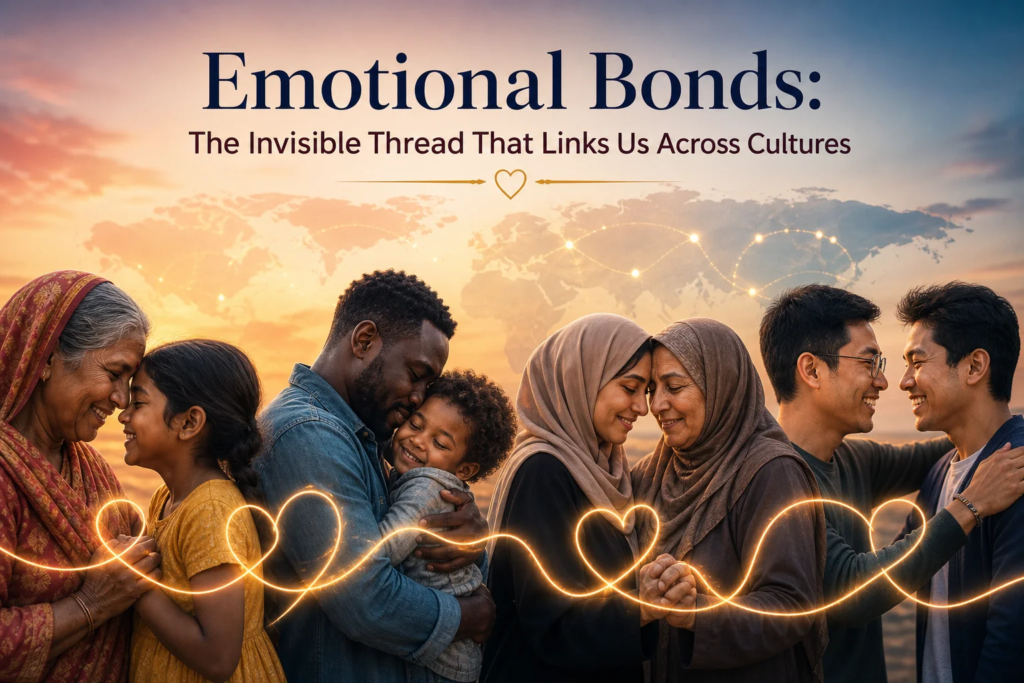
Introduction: The Human Connection We Feel Before We Understand
A baby reaches for a parent’s face in Nairobi. A grandmother in Seoul prepares a favorite meal before her grandchild arrives. A stranger in Toronto opens the door to a refugee family they have never met. A village in New Zealand gathers around someone in grief, not with speeches, but with presence.
Different languages. Different rituals. Different histories.
Yet beneath all of it runs the same quiet force: Emotional Bonds: The Invisible Thread That Links Us Across Cultures.
Before we learn rules, borders, customs, or ideologies, we learn connection. We recognize warmth in a voice, safety in a touch, belonging in shared laughter, and loss in silence. Emotional bonds are not decorative parts of human life; they are the architecture. They shape families, friendships, communities, workplaces, nations, and even peacebuilding efforts.
In a world that often emphasizes cultural differences, Emotional Bonds: The Invisible Thread That Links Us Across Cultures reminds us of something profound: we are not as separate as we appear. Culture influences how we express love, grief, loyalty, respect, and care—but the need to connect is universal.
This article explores how emotional bonds across cultures are formed, expressed, tested, and strengthened. We’ll look at science, tradition, migration, family systems, technology, conflict resolution, and real-world case studies that show how Emotional Bonds: The Invisible Thread That Links Us Across Cultures works in everyday life.
Related Long-Tail Keyword Variations
To understand the topic more fully, here are natural variations of the focus keyword used throughout this article:
| Keyword Variation | Meaning |
|---|---|
| Emotional bonds across cultures | Human attachments that exist beyond cultural differences |
| Invisible thread of human connection | The unseen force that links people emotionally |
| Cross-cultural emotional connection | Emotional understanding between people from different backgrounds |
| Universal emotional bonds | Shared human feelings such as love, care, grief, and trust |
| Cultural expressions of emotional bonds | How different societies show affection, loyalty, and belonging |
| Emotional connection in multicultural communities | Bonds formed among people from diverse cultural identities |
| Human relationships across cultures | Social and emotional connections between cultures |
These variations all point back to the central idea: Emotional Bonds: The Invisible Thread That Links Us Across Cultures.
What Are Emotional Bonds?
Emotional bonds are deep psychological and social connections that make people feel attached, valued, protected, and understood. They can exist between parents and children, friends, romantic partners, neighbors, coworkers, communities, and even entire societies.
At their core, emotional bonds are built through:
- Trust
- Shared experience
- Empathy
- Repeated care
- Mutual recognition
- Emotional safety
- Memory and meaning
What makes Emotional Bonds: The Invisible Thread That Links Us Across Cultures so powerful is that these bonds do not require perfect sameness. People can speak different languages, worship differently, eat different foods, and hold different customs—yet still feel deeply connected.
A hug may not mean the same thing everywhere. Eye contact may be respectful in one culture and uncomfortable in another. Silence may signal peace in one place and tension in another. But the emotional need underneath remains recognizable: “Do I matter to you?” “Am I safe with you?” “Will you stand with me?”
That is the invisible thread.
Why Emotional Bonds Matter More Than Ever
We live in a time of historic movement and contact. Families migrate. Workplaces become global. Friendships form online. Students study abroad. Communities become multilingual and multicultural. At the same time, polarization, loneliness, prejudice, and social fragmentation are rising in many parts of the world.
This makes Emotional Bonds: The Invisible Thread That Links Us Across Cultures not only a beautiful idea, but an urgent one.
Emotional bonds help people:
- Build trust across difference
- Reduce fear of unfamiliar cultures
- Strengthen family and community resilience
- Improve communication in multicultural spaces
- Support healing after trauma or displacement
- Create more compassionate societies
When emotional bonds are absent, stereotypes fill the space. But when people share meals, stories, grief, music, humor, and responsibility, cultural distance begins to shrink.
The invisible thread of human connection is not sentimental. It is practical. It helps people cooperate, survive, and flourish.
The Science Behind Emotional Bonds Across Cultures
Research in psychology, anthropology, and neuroscience shows that human beings are biologically wired for connection. Attachment theory, first developed through studies of children and caregivers, suggests that early emotional bonds shape how people relate to others throughout life.
Although parenting styles differ across cultures, the need for secure attachment is widely recognized. Children everywhere require some form of dependable care, emotional responsiveness, and protection.
Neuroscience also shows that emotional connection activates systems related to safety, reward, and stress regulation. When we feel seen and supported, our bodies respond. Heart rates calm. Stress hormones decrease. Trust increases.
This explains why Emotional Bonds: The Invisible Thread That Links Us Across Cultures is felt not only in the mind, but also in the body.
Universal Emotional Signals
While cultures shape expression, many emotional signals are widely understood.
| Emotional Experience | Common Human Signal | Cultural Variation |
|---|---|---|
| Love | Caregiving, protection, attention | Expressed through words, service, food, touch, or sacrifice |
| Grief | Withdrawal, tears, ritual, remembrance | Public mourning in some cultures, private grief in others |
| Respect | Listening, deference, acknowledgment | Eye contact may be respectful or disrespectful depending on culture |
| Joy | Smiling, laughter, celebration | Celebrated through dance, song, prayer, feasting, or quiet gratitude |
| Belonging | Inclusion, shared identity, loyalty | Expressed through family duty, community rituals, or chosen groups |
The key lesson: emotional bonds across cultures may wear different clothing, but they often carry the same heartbeat.
Culture Shapes the Language of Love
One of the most fascinating parts of Emotional Bonds: The Invisible Thread That Links Us Across Cultures is that love does not always look like love to outsiders.
In some Western societies, emotional closeness is often expressed verbally: “I love you,” “I’m proud of you,” or “I miss you.” In many Asian, African, Indigenous, and Latin American communities, love may be expressed more through action than words.
A parent may not say “I love you” often, but may work two jobs, prepare food, pay school fees, or insist on practical advice. A friend may show loyalty by arriving unasked during a crisis. A sibling may express affection through teasing rather than tenderness.
Misunderstandings arise when one culture expects emotional expression to look like its own.
For example:
- A reserved person may be deeply loving, not cold.
- A direct communicator may be honest, not rude.
- A family-oriented decision may reflect loyalty, not lack of independence.
- Public affection may signal warmth in one culture and discomfort in another.
Understanding Emotional Bonds: The Invisible Thread That Links Us Across Cultures requires emotional translation. We must ask not only, “What did they do?” but “What does this action mean in their world?”
Table: How Different Cultures May Express Emotional Bonds
| Cultural Context | Common Expression of Emotional Bonds | Possible Misinterpretation by Outsiders | Deeper Meaning |
|---|---|---|---|
| Japanese | Quiet support, obligation, group harmony | Emotional distance | Care through consideration and restraint |
| Mexican | Frequent family gatherings, warmth, physical affection | Over-involvement | Belonging, loyalty, and relational identity |
| Scandinavian | Respect for personal space and independence | Coldness | Trust through autonomy and non-intrusion |
| Arab | Hospitality, generosity, family honor | Excessive formality or intensity | Respect, protection, and relational duty |
| Indian | Family consultation, interdependence | Lack of privacy | Collective care and responsibility |
| Māori | Whānau, ancestry, communal identity | Group pressure | Kinship, continuity, and shared belonging |
| West African | Communal support, elder respect, shared child-rearing | Lack of individual boundaries | Collective resilience and social responsibility |
This table shows why Emotional Bonds: The Invisible Thread That Links Us Across Cultures must be understood through cultural context rather than surface behavior.
Case Study 1: Japan’s “Kizuna” After the 2011 Tōhoku Earthquake
After the devastating 2011 earthquake and tsunami in Japan, the word “kizuna” became nationally significant. Kizuna means bonds, ties, or connections between people. In the aftermath of disaster, communities relied on shared responsibility, quiet endurance, and collective care.
Volunteers traveled to affected areas. Neighbors checked on the elderly. Families honored the dead through ritual and memory. Support was often not loud or dramatic, but steady and deeply meaningful.
Analysis
This case powerfully illustrates Emotional Bonds: The Invisible Thread That Links Us Across Cultures because it shows how emotional connection can become a survival mechanism. In Japan, emotional bonds were expressed through duty, restraint, service, and collective resilience rather than constant verbal expression.
The lesson is clear: emotional bonds across cultures do not always appear as open displays of emotion. Sometimes the invisible thread is strongest in disciplined compassion.
Case Study 2: Canada’s Private Sponsorship of Refugees
Canada’s private refugee sponsorship model has allowed groups of citizens to support refugee families by helping them find housing, learn local systems, access education, and build community connections. Many sponsors begin as helpers and become long-term friends or extended family figures.
Syrian refugee sponsorship after 2015 offers a powerful example. Many families arrived after trauma, displacement, and loss. Sponsors often helped with practical needs, but the deeper transformation happened through trust: shared meals, birthdays, school milestones, hospital visits, and conversations across language barriers.
Analysis
This case shows Emotional Bonds: The Invisible Thread That Links Us Across Cultures in action across religion, language, nationality, and lived experience. Practical support opened the door, but emotional connection created belonging.
It also reveals an important truth: cross-cultural emotional connection is not built by grand speeches. It grows through repeated acts of reliability.
Case Study 3: Ubuntu and South Africa’s Truth and Reconciliation Process
The African philosophy of Ubuntu is often summarized as “I am because we are.” It emphasizes that personhood is formed through relationships. After apartheid, South Africa’s Truth and Reconciliation Commission drew partly on relational and restorative ideas. While imperfect and debated, the process recognized that national healing required more than legal judgment. It required testimony, acknowledgment, grief, and the possibility of restored human dignity.
Victims told stories. Perpetrators were confronted with human consequences. Communities witnessed pain that had often been denied or hidden.
Analysis
Ubuntu demonstrates Emotional Bonds: The Invisible Thread That Links Us Across Cultures at a societal level. Emotional bonds are not limited to private life; they can influence justice, memory, and national repair.
The relevance is profound: societies fractured by violence cannot heal only through policies. They also need emotional recognition.
Case Study 4: Māori Family Group Conferencing in New Zealand
New Zealand’s Family Group Conferencing model, influenced by Māori values, brings family, community members, victims, and professionals together to address harm, especially in youth justice and child welfare contexts. Instead of isolating the individual offender or child, the process recognizes the wider relational network.
The emphasis is on accountability, restoration, belonging, and collective responsibility.
Analysis
This is a strong example of emotional bonds across cultures shaping real-world systems. It challenges highly individualistic approaches by asking: Who belongs to this person? Who has been harmed? Who can help repair the damage?
The model reflects Emotional Bonds: The Invisible Thread That Links Us Across Cultures because it treats people not as isolated units, but as relational beings.
Case Study 5: Multicultural Healthcare and the Power of Trust
In healthcare, emotional bonds can directly affect outcomes. A doctor may offer excellent medical advice, but if the patient feels misunderstood, judged, or culturally dismissed, trust breaks down.
For example, in multicultural maternity care, some patients may rely heavily on family decision-making, traditional postpartum practices, religious beliefs, or modesty norms. Healthcare providers who acknowledge these values often build stronger therapeutic relationships.
A nurse who asks, “Are there cultural or family practices you would like us to respect during your care?” can transform the patient experience.
Analysis
This case reveals the practical importance of Emotional Bonds: The Invisible Thread That Links Us Across Cultures in professional settings. Emotional trust is not separate from competence. In many fields—medicine, education, social work, leadership—people receive support better when they feel respected.
Cultural humility strengthens emotional connection.
The Role of Food in Emotional Bonds Across Cultures
If there is one universal love language, it may be food.
Across cultures, feeding someone is rarely just biological. It is emotional. A mother packing lunch, a host pouring tea, a neighbor bringing soup, a family preparing festival dishes—all communicate care.
Food carries memory. It preserves homeland. It softens awkwardness. It gives people something to share when words are limited.
Think of:
- Korean kimchi prepared across generations
- Mexican tamales made collectively for holidays
- Indian sweets shared during Diwali
- Italian Sunday meals that gather extended family
- Ethiopian injera eaten from a shared plate
- Middle Eastern coffee rituals offered to guests
- Jewish challah at Shabbat
- Nigerian jollof rice at celebrations
Food makes Emotional Bonds: The Invisible Thread That Links Us Across Cultures visible, edible, and memorable.
A shared meal says: “You are welcome here.”
Music, Dance, and Ritual: The Emotional Grammar of Belonging
Music and dance create emotional bonds even when people do not share a language. A drumbeat, chant, lullaby, wedding song, or funeral hymn can unite bodies and emotions in the same rhythm.
Rituals also help communities process life transitions. Birth, naming, coming-of-age, marriage, death, harvest, migration, and mourning are marked differently around the world, but the emotional functions are similar.
Rituals help people:
- Make meaning from change
- Share grief and joy
- Strengthen group identity
- Pass values across generations
- Reassure individuals that they are not alone
This is another way Emotional Bonds: The Invisible Thread That Links Us Across Cultures becomes tangible. Culture gives emotion a container.
Without ritual, emotion can feel chaotic. With ritual, emotion becomes shared.
Language, Translation, and the Words We Cannot Easily Translate
Some emotional concepts are difficult to translate because they are embedded in culture.
Examples include:
| Word | Culture/Language | Approximate Meaning |
|---|---|---|
| Ubuntu | Southern African philosophy | Humanity through relationship |
| Kizuna | Japanese | Bonds or ties between people |
| Saudade | Portuguese | Deep longing, nostalgia, emotional absence |
| Gezelligheid | Dutch | Cozy togetherness and warm social comfort |
| Whānau | Māori | Extended family, kinship, belonging |
| Aloha | Hawaiian | Love, presence, compassion, greeting, spirit |
| Sisu | Finnish | Courage, resilience, inner strength |
| Sobremesa | Spanish | Time spent talking after a meal |
These words show how cultures name emotional realities differently. Yet each points back to Emotional Bonds: The Invisible Thread That Links Us Across Cultures.
When we learn another culture’s emotional vocabulary, we gain more than words. We gain new ways to feel and understand.
Family Bonds: Universal Need, Cultural Variety
Family is one of the strongest arenas for emotional bonding, but family itself is defined differently across cultures.
In some societies, the nuclear family—parents and children—is emphasized. In others, extended family networks are central. Grandparents, cousins, aunts, uncles, godparents, elders, and community members may all play major roles.
Neither model is automatically superior. Each has strengths and tensions.
Individualistic Family Systems
These often emphasize:
- Personal choice
- Independence
- Privacy
- Emotional self-expression
- Boundaries
Collectivist Family Systems
These often emphasize:
- Interdependence
- Duty
- Respect for elders
- Shared identity
- Family reputation and continuity
The challenge in multicultural families is not deciding which system is “right,” but understanding how love is being communicated.
In one family, love may mean encouraging a child to leave home and pursue independence. In another, love may mean keeping adult children close and involved in family decisions.
Both can reflect emotional bonds. The invisible thread simply takes different forms.
Friendship Across Cultures: From Quick Warmth to Slow Trust
Friendship is another area where cultural expectations differ.
In some cultures, friendship forms quickly through openness, humor, and frequent social invitations. In others, friendship develops slowly and requires long-term reliability before emotional intimacy is shared.
Some people use the word “friend” broadly. Others reserve it for a very small circle.
This can lead to confusion:
- “Why are they so friendly if we just met?”
- “Why are they so distant after months of working together?”
- “Why don’t they share personal feelings?”
- “Why do they ask so many personal questions?”
Understanding Emotional Bonds: The Invisible Thread That Links Us Across Cultures helps us avoid premature judgment. People may be following different friendship scripts.
The solution is curiosity. Ask, observe, and allow trust to grow at the pace both people can sustain.
Romantic Love and Cross-Cultural Relationships
Romantic relationships across cultures can be deeply enriching and deeply challenging. Partners may differ in communication styles, gender expectations, family involvement, religion, conflict management, emotional expression, and ideas about marriage.
One person may expect direct emotional discussion. Another may show love through responsibility and practical sacrifice. One family may expect frequent visits. Another may value couple privacy. One partner may see disagreement as normal. Another may experience it as disrespectful.
Successful cross-cultural couples often develop a third culture—a shared relational world that honors both backgrounds while creating new customs.
They ask questions such as:
- What does love look like in your family?
- How did your parents handle conflict?
- What role should extended family play?
- How do you prefer to receive comfort?
- What traditions matter most to you?
- How do we celebrate both identities?
In this context, Emotional Bonds: The Invisible Thread That Links Us Across Cultures becomes not just an idea, but a daily practice of listening, compromise, and mutual translation.
Emotional Bonds in Multicultural Workplaces
Workplaces are increasingly global, and emotional bonds matter there too. Professional environments often pretend to be purely rational, but trust, belonging, recognition, and psychological safety shape performance.
In multicultural teams, misunderstandings can emerge around:
- Direct versus indirect feedback
- Attitudes toward hierarchy
- Time management
- Public disagreement
- Individual versus group recognition
- Humor
- Silence in meetings
- Decision-making speed
Leaders who understand emotional bonds across cultures create better teams. They do not assume everyone builds trust the same way.
Practical Workplace Trust Chart
| Leadership Action | Emotional Impact | Cross-Cultural Benefit |
|---|---|---|
| Learn correct name pronunciation | Recognition and respect | Reduces cultural invisibility |
| Invite multiple communication styles | Safety and inclusion | Helps both direct and indirect communicators |
| Clarify expectations explicitly | Reduces anxiety | Prevents culture-based assumptions |
| Recognize team and individual contributions | Balanced appreciation | Respects collectivist and individualist values |
| Create informal connection opportunities | Builds trust | Encourages human bonds beyond tasks |
| Address bias quickly | Restores safety | Protects dignity and belonging |
A workplace that values Emotional Bonds: The Invisible Thread That Links Us Across Cultures becomes more than diverse. It becomes connected.
Technology: Does the Invisible Thread Survive Online?
Digital communication has transformed emotional bonds. Families separated by migration use video calls to stay close. International friendships form through gaming communities, language exchanges, social media, and online learning. Diaspora communities preserve culture through digital storytelling.
Technology can strengthen emotional bonds across cultures by allowing people to:
- Share daily life instantly
- Maintain long-distance family ties
- Learn about other cultures
- Organize mutual aid
- Translate languages
- Create global communities around shared interests
But technology also has limits. Miscommunication increases without tone, body language, and context. Online spaces can flatten culture into stereotypes. Emotional bonds may become broad but shallow if not nurtured intentionally.
The invisible thread of human connection can travel through screens, but it still needs presence, attention, honesty, and care.
Migration and the Emotional Cost of Belonging Between Worlds
Migration is one of the most powerful tests of emotional bonds. People who move across borders often carry invisible emotional luggage: homesickness, guilt, hope, obligation, grief, and identity conflict.
Immigrants may feel emotionally tied to both homeland and host country. Their children may inherit cultural memories they did not directly live. Families may become transnational, with love stretched across time zones.
Common emotional experiences include:
- Missing family rituals
- Feeling pressure to succeed
- Translating for parents
- Navigating cultural expectations
- Experiencing identity confusion
- Building new support networks
- Preserving language and tradition
Here, Emotional Bonds: The Invisible Thread That Links Us Across Cultures becomes both comfort and tension. Bonds to the past help preserve identity. Bonds in the new place help create belonging.
Healthy multicultural societies make room for both.
The Shadow Side: When Emotional Bonds Exclude Others
Emotional bonds are powerful, but they are not automatically positive. Strong bonds within a group can sometimes create suspicion toward outsiders. Family loyalty can become control. National belonging can become xenophobia. Cultural pride can become superiority.
This is why Emotional Bonds: The Invisible Thread That Links Us Across Cultures must be paired with empathy beyond the inner circle.
The goal is not to weaken close bonds, but to widen moral imagination.
Healthy emotional bonds say: “These are my people.”
Mature emotional bonds add: “And other people matter too.”
The invisible thread should not become a rope that ties people only to their own group. At its best, it becomes a bridge.
How to Build Emotional Bonds Across Cultures
Building cross-cultural emotional connection does not require becoming an expert in every tradition. It requires humility, patience, and genuine interest.
1. Listen Before Interpreting
When someone behaves differently than expected, pause before judging. Ask what the behavior might mean in their cultural context.
2. Learn Names, Stories, and Contexts
A person’s name, migration story, family structure, and traditions often carry emotional significance.
3. Share Food and Rituals Respectfully
Accepting hospitality or inviting someone into your own traditions can create powerful bonds.
4. Ask Better Questions
Instead of “Why do you do that?” try “What does this tradition mean to you?”
5. Respect Different Emotional Styles
Some people process feelings openly. Others need privacy. Emotional depth is not always loud.
6. Show Up Consistently
Trust grows through repeated reliability. Small acts matter.
7. Repair Misunderstandings Quickly
Cross-cultural relationships will involve mistakes. Apologize, clarify, and learn.
8. Avoid Cultural Performance
Do not reduce someone to festivals, food, or clothing. Culture is lived experience, not decoration.
9. Honor Both Similarity and Difference
Connection does not require pretending everyone is the same. Real emotional bonds allow difference to remain.
10. Practice Mutual Adaptation
Do not expect only one person or group to adjust. Shared belonging requires shared effort.
These practices make Emotional Bonds: The Invisible Thread That Links Us Across Cultures visible in daily life.
A Simple Framework: The THREAD Model
To remember how emotional bonds across cultures are built, use the THREAD model.
| Letter | Principle | Practice |
|---|---|---|
| T | Trust | Keep promises and respect boundaries |
| H | Humility | Admit what you do not know |
| R | Recognition | See the person beyond stereotypes |
| E | Empathy | Try to understand emotional meaning |
| A | Adaptation | Adjust communication when needed |
| D | Dialogue | Keep honest conversation open |
The THREAD model reflects the heart of Emotional Bonds: The Invisible Thread That Links Us Across Cultures: connection is created through repeated, respectful human choices.
What Children Teach Us About Emotional Bonds
Children often understand emotional bonds before adults complicate them. They may not know each other’s language, but they play. They share toys, copy gestures, laugh at the same absurdities, and comfort each other with surprising tenderness.
In multicultural classrooms, teachers often see friendships form through rhythm, drawing, games, snacks, and shared routines. Children notice difference, but difference does not always become distance unless adults teach it that way.
This does not mean children are free from bias. They absorb social messages early. But they also show that emotional bonds across cultures can begin with simple presence.
A child asking another child to play may be one of the purest examples of Emotional Bonds: The Invisible Thread That Links Us Across Cultures.
Storytelling: The Bridge Between Worlds
Stories are among humanity’s oldest bonding tools. Around fires, in temples, at dinner tables, through novels, films, songs, and podcasts, people use stories to say: “This is who we are. This is what we survived. This is what we love.”
Cross-cultural storytelling is especially powerful because it allows people to enter another emotional world without invading it.
When someone tells a story about leaving home, caring for a parent, losing a loved one, falling in love, or searching for dignity, listeners may recognize their own emotions in unfamiliar details.
That recognition is the invisible thread.
Storytelling turns strangers into human beings with names, memories, and reasons.
Emotional Bonds and Peacebuilding
Conflict often depends on emotional disconnection. It becomes easier to harm people when they are seen as categories rather than humans.
Peacebuilding work frequently involves rebuilding emotional recognition. Dialogue circles, victim-offender mediation, interfaith projects, youth exchanges, and community reconciliation efforts all rely on the possibility that people can begin to see one another differently.
This does not mean emotional bonds erase injustice. Real peace requires accountability, structural change, and truth. But emotional bonds can make those processes more humane and more durable.
Emotional Bonds: The Invisible Thread That Links Us Across Cultures matters because no society can legislate trust into existence. Trust must be lived.
The Future of Emotional Bonds in a Globalized World
As globalization continues, cultural identities will become more layered. More people will belong to multiple places, speak multiple languages, marry across cultures, work across borders, and raise children between traditions.
The future will require emotional intelligence at a cultural level.
We will need people who can:
- Hold complex identities
- Communicate across difference
- Resist stereotypes
- Build trust quickly and ethically
- Honor ancestral traditions while adapting to new realities
- Create belonging without demanding sameness
In that future, Emotional Bonds: The Invisible Thread That Links Us Across Cultures will be one of the most important human skills.
The societies that thrive will not simply be the most technologically advanced. They will be the ones that know how to connect.
Conclusion: The Thread Is Already in Our Hands
Emotional Bonds: The Invisible Thread That Links Us Across Cultures is not an abstract slogan. It is present in a refugee family’s first shared meal with new neighbors. It is in a grandmother’s recipe, a mourning song, a careful apology, a remembered name, a hand held in silence, a workplace where people feel seen, and a child inviting another child to play.
Culture shapes how we express emotion, but it does not erase our shared need for connection. Across continents and customs, people long to be recognized, protected, loved, respected, and remembered.
The great challenge of our time is not merely learning about other cultures. It is learning how to bond across them.
Start small. Learn someone’s story. Pronounce their name correctly. Ask what matters to them. Share a meal. Listen without rushing to compare. Repair mistakes. Let difference deepen curiosity rather than fear.
The invisible thread is already there.
Our task is to notice it, honor it, and strengthen it—one human connection at a time.
1. What does “Emotional Bonds: The Invisible Thread That Links Us Across Cultures” mean?
It means that despite cultural differences, human beings share a universal need for connection, belonging, love, trust, and emotional safety. Cultures may express these bonds differently, but the underlying need is common across humanity.
2. Are emotional bonds the same in every culture?
No. Emotional bonds are universal, but their expression varies. Some cultures show love through words, while others show it through service, sacrifice, food, duty, or presence. Understanding cultural context is essential.
3. How can I build emotional bonds with someone from a different culture?
Start with respect, curiosity, and consistency. Learn their name, listen to their story, ask thoughtful questions, avoid stereotypes, and be open to different ways of expressing emotion.
4. Why do cross-cultural misunderstandings happen in relationships?
They often happen because people interpret behavior through their own cultural expectations. For example, silence may seem cold to one person but respectful to another. Emotional translation helps reduce misunderstanding.
5. Can emotional bonds help reduce prejudice?
Yes. Meaningful emotional contact can challenge stereotypes and humanize people from different backgrounds. Shared experiences, friendships, storytelling, and cooperation can reduce fear and increase empathy.
6. How do emotional bonds affect multicultural workplaces?
They influence trust, communication, teamwork, and psychological safety. Employees perform better when they feel respected, included, and understood across cultural differences.
7. Why is food so important in emotional bonds across cultures?
Food is a powerful symbol of care, hospitality, memory, and belonging. Sharing food allows people to connect even when language or customs differ.
8. Can technology create real emotional bonds across cultures?
Yes, but it depends on how it is used. Video calls, online communities, and digital storytelling can create meaningful connection, but emotional bonds still require attention, honesty, and consistency.


The PsyForU Editorial Collective is the research and editorial team of PsyForU Research International. The collective prepares educational, psychological, mental-health-awareness, inclusion, neurodiversity, and research-methodology content for students, parents, educators, researchers, and general readers. PsyForU content is intended for awareness, education, and capacity-building and should not be treated as clinical diagnosis, therapy, medical advice, legal advice, or emergency mental-health support.