


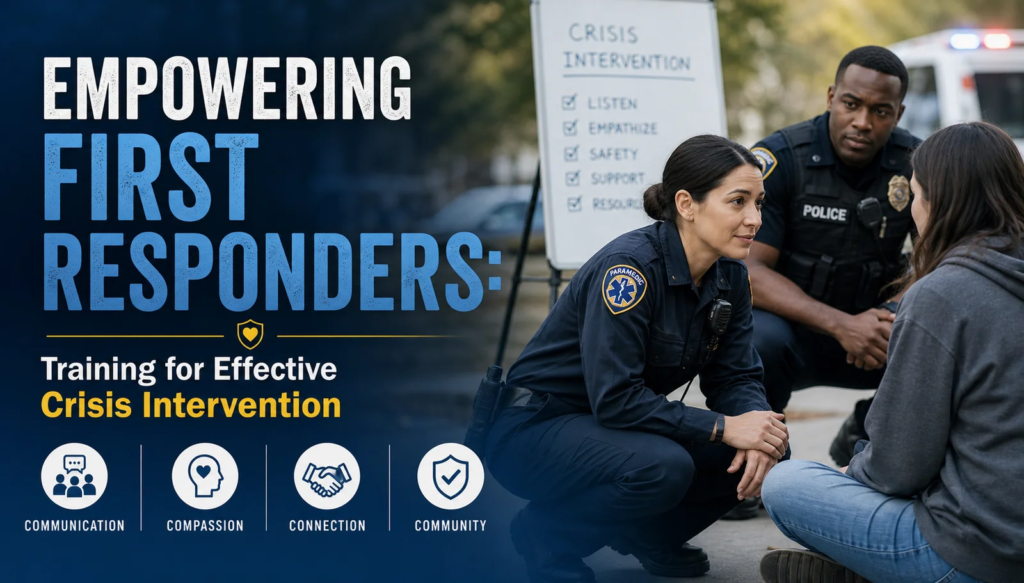
When a crisis unfolds, the first person on the scene may not be a doctor, therapist, negotiator, or emergency manager. It may be a police officer responding to a welfare check, a firefighter entering a home after a domestic dispute, an EMT treating someone in panic, or a dispatcher listening to the first desperate words of a caller.
In those moments, training can be the difference between escalation and safety, fear and trust, tragedy and recovery.
That is why Empowering First Responders: Training for Effective Crisis Intervention is no longer a “nice-to-have” professional development topic. It is an essential public safety priority. Communities increasingly expect emergency personnel to do more than respond quickly. They expect them to respond wisely, compassionately, and with the skills needed to manage behavioral health crises, trauma, substance-related emergencies, domestic violence, suicide risk, and high-stress public incidents.
First responders are asked to make difficult decisions in unstable environments with limited information and very little time. The right crisis intervention training gives them practical tools, emotional resilience, and coordinated support systems so they can protect others while also protecting themselves.
This article explores Empowering First Responders: Training for Effective Crisis Intervention in depth: what it means, why it matters, what effective training includes, how real-world programs work, and how agencies can build stronger, safer responses for the future.
Why Empowering First Responders Matters More Than Ever
Modern emergency response is changing. Calls involving mental health crises, substance use, homelessness, family violence, grief, trauma, and community unrest have become routine for many agencies. First responders are often the first contact point for people in their most vulnerable moments.
Traditional emergency training has long focused on speed, command presence, technical skill, and physical safety. Those remain vital. But today’s environment demands more. Empowering First Responders: Training for Effective Crisis Intervention means preparing responders to recognize distress, communicate clearly, de-escalate tension, collaborate with behavioral health partners, and make decisions that reduce harm.
This does not mean turning police officers, firefighters, EMTs, or dispatchers into therapists. It means giving them the tools to stabilize a crisis until the right care, protection, or resources can take over.
The Reality on the Ground
A person experiencing psychosis may not respond to commands in a predictable way. A teenager threatening self-harm may need calm connection before compliance. A veteran with PTSD may react strongly to lights, sirens, or sudden movements. A person overdosing may be medically unstable, frightened, or combative after reversal medication.
Without specialized preparation, even well-intentioned responders may unintentionally escalate the situation. With the right training, however, they can slow the scene down, identify risk factors, communicate with empathy, and guide the person toward safety.
That is the heart of Empowering First Responders: Training for Effective Crisis Intervention: better outcomes for responders, individuals in crisis, families, agencies, and communities.
What Crisis Intervention Really Means
Crisis intervention is the immediate, short-term support provided to someone experiencing acute emotional, psychological, medical, or situational distress. It is not a single technique. It is a structured approach that combines assessment, communication, safety planning, and connection to appropriate services.
In first response settings, crisis intervention may involve:
- De-escalating a person threatening self-harm
- Supporting a survivor after violence or trauma
- Responding to a behavioral health emergency
- Managing panic, grief, confusion, or agitation
- Helping families during sudden loss
- Reducing harm during substance-related emergencies
- Coordinating care with hospitals, mobile crisis teams, shelters, or mental health providers
Empowering First Responders: Training for Effective Crisis Intervention gives emergency personnel a framework for recognizing what type of crisis they are facing and choosing the safest response.
Crisis Intervention Is Not Just “Being Nice”
Compassion is important, but crisis intervention is more than kindness. It is a professional skill set. Effective responders must understand:
- Human stress responses
- Trauma-informed communication
- Mental health symptoms
- Suicide risk indicators
- Cultural and developmental differences
- Scene safety and threat assessment
- Legal and ethical responsibilities
- Referral pathways and community resources
The goal is not simply to calm someone down. The goal is to reduce immediate danger, preserve dignity, and create a path toward resolution.
Core Principles of Empowering First Responders: Training for Effective Crisis Intervention
Strong crisis intervention training is built on practical principles that responders can use under pressure. The best programs are simple enough to remember in the field but deep enough to guide complex decisions.
| Core Principle | What It Means in Practice | Why It Matters |
|---|---|---|
| Safety First | Protect the individual, responders, bystanders, and the scene | No intervention works if the scene becomes unsafe |
| Slow Down When Possible | Avoid rushing communication when there is no immediate threat | Time can reduce emotional intensity |
| Listen Before Directing | Allow the person to feel heard before giving instructions | People are more likely to cooperate when they feel respected |
| Use Clear, Calm Language | Speak simply, avoid jargon, reduce verbal pressure | Stress impairs processing and decision-making |
| Recognize Trauma | Assume behavior may be shaped by fear, pain, or past harm | Prevents misreading distress as defiance |
| Collaborate | Work with behavioral health, medical, and community partners | No single responder can solve every crisis alone |
| Preserve Dignity | Treat the person as a human being, not a problem to remove | Builds trust and reduces resistance |
| Support Responders | Provide peer support, rest, and mental health resources | Healthy responders make better decisions |
These principles are central to Empowering First Responders: Training for Effective Crisis Intervention because they combine compassion with operational discipline.
The Skills Every First Responder Needs for Effective Crisis Intervention
A meaningful crisis intervention program must move beyond classroom theory. Responders need skills they can apply during chaotic, emotionally charged encounters.
1. De-escalation Communication
De-escalation is one of the most recognized components of Empowering First Responders: Training for Effective Crisis Intervention. It includes verbal and nonverbal strategies that reduce tension.
Key techniques include:
- Speaking in a steady tone
- Keeping body language open and nonthreatening
- Avoiding unnecessary confrontation
- Asking open-ended questions
- Reflecting emotions: “It sounds like you’re overwhelmed.”
- Offering choices when possible
- Avoiding power struggles
- Explaining actions before taking them
A simple sentence like, “I’m here to understand what’s going on, not to make things worse,” can shift the emotional tone of an encounter.
2. Active Listening
People in crisis often feel ignored, trapped, or misunderstood. Active listening helps responders build rapport quickly.
Useful listening techniques include:
- Paraphrasing what the person says
- Naming emotions carefully
- Allowing silence
- Avoiding immediate judgment
- Validating feelings without validating harmful behavior
For example: “I can hear how angry you are. I want to help keep everyone safe while we talk through this.”
This approach is central to first responder crisis intervention training because it reduces defensiveness and opens a path to cooperation.
3. Behavioral Health Awareness
Responders do not need to diagnose mental illness, but they do need to recognize signs that someone may be experiencing a behavioral health crisis.
Possible indicators include:
- Hallucinations or delusional thinking
- Extreme paranoia
- Severe depression or hopelessness
- Disorganized speech
- Panic or dissociation
- Suicidal statements
- Unusual agitation or confusion
- Inability to care for basic needs
Empowering First Responders: Training for Effective Crisis Intervention teaches responders to identify these signs and adjust their approach.
4. Suicide Risk Recognition
Suicide-related calls require calm, direct, and informed responses. Training should help responders ask about suicide clearly and compassionately.
Important questions may include:
- “Are you thinking about killing yourself?”
- “Do you have a plan?”
- “Do you have access to the means?”
- “Have you tried before?”
- “What has kept you alive until now?”
Asking directly does not “put the idea” in someone’s head. It can reduce isolation and open a door to help.
5. Trauma-Informed Response
Trauma affects how people perceive authority, touch, loud noises, confinement, and sudden movement. Trauma-informed crisis intervention recognizes that a person’s behavior may be a survival response.
A trauma-informed responder asks: “What happened to this person?” rather than only “What is wrong with this person?”
This shift is vital to Empowering First Responders: Training for Effective Crisis Intervention because it encourages responders to reduce unnecessary triggers while maintaining safety.
6. Cultural Competence and Humility
Crisis communication is shaped by language, culture, disability, religion, age, gender identity, immigration status, and past experiences with institutions.
Training should include:
- Working with interpreters
- Avoiding assumptions
- Understanding cultural expressions of distress
- Respecting family and community dynamics
- Recognizing historical mistrust of systems
- Adapting communication for neurodivergent individuals
Cultural humility strengthens trust and reduces misunderstanding.
7. Tactical Patience
Tactical patience means waiting strategically when immediate action is not necessary. It gives responders time to gather information, bring in specialists, reduce emotional intensity, and develop safer options.
This concept is especially important in behavioral health calls, barricade situations, suicide threats, and emotionally volatile domestic incidents.
Building a Strong Crisis Intervention Training Program
Not all training programs are equal. A one-time lecture may raise awareness, but it rarely changes field behavior. Effective programs are ongoing, scenario-based, and supported by leadership.
A strong Empowering First Responders: Training for Effective Crisis Intervention program should include the following components.
Training Program Framework
| Training Component | Purpose | Example Activity |
|---|---|---|
| Foundational Education | Build understanding of crisis, trauma, and behavioral health | Classroom instruction with real-world examples |
| Scenario Practice | Turn concepts into field-ready skills | Role-play with trained actors |
| Communication Drills | Improve verbal de-escalation | Practicing active listening under pressure |
| Cross-Agency Collaboration | Strengthen coordination | Joint exercises with EMS, police, fire, dispatch, and clinicians |
| Legal/Ethical Guidance | Clarify authority and limits | Case reviews involving consent, custody, and safety |
| Resource Mapping | Connect people to services | Creating referral lists and warm handoff protocols |
| Responder Wellness | Protect personnel from burnout and trauma | Peer support and stress management training |
| Evaluation | Measure outcomes and improve | Tracking use-of-force, hospital diversion, repeat calls |
A truly effective model of Empowering First Responders: Training for Effective Crisis Intervention does not end when the class is over. It becomes part of the agency’s culture.
Case Study 1: Crisis Intervention Team Model in Memphis
One of the most widely known examples of crisis intervention reform is the Crisis Intervention Team model, often associated with Memphis, Tennessee. The model was developed after a tragic police encounter involving a person experiencing mental illness. Community leaders, law enforcement, mental health professionals, and advocates came together to create a better response.
The program trained selected officers in mental health awareness, de-escalation, community resources, and safe transport options. Officers learned to identify behavioral health symptoms, communicate more effectively, and divert individuals to treatment when appropriate rather than relying solely on arrest or emergency detention.
Why This Case Matters
The Memphis model shows how Empowering First Responders: Training for Effective Crisis Intervention can transform a community’s response to behavioral health emergencies. It is not only about individual officer skill. It is about partnerships, protocols, and shared responsibility.
Key Lessons
- Training works best when paired with community mental health access
- Specialized responders can support patrol officers in complex calls
- Collaboration between agencies builds trust
- Diversion can reduce unnecessary jail involvement
- Crisis response improves when families and advocates have a voice
This case remains relevant because it demonstrates that effective crisis intervention training must be connected to a larger system of care.
The Role of Dispatchers in Crisis Intervention
Dispatchers are often the first first responders. Their words shape the entire response before anyone arrives on scene.
A caller may be panicked, confused, intoxicated, injured, grieving, or afraid. The dispatcher must gather information while also stabilizing the caller emotionally. This makes dispatch training a crucial part of Empowering First Responders: Training for Effective Crisis Intervention.
Dispatchers Can Help Identify:
- Whether weapons are present
- Whether the person is suicidal
- Whether children or vulnerable adults are involved
- Whether substances are a factor
- Whether the person has known medical or mental health conditions
- Whether the scene is escalating or calming
- Whether specialized responders are needed
Crisis Communication for Dispatchers
Effective dispatcher training includes:
- Calm voice control
- Suicide call protocols
- Domestic violence risk screening
- Behavioral health triage
- Instructions for overdose response
- Coordination with mobile crisis teams
- Support for callers during active danger
When dispatchers receive strong crisis intervention training, responders arrive better informed and better prepared.
Case Study 2: Co-Responder Teams in Behavioral Health Emergencies
Many communities now use co-responder models, where law enforcement or EMS personnel respond alongside mental health professionals. These teams may be called to situations involving suicidal individuals, psychosis, severe anxiety, homelessness, substance use, or repeated crisis calls.
In a typical co-responder model, the first responder handles immediate safety while the clinician provides behavioral health assessment, de-escalation support, and connection to services.
Why This Case Matters
Co-responder teams are a practical example of Empowering First Responders: Training for Effective Crisis Intervention because they recognize a simple truth: responders should not have to manage every crisis alone.
Common Benefits
| Benefit | Impact |
|---|---|
| Better Assessment | Clinicians help identify behavioral health needs |
| Reduced Arrests | People may be diverted to treatment instead of jail |
| Fewer Emergency Room Transports | Some crises can be stabilized in the community |
| Improved Safety | Teams combine safety awareness with clinical skill |
| Lower Repeat Calls | People can be connected to longer-term services |
| Stronger Trust | Families often feel reassured by a care-focused response |
Brief Analysis
The co-responder model shows that training and teamwork are inseparable. Even highly trained responders benefit from having behavioral health partners available. Crisis intervention training for first responders becomes more powerful when responders know who to call, how to collaborate, and how to make warm referrals.
The Importance of Scenario-Based Training
Crisis intervention cannot be mastered through slides alone. Responders need realistic practice that mirrors field conditions.
Scenario-based training helps responders build confidence before they face real danger. It allows them to make mistakes in a learning environment, receive feedback, and refine their approach.
Examples of Effective Scenarios
- A suicidal person on a bridge
- A parent grieving after sudden loss
- A person experiencing hallucinations in public
- A domestic argument with escalating emotions
- A teenager having a panic attack at school
- A person refusing medical care after overdose reversal
- A veteran startled by emergency lights and commands
- A nonverbal autistic adult overwhelmed in a crowded place
Each scenario should include communication, safety assessment, ethical decision-making, and after-action review.
Why Practice Matters
Under stress, people fall back on training. If responders have practiced calm language, active listening, tactical patience, and safe positioning, those skills become easier to access in real emergencies.
That is why Empowering First Responders: Training for Effective Crisis Intervention must prioritize repetition, realism, and feedback.
Case Study 3: EMS Response to Opioid Overdose and Post-Reversal Crisis
Consider an EMS crew responding to a suspected opioid overdose. They administer naloxone, and the patient regains consciousness. Instead of expressing gratitude, the patient becomes frightened, disoriented, angry, and physically restless. Bystanders are shouting. A family member is crying. Police are on scene.
Without crisis intervention skills, the situation can deteriorate quickly. The patient may refuse transport, lash out, or flee. Responders may interpret agitation as aggression rather than confusion, withdrawal, or fear.
With proper training, EMS personnel can:
- Explain what happened in simple terms
- Reduce crowd pressure
- Avoid shaming language
- Assess medical risk calmly
- Offer choices when possible
- Involve peer recovery support if available
- Encourage follow-up care
- Protect the patient’s dignity
Why This Case Matters
This example highlights the medical side of Empowering First Responders: Training for Effective Crisis Intervention. Crisis intervention is not only about mental illness. It also applies to substance use, medical trauma, grief, panic, and fear.
Brief Analysis
The post-overdose period is a critical window. A respectful, skilled response may increase the chance that the person accepts care or treatment resources. A humiliating or forceful interaction may push them further away from help.
Responders Need Support Too: The Wellness Side of Crisis Intervention
A serious conversation about Empowering First Responders: Training for Effective Crisis Intervention must include responder wellness. First responders repeatedly witness suffering, danger, death, conflict, and human vulnerability. Over time, this exposure can lead to burnout, compassion fatigue, anxiety, depression, substance misuse, relationship strain, and post-traumatic stress.
You cannot build a compassionate crisis response system while ignoring the emotional cost to the people providing that response.
Common Stress Injuries Among First Responders
| Stress Injury | Possible Signs | Supportive Response |
|---|---|---|
| Burnout | Cynicism, exhaustion, reduced motivation | Rest, workload review, leadership support |
| Compassion Fatigue | Emotional numbness, irritability | Peer support, counseling, decompression |
| Acute Stress | Sleep problems, intrusive memories | Early intervention, time off, professional help |
| Moral Injury | Guilt, shame, conflict over decisions | Reflective supervision, trusted discussion |
| PTSD | Hypervigilance, avoidance, flashbacks | Trauma-informed therapy and long-term support |
Training Must Normalize Help-Seeking
Responder wellness training should include:
- Peer support teams
- Confidential counseling access
- Critical incident stress resources
- Supervisor training
- Family education
- Sleep and recovery practices
- Substance use support
- Mental health check-ins after major events
A healthy responder is more patient, more observant, and more capable of making sound decisions in crisis. In this sense, wellness is not separate from crisis intervention. It is part of it.
Leadership’s Role in Empowering First Responders
Training succeeds when leadership reinforces it. If supervisors dismiss de-escalation as weakness or reward only speed and control, crisis intervention skills may fade. If leadership models patience, accountability, and learning, responders are more likely to use those skills.
Effective leaders support Empowering First Responders: Training for Effective Crisis Intervention by:
- Making training mandatory and recurring
- Allocating time for practice, not just lectures
- Reviewing incidents for learning, not blame
- Building partnerships with mental health providers
- Supporting responder wellness
- Tracking outcomes and improving policies
- Recognizing excellent crisis intervention work
- Encouraging honest feedback from field personnel
Culture matters. Responders need to know that using communication, patience, and empathy is not “soft.” It is skilled, strategic, and professional.
Technology and Tools That Strengthen Crisis Intervention
Technology cannot replace human judgment, but it can support better decisions.
Useful tools may include:
- Computer-aided dispatch flags for known crisis history
- Mobile access to behavioral health resources
- Telehealth consultation with clinicians
- Body-worn camera review for training
- Data dashboards tracking crisis call outcomes
- GPS-based mobile crisis team deployment
- Digital referral platforms
- Language interpretation tools
However, agencies must balance technology with privacy, consent, and ethical use of data. Information should help responders provide safer care, not stigmatize individuals.
In modern Empowering First Responders: Training for Effective Crisis Intervention, technology should support communication, coordination, and accountability.
Measuring Success: How Agencies Know Training Is Working
A common mistake is assuming training is effective simply because people attended. Real success requires measurement.
Agencies can track both quantitative and qualitative outcomes.
Crisis Intervention Success Metrics
| Metric | What It Reveals |
|---|---|
| Use-of-force incidents | Whether de-escalation may be reducing physical interventions |
| Injuries to responders or civilians | Overall safety impact |
| Arrest diversion rates | Whether people are being connected to care when appropriate |
| Emergency room transport rates | Whether alternatives are being used effectively |
| Repeat crisis calls | Whether follow-up systems are working |
| Time on scene | Whether response is efficient and safe |
| Complaints and commendations | Community perception and trust |
| Responder confidence surveys | Whether training improves readiness |
| Referral completion rates | Whether people actually connect to services |
Measurement should be used to improve the system, not punish responders for complex outcomes beyond their control.
Case Study 4: School Crisis Response After a Student Threat
A school resource officer and local EMS team respond after a student makes suicidal statements and locks themselves in a restroom. Staff are frightened. Other students are filming. The student refuses to come out.
A crisis-trained responder avoids shouting commands through the door. Instead, they reduce the audience, ask staff for background, learn the student’s preferred name, and speak calmly from outside.
They say: “I’m not here to embarrass you. I just want to make sure you’re safe. We can take this one step at a time.”
Eventually, the student opens the door. EMS conducts a safety assessment, and a mental health crisis team is contacted. The student is transported for evaluation with minimal force and reduced public exposure.
Why This Case Matters
This situation demonstrates Empowering First Responders: Training for Effective Crisis Intervention in a youth setting. Young people in crisis may be especially sensitive to shame, peer attention, and perceived punishment.
Brief Analysis
The responders’ success came from slowing down, protecting dignity, gathering context, and using calm language. The outcome was safer because the team treated the student as a person in pain, not a disruption to remove.
Barriers to Effective Crisis Intervention Training
Even when agencies support the idea, implementation can be difficult.
Common barriers include:
- Limited funding
- Staffing shortages
- High call volume
- Lack of local mental health resources
- Resistance to culture change
- Inconsistent training standards
- Poor interagency communication
- Rural service gaps
- Data-sharing limitations
- Responder fatigue
These barriers are real, but they are not reasons to give up. They are reasons to design realistic, phased approaches.
Practical Solutions
| Barrier | Practical Response |
|---|---|
| Limited Budget | Use train-the-trainer models and regional partnerships |
| Staffing Shortages | Offer shorter recurring modules instead of only long courses |
| Rural Gaps | Use telehealth crisis consultation and regional mobile teams |
| Cultural Resistance | Highlight safety benefits and field success stories |
| Lack of Services | Create resource maps and strengthen referral agreements |
| Training Decay | Use refreshers, roll-call scenarios, and after-action reviews |
The most successful efforts in Empowering First Responders: Training for Effective Crisis Intervention are practical, not perfect. Agencies should start with what they can build and improve over time.
Long-Tail Keyword Variations for Contextual SEO
For natural optimization, related phrases can be used alongside the focus keyword. Examples include:
- First responder crisis intervention training
- Effective crisis intervention for emergency personnel
- Crisis response training for police officers
- De-escalation training for first responders
- Mental health crisis training for EMS
- Trauma-informed training for first responders
- Behavioral health crisis response training
- Crisis intervention skills for emergency responders
- Public safety crisis intervention strategies
- Empowering emergency responders through crisis training
- First responder mental health and crisis response
- Crisis communication training for dispatchers
- Co-responder crisis intervention models
- Suicide prevention training for first responders
- Community-based crisis response training
These variations support the broader theme of Empowering First Responders: Training for Effective Crisis Intervention without forcing repetitive language.
The Future of Empowering First Responders: Training for Effective Crisis Intervention
The future of public safety will require more integrated, humane, and evidence-informed crisis response systems.
We are likely to see greater emphasis on:
- Mobile crisis units
- Co-responder programs
- Peer support specialists
- Community paramedicine
- Behavioral health urgent care centers
- Specialized dispatcher triage
- Virtual clinician support
- Data-driven training improvements
- Trauma-informed leadership
- Responder wellness programs
The future of Empowering First Responders: Training for Effective Crisis Intervention is not about replacing traditional emergency response. It is about strengthening it.
First responders will always need courage, technical skill, and quick decision-making. But they also need emotional intelligence, cultural awareness, patience, and strong support networks. The best responders of the future will be both tactically prepared and relationally skilled.
Action Steps for Agencies and Communities
If your agency, organization, or community wants to improve crisis response, start with concrete steps.
For Emergency Service Agencies
- Assess current crisis call trends
- Identify training gaps
- Provide recurring de-escalation and behavioral health training
- Build relationships with local mental health providers
- Create clear referral and diversion pathways
- Include dispatchers in crisis training
- Develop peer support and wellness programs
- Review critical incidents for learning
- Measure outcomes over time
- Celebrate effective crisis intervention work
For Community Leaders
- Fund crisis intervention training
- Expand behavioral health resources
- Support co-responder and mobile crisis models
- Include families and advocates in planning
- Improve access to crisis stabilization centers
- Encourage collaboration across agencies
- Reduce stigma around mental health and substance use
For Individual First Responders
- Practice active listening every day
- Learn local crisis resources
- Use tactical patience when safe
- Watch for signs of suicide risk
- Ask for backup early
- Reflect after difficult calls
- Take your own stress seriously
- Support peers who are struggling
These steps bring Empowering First Responders: Training for Effective Crisis Intervention from concept to reality.
Conclusion: Stronger Training, Safer Communities
Crises are human moments. They are messy, emotional, unpredictable, and often frightening. First responders enter those moments when most people are stepping away. They deserve the best preparation possible.
Empowering First Responders: Training for Effective Crisis Intervention is about giving emergency personnel more than procedures. It gives them confidence, judgment, communication skills, emotional resilience, and trusted partnerships. It helps them see the person behind the crisis while still protecting everyone on scene.
The strongest crisis response systems do not rely on heroics alone. They rely on training, teamwork, compassion, accountability, and care for the responders themselves.
When first responders are empowered, communities become safer. People in crisis are treated with greater dignity. Families have more hope. Agencies build trust. And responders go home knowing they had the tools to make a difficult moment better.
The takeaway is simple but powerful: crisis intervention is not just a specialty skill. It is a core public safety skill. Investing in Empowering First Responders: Training for Effective Crisis Intervention is an investment in life, safety, trust, and humanity.
1. What is the main goal of crisis intervention training for first responders?
The main goal is to help first responders safely stabilize people in acute distress. This includes reducing escalation, improving communication, identifying risk, protecting everyone on scene, and connecting individuals to appropriate care or services.
2. Does crisis intervention training replace traditional emergency response tactics?
No. Empowering First Responders: Training for Effective Crisis Intervention strengthens traditional response. It adds communication, behavioral health awareness, and de-escalation tools while preserving safety, tactical awareness, and legal responsibilities.
3. Who should receive crisis intervention training?
Police officers, firefighters, EMTs, paramedics, dispatchers, correctional officers, emergency managers, school resource officers, supervisors, and community response teams can all benefit. Dispatchers are especially important because they shape the response before crews arrive.
4. How often should first responders receive crisis intervention training?
Initial training is important, but refreshers are essential. Agencies should provide recurring scenario-based practice, short skill drills, after-action reviews, and updated resource information at least annually, with more frequent micro-training when possible.
5. What topics should be included in effective crisis intervention training?
Strong programs should include de-escalation, active listening, suicide prevention, trauma-informed care, behavioral health awareness, substance use response, cultural competence, legal considerations, dispatcher protocols, referral pathways, and responder wellness.
6. How does crisis intervention training improve safety?
It helps responders recognize warning signs, reduce unnecessary confrontation, communicate more effectively, slow situations down when possible, and bring in appropriate resources. This can reduce injuries, use-of-force incidents, arrests, and repeat crisis calls.
7. What is a co-responder model?
A co-responder model pairs first responders, such as police or EMS, with behavioral health professionals. Together, they respond to crisis calls where clinical assessment and de-escalation support may improve outcomes.
8. Why is responder wellness part of crisis intervention?
Responders under chronic stress may have less patience, reduced focus, and higher emotional reactivity. Supporting their mental health improves decision-making, compassion, safety, and long-term career sustainability. Wellness is a core part of Empowering First Responders: Training for Effective Crisis Intervention.


The PsyForU Editorial Collective is the research and editorial team of PsyForU Research International. The collective prepares educational, psychological, mental-health-awareness, inclusion, neurodiversity, and research-methodology content for students, parents, educators, researchers, and general readers. PsyForU content is intended for awareness, education, and capacity-building and should not be treated as clinical diagnosis, therapy, medical advice, legal advice, or emergency mental-health support.