


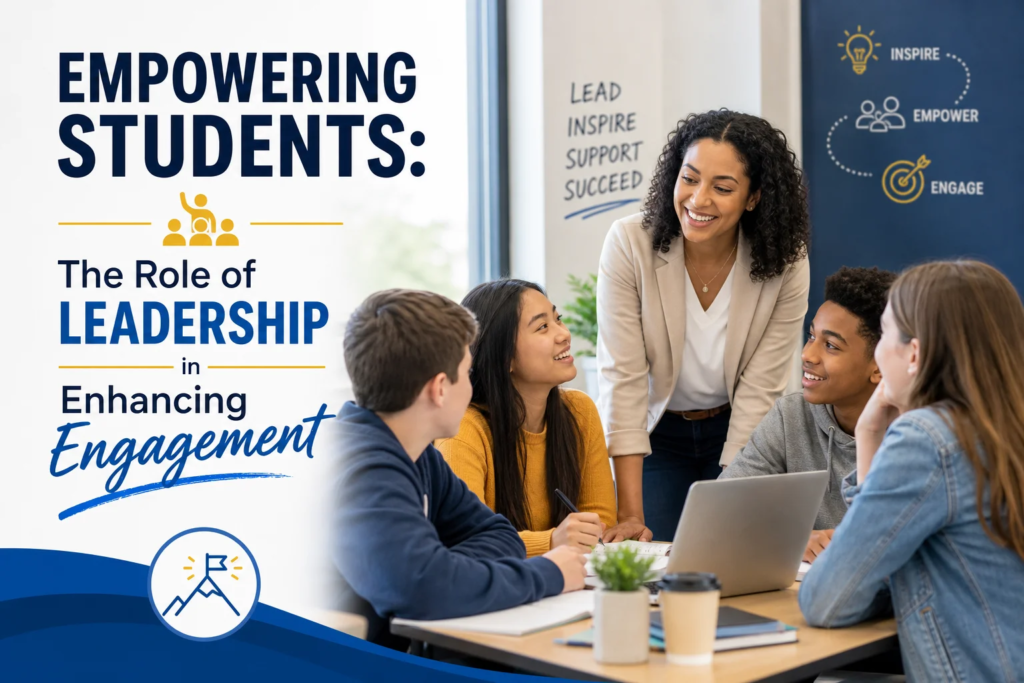
Introduction: Engagement Is Not a Student Problem—It Is a Leadership Opportunity
Walk into two classrooms with the same curriculum, the same technology, and students from similar backgrounds. In one, learners sit quietly, complete the minimum, and wait for the bell. In the other, students ask questions, challenge ideas, support one another, revise their work, and speak with confidence about why their learning matters.
What makes the difference?
It is tempting to say “student motivation,” but that answer is too simple. Engagement does not appear by accident. It is shaped by culture, trust, expectations, belonging, voice, and purpose. In other words, it is shaped by leadership.
That is why Empowering Students: The Role of Leadership in Enhancing Engagement is more than an educational slogan. It is a practical strategy for transforming schools, classrooms, colleges, and learning communities into places where students do not merely attend—they participate, contribute, and grow.
Student empowerment happens when learners believe their voice matters, their effort has meaning, and their decisions influence their learning journey. Leadership is the force that makes that belief credible. Principals, teachers, department heads, student leaders, counselors, and even community partners all play a role in designing environments where engagement becomes the norm rather than the exception.
This article explores Empowering Students: The Role of Leadership in Enhancing Engagement in depth: what it means, why it matters, how it works in real schools, and what leaders can do immediately to strengthen student participation. We will examine practical frameworks, case studies, leadership behaviors, classroom strategies, and measurable indicators that help move engagement from an abstract goal to a daily reality.
Understanding Student Empowerment
Student empowerment is the process of giving learners meaningful opportunities to make decisions, express ideas, take ownership, and influence their educational experience. It does not mean students do whatever they want. It means students are trusted, supported, and challenged to become active partners in learning.
When schools focus on Empowering Students: The Role of Leadership in Enhancing Engagement, they shift away from a compliance-based model of education. Instead of asking, “How do we get students to follow instructions?” empowered schools ask, “How do we help students become responsible, curious, capable contributors?”
Empowered students typically show:
- Greater academic persistence
- Stronger self-confidence
- Higher participation in class discussions
- Better attendance and school connection
- Increased willingness to collaborate
- More ownership of goals and progress
- Improved problem-solving and communication skills
Empowerment is not only about choice. It is also about capacity. Students need skills, structures, feedback, and adult guidance to use their voices productively. Leadership creates the conditions where empowerment becomes safe, purposeful, and sustainable.
Why Leadership Is Central to Student Engagement
Engagement is often discussed as if it belongs only to students. But student engagement is deeply connected to adult behavior and organizational design. Leaders influence how teachers teach, how students are treated, how decisions are made, and how success is defined.
The idea of Empowering Students: The Role of Leadership in Enhancing Engagement reminds us that leadership is not limited to titles. A principal may set the vision, but a classroom teacher creates daily opportunities for voice. A counselor may build belonging through advisory systems. A student council member may lead peer initiatives. A coach may help students develop discipline and confidence. Leadership is distributed across the learning environment.
Strong leadership improves engagement by:
- Creating a clear vision for student agency
- Building relational trust across the school
- Supporting teachers with training and time
- Designing structures for student voice
- Using data to identify disengagement early
- Celebrating growth, effort, and contribution
- Removing barriers that limit participation
When leaders take empowerment seriously, engagement becomes more than excitement. It becomes commitment.
The Three Dimensions of Student Engagement
To understand Empowering Students: The Role of Leadership in Enhancing Engagement, it helps to define engagement clearly. Student engagement is not simply paying attention. It includes behavioral, emotional, and cognitive dimensions.
| Dimension of Engagement | What It Looks Like | Leadership Role |
|---|---|---|
| Behavioral engagement | Attendance, participation, completing work, joining activities | Create routines, expectations, and opportunities for involvement |
| Emotional engagement | Belonging, interest, confidence, connection to school | Build relationships, inclusion, and psychological safety |
| Cognitive engagement | Critical thinking, goal-setting, persistence, deep learning | Promote challenge, reflection, inquiry, and student ownership |
A student may be behaviorally engaged but emotionally disconnected. For example, they submit assignments but feel invisible. Another student may feel connected socially but avoid academic challenge. True engagement requires all three dimensions.
Leadership matters because each dimension is influenced by school culture. If leaders only reward compliance, students may behave but not think deeply. If leaders only promote fun activities without academic purpose, students may enjoy school but not develop resilience. The goal of student empowerment and engagement through leadership is to connect belonging, responsibility, and meaningful learning.
From Compliance to Commitment: A Necessary Shift
Many traditional school systems are built around compliance. Students are told where to sit, when to speak, what to learn, how to show understanding, and when they are successful. Some structure is necessary, of course. But when compliance becomes the main goal, students may learn to perform for approval rather than pursue understanding.
Empowerment changes the question.
Instead of:
- “How do we make students listen?”
- “How do we control behavior?”
- “How do we get students to finish the worksheet?”
Leaders begin asking:
- “How do we make learning meaningful?”
- “How do we invite student voice?”
- “How do we teach students to manage responsibility?”
- “How do we help learners see themselves as capable?”
This is the heart of Empowering Students: The Role of Leadership in Enhancing Engagement. The goal is not to eliminate adult guidance. The goal is to move students from passive recipients to active participants.
A compliance culture says, “Do this because I said so.”
An empowerment culture says, “Here is why this matters, here is your role, and here is how I will support you.”
That difference can transform a classroom.
Key Leadership Practices That Empower Students
Leadership becomes powerful when it is translated into daily habits. The following practices are central to Empowering Students: The Role of Leadership in Enhancing Engagement.
1. Build Trust Before Demanding Performance
Students are more likely to engage when they believe adults respect them. Trust does not mean lowering expectations. In fact, students often respond best when high expectations are paired with high support.
Leaders build trust by:
- Listening without immediately correcting
- Following through on promises
- Being transparent about decisions
- Treating student concerns seriously
- Creating predictable and fair systems
- Encouraging teachers to know students personally
A student who feels known is more likely to take academic risks.
2. Give Students Meaningful Voice
Student voice is not asking learners to vote on pizza toppings once a year. Meaningful voice involves authentic influence over learning, school culture, and problem-solving.
Examples include:
- Student-led conferences
- Classroom feedback surveys
- Student advisory boards
- Peer mentoring programs
- Project topic choices
- Co-created classroom norms
- Student participation in school improvement planning
Voice must lead somewhere. If students share feedback and nothing changes, empowerment becomes performative. Effective leaders close the loop by saying, “Here is what we heard, here is what we are doing, and here is what we cannot change yet.”
3. Design Choice With Structure
Choice is one of the most effective tools for engagement, but too much unstructured choice can overwhelm students. Leaders can support teachers in designing guided choices.
For example, students might choose:
- Which book to read within a theme
- Which product to create for a project
- Which problem to investigate
- Which role to play in a group
- Which revision goal to prioritize
- Which community issue to address
The leadership challenge is to make choice meaningful while keeping learning goals clear.
4. Encourage Student Leadership
Students become empowered when they practice leadership, not just hear adults talk about it.
Student leadership opportunities may include:
- Peer tutoring
- Club leadership
- Restorative justice circles
- School ambassadors
- Event planning teams
- Digital media teams
- Environmental action groups
- Student research committees
In schools committed to Empowering Students: The Role of Leadership in Enhancing Engagement, student leadership is not reserved for the highest achievers. It is intentionally widened so quieter students, struggling students, multilingual learners, and students with disabilities also have opportunities to contribute.
5. Use Feedback as a Growth Tool
Grades often tell students where they stand, but feedback tells them where to go next. Empowering leadership encourages feedback systems that help students reflect and improve.
Powerful feedback is:
- Specific
- Timely
- Actionable
- Connected to goals
- Focused on growth
- Encouraging without being vague
When students learn to use feedback, they become partners in improvement.
Leadership Styles That Strengthen Engagement
Not every leadership style supports empowerment. Some styles create dependency, fear, or passivity. Others create ownership and shared purpose.
Transformational Leadership
Transformational leaders inspire people around a shared vision. In education, this means helping teachers, students, and families believe that learning can be meaningful and inclusive.
This style supports Empowering Students: The Role of Leadership in Enhancing Engagement because it emphasizes motivation, purpose, and growth.
Distributed Leadership
Distributed leadership recognizes that leadership is not held by one person. Teachers, students, families, and staff all contribute to school improvement.
This approach is especially important for student engagement because students are more likely to participate when they see leadership as something they can practice.
Servant Leadership
Servant leaders focus on meeting the needs of others. In schools, servant leadership appears when adults ask, “What barriers are preventing students from thriving, and how can we remove them?”
This style is deeply connected to student empowerment through educational leadership because it centers dignity, listening, and support.
Instructional Leadership
Instructional leaders focus on teaching and learning quality. They support curriculum, assessment, teacher development, and academic expectations.
Without instructional leadership, empowerment may become disconnected from learning. Strong instructional leaders make sure student voice and choice lead to deeper understanding.
Table: Leadership Actions and Their Impact on Engagement
| Leadership Action | Student Empowerment Effect | Engagement Outcome |
|---|---|---|
| Establish student advisory groups | Students influence decisions | Stronger belonging and ownership |
| Support project-based learning | Students solve meaningful problems | Higher cognitive engagement |
| Train teachers in student-centered instruction | Classrooms become more interactive | Increased participation |
| Use restorative practices | Students learn accountability and repair | Improved emotional safety |
| Create student-led conferences | Students reflect on progress | Greater goal ownership |
| Offer flexible demonstration of learning | Students use strengths creatively | More motivation and confidence |
| Track attendance and participation data | Disengagement is noticed earlier | Faster intervention |
| Celebrate student contribution | Students feel valued | Stronger school connection |
This table shows why Empowering Students: The Role of Leadership in Enhancing Engagement is not a single program. It is a set of aligned leadership choices.
Creating a Culture of Belonging
Students cannot be empowered if they feel they do not belong. Belonging is the emotional foundation of engagement. A student who feels excluded, stereotyped, or ignored is unlikely to participate fully, even if the lesson is well designed.
Leaders influence belonging through policies, language, representation, and relationships.
A culture of belonging includes:
- Inclusive curriculum materials
- Respect for student identities
- Anti-bullying systems that work
- Welcoming physical spaces
- Staff who pronounce names correctly
- Opportunities for every student to be seen
- Fair discipline practices
- Family and community connection
Belonging is not soft. It is strategic. When students feel safe and respected, they are more willing to ask questions, admit confusion, try again, and collaborate.
In the context of Empowering Students: The Role of Leadership in Enhancing Engagement, belonging is not an optional extra. It is the soil in which empowerment grows.
The Role of Teachers as Everyday Leaders
Teachers are often the most influential leaders in a student’s daily life. A school principal may define the mission, but teachers translate that mission into lived experience.
Teacher leadership enhances engagement when educators:
- Invite student questions
- Share learning goals clearly
- Offer choices in assignments
- Use discussion protocols
- Encourage peer collaboration
- Model curiosity and humility
- Provide feedback that builds confidence
- Connect lessons to real life
One of the most powerful teacher leadership moves is to shift from “sage on the stage” to “designer of learning.” This does not mean teachers stop teaching. It means they design experiences where students think, discuss, investigate, create, and reflect.
For example, instead of lecturing for an entire period about environmental science, a teacher might present a local water quality issue and ask students to analyze data, interview community members, and propose solutions. The teacher still guides the process, but students do the intellectual heavy lifting.
That is Empowering Students: The Role of Leadership in Enhancing Engagement at classroom level.
Student Voice: From Tokenism to Real Influence
Many schools claim to value student voice, but not all student voice initiatives are equal. Some are symbolic. Others are transformative.
The ladder below shows different levels of student voice.
| Level | Description | Example | Empowerment Value |
|---|---|---|---|
| Decoration | Students are visible but not heard | Posters with student photos | Low |
| Consultation | Students are asked for opinions | Annual survey | Moderate if acted upon |
| Participation | Students join activities | Student council event planning | Moderate |
| Partnership | Students help shape decisions | Co-designing school norms | High |
| Leadership | Students initiate and lead change | Student-led equity committee | Very high |
For student voice to support Empowering Students: The Role of Leadership in Enhancing Engagement, leaders must move beyond consultation toward partnership and leadership.
A practical approach is the “Listen–Act–Report Back” cycle:
- Listen to student experiences.
- Identify patterns and priorities.
- Act on feasible recommendations.
- Report back honestly.
- Invite students into the next stage.
This cycle builds trust because students see that their voices matter.
Case Study 1: High Tech High and Project-Based Learning
High Tech High, a network of schools in California, is widely known for project-based learning, public exhibitions, and student-centered instruction. Students frequently work on interdisciplinary projects that require research, collaboration, design, revision, and presentation to authentic audiences.
Rather than treating students as passive receivers of content, High Tech High’s model asks learners to create meaningful work. Projects may combine science, humanities, art, and technology. Students often display their work publicly, which increases accountability and pride.
Why It Matters
This case illustrates Empowering Students: The Role of Leadership in Enhancing Engagement because the leadership model supports teachers in designing rich learning experiences. School leaders create time, culture, and expectations for collaboration. Teachers are trusted as designers. Students are trusted as creators.
Brief Analysis
The key lesson is that engagement rises when students produce work that matters beyond the gradebook. Leadership is essential because project-based learning requires structural support: planning time, flexible schedules, public exhibitions, and a culture that values revision. Without leadership, projects can become isolated activities. With leadership, they become a schoolwide engagement strategy.
Case Study 2: Iowa BIG and Community-Based Learning
Iowa BIG, a public school initiative in Cedar Rapids, Iowa, connects students with real community problems. Learners work with local businesses, nonprofits, and civic organizations on projects that have authentic value. Students may investigate environmental issues, develop public awareness campaigns, design prototypes, or support community improvement efforts.
The model is built around student agency. Students are not simply completing assignments for teachers; they are contributing to real-world work.
Why It Matters
Iowa BIG demonstrates student empowerment and leadership in enhancing engagement by showing what happens when learning moves beyond classroom walls. Students often become more invested because they can see the impact of their work.
Brief Analysis
The relevance to Empowering Students: The Role of Leadership in Enhancing Engagement is clear: leaders must build partnerships, manage logistics, support teacher collaboration, and protect the integrity of student-centered learning. Community-based learning does not happen because one teacher has a good idea. It requires leadership that values relationships and real-world relevance.
Case Study 3: Student-Led Conferences in Expeditionary Learning Schools
Many schools inspired by EL Education use student-led conferences as a core practice. Instead of parents meeting only with teachers, students present evidence of their learning, reflect on strengths and challenges, and set goals.
This practice shifts the ownership of learning. Students must understand their progress, explain their work, and identify next steps. Families hear directly from learners, not just adults.
Why It Matters
Student-led conferences are a practical example of Empowering Students: The Role of Leadership in Enhancing Engagement because they turn assessment into reflection. Students become active narrators of their own growth.
Brief Analysis
The leadership lesson is that empowerment can be embedded into existing systems. Conferences already happen in many schools. By redesigning them around student voice, leaders can increase engagement without adding an entirely new program. The practice also strengthens communication among students, teachers, and families.
Case Study 4: Restorative Practices in School Culture
Schools using restorative practices focus on repairing harm, building community, and teaching accountability. Instead of relying only on exclusionary discipline, restorative approaches invite students to reflect on impact, listen to others, and participate in solutions.
Restorative circles, peer mediation, and community-building conversations can help students feel more connected and responsible.
Why It Matters
This case connects strongly to Empowering Students: The Role of Leadership in Enhancing Engagement because discipline systems shape engagement. Students who are repeatedly removed from learning often become more disconnected. Restorative leadership keeps students accountable while preserving belonging.
Brief Analysis
Restorative practices require careful leadership. If implemented superficially, they can feel like forced conversations. Effective leaders provide training, consistency, and follow-up. The empowerment comes from helping students participate in repairing relationships rather than simply receiving punishment.
The Engagement Equation: A Practical Framework
A useful way to think about Empowering Students: The Role of Leadership in Enhancing Engagement is through a simple equation:
Engagement = Belonging + Purpose + Voice + Challenge + Support
Each part matters.
| Element | Student Question | Leadership Response |
|---|---|---|
| Belonging | “Do I matter here?” | Build inclusive relationships and culture |
| Purpose | “Why does this learning matter?” | Connect learning to real life and future goals |
| Voice | “Do I have influence?” | Create authentic decision-making opportunities |
| Challenge | “Am I being pushed to grow?” | Maintain high expectations |
| Support | “Will someone help me succeed?” | Provide feedback, resources, and encouragement |
If one element is missing, engagement weakens. For example, challenge without support creates anxiety. Voice without purpose creates scattered activity. Belonging without challenge can become comfort without growth.
Effective leaders balance all five.
Empowering Students Through Curriculum Design
Curriculum can either empower or disengage. A curriculum that feels disconnected from students’ lives may produce compliance but rarely deep commitment. A curriculum that includes relevance, inquiry, and choice can increase engagement dramatically.
Leadership can support empowering curriculum by encouraging:
- Essential questions
- Interdisciplinary projects
- Culturally responsive materials
- Real-world problem-solving
- Student research and inquiry
- Public presentations of learning
- Opportunities for revision
- Reflection and self-assessment
For example, instead of teaching persuasive writing through isolated prompts, students might identify a local issue they care about, research multiple perspectives, write an argument, and present recommendations to a community audience.
That is not just a writing assignment. It is student empowerment in action.
The connection to Empowering Students: The Role of Leadership in Enhancing Engagement is direct: leaders must give teachers permission, support, and resources to design learning that feels meaningful.
Empowering Students Through Assessment
Assessment often drives student behavior. If assessments reward memorization only, students may focus on short-term recall. If assessments reward thinking, reflection, creativity, and improvement, students engage differently.
Empowering assessment practices include:
- Rubrics students understand
- Opportunities for revision
- Self-assessment
- Peer feedback
- Portfolios
- Performance tasks
- Student goal-setting
- Reflection journals
One especially powerful practice is portfolio defense, where students collect evidence of learning and explain how they have grown. This develops metacognition—the ability to think about one’s own thinking.
Assessment should answer more than “What score did I get?” It should help students ask:
- What did I learn?
- How did I improve?
- What strategies worked?
- What do I need next?
- How can I apply this learning?
This is a key part of Empowering Students: The Role of Leadership in Enhancing Engagement because empowered students understand their own progress.
The Role of Technology in Student Empowerment
Technology does not automatically create engagement. A boring worksheet on a screen is still a boring worksheet. However, when used thoughtfully, technology can expand student voice, creativity, collaboration, and access.
Leaders can support technology for empowerment by focusing on learning goals first.
Effective uses include:
- Digital portfolios
- Collaborative documents
- Student podcasts
- Video reflections
- Online discussion boards
- Data visualization tools
- Assistive technology
- Virtual exchanges with other communities
- Student-created websites or presentations
Technology also helps leaders gather feedback. Short pulse surveys, digital exit tickets, and anonymous suggestion forms can reveal patterns of disengagement early.
The goal is not more screen time. The goal is more meaningful participation. In the broader conversation about Empowering Students: The Role of Leadership in Enhancing Engagement, technology is a tool—not the strategy itself.
Student Leadership Programs That Actually Work
Many schools have student leadership programs, but some only involve a small group of already confident students. A more empowering model widens access and teaches leadership as a skill.
Effective student leadership programs include:
- Clear purpose
- Diverse student representation
- Adult coaching
- Real responsibilities
- Reflection and feedback
- Connection to school improvement
- Opportunities for visible impact
Examples of meaningful student leadership roles:
- Student curriculum reviewers
- Peer wellness ambassadors
- New student mentors
- Equity and inclusion representatives
- Sustainability team members
- Digital citizenship leaders
- Library or learning commons advisors
- Student researchers gathering feedback
The most important question is: “Do students have real influence?”
If the answer is yes, the program supports Empowering Students: The Role of Leadership in Enhancing Engagement. If the answer is no, it may be leadership in name only.
Measuring Student Engagement Without Reducing It to Numbers
Leaders need data, but engagement is too complex to be captured by one metric. Attendance matters, but a student can attend and still be disengaged. Grades matter, but a student can earn high grades while feeling little ownership. Surveys matter, but they must be interpreted carefully.
A balanced engagement dashboard might include:
| Metric | What It Reveals | Limitation |
|---|---|---|
| Attendance | Behavioral connection | Does not show emotional engagement |
| Participation rates | Involvement in learning | May miss quiet forms of engagement |
| Assignment completion | Academic behavior | Does not measure depth |
| Student surveys | Belonging, voice, motivation | Depends on survey quality |
| Discipline data | School climate and exclusion | Needs equity analysis |
| Extracurricular involvement | Connection beyond class | Access may vary |
| Student interviews | Lived experience | Time-intensive |
| Portfolio reflections | Ownership and growth | Requires consistent implementation |
The best leaders combine quantitative and qualitative data. They look at patterns, ask students what the data means, and respond with action.
This approach supports Empowering Students: The Role of Leadership in Enhancing Engagement because students are not treated as data points. They are invited into the improvement process.
Common Barriers to Student Empowerment
Even leaders who believe in empowerment face obstacles. Naming those barriers helps schools address them honestly.
Barrier 1: Fear of Losing Control
Some educators worry that student voice will lead to chaos. In reality, empowerment works best with clear expectations. Students need boundaries, routines, and guidance.
Empowerment is not the absence of structure. It is shared responsibility within structure.
Barrier 2: Time Pressure
Teachers often feel pressured to cover content. Student-centered learning can seem time-consuming. Leadership helps by prioritizing depth over superficial coverage and providing planning support.
Barrier 3: Uneven Staff Buy-In
Not every teacher will immediately embrace student empowerment. Leaders should offer professional learning, model practices, and create low-risk entry points.
Barrier 4: Tokenistic Student Voice
If students are asked for input but never see change, cynicism grows. Leaders must act on feedback where possible and explain constraints honestly.
Barrier 5: Equity Gaps
Empowerment opportunities often go to students who are already confident, high-achieving, or socially visible. Leaders must intentionally include marginalized voices.
Addressing these barriers is essential to Empowering Students: The Role of Leadership in Enhancing Engagement in a way that is fair and lasting.
Equity and Empowerment: Who Gets to Lead?
A school cannot claim to empower students if only certain students are heard. True empowerment requires equity.
Leaders should ask:
- Which students are most often invited to speak?
- Which students are missing from leadership groups?
- Do discipline policies silence certain students?
- Are multilingual learners given accessible ways to contribute?
- Are students with disabilities included in decision-making?
- Do students from marginalized backgrounds see themselves reflected in curriculum?
- Are family voices included respectfully?
Equity-focused leadership recognizes that engagement is not just about motivation. It is also about access, identity, safety, and opportunity.
This is one of the most important insights in Empowering Students: The Role of Leadership in Enhancing Engagement: students cannot engage fully in an environment where they feel underestimated or excluded.
The Family and Community Connection
Student empowerment does not stop at the classroom door. Families and communities can strengthen engagement when they are treated as partners rather than outsiders.
Leaders can build family and community partnerships by:
- Inviting families into goal-setting conversations
- Communicating in accessible languages
- Hosting student exhibitions
- Partnering with local organizations
- Creating mentorship programs
- Asking families about student strengths and interests
- Connecting learning to community needs
Community partnerships are especially powerful because they help students see that learning has real-world relevance. A student who interviews local elders for a history project, designs a garden with a neighborhood group, or builds a campaign for public health is more likely to see learning as meaningful.
This expands Empowering Students: The Role of Leadership in Enhancing Engagement beyond school walls.
Professional Development for Empowering Leadership
Teachers and leaders need support to shift practice. Empowerment cannot depend on individual charisma. It must be developed through professional learning.
High-quality professional development should include:
- Modeling student-centered strategies
- Time for collaborative planning
- Peer observation
- Coaching cycles
- Student feedback analysis
- Equity reflection
- Practical tools teachers can use immediately
- Opportunities to test and revise approaches
For example, a school might focus one semester on improving classroom discussion. Teachers learn protocols, observe one another, collect student feedback, and reflect on participation patterns. Over time, students become more confident contributors.
Professional development is a major driver of Empowering Students: The Role of Leadership in Enhancing Engagement because educators need both mindset and method.
A Step-by-Step Action Plan for Leaders
Leaders who want to begin empowering students may wonder where to start. The following action plan provides a practical sequence.
Step 1: Listen to Students
Start with surveys, focus groups, classroom circles, or informal conversations. Ask students:
- When do you feel most engaged?
- When do you feel least engaged?
- Do you feel your voice matters?
- What helps you learn?
- What gets in the way?
Step 2: Identify One Priority
Do not try to change everything at once. Choose one area, such as student voice, classroom choice, belonging, or feedback.
Step 3: Build a Small Team
Include administrators, teachers, students, and support staff. If possible, include families or community partners.
Step 4: Design a Pilot
Try a manageable change, such as student-led conferences in one grade level or student feedback surveys in one department.
Step 5: Measure and Reflect
Collect evidence. Ask students and teachers what changed. Look at engagement indicators.
Step 6: Scale Carefully
Expand what works, adjust what does not, and provide support.
Step 7: Celebrate Student Contribution
Share stories of student leadership, growth, and impact.
This process embodies Empowering Students: The Role of Leadership in Enhancing Engagement because it treats students as partners from the beginning.
Practical Classroom Strategies That Leaders Can Encourage
Here are specific strategies teachers can use to empower students daily.
| Strategy | How It Works | Why It Increases Engagement |
|---|---|---|
| Choice boards | Students choose from several task options | Builds autonomy |
| Socratic seminars | Students lead discussion around questions | Strengthens voice and reasoning |
| Learning contracts | Students set goals and plan work | Builds ownership |
| Exit tickets | Students share understanding or questions | Makes feedback immediate |
| Peer teaching | Students explain concepts to classmates | Builds confidence and collaboration |
| Project exhibitions | Students present work publicly | Adds authenticity and pride |
| Reflection journals | Students track growth and challenges | Builds metacognition |
| Co-created rubrics | Students help define quality | Clarifies expectations and ownership |
These strategies are not complicated, but they require a leadership culture that values experimentation and reflection.
The Emotional Side of Empowerment
Empowerment is not only instructional. It is emotional. Students need courage to speak, create, lead, and take risks.
Many students have learned to stay quiet because being wrong feels unsafe. Others have experienced school as a place where they are judged more than understood. Leadership must address this emotional reality.
Adults can support emotional empowerment by saying:
- “Your perspective matters.”
- “Mistakes are part of learning.”
- “You can revise this.”
- “I believe you can grow.”
- “Let’s figure this out together.”
- “What do you think would help?”
These messages may sound simple, but repeated consistently, they reshape student identity.
A student who once thought, “I’m not good at this,” may begin to think, “I can improve.” That mindset shift is central to Empowering Students: The Role of Leadership in Enhancing Engagement.
Empowerment in Higher Education
While much of the discussion focuses on K–12 schools, Empowering Students: The Role of Leadership in Enhancing Engagement is equally relevant in colleges and universities.
Higher education leaders can increase engagement by:
- Including students in curriculum committees
- Supporting undergraduate research
- Creating peer mentoring programs
- Offering flexible learning pathways
- Encouraging community-based learning
- Expanding student support services
- Designing inclusive classrooms
- Using student feedback meaningfully
College students are adults or emerging adults, yet many still experience education as something done to them rather than with them. Empowering leadership helps them become scholars, professionals, and civic contributors.
In universities, student empowerment is also linked to retention. Students who feel connected, supported, and purposeful are more likely to persist.
The Role of Student Agency in Future Readiness
The future will reward learners who can adapt, collaborate, question, create, and lead. Memorizing information is not enough. Students need agency—the ability to make choices, take initiative, and act with purpose.
Employers and communities increasingly value:
- Communication
- Critical thinking
- Creativity
- Collaboration
- Ethical judgment
- Self-direction
- Cultural competence
- Problem-solving
These skills develop when students are given opportunities to practice them. A school that focuses on Empowering Students: The Role of Leadership in Enhancing Engagement is also preparing students for life beyond school.
Engagement is not just about today’s lesson. It is about tomorrow’s capacity.
What Empowered Students Say and Do
You can often recognize an empowered learning environment by listening to students.
In less empowered environments, students may say:
- “Is this for a grade?”
- “Just tell me what to do.”
- “I’m not good at this.”
- “Why do we need to learn this?”
- “Nobody listens anyway.”
In empowered environments, students are more likely to say:
- “Can I try a different approach?”
- “I revised this because…”
- “Our group decided…”
- “This connects to…”
- “I want feedback on…”
- “We think the school should…”
The language of students reveals the culture of leadership. When students speak with ownership, it is usually because adults have created conditions for ownership.
That is the living evidence of Empowering Students: The Role of Leadership in Enhancing Engagement.
A Simple Leadership Reflection Tool
Leaders can use the following reflection questions to evaluate current practice.
| Question | Yes/No/Not Yet | Evidence |
|---|---|---|
| Do students have regular opportunities to influence learning? | ||
| Are student voices included in school improvement decisions? | ||
| Do teachers receive support for student-centered instruction? | ||
| Are engagement data reviewed through an equity lens? | ||
| Do students understand learning goals and success criteria? | ||
| Are families and communities treated as partners? | ||
| Do discipline practices preserve dignity and belonging? | ||
| Are leadership opportunities accessible to diverse students? |
This tool can begin an honest conversation. The goal is not perfection. The goal is progress.
Long-Tail Keyword Variations for Contextual Understanding
The main focus keyword is Empowering Students: The Role of Leadership in Enhancing Engagement, but related long-tail variations help capture the full topic naturally. Examples include:
- How leadership empowers students and improves engagement
- Student empowerment strategies for school leaders
- The role of educational leadership in student engagement
- Empowering students through student voice and choice
- Leadership practices that increase student participation
- Building student agency through effective school leadership
- How principals can improve student engagement
- Student-centered leadership for deeper learning
- Empowering learners through inclusive school culture
- Student leadership and engagement in education
These variations reflect the broader meaning of Empowering Students: The Role of Leadership in Enhancing Engagement and help readers understand the practical applications.
Mistakes Leaders Should Avoid
Even well-intentioned leaders can undermine empowerment. Here are common mistakes to watch for.
Mistake 1: Confusing Fun With Engagement
Fun can support engagement, but it is not the same thing. A game may be enjoyable without producing deep learning. True engagement includes purpose, challenge, and reflection.
Mistake 2: Asking for Student Voice Too Late
If students are only consulted after decisions are already made, they may feel used. Invite them early.
Mistake 3: Empowering Only the “Easy” Students
Students who are quiet, struggling, or frequently disciplined may need empowerment most. Leadership opportunities should not be limited to polished speakers and top performers.
Mistake 4: Ignoring Teacher Capacity
Teachers cannot create empowering classrooms without time, tools, and support. Leaders must invest in adult learning.
Mistake 5: Treating Empowerment as a Program
Empowerment is not a one-time initiative. It is a culture. Programs can help, but daily leadership behaviors matter most.
Avoiding these mistakes strengthens Empowering Students: The Role of Leadership in Enhancing Engagement as a sustainable approach rather than a temporary campaign.
The Power of Small Changes
One encouraging truth is that leaders do not need to redesign an entire school overnight. Small changes can create momentum.
A teacher might begin by offering two assignment options. A principal might host monthly student listening circles. A department might add student reflection to major assessments. A school might invite students to help revise hallway expectations.
Small changes communicate a big message: students matter.
Over time, these practices accumulate. Students begin to speak more honestly. Teachers begin to share strategies. Families notice greater confidence. Leaders gain better insight into what students need.
This is how Empowering Students: The Role of Leadership in Enhancing Engagement becomes real—not through slogans, but through repeated acts of trust.
Conclusion: Empowerment Is the Pathway to Lasting Engagement
Student engagement is not built through pressure, prizes, or polished mission statements. It is built through relationships, relevance, voice, challenge, and support. Most importantly, it is built through leadership that believes students are capable of more than compliance.
Empowering Students: The Role of Leadership in Enhancing Engagement is ultimately about changing how schools see young people. Students are not empty containers to fill. They are thinkers, creators, problem-solvers, leaders, and community members in development.
When leaders create cultures of belonging, invite authentic student voice, support teachers, use data wisely, and connect learning to real life, engagement becomes deeper and more durable. Students do not simply complete tasks; they take ownership. They do not merely follow rules; they contribute to community. They do not wait to be inspired; they learn how to act with purpose.
The most powerful takeaway is this: empowerment does not require perfect conditions. It begins with a decision to listen, trust, guide, and share responsibility.
Every school leader, teacher, and educational partner can start today by asking one simple question:
What is one meaningful way we can give students more ownership of their learning this week?
The answer to that question may be the first step toward a more engaged, confident, and empowered generation of learners.
1. What does student empowerment mean in education?
Student empowerment means giving learners meaningful voice, choice, responsibility, and support in their education. It involves helping students take ownership of learning, set goals, make decisions, reflect on progress, and contribute to their school community.
2. How does leadership improve student engagement?
Leadership improves engagement by shaping school culture, supporting teachers, creating opportunities for student voice, building belonging, and ensuring learning feels purposeful. The connection between Empowering Students: The Role of Leadership in Enhancing Engagement is strong because leaders create the conditions that make engagement possible.
3. Does empowering students mean giving them complete control?
No. Empowerment is not the same as unlimited freedom. Students still need structure, expectations, guidance, and feedback. Effective empowerment gives students meaningful responsibility within clear boundaries.
4. What are simple ways teachers can empower students?
Teachers can empower students by offering choices, using student-led discussions, encouraging reflection, inviting feedback, allowing revision, connecting lessons to real-world issues, and creating opportunities for peer collaboration.
5. Why is student voice important for engagement?
Student voice matters because learners are more likely to engage when they feel heard and respected. When students influence decisions, they develop ownership, confidence, and stronger connection to learning.
6. How can schools measure student engagement?
Schools can measure engagement through attendance, participation, assignment completion, surveys, discipline data, student interviews, extracurricular involvement, and portfolio reflections. The best approach combines numbers with student stories.
7. What role do principals play in empowering students?
Principals set the vision, allocate resources, support teachers, build culture, and create systems for student participation. A principal committed to Empowering Students: The Role of Leadership in Enhancing Engagement ensures student voice is part of school improvement, not an afterthought.
8. Can student empowerment help struggling learners?
Yes. Empowerment can be especially valuable for struggling learners because it builds confidence, ownership, and connection. However, these students may need additional scaffolding, encouragement, and accessible leadership opportunities.
9. How does student leadership support engagement?
Student leadership gives learners real responsibility and visible impact. When students mentor peers, lead projects, participate in decision-making, or solve school problems, they become more invested in the learning community.
10. What is the first step toward empowering students?
The first step is listening. Ask students about their experiences, what helps them learn, and where they want more voice or choice. Then act on what you hear. That simple cycle is the foundation of Empowering Students: The Role of Leadership in Enhancing Engagement.


The PsyForU Editorial Collective is the research and editorial team of PsyForU Research International. The collective prepares educational, psychological, mental-health-awareness, inclusion, neurodiversity, and research-methodology content for students, parents, educators, researchers, and general readers. PsyForU content is intended for awareness, education, and capacity-building and should not be treated as clinical diagnosis, therapy, medical advice, legal advice, or emergency mental-health support.