


Can DNA solve crimes that have gone cold for decades? The rise of forensic genetic genealogy has changed how we solve crimes. It gives us a new way to crack cases that were once thought impossible.
This new method mixes old-school genealogy with cutting-edge DNA tech. It lets detectives find suspects by tracing their genetic history. This could lead to solving cold cases.
The use of DNA in solving cold cases is getting a lot of attention. But it also raises big ethical concerns about privacy and genetic data. As we look into how this tech works and its successes, we must also think about the ethical debates it sparks.
Key Takeaways
- The technique of forensic genetic genealogy combines traditional genealogy with modern DNA analysis.
- It has been instrumental in solving cold cases by identifying suspects through genetic lineage.
- The use of public genealogy databases is key in this investigative process.
- Ethical concerns about privacy and genetic data usage are big.
- Finding the right balance between solving crimes and respecting privacy is a major challenge.
The Evolution of DNA in Criminal Investigations
DNA profiling has changed criminal investigations a lot. It helps find suspects and solve crimes. This new tech has made forensic science better, helping solve cases that were once impossible.
From Fingerprints to DNA Profiling
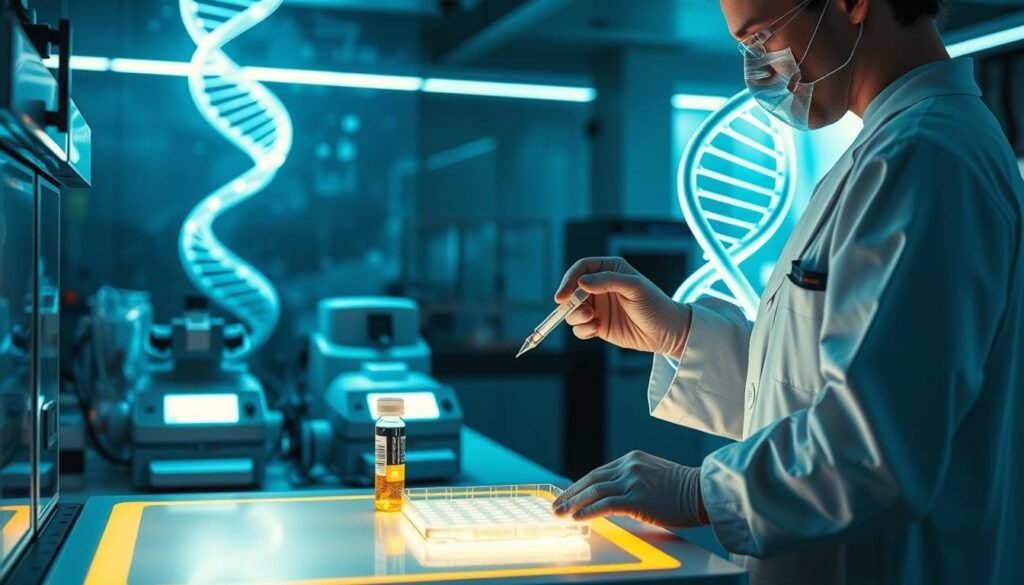
The move from fingerprints to DNA is a big step forward. Fingerprints used to be the top way to identify people. But now, DNA analysis is more accurate and reliable. DNA profiling looks at the unique genetic material in cells, helping tell people apart, even if they’re related.
The Limitations of Traditional DNA Analysis
Even with its benefits, traditional DNA analysis has its downsides. Degraded or partial DNA samples can be hard to work with. Also, it often compares DNA to known profiles in databases, which might not be big enough.
Forensic genetic genealogy has helped with these issues. It looks at genetic relatives of suspects, expanding the search.
A leading forensic scientist said,
“The advent of DNA profiling has been a game-changer in criminal investigations, but it’s not without its challenges.”
This quote shows the challenges and chances DNA technology brings to forensic science.
Understanding Forensic Genetic Genealogy
Forensic genetic genealogy mixes old-school genealogy with new genetic tech. It’s a fresh way to find suspects. This field is making waves by using DNA from ancestry sites to crack cold cases.
Defining the Methodology
It starts with DNA from crime scenes. Then, this DNA gets analyzed to make a genetic profile. This profile is checked against DNA databases to find relatives of the suspect.
The steps are simple:
- DNA extraction and profiling
- Searching commercial DNA databases for matches
- Building family trees to identify the suspect
How It Differs from Traditional Forensic Techniques
Forensic genetic genealogy is different from old DNA methods. It doesn’t compare DNA directly to known people. Instead, it looks for family ties to find unknown suspects.
| Aspect | Traditional Forensic DNA Analysis | Forensic Genetic Genealogy |
|---|---|---|
| Database Comparison | Direct comparison to known individuals | Comparison to find familial matches |
| Investigation Approach | Focus on direct DNA matches | Building family trees from genetic matches |
The Intersection of Genealogy and Criminal Investigation
Forensic genetic genealogy brings together genealogy and crime solving. It uses genealogy to follow a suspect’s family line. This can lead to finding the suspect.
The Science Behind the Breakthrough
Forensic genetic genealogy combines genetic data analysis and genealogical research. It has changed how we solve crimes by opening new ways to crack cold cases.
Understanding SNPs and Autosomal DNA
Single Nucleotide Polymorphisms (SNPs) are small changes in DNA at specific spots. Autosomal DNA comes from both parents and is not on sex chromosomes. SNPs are key in forensic genetic genealogy because they give a detailed genetic fingerprint for identifying people and their relatives.
Autosomal DNA testing finds genetic matches, which are people who share a common ancestor. This is important for building family trees and finding suspects.
The Role of Commercial DNA Databases
Commercial DNA databases like GEDmatch and FamilyTreeDNA are vital in forensic genetic genealogy. They hold a lot of genetic data to find relatives of suspects.
By matching DNA from crime scenes with these databases, investigators find genetic matches and build family trees.
Creating Family Trees from Genetic Matches
When a genetic match is found, investigators build a family tree to find suspects. They analyze genetic data and mix it with traditional genealogy.
Building family trees from genetic matches is complex but powerful for solving cold cases.
| Technique | Description | Application |
|---|---|---|
| SNP Analysis | Analysis of Single Nucleotide Polymorphisms | Identifying genetic matches |
| Autosomal DNA Testing | Testing of autosomal DNA | Constructing family trees |
| Genetic Genealogy | Combining genetic data with genealogical research | Identifying possible suspects |
The Golden State Killer Case: A Watershed Moment
The capture of the Golden State Killer was a big deal for forensic genetic genealogy in law enforcement. This case, unsolved for decades, showed how genetic genealogy can solve cold cases.
Decades of Investigation with No Leads
The Golden State Killer, also known as the East Area Rapist, scared California communities from the late 1970s to the mid-1980s. He committed many rapes and murders. Despite lots of DNA evidence, the case was stuck because old DNA analysis methods were not enough.
How Genetic Genealogy Broke the Case
Then, investigators used forensic genetic genealogy. This method compares DNA from crime scenes with DNA from DNA databases. It helps find relatives of the suspect. By making family trees from these matches, they found the killer.
Impact on the Field of Criminal Investigation
The Golden State Killer case showed how law enforcement genealogy works. It opened doors for using it in other cold cases. This new tool gives hope for solving crimes that seemed impossible to crack.
Notable Cold Cases Solved Through Forensic Genetic Genealogy
Forensic genetic genealogy has changed how we solve crimes. It has helped solve cold cases that were once unsolvable. This method has brought closure to families and justice to victims.
The Bear Brook Murders
The Bear Brook murders, also known as the Allenstown Four, were found in New Hampshire in 1985 and 2000. The remains of four people, including two children, were found in 55-gallon barrels. Forensic genetic genealogy helped identify the victims and their killer, solving the case.
The April Tinsley Case
In 1988, April Tinsley, an 8-year-old girl, was abducted and murdered in Fort Wayne, Indiana. For over 30 years, the case was unsolved. Forensic genetic genealogy was used to solve it, thanks to DNA evidence from the crime scene.
The Jay Cook and Tanya Van Cuylenborg Murders
Jay Cook and Tanya Van Cuylenborg were murdered in Snohomish County, Washington, in 2001. The case was cold until 2018. Forensic genetic genealogy identified the suspect, William Earl Talbott II, through DNA evidence.
The Angie Dodge Case
Angie Dodge was raped and murdered in 1996 in Idaho Falls, Idaho. The case was initially solved but later overturned. In 2019, forensic genetic genealogy identified the real perpetrator, Michael Usry Jr., through DNA.
| Case | Year | Location | Suspect Identified |
|---|---|---|---|
| Bear Brook Murders | 1985 | New Hampshire | Yes |
| April Tinsley | 1988 | Indiana | Yes (John D. Miller) |
| Jay Cook and Tanya Van Cuylenborg | 2001 | Washington | Yes (William Earl Talbott II) |
| Angie Dodge | 1996 | Idaho | Yes (Michael Usry Jr.) |
These cases show how powerful forensic genetic genealogy is. It helps solve cold cases that were once unsolvable. This brings justice to victims and their families.
The Methodology: From Crime Scene to Suspect Identification
Identifying a suspect through forensic genetic genealogy is a detailed process. It starts at the crime scene. This method needs careful attention and a deep understanding of genetic genealogy.
Collecting and Preserving DNA Evidence
The first step is to collect and preserve DNA evidence from the crime scene. This means handling and storing biological samples carefully. Proper collection techniques are key to keep the DNA evidence good for analysis.
Laboratory Analysis and Sequencing
After collecting DNA evidence, it goes to a lab for analysis and sequencing. Here, DNA is extracted and a DNA profile is made. This profile is then matched against genetic data in databases to find relatives of the suspect.
Database Searches and Family Tree Construction
The DNA profile is searched in databases like GEDmatch or FamilyTreeDNA. Genetic genealogy research builds a family tree that includes the suspect and their relatives.
Narrowing Down Suspects
By looking at the family tree and other details, investigators can narrow down suspects. They check alibis, do more investigations, and find the suspect.
| Step | Description |
|---|---|
| 1. DNA Collection | Collecting DNA evidence from the crime scene |
| 2. Laboratory Analysis | Extracting and sequencing DNA |
| 3. Database Search | Searching commercial genetic databases for matches |
| 4. Family Tree Construction | Building a family tree using genetic genealogy research |
| 5. Suspect Identification | Narrowing down suspects based on the family tree and other factors |
Key Players in the Forensic Genetic Genealogy Field
Many organizations and individuals have helped grow the field of forensic genetic genealogy. They have played a big role in making genetic genealogy useful in solving crimes.
Pioneering Companies and Organizations
Parabon NanoLabs and the DNA Doe Project are leading the way. They offer key services like genetic genealogy consulting and DNA analysis. These services have been key in solving many cold cases.
Notable Genetic Genealogists
Genetic genealogists like CeCe Moore and Barbara Rae-Venter have made big impacts. Their work in law enforcement genealogy has helped find suspects in cold cases. This has brought closure to families of victims.
Law Enforcement Specialized Units
Law enforcement agencies have set up special units for forensic genetic genealogy. These units work with genetic genealogists. Together, they solve cases that were once unsolvable.
The teamwork between companies, genetic genealogists, and law enforcement has been vital. As the field grows, we’ll see new ways genetic genealogy is used in solving crimes.
Privacy Concerns: The Dark Side of Genetic Sleuthing
Forensic genetic genealogy has changed how we solve crimes. But it also brings up big privacy worries. As this tech gets better, we need to talk about the right way to use genetic data.
Informed Consent Issues
One big worry is informed consent. People give their DNA to services without knowing how it might be used later. This tech uses these databases to find suspects, often without the person’s okay.
Is it fair to use someone’s DNA without their say-so? Should people be able to choose not to be used in this way? And how can we make sure they can?
Family Privacy Implications
Family privacy is another big concern. When a DNA match is found, it can tell us things about more than just the person who gave the DNA. It can reveal secrets about their family too.
For example, someone might find a long-lost relative through DNA. This could change their family’s dynamics in big ways.
The “Genetic Panopticon” Debate
The idea of a “genetic panopticon” is scary. It means we could be watched all the time through our DNA. This could make us think twice about what we say and do.
Racial and Ethnic Representation Concerns
Another important issue is who is in these DNA databases. Some groups might not be as well-represented. This means they might not get the benefits of DNA testing, like solving crimes in their community.
| Concerns | Description | Potential Impact |
|---|---|---|
| Informed Consent | Lack of clear understanding on how genetic data is used | Potential for misuse of genetic information |
| Family Privacy | Revelation of family secrets or unknown relatives | Disruption of family dynamics |
| Genetic Panopticon | Pervasive genetic surveillance | Chilling effect on free speech and behavior |
We need to tackle these issues with strong laws, clear practices, and open talks. This will help us use forensic genetic genealogy in a way that respects everyone’s privacy.
Legal Frameworks Governing Genetic Investigation
The laws around genetic data in criminal cases are changing fast. Forensic genetic genealogy is helping solve old crimes. But, we need clear laws to use it right.
Current US Laws Governing Genetic Data
The US doesn’t have one federal law for using genetic data in crimes. Instead, different state laws control how genetic info is used. The Genetic Information Nondiscrimination Act (GINA) of 2008 helps protect against misuse. But, it doesn’t cover law enforcement use.
“The lack of a clear federal law on genetic data in crime solving makes the legal rules complex and sometimes different.” –
Law Enforcement Access to Commercial Databases
Police are using private genetic databases more often. But, how these databases share data varies. For example, AncestryDNA and 23andMe have rules against giving data to police. Yet, some companies might share it under certain conditions.
Emerging Legal Precedents
As forensic genetic genealogy grows, courts are making new rules. They’re figuring out if the Fourth Amendment protects against genetic searches.
State-by-State Variations
Laws on genetic data differ a lot from state to state. Some states protect genetic data more than others. And, some let police get data easier than others.
| State | Law Governing Genetic Data | Law Enforcement Access |
|---|---|---|
| California | Strict protection under the California Genetic Information Privacy Act | Limited access with court order |
| Texas | Genetic data protected under Texas Privacy Act | Access allowed with warrant |
| New York | Comprehensive genetic privacy law enacted in 2020 | Restricted access pending further legislation |
In conclusion, the laws on genetic investigation in the US are complex and changing. As technology gets better, we’ll see more legal issues and rules. These will shape the future of using genetic data in solving crimes.
The Ethical Debate: Public Safety vs. Individual Privacy
Forensic genetic genealogy has started a big debate. People on both sides argue about public safety and privacy. This method is good at solving cold cases, but it raises big questions about ethics.
Arguments for Expanded Use
Those who want to use it more say it helps catch criminals. They believe solving crimes and giving closure to families is more important than privacy worries. They also think using DNA from public sources is okay.
Arguments for Stricter Limitations
But, others say we need to be careful with privacy. They think using DNA without consent is a big issue. They also fear misuse of genetic data and its long-term effects on privacy.
Perspectives from Ethicists and Legal Scholars
Ethicists and legal experts have different views. Some want stricter rules for using genetic genealogy. Others think we need a balanced approach that protects both safety and privacy.
Finding the Balance
Finding a middle ground is key. We need to talk more about this, involving law enforcement, ethicists, scholars, and the public. This way, we can use genetic genealogy to solve crimes without stepping on privacy rights.
Challenges and Limitations of Forensic Genetic Genealogy
Forensic genetic genealogy has changed how we solve crimes. It has helped solve many cold cases. But, it also faces big challenges and limitations.
Technical Challenges
One big challenge is understanding and using genetic data. This field uses DNA family matching and genetic genealogy research. It needs advanced algorithms and lots of computer power.
Resource Constraints
Another big challenge is the need for lots of resources. Creating detailed family trees and checking genetic matches takes a lot of time and skill. Police often have to work with private companies and genealogists. This can be hard on their resources.
Potential for Misidentification
There’s also a risk of misidentifying people. Genetic genealogy isn’t perfect, and mistakes can happen. This can lead to wrong leads and wasted time and money.
Defense Challenges in Court
In court, using genetic genealogy can be tricky. The defense might question how reliable the evidence is. This can make the legal process more complicated.
| Challenge | Description | Impact |
|---|---|---|
| Technical Challenges | Complexity of genetic data analysis | Requires sophisticated algorithms and resources |
| Resource Constraints | Time and expertise required for family trees and genetic matches | Strains law enforcement resources |
| Potential for Misidentification | Incomplete or inaccurate genetic data | False leads and misallocated resources |
As forensic genealogy techniques get better, we need to tackle these challenges. This will help keep genetic genealogy a strong tool in solving crimes.
The Future of DNA-Based Criminal Investigations
The world of criminal investigations is about to change a lot, thanks to DNA technology. New genetic methods will make solving crimes faster and more accurate. This will be a big step forward.
Technological Advancements on the Horizon
New tech is coming to DNA-based investigations. Next-generation sequencing (NGS) lets us analyze many DNA samples at once. This makes DNA analysis faster and cheaper.
Also, artificial intelligence (AI) and machine learning (ML) will help us understand DNA data better. This will lead to more precise and quick investigations.
Expanding Applications Beyond Cold Cases
DNA tech is not just for solving old crimes anymore. Forensic genetic genealogy is being used for newer crimes too. It could change how we solve crimes by giving new clues.
Also, DNA is being used in other forensic areas. Like predictive phenotyping, which makes sketches of suspects from DNA.
International Adoption and Standardization
DNA tech is becoming global, so we need to work together. Interpol and others are setting standards for DNA work worldwide. This will help fight crime across borders.
Potential Regulatory Changes
Lawmakers might change rules as DNA tech grows. They might make laws stricter to protect privacy while keeping us safe. This could change how DNA evidence is used.
Impact on Victims’ Families and Communities
Forensic genetic genealogy has changed how we solve crimes. It has brought closure to families after years of waiting. This technology has solved crimes and given comfort to those waiting for answers.
Closure After Decades of Uncertainty
For victims’ families, solving cold cases has been a game-changer. It ends their long wait, letting them grieve and heal.
Psychological Effects of Solved vs. Unsolved Cases
Having a case solved has a huge impact on families. It’s a stark contrast to the pain of unsolved cases. Studies show that solved cases can lead to deep healing for families.
Community Healing and Justice
Solving cold cases also helps the community heal. It shows that justice can be served, even years later.
Testimonials from Affected Families
Families who get answers through forensic genetic genealogy feel many emotions. They feel relief, gratitude, and sometimes sadness. As one family member said, “After all these years, we have answers. It’s a bittersweet feeling, but it’s closure.”
Conclusion: Balancing Justice and Ethics in the Genetic Age
Forensic genetic genealogy has changed how we solve crimes. It uses DNA databases and advanced tech to find suspects. This helps bring closure to families of victims.
But, there are big ethical questions. This method uses DNA without asking people first. It could be seen as a privacy issue. We need to find a way to balance justice with privacy rights.
It’s important to think about the ethics of DNA use in solving crimes. We should make sure the benefits are worth the risks. Lawmakers, ethicists, and police need to talk more about this.
In the end, using DNA to solve crimes can make society better. We must face the challenges of this technology. This way, we can ensure justice is fair and privacy is respected.
FAQ
What is forensic genetic genealogy?
How does forensic genetic genealogy differ from traditional DNA profiling?
What are the main ethical concerns surrounding forensic genetic genealogy?
How are commercial DNA databases used in forensic genetic genealogy?
What are some notable cases that have been solved using forensic genetic genealogy?
What are the technical challenges associated with forensic genetic genealogy?
How is forensic genetic genealogy regulated?
What is the future of forensic genetic genealogy?
How does forensic genetic genealogy impact victims’ families and communities?


The PsyForU Editorial Collective is the research and editorial team of PsyForU Research International. The collective prepares educational, psychological, mental-health-awareness, inclusion, neurodiversity, and research-methodology content for students, parents, educators, researchers, and general readers. PsyForU content is intended for awareness, education, and capacity-building and should not be treated as clinical diagnosis, therapy, medical advice, legal advice, or emergency mental-health support.