


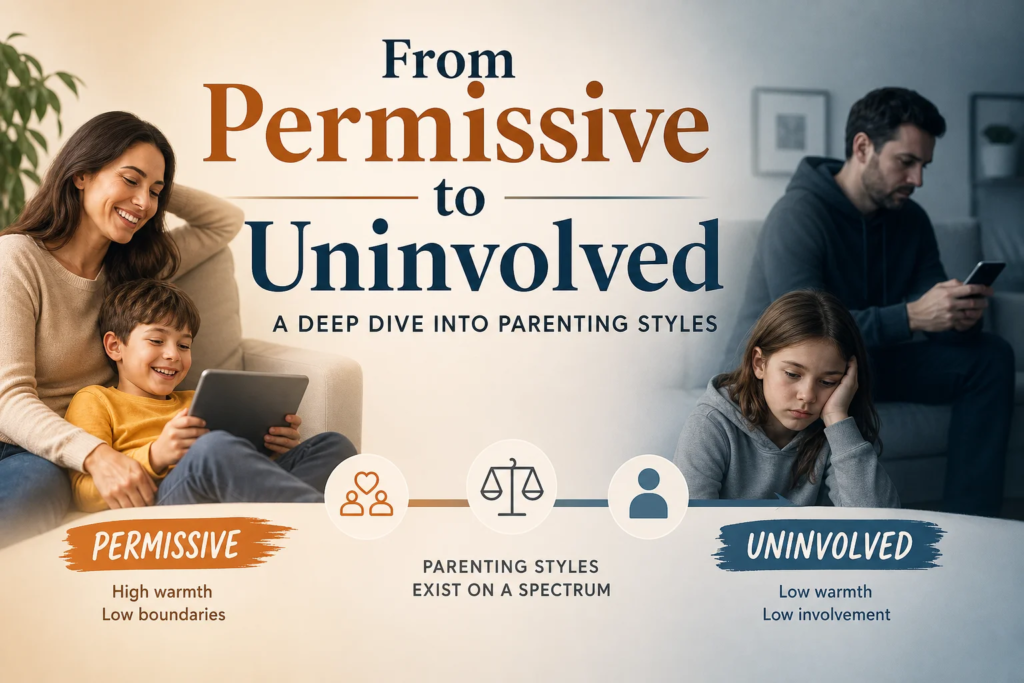
Introduction: Why Parenting Style Matters More Than Most People Realize
A child does not need a perfect parent. No child has one. What children do need is a parent who is emotionally present, reasonably consistent, and willing to guide them through life with both warmth and boundaries.
That is where parenting styles become so important.
The way a parent responds to tantrums, homework struggles, bedtime resistance, emotional outbursts, screen-time negotiations, and broken rules shapes more than daily behavior. It shapes how children understand love, responsibility, safety, independence, self-control, and trust.
This is why From Permissive to Uninvolved: A Deep Dive into Parenting Styles is such an important conversation. Many parents do not intentionally choose a parenting style. They simply react. They repeat what they experienced, or they overcorrect from it. A parent who grew up with harsh discipline may become overly lenient. A parent who feels exhausted, unsupported, or emotionally drained may slowly drift from being permissive into being uninvolved without realizing it.
And that shift matters.
Permissive parenting and uninvolved parenting can sometimes look similar from the outside because both may involve limited rules, inconsistent discipline, and children making many decisions on their own. But beneath the surface, they are very different. Permissive parents are usually warm and emotionally available but struggle with limits. Uninvolved parents are often emotionally distant, unavailable, or detached from the child’s daily needs.
Understanding the difference is not about blaming parents. It is about awareness, repair, and growth.
This article, From Permissive to Uninvolved: A Deep Dive into Parenting Styles, explores the full spectrum of parenting approaches, with a special focus on how permissiveness can slide into emotional disengagement if parents are not careful. We will look at real-world examples, practical strategies, common mistakes, and healthier alternatives that support children without controlling them.
By the end, you will have a clearer understanding of what children truly need: not perfection, not constant entertainment, not unlimited freedom, and not rigid control — but steady, loving leadership.
Understanding the Four Major Parenting Styles
Before focusing specifically on From Permissive to Uninvolved: A Deep Dive into Parenting Styles, it helps to understand the larger parenting framework. Developmental psychology often describes four broad parenting styles:
- Authoritative
- Authoritarian
- Permissive
- Uninvolved
These styles are usually understood through two major dimensions:
- Responsiveness: How warm, emotionally available, and supportive a parent is.
- Demandingness: How much structure, expectation, accountability, and guidance a parent provides.
The balance between these two dimensions creates very different family environments.
Table: The Four Parenting Styles at a Glance
| Parenting Style | Warmth/Responsiveness | Rules/Structure | Common Parent Message | Common Child Experience |
|---|---|---|---|---|
| Authoritative | High | High | “I love you, and I will guide you.” | Secure, supported, accountable |
| Authoritarian | Low to moderate | High | “Do as I say because I said so.” | Controlled, anxious, obedient or rebellious |
| Permissive | High | Low | “I want you to be happy, so I won’t push too hard.” | Loved but under-guided |
| Uninvolved | Low | Low | “You’re mostly on your own.” | Neglected, unsupported, emotionally uncertain |
The healthiest style is generally considered authoritative parenting, because it blends emotional warmth with clear expectations. Children are allowed to have feelings, opinions, and individuality, but they are not left without guidance.
The focus of From Permissive to Uninvolved: A Deep Dive into Parenting Styles is the lower-structure side of parenting: the zone where children may receive too little guidance, too few boundaries, and sometimes too little emotional connection.
What Is Permissive Parenting?
Permissive parenting is a style marked by high warmth and low structure. A permissive parent usually loves deeply, listens often, and wants their child to feel accepted. The problem is not lack of affection. The problem is lack of consistent boundaries.
Permissive parents often avoid conflict. They may struggle to say no, enforce consequences, or tolerate their child’s disappointment. Their intentions are often compassionate. They want to protect their child from pain, embarrassment, frustration, or rejection. But over time, children may learn that rules are flexible, persistence gets them what they want, and uncomfortable emotions should be avoided rather than managed.
In From Permissive to Uninvolved: A Deep Dive into Parenting Styles, permissive parenting is important because it can look loving on the surface while quietly depriving children of essential skills.
Common Signs of Permissive Parenting
A permissive parent may:
- Give in after a child whines, cries, argues, or negotiates.
- Set rules but rarely enforce them.
- Avoid consequences because they feel guilty.
- Act more like a friend than a parent.
- Allow unlimited screen time, snacks, spending, or bedtime flexibility.
- Rescue the child from normal responsibilities.
- Struggle to tolerate the child being upset.
- Make decisions based on keeping peace rather than teaching skills.
A permissive parent might say:
- “I know I said no, but fine, just this once.”
- “I don’t want to make them feel bad.”
- “They’ll learn when they’re older.”
- “I want my child to like me.”
- “It’s easier to just let it go.”
The key issue is not kindness. Kindness is essential. The issue is kindness without leadership.
What Is Uninvolved Parenting?
Uninvolved parenting, sometimes called neglectful parenting, is characterized by low warmth and low structure. Unlike permissive parenting, uninvolved parenting does not simply lack boundaries. It often lacks emotional availability.
An uninvolved parent may provide basic physical necessities, but they are disconnected from the child’s emotional world, school life, friendships, struggles, and daily experiences. In more severe cases, the child may experience neglect.
This is why From Permissive to Uninvolved: A Deep Dive into Parenting Styles requires careful attention. The movement from permissive to uninvolved may not happen dramatically. It can happen slowly through exhaustion, stress, depression, addiction, work overload, unresolved trauma, or emotional burnout.
Common Signs of Uninvolved Parenting
An uninvolved parent may:
- Rarely ask about school, friends, emotions, or problems.
- Provide little supervision.
- Be emotionally distant or unavailable.
- Ignore behavioral issues until they become severe.
- Leave children to manage responsibilities beyond their maturity level.
- Offer few rules and little affection.
- Spend little meaningful time with the child.
- Respond with indifference rather than guidance.
An uninvolved parent might say:
- “They can figure it out.”
- “I don’t have time for this.”
- “It’s not a big deal.”
- “They’re old enough to handle themselves.”
- “I don’t know what they’re doing most of the time.”
While permissive parenting often comes from over-accommodation, uninvolved parenting often comes from emotional withdrawal.
Permissive vs. Uninvolved Parenting: The Critical Difference
The heart of From Permissive to Uninvolved: A Deep Dive into Parenting Styles is understanding the difference between a parent who is loving but lax and a parent who is disconnected.
At first glance, both permissive and uninvolved parenting may produce similar household patterns: few rules, inconsistent discipline, and children making many choices independently. But the child’s emotional experience is often very different.
Table: Permissive Parenting vs. Uninvolved Parenting
| Category | Permissive Parenting | Uninvolved Parenting |
|---|---|---|
| Emotional warmth | Usually high | Usually low |
| Rules | Few or inconsistent | Few or absent |
| Discipline | Avoided or weak | Rare or indifferent |
| Parent-child bond | Often close, but unclear roles | Often distant or unreliable |
| Parent motivation | Avoid conflict, protect child from distress | Disengagement, overwhelm, neglect, or detachment |
| Child’s likely feeling | “My parent loves me but doesn’t guide me.” | “I’m mostly alone.” |
| Long-term concern | Poor self-control, entitlement, anxiety around limits | Emotional insecurity, low self-worth, behavioral or academic struggles |
This distinction matters because solutions differ.
A permissive parent often needs help building confidence with boundaries. An uninvolved parent may need support reconnecting emotionally, addressing stressors, and becoming reliably present.
In From Permissive to Uninvolved: A Deep Dive into Parenting Styles, the goal is not to label parents as “good” or “bad.” The goal is to identify patterns and change them before they harden into long-term family dynamics.
How Permissive Parenting Can Drift Toward Uninvolved Parenting
Not all permissive parenting becomes uninvolved parenting. Many permissive parents are deeply engaged. However, there can be a slippery slope.
A parent may begin by saying yes too often because they want to avoid conflict. Over time, the child becomes more resistant to limits. The parent feels more exhausted. Arguments become longer. Rules feel impossible to enforce. Eventually, the parent may emotionally check out.
That is the dangerous bridge between permissive and uninvolved parenting.
The Drift Often Looks Like This
| Stage | Parent Behavior | Child Response | Risk |
|---|---|---|---|
| Early permissiveness | Parent avoids saying no | Child pushes boundaries | Rules lose meaning |
| Increased conflict | Parent gives in to avoid arguments | Child learns persistence works | Parent feels powerless |
| Emotional fatigue | Parent stops trying to enforce limits | Child gains too much control | Household becomes child-led |
| Withdrawal | Parent disengages from conflict and connection | Child feels unsupported | Permissiveness becomes emotional distance |
In From Permissive to Uninvolved: A Deep Dive into Parenting Styles, this drift is one of the most important patterns to recognize. Parents often do not become uninvolved because they do not care. Sometimes they become uninvolved because they feel defeated.
A parent may think, “Nothing works anyway,” and stop trying.
But something can work: rebuilding connection and structure at the same time.
Why Parents Become Permissive
Permissive parenting rarely appears out of nowhere. It usually has a story.
Some parents become permissive because they were raised in harsh, authoritarian homes. They remember fear, punishment, yelling, shame, or emotional distance. Determined not to repeat that pain, they swing to the opposite extreme.
They may think:
- “My parents were too strict, so I won’t have many rules.”
- “I never felt heard, so I’ll let my child decide.”
- “I was punished for having feelings, so I’ll never upset my child.”
- “I want my home to feel safe, not controlling.”
These are loving motives. But without balance, the result can be a home where the child feels emotionally accepted but not securely guided.
Other reasons parents become permissive include:
- Guilt from divorce, long work hours, or past mistakes.
- Fear of damaging the child’s confidence.
- Lack of parenting models.
- Desire to be liked.
- Exhaustion.
- Co-parenting inconsistency.
- Confusion about gentle parenting.
- Belief that discipline equals punishment.
A major insight from From Permissive to Uninvolved: A Deep Dive into Parenting Styles is that many parents confuse boundaries with harshness. But healthy boundaries are not rejection. They are protection.
A child can be disappointed and still be loved. A child can be corrected and still be respected. A child can hear “no” and still feel safe.
Why Parents Become Uninvolved
Uninvolved parenting can have many causes, and not all of them come from indifference. Sometimes parents are dealing with serious challenges that reduce their emotional availability.
Possible contributors include:
- Chronic stress.
- Depression or anxiety.
- Substance abuse.
- Financial instability.
- Relationship conflict.
- Trauma history.
- Social isolation.
- Overwork.
- Lack of parenting education.
- Emotional immaturity.
- Intergenerational neglect.
That said, understanding causes does not erase impact. Children still need care, guidance, and emotional connection.
This is where From Permissive to Uninvolved: A Deep Dive into Parenting Styles becomes practical. If a parent sees themselves becoming distant, numb, irritable, or checked out, the answer is not shame. The answer is support, repair, and intentional reconnection.
Uninvolved parenting is especially concerning because children may interpret parental distance personally. A child may not think, “My parent is overwhelmed.” A child may think, “I am not worth noticing.”
That belief can follow a child for years.
The Child’s Perspective: What It Feels Like
Adults often evaluate parenting based on intentions. Children experience parenting based on patterns.
A permissive parent may intend to be loving. But a child may feel secretly anxious because no one is clearly in charge.
An uninvolved parent may intend to give independence. But a child may feel abandoned.
Children need both roots and rails: emotional roots that say, “You belong,” and behavioral rails that say, “Here is the safe path.”
How Children May Interpret Each Style
| Parenting Style | What the Parent May Intend | What the Child May Learn |
|---|---|---|
| Permissive | “I want you to feel free.” | “Rules do not matter much.” |
| Permissive | “I don’t want to upset you.” | “My feelings are too powerful for adults to handle.” |
| Uninvolved | “You need independence.” | “I have to handle life alone.” |
| Uninvolved | “I’m too busy right now.” | “I’m not important enough.” |
| Authoritative | “I care enough to guide you.” | “I am loved, capable, and accountable.” |
In From Permissive to Uninvolved: A Deep Dive into Parenting Styles, the child’s inner experience is central. Parenting is not only about managing behavior. It is about shaping the emotional atmosphere in which a child develops.
Case Study 1: The Loving but Permissive Parent
Background
Maria is a single mother of eight-year-old Leo. She works full-time and feels guilty that Leo spends long hours in after-school care. When they get home, she wants their evenings to be peaceful. Leo often refuses homework, asks for extra screen time, and negotiates bedtime.
Maria sets rules, but she rarely follows through.
She says:
- “Only 30 minutes of tablet time.”
- “Bedtime is 8:30.”
- “You need to finish homework before games.”
But when Leo protests, Maria gives in. She tells herself he has had a long day too.
Over time, Leo becomes more demanding. He interrupts Maria’s work calls, melts down when the tablet is removed, and refuses to sleep without another show.
Analysis
This case illustrates the permissive side of From Permissive to Uninvolved: A Deep Dive into Parenting Styles. Maria is emotionally warm. She loves Leo deeply. She is not neglectful. But her guilt prevents her from offering the structure Leo needs.
Leo is not “bad.” He is adapting to the system. He has learned that boundaries are negotiable if he escalates long enough.
What Would Help
Maria does not need to become harsh. She needs predictable routines.
A healthier approach might sound like:
“Leo, I know you want more tablet time. It is hard to stop when something is fun. The tablet is done for tonight. You can be upset, and I will sit with you, but the answer is still no.”
This response combines warmth and firmness. That is the authoritative alternative.
Case Study 2: The Teen Who Looks Independent but Feels Alone
Background
Darren is 15. His father, Marcus, works nights and sleeps during the day. His mother lives in another state. Marcus assumes Darren is mature because he gets himself to school, makes his own meals, and spends most evenings in his room.
Darren’s grades begin slipping. He stops going to soccer practice. He spends more time online and starts missing assignments. Marcus notices but says, “He’s old enough to figure it out.”
Darren tells a school counselor, “Nobody really cares what I do.”
Analysis
This case shows the uninvolved side of From Permissive to Uninvolved: A Deep Dive into Parenting Styles. Marcus may not intend to neglect Darren. He may be exhausted and overwhelmed. But Darren experiences the lack of supervision and emotional connection as abandonment.
Teenagers need independence, but they also need monitoring, interest, and emotional presence. A teenager who can make food and get to school still needs a parent who asks questions and notices changes.
What Would Help
Marcus could begin with small but consistent reconnection:
- A 15-minute daily check-in.
- Weekly grade review without shaming.
- One shared meal on weekends.
- Clear expectations about school attendance and online time.
- Direct emotional repair: “I realize I have not been as present as you needed. I want to change that.”
The repair matters. Children and teens do not need parents to have done everything right. They need parents who are willing to come back.
Case Study 3: When Gentle Parenting Is Misunderstood
Background
Alicia and Ben are parents to four-year-old Sophie. They follow parenting accounts online and want to raise Sophie with respect. They avoid yelling and punishments, which is positive. But they also avoid limits.
When Sophie hits another child at a playdate, Alicia says, “She’s expressing big feelings.” When Sophie throws food, Ben says, “We don’t want to shame her.” When Sophie refuses to get in the car seat, they wait 25 minutes until she agrees.
They believe they are practicing gentle parenting, but they are actually becoming permissive.
Analysis
This is a common misunderstanding in From Permissive to Uninvolved: A Deep Dive into Parenting Styles. Gentle parenting does not mean boundary-free parenting. Respectful parenting still includes limits, safety, accountability, and follow-through.
Children are not harmed by loving boundaries. In fact, they are often relieved by them.
What Would Help
A more balanced response would be:
“I won’t let you hit. You are angry, and I will help you, but I will move your hands to keep everyone safe.”
Or:
“Food stays on the plate. If you throw it again, lunch is finished.”
This protects the child’s dignity while still teaching responsibility.
The Hidden Costs of Permissive Parenting
Permissive parenting can feel peaceful in the short term but costly in the long term.
When children do not experience consistent limits, they may struggle with:
- Frustration tolerance.
- Delayed gratification.
- Respect for others’ boundaries.
- Emotional regulation.
- Responsibility.
- Persistence.
- Accepting disappointment.
- Following rules outside the home.
A child raised with permissiveness may be shocked when teachers, coaches, employers, or peers do not accommodate them the same way their parents do.
This is a key theme in From Permissive to Uninvolved: A Deep Dive into Parenting Styles: what feels loving today may not prepare a child for tomorrow.
Short-Term Relief vs. Long-Term Growth
| Parent Choice | Short-Term Result | Long-Term Risk |
|---|---|---|
| Giving in to stop whining | Immediate quiet | More whining next time |
| Avoiding consequences | Child stays happy | Low accountability |
| Letting child quit when frustrated | Less conflict | Reduced resilience |
| Allowing unlimited screens | Parent gets a break | Poor self-regulation |
| Rescuing from every mistake | Child avoids discomfort | Weak problem-solving skills |
Permissiveness often trades long-term development for short-term peace.
The Hidden Costs of Uninvolved Parenting
Uninvolved parenting can be deeply damaging because it affects a child’s sense of worth and security.
Children may develop the belief that their needs are burdensome or invisible. They may become overly self-reliant, emotionally guarded, attention-seeking, or vulnerable to unhealthy relationships.
Possible outcomes may include:
- Low self-esteem.
- Academic problems.
- Poor emotional regulation.
- Risk-taking behavior.
- Difficulty trusting others.
- Attachment insecurity.
- Loneliness.
- Anger or withdrawal.
- Difficulty asking for help.
In From Permissive to Uninvolved: A Deep Dive into Parenting Styles, this is one of the most serious concerns. Children need more than physical survival. They need emotional recognition.
A child needs someone to notice:
- “You seem quieter than usual.”
- “That friendship issue sounds painful.”
- “I saw how hard you tried.”
- “Let’s look at your homework together.”
- “I’m here, even when things are hard.”
Presence is not luxury parenting. Presence is foundational.
Authoritative Parenting: The Healthy Middle Path
If permissive parenting is high warmth but low structure, and uninvolved parenting is low warmth and low structure, authoritative parenting offers the healthier alternative: high warmth and high structure.
Authoritative parents are not controlling, cold, or rigid. They listen. They explain. They validate emotions. But they also set expectations and follow through.
They understand that children need both compassion and correction.
What Authoritative Parenting Sounds Like
| Situation | Permissive Response | Uninvolved Response | Authoritative Response |
|---|---|---|---|
| Child refuses homework | “Fine, do it later.” | “Not my problem.” | “You can take a 10-minute break, then I’ll sit nearby while you start.” |
| Teen breaks curfew | “Just don’t do it again.” | “Whatever.” | “I’m glad you’re safe. We need to discuss trust and adjust plans for next weekend.” |
| Child screams for candy | “Okay, but stop crying.” | Ignores child | “I know you want it. We’re not buying candy today. You can be upset.” |
| Child hits sibling | “They’re just tired.” | “Handle it yourselves.” | “I won’t let you hit. Take space, then we’ll repair.” |
This balanced approach is the most practical takeaway from From Permissive to Uninvolved: A Deep Dive into Parenting Styles. Children thrive when they feel loved and led.
Boundaries Are Not the Opposite of Love
Many permissive parents resist boundaries because they fear becoming harsh. But boundaries are not the opposite of love. Boundaries are one of the ways love becomes trustworthy.
A boundary tells a child:
- “I care enough to teach you.”
- “I can handle your disappointment.”
- “You are not in charge of the whole household.”
- “Your feelings matter, but they do not make every decision.”
- “I will keep you safe, even when you disagree.”
This idea is central to From Permissive to Uninvolved: A Deep Dive into Parenting Styles. Children are not emotionally harmed by reasonable limits. They are harmed by humiliation, rejection, violence, inconsistency, and emotional abandonment.
A child can cry because screen time is over and still be safe. A child can be angry about bedtime and still be loved. A teenager can dislike a consequence and still benefit from accountability.
How to Move from Permissive to Balanced Parenting
If you recognize permissive patterns in yourself, the goal is not to suddenly become strict. Abrupt overcorrection can confuse children and create unnecessary power struggles.
Instead, begin with small, consistent changes.
Step 1: Choose Three Non-Negotiables
Do not try to fix everything at once. Choose three areas that matter most.
Examples:
- Bedtime.
- Homework.
- Respectful language.
- Screen time.
- Chores.
- Safety rules.
Say clearly:
“These are the rules we are going to practice consistently.”
Step 2: Expect Pushback
If your child is used to flexible limits, they may protest when boundaries become firmer. This does not mean you are doing something wrong. It means the family system is changing.
Stay calm. Do not lecture too much. Repeat the rule.
Step 3: Validate Feelings Without Changing the Limit
Try:
- “I know this is frustrating.”
- “You really wanted more time.”
- “It makes sense that you’re upset.”
- “The answer is still no.”
- “I’m here with you while you calm down.”
This is one of the most important tools in From Permissive to Uninvolved: A Deep Dive into Parenting Styles: connection without surrender.
Step 4: Use Predictable Consequences
Consequences should be related, reasonable, and respectful.
If a child refuses to put away a toy, the toy may be unavailable for a period of time. If a teen breaks phone rules, phone access may be limited. If a child speaks disrespectfully, the conversation pauses until they can try again.
The goal is teaching, not revenge.
Step 5: Repair After Conflict
After a difficult moment, reconnect.
Say:
“That was hard. I love you. We are still working on this together.”
Repair helps children understand that conflict does not destroy connection.
How to Move from Uninvolved to Connected Parenting
If you recognize uninvolved patterns, start with reconnection. Rules matter, but emotional presence comes first.
A child who has felt ignored may not immediately trust sudden involvement. They may resist, dismiss, or test your sincerity. Be patient. Consistency rebuilds trust.
Step 1: Start Small and Specific
Instead of saying, “We need to spend more time together,” try:
- “I want to have breakfast with you on Saturdays.”
- “I’m going to check in after school for 10 minutes.”
- “Let’s take a walk twice a week.”
- “I want to know more about what you’re into.”
Small promises kept are better than big promises broken.
Step 2: Ask Better Questions
Avoid questions that feel like interrogation.
Instead of:
“How was school?”
Try:
- “What was the best part of today?”
- “Who did you sit with at lunch?”
- “Was anything stressful?”
- “What’s something you wish adults understood?”
- “What are you looking forward to this week?”
Step 3: Notice Without Immediately Correcting
If the first thing a child hears after reconnection is criticism, they may withdraw.
Begin by noticing:
- “You seem tired lately.”
- “I’ve missed talking with you.”
- “I can tell that game matters to you.”
- “You worked hard on that.”
Then gradually add structure.
Step 4: Apologize When Needed
A sincere apology can be powerful.
Try:
“I realize I have not been as involved as I should have been. That may have made you feel alone. I’m sorry. I want to do better, and I’m going to show you through my actions.”
This kind of repair is an essential part of From Permissive to Uninvolved: A Deep Dive into Parenting Styles.
Step 5: Get Support
If emotional withdrawal is connected to depression, trauma, addiction, burnout, or overwhelming stress, support is not optional. It is necessary.
That support may include therapy, parenting classes, community resources, family counseling, spiritual support, trusted relatives, or school-based help.
Parenting was never meant to happen in isolation.
The Role of Culture, Family History, and Stress
Parenting styles do not develop in a vacuum. Culture, family history, financial pressure, community support, and personal stress all shape how parents respond.
In some families, strict obedience is valued. In others, emotional expression is encouraged. Some parents were raised to believe children should be seen and not heard. Others were raised with little supervision and assume independence should come early.
The purpose of From Permissive to Uninvolved: A Deep Dive into Parenting Styles is not to ignore cultural differences. It is to identify universal child needs within different family contexts.
Across cultures, children benefit from:
- Emotional safety.
- Reliable caregivers.
- Age-appropriate expectations.
- Protection from harm.
- Opportunities to build responsibility.
- Respectful guidance.
- Belonging.
The exact expression may vary, but the needs remain deeply human.
Parenting Style and Screen Time
Screen time is one of the clearest modern examples of the difference between permissive, uninvolved, and authoritative parenting.
A permissive parent may allow unlimited screen time because saying no causes conflict. An uninvolved parent may not know what the child is watching or how long they are online. An authoritative parent sets limits, explains them, monitors content, and helps the child build self-regulation.
Table: Parenting Styles and Screen Time
| Style | Screen-Time Pattern | Likely Issue |
|---|---|---|
| Permissive | “You can keep watching if you stop complaining.” | Child learns protest works |
| Uninvolved | “I don’t know what they do online.” | Lack of supervision and safety |
| Authoritarian | “No screens ever, no discussion.” | Child may hide use |
| Authoritative | “Screens are allowed after responsibilities, with limits.” | Builds balance and trust |
In From Permissive to Uninvolved: A Deep Dive into Parenting Styles, screen time is a practical testing ground. It reveals whether parents can combine warmth, structure, monitoring, and flexibility.
Parenting Style and Discipline
Discipline does not mean punishment. The word discipline is connected to teaching. Healthy discipline helps children learn what to do next time.
Permissive parenting avoids discipline. Uninvolved parenting neglects discipline. Authoritarian parenting may overuse punishment. Authoritative parenting teaches through limits, consequences, modeling, and repair.
Healthy Discipline Includes
- Clear expectations.
- Calm follow-through.
- Natural or logical consequences.
- Emotional coaching.
- Skill-building.
- Repair after harm.
- Consistency.
Healthy Discipline Avoids
- Shame.
- Threats without follow-through.
- Physical punishment.
- Name-calling.
- Silent treatment.
- Explosive anger.
- Random consequences.
- Emotional withdrawal.
A useful phrase from From Permissive to Uninvolved: A Deep Dive into Parenting Styles is this:
Discipline should leave a child thinking, “I can do better,” not “I am bad.”
Common Mistakes Parents Make When Changing Styles
Changing parenting patterns is difficult. Parents often start with good intentions but run into predictable traps.
Mistake 1: Going From Too Loose to Too Strict Overnight
If a household has had few rules, suddenly introducing many harsh rules can backfire. Children need time to adjust.
Start with a few boundaries and enforce them calmly.
Mistake 2: Talking Too Much
Long lectures often lose children. Be brief.
Try:
“The rule is homework before games. I’ll help you start.”
Mistake 3: Confusing Calm With Weakness
A calm parent can still be firm. You do not need to yell to be taken seriously.
Mistake 4: Expecting Immediate Gratitude
Children may not thank you for boundaries. That does not mean boundaries are wrong.
Mistake 5: Giving Up After One Bad Day
Progress is not linear. One meltdown does not mean failure.
This is why From Permissive to Uninvolved: A Deep Dive into Parenting Styles emphasizes consistency over perfection.
Practical Scripts for Real-Life Parenting Moments
Sometimes parents understand the theory but freeze in the moment. Scripts can help.
When a Child Refuses to Listen
“I hear that you don’t want to. The rule still stands. You can choose to do it now, or you can choose the consequence.”
When a Child Melts Down Over a Limit
“You are really upset. I’m not changing the answer, but I will stay nearby while you calm down.”
When a Teen Says, ‘You Don’t Trust Me’
“I want to trust you. Trust grows when actions match agreements. Let’s talk about how to rebuild it.”
When You Have Been Too Permissive
“I know I have not been consistent with this rule. That has probably been confusing. Starting today, we are going to handle it differently.”
When You Have Been Uninvolved
“I realize I have not checked in enough. I care about what is happening in your life. I want to start showing up more consistently.”
These scripts reflect the heart of From Permissive to Uninvolved: A Deep Dive into Parenting Styles: honest, warm, firm, and repair-focused parenting.
A Simple Self-Assessment for Parents
Use the following questions as a reflection tool. This is not a diagnosis. It is a starting point.
Table: Parenting Style Reflection Checklist
| Question | Often | Sometimes | Rarely |
|---|---|---|---|
| Do I avoid saying no because I fear my child’s reaction? | |||
| Do I set rules but fail to enforce them? | |||
| Do I know what is happening in my child’s school and social life? | |||
| Do I spend meaningful one-on-one time with my child? | |||
| Do I follow through on consequences calmly? | |||
| Do I validate feelings while maintaining limits? | |||
| Do I feel emotionally checked out from parenting? | |||
| Does my child seem unsure whether I will respond consistently? |
If you answered “often” to avoiding limits, you may lean permissive. If you answered “rarely” to emotional involvement questions, you may be drifting toward uninvolved patterns.
The value of From Permissive to Uninvolved: A Deep Dive into Parenting Styles is not in labeling yourself. It is in noticing where change is needed.
The 7-Day Reset Plan for More Balanced Parenting
Here is a simple one-week plan to begin shifting toward authoritative parenting.
Day 1: Observe Without Judging
Notice your patterns. When do you give in? When do you withdraw? When do you feel triggered?
Day 2: Choose One Boundary
Pick one rule to enforce consistently. Keep it simple.
Example: “Devices charge outside bedrooms at 9 p.m.”
Day 3: Add One Connection Ritual
Spend 10 minutes of focused time with your child. No phone. No correction. Just connection.
Day 4: Practice Validation Plus Limit
Use this formula:
“I understand you feel . The rule is .”
Example:
“I understand you feel angry. The rule is no hitting.”
Day 5: Follow Through Calmly
Expect resistance. Stay steady.
Day 6: Repair One Past Pattern
Say:
“I’m working on being more consistent. I may not get it perfect, but I’m trying.”
Day 7: Review and Adjust
Ask:
- What improved?
- What was hard?
- What boundary needs more clarity?
- Where did connection increase?
This plan captures the practical spirit of From Permissive to Uninvolved: A Deep Dive into Parenting Styles: small changes, repeated consistently, can transform the emotional climate of a home.
Conclusion: Children Need Love That Leads
Parenting is not about choosing between kindness and authority. Children need both.
Permissive parenting offers warmth but often lacks guidance. Uninvolved parenting lacks both guidance and emotional presence. Authoritarian parenting may provide structure but often misses emotional safety. Authoritative parenting offers the most balanced path: love with limits, empathy with expectations, freedom with responsibility.
The journey explored in From Permissive to Uninvolved: A Deep Dive into Parenting Styles reminds us that the absence of boundaries is not the same as love, and the absence of conflict is not the same as peace. Real peace in a family comes from trust, consistency, connection, and repair.
If you see yourself in permissive patterns, begin with one boundary. If you see yourself in uninvolved patterns, begin with one moment of reconnection. If you feel guilty, remember this: guilt can keep you stuck, but responsibility can move you forward.
No parent gets every moment right. What matters is the willingness to notice, repair, and grow.
Your child does not need a flawless parent.
Your child needs a present one.
And that is the ultimate lesson of From Permissive to Uninvolved: A Deep Dive into Parenting Styles.
1. What is the main difference between permissive and uninvolved parenting?
The main difference is emotional involvement. Permissive parents are usually warm and loving but struggle with rules and follow-through. Uninvolved parents provide little structure and little emotional connection. In From Permissive to Uninvolved: A Deep Dive into Parenting Styles, this distinction is essential because the solutions are different.
2. Can permissive parenting harm a child even if the parent is loving?
Yes. Love is vital, but children also need boundaries, responsibility, and guidance. A permissive parent may unintentionally make it harder for a child to develop self-control, patience, resilience, and respect for limits.
3. Is uninvolved parenting always intentional neglect?
Not always. Some parents become uninvolved because of stress, depression, trauma, work overload, or lack of support. However, the impact on the child can still be serious. Children need emotional presence, not just physical care.
4. How can I stop being a permissive parent without becoming too strict?
Start small. Choose a few important rules, explain them clearly, validate your child’s feelings, and follow through calmly. The goal is not harsh control. The goal is warm leadership. This is a central message of From Permissive to Uninvolved: A Deep Dive into Parenting Styles.
5. What should I do if I realize I have been emotionally unavailable?
Begin with honest repair. Tell your child you recognize the distance and want to be more present. Then prove it through small, consistent actions: daily check-ins, shared meals, school involvement, and reliable follow-through.
6. Is gentle parenting the same as permissive parenting?
No. Gentle parenting includes empathy and respect, but it should also include boundaries. Permissive parenting avoids limits. Healthy gentle parenting says, “Your feelings matter, and the boundary still stands.”
7. What is the healthiest parenting style?
Authoritative parenting is widely considered the healthiest overall style because it combines warmth with structure. It allows children to feel loved while also learning responsibility, self-control, and respect.
8. Can a parent change their parenting style after years of permissiveness or distance?
Yes. Change is possible at any stage. Children may need time to trust the change, especially if old patterns were deeply established. Consistency, humility, and repair are key.
9. How do I know if I am giving my child independence or being uninvolved?
Healthy independence includes support, monitoring, and connection. Uninvolved parenting leaves a child largely alone emotionally or practically. Ask yourself: “Do I know what my child is experiencing, and do they know they can come to me?”
10. What is the biggest takeaway from From Permissive to Uninvolved: A Deep Dive into Parenting Styles?
The biggest takeaway is that children need both affection and direction. Love without limits can leave children unprepared. Rules without warmth can leave them afraid. But love with steady guidance helps children feel secure, capable, and deeply valued.


The PsyForU Editorial Collective is the research and editorial team of PsyForU Research International. The collective prepares educational, psychological, mental-health-awareness, inclusion, neurodiversity, and research-methodology content for students, parents, educators, researchers, and general readers. PsyForU content is intended for awareness, education, and capacity-building and should not be treated as clinical diagnosis, therapy, medical advice, legal advice, or emergency mental-health support.