


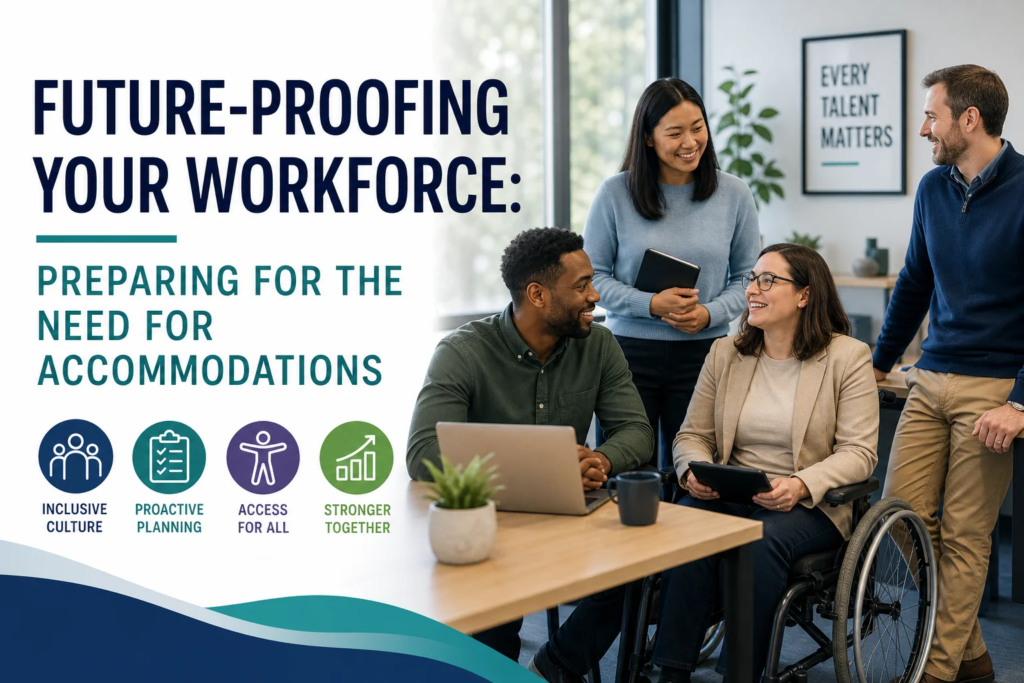
The workforce is changing faster than most policies can keep up. Employees are staying in the labor market longer, mental health needs are more visible, neurodiversity is reshaping talent strategy, chronic health conditions are increasingly common, and flexible work is no longer a perk—it is often a practical requirement for people to do their best work.
That is why Future-Proofing Your Workforce: Preparing for the Need for Accommodations is no longer just an HR topic. It is a business resilience strategy.
Organizations that wait until an accommodation request lands in an inbox are already behind. The companies that thrive in the next decade will be the ones that design work with enough flexibility, dignity, and structure to support a wide range of human needs before those needs become urgent.
This article explores how leaders can approach Future-Proofing Your Workforce: Preparing for the Need for Accommodations with a proactive mindset—building systems that reduce risk, improve retention, support inclusion, and unlock performance.
Why Future-Proofing Your Workforce Matters Now
For years, workplace accommodations were often treated as exceptions: a special chair, modified hours, assistive software, a temporary adjustment after surgery, or a private conversation with HR.
That view is outdated.
Today, Future-Proofing Your Workforce: Preparing for the Need for Accommodations means recognizing that accommodation needs are not rare interruptions to business as usual. They are a predictable part of managing a modern workforce.
Several trends are accelerating this shift:
| Workforce Trend | Why It Matters for Accommodations |
|---|---|
| Aging workforce | More employees may need ergonomic, mobility, vision, hearing, or flexible scheduling support. |
| Rise in chronic conditions | Conditions such as diabetes, autoimmune disorders, long COVID, migraines, and arthritis may require ongoing adjustments. |
| Increased mental health awareness | Employees may need flexibility, reduced sensory overload, modified communication, or leave options. |
| Neurodiversity inclusion | More organizations are hiring and supporting people with ADHD, autism, dyslexia, and other cognitive differences. |
| Hybrid and remote work | Work location itself has become part of accommodation planning. |
| Caregiving responsibilities | Employees may need flexibility to care for children, aging parents, spouses, or family members with disabilities. |
| Legal and compliance expectations | Employers must be prepared to engage in timely, good-faith accommodation processes. |
The core insight is simple: accommodation readiness is workforce readiness.
When companies invest in future-proofing workforce accommodations, they reduce disruption, improve employee trust, and become better equipped to adapt to demographic, technological, and social change.
What “Accommodations” Really Means in the Modern Workplace
Before diving deeper into Future-Proofing Your Workforce: Preparing for the Need for Accommodations, it helps to define what accommodations actually include.
A workplace accommodation is a reasonable adjustment that enables an employee or candidate to perform essential job functions, access opportunities, or participate equitably in the workplace.
Accommodations may relate to:
- Disability
- Pregnancy or childbirth
- Religious practices
- Temporary injuries
- Mental health conditions
- Neurodivergence
- Chronic illness
- Sensory needs
- Mobility limitations
- Caregiving realities
- Recovery from medical treatment
They can be physical, technological, procedural, environmental, or cultural.
Common Accommodation Categories
| Accommodation Type | Examples | Business Benefit |
|---|---|---|
| Schedule flexibility | Adjusted start times, split shifts, compressed weeks | Reduces absenteeism and improves retention |
| Remote or hybrid work | Work-from-home days, virtual meetings | Expands access and supports productivity |
| Ergonomic support | Standing desks, adaptive keyboards, seating | Prevents injury and improves comfort |
| Assistive technology | Screen readers, captioning tools, speech-to-text software | Improves accessibility and output quality |
| Modified communication | Written instructions, meeting agendas, follow-up notes | Reduces confusion and improves accountability |
| Environmental changes | Quiet rooms, lighting adjustments, noise reduction | Supports focus, sensory regulation, and wellness |
| Job restructuring | Reallocating marginal tasks, changing workflow | Keeps employees performing essential duties |
| Leave or intermittent time off | Medical leave, therapy appointments, recovery time | Supports continuity and reduces turnover |
| Religious accommodations | Schedule changes, dress flexibility, prayer space | Supports inclusion and legal compliance |
A key part of Future-Proofing Your Workforce: Preparing for the Need for Accommodations is understanding that accommodations are not favors. They are practical tools that remove barriers to performance.
From Reactive to Proactive: The Accommodation Mindset Shift
Many organizations still operate in reactive mode. An employee discloses a need, a manager becomes unsure, HR scrambles, legal gets involved, and everyone tries to solve the issue under pressure.
That approach is inefficient and risky.
A proactive model for Future-Proofing Your Workforce: Preparing for the Need for Accommodations starts earlier. It asks:
- Where are barriers likely to appear?
- Which roles have rigid requirements that may not be truly essential?
- Are managers trained to respond appropriately?
- Do employees know how to request support?
- Are tools, policies, and workspaces accessible by default?
- Can accommodations be handled consistently without becoming bureaucratic?
Reactive organizations ask, “What do we do now that someone needs help?”
Future-ready organizations ask, “How do we design work so more people can succeed from the start?”
That distinction is crucial.
The Business Case for Preparing for Workplace Accommodation Needs
Some leaders still worry that accommodations will be expensive, complicated, or disruptive. In reality, many accommodations are low-cost or no-cost. Often, the greater expense comes from turnover, absenteeism, disengagement, workers’ compensation claims, discrimination complaints, or lost institutional knowledge.
According to the Job Accommodation Network, many workplace accommodations cost little or nothing, and employers frequently report benefits such as improved productivity, better morale, reduced insurance costs, and higher retention.
The business case for Future-Proofing Your Workforce: Preparing for the Need for Accommodations includes:
1. Better Retention
Replacing an employee is expensive. Recruitment, onboarding, lost productivity, and team disruption add up quickly. If a reasonable adjustment helps a skilled employee remain productive, it is often far more cost-effective than hiring a replacement.
2. Stronger Talent Attraction
Candidates increasingly evaluate employers based on flexibility, inclusion, and wellbeing. Companies that are serious about future-proofing workforce accommodations send a clear signal: talented people with diverse needs are welcome here.
3. Reduced Legal Risk
Employers that lack clear accommodation processes are more likely to make inconsistent decisions, miss deadlines, or mishandle sensitive information. Preparation creates structure and consistency.
4. Higher Productivity
Accommodations remove friction. A screen reader, quiet workspace, flexible schedule, or clearer workflow can dramatically improve an employee’s ability to perform.
5. More Inclusive Innovation
Teams with diverse bodies, minds, backgrounds, and lived experiences solve problems differently. Accessibility and accommodation often lead to better design for everyone.
A Practical Framework for Future-Proofing Your Workforce
To make Future-Proofing Your Workforce: Preparing for the Need for Accommodations actionable, organizations need more than good intentions. They need a repeatable framework.
Here is a practical five-part model.
The PREPARE Framework
| Step | Action | Goal |
|---|---|---|
| P — Predict | Identify likely accommodation needs based on workforce trends and role demands | Reduce surprise and improve planning |
| R — Review | Audit policies, job descriptions, technology, and physical spaces | Find barriers before they create problems |
| E — Educate | Train managers and employees on accommodation processes | Improve response quality and trust |
| P — Personalize | Use an interactive process to tailor solutions | Support individual needs without overgeneralizing |
| A — Automate | Use systems to track requests, deadlines, and outcomes securely | Ensure consistency and compliance |
| R — Reassess | Review accommodations over time | Adapt as jobs, tools, or needs change |
| E — Embed | Build accessibility into culture and operations | Make inclusion sustainable |
This framework turns Future-Proofing Your Workforce: Preparing for the Need for Accommodations from a vague aspiration into a management discipline.
Step 1: Predict Accommodation Needs Before They Become Urgent
The first step in preparing for the need for workplace accommodations is prediction—not prediction about individuals, but prediction about patterns.
For example:
- A manufacturing company may anticipate ergonomic and mobility needs.
- A call center may prepare for hearing, speech, mental health, and repetitive strain concerns.
- A tech company may prioritize neurodiversity, remote work, and digital accessibility.
- A healthcare employer may need strong protocols for pregnancy, injury recovery, religious scheduling, and burnout.
- A professional services firm may need flexibility for mental health, caregiving, and chronic illness.
Prediction should be ethical and privacy-conscious. The goal is not to label employees. The goal is to identify where the work environment itself may create barriers.
Questions to Ask
- Which jobs require long periods of standing, sitting, lifting, driving, or screen use?
- Which roles have strict schedules, and are those schedules essential?
- Which tools are inaccessible to people using assistive technology?
- Where do employees experience high sensory, emotional, or cognitive load?
- Are job descriptions written around essential functions or outdated habits?
- Do managers know what to do when an employee says, “I’m struggling”?
This is where Future-Proofing Your Workforce: Preparing for the Need for Accommodations becomes strategic. You are not merely responding to individual needs; you are improving the design of work.
Step 2: Audit Job Descriptions and Essential Functions
One of the most overlooked parts of Future-Proofing Your Workforce: Preparing for the Need for Accommodations is the job description.
Many job descriptions are outdated, inflated, or copied from old templates. They may include physical, schedule, or communication requirements that are not truly essential.
For example:
- “Must be able to lift 50 pounds” may appear in a job description even if lifting is rare and could be handled with equipment or team support.
- “Must work 8:00 a.m. to 5:00 p.m.” may be unnecessary if deliverables matter more than exact hours.
- “Must have excellent verbal communication skills” may exclude qualified candidates when written communication would be equally effective.
- “Must be able to work in a fast-paced, noisy environment” may reflect poor process design rather than a true job requirement.
A future-ready workforce strategy asks whether each requirement is essential, marginal, or simply traditional.
Job Description Audit Table
| Requirement | Ask This Question | Future-Proofing Action |
|---|---|---|
| Physical demands | Is this task essential, frequent, and unavoidable? | Clarify actual needs and consider tools or task sharing |
| Work location | Must the job be done onsite every day? | Identify remote or hybrid possibilities |
| Schedule | Are fixed hours necessary? | Consider flexible start times or core hours |
| Communication style | Is verbal communication essential? | Allow written, visual, or assisted communication |
| Technology use | Are tools accessible? | Test compatibility with assistive technology |
| Travel | Is travel essential or occasional? | Offer virtual alternatives when possible |
When organizations clean up job descriptions, they make accommodation conversations more objective and less emotional. That is a critical advantage in future-proofing your workforce for accommodation needs.
Step 3: Train Managers to Respond the Right Way
Managers are often the first people employees approach when they need support. Unfortunately, many managers are not trained to recognize accommodation requests or respond appropriately.
An employee may not say, “I am requesting a reasonable accommodation.”
They may say:
- “I’m having trouble getting to work on time because of my treatment schedule.”
- “The office lighting is making my migraines worse.”
- “I can do the work, but the open office makes it hard to concentrate.”
- “I need time off for medical appointments.”
- “My medication makes mornings difficult.”
- “I’m overwhelmed by back-to-back meetings.”
These statements may trigger the need for an accommodation conversation.
A vital part of Future-Proofing Your Workforce: Preparing for the Need for Accommodations is training managers to avoid common mistakes.
What Managers Should Do
- Listen without judgment.
- Thank the employee for sharing.
- Avoid asking intrusive medical questions.
- Refer the employee to the proper process.
- Document appropriately.
- Maintain confidentiality.
- Focus on job-related needs and possible solutions.
- Partner with HR instead of improvising.
What Managers Should Avoid
- Saying, “We don’t do that here.”
- Asking for a diagnosis.
- Sharing the employee’s situation with the team.
- Retaliating or treating the employee as less committed.
- Delaying unnecessarily.
- Making assumptions about what the employee can or cannot do.
Manager readiness may be the single most important element of Future-Proofing Your Workforce: Preparing for the Need for Accommodations. A well-trained manager can preserve trust. An untrained manager can create risk in one conversation.
Step 4: Build a Clear, Human-Centered Accommodation Process
Employees should not have to solve a maze to get support.
A strong accommodation process should be easy to understand, confidential, timely, and respectful. It should also be consistent enough to protect the organization from uneven treatment.
A Future-Ready Accommodation Process
| Process Stage | What Should Happen | Employee Experience Goal |
|---|---|---|
| Request | Employee communicates a need for adjustment | “I know where to go and whom to ask.” |
| Acknowledgment | HR or designated contact responds promptly | “My request is being taken seriously.” |
| Clarification | Employer gathers job-related information | “I am not being interrogated.” |
| Interactive process | Employer and employee discuss possible options | “We are solving this together.” |
| Decision | Accommodation is approved, modified, or denied with explanation | “The decision is clear and fair.” |
| Implementation | Tools, schedule changes, or modifications are put in place | “Support actually happens.” |
| Follow-up | Accommodation is reviewed for effectiveness | “The company cares whether this works.” |
The phrase “interactive process” is important. It means the employer and employee engage in a good-faith conversation to identify a workable solution.
Future-ready organizations do not treat accommodations as one-time transactions. They treat them as adaptive agreements that may need refinement.
That is why Future-Proofing Your Workforce: Preparing for the Need for Accommodations must include follow-up. A solution that works today may need adjustment after a software change, role change, health change, or team restructure.
Step 5: Make Technology Accessible by Default
Digital accessibility is now central to preparing for workplace accommodation needs.
Employees rely on software for communication, collaboration, scheduling, learning, performance management, benefits, payroll, and customer service. If those tools are inaccessible, employees may be excluded even if the company has inclusive policies on paper.
Accessible technology supports employees who use:
- Screen readers
- Captioning
- Keyboard navigation
- Voice recognition
- Color contrast settings
- Magnification
- Alternative input devices
- Cognitive support tools
- Translation or transcription tools
Digital accessibility is also good design. Captions help employees in noisy environments. Clear headings help everyone scan information. Recorded meetings support people in different time zones. Keyboard shortcuts help power users. Plain language reduces errors.
Accessibility-by-Default Checklist
| Area | Future-Proofing Question |
|---|---|
| Video meetings | Are captions available and accurate? |
| Documents | Are PDFs, Word files, and slides screen-reader friendly? |
| Internal platforms | Can employees navigate without a mouse? |
| Learning systems | Are training videos captioned and transcripts provided? |
| Color use | Is information understandable without relying only on color? |
| Procurement | Do vendors provide accessibility documentation? |
| AI tools | Are automated systems tested for bias and accessibility barriers? |
A serious approach to Future-Proofing Your Workforce: Preparing for the Need for Accommodations means accessibility cannot be an afterthought added after someone complains. It must be part of procurement, implementation, training, and quality control.
Step 6: Normalize Flexibility Without Losing Accountability
Flexibility is one of the most powerful accommodation tools available. It is also one of the most misunderstood.
Some leaders worry that flexibility means lower standards. In reality, effective flexibility requires clearer standards.
If employees have flexible hours, remote work options, or modified workflows, managers must be clear about:
- Expected outcomes
- Deadlines
- Communication norms
- Availability windows
- Performance measures
- Security requirements
- Team coordination
In other words, Future-Proofing Your Workforce: Preparing for the Need for Accommodations does not mean abandoning structure. It means replacing unnecessary rigidity with purposeful structure.
Examples of Accountable Flexibility
| Need | Possible Accommodation | Accountability Mechanism |
|---|---|---|
| Medical appointments | Flexible start time twice per week | Core hours and deliverable tracking |
| Anxiety or sensory overload | Remote work on high-meeting days | Weekly check-ins and project milestones |
| Chronic pain | Sit-stand desk and microbreaks | Productivity based on output, not posture |
| ADHD | Written priorities and deadline reminders | Shared task management system |
| Caregiving | Compressed workweek | Coverage plan and response expectations |
| Religious observance | Adjusted schedule | Advance planning for team coverage |
The lesson is straightforward: flexibility works best when expectations are explicit.
Case Study 1: Microsoft’s Neurodiversity Hiring Program
Microsoft has been widely recognized for its efforts to recruit and support neurodivergent talent, including through its Autism Hiring Program. Traditional hiring processes often disadvantage autistic candidates because they may rely heavily on rapid social performance, ambiguous interview questions, or high-pressure interactions.
Microsoft adjusted parts of the hiring experience to better identify technical capability, problem-solving skills, and job fit. The company also developed support structures to help new hires transition into roles.
Relevance to Future-Proofing
This case study shows that Future-Proofing Your Workforce: Preparing for the Need for Accommodations begins before employment. If the hiring process itself filters out qualified people because of unnecessary barriers, the organization loses talent before it ever reaches the accommodation stage.
Brief Analysis
Microsoft’s approach is powerful because it challenges the assumption that every candidate must demonstrate ability in the same way. By redesigning hiring practices, the company expanded access to talent while strengthening its innovation pipeline. The broader lesson: future-proofing workforce accommodations should include recruitment, onboarding, performance management, and career development—not just employee relations.
Step 7: Prepare for Mental Health Accommodations
Mental health is one of the most important frontiers in Future-Proofing Your Workforce: Preparing for the Need for Accommodations.
Employees may experience anxiety, depression, PTSD, bipolar disorder, burnout, grief, or other mental health conditions. These needs can be invisible, episodic, and highly individual.
Possible accommodations may include:
- Flexible scheduling for therapy or treatment
- Temporary workload adjustment
- Quiet workspace
- Remote work options
- Written instructions
- Modified meeting expectations
- Breaks during the day
- Reduced exposure to triggering environments
- Leave or intermittent leave
- Clearer prioritization of tasks
Mental health accommodations require sensitivity. Managers should not become therapists, and employers should not demand unnecessary personal details. The focus should remain on work-related limitations and practical adjustments.
Mental Health Accommodation Planning Table
| Challenge | Supportive Accommodation | Leadership Practice |
|---|---|---|
| Panic symptoms | Flexible breaks or remote work | Avoid punitive reactions to disclosed needs |
| Depression-related fatigue | Adjusted start time | Clarify priorities and reduce ambiguity |
| PTSD triggers | Environmental or schedule modification | Maintain confidentiality |
| Burnout recovery | Temporary workload review | Address systemic workload issues |
| Difficulty concentrating | Quiet space or meeting-free blocks | Encourage focused work norms |
Preparing for mental health needs is not about lowering performance expectations. It is about creating conditions where people can meet expectations sustainably.
Step 8: Design Inclusive Workspaces
Physical workspaces still matter—even in hybrid companies.
A workplace designed for only one type of body or sensory experience will eventually create barriers. An inclusive workplace anticipates variety.
Consider:
- Adjustable desks and chairs
- Accessible entrances and restrooms
- Clear pathways
- Quiet rooms
- Lactation spaces
- Prayer or meditation spaces
- Lighting options
- Low-scent policies
- Visual alarms
- Hearing loop systems
- Accessible parking
- Gender-inclusive restrooms
- Safe evacuation procedures for employees with disabilities
One common mistake is assuming that compliance with building codes equals full accessibility. It does not. Codes establish minimums. Future-Proofing Your Workforce: Preparing for the Need for Accommodations requires thinking beyond minimum compliance toward real usability.
Ask employees what helps them do their best work. Conduct accessibility walkthroughs. Involve people with lived experience. Test emergency plans. Evaluate conference rooms, kitchens, break areas, reception spaces, and shared equipment.
The goal is not perfection on day one. The goal is continuous improvement.
Case Study 2: Walgreens and Inclusive Distribution Centers
Walgreens has been frequently cited for its inclusive employment initiatives in distribution centers, where people with disabilities have worked alongside employees without disabilities in integrated settings. The company invested in training, process design, and workplace supports to enable employees with different abilities to perform effectively.
Reports over the years have highlighted that inclusive distribution models can achieve strong productivity and safety outcomes while expanding employment opportunities.
Relevance to Future-Proofing
This example illustrates that Future-Proofing Your Workforce: Preparing for the Need for Accommodations is not limited to office jobs. Manufacturing, logistics, retail, healthcare, hospitality, and field operations can all benefit from thoughtful job design and inclusive systems.
Brief Analysis
Walgreens’ experience is valuable because it reframes accommodation as operational design. Instead of treating disability inclusion as separate from productivity, the company integrated inclusion into workflow, training, and management practices. The takeaway: accommodation readiness can strengthen—not weaken—operational performance.
Step 9: Use Data Carefully and Ethically
Data can help organizations improve accommodation planning, but it must be handled with care.
Useful metrics may include:
- Number of accommodation requests
- Types of accommodations requested
- Average response time
- Approval rates
- Implementation time
- Employee satisfaction with process
- Retention after accommodation
- Recurring barriers by department
- Technology accessibility issues
- Manager training completion
However, medical information must remain confidential, and data should not be used to stigmatize individuals or groups.
Accommodation Metrics Dashboard
| Metric | Why It Matters | Warning Sign |
|---|---|---|
| Response time | Shows process efficiency | Requests sit unanswered for weeks |
| Implementation time | Measures follow-through | Approved accommodations are delayed |
| Request patterns | Reveals systemic barriers | Same issue appears repeatedly |
| Employee satisfaction | Measures trust and fairness | Employees describe process as confusing |
| Manager training rate | Indicates readiness | Frontline managers lack training |
| Retention rate | Shows business impact | Employees leave after unsupported needs |
Data gives leaders the ability to move from anecdotes to action. It helps make Future-Proofing Your Workforce: Preparing for the Need for Accommodations measurable.
Step 10: Build Accommodation Readiness Into Leadership Culture
Policies matter. Culture determines whether people use them.
If employees believe requesting an accommodation will damage their reputation, stall their career, or make them look difficult, they may stay silent until performance suffers or they leave.
A culture that supports Future-Proofing Your Workforce: Preparing for the Need for Accommodations has several visible traits:
- Leaders talk openly about inclusion and accessibility.
- Managers are evaluated on people leadership, not just output.
- Employees are not penalized for using approved accommodations.
- Flexibility is normalized where possible.
- Confidentiality is respected.
- Teams avoid gossip about accommodations.
- Career growth remains available to employees with accommodations.
- Accessibility is included in project planning.
- Employee resource groups have a voice in decision-making.
Culture is built through repeated signals. A CEO mentioning accessibility once is not enough. Employees watch what happens when someone actually asks for support.
Case Study 3: IBM and Enterprise Accessibility
IBM has a long history of focusing on accessibility, including enterprise accessibility practices, inclusive technology, and accessibility standards across products and workplaces. The company has invested in tools, research, and processes designed to make technology more usable for people with disabilities.
Relevance to Future-Proofing
IBM’s approach shows that Future-Proofing Your Workforce: Preparing for the Need for Accommodations should be embedded into systems, not handled only through individual exceptions. When accessibility is built into technology and operations, fewer employees have to fight for basic access.
Brief Analysis
IBM’s example is especially relevant for large organizations with complex digital ecosystems. It demonstrates that accommodation readiness scales when accessibility is treated as infrastructure. The lesson: the more accessible your systems are by default, the fewer emergency fixes you need later.
Preparing for AI, Automation, and New Accommodation Challenges
Artificial intelligence is changing work—and accommodation strategy must keep up.
AI tools may create opportunities for employees with disabilities, such as:
- Automated captions
- Writing assistance
- Task reminders
- Voice interfaces
- Real-time translation
- Summarization tools
- Cognitive support
- Visual recognition tools
But AI can also create barriers.
For example:
- Hiring algorithms may screen out candidates with nontraditional career paths.
- Productivity monitoring tools may penalize employees who work differently.
- Automated scheduling may ignore medical or religious constraints.
- AI transcription may perform poorly with certain speech patterns or accents.
- Chatbots may be inaccessible to screen readers.
- Surveillance systems may discourage employees from using needed breaks.
Future-ready employers must evaluate AI tools through an accommodation and accessibility lens.
AI Accommodation Risk Table
| AI Use Case | Potential Risk | Future-Proofing Action |
|---|---|---|
| Resume screening | Bias against career gaps or nontraditional profiles | Audit outcomes and allow human review |
| Productivity tracking | Penalizes accommodated work patterns | Exclude protected accommodation data from punitive analysis |
| Meeting transcription | Inaccurate for some voices | Offer correction and alternative tools |
| Scheduling software | Ignores flexibility needs | Build manual override options |
| Training platforms | Inaccessible interface | Require accessibility testing before purchase |
The next phase of Future-Proofing Your Workforce: Preparing for the Need for Accommodations will require close collaboration between HR, legal, IT, procurement, operations, and employees themselves.
The Role of Universal Design in Accommodation Readiness
Universal design means creating environments, tools, and processes that are usable by as many people as possible from the beginning.
It does not eliminate every individual accommodation need, but it reduces unnecessary barriers.
Examples include:
- Captions on all training videos
- Flexible meeting participation options
- Clear written agendas
- Accessible document templates
- Adjustable workstations
- Multiple ways to communicate
- Plain-language policies
- Hybrid access to important meetings
- Quiet spaces
- Predictable scheduling practices
Universal design is one of the smartest approaches to Future-Proofing Your Workforce: Preparing for the Need for Accommodations because it shifts the organization from exception management to inclusive design.
Think of curb cuts on sidewalks. They were designed for wheelchair users, but they also help parents with strollers, travelers with luggage, workers with carts, and delivery drivers. Workplace accessibility often works the same way.
When you design for people at the margins, you often improve the experience for everyone.
Budgeting for Accommodations Without Panic
Accommodation budgeting does not need to be complicated, but it should be intentional.
One common mistake is forcing individual departments to absorb accommodation costs entirely. This can create subtle resistance, especially if managers see accommodations as a hit to their local budget.
A better model is a centralized accommodation fund.
Why Centralized Funding Helps
- Reduces manager bias against accommodation requests
- Speeds up purchasing decisions
- Creates consistency across departments
- Improves tracking and forecasting
- Signals organizational commitment
- Prevents employees from feeling like a burden to their team
Budget planning is an underrated part of Future-Proofing Your Workforce: Preparing for the Need for Accommodations. Even if many accommodations are inexpensive, having funds available prevents delays and excuses.
Sample Accommodation Budget Categories
| Budget Category | Examples |
|---|---|
| Ergonomics | Chairs, desks, keyboards, monitor arms |
| Assistive technology | Screen readers, captioning tools, speech-to-text software |
| Workspace adjustments | Lighting, sound reduction, accessible fixtures |
| Professional services | Interpreters, job coaches, accessibility consultants |
| Training | Manager education, disability inclusion workshops |
| Digital accessibility | Audits, remediation, accessible platform upgrades |
A modest, well-managed budget can prevent far more expensive problems later.
How to Communicate Accommodation Policies Clearly
Even the best accommodation policy fails if employees do not know it exists.
Communication should be simple, repeated, and accessible. Avoid burying important information in a 90-page handbook.
Employees should know:
- What accommodations are
- Who can request them
- How to make a request
- What information may be needed
- How confidentiality is protected
- How long the process typically takes
- What to do if an accommodation is not working
- Whom to contact with concerns
Better Policy Language
Instead of saying:
“Employees seeking reasonable accommodation pursuant to applicable statutory requirements shall submit documentation to Human Resources for review.”
Say:
“If you need a change at work because of a medical condition, disability, pregnancy-related need, religious practice, or other protected need, contact HR. We will work with you confidentially to understand the work-related issue and explore reasonable options.”
Clear language builds trust. Trust increases early disclosure. Early disclosure allows better planning. That is the heart of Future-Proofing Your Workforce: Preparing for the Need for Accommodations.
Avoiding Common Mistakes
Even well-meaning employers can stumble. Here are some of the most common errors in accommodation management.
| Mistake | Why It Hurts | Better Approach |
|---|---|---|
| Waiting too long to respond | Damages trust and may increase legal risk | Acknowledge requests quickly |
| Over-requesting medical details | Feels invasive and may violate privacy expectations | Ask only for relevant functional information |
| Assuming one solution fits all | Ignores individual needs | Use an interactive process |
| Letting managers improvise | Creates inconsistency | Train managers and centralize guidance |
| Treating accommodations as permanent without review | Needs may change | Schedule follow-ups |
| Ignoring team communication | Can create confusion or resentment | Explain workflow changes without disclosing private details |
| Viewing accommodations as special treatment | Fuels stigma | Frame accommodations as barrier removal |
| Forgetting candidates | Excludes talent before hiring | Make recruitment accessible |
Avoiding these mistakes is essential to future-proofing your workforce for accommodations in a way that is both humane and operationally sound.
A 12-Month Roadmap for Accommodation Readiness
Organizations do not have to fix everything overnight. A phased approach works well.
12-Month Future-Proofing Roadmap
| Timeline | Priority Actions |
|---|---|
| Months 1–2 | Audit current policies, request process, and manager knowledge |
| Months 3–4 | Review job descriptions and identify essential functions |
| Months 5–6 | Train managers on accommodation basics and confidentiality |
| Months 7–8 | Assess digital accessibility and procurement standards |
| Months 9–10 | Create centralized tracking, funding, and documentation systems |
| Months 11–12 | Gather employee feedback, refine process, and publish improvements |
This roadmap makes Future-Proofing Your Workforce: Preparing for the Need for Accommodations manageable. The key is momentum. Every improvement reduces friction for the next employee, manager, and team.
Long-Tail Keyword Variations for Contextual SEO
The following long-tail variations naturally support the main topic of Future-Proofing Your Workforce: Preparing for the Need for Accommodations:
- future-proofing workforce accommodations
- preparing for workplace accommodation needs
- how to prepare for employee accommodation requests
- workplace accommodation planning strategy
- proactive accommodation management
- reasonable accommodation readiness
- building an inclusive workforce for the future
- accessibility and accommodation planning
- future-ready HR accommodation policies
- preparing managers for accommodation requests
- employee accommodation best practices
- inclusive workforce planning for accommodations
- accommodation readiness in the workplace
- future-proofing HR policies for accessibility
- workforce planning for disability accommodations
These variations reflect how real people search for guidance on this issue and help reinforce the broader theme of Future-Proofing Your Workforce: Preparing for the Need for Accommodations.
Conclusion: Build a Workforce Ready for Real Life
The future of work will not be shaped only by technology, automation, or market disruption. It will be shaped by whether organizations can support real human beings with real, changing needs.
Future-Proofing Your Workforce: Preparing for the Need for Accommodations is about more than compliance. It is about building workplaces where people do not have to choose between their health and their careers, their faith and their schedule, their disability and their ambition, or their caregiving responsibilities and their professional growth.
The best employers will not wait for crisis moments. They will audit barriers, train managers, improve accessibility, clarify processes, budget wisely, and normalize flexibility with accountability.
A future-ready workforce is not one where everyone works the same way. It is one where everyone has a fair chance to contribute meaningfully.
Start small if you need to. Review one policy. Train one management team. Caption one library of videos. Update one job description. Create one clearer request process.
The work of Future-Proofing Your Workforce: Preparing for the Need for Accommodations is ongoing—but every step makes your organization stronger, kinder, more resilient, and better prepared for the future.
1. What does “Future-Proofing Your Workforce: Preparing for the Need for Accommodations” mean?
Future-Proofing Your Workforce: Preparing for the Need for Accommodations means proactively designing policies, jobs, technologies, and workplace cultures so employees and candidates can access reasonable support when they need it. Instead of reacting case by case under pressure, organizations prepare systems in advance.
2. Are workplace accommodations usually expensive?
No. Many accommodations are low-cost or no-cost, such as schedule adjustments, written instructions, remote work, modified meeting formats, or flexible breaks. Some accommodations require investment, such as assistive technology or ergonomic equipment, but the cost is often lower than turnover, absenteeism, or legal disputes.
3. How can managers recognize an accommodation request?
An employee does not need to use legal or formal language. If someone mentions that a medical condition, disability, pregnancy-related need, religious practice, or similar issue is affecting work, the manager should treat it as a possible accommodation request and involve HR or the designated accommodation contact.
4. Does accommodation mean lowering performance standards?
No. Accommodations are intended to remove barriers so employees can perform essential job functions. Performance expectations can remain clear and consistent, but the way work is done may be adjusted when reasonable.
5. How often should accommodations be reviewed?
Accommodations should be reviewed after implementation and periodically afterward, especially when job duties, technology, health needs, work location, or team structures change. Follow-up is a key part of Future-Proofing Your Workforce: Preparing for the Need for Accommodations.
6. Should companies have a centralized accommodation budget?
Yes, in many cases. A centralized budget can reduce manager resistance, improve consistency, speed up approvals, and help the organization track accommodation spending more accurately.
7. How does remote work fit into accommodation planning?
Remote work can be a powerful accommodation, especially for employees with mobility limitations, chronic illness, sensory needs, mental health conditions, or treatment schedules. However, it should be evaluated based on job duties, business needs, and the employee’s specific situation.
8. What is the biggest mistake employers make with accommodations?
One of the biggest mistakes is waiting too long or responding inconsistently. Delays and confusion damage trust. A clear process, trained managers, and timely communication are essential for future-proofing workforce accommodations.
9. How can small businesses prepare for accommodation needs?
Small businesses can start by creating a simple written process, training supervisors, reviewing job descriptions, improving flexibility where possible, and identifying affordable accommodation resources. Preparation does not require a large HR department—it requires clarity, consistency, and good faith.
10. Why is accessibility important to Future-Proofing Your Workforce: Preparing for the Need for Accommodations?
Accessibility reduces the need for individual fixes by making tools, spaces, and processes usable by more people from the start. It is one of the most effective ways to support Future-Proofing Your Workforce: Preparing for the Need for Accommodations at scale.


The PsyForU Editorial Collective is the research and editorial team of PsyForU Research International. The collective prepares educational, psychological, mental-health-awareness, inclusion, neurodiversity, and research-methodology content for students, parents, educators, researchers, and general readers. PsyForU content is intended for awareness, education, and capacity-building and should not be treated as clinical diagnosis, therapy, medical advice, legal advice, or emergency mental-health support.