


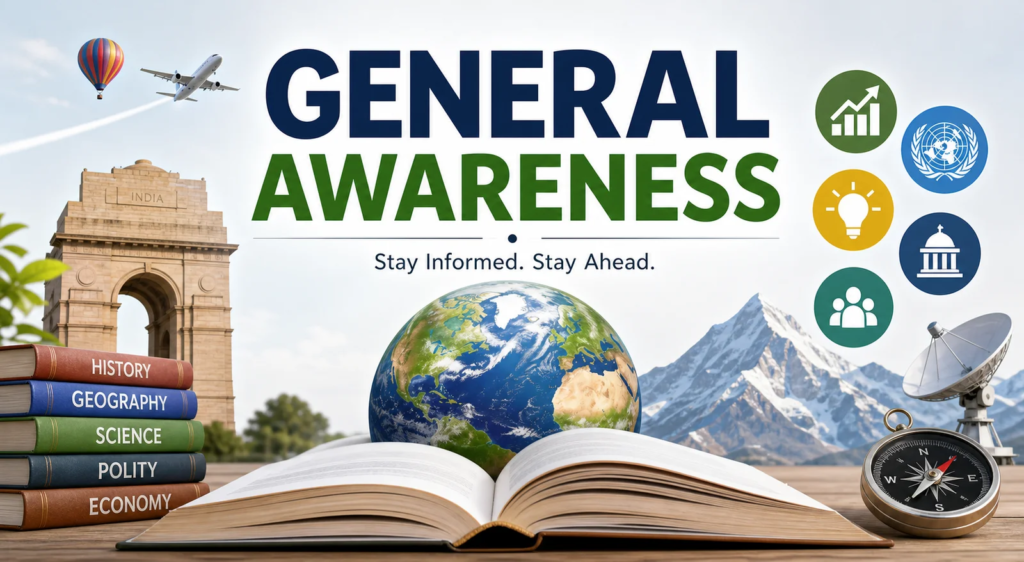
The Ultimate Guide to General Awareness: Essential Knowledge for Smarter Decisions, Stronger Careers, and Confident Citizenship
Introduction: Why General Awareness Is No Longer Optional
Imagine walking into a job interview, a competitive exam hall, a business meeting, or even a casual conversation—and realizing that the topic everyone is discussing is something you know nothing about. It could be inflation, climate change, artificial intelligence, elections, public health, financial literacy, sports, global conflicts, or a new government policy. In that moment, knowledge is not just information. It becomes confidence, credibility, and opportunity.
That is the real power of General Awareness.
General Awareness is more than memorizing facts. It is the ability to understand what is happening around you, connect events with their causes and consequences, and respond intelligently. It helps students perform better in exams, professionals make smarter decisions, entrepreneurs identify trends, and citizens participate meaningfully in society.
In a world overflowing with information, the challenge is not access. The challenge is awareness with understanding. Anyone can scroll through headlines. But people with strong General Awareness know what matters, why it matters, and how it affects their lives.
This in-depth guide explores the meaning, importance, sources, methods, real-world applications, and long-term value of General Awareness. Whether you are preparing for competitive exams, improving your personality, building a career, or simply trying to become a better-informed individual, this article will give you a practical and powerful roadmap.
What Is General Awareness?
General Awareness refers to broad knowledge about current events, history, geography, economics, science, technology, politics, culture, environment, sports, and social issues. It includes both static knowledge and current knowledge.
Static knowledge includes facts that do not change frequently, such as national capitals, historical events, constitutional provisions, important scientific discoveries, and geographical features. Current knowledge includes recent events such as elections, policy changes, sports tournaments, economic updates, international summits, and technological innovations.
In simple terms, General Awareness is your understanding of the world around you.
It answers questions like:
- What major events are happening nationally and globally?
- Why are prices rising or falling?
- How do government policies affect citizens?
- What scientific discoveries are changing the future?
- Which social issues require public attention?
- How do international relations influence trade, security, and diplomacy?
General Awareness is not just about “knowing more.” It is about thinking better.
General Awareness vs General Knowledge: What Is the Difference?
Many people use General Awareness and general knowledge interchangeably, but there is a subtle difference.
| Aspect | General Awareness | General Knowledge |
|---|---|---|
| Meaning | Awareness of recent and relevant events, issues, and developments | Broad factual knowledge across subjects |
| Nature | Dynamic and current | Mostly static |
| Examples | Latest budget, recent awards, new government schemes, international summits | Capitals, rivers, historical facts, inventions |
| Usefulness | Helpful in exams, interviews, discussions, decision-making | Builds intellectual foundation |
| Update Frequency | Needs regular updates | Changes less often |
General knowledge forms the base, while General Awareness keeps that base alive and relevant. For example, knowing that the United Nations was founded in 1945 is general knowledge. Understanding the role of the United Nations in current global conflicts is General Awareness.
A well-informed person needs both.
Why General Awareness Matters in Today’s World
The importance of General Awareness has grown rapidly because society has become more interconnected. A fuel price change in one country can affect food prices in another. A health crisis can disrupt global travel. A new technology can change employment patterns worldwide.
Here are the major reasons General Awareness matters.
1. It Improves Decision-Making
Good decisions require context. When you understand economic trends, policy changes, market movements, and social developments, you make wiser choices.
For example, a person with strong General Awareness may understand why interest rates are rising and make better decisions about loans, savings, and investments.
2. It Builds Confidence
Knowledge creates confidence. Whether you are speaking in a group discussion, attending an interview, or participating in a workplace meeting, General Awareness helps you express informed opinions.
People who understand current affairs are often perceived as sharper, more responsible, and more mature.
3. It Strengthens Competitive Exam Preparation
General Awareness is a crucial section in many competitive exams, including banking exams, civil services, defense exams, railway exams, MBA entrance tests, and government recruitment exams.
Unlike subjects that require lengthy calculations, General Awareness can help candidates score quickly if they prepare consistently.
4. It Enhances Career Growth
Professionals with General Awareness understand industry trends, customer behavior, economic conditions, regulatory changes, and emerging technologies. This makes them better decision-makers.
A marketing professional who understands social trends can create stronger campaigns. A finance professional who follows economic news can provide better advice. A manager aware of labor policies can lead responsibly.
5. It Creates Responsible Citizens
Democracy works best when citizens are informed. General Awareness helps people understand rights, duties, laws, elections, public policies, and social issues.
An aware citizen does not blindly believe rumors. They verify information, ask questions, and participate constructively.
Key Areas Covered Under General Awareness
General Awareness is a broad field. To master it, you need to understand its major components.
| Area | What It Includes | Why It Matters |
|---|---|---|
| Current Affairs | National and international news, appointments, awards, summits | Essential for exams and informed discussions |
| History | Ancient, medieval, modern history, freedom movements | Builds cultural and political understanding |
| Geography | Physical, political, economic, and environmental geography | Helps understand climate, resources, and geopolitics |
| Polity | Constitution, governance, rights, institutions | Important for citizenship and exams |
| Economy | Budget, inflation, banking, GDP, trade, taxation | Useful for financial decisions and policy understanding |
| Science & Technology | Discoveries, space, AI, biotech, health science | Explains innovation and future trends |
| Environment | Climate change, biodiversity, sustainability | Critical for global survival |
| Sports | Events, records, tournaments, players | Common in exams and public conversation |
| Culture | Art, literature, festivals, heritage | Builds social and cultural sensitivity |
| International Relations | Diplomacy, treaties, organizations, conflicts | Explains global power dynamics |
A balanced General Awareness strategy should include all these areas, not just headlines.
The Evolution of General Awareness in the Information Age
Earlier, General Awareness came from newspapers, radio, textbooks, magazines, and public discussions. Today, information arrives instantly through smartphones, news apps, podcasts, social media, newsletters, and video platforms.
This has created both opportunity and risk.
On one hand, people can access global information in seconds. On the other hand, misinformation spreads just as quickly. This makes modern General Awareness different from old-style fact collection.
Today, awareness requires four skills:
- Finding reliable information
- Understanding context
- Identifying bias
- Remembering and applying knowledge
A truly aware person does not simply consume information. They evaluate it.
Core Sources for Building Strong General Awareness
The quality of your General Awareness depends heavily on your sources. Random scrolling rarely builds deep understanding. You need a structured mix of reliable sources.
Recommended Sources
| Source Type | Examples | Best Use |
|---|---|---|
| Newspapers | National newspapers, financial newspapers, regional newspapers | Daily current affairs and editorial analysis |
| Government Websites | Ministries, central banks, official statistics portals | Authentic policy and data updates |
| Monthly Magazines | Competitive exam magazines, economic reviews | Revision and summaries |
| Books | History, polity, economy, geography books | Static General Awareness |
| Podcasts | News explainers, public policy podcasts | Learning during travel or routine tasks |
| Documentaries | History, science, environment, geopolitics | Visual understanding |
| Newsletters | Daily current affairs newsletters | Quick updates |
| Reports | UN, World Bank, IMF, WHO, national surveys | Data-based understanding |
The best approach is to combine daily updates with weekly revision and monthly consolidation.
How to Develop General Awareness: A Practical Roadmap
Building General Awareness is not about studying all day. It is about developing consistent habits.
Step 1: Read the News Daily
Spend 20 to 30 minutes reading quality news. Focus on major developments rather than sensational stories.
Prioritize:
- Government policies
- Economy and finance
- International relations
- Science and technology
- Environment
- Social issues
- Important legal and constitutional developments
Step 2: Make Short Notes
Do not copy entire articles. Write brief notes in your own words.
Use this format:
| Topic | What Happened? | Why It Matters | Key Facts |
|---|---|---|---|
| Example: Climate summit | Countries discussed emission targets | Affects climate policy and energy transition | Venue, participants, agreements |
This helps transform passive reading into active learning.
Step 3: Connect Static and Current Topics
If you read about a Supreme Court judgment, revise related constitutional articles. If you read about a cyclone, revise geography concepts such as pressure systems and coastal vulnerability.
This is one of the best ways to strengthen General Awareness for competitive exams.
Step 4: Practice Recall
At the end of each day, ask yourself:
- What are the three most important events today?
- Which country, institution, or person was involved?
- What is the background?
- What may happen next?
Recall builds memory better than rereading.
Step 5: Discuss and Explain
If you can explain a topic simply, you understand it well. Discussing current issues with friends, peers, or study groups improves clarity.
General Awareness becomes stronger when knowledge moves from memory to expression.
Daily, Weekly, and Monthly General Awareness Plan
A structured plan prevents overload.
| Time Frame | Activity | Duration |
|---|---|---|
| Daily | Read newspaper or trusted news summary | 30 minutes |
| Daily | Make 5 to 10 bullet notes | 10 minutes |
| Daily | Revise previous day’s notes | 5 minutes |
| Weekly | Review major national and international events | 1 hour |
| Weekly | Attempt quiz or MCQs | 30 minutes |
| Monthly | Prepare summary of awards, appointments, schemes, reports | 2 hours |
| Monthly | Revise static topics connected to current events | 2 hours |
Consistency matters more than intensity. Ten focused minutes every day can be more effective than five distracted hours once a week.
General Awareness for Competitive Exams
For many students, General Awareness is a scoring section. It requires less calculation time and can significantly improve overall marks. However, it can also feel unpredictable because the syllabus is vast.
The key is smart preparation.
Common General Awareness Topics in Exams
| Topic | Examples |
|---|---|
| Current Affairs | Recent events from last 6 to 12 months |
| Banking Awareness | RBI, monetary policy, financial institutions |
| Economy | Budget, GDP, inflation, taxation |
| Polity | Constitution, Parliament, judiciary |
| Static GK | Capitals, currencies, national parks, books |
| Awards & Honors | National and international awards |
| Sports | Tournaments, winners, records |
| Science & Technology | Space missions, discoveries, innovations |
| Government Schemes | Objectives, ministries, beneficiaries |
Exam Strategy
For exam-focused General Awareness, follow these tips:
- Cover at least the last six months of current affairs.
- Revise monthly PDFs or summaries.
- Practice quizzes daily.
- Focus on repeated themes such as budgets, schemes, awards, and reports.
- Do not ignore static General Awareness.
- Make separate lists for important days, books and authors, appointments, and indices.
The goal is not to know everything. The goal is to know what is most likely to be asked.
General Awareness in Interviews and Group Discussions
In interviews, General Awareness shows maturity. Interviewers often use current topics to test your thinking, not just your memory.
For example, they may ask:
- What is your opinion on digital payments?
- How does inflation affect common citizens?
- What are the advantages and risks of artificial intelligence?
- Should renewable energy receive more investment?
- How can youth contribute to democracy?
A good answer includes facts, balance, and personal reasoning.
Simple Answer Framework
Use the PREP method:
| Step | Meaning | Example |
|---|---|---|
| P | Point | “Digital payments have improved financial convenience.” |
| R | Reason | “They reduce cash dependency and increase transaction speed.” |
| E | Example | “UPI-like systems have made small payments easier.” |
| P | Point Again | “However, cybersecurity awareness must improve.” |
General Awareness helps you speak with structure instead of guessing.
General Awareness and Career Success
Professionals often underestimate the role of General Awareness. Yet every industry is affected by external events.
Examples by Profession
| Profession | How General Awareness Helps |
|---|---|
| Teacher | Connects lessons with real-world examples |
| Lawyer | Understands legal reforms and judgments |
| Banker | Tracks monetary policy, inflation, financial regulation |
| Entrepreneur | Identifies market trends and consumer needs |
| Journalist | Interprets events accurately |
| Civil servant | Designs and implements policies effectively |
| Doctor | Understands public health issues and medical developments |
| Marketer | Reads consumer sentiment and cultural trends |
| Investor | Follows economic and geopolitical signals |
In the workplace, General Awareness can separate reactive employees from strategic thinkers.
Case Study 1: General Awareness in Competitive Exam Success
Background
A student preparing for a banking exam struggled with quantitative aptitude but consistently scored well in English and reasoning. However, their General Awareness score was weak because they relied on last-minute memorization.
Three months before the exam, the student changed strategy. They began reading daily current affairs summaries, making notes, revising weekly, and practicing quizzes. Instead of memorizing isolated facts, they connected banking news with economic concepts such as repo rate, inflation, non-performing assets, and digital payments.
Result
By exam day, the student had revised six months of current affairs multiple times. Their General Awareness score improved significantly and helped compensate for average performance in quantitative aptitude.
Analysis
This case shows that General Awareness rewards consistency. Last-minute preparation rarely works because the volume is large. A structured approach turns General Awareness from a weakness into a scoring advantage.
Case Study 2: General Awareness in Business Decision-Making
Background
A small retail business owner noticed rising fuel prices and news reports about supply chain disruptions. Instead of ignoring the trend, the owner reviewed inventory costs, supplier reliability, and customer demand patterns.
Because of strong General Awareness, the owner anticipated price increases and adjusted procurement early. They diversified suppliers and communicated transparently with customers about possible price changes.
Result
While competitors faced stock shortages and sudden cost pressure, this business remained stable. Customers appreciated the transparency, and the owner protected profit margins.
Analysis
General Awareness is not limited to exams or academics. It has practical business value. Awareness of economic and global trends can help businesses manage risk before problems become severe.
Case Study 3: General Awareness and Public Health
Background
During a public health emergency, communities with better awareness of official guidelines responded more effectively. People who followed credible health advisories understood preventive measures, vaccination benefits, and misinformation risks.
In contrast, areas influenced by rumors faced confusion and lower compliance with safety measures.
Result
Awareness helped people make safer decisions, support vulnerable groups, and reduce panic. Community leaders who communicated verified information played a major role in improving public response.
Analysis
This case highlights the social importance of General Awareness. In public health, awareness can save lives. It helps people distinguish facts from fear and act responsibly.
Case Study 4: General Awareness in Environmental Action
Background
A college group learned about local water scarcity through news reports and government data. Instead of treating it as a distant issue, they conducted a campus water audit.
They discovered leaking taps, excessive water usage in gardens, and poor rainwater harvesting. The students prepared a report and presented it to the administration.
Result
The college repaired leaks, installed water-saving fixtures, and began awareness campaigns. Water usage reduced noticeably over the next semester.
Analysis
Environmental General Awareness becomes powerful when it leads to local action. Knowledge about climate change, water scarcity, pollution, and biodiversity can inspire practical solutions.
The Role of Digital Literacy in General Awareness
Modern General Awareness depends on digital literacy. People now receive news through social media, messaging apps, and online platforms. But not all information is reliable.
Digital literacy means knowing how to verify information before believing or sharing it.
How to Identify Reliable Information
| Checkpoint | Question to Ask |
|---|---|
| Source | Is the information from a credible organization? |
| Date | Is it current or outdated? |
| Evidence | Does it include data, documents, or official statements? |
| Bias | Is it trying to manipulate emotions? |
| Cross-check | Is the same information reported elsewhere? |
| Author | Is the writer qualified or accountable? |
A person with strong General Awareness is careful, not gullible.
Common Mistakes People Make While Building General Awareness
Many people want to improve their General Awareness but follow ineffective habits.
Mistake 1: Reading Too Many Sources
More sources do not always mean better knowledge. Reading ten news apps without revision creates confusion.
Choose fewer, better sources.
Mistake 2: Memorizing Without Understanding
Facts matter, but context matters more. If you memorize the name of a policy without understanding its purpose, your knowledge remains shallow.
Mistake 3: Ignoring Revision
General Awareness fades quickly without revision. Weekly and monthly review is essential.
Mistake 4: Depending Only on Social Media
Social media can be useful for updates, but it should not be your primary source. It often rewards speed over accuracy.
Mistake 5: Studying Randomly
Without a plan, you may spend too much time on entertainment news and miss important topics like economy, polity, environment, and science.
Mistake 6: Avoiding Difficult Topics
Many learners skip economics, international relations, or science because they seem complex. But these areas are crucial for deep General Awareness.
How to Remember General Awareness Facts Longer
Memory improves when information is organized.
Use Categorization
Group facts under headings:
- Awards
- Appointments
- Sports
- Reports and indices
- Government schemes
- Science and technology
- International events
Use Mind Maps
For complex topics, create mind maps. For example, if studying climate change, branches can include causes, effects, agreements, organizations, and national policies.
Use Spaced Revision
Revise after:
- 1 day
- 1 week
- 1 month
This method helps transfer information into long-term memory.
Use Association
Connect facts with stories. For example, instead of memorizing a summit name alone, connect it with the host country, theme, major outcomes, and participating organizations.
Teach Someone Else
Teaching is one of the strongest memory tools. If you can explain a topic clearly, you are unlikely to forget it easily.
General Awareness and Critical Thinking
General Awareness without critical thinking can become shallow. Critical thinking helps you ask better questions.
For example, when reading about unemployment, do not stop at the headline. Ask:
- Which sectors are most affected?
- Is the data official?
- What age group is impacted?
- What policies are being introduced?
- How does this compare with previous years?
- What are the long-term consequences?
This deeper approach transforms General Awareness into insight.
The Connection Between General Awareness and Communication Skills
People with strong General Awareness often communicate better because they have more examples, references, and perspectives.
In essays, speeches, debates, and interviews, awareness gives substance to language. A person may speak fluent English but still sound weak if they lack ideas. On the other hand, someone with moderate language skills but strong General Awareness can often make a powerful impression.
Communication improves when you can support opinions with facts.
For example:
Weak statement:
“Pollution is a big problem.”
Stronger statement:
“Air pollution is not only an environmental issue but also a public health and economic concern. It increases respiratory diseases, reduces productivity, and forces governments to spend more on healthcare.”
The second statement reflects awareness, clarity, and depth.
General Awareness for Students
Students should build General Awareness early because it supports academic performance and personality development.
Benefits for Students
- Improves essay writing
- Helps in debates and quizzes
- Supports exam preparation
- Builds confidence in interviews
- Encourages curiosity
- Develops social responsibility
- Improves reading habits
Students can begin with simple routines: reading headlines, watching weekly explainers, maintaining a current affairs notebook, and discussing one important topic daily.
General Awareness for Professionals
Professionals need General Awareness to stay relevant. Industries change quickly, and those who fail to track trends may fall behind.
For example:
- HR professionals should know labor laws and workplace trends.
- IT professionals should follow cybersecurity and AI developments.
- Finance professionals should monitor interest rates and markets.
- Healthcare professionals should track medical research and public health guidelines.
- Educators should understand education policy and learning technologies.
General Awareness helps professionals move from task execution to strategic contribution.
General Awareness for Citizens
A society becomes stronger when its citizens are aware. General Awareness helps people understand elections, rights, duties, taxes, public services, environmental responsibilities, and social justice issues.
An aware citizen:
- Votes responsibly
- Questions misinformation
- Understands public policies
- Respects diversity
- Participates in community issues
- Holds institutions accountable
- Supports evidence-based decisions
General Awareness is therefore not just personal capital. It is democratic capital.
Long-Tail Keyword Variations Related to General Awareness
For SEO and contextual understanding, here are useful long-tail variations of the focus keyword:
| Long-Tail Keyword | Context |
|---|---|
| General Awareness for competitive exams | Exam preparation |
| daily General Awareness tips | Habit-building |
| importance of General Awareness | Educational and career value |
| how to improve General Awareness | Practical learning |
| General Awareness questions and answers | Quiz preparation |
| current affairs and General Awareness | News-based learning |
| General Awareness for interviews | Career readiness |
| General Awareness topics for students | Academic use |
| General Awareness preparation strategy | Structured study plan |
| best sources for General Awareness | Resource selection |
Using these variations naturally helps readers and search engines understand the depth of the topic.
Sample General Awareness Study Chart
Here is a simple weekly chart you can follow.
| Day | Focus Area | Activity |
|---|---|---|
| Monday | National current affairs | Read news and note key policies |
| Tuesday | Economy | Study inflation, budget, banking, markets |
| Wednesday | International affairs | Review global summits, conflicts, treaties |
| Thursday | Science and technology | Note innovations, space missions, health updates |
| Friday | Environment | Study climate, biodiversity, conservation |
| Saturday | Static GK | Revise history, geography, polity |
| Sunday | Revision and quiz | Attempt MCQs and review notes |
This balanced plan keeps General Awareness manageable and prevents last-minute overload.
How General Awareness Builds a Better Personality
A well-aware person often appears more thoughtful, adaptable, and confident. This is because General Awareness improves worldview.
It helps you:
- Understand different perspectives
- Avoid narrow thinking
- Speak with evidence
- Appreciate cultures and societies
- Respond calmly to change
- Develop empathy
- Become intellectually curious
Personality is not just about appearance or speaking style. It is also about awareness, judgment, and emotional maturity.
The Future of General Awareness
The future will demand even stronger General Awareness because change is accelerating. Artificial intelligence, climate change, digital currencies, biotechnology, geopolitical shifts, and automation will reshape how people live and work.
In the future, being aware will mean understanding:
- How AI affects jobs
- Why data privacy matters
- How climate change influences migration and food security
- What digital finance means for ordinary citizens
- How global conflicts affect local prices
- Why mental health is a public priority
- How technology changes education
The most successful people will not be those who merely collect information. They will be those who understand patterns.
Practical Tools to Improve General Awareness
Here are some practical tools you can use:
1. Current Affairs Notebook
Maintain a notebook with sections like economy, polity, science, environment, and international affairs.
2. Flashcards
Use flashcards for awards, dates, reports, and important facts.
3. Monthly Revision Sheets
Create one-page summaries for each month.
4. Quizzes
Attempt daily or weekly quizzes to test retention.
5. Explainer Videos
Use them for complex topics, but verify the information from reliable sources.
6. Editorial Reading
Editorials help develop analytical General Awareness, especially for essays and interviews.
7. Government Reports
For serious learners, official reports provide authentic data.
A Simple 30-Day General Awareness Challenge
If you want to begin immediately, try this 30-day plan.
| Days | Task |
|---|---|
| Days 1–5 | Read daily news and write 5 key points |
| Days 6–10 | Add economy and government policy notes |
| Days 11–15 | Study international affairs and organizations |
| Days 16–20 | Revise static GK linked to current events |
| Days 21–25 | Practice daily quizzes |
| Days 26–30 | Prepare a monthly summary and discuss 5 topics |
By the end of 30 days, you will not know everything, but you will have built a habit. That habit is the foundation of lifelong General Awareness.
Conclusion: General Awareness Is the Advantage That Keeps Growing
General Awareness is one of the most valuable skills in modern life. It helps you succeed in exams, perform better in interviews, grow professionally, make informed decisions, and contribute meaningfully to society.
At its best, General Awareness is not about memorizing endless facts. It is about curiosity, context, judgment, and action. It teaches you to look beyond headlines and understand the deeper forces shaping the world.
Start small. Read daily. Take notes. Ask questions. Verify information. Revise regularly. Discuss ideas. Connect current events with history, economy, science, polity, and society.
The more aware you become, the more confident and capable you feel. In a noisy world, General Awareness gives you clarity. In uncertain times, it gives you direction. And in every stage of life, it gives you the power to think, speak, and act wisely.
FAQs on General Awareness
1. What is General Awareness in simple words?
General Awareness means knowing and understanding important events, facts, issues, and developments happening around you. It includes current affairs, history, geography, economy, politics, science, environment, sports, and culture.
2. Why is General Awareness important?
General Awareness is important because it improves decision-making, confidence, exam performance, interview skills, communication, and responsible citizenship. It helps people understand the world instead of simply reacting to it.
3. How can I improve my General Awareness daily?
You can improve General Awareness by reading reliable news daily, making short notes, revising weekly, practicing quizzes, watching quality explainers, and connecting current events with static subjects like history, polity, geography, and economics.
4. Is General Awareness useful only for competitive exams?
No. General Awareness is useful for everyone. It helps students, professionals, entrepreneurs, voters, parents, teachers, and leaders. It supports better conversations, smarter choices, and stronger social understanding.
5. What are the best topics to study for General Awareness?
Important topics include current affairs, national and international news, economy, polity, history, geography, science and technology, environment, sports, awards, government schemes, books and authors, and important reports.
6. How much time should I spend on General Awareness every day?
For most learners, 30 to 45 minutes daily is enough if done consistently. Competitive exam aspirants may need more time, especially for revision and quizzes.
7. How do I remember General Awareness facts for a long time?
Use short notes, flashcards, categorization, mind maps, spaced revision, and quizzes. Teaching or explaining topics to someone else also improves memory.
8. What is the difference between current affairs and General Awareness?
Current affairs are recent events and developments. General Awareness is broader. It includes current affairs plus static knowledge such as history, geography, polity, science, economy, and culture.
9. Can social media help improve General Awareness?
Social media can help if you follow credible sources, but it should not be your only source. Always verify important information through trusted news platforms, official websites, or reliable reports.
10. What is the best strategy for General Awareness in exams?
Cover the last 6 to 12 months of current affairs, revise monthly summaries, practice MCQs, study static GK, and focus on high-yield topics such as government schemes, economy, awards, sports, reports, and appointments.

