


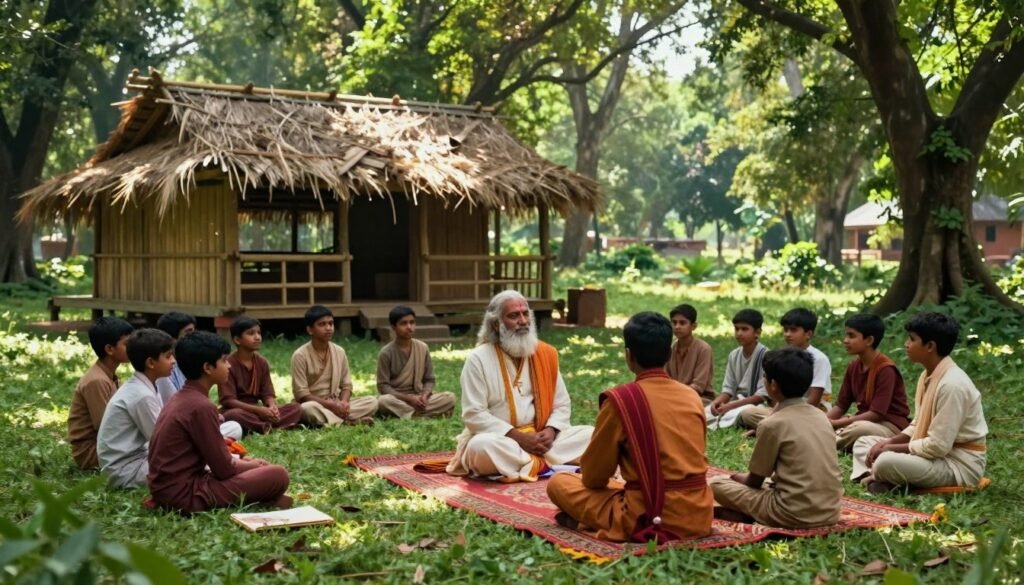
Imagine a young scholar arriving at a forest retreat in ancient India around 500 BCE. The student had little but a lot of curiosity. For twelve years, they lived with a master teacher, learning texts, theories, and life skills. This Gurukul model shaped history’s greatest minds and is a sophisticated educational framework.
Ancient Indian education was more than just learning. It was a journey to become a complete human being. The term Vidya, from Sanskrit, meant “to know.” It was about gaining knowledge that frees us from ignorance and reveals life’s deeper truths.
The Gurukul system was at the heart of ancient Indian education. These schools were places where students and teachers lived together. They learned about intellectual, moral, physical, and spiritual growth. This made Gurukul education different from other models.
Learning systems in ancient India started as early as 1500 BCE. They taught philosophy, sciences, arts, and more. The teacher-student bond, called Guru-Shishya Parampara, was key. It built respect and deep connections, helping in true knowledge sharing.
Learning from ancient Indian education can inspire today’s schools. Modern schools face challenges like student disengagement and commercialization. The wisdom of Traditional Indian Learning offers insights for change and renewal.
Key Takeaways
- Gurukul education was a residential system where students lived with teachers for 12 to 18 years, developing intellectual, moral, physical, and spiritual capabilities.
- The concept of Vidya in ancient Indian education meant transformative knowledge that liberates from ignorance, not just skill acquisition or literacy.
- Traditional Indian Learning integrated multiple disciplines including philosophy, sciences, arts, medicine, governance, and ethics into complementary curricula.
- The Guru-Shishya Parampara emphasized personal mentorship and deep relationships between teachers and students as the foundation of knowledge transfer.
- Ancient Indian education prioritized holistic human development, addressing intellectual, moral, physical, and spiritual dimensions simultaneously.
- Historical records demonstrate organized educational systems existed from the Vedic period around 1500 BCE, making them among the world’s earliest formal learning structures.
- The principles underlying ancient Indian education systems offer contemporary solutions to modern educational challenges including student engagement and value-based learning.
Understanding the Concept of Gurukul
The term Gurukul comes from Sanskrit and ancient Indian philosophy. It combines “Guru,” meaning a teacher, and “Kula,” meaning family. This shows the heart of the Indian Gurukul System, focusing on family-like bonds between teacher and student.
In a Gurukul, students lived with their guru as family. This setup offered learning all day, not just in class. It helped students grow in both mind and character.
Definition and Origin of Gurukul
A Gurukul was a place where students lived and learned together. They stayed for 12 to 18 years, learning discipline and trust in their guru. There, they got education without paying fees, helping with household chores instead.
Gurukul education started in ancient Vedic times. It was based on passing down knowledge from teacher to student. This was done through personal talks and daily examples.
Characteristics of Gurukuls
Real Gurukuls had some key features:
- Small classes for personal attention
- Students lived with the guru as family
- No money was needed for education
- All students were treated equally
- Learning was both theoretical and practical
- Students were fully immersed in their studies
The Role of Environment in Learning
Gurukuls were often in natural places like forests and rivers. This helped students focus on learning without city distractions.
Students learned outside, under trees and by rivers. They saw nature’s cycles and plants up close. This made abstract ideas real.
The natural world taught students in its own way. They learned by observing nature, mixing science and spirituality. This approach showed how learning, health, and spirit are connected in Gurukul education.
The Evolution of Guru-Shishya Parampara
The Guru-Shishya Parampara is a key part of India’s educational history. It started in the Vedic period, where knowledge was passed from teacher to student. This tradition helped keep wisdom alive through generations.
Historical Context of Guru-Shishya Relation
The Guru-Shishya Parampara began around 1500 to 500 BCE. The Rigveda uses a metaphor of “two birds on the same tree” to describe the guru and student. This shows how they share knowledge but have different roles.
In the Upanishadic era, teachers and students had deep conversations. They discussed life’s biggest questions. This led to spiritual growth through questioning and reflection.
The word “guru” means “remover of darkness.” It shows how students saw their teachers as more than just teachers. They were guides who helped students find their way.
Key Figures in Guru-Shishya Tradition
History is full of examples of the Guru-Shishya Parampara. These relationships helped shape leaders in many fields:
- Krishna and Arjuna: Dronacharya taught Arjuna how to be a great warrior. He taught him through personal lessons and strict training.
- Karna’s Education: Karna, born outside the warrior caste, learned from Parashurama. This shows how the tradition can cross social boundaries.
- Adi Shankaracharya: Shankaracharya studied under Govindapada. He learned about non-dual philosophy, changing Indian thought.
- Chanakya and Chandragupta Maurya: Chanakya taught Chandragupta. He helped him go from a commoner to the emperor of the Mauryan dynasty.
Influence of Time on Teaching Methods
The Guru-Shishya Parampara has changed over time but stayed true to its core. Early teaching focused on memorization and rituals. The Upanishadic period introduced dialectical reasoning and meditation.
Classical schools like Nalanda and Takshashila brought structure. Medieval bhakti movements made teachings more accessible. Today, we mix old wisdom with new methods.
| Historical Period | Teaching Focus | Primary Method |
|---|---|---|
| Vedic Era (1500-500 BCE) | Sacred knowledge preservation | Oral recitation and memorization |
| Upanishadic Age (800-200 BCE) | Philosophical inquiry | Dialogue and contemplation |
| Classical Period | Comprehensive disciplines | Institutional learning with personal mentorship |
| Medieval Period | Spiritual devotion | Accessible community-based teaching |
| Contemporary Era | Integrated wisdom | Traditional methods with modern tools |
Through all these changes, the Guru-Shishya Parampara stayed true to its heart. The guru was a moral guide, showing the way through life. The bond between guru and student went beyond books, leading to personal growth. This is why the tradition has shaped India for so long and continues to inspire teachers today.
Core Principles of Ancient Indian Education
The roots of Ancient Indian Education were deeply rooted in philosophy. It aimed to grow humans in many ways, not just in books. The Vedic Education System combined learning, physical health, emotional balance, and spiritual growth. This made people smart, strong, emotionally stable, and spiritually connected.
This system saw knowledge as more than just facts. It aimed to make the whole person ready to help society.
Emphasis on Holistic Development
Ancient Indian Education didn’t focus on just one part of human growth. It knew that people have many sides that need to grow together:
- Intellectual dimension: Skills in thinking, memory, and analysis
- Physical dimension: Growth through yoga and practical work
- Emotional dimension: Emotional growth through art and self-control
- Moral dimension: Teaching ethics and character
- Spiritual dimension: Finding inner peace through meditation
This way, people could do well in many areas of life and stay balanced inside.
Learning through Experience and Practice
The Vedic Education System believed in anubhava, or learning by doing. Students didn’t just listen; they got involved in real-life learning. They watched the sky instead of just reading about astronomy. They grew plants to learn about nature, not just memorize facts.
This hands-on method had three steps:
- Shravan – listening to teachings and getting knowledge
- Manan – thinking deeply about what was learned
- Nidhidhyasan – putting knowledge into practice through experience and meditation
This process turned knowledge into wisdom and understanding that people could live by.
The Unity of Knowledge and Spirituality
Ancient Indian Education didn’t separate learning from spiritual beliefs. The Vedic Education System believed all true knowledge leads to spiritual truth and freedom. It saw two kinds of knowledge: Para Vidya (spiritual) and Apara Vidya (practical).
These weren’t against each other; they went together. Science gave skills for life, while spiritual knowledge gave meaning and purpose. The Purushartha framework showed four good goals for humans:
| Pursuit | Meaning | Educational Focus |
|---|---|---|
| Dharma | Righteous conduct and duty | Moral and ethical foundation |
| Artha | Material prosperity | Economic and practical skills |
| Kama | Aesthetic and sensual enjoyment | Arts, culture, and refinement |
| Moksha | Spiritual liberation | Meditation and self-realization |
This education prepared students for all these areas. It made them productive, ethical, cultured, and spiritually aware. This idea is important for education today.
Structure and Daily Life in Gurukuls
Gurukuls had a special setup where learning thrived. They followed a daily routine and lived together. This way of life taught students important lessons, not just in class.
Daily Routines and Its Significance
Life in a Gurukul started early, around 4 to 6 AM. This time was called Brahma muhurta. It was important for learning.
The morning included:
- Personal cleaning and hygiene to build discipline
- Meditation and prayer for clear minds
- Vedic recitation when the mind was sharp
- Learning from the guru through talking
- Physical training like archery and yoga
In the afternoon, students applied what they learned. They did astronomy or medicine. Evenings were for helping out around the house. This way, learning was hands-on, not just listening.
Living Arrangements for Students
Students lived simply in shared spaces. They had few things and wore simple clothes. This simplicity had big benefits.
| Living Aspect | Educational Purpose |
|---|---|
| Minimal possessions | Eliminated competition based on wealth |
| Simple shared spaces | Made everyone equal, no matter their background |
| Communal sleeping arrangements | Built brotherhood and responsibility |
| Limited material comfort | Teached resilience and not to value material things too much |
| Basic clothing standards | Helped students focus on learning, not looks |
This way of living taught that true wealth is in knowledge and character. The Gurukul taught contentment and adaptability through daily life.
The Role of Community in Education
Living together made learning a group effort. Meals were shared, breaking down social barriers. Everyone served the guru first, showing respect.
Being part of a community offered many learning chances:
- Older students helped younger ones, creating a learning network
- Working together on projects and debates improved teamwork
- Visitors brought new ideas and perspectives
- Shared rituals and festivals built cultural bonds
- Discussing stories and morals taught cultural wisdom
This approach taught values like cooperation and respect. It showed that disciplined routines were key to success. The Gurukul’s focus on merit, not wealth, helped students grow ethically.
Subjects Taught in Gurukul Education
The ancient gurukuls offered a wide range of subjects. Students learned about sciences, arts, philosophy, and practical skills. This broad education showed the Vedic System’s belief in learning all aspects of life.
At the heart of gurukul education were the Ancient Vedas. The four Vedas were seen as more than just texts. They were sources of wisdom. Students learned to understand their meanings and apply their teachings to everyday life.
Traditional Sciences and Arts
Students in gurukuls studied advanced sciences. They learned about mathematics and astronomy to predict the stars. They also studied medicine, architecture, and engineering.
The arts were also a big part of the education. Music and dance helped students express themselves. They learned sixty-four traditional arts, making them well-rounded.
Philosophy and Spiritual Discourses
Philosophy was a key part of gurukul education. Students explored six schools of Indian philosophy. They learned to think critically and develop their own views.
Importance of Language and Literature
Language was the base of gurukul learning. Students learned Sanskrit grammar and poetry. This helped them in debates and creating original works.
| Subject Category | Core Subjects | Learning Outcomes | Duration |
|---|---|---|---|
| Language & Literature | Sanskrit grammar, Vedas, Epics, Poetry | Literacy, scholarly debate, original composition | Years 1-4 |
| Sciences | Astronomy, Mathematics, Medicine, Architecture | Practical knowledge, technical skills, calculations | Years 3-6 |
| Philosophy | Six orthodox schools, Logic, Ethics | Critical thinking, worldview development | Years 4-8 |
| Arts & Skills | Music, Dance, Sculpture, Sixty-four traditional arts | Creative expression, technical proficiency | Years 2-7 |
| Physical Education | Archery, Wrestling, Yoga, Horsemanship | Physical strength, martial skill, health | Daily throughout |
| Social Sciences | Political theory, Economics, Law, Ethics | Practical governance knowledge, moral reasoning | Years 5-8 |
The education in Ancient Vedas started with basic skills at ages five to eight. Then, students learned deeper language and memorized key texts from ages eight to twelve. From ages twelve to sixteen, they focused on specialized studies and research. The last years were for mastering skills and preparing for adult roles.
- Primary foundation included basic reading, writing, and moral instruction through storytelling
- Intermediate stages developed subject specialization while maintaining broad knowledge
- Advanced learning required debate participation and critical analysis of texts
- Final stage involved teaching younger students and applying knowledge practically
This education approach was very effective. Students became experts in many areas, ready to help society. They could be teachers, administrators, doctors, or spiritual leaders. The Vedic System created well-rounded individuals, ready to make a difference in ancient Indian society.
The Role of the Guru in Education
In ancient Indian education, the guru was more than just a teacher. They were seen as the living embodiment of knowledge, moral guidance, and spiritual wisdom. This view showed that learning went beyond just reading books and memorizing facts. The Guru Gita, a sacred text, says: “The Guru is Brahma, the Guru is Vishnu, the Guru is Maheshwara,” highlighting the guru’s revered status in the Guru-Shishya Parampara tradition.
The guru played a key role in shaping students’ minds, morals, and spirits. Unlike today’s education, which often separates learning from character building, ancient India’s model combined all aspects of growth. Gurus were not just teachers but also role models, guides, and mentors. This approach made education authentic, accountable, and caring for students’ long-term growth.
Qualities of a True Guru
True gurus had certain qualities that set them apart from regular teachers. Traditional texts outlined these qualities precisely, ensuring only the right people could guide students through the Guru-Shishya Parampara system.
| Guru Quality | Sanskrit Term | Meaning and Application |
|---|---|---|
| Scriptural Learning | Śrotriya | Deep knowledge of sacred texts received through proper lineage transmission |
| Spiritual Realization | Brahma-niṣṭha | Personal experience of ultimate reality through dedicated spiritual practice |
| Freedom from Desire | Akāma-hata | Liberation from selfish motives and personal gain in teaching |
| Compassionate Heart | Karuṇāmaya | Genuine concern for students’ welfare and spiritual progress |
| Emotional Stability | Dhairya-sampanna | Patience, steadiness, and calm demeanor in all circumstances |
| Integrated Wisdom | Jñāna-sampanna | Both theoretical knowledge and practical wisdom from lived experience |
Gurus had both intellectual and moral authority. They taught by example as much as by words. Students saw virtues like honesty and courage in action, making learning real and achievable.
Mentorship and Guidance
The Guru-Shishya Parampara created a unique bond between teacher and student. Gurus knew each student’s strengths and weaknesses, tailoring their teaching to fit. This included:
- Evaluating students’ readiness before sharing advanced knowledge
- Using various teaching methods like storytelling and debate
- Providing hands-on training and skill development
- Correcting errors patiently until mastery was achieved
- Challenging students with increasingly complex material
Gurus also acted as emotional anchors. They encouraged students, celebrated their successes, and offered advice during tough times. Many guru-student relationships lasted a lifetime, building trust and respect.
The Guru’s Influence on Personal Development
Gurus had a profound impact on personal growth, going beyond what modern education covers. They guided students in making life choices, from careers to relationships and spiritual practices. This guidance was based on deep understanding of each student’s abilities and challenges.
The spiritual aspect of the guru-student relationship was key. Gurus helped students connect with the world beyond the mundane. The word “guru” means “remover of darkness,” highlighting their role in awakening students’ spiritual awareness.
Gurus had significant responsibilities. They treated all students equally, refused payment for spiritual teachings, kept students’ personal struggles confidential, and continued learning themselves. This showed the value of lifelong learning.
The transformation possible through the Guru-Shishya Parampara was unmatched. Gurus could tailor their teaching to overcome each student’s unique obstacles. This approach recognized and nurtured individual talents while maintaining accountability through direct relationship.
The Shishya’s Responsibilities
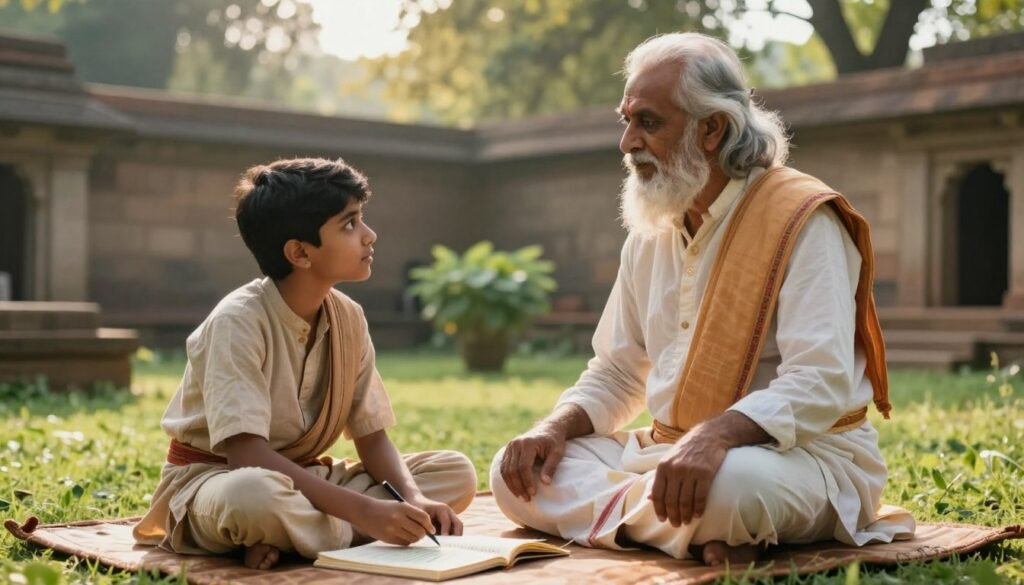
In the Guru-Shishya Parampara, students had big roles that shaped their minds and characters. The bond between teacher and learner was strong. Students had to work hard and show respect to learn well.
Being a student meant more than just listening. It was about being active, dedicated, and growing personally. This is why ancient Indian education made such great scholars and leaders.
Attitude and Discipline Required from Students
Students in traditional gurukuls learned important qualities. Humility was key. They saw their own ignorance as a chance to learn.
The Bhagavad Gita (4.34) says students must prostrate, ask questions, and serve the teacher. This showed respect and openness to learning.
Discipline was a big part of their training:
- Brahmacharya (celibacy and sense control) helped focus on learning
- Simple vegetarian food taught non-attachment
- Waking up early helped learn better
- True and gentle speech was important
- Being clean and respectful was key
The Brahmacharya stage was all about learning. It taught students to be humble and devoted. This stage was the start of their moral and intellectual journey.
The Importance of Respecting the Guru
Respecting the guru was more than just saying please and thank you. It was about being ready to learn. Without respect, students might miss the true meaning of what they were taught.
Helping the guru showed respect through action. Students did chores, helped with teaching, and took care of the teacher’s needs. These actions taught humility, helped them learn, and built a strong bond with the teacher.
Eklavya’s sacrifice teaches us the profound humility embedded in expressing gratitude for mentorship, highlighting the essential values of devotion and thankfulness.
Eklavya’s story shows the power of devotion. He became a great archer without being formally accepted as a student. His sacrifice to Dronacharya showed deep respect, showing how special the guru-student bond was.
Lifelong Learning and Continuous Growth
Learning didn’t stop after school in traditional systems. The idea of nitya-adhyayana (lifelong learning) meant always growing intellectually. Students knew Gurukul was just the start of their learning journey.
Learning happened at every stage of life:
| Life Stage | Learning Focus | Duration |
|---|---|---|
| Brahmacharya | Foundational knowledge and character development | 0-25 years |
| Grihastha | Applying knowledge in family, profession, and civic life | 25-50 years |
| Vanaprastha | Deeper reflection, mentoring others, advanced study | 50-75 years |
| Sannyasa | Spiritual realization and teaching wisdom to others | 75+ years |
Students had to keep knowledge alive for future generations. They honored their guru by living well and supporting them later if needed. True learning meant always reviewing what they learned, staying open to new ideas, and applying knowledge to life.
The Guru-Shishya Parampara was based on mutual respect and commitment. Gurus taught and guided, and students learned and passed on knowledge. This created a lifelong bond of learning and growth in Traditional Indian Learning systems.
The Impact of Gurukuls on Society
The Gurukul system deeply influenced Indian civilization. It went beyond just teaching in classrooms. These schools were cultural keepers, knowledge hubs, and social pillars for thousands of years. They show why ancient Indian education is key for today’s learning needs.
Gurukuls touched every part of Indian life. They kept languages, texts, and traditions alive. They trained leaders, thinkers, and teachers who guided communities. They linked distant areas through shared knowledge and values. This broad influence helped Indian civilization grow and keep its identity.
Educational Retriever and Cultural Preservation
Gurukuls were knowledge banks that protected India’s intellectual treasures. They kept sacred texts accurate for centuries through oral traditions. Sanskrit study kept language pure and allowed for deep philosophical thoughts. Arts like music, dance, and sculpture were passed down, keeping traditions alive.
This preservation was through direct teaching. Students memorized texts through repetition. They learned about rituals, artistic techniques, and spiritual wisdom. This ensured cultural values and knowledge were passed down without break.
Contributions of Gurukuls to Indian Society
Gurukuls led to great intellectual achievements. They trained mathematicians who created the decimal system and zero. They educated astronomers who accurately tracked planets. Philosophers developed logical systems that are studied today. Physicians organized medical knowledge into Ayurveda, a healing science.
Beyond learning, Gurukuls shaped society and governance. They prepared administrators and counselors for rulers. They also taught spiritual teachers who guided communities. These schools helped create a shared cultural understanding across India’s diverse regions.
| Contribution Area | Impact on Society | Lasting Legacy |
|---|---|---|
| Mathematics and Astronomy | Development of decimal system, zero, and planetary calculations | Foundation for modern mathematics |
| Philosophy and Logic | Creation of Nyaya and other logical systems | Frameworks for critical thinking |
| Medicine | Systematization of Ayurvedic knowledge | Holistic healing practices |
| Language and Literature | Preservation of Sanskrit and linguistic analysis | Advanced grammatical understanding |
| Arts and Culture | Transmission of classical music, dance, and sculpture | Living cultural traditions |
| Governance | Training of ethical leaders and administrators | Stable regional governments |
Modern Adaptations of Ancient Practices
Today, education is finding value in Gurukul ways again. The National Education Policy 2020 suggests using traditional knowledge in schools. It sees Gurukul methods as a solution to modern education’s problems.
Modern changes include:
- Mentorship-based learning connecting experienced teachers with committed students
- Value-based education focusing on ethics and skills
- Experiential learning through direct practice and immersion
- Holistic development covering intellectual, moral, physical, and spiritual aspects
- Community engagement creating shared learning environments
- Sustainable living practices reflecting environmental wisdom
International education, like Montessori and Waldorf, shares Gurukul’s spirit. Corporate training is also adopting mentorship and hands-on learning. These changes show Gurukul’s wisdom is relevant today.
Gurukul education aims to develop whole people, not just skilled workers. This is more important now as we see the flaws in test-driven schooling. By embracing ancient Indian wisdom, today’s schools can offer better learning experiences for students and communities.
Comparisons with Modern Education Systems
Looking at Ancient Indian Education and the Modern Guru-Shishya Tradition shows us what education should be. Modern schools and ancient gurukuls share some basics but differ in goals, methods, and results. By comparing them, we learn from the past and see the value of today’s education.
Similarities Between Gurukuls and Contemporary Schools
Both gurukuls and modern schools believe education shapes us and society. They share key features that link past and present learning:
- Both have dedicated teachers who pass on knowledge to the next generation
- Both have learning stages that get more complex
- Both check if students understand through tests
- Both prepare students for adult life
- Both create learning communities where people share ideas
These similarities show that some educational ideas are timeless, crossing centuries and cultures.
Differences and Limitations of Modern Systems
Ancient Indian Education and the Modern Guru-Shishya Tradition were different from today’s schools. They differ in many important ways:
| Educational Element | Ancient Gurukul System | Modern Education System |
|---|---|---|
| Primary Goal | Holistic human development: intellectual, moral, physical, and spiritual growth | Cognitive skill development and job preparation through credentials |
| Learning Pace | Mastery-based progression regardless of time required | Age-based grade progression with standardized timelines |
| Teaching Approach | Personalized instruction tailored to individual student capacity | Standardized curricula for large groups and average students |
| Teacher-Student Bond | Deep, long-term mentoring relationships with intimate knowledge of each student | Impersonal, transactional relationships across multiple teachers |
| Assessment Methods | Continuous observation, oral exams, practical demonstrations, holistic judgment | Written tests, standardized exams, quantitative grades |
| Knowledge Integration | Connected wisdom applied to life with ethical and spiritual principles | Fragmented subjects with limited real-world connections |
Modern education has its limits. It focuses too much on tests, leading to teaching to the test. It also emphasizes competition over teamwork, causing stress. It separates learning from ethics and morals, leaving graduates without a strong sense of right and wrong.
Large classes make it hard for teachers to give personal attention. The focus on getting good grades can make learning feel forced, not joyful.
Bridging Traditional and Modern Education
To connect these systems, we need to think carefully. Modern education has strengths like organized knowledge and technology. Ancient Indian Education offered deep mentorship and wisdom.
Here are some ways to bring them together:
- Start mentorship programs for long-term teacher-student bonds
- Add contemplative practices and ethics to school subjects
- Use mastery-based progression to let students advance when they’re ready
- Make classes smaller to help teachers connect better with students
- Link subjects together with themes to show how they’re connected
- Include hands-on learning and projects alongside theory
- Focus on teamwork and growth over competition
The National Education Policy 2020 in India tries to blend old and new education. It uses ancient wisdom while meeting today’s needs. This shows that combining both systems is key. Modern education is great at organizing knowledge but often forgets about the whole person. Ancient education focused on personal growth but had its own limits.
The best way forward is to mix the best of both worlds. This way, education can fully develop us while preparing us for today’s world.
The Role of Technology in Traditional Learning
Technology and Traditional Indian Learning meet in a complex way. Modern education must figure out how digital tools can help the Guru-Shishya Parampara without losing its essence. We look at ancient technology use and today’s digital tools that honor traditional wisdom.
Ancient gurukuls used advanced technologies for their time. They used oral memorization, musical notation, and astronomical tools. Medical texts and mathematical innovations also showed their tech savvy.
Technological Integration in Ancient Education
Ancient education wasn’t isolated from technology. The tech they used was different from today’s. It made humans better without replacing wisdom. It needed a lot of practice and worked with other knowledge systems.
Today, practical learning is key in a changing world. Traditional Indian Learning’s focus on hands-on experience is as relevant as ever.
Evolving Methods with Digital Tools
Modern Guru-Shishya Tradition is now exploring digital tools carefully. Today’s chances include:
- Online access to traditional texts and teachings
- Multimedia to help understand complex ideas
- Connecting learners worldwide
- Keeping endangered knowledge safe
- Learning platforms that fit each student’s pace
These tools make knowledge more accessible. But, they should not replace face-to-face learning, which is vital for practices like yoga and martial arts.
Challenges and Opportunities
There are big challenges with digital tools. Traditional Indian Learning needs time, focus, and deep engagement. Digital tools can split our attention and make learning shallow. The bond between guru and student, key to true learning, might get lost in screen-based learning.
| Traditional Learning Elements | Digital Integration Benefits | Risk Factors |
|---|---|---|
| Embodied practices (yoga, martial arts) | Documentation and visual reference | Cannot fully replicate hands-on correction |
| One-on-one guru guidance | Video interaction and online forums | Loss of personal relational depth |
| Memorization through oral recitation | Digital practice applications and databases | Risk of passive consumption |
| Community-based learning | Global connectivity and collaboration | Dilution of focused group experience |
| Contemplative silence | Structured online spaces | Digital distractions undermine focus |
The guru-shishya parampara is timeless for personal and professional growth. Careful use of technology can keep traditional values alive. Using tech for access and documentation, while keeping in-person learning for core subjects, is a good balance. Technology should enhance Traditional Indian Learning, not define it.
Some teachers stick to traditional methods, with no digital devices. Others mix online learning with in-person retreats. Each method shows different values on accessibility versus deep learning.
The big question is: Can the depth and holistic growth of the Modern Guru-Shishya Tradition be kept in digital formats? The answer depends on our priorities and how we integrate technology. Human values and judgment should lead, not technology.
Challenges Faced by Gurukuls Today
The Indian Gurukul System faces big challenges today. These come from historical changes, economic pressures, and fast social shifts. It’s key to understand these obstacles to keep ancient wisdom alive in today’s world.
The decline of traditional Gurukuls started long ago. Medieval invasions hurt educational centers in the 11th century. The British colonial policies from the early 19th century were the biggest blow to indigenous education.
Colonial administrators, like Thomas Macaulay, pushed for English schools and downplayed Sanskrit education. By the time of G.W. Leitner’s 1882 report on Punjab, many traditional schools had vanished.
Modernization and Its Effects
Today’s job market wants specific degrees from recognized universities. Families are hesitant to invest in Gurukul education when jobs are uncertain. Young students worry about fitting into global job markets.
Modern careers need technical skills and scientific training. Classical Indian Gurukul System curricula might not focus on these areas.
Regulatory rules add pressure. Government standards, accreditation, and child welfare rules were made for conventional schools. These rules might not fit traditional Gurukul models or teaching methods.
Urban development poses practical challenges. Cities lack space for Gurukuls’ natural settings. Land costs in cities make starting residential schools hard. Families now live in nuclear setups, making long-term education emotionally tough for students.
Preservation of Ancient Practices
Oral traditions face challenges in today’s digital age. Students relying on written and digital recordings lose memorization skills. Sanskrit proficiency drops, making primary texts hard to access without translation.
Lineage breaks happen when knowledge holders pass away without successors. Mastering classical disciplines takes years. Few students commit to such long study periods today. Questions arise about what’s true traditional practice versus modern invention.
| Challenge Category | Specific Obstacles | Impact on Gurukuls |
|---|---|---|
| Economic Pressures | Modern credentials requirement, limited job opportunities, family financial concerns | Reduced student enrollment, difficulty sustaining institutions |
| Regulatory Requirements | Government standards, accreditation processes, child welfare regulations | Compliance costs, modification of traditional methods |
| Social Changes | Nuclear family structures, urbanization, gender norm shifts | Changed family support systems, space constraints, curriculum adaptation demands |
| Knowledge Transmission | Declining memorization skills, Sanskrit language decline, lineage breaks | Loss of authentic teachings, difficulty preserving classical texts |
| Societal Values | Generational shifts, global knowledge expectations, technological focus | Perception of tradition as culturally important but practically irrelevant |
Societal Changes and Adaptation
Generational values have changed a lot. Younger Indians see traditional knowledge as important but not practical. The information age demands global knowledge, scientific methods, and critical thinking.
Gender inclusion is both a challenge and an opportunity. Gurukuls used to be for male students. Today, they need to welcome all genders. Adapting traditional frameworks to modern values requires careful curriculum redesign.
Contemporary Gurukul initiatives show different ways to adapt:
- Some keep traditional residential education but add modern subjects
- Others mix traditional and modern curricula
- Some focus on specific traditional knowledge like music, yoga, Sanskrit, or Ayurveda
- Weekend or summer programs offer traditional learning to students in regular schools
- Online platforms try to make traditional teachings accessible
The main challenge is balancing preservation and adaptation. Too much preservation might make Gurukuls seem outdated. Too much adaptation might lose the unique insights of the Indian Gurukul System. Finding the right balance is key.
This challenge reflects broader questions about cultural continuity. How can we keep traditional wisdom alive while adapting to new realities? How can ancient insights inform modern practice without going back too far? The answers are not clear, with different Gurukul institutions trying different approaches.
Promoting the Guru-Shishya Parampara in the U.S.
The U.S. offers a special chance to share the Guru-Shishya Parampara with new people. Many in America see the limits of just testing and cold teaching. Schools are looking for ways to teach that are more personal and cover all aspects of learning.
The Modern Guru-Shishya Tradition is a great answer to these needs. It’s timeless, helping people grow in today’s fast-changing world.
Bringing traditional learning to America needs careful planning. Laws, culture, and money matters must fit with what Americans want. But the key of trust and understanding between teacher and student is just as important here as anywhere else.
Open talk is key to good teaching. These ideas can work in America while keeping the heart of old knowledge sharing.
Establishing Modern Gurukuls
Starting modern Gurukuls in the U.S. means using smart strategies. Yoga and meditation places offer deep training programs. These programs mix study, practice, and mentorship, leading to teacher certifications.
Vedanta schools and Hindu temples teach philosophy in English. They keep traditional ways while fitting for busy Americans.
Ayurvedic schools blend old knowledge with new science. They train people for a mix of traditional and modern health care. Schools for Indian music and dance teach the Guru-Shishya Parampara through long study and practice. Martial arts schools teach Kalaripayattu, combining discipline with philosophy.
Community Engagement and Workshops
Getting the word out needs easy ways for Americans to start. Workshops explain the old teaching ways in simple terms. Short programs let people try out traditional learning. Weekend retreats mix meditation, talks, and community activities, drawing in those interested.
Books, podcasts, and videos share traditional wisdom in today’s terms. This helps people see how old teachings are relevant now.
| Engagement Strategy | Target Audience | Key Benefits | Time Commitment |
|---|---|---|---|
| Introductory Workshops | General public and professionals | Accessible education on traditional philosophy | 1-3 hours |
| Weekend Retreats | Committed learners | Experiential understanding of practices | 2-3 days |
| Intensive Certifications | Career-focused individuals | Professional credentials and deep knowledge | 200-500 hours |
| Online Courses | Remote learners nationwide | Flexible access to traditional teachings | 6-12 weeks |
| Media Content | Curious explorers | Low-barrier introduction to concepts | Self-paced |
Building a community keeps traditional learning alive. People involved in learning support each other. Local groups can host talks on traditional education. Museums and cultural centers offer a place for learning.
Collaborations with Educational Institutions
Universities are adding contemplative practices and mindfulness. Schools training teachers are interested in new teaching methods. The Guru-Shishya Parampara fits well with these goals.
Professional schools in fields like medicine and law see the value of teaching ethics and self-awareness. They use traditional methods to do this.
Working with universities can help prove the value of traditional learning. They can study how it works in today’s world. Companies also offer chances to use traditional teaching methods. They focus on skills like emotional intelligence and mindfulness.
It’s important to keep the core of traditional teaching while making it fit for today. Teaching that’s personal, covers all aspects of learning, and is based on experience is always valuable. This way, we honor the old ways while meeting today’s needs.
The Future of Gurukul Education
Gurukul education is more than just keeping old traditions alive. Today, people all over the world want something different from school. They want education that makes us whole, not just prepares us for jobs.
The National Education Policy 2020 in India gets this. It wants to mix old wisdom with new learning methods. This change shows schools are ready to learn from the past.
Potential for Global Influence
More and more, schools around the world are looking at Gurukul’s ideas. UNESCO and the United Nations are talking about learning that’s whole and values-based. These ideas have been part of the Vedic Education System for a long time.
In North America and Europe, schools are adding meditation and wisdom to their lessons. They’re trying new ways of learning that are like Gurukul. This could be a big chance for old ways to shape new education.
Integrating Ancient Wisdom with Modern Learning
To mix old and new, we need to think carefully:
- Preserve the deep learning and ethics of Gurukul
- Adapt old ways to fit with new subjects and learning styles
- Synthesize the best of both worlds, keeping the heart of Gurukul
There are ways to blend old and new. Some schools add traditional lessons after regular classes. Others mix old and new in their programs. This way, everyone can learn in a way that feels right.
| Educational Model | Primary Focus | Student Reach | Traditional Authenticity | Modern Integration |
|---|---|---|---|---|
| Supplementary Programs | After-school traditional instruction | Moderate | High | Complementary |
| Hybrid Institutions | Combined traditional and modern curricula | Wide | Moderate to High | Balanced |
| Specialized Centers | Focused knowledge domains | Targeted | Very High | Professional Credentials |
| Online-Blended Programs | Digital access with in-person intensives | Extensive | Moderate | Highly Integrated |
Sustainability of Tradition in Contemporary Times
To keep Gurukul alive, we must face a few big challenges:
- Show how Ancient Indian Education meets today’s needs
- Keep teaching standards high and true to tradition
- Make learning accessible to all, no matter where they are or who they are
- Get support from schools and funding that lasts
- Train teachers who know both old wisdom and new ways
Technology can help or hurt. It can bring teachers and students together worldwide. But, it can also make learning feel less real and less deep.
The future might have different paths. Some places will stick to traditional Gurukul ways. Others will mix old and new. And everywhere, people will look to Gurukul for wisdom.
Success means keeping the heart of Gurukul alive. It’s not just about growing schools. It’s about keeping the wisdom of Gurukul alive for today’s world.
Celebrating Gurukul Legacy
The ancient Indian education system is more than just history. It’s a living tradition that shapes how we learn and pass on knowledge. Today, schools, cultural groups, and families around the world value these methods. Scholars study them, festivals honor teachers, and museums showcase Gurukul artifacts.
These efforts keep the legacy alive and relevant for today’s world.
Events and Recognition of Gurukul Tradition
Communities celebrate Gurukul heritage all year. Guru Purnima is a key day, honoring the teacher-student bond. Academic conferences and Vasant Panchami mark the start of learning season.
Documentaries and publications share Gurukul stories. Awards honor teachers and institutions dedicated to traditional knowledge. These events connect generations and highlight the importance of holistic education.
The Role of Local Communities in Preservation
Families and local groups are key in keeping traditional wisdom alive. Parents sacrifice to give their kids traditional education. Temples and cultural centers teach Sanskrit, philosophy, and classical arts.
Elder community members share stories and skills with the young. Diaspora communities run weekend schools and summer camps. These efforts face challenges like urbanization and economic pressures.
Success depends on dedication, support, and programs connecting youth with elders and traditional knowledge.
Contributions to Global Educational Discourse
Gurukul principles offer insights to education worldwide. They challenge narrow focuses on test scores or job training. The mentorship model shows the power of teacher-student relationships.
Ancient Indian education combined knowledge with ethics. It shows education should include moral formation. Experiential learning from Gurukul tradition is backed by modern research.
Mastery-based progression offers alternatives to age-based grading. Community-centered learning builds individual and collective growth. These ideas remind educators that learning is about wisdom, character, and human development.

