


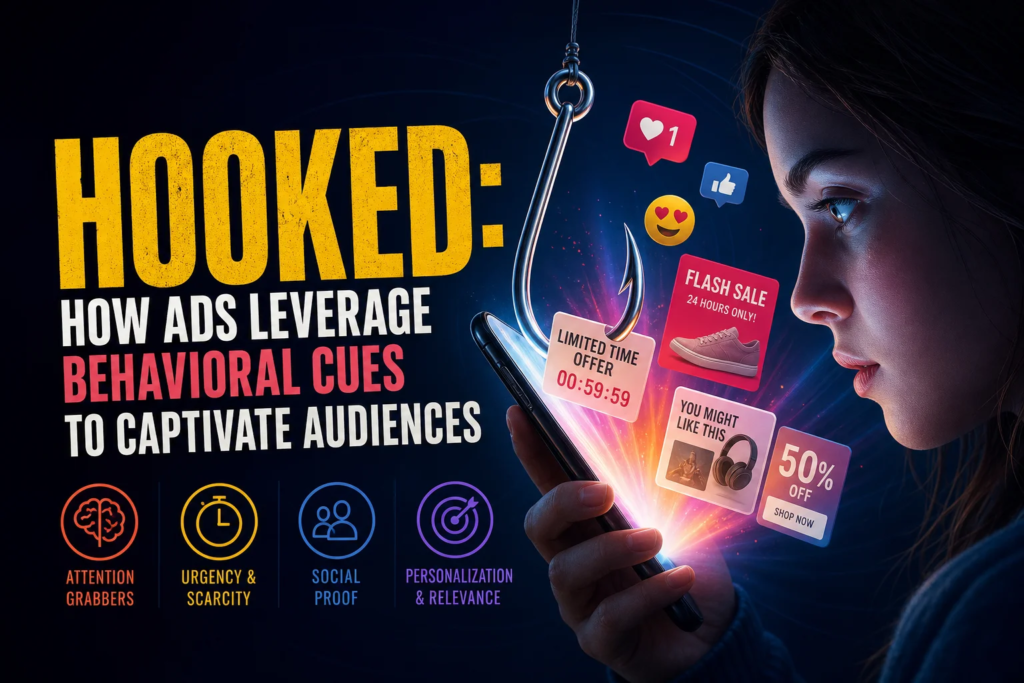
The Ultimate Guide to Hooked: How Ads Leverage Behavioral Cues to Captivate Audiences
Introduction: Why Some Ads Stick While Others Disappear
You scroll past hundreds of ads every week. Some barely register. Others stop you mid-scroll, make you laugh, spark curiosity, trigger nostalgia, or convince you that maybe—just maybe—you need that product after all.
That difference is not random.
The most effective advertising does not simply show people a product. It taps into how people think, feel, decide, remember, and act. In other words, the secret behind compelling campaigns is behavioral science.
That is the heart of Hooked: How Ads Leverage Behavioral Cues to Captivate Audiences. Great ads are not just creative; they are psychologically precise. They understand that people are influenced by social proof, urgency, identity, emotion, memory, habit, reward, and context.
But here is the important distinction: behavioral advertising does not have to be manipulative. At its best, it helps brands communicate more clearly, reduce friction, and connect with audiences in ways that feel relevant and meaningful.
In this in-depth article, we will explore Hooked: How Ads Leverage Behavioral Cues to Captivate Audiences from every angle: the psychology behind attention, the cues that drive action, real-world case studies, ethical considerations, and practical takeaways for marketers who want to create ads that resonate without crossing the line.
What Does “Hooked” Really Mean in Advertising?
When marketers say an audience is “hooked,” they usually mean the ad has done three things successfully:
- Captured attention
- Created emotional or cognitive engagement
- Motivated the next action
That action might be clicking, watching, sharing, signing up, visiting a store, comparing products, or simply remembering the brand later.
In the context of Hooked: How Ads Leverage Behavioral Cues to Captivate Audiences, being “hooked” does not mean being tricked. It means an ad has aligned with a behavioral cue that already exists in the audience’s mind.
For example:
- A limited-time offer activates urgency.
- A customer review activates social proof.
- A before-and-after image activates contrast.
- A personalized message activates relevance.
- A brand story activates identity and emotion.
The best ads work because they meet people where they already are psychologically.
Why Behavioral Cues Matter More Than Ever
Modern audiences are overwhelmed. They see ads across search engines, social media, streaming platforms, podcasts, apps, email inboxes, websites, and even smart TVs.
Attention has become one of the most competitive markets in the world.
That is why how ads leverage behavioral cues to captivate audiences has become a major topic in marketing strategy. Brands cannot rely on visibility alone. An ad can be perfectly placed and still fail if it does not connect with a real human motivation.
Behavioral cues help advertisers answer questions like:
- Why do people click one headline and ignore another?
- Why does one product page convert while another loses visitors?
- Why do some campaigns become cultural moments?
- Why do people trust strangers’ reviews more than polished brand claims?
- Why do consumers abandon carts even after showing purchase intent?
The answers usually live inside human behavior.
The Core Psychology Behind Hooked Advertising
At the foundation of Hooked: How Ads Leverage Behavioral Cues to Captivate Audiences is a simple truth: people are not purely rational decision-makers.
We like to believe we compare options objectively, weigh pros and cons, and make logical choices. Sometimes we do. But often, our decisions are shaped by mental shortcuts, emotional triggers, and environmental cues.
These mental shortcuts are known as heuristics. They help us make fast decisions without analyzing every detail.
Common Behavioral Cues Used in Advertising
| Behavioral Cue | What It Means | How Ads Use It | Example |
|---|---|---|---|
| Social proof | People look to others for guidance | Reviews, testimonials, ratings, popularity claims | “Loved by 2 million customers” |
| Scarcity | Limited availability increases perceived value | Low-stock alerts, limited editions | “Only 3 left” |
| Urgency | Time pressure encourages faster decisions | Countdown timers, flash sales | “Offer ends tonight” |
| Loss aversion | People fear losing more than they enjoy gaining | Missed savings, expiring benefits | “Don’t miss your 20% discount” |
| Authority | People trust credible experts | Doctor endorsements, certifications | “Recommended by dermatologists” |
| Reciprocity | People feel inclined to return value | Free trials, free guides, samples | “Download your free checklist” |
| Familiarity | Repetition builds comfort and trust | Retargeting, consistent branding | Seeing the same brand across platforms |
| Identity | People buy products that reflect who they are | Lifestyle messaging, community language | “For creators who think differently” |
These cues are powerful because they are deeply human.
Attention: The First Battle Every Ad Must Win
Before an ad can persuade, it must be noticed.
In the world of Hooked: How Ads Leverage Behavioral Cues to Captivate Audiences, attention is the entry point. Without attention, the best offer, smartest copy, or strongest product benefit does not matter.
What Captures Attention?
Ads typically capture attention through one or more of the following:
- Novelty: Something unexpected or unusual
- Emotion: Humor, joy, fear, awe, empathy, nostalgia
- Contrast: A strong before-and-after or visual difference
- Movement: Motion in video or animated formats
- Relevance: A message that feels personally meaningful
- Pattern interruption: Breaking what the viewer expects to see
A skincare ad showing a bottle on a white background may be ignored. But a skincare ad opening with “I stopped using 12 products and my skin finally calmed down” creates curiosity because it disrupts expectations.
That is behavioral cue advertising in action.
The Curiosity Gap: Why We Click to Know More
Curiosity is one of the strongest behavioral cues in advertising.
The curiosity gap occurs when people sense they are missing information and feel motivated to close that gap. This is why headlines such as “The mistake most homeowners make before selling” or “What your grocery receipt reveals about inflation” can be so effective.
However, curiosity must be handled carefully. If an ad creates curiosity but fails to deliver meaningful value, it feels like clickbait.
Ethical Curiosity vs. Clickbait
| Approach | Example | Audience Reaction |
|---|---|---|
| Ethical curiosity | “The 3 overlooked costs first-time buyers should know” | Trust, interest, usefulness |
| Clickbait | “You won’t believe what happened next!” | Suspicion, disappointment |
| Clear intrigue | “Why expensive running shoes may not prevent injury” | Engagement and learning |
| Manipulative mystery | “Doctors hate this one weird trick” | Low trust |
A core lesson from Hooked: How Ads Leverage Behavioral Cues to Captivate Audiences is that curiosity works best when it respects the audience.
Emotion: The Shortcut to Memory
People may forget product specifications, but they remember how an ad made them feel.
Emotion is central to how ads leverage behavioral cues to captivate audiences because emotional activation increases memory encoding. That means emotionally engaging ads are more likely to be recalled later.
Different emotions serve different marketing purposes:
| Emotion | Advertising Effect | Common Use Case |
|---|---|---|
| Joy | Creates positive brand association | Lifestyle, food, travel, entertainment |
| Nostalgia | Builds warmth and familiarity | Heritage brands, family products |
| Fear | Highlights risks or consequences | Insurance, health, cybersecurity |
| Relief | Positions product as a solution | Pain relief, financial tools, productivity |
| Pride | Connects to achievement and identity | Fitness, education, professional tools |
| Belonging | Builds community connection | Fashion, sports, social platforms |
| Awe | Elevates brand perception | Luxury, technology, automotive |
The most memorable ads often combine emotion with story. They do not simply say, “Our product is useful.” They show a transformation.
Identity-Based Advertising: “People Like Me Choose This”
One of the most powerful insights in Hooked: How Ads Leverage Behavioral Cues to Captivate Audiences is that people do not only buy products. They buy meanings.
A person may buy a certain sneaker because it is comfortable. But they may also buy it because it says something about who they are: active, stylish, ambitious, creative, rebellious, disciplined, or community-minded.
Identity-based ads work by aligning the product with the audience’s self-image.
Examples of Identity Cues
- “For founders who move fast”
- “Built for runners who never quit”
- “Skincare for sensitive skin, not perfect skin”
- “The planner for people with too many ideas”
- “Made for parents who want safer choices”
These messages do more than describe products. They invite the audience to recognize themselves.
That recognition creates a psychological bridge between brand and buyer.
Social Proof: Why We Trust the Crowd
Social proof is one of the most widely used behavioral cues in advertising. It is also one of the most effective.
When people are uncertain, they look to others. This is why ratings, reviews, testimonials, influencer partnerships, user-generated content, bestseller labels, and popularity claims are everywhere.
In the framework of Hooked: How Ads Leverage Behavioral Cues to Captivate Audiences, social proof works because it reduces perceived risk.
If thousands of people have already bought, reviewed, or recommended something, the decision feels safer.
Types of Social Proof in Ads
| Type of Social Proof | Example | Why It Works |
|---|---|---|
| Customer reviews | “4.8 stars from 12,000 reviews” | Reduces uncertainty |
| Expert endorsement | “Recommended by nutritionists” | Adds authority |
| Influencer proof | Creator using product on video | Builds relatability |
| User-generated content | Real customer photos | Feels authentic |
| Popularity claim | “Our most-loved moisturizer” | Signals broad approval |
| Case results | “Helped teams reduce admin time by 30%” | Shows measurable value |
The strongest social proof is specific, credible, and relevant. “Thousands love us” is weaker than “12,482 small business owners use this invoicing tool every month.”
Scarcity and Urgency: The Psychology of Now
Scarcity and urgency are classic behavioral cues, but they must be used responsibly.
Scarcity says: There may not be enough.
Urgency says: There may not be enough time.
Both cues work because people are motivated to avoid missing out. This connects to loss aversion, the behavioral principle that losses often feel more painful than equivalent gains feel pleasurable.
In advertising, this might look like:
- “Sale ends at midnight”
- “Only 100 seats available”
- “Limited edition color”
- “Enrollment closes Friday”
- “Early-bird pricing ends soon”
Used honestly, these cues help people make timely decisions. Used dishonestly, they damage trust.
A major lesson from Hooked: How Ads Leverage Behavioral Cues to Captivate Audiences is that long-term brand trust is more valuable than short-term pressure.
Personalization: The Cue of Relevance
Personalization is one of the defining features of modern advertising. It is also central to how ads leverage behavioral cues to captivate audiences in digital environments.
People are more likely to engage with ads that feel relevant to their needs, preferences, context, or behavior.
Examples include:
- Showing winter coats to users in cold climates
- Recommending products based on browsing history
- Sending abandoned-cart reminders
- Displaying content based on life stage, such as new parents or college students
- Adjusting email subject lines based on past engagement
Personalization works because relevance reduces cognitive effort. The audience does not have to ask, “Is this for me?” The ad makes that answer obvious.
However, personalization can become uncomfortable if it feels invasive. The best personalization feels helpful, not creepy.
The Role of Repetition: Familiarity Builds Trust
People often need multiple exposures before they act.
This is why retargeting, consistent branding, repeated slogans, jingles, mascots, and visual identity matter. Repetition creates familiarity, and familiarity often increases trust.
This is sometimes called the mere exposure effect: people tend to develop a preference for things they have seen before.
In Hooked: How Ads Leverage Behavioral Cues to Captivate Audiences, repetition is not about annoying people with the same ad endlessly. It is about creating a recognizable pattern across touchpoints.
Effective Repetition Looks Like This
| Weak Repetition | Strong Repetition |
|---|---|
| Showing the exact same ad too often | Rotating creative around one clear message |
| Repeating vague brand claims | Reinforcing a specific benefit |
| Following users aggressively | Using frequency caps and audience timing |
| Prioritizing impressions only | Building a coherent customer journey |
The best campaigns feel familiar without feeling stale.
Reward Loops: Why Some Ads Invite Interaction
Some ads do more than present information. They create a mini-experience.
Interactive quizzes, gamified discounts, swipeable product selectors, polls, augmented reality try-ons, and personalized calculators all use reward loops.
The user takes an action and receives feedback. That feedback encourages the next action.
Examples:
- Take a quiz → get a personalized recommendation
- Spin a wheel → reveal a discount
- Upload a room photo → preview furniture
- Choose preferences → see curated outfits
- Answer questions → calculate savings
This is another dimension of Hooked: How Ads Leverage Behavioral Cues to Captivate Audiences: the more involved people become, the more invested they feel.
Still, reward-based ads should provide real value. A quiz that recommends the same product to everyone quickly feels fake.
Friction: The Hidden Enemy of Conversion
An ad can capture attention, create desire, and still fail if the next step is too difficult.
Behavioral cues do not end with the ad itself. Landing pages, forms, checkout flows, loading speed, payment options, and confirmation messages all influence behavior.
Common friction points include:
- Too many form fields
- Unclear pricing
- Slow pages
- Weak mobile experience
- Surprise shipping costs
- Confusing calls to action
- Lack of trust signals
- No easy way to compare options
If Hooked: How Ads Leverage Behavioral Cues to Captivate Audiences is about capturing interest, conversion design is about preserving that interest long enough for action.
Friction Reduction Checklist
| Funnel Stage | Behavioral Goal | Improvement |
|---|---|---|
| Ad click | Maintain curiosity | Match ad promise to landing page |
| Landing page | Build confidence | Use clear headline and proof |
| Product page | Reduce uncertainty | Add reviews, images, FAQs |
| Checkout | Prevent abandonment | Show total cost early |
| Signup | Reduce effort | Offer social login or fewer fields |
| Confirmation | Reinforce choice | Send reassuring follow-up |
People rarely abandon because they are lazy. They abandon because the experience creates too much uncertainty or effort.
Case Study 1: Coca-Cola’s “Share a Coke” and the Power of Personalization
Coca-Cola’s “Share a Coke” campaign replaced the brand’s logo on bottles with popular first names. The idea was simple: people could find a bottle with their name or buy one for a friend.
The campaign became a global success.
Behavioral Cues Used
- Personalization
- Social sharing
- Emotional connection
- Gift-giving
- Novelty
- Identity recognition
Why It Worked
The product did not change. A Coke was still a Coke. But the meaning changed. A bottle became personal, social, and shareable.
The campaign made people search for names, post photos, and buy bottles as small gifts. It transformed an everyday product into a personalized experience.
Relevance to the Topic
This is a classic example of Hooked: How Ads Leverage Behavioral Cues to Captivate Audiences because the campaign turned personalization into participation. It did not just advertise to people; it invited them into the campaign.
Case Study 2: Nike and Identity-Driven Motivation
Nike’s advertising has long focused less on product features and more on identity, aspiration, and personal achievement.
Campaigns such as “Just Do It” and “Find Your Greatness” use behavioral cues tied to self-concept. Nike does not simply say, “Our shoes are durable.” It says, “You are capable of more.”
Behavioral Cues Used
- Identity
- Aspiration
- Emotional motivation
- Belonging
- Achievement
- Social meaning
Why It Worked
Nike understands that sportswear is not just about performance. It is about how people want to see themselves: disciplined, brave, active, resilient, and strong.
By focusing on the inner narrative of the consumer, Nike creates ads that feel personally meaningful.
Relevance to the Topic
Nike shows how ads leverage behavioral cues to captivate audiences by connecting products to identity. The emotional cue is not “buy shoes.” It is “become the kind of person who keeps going.”
Case Study 3: Spotify Wrapped and the Joy of Personalized Sharing
Spotify Wrapped is not a traditional ad campaign in the narrowest sense, but it is one of the most effective modern examples of behavioral marketing.
Every year, Spotify gives users a personalized summary of their listening habits. People see their top artists, favorite songs, minutes listened, and musical personality. Then they share it widely on social media.
Behavioral Cues Used
- Personalization
- Social proof
- Self-expression
- Nostalgia
- Gamification
- Anticipation
Why It Worked
Spotify Wrapped turns user data into identity content. People share it because it says something about them. Their music taste becomes a badge of personality.
It also creates anticipation. Users expect it every year, which builds habit and cultural relevance.
Relevance to the Topic
Spotify Wrapped is a brilliant example of Hooked: How Ads Leverage Behavioral Cues to Captivate Audiences because it makes the customer the center of the campaign. The audience does not feel advertised to; they feel seen.
Case Study 4: Amazon and Behavioral Nudges in Retargeting
Amazon’s advertising and recommendation ecosystem is built around behavioral cues. Product recommendations, “customers also bought,” cart reminders, ratings, reviews, and limited-time deals all reduce friction and encourage action.
Behavioral Cues Used
- Social proof
- Personalization
- Convenience
- Loss aversion
- Scarcity
- Familiarity
- Choice architecture
Why It Worked
Amazon does not rely on one cue. It combines many small cues throughout the shopping journey.
A shopper might see a product recommendation, notice thousands of reviews, compare delivery speed, see a limited deal, and receive a reminder after leaving the item in the cart.
Each cue answers a different psychological question:
- Is this relevant to me?
- Do others trust it?
- Can I get it quickly?
- Will I miss out?
- Is the effort low?
Relevance to the Topic
Amazon illustrates how behavioral cues in advertising extend beyond the ad itself. The entire experience is designed to help users move from interest to decision with minimal friction.
Case Study 5: Dove Real Beauty and Emotional Authenticity
Dove’s Real Beauty campaign challenged narrow beauty standards by featuring real women with diverse body types, ages, and appearances.
Instead of focusing only on product claims, Dove built a movement around confidence, representation, and self-acceptance.
Behavioral Cues Used
- Emotional connection
- Identity
- Belonging
- Contrast
- Social values
- Authenticity
Why It Worked
The campaign resonated because it tapped into a deeply felt cultural tension. Many consumers were tired of unrealistic beauty advertising. Dove offered a message that felt human and validating.
Relevance to the Topic
Dove Real Beauty demonstrates Hooked: How Ads Leverage Behavioral Cues to Captivate Audiences through emotional truth. The campaign worked because it understood the audience’s lived experience, not just their purchasing behavior.
Behavioral Cues Across the Customer Journey
Different cues work better at different stages of the customer journey.
A person who has never heard of a brand needs different messaging from someone comparing prices or hesitating at checkout.
Behavioral Cue Map
| Customer Stage | Audience Mindset | Effective Behavioral Cues | Ad Example |
|---|---|---|---|
| Awareness | “What is this?” | Novelty, emotion, curiosity | “The smarter way to plan meals” |
| Interest | “Is this relevant?” | Personalization, identity, benefits | “Meal plans for busy parents” |
| Consideration | “Can I trust this?” | Reviews, authority, comparisons | “Rated 4.9 by 8,000 families” |
| Intent | “Should I act now?” | Urgency, incentives, loss aversion | “Get 20% off before midnight” |
| Purchase | “Is this easy and safe?” | Friction reduction, guarantees | “Free returns for 30 days” |
| Loyalty | “Was this worth it?” | Rewards, community, recognition | “You unlocked VIP access” |
| Advocacy | “Should I share this?” | Social identity, referral rewards | “Give a friend $10 off” |
The more precisely a brand matches cue to journey stage, the more effective the campaign becomes.
The Ethics of Behavioral Advertising
No discussion of Hooked: How Ads Leverage Behavioral Cues to Captivate Audiences is complete without ethics.
Behavioral cues are powerful. That means marketers have a responsibility to use them carefully.
Ethical advertising respects the consumer’s autonomy. It informs, guides, and persuades without deceiving, shaming, frightening unnecessarily, or exploiting vulnerabilities.
Ethical vs. Manipulative Use of Behavioral Cues
| Behavioral Cue | Ethical Use | Manipulative Use |
|---|---|---|
| Scarcity | “Only 250 tickets available” when true | Fake low-stock warnings |
| Urgency | Real deadline for a sale | Countdown timer that resets |
| Social proof | Verified customer reviews | Fake testimonials |
| Personalization | Helpful relevant recommendations | Overly invasive targeting |
| Fear | Explaining genuine risks | Exaggerating danger |
| Authority | Real expert endorsement | Misleading credentials |
| Rewards | Transparent loyalty benefits | Hidden terms and conditions |
The goal should be to reduce confusion, not pressure people into choices they regret.
Trust is not a soft metric. It is a business asset.
How Small Brands Can Use Behavioral Cues Without Huge Budgets
You do not need a global advertising budget to apply the lessons of Hooked: How Ads Leverage Behavioral Cues to Captivate Audiences.
Small brands can use behavioral cues in simple, practical ways.
Practical Examples for Small Businesses
| Goal | Behavioral Cue | Low-Budget Tactic |
|---|---|---|
| Build trust | Social proof | Add customer reviews to ads and landing pages |
| Increase clicks | Curiosity | Use specific educational headlines |
| Improve relevance | Personalization | Segment email lists by interest |
| Increase urgency | Real deadlines | Promote seasonal offers honestly |
| Reduce friction | Simplicity | Use one clear call to action |
| Create loyalty | Reciprocity | Offer helpful free resources |
| Build identity | Community | Use language your audience uses |
A local fitness coach might run an ad saying, “Strength training for women over 40 who want to feel confident again.” That uses identity, relevance, and emotional motivation in one sentence.
A small bakery might say, “Only 40 holiday cookie boxes available this weekend.” That uses scarcity ethically if the number is real.
Writing Ad Copy That Uses Behavioral Cues Naturally
Good ad copy does not cram psychological triggers into every sentence. It chooses the right cue for the audience and moment.
Here are some examples of behavioral cue-based copywriting.
Social Proof Copy
- “Join 15,000 freelancers who use this template to send better proposals.”
- “Rated 4.8 stars by parents who wanted a calmer bedtime routine.”
- “Our bestselling jacket is back in stock.”
Curiosity Copy
- “The overlooked reason your ads get clicks but no sales.”
- “Most budgeting apps miss this one habit.”
- “What your morning routine says about your productivity.”
Identity Copy
- “For teams that would rather build than sit in meetings.”
- “Made for runners who train before sunrise.”
- “Skincare for people who are done fighting their skin.”
Loss Aversion Copy
- “Don’t let unused vacation days disappear.”
- “Avoid the three mistakes that make home repairs more expensive.”
- “Your free trial ends tomorrow—keep your progress.”
Friction-Reducing Copy
- “No credit card required.”
- “Cancel anytime.”
- “Set up in under five minutes.”
- “Free returns, no questions asked.”
These examples show how ads leverage behavioral cues to captivate audiences without sounding robotic or aggressive.
Visual Cues: The Psychology Beyond Words
Words matter, but visual cues often work faster.
People process images quickly. Before they read the headline, they may already feel something based on color, composition, facial expression, contrast, or movement.
Common Visual Behavioral Cues
| Visual Cue | Psychological Effect | Example |
|---|---|---|
| Faces | Draws attention and emotion | A smiling customer looking at the product |
| Eye direction | Guides viewer focus | Person looking toward CTA button |
| Contrast | Highlights importance | Bright product against dark background |
| Before/after | Shows transformation | Fitness, cleaning, design ads |
| Color | Signals mood or category | Green for wellness, black for luxury |
| Motion | Captures attention | Short looping video |
| Simplicity | Reduces cognitive load | Minimal product layout |
A powerful visual can communicate a behavioral message before the viewer consciously analyzes it.
This is another reason Hooked: How Ads Leverage Behavioral Cues to Captivate Audiences matters: effective advertising is often felt before it is understood.
The Role of Timing and Context
The same ad can perform differently depending on when and where it appears.
A coffee ad at 7:30 a.m. may feel relevant. The same ad at midnight may not. A tax software ad in February may feel useful. In July, it may be ignored.
Behavioral cues are context-sensitive.
Contextual Factors That Shape Ad Response
- Time of day
- Season
- Location
- Device type
- Platform mindset
- Recent behavior
- Weather
- Cultural events
- Purchase stage
For example, someone browsing LinkedIn may respond better to professional identity cues, while someone on TikTok may respond better to humor, authenticity, or quick visual storytelling.
Understanding context is essential to Hooked: How Ads Leverage Behavioral Cues to Captivate Audiences because behavior changes with environment.
Metrics That Reveal Behavioral Engagement
If you want to know whether behavioral cues are working, look beyond impressions.
Impressions tell you whether an ad was shown. They do not tell you whether it mattered.
Useful Metrics
| Metric | What It Reveals |
|---|---|
| Click-through rate | Initial attention and relevance |
| View-through rate | Video engagement |
| Scroll depth | Landing page interest |
| Conversion rate | Persuasive effectiveness |
| Cart abandonment rate | Friction or uncertainty |
| Repeat purchase rate | Satisfaction and loyalty |
| Share rate | Identity and emotional resonance |
| Review volume | Post-purchase engagement |
| Brand search lift | Memory and awareness |
The best campaigns measure behavior at multiple points, not just the first click.
Common Mistakes Brands Make With Behavioral Cues
Behavioral cues can improve advertising, but only when used thoughtfully.
Mistake 1: Using Too Many Cues at Once
An ad that says “Limited time! Expert approved! Loved by millions! Free gift! Don’t miss out!” can feel overwhelming.
Better: choose the strongest cue for the situation.
Mistake 2: Faking Scarcity
Fake urgency may increase short-term conversions, but it damages trust when customers notice.
Mistake 3: Ignoring Audience Sophistication
Some audiences are highly skeptical. Heavy-handed persuasion can backfire.
Mistake 4: Personalizing Too Aggressively
There is a fine line between relevant and intrusive.
Mistake 5: Optimizing Clicks Instead of Satisfaction
A clickbait ad may get traffic, but if the landing page disappoints, the brand loses credibility.
The strongest interpretation of Hooked: How Ads Leverage Behavioral Cues to Captivate Audiences is not “use psychology to force action.” It is “understand people well enough to serve them better.”
A Practical Framework: The HOOKED Model for Ethical Advertising
To make these ideas easier to apply, here is a simple framework inspired by the topic Hooked: How Ads Leverage Behavioral Cues to Captivate Audiences.
H — Highlight a Real Human Need
Start with the audience’s problem, desire, fear, aspiration, or context.
Ask:
- What are they trying to achieve?
- What are they worried about?
- What do they already believe?
- What would make them feel understood?
O — Offer a Clear Cue
Choose one primary behavioral cue.
Examples:
- Social proof for uncertainty
- Urgency for deadlines
- Identity for lifestyle products
- Authority for high-risk decisions
- Simplicity for complex tools
O — Optimize for Low Friction
Make the next step easy.
- Clear CTA
- Fast loading page
- Simple form
- Transparent pricing
- Trust signals
- Mobile-friendly design
K — Keep the Promise
The ad must match the experience. If the ad promises a free guide, deliver a useful guide. If it promises a discount, make the discount easy to redeem.
E — Evaluate Behavior
Track what people actually do.
- Do they click?
- Do they stay?
- Do they convert?
- Do they return?
- Do they share?
- Do they complain?
D — Design for Trust
Use behavioral cues in a way that builds long-term credibility.
Trust compounds. So does distrust.
Long-Tail Keyword Variations for Contextual SEO
Here are example long-tail variations related to Hooked: How Ads Leverage Behavioral Cues to Captivate Audiences that fit naturally into content strategy:
- How ads use behavioral cues to influence buying decisions
- Behavioral cues in advertising psychology
- How advertisers capture audience attention
- Psychology behind effective advertising campaigns
- How brands use social proof in ads
- Ethical behavioral advertising strategies
- Consumer psychology in digital advertising
- How urgency and scarcity work in marketing
- Emotional triggers in advertising
- How personalization improves ad engagement
- Behavioral science marketing examples
- Why some ads are more memorable than others
- How ads leverage behavioral cues to captivate audiences online
- Hooked advertising strategies for modern brands
- Behavioral marketing case studies
These variations support the main keyword while keeping the writing natural and readable.
The Future of Behavioral Cue Advertising
The future of Hooked: How Ads Leverage Behavioral Cues to Captivate Audiences will be shaped by three forces: artificial intelligence, privacy expectations, and consumer skepticism.
1. AI Will Improve Relevance
AI can help brands analyze behavior, personalize creative, test messages, and predict customer needs. But better targeting does not automatically mean better advertising. Brands still need empathy, creativity, and ethical judgment.
2. Privacy Will Redefine Personalization
As consumers demand more control over their data, advertisers will need to rely more on permission-based relationships, first-party data, contextual advertising, and transparent value exchange.
3. Authenticity Will Matter More
Audiences are increasingly skilled at recognizing formulaic persuasion. The brands that win will be those that use behavioral insights to create genuinely useful, entertaining, or meaningful experiences.
The next era of behavioral advertising will not belong to brands that shout the loudest. It will belong to brands that understand people the best.
Conclusion: Captivation Begins With Understanding
At its core, Hooked: How Ads Leverage Behavioral Cues to Captivate Audiences is not just about advertising tactics. It is about human understanding.
The most effective ads work because they connect with real behavioral patterns:
- People seek belonging.
- People trust others like them.
- People avoid loss.
- People respond to relevance.
- People remember emotion.
- People prefer simplicity.
- People act when the next step feels clear.
But the most important takeaway is this: behavioral cues should be used to create better communication, not manipulation.
When brands use psychology responsibly, advertising becomes more useful. It helps people discover solutions, make confident choices, and connect with brands that fit their values and needs.
If you want your ads to captivate, do not start with the product. Start with the person.
Understand what they feel, what they fear, what they want, what they value, and what makes action easier. That is how ads become memorable. That is how campaigns become share-worthy. That is how audiences become truly hooked.
FAQs About Hooked: How Ads Leverage Behavioral Cues to Captivate Audiences
1. What are behavioral cues in advertising?
Behavioral cues are psychological signals that influence how people notice, interpret, and respond to ads. Common examples include social proof, urgency, scarcity, personalization, authority, curiosity, emotion, and identity-based messaging.
2. Is using behavioral cues in ads manipulative?
Not necessarily. Behavioral cues become manipulative when they deceive, pressure, or exploit people. When used ethically, they help audiences understand value, reduce uncertainty, and make informed decisions.
3. Why is social proof so effective in advertising?
Social proof works because people often look to others when making decisions, especially when they are uncertain. Reviews, testimonials, ratings, and user-generated content help reduce perceived risk and build trust.
4. How do ads use urgency without seeming pushy?
Urgency works best when it is honest and specific. For example, “Sale ends Friday” is clear and ethical if the sale truly ends Friday. Avoid fake countdown timers or exaggerated pressure tactics.
5. What is the most powerful behavioral cue in advertising?
There is no single cue that works best in every situation. Social proof is powerful for building trust, urgency helps with timely action, personalization improves relevance, and emotion strengthens memory. The best cue depends on the audience and campaign goal.
6. How can small businesses apply behavioral advertising?
Small businesses can use customer reviews, clear calls to action, personalized email segments, limited-time seasonal offers, before-and-after visuals, helpful free resources, and community-focused messaging.
7. Why do emotional ads perform well?
Emotional ads perform well because emotion improves memory and makes messages feel more meaningful. People may forget details, but they often remember how an ad made them feel.
8. What is the biggest mistake brands make with behavioral cues?
The biggest mistake is using cues without trust. Fake scarcity, exaggerated claims, intrusive personalization, or misleading social proof may generate short-term clicks but can damage long-term credibility.

