


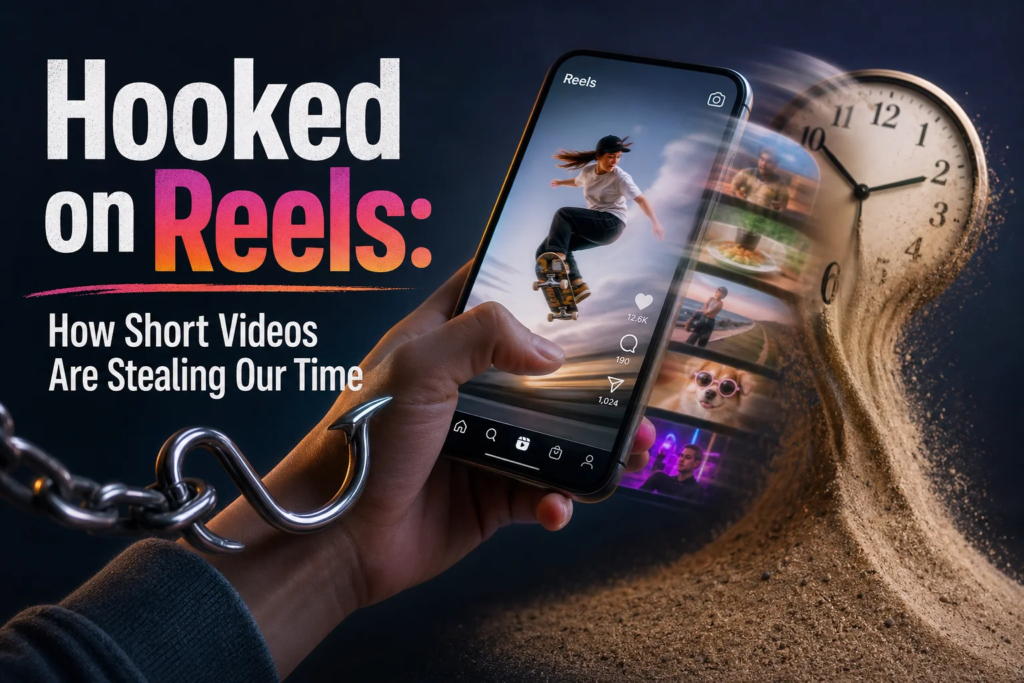
You open Instagram “just for a minute.” One Reel makes you laugh. The next teaches you a recipe you’ll probably never cook. Then comes a travel clip, a celebrity interview, a gym transformation, a dog wearing sunglasses, a hot take, a relationship tip, a productivity hack, and suddenly the room has gone quiet because 47 minutes have disappeared.
That is the strange modern magic of short-form video.
Hooked on Reels: How Short Videos Are Stealing Our Time is not just a catchy phrase. It describes a daily reality for millions of people who feel their attention being pulled into endless streams of bite-sized entertainment. Reels, TikToks, Shorts, and other short videos are designed to be frictionless, emotional, and instantly rewarding. They ask for almost nothing from us—just a thumb flick—and somehow take more time than we planned to give.
This article explores why we get hooked on Reels, how short videos steal our time, what happens to our focus and habits, and how we can reclaim control without deleting every app or pretending social media has no value.
Why “Hooked on Reels: How Short Videos Are Stealing Our Time” Matters Now
Short videos are no longer a side feature of social media. They are the main event.
Instagram prioritizes Reels. YouTube pushes Shorts. TikTok built an empire on endless swipeable clips. Facebook, Snapchat, Pinterest, and even shopping apps now mimic the same vertical-video experience. The format has become the internet’s default attention machine.
The concern behind Hooked on Reels: How Short Videos Are Stealing Our Time is not simply that people enjoy watching videos. Entertainment is not the enemy. The deeper issue is that short videos are engineered to blur the line between “I chose this” and “I can’t stop this.”
A single Reel feels harmless. But the habit becomes powerful because:
- Each video is short enough to feel low-risk.
- The next video loads instantly.
- The algorithm learns your preferences quickly.
- There is no natural stopping point.
- Emotional variety keeps your brain alert.
- Social comparison keeps you checking.
- Notifications pull you back after you leave.
In other words, being hooked on Reels is not a personal weakness. It is often the predictable result of extremely persuasive design.
The Short-Video Boom: From Entertainment to Everyday Habit
Short-form video grew because it solved a major problem for platforms: people are busy, impatient, and overwhelmed. A 10-minute video requires commitment. A 15-second Reel does not.
That is exactly why the format is so addictive.
A short video offers the promise of quick pleasure with almost no effort. You do not need to read, search, think deeply, or decide what to watch. The platform decides for you. Your job is to react, swipe, and continue.
How Short Videos Became So Dominant
| Platform Feature | What It Does | Why It Keeps You Watching |
|---|---|---|
| Infinite scroll | Removes the end point | You never reach a natural pause |
| Autoplay | Starts content immediately | No decision needed |
| Personalized algorithm | Learns your tastes | Content feels “made for you” |
| Short duration | Lowers resistance | “One more” feels harmless |
| Full-screen format | Blocks distractions | Your attention is captured |
| Likes/comments/shares | Adds social reward | You feel part of a live culture |
| Trending sounds | Creates familiarity | Repetition increases comfort |
The phrase Hooked on Reels: How Short Videos Are Stealing Our Time captures this new relationship with media perfectly. We are not just watching content anymore. We are being guided through an endless attention loop.
The Psychology Behind Getting Hooked on Reels
To understand how short videos are stealing our time, we have to look at the brain.
Short videos activate several psychological mechanisms at once. Each one is simple. Together, they are incredibly powerful.
1. Variable Rewards
Sometimes the next Reel is boring. Sometimes it is hilarious. Sometimes it is shocking, useful, attractive, inspiring, or oddly satisfying.
That unpredictability matters.
Variable rewards are powerful because the brain keeps searching for the next “hit.” If every Reel were equally entertaining, the experience would become predictable. But because the next swipe might reveal something amazing, you keep going.
This is one reason people get hooked on Reels even when they are not enjoying every video. They are not only watching the current clip. They are chasing the possibility of the next great one.
2. Dopamine and Anticipation
Dopamine is often described as the “pleasure chemical,” but it is more closely linked to motivation, anticipation, and reward-seeking. Short videos create repeated moments of anticipation: What will come next? Will it be funny? Will it teach me something? Will it surprise me?
The swipe becomes a tiny gamble.
That is why Hooked on Reels: How Short Videos Are Stealing Our Time feels so accurate. Time disappears because the brain is not measuring minutes carefully. It is moving from one reward prediction to the next.
3. Emotional Whiplash
A single scrolling session might include:
- A comedy clip
- A tragic news story
- A luxury vacation
- A political rant
- A cooking tip
- A breakup confession
- A fitness transformation
- A cute animal video
This emotional switching keeps the brain stimulated. But it can also leave you feeling scattered, overstimulated, or oddly drained.
Short videos steal time partly because they prevent mental closure. Your attention is constantly interrupted before it can settle.
4. Social Comparison
Reels are not just entertainment. They are also mirrors—sometimes distorted ones.
You see people who look fitter, richer, happier, more successful, more confident, more creative, more loved, and more productive. Even when you know the content is edited, staged, or selective, it can still affect your mood.
The hooked on Reels cycle often deepens when people use short videos not only to relax, but to compare, validate, escape, or self-soothe.
The Time-Theft Problem: How “Just Five Minutes” Becomes an Hour
The core concern in Hooked on Reels: How Short Videos Are Stealing Our Time is not one video. It is accumulation.
Most people do not sit down and intentionally say, “I will spend 90 minutes watching short clips.” Instead, the time vanishes in fragments.
The Hidden Math of Short-Video Scrolling
| Session Type | Average Length | Sessions Per Day | Daily Time | Monthly Time |
|---|---|---|---|---|
| Quick check | 5 minutes | 6 | 30 minutes | 15 hours |
| Casual scrolling | 15 minutes | 4 | 60 minutes | 30 hours |
| Evening binge | 45 minutes | 1 | 45 minutes | 22.5 hours |
| Mixed daily use | — | — | 90 minutes | 45 hours |
| Heavy use | 3 hours | — | 180 minutes | 90 hours |
Even moderate short-video use can take 30 to 45 hours a month. That is enough time to read several books, finish a course, exercise regularly, learn basic cooking, call family more often, or simply sleep better.
This is why the conversation around short videos stealing our time has become urgent. The theft is usually invisible. You do not notice it daily, but you feel it monthly and yearly.
Why Reels Feel Productive Even When They Aren’t
One reason people become hooked on Reels is that the content often looks useful.
There are Reels about finance, health, language learning, history, cooking, business, relationships, psychology, and productivity. Some are genuinely valuable. The problem is that learning through short videos can create the feeling of progress without the structure of real progress.
You might watch:
- 12 videos about investing but never open a savings account.
- 20 fitness Reels but never follow a training plan.
- 30 productivity tips but still avoid the hard task.
- 15 recipe videos but still order takeout.
- 10 mental health clips but never build a support routine.
This is called passive productivity. It feels like improvement, but it often replaces action.
The Hooked on Reels: How Short Videos Are Stealing Our Time problem becomes more subtle when the videos are educational. You are not “wasting time,” you tell yourself. You are learning. But learning requires retention, reflection, and application—not endless consumption.
The Design Tricks That Keep Us Watching
Short-video platforms are built around retention. That means the system’s goal is to keep you engaged for as long as possible.
Here is how common design features affect behavior.
| Design Feature | User Experience | Time Cost | Counter-Move |
|---|---|---|---|
| Infinite feed | “There’s always more” | No stopping point | Set a timer before opening |
| Instant replay | “I’ll watch that again” | Repeated loops | Pause and ask why |
| Algorithmic personalization | “This app knows me” | Stronger attachment | Reset recommendations periodically |
| Trending audio | “I’ve heard this before” | Familiarity loop | Mute autoplay when possible |
| Notifications | “I should check this” | Re-entry trigger | Turn off nonessential alerts |
| Save button | “I’ll use this later” | False productivity | Review saved posts weekly |
| Comments section | “What are people saying?” | Extra scrolling layer | Avoid comments during quick checks |
The phrase Hooked on Reels: How Short Videos Are Stealing Our Time is powerful because it points to design, not just discipline. Many users blame themselves for poor focus, but the apps are intentionally built to compete for every available second.
Case Study 1: The Student Who Lost Her Evenings
Profile: “Maya,” a 20-year-old university student
Problem: Short study breaks turned into long scrolling sessions
Platform habit: Instagram Reels and TikTok before and after studying
Maya started using Reels during short breaks between study blocks. Her plan was reasonable: study for 45 minutes, scroll for five minutes, return to work.
But the five-minute break regularly became 25 minutes. Then she felt guilty, rushed through assignments, and stayed up late. Eventually, she began using Reels as a way to avoid the stress caused by previous scrolling delays.
It became a loop:
- Study feels stressful.
- Open Reels for relief.
- Lose track of time.
- Feel behind.
- Stress increases.
- Open Reels again.
Analysis
Maya’s case shows how Hooked on Reels: How Short Videos Are Stealing Our Time is often connected to emotional avoidance. She was not lazy. She was overwhelmed. Short videos provided instant relief, but they also deepened the original problem.
The solution was not total deletion. Maya moved Reels off her home screen, used app limits, and replaced study breaks with walking, stretching, or texting one friend. Her scrolling did not vanish overnight, but her evenings became more predictable.
Case Study 2: The Marketing Team That Became Addicted to Trends
Profile: A small e-commerce marketing team
Problem: Constant trend-watching reduced deep creative work
Platform habit: Reels research, TikTok trend scanning, competitor monitoring
A small skincare brand encouraged its marketing team to stay active on short-video platforms. At first, this helped. The team spotted trends quickly, created relatable content, and grew engagement.
But after several months, the team noticed a problem. They were spending hours “researching” Reels without producing stronger campaigns. Meetings became filled with phrases like “We should do this trend” or “This audio is everywhere.” Strategy weakened because everyone was reacting to the feed.
Analysis
This case reveals another side of short videos stealing our time: professional distraction disguised as industry awareness.
For creators, marketers, journalists, designers, and entrepreneurs, short videos can be useful. But without boundaries, research turns into consumption. The team eventually created a structured trend review process:
| Old Habit | New Boundary |
|---|---|
| Random scrolling throughout the day | Two 20-minute research windows |
| Saving unlimited ideas | Weekly review of top 10 concepts |
| Copying trends quickly | Asking: “Does this fit our brand?” |
| Measuring views only | Measuring leads, saves, and conversions |
The team did not abandon Reels. They stopped being hooked on Reels and started using them intentionally.
Case Study 3: The Parent Who Felt Present but Wasn’t
Profile: “Daniel,” 38, father of two
Problem: Evening scrolling interrupted family attention
Platform habit: Reels after dinner and before bed
Daniel did not think he had a social media problem. He worked hard, helped at home, and only watched Reels to unwind.
But his children began saying, “Dad, look,” multiple times before he responded. His spouse noticed that conversations ended when his phone came out. Daniel was physically in the room but mentally inside the feed.
When he checked his screen-time report, he found that Reels and short videos took nearly two hours a day, mostly in small evening bursts.
Analysis
Daniel’s story shows that Hooked on Reels: How Short Videos Are Stealing Our Time is also about attention quality. The issue was not just lost minutes. It was lost presence.
Daniel created a simple rule: no short-video apps between dinner and the kids’ bedtime. At first, he felt restless. Within two weeks, he reported better conversations, less bedtime conflict, and more relaxed evenings.
Sometimes reclaiming time means reclaiming the moments that were already yours.
Case Study 4: The Creator Who Couldn’t Stop Consuming
Profile: “Aisha,” 29, content creator
Problem: Consuming more content than she created
Platform habit: Reels for inspiration, analytics checking, trend comparison
Aisha built a modest audience by posting lifestyle and career advice videos. But as her account grew, she became more anxious. She checked other creators constantly, compared views, studied hooks, and watched trending videos late into the night.
Her creativity declined. She felt that everything had already been done. The same platform that helped her build a voice started making her doubt that voice.
Analysis
This is one of the most overlooked parts of Hooked on Reels: How Short Videos Are Stealing Our Time. For creators, the feed can become both workplace and trap. Inspiration can turn into comparison. Analysis can turn into obsession.
Aisha created “input-free mornings,” where she wrote and planned before opening social apps. Her work improved because her first thoughts of the day were her own—not reactions to everyone else’s.
The Attention Economy: Your Time Is the Product
The reason short videos are so hard to resist is not accidental. Social media platforms operate in the attention economy, where user attention can be converted into advertising revenue, data, influence, and market power.
If you spend more time watching, platforms can:
- Show more ads.
- Collect more behavioral signals.
- Improve content recommendations.
- Increase creator dependency.
- Strengthen habit formation.
- Sell more targeted advertising.
This does not mean every platform is evil or every creator is manipulative. It means the business model rewards retention.
That is the heart of Hooked on Reels: How Short Videos Are Stealing Our Time. Your time has commercial value. If you do not decide how to spend it, someone else’s algorithm will.
What Short Videos Do to Focus
Many people report that after heavy short-video use, longer tasks feel harder. Reading a book, watching a full lecture, writing an essay, or sitting through a meeting can feel painfully slow.
This is not because your brain is “broken.” It is because attention adapts to what it practices.
If you repeatedly practice rapid switching, novelty seeking, and low-effort stimulation, your brain becomes more comfortable with those patterns. Deep focus, by contrast, requires patience, boredom tolerance, and delayed reward.
Short Video Habits vs. Deep Work Habits
| Short-Video Mode | Deep-Focus Mode |
|---|---|
| Fast novelty | Slow concentration |
| Constant switching | Sustained attention |
| Instant reward | Delayed reward |
| Passive consumption | Active thinking |
| Emotional stimulation | Cognitive effort |
| Algorithm chooses | You choose |
| No clear endpoint | Defined goal |
The concern behind how short videos are stealing our time is not just that we lose hours. It is that we may lose the ability to spend hours well.
The Emotional Cost of Being Hooked on Reels
Short videos often begin as relaxation. But heavy use can leave people feeling:
- Restless
- Distracted
- Inadequate
- Overstimulated
- Tired
- Unmotivated
- Irritable
- Behind on life
- Less satisfied with ordinary moments
This happens because Reels compress life into highlights. Everyone seems funnier, richer, more attractive, more disciplined, or more successful. Real life starts to feel dull by comparison.
The Hooked on Reels: How Short Videos Are Stealing Our Time issue is emotional as much as practical. The feed does not only occupy your minutes. It can reshape your expectations of beauty, success, relationships, productivity, and happiness.
Are Short Videos Always Bad?
No.
A balanced view matters. Short videos can be useful, creative, educational, and socially meaningful. They can help small businesses grow, spread public health information, teach skills, make people laugh, and connect communities.
The problem is not the format itself. The problem is unconscious overuse.
Short videos are tools. But tools become traps when they are designed to keep using us back.
A healthy relationship with Reels looks like this:
| Unhealthy Use | Healthy Use |
|---|---|
| Opening automatically | Opening intentionally |
| Scrolling without a goal | Watching with a purpose |
| Losing track of time | Setting clear limits |
| Comparing yourself | Learning or enjoying consciously |
| Using Reels to avoid tasks | Using Reels after priorities |
| Watching late at night | Protecting sleep |
| Saving endlessly | Applying what you save |
The goal is not to panic about Hooked on Reels: How Short Videos Are Stealing Our Time. The goal is to become aware enough to choose.
Signs You May Be Hooked on Reels
You may be more affected than you think if you notice these patterns:
- You open Reels without remembering why.
- You regularly spend longer than planned.
- You feel irritated when interrupted while scrolling.
- You use short videos to avoid stress or boredom.
- You struggle to watch longer content.
- You check Reels before getting out of bed.
- You scroll while eating, walking, or talking to others.
- You feel worse after watching but keep returning.
- You lose sleep because of late-night scrolling.
- You often say, “Where did the time go?”
If several of these feel familiar, the hooked on Reels pattern may already be shaping your day.
A Practical Reset: How to Take Back Your Time
You do not need to throw your phone into the ocean. You need friction, awareness, and replacement habits.
Here are practical ways to fight back against short videos stealing your time.
1. Check Your Real Usage
Before changing anything, look at your screen-time report. Most people underestimate their use.
Ask:
- How much time do I spend on Reels, TikTok, or Shorts daily?
- When do I scroll most?
- What emotion usually triggers it?
- Which app pulls me in fastest?
- What am I not doing because of this habit?
Awareness breaks denial.
2. Create “No-Reels Zones”
Set specific times and places where short videos are off-limits.
Good options include:
- First 30 minutes after waking
- During meals
- Work or study blocks
- Bathroom breaks
- Family time
- Public transport if you want reading time
- Last hour before bed
The more specific the rule, the easier it is to follow.
3. Add Friction
Apps win because access is easy. Make it slightly harder.
Try:
- Removing apps from your home screen
- Logging out after each use
- Turning your screen grayscale
- Disabling autoplay where possible
- Using website versions instead of apps
- Setting app timers
- Keeping your phone outside the bedroom
- Turning off nonessential notifications
Friction gives your intention time to catch up with your impulse.
4. Replace, Don’t Just Remove
If Reels give you relaxation, stimulation, or escape, you need alternatives.
Try replacing short-video scrolling with:
| If You Scroll Because You Feel… | Try This Instead |
|---|---|
| Bored | Read 5 pages, take a walk, do a puzzle |
| Stressed | Breathe for 2 minutes, stretch, journal |
| Lonely | Text or call one real person |
| Tired | Nap, hydrate, go outside |
| Avoidant | Set a 10-minute task timer |
| Uninspired | Listen to music without scrolling |
| Restless | Do pushups, clean one small area |
The best replacement is not always “productive.” Sometimes it is simply more nourishing.
5. Use the “One-Screen Rule”
Before opening Reels, decide what you are there to do. Then limit yourself to one screen of scrolling or one search topic.
For example:
- “I am looking for dinner ideas.”
- “I will watch three saved workout videos.”
- “I will check my friend’s post and leave.”
- “I will spend 10 minutes finding content ideas.”
This turns passive scrolling into active choosing.
6. Build Deep Attention Again
If Hooked on Reels: How Short Videos Are Stealing Our Time describes your current routine, rebuild focus gradually.
Start with:
- 10 minutes of reading
- 15 minutes of phone-free work
- One full podcast episode while walking
- A 25-minute focus timer
- Cooking without checking your phone
- Watching a long video without switching tabs
Deep attention is like fitness. You rebuild it through repetition.
A 7-Day Short-Video Reset Plan
Here is a simple plan to reduce the feeling of being hooked on Reels without going extreme.
| Day | Challenge | Goal |
|---|---|---|
| Day 1 | Check screen-time data | Face the real numbers |
| Day 2 | Turn off short-video notifications | Reduce triggers |
| Day 3 | Move apps off home screen | Add friction |
| Day 4 | No Reels before noon | Protect your morning mind |
| Day 5 | Replace one scrolling session | Build a better habit |
| Day 6 | Review saved videos and delete useless ones | Break false productivity |
| Day 7 | Set weekly rules | Make the change sustainable |
At the end of the week, ask: Do I feel calmer? Did I sleep better? Did I recover time? Was I more present?
The goal is not perfection. The goal is proof that your attention can return to you.
How Parents Can Talk to Teens About Reels
Teens are often deeply immersed in short-video culture, but lectures rarely work. Saying “your phone is ruining your brain” usually creates defensiveness.
A better conversation starts with curiosity.
Try asking:
- “Which videos do you actually enjoy?”
- “Do you ever feel worse after scrolling?”
- “How do you know when you’ve had enough?”
- “What makes it hard to stop?”
- “Do you think the app is designed to keep people watching?”
This frames Hooked on Reels: How Short Videos Are Stealing Our Time as a shared challenge, not a moral failure.
Families can also create collective boundaries:
- Phone-free meals
- Charging phones outside bedrooms
- Shared screen-time reviews
- Weekend outdoor time
- No short videos during homework
- Parent modeling of healthy use
Children notice what adults do more than what they say. If parents are also hooked on Reels, the family conversation should be honest, not hypocritical.
How Businesses and Creators Can Use Reels Without Being Consumed
For creators and brands, short videos are often necessary. But using Reels strategically is different from being controlled by them.
Here are smart boundaries:
- Separate creation time from consumption time.
- Batch content research into scheduled windows.
- Track business metrics, not just views.
- Avoid copying trends that do not fit your values.
- Do not start the day by checking competitors.
- Protect creative thinking before algorithm exposure.
- Take regular “input breaks” to refresh originality.
The irony of Hooked on Reels: How Short Videos Are Stealing Our Time is that even people who profit from short videos can be harmed by overconsumption. The healthiest creators use the platform without letting the platform use them.
The Bigger Cultural Question: What Are We Practicing?
Every habit is practice.
When we scroll Reels for hours, we are practicing:
- Seeking novelty
- Avoiding boredom
- Reacting quickly
- Comparing constantly
- Consuming passively
- Switching attention
- Expecting instant reward
When we reclaim time, we practice:
- Choosing deliberately
- Staying present
- Thinking deeply
- Creating instead of only consuming
- Resting without stimulation
- Being comfortable with silence
- Valuing real relationships
That is why Hooked on Reels: How Short Videos Are Stealing Our Time is more than a digital wellness topic. It is a question about the kind of minds and lives we are building.
Long-Tail Keyword Variations Related to the Topic
Here are natural variations connected to Hooked on Reels: How Short Videos Are Stealing Our Time:
- Why am I hooked on Reels?
- How short videos steal our time
- Are Instagram Reels addictive?
- How to stop scrolling Reels
- Effects of short videos on attention span
- Social media time-wasting habits
- How Reels affect productivity
- Short-form video addiction signs
- How to reduce Instagram Reels usage
- Why TikTok and Reels are so addictive
- How to reclaim time from social media
- Digital wellness tips for short-video users
These phrases reflect the same core concern: short videos are entertaining, but without boundaries, they can quietly take over our attention.
Conclusion: Reclaiming Your Attention Is a Modern Superpower
Hooked on Reels: How Short Videos Are Stealing Our Time is not about blaming technology or shaming people for enjoying funny, creative, or useful videos. It is about recognizing a simple truth: your attention is one of the most valuable things you own.
Short videos are powerful because they are easy, fast, emotional, and endless. They can entertain us, teach us, and connect us. But they can also fragment our focus, drain our energy, weaken our presence, and steal hours we meant to spend elsewhere.
The answer is not panic. It is intention.
Check your usage. Add friction. Set boundaries. Replace mindless scrolling with meaningful rest. Use Reels when they serve you, and step away when they start steering your day.
You do not need to quit the internet to reclaim your life. You only need to remember that your time is not loose change for an algorithm to collect. It is your life, one minute at a time.
1. Why are Reels so addictive?
Reels are addictive because they combine short duration, autoplay, infinite scrolling, personalized recommendations, and unpredictable rewards. Your brain keeps waiting for the next funny, useful, shocking, or exciting clip. This makes it easy to become hooked on Reels without noticing how much time has passed.
2. Are short videos bad for attention span?
Short videos are not automatically bad, but heavy use may make sustained attention feel harder. If your brain gets used to rapid novelty and constant switching, slower tasks like reading, studying, or deep work can feel less rewarding. This is a major concern in Hooked on Reels: How Short Videos Are Stealing Our Time.
3. How can I stop wasting time on Reels?
Start by checking your screen-time report. Then turn off notifications, remove the app from your home screen, set daily limits, avoid Reels before bed, and create phone-free zones. Most importantly, replace scrolling with something that meets the same need, such as rest, movement, connection, or focused work.
4. Should I delete Instagram or TikTok completely?
Not necessarily. Some people benefit from deleting apps, especially during exams, stressful periods, or sleep problems. Others do better with boundaries. The goal is to stop being controlled by short videos. If you can use them intentionally, deletion may not be needed.
5. Why do I feel tired after watching Reels?
Reels expose you to rapid emotional shifts, bright visuals, sounds, opinions, jokes, comparisons, and information. This can overstimulate your brain. Even though you are sitting still, your attention is working hard. That is why short videos stealing your time can also feel like they are stealing your energy.
6. Can Reels be educational?
Yes. Many Reels teach useful ideas, skills, and perspectives. The problem is when educational scrolling replaces real action. Watching 30 productivity videos is not the same as completing one important task. Use educational Reels as a starting point, not the whole learning process.
7. How do I know if I am hooked on Reels?
You may be hooked if you open Reels automatically, spend longer than planned, lose sleep, avoid responsibilities, feel irritated when interrupted, or feel worse after scrolling but keep doing it. If Hooked on Reels: How Short Videos Are Stealing Our Time feels personally familiar, it may be time for a reset.
8. What is the best first step to reduce short-video use?
The best first step is to create one clear boundary. For example: “No Reels for the first hour after waking” or “No short videos in bed.” A single strong rule is easier to follow than a vague goal like “use my phone less.”

