


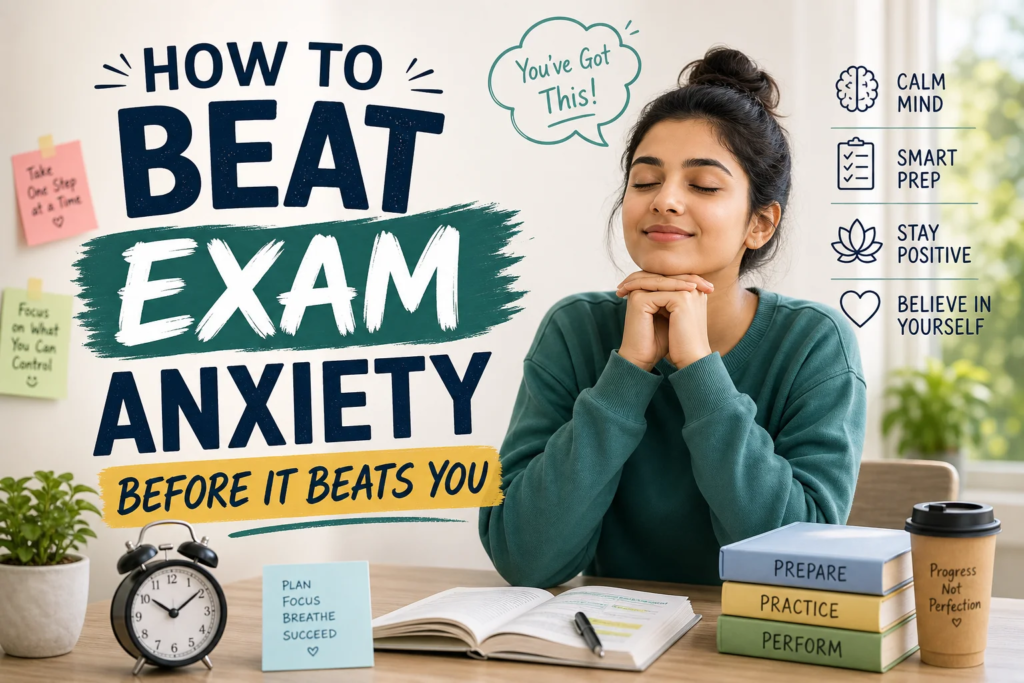
The Ultimate Guide: How to Beat Exam Anxiety Before It Beats You
Introduction: When the Exam Starts Before the Exam Starts
You know the feeling.
Your notes are open. Your highlighters are scattered across the desk. The clock is louder than usual. You read the same paragraph three times, but nothing sticks. Then the thoughts arrive: What if I forget everything? What if I fail? What if everyone else is more prepared than I am?
That is exam anxiety doing what it does best: turning a test into a threat before you even enter the room.
Learning How to Beat Exam Anxiety Before It Beats You is not just about “calming down.” It is about understanding what happens in your brain and body, building a smarter preparation system, and learning practical techniques that help you perform under pressure.
Exam anxiety is common, but it is not harmless. It can affect memory, focus, sleep, confidence, and decision-making. The good news? It is also manageable. With the right tools, you can stop anxiety from hijacking your performance and start walking into exams with more clarity, control, and confidence.
This guide will show you How to Beat Exam Anxiety Before It Beats You using proven strategies, real-world examples, practical routines, and mindset shifts that actually work.
What Is Exam Anxiety?
Exam anxiety is a form of performance anxiety. It happens when your brain interprets an exam as a serious threat rather than a challenge. Instead of helping you stay alert, stress becomes overwhelming.
A little pressure can be useful. It can motivate you to study, stay focused, and take the exam seriously. But too much anxiety can interfere with the very skills you need most: memory, reasoning, reading comprehension, problem-solving, and calm decision-making.
If you want to understand How to Beat Exam Anxiety Before It Beats You, you first need to recognize what it looks like.
Common Symptoms of Exam Anxiety
| Type of Symptom | What It May Feel Like |
|---|---|
| Physical | Sweating, shaky hands, fast heartbeat, nausea, headaches, tight chest |
| Mental | Racing thoughts, blanking out, difficulty concentrating, overthinking |
| Emotional | Fear, panic, irritability, dread, helplessness |
| Behavioral | Avoiding study, procrastination, checking notes obsessively, poor sleep |
| Academic | Forgetting material, rushing answers, misreading questions, lower scores |
Exam anxiety can begin days or weeks before the test. For some students, the most stressful part is not the exam itself but the anticipation of it.
That is why How to Beat Exam Anxiety Before It Beats You starts before exam day.
Why Exam Anxiety Feels So Powerful
Exam anxiety feels intense because your nervous system is doing exactly what it was designed to do: protect you.
When your brain detects danger, it activates the fight-or-flight response. Stress hormones like adrenaline and cortisol rise. Your heart beats faster. Your breathing changes. Your muscles tense. Your brain becomes alert to risk.
This response is useful if you are facing a physical threat. But during an exam, it can backfire.
You do not need to run from the exam paper. You need to think clearly.
What Happens in the Brain?
When anxiety rises, the emotional part of the brain can overpower the thinking part. The amygdala, which detects threat, becomes highly active. Meanwhile, the prefrontal cortex, responsible for planning, reasoning, and working memory, may become less efficient.
That is why students often say:
- “I knew it yesterday, but I forgot everything during the test.”
- “My mind went completely blank.”
- “I panicked and made silly mistakes.”
- “I couldn’t understand questions I normally find easy.”
This is not laziness. It is not stupidity. It is a stress response.
The goal of How to Beat Exam Anxiety Before It Beats You is to train your body and mind to interpret exams differently: not as danger, but as a demanding task you are prepared to handle.
The Hidden Causes of Exam Anxiety
Exam anxiety does not appear out of nowhere. It usually has roots.
Some causes are obvious, like not studying enough. Others are subtle, like perfectionism, past embarrassment, pressure from family, comparison with classmates, or fear of disappointing yourself.
Common Root Causes
| Cause | How It Fuels Anxiety |
|---|---|
| Poor preparation | Creates uncertainty and fear of being exposed |
| Perfectionism | Makes anything less than top marks feel like failure |
| Past bad experiences | Teaches the brain to expect another negative outcome |
| Parental or social pressure | Makes the exam feel tied to identity or worth |
| Lack of sleep | Weakens emotional regulation and memory |
| Comparison | Increases self-doubt and panic |
| Cramming | Creates temporary familiarity but poor long-term recall |
| Negative self-talk | Trains the brain to expect disaster |
If you are serious about learning How to Beat Exam Anxiety Before It Beats You, you need to identify your personal anxiety triggers.
Ask yourself:
- Do I fear failing, or do I fear being judged?
- Do I study consistently, or do I rely on last-minute pressure?
- Do I expect myself to be perfect?
- Do I compare my progress to others?
- Do I sleep well before exams?
- Do I know how to calm my body when panic starts?
Your answers reveal where your plan should begin.
The Exam Anxiety Cycle
Exam anxiety often follows a predictable cycle.
The Anxiety Loop
| Stage | What Happens | Result |
|---|---|---|
| 1. Fear begins | “What if I fail?” | Stress rises |
| 2. Avoidance starts | You delay studying | Guilt increases |
| 3. Pressure builds | Less time remains | Panic grows |
| 4. Cramming happens | You study under stress | Memory is weaker |
| 5. Exam performance suffers | You blank out or rush | Confidence drops |
| 6. Fear is reinforced | “I’m bad at exams” | Anxiety returns next time |
Breaking this loop is central to How to Beat Exam Anxiety Before It Beats You.
The earlier you interrupt the cycle, the easier it becomes. Waiting until the night before the exam makes anxiety harder to control. But if you build small daily habits, your confidence grows naturally.
Step One: Replace Panic Preparation With Strategic Preparation
Many students study hard but not effectively. They reread notes, highlight pages, watch videos, and feel productive. But when the exam arrives, they cannot retrieve the information.
Why? Because recognition is not the same as recall.
You may recognize a concept while reading it, but exams require you to pull it from memory and use it under pressure.
To master How to Beat Exam Anxiety Before It Beats You, you need preparation that builds confidence through evidence.
Use Active Recall
Active recall means testing yourself before the test does.
Instead of rereading a chapter five times, close the book and ask:
- What are the main ideas?
- Can I explain this without looking?
- What examples prove this concept?
- What mistakes might I make?
- How would this appear in an exam question?
Active recall teaches your brain, “I can retrieve this.”
That is confidence.
Use Spaced Repetition
Spaced repetition means reviewing material over increasing intervals rather than cramming.
For example:
| Day | Task |
|---|---|
| Day 1 | Learn topic and make summary questions |
| Day 2 | Test yourself without notes |
| Day 4 | Review mistakes |
| Day 7 | Practice exam-style questions |
| Day 14 | Complete mixed-topic quiz |
| Day 21 | Simulate exam conditions |
Spaced repetition reduces anxiety because your brain has seen the material many times in different contexts.
When students ask How to Beat Exam Anxiety Before It Beats You, one of the best answers is: stop relying on familiarity and start building retrieval strength.
Step Two: Create an Exam Confidence Plan
Confidence is not something you magically feel. It is something you build through repeated proof.
An exam confidence plan helps you replace vague worry with visible progress.
The Three-Part Exam Confidence Plan
| Part | Purpose | Example |
|---|---|---|
| Content mastery | Know the material | Review key topics and definitions |
| Exam practice | Apply knowledge | Do timed past papers |
| Anxiety control | Regulate stress | Practice breathing and self-talk |
Most students focus only on content. But How to Beat Exam Anxiety Before It Beats You requires all three.
If you know the content but never practice under timed conditions, the exam may still feel shocking. If you practice past papers but ignore sleep, your brain may underperform. If you only calm yourself but do not study, confidence will be fragile.
A balanced plan is stronger.
Step Three: Turn “What If?” Thoughts Into “Even If” Plans
Exam anxiety loves “what if” questions.
- What if I fail?
- What if I forget?
- What if the questions are impossible?
- What if I panic?
- What if I disappoint everyone?
These thoughts feel like problem-solving, but they are usually mental traps. They create fear without producing action.
A powerful technique is to turn “what if” into “even if.”
Reframing Table
| Anxiety Thought | Stronger Reframe |
|---|---|
| What if I forget everything? | Even if I forget something, I can start with what I know. |
| What if I panic? | Even if I panic, I can pause, breathe, and reset. |
| What if the questions are hard? | Even if they are hard, they are hard for others too. |
| What if I fail? | Even if I do badly, I can learn, recover, and improve. |
| What if I run out of time? | Even if time feels tight, I can prioritize high-value questions. |
This shift matters because it teaches your brain that difficulty is survivable.
A major part of How to Beat Exam Anxiety Before It Beats You is not pretending nothing will go wrong. It is knowing you can respond if something does.
Step Four: Practice Calm Before You Need Calm
You cannot expect your nervous system to become calm on command if you have never trained it.
Relaxation is a skill. Like any skill, it improves with practice.
Simple Breathing Technique: The 4-6 Reset
Try this:
- Inhale through your nose for 4 seconds.
- Exhale slowly for 6 seconds.
- Repeat for 2–3 minutes.
- Relax your shoulders and jaw as you breathe out.
Longer exhalations signal safety to the nervous system. This can reduce physical symptoms like a racing heart or tight chest.
Grounding Technique: 5-4-3-2-1
When panic starts, look around and name:
- 5 things you can see
- 4 things you can feel
- 3 things you can hear
- 2 things you can smell
- 1 thing you can taste
Grounding pulls your attention out of catastrophic thoughts and back into the present.
This is one of the most practical tools in How to Beat Exam Anxiety Before It Beats You, especially during the exam itself.
Step Five: Build a Pre-Exam Routine
Routines reduce uncertainty. Uncertainty fuels anxiety.
A pre-exam routine tells your brain, “We have done this before. We know what to do.”
Example Pre-Exam Routine
| Time | Action |
|---|---|
| Night before | Pack materials, review light summary, stop intense study early |
| 90 minutes before | Eat balanced meal or snack |
| 60 minutes before | Avoid panic conversations with anxious classmates |
| 30 minutes before | Do breathing exercise and review formula sheet/key points |
| 10 minutes before | Use grounding technique and positive cue phrase |
| During exam | Scan paper, plan time, start with manageable questions |
Your routine should be simple and repeatable.
A good routine is a cornerstone of How to Beat Exam Anxiety Before It Beats You because it prevents emotional chaos from controlling your behavior.
Step Six: Stop Cramming Like It’s a Strategy
Cramming feels productive because it creates urgency. But urgency is not the same as learning.
Cramming may help you recognize information briefly, but it often increases anxiety and reduces sleep. It also gives your brain the message that exams are emergencies.
If you want to learn How to Beat Exam Anxiety Before It Beats You, you need to move from emergency studying to steady studying.
Cramming vs. Strategic Study
| Cramming | Strategic Study |
|---|---|
| Last-minute | Spread over days or weeks |
| Stress-driven | Plan-driven |
| Mostly rereading | Active recall and practice |
| Poor sleep | Protected sleep |
| Panic confidence | Evidence-based confidence |
| Short-term memory | Durable learning |
If you have limited time, do not panic. You can still study strategically.
Focus on:
- High-value topics
- Past papers
- Mistake review
- Key formulas or definitions
- Short active recall sessions
Even two focused hours can be more effective than six distracted hours.
Step Seven: Use Practice Exams to Desensitize Fear
One reason exams feel terrifying is that students rarely practice in exam-like conditions.
They study in comfortable environments with notes nearby, music playing, snacks available, and no time pressure. Then the real exam feels like a different planet.
Practice exams reduce the shock.
How to Simulate Exam Conditions
- Set a timer.
- Put notes away.
- Sit at a desk.
- Use only allowed materials.
- Complete the paper without checking answers.
- Review mistakes afterward.
- Track patterns.
This method teaches your brain that exam conditions are familiar, not threatening.
If your goal is How to Beat Exam Anxiety Before It Beats You, practice exams are not optional. They are emotional training as much as academic training.
Case Study 1: Maya and the “Blank Mind” Problem
Maya was a high-achieving student who studied for hours but froze during exams. She would recognize questions, feel a rush of panic, and suddenly forget everything.
Her problem was not lack of intelligence. It was retrieval under pressure.
What Changed
Maya began using active recall every day. Instead of rereading notes, she wrote questions on flashcards and answered them out loud. Twice a week, she completed timed practice questions. Before each session, she practiced the 4-6 breathing technique.
After four weeks, her exam scores improved, but more importantly, her fear decreased.
Analysis
Maya’s case shows that How to Beat Exam Anxiety Before It Beats You is about training recall in realistic conditions. Her anxiety reduced because she had repeated proof that she could remember information even while timed.
Step Eight: Manage Perfectionism Before It Manages You
Perfectionism is one of the biggest drivers of exam anxiety.
It sounds like this:
- “If I don’t get an A, I’ve failed.”
- “One mistake ruins everything.”
- “Everyone expects me to be the best.”
- “I should understand this immediately.”
- “If I struggle, I’m not smart enough.”
Perfectionism turns exams into identity tests.
But an exam is not your identity. It is a measurement of performance on specific questions at a specific time.
Healthier Standards
| Perfectionist Standard | Healthier Standard |
|---|---|
| I must know everything. | I need to know enough and apply it well. |
| I cannot make mistakes. | I can make some mistakes and still perform strongly. |
| Struggle means failure. | Struggle means I found an area to improve. |
| My grade defines me. | My grade gives feedback, not a final verdict. |
| I must feel confident. | I can act prepared even if I feel nervous. |
A key lesson in How to Beat Exam Anxiety Before It Beats You is that excellence and perfection are not the same thing.
Excellence allows growth. Perfectionism punishes it.
Step Nine: Protect Sleep Like It Is Part of the Exam
Sleep is not a reward for studying. Sleep is part of studying.
During sleep, your brain consolidates memory, processes information, regulates emotion, and restores attention. If you sacrifice sleep to study, you may gain extra exposure to material but lose the ability to use it well.
What Poor Sleep Does Before Exams
| Lack of Sleep Can Reduce | Why It Matters |
|---|---|
| Working memory | Harder to solve multi-step problems |
| Emotional control | Anxiety feels stronger |
| Concentration | Easier to misread questions |
| Recall | More blanking out |
| Decision-making | More careless mistakes |
If you want How to Beat Exam Anxiety Before It Beats You to become more than a slogan, start by treating sleep as non-negotiable.
Better Night-Before Strategy
Do:
- Review summaries lightly.
- Pack your bag.
- Set alarms.
- Avoid heavy caffeine late.
- Stop intense studying at least 30–60 minutes before bed.
- Use a calming routine.
Avoid:
- All-night cramming.
- Comparing progress with friends.
- Starting brand-new topics late at night.
- Doom-scrolling exam forums.
- Testing yourself until you panic.
Step Ten: Eat and Move for a Calmer Brain
Your body and mind are not separate. Blood sugar crashes, dehydration, and physical tension can all worsen anxiety symptoms.
Exam-Day Food Tips
Choose meals that include:
- Complex carbohydrates
- Protein
- Healthy fats
- Water
Examples:
- Oatmeal with nuts and fruit
- Eggs with whole-grain toast
- Yogurt with granola
- Rice with chicken or tofu
- Peanut butter banana toast
Avoid experimenting with new foods right before an exam. Also be careful with too much caffeine. It may increase alertness, but it can also intensify shaking, sweating, and racing thoughts.
Movement Helps Too
A short walk before studying or before an exam can reduce stress hormones and improve focus. You do not need an intense workout. Even 10 minutes of movement can help.
This physical side of How to Beat Exam Anxiety Before It Beats You is often overlooked, but it can make a significant difference.
Step Eleven: Learn What to Do During the Exam
Preparation matters, but exam-room strategy matters too.
Anxiety often spikes in the first few minutes. If you expect that, you can manage it.
First Five Minutes Strategy
- Sit down and place your feet flat on the floor.
- Take three slow breaths.
- Read the instructions carefully.
- Scan the paper.
- Mark easy or familiar questions.
- Estimate time per section.
- Start with a question you can answer.
Starting with something manageable builds momentum.
If Your Mind Goes Blank
Do not panic about panicking.
Try this:
- Put your pen down for 10 seconds.
- Exhale slowly.
- Write down any related keywords.
- Skip and return if needed.
- Answer a different question to restart recall.
Memory is often cue-dependent. Once you begin writing related information, more may return.
Knowing what to do when things go wrong is central to How to Beat Exam Anxiety Before It Beats You.
Case Study 2: Daniel and the Timed-Test Panic
Daniel understood math during homework but panicked during timed tests. He rushed, skipped steps, and made careless mistakes.
His teacher noticed that Daniel rarely practiced with a timer. He knew the content, but time pressure made him feel unsafe.
What Changed
Daniel started doing short timed drills: 10 minutes, then 15, then 25. He practiced writing clean solution steps and checking his work. He also created a rule: if stuck for more than 90 seconds, mark the question and move on.
Results
His speed improved, but the biggest change was emotional. Timed conditions became familiar.
Analysis
Daniel’s story illustrates a crucial principle of How to Beat Exam Anxiety Before It Beats You: exposure reduces fear. Avoiding timed practice made the exam feel threatening. Gradual practice made it manageable.
Step Twelve: Use Self-Talk That Actually Works
Telling yourself “I’m amazing” may not work if you do not believe it. Effective self-talk should be believable, specific, and action-oriented.
Instead of:
- “I will definitely get 100%.”
- “Nothing bad will happen.”
- “I’m not anxious.”
Try:
- “I have prepared, and I can handle one question at a time.”
- “Nerves are uncomfortable, not dangerous.”
- “I can pause and reset.”
- “I don’t need perfection to succeed.”
- “Start with what I know.”
This kind of self-talk is a practical tool for How to Beat Exam Anxiety Before It Beats You because it gives your brain instructions, not empty reassurance.
Create a Cue Phrase
A cue phrase is a short sentence you repeat when anxiety rises.
Examples:
- “One question at a time.”
- “Breathe, read, begin.”
- “I can do hard things calmly.”
- “Start where you are.”
- “Slow is smooth, smooth is fast.”
Write your cue phrase on your study planner. Practice it during mock exams so it feels familiar on test day.
Step Thirteen: Avoid Anxiety Contagion
Anxiety can spread.
Before exams, students often gather and ask each other panic-fueled questions:
- “Did you study chapter 12?”
- “I heard the exam is impossible.”
- “My cousin said everyone failed last year.”
- “Wait, you didn’t memorize that table?”
These conversations can destroy calm in minutes.
Protect your mental space.
Before the Exam, Avoid:
- Last-minute group panic
- Comparing how many hours you studied
- Asking others what they think will appear
- Listening to dramatic predictions
- Reviewing huge amounts of material at the door
Instead:
- Stand somewhere quiet.
- Listen to calming music.
- Review a one-page summary.
- Breathe.
- Remind yourself of your plan.
Sometimes How to Beat Exam Anxiety Before It Beats You means choosing not to absorb other people’s fear.
Step Fourteen: Make a Mistake Review System
Mistakes are not proof that you are failing. They are data.
A mistake review system turns errors into improvement.
Mistake Log Template
| Question/Topic | Mistake Type | Why It Happened | Fix |
|---|---|---|---|
| Algebra equations | Calculation error | Rushed final step | Check signs before final answer |
| Biology definitions | Memory gap | Did not use active recall | Make flashcards |
| Essay structure | Weak conclusion | Ran out of time | Practice timed outlines |
| History dates | Confusion between events | Similar topics mixed | Create comparison chart |
Mistakes become less scary when they become specific.
Instead of thinking, “I’m terrible at this,” you learn, “I need to practice applying formula X under time pressure.”
This is an underrated strategy in How to Beat Exam Anxiety Before It Beats You because anxiety thrives on vague fear. Specific problems are easier to solve.
Step Fifteen: Use the Two-List Method
When anxiety feels overwhelming, try making two lists.
List 1: Things I Can Control
- My study schedule
- My sleep routine
- My practice questions
- My breathing
- My exam strategy
- My attitude toward mistakes
- My phone use
- My preparation materials
List 2: Things I Cannot Fully Control
- The exact questions
- Other students’ preparation
- The examiner’s mood
- Past results
- Whether I feel nervous
- What people think
Now put your energy into List 1.
This method is a simple but powerful part of How to Beat Exam Anxiety Before It Beats You because it redirects attention from fear to action.
Case Study 3: Aisha and Pressure From Family Expectations
Aisha was the first in her family expected to attend medical school. Her parents were supportive, but their hopes felt heavy. Every exam felt like a judgment on her future.
She studied constantly but never felt “done.” She slept poorly and cried before major tests.
What Changed
Aisha met with a school counselor and learned to separate performance from identity. She created a weekly study plan with built-in rest. She also had an honest conversation with her parents, explaining that encouragement helped more than repeated questions about grades.
Her parents began asking, “How can we support you this week?” instead of “What score do you think you’ll get?”
Analysis
Aisha’s case shows that How to Beat Exam Anxiety Before It Beats You sometimes requires changing the emotional environment around exams. Anxiety is not always caused by study habits alone. Support, communication, and boundaries matter.
Step Sixteen: Build a Weekly Anti-Anxiety Study Schedule
A weekly plan prevents the “I’ll study everything later” trap.
Here is a sample schedule.
Sample Weekly Study Plan
| Day | Main Goal | Anxiety-Reducing Action |
|---|---|---|
| Monday | Review Topic 1 | 20 active recall questions |
| Tuesday | Practice Topic 2 | 30-minute timed drill |
| Wednesday | Review mistakes | Update mistake log |
| Thursday | Mixed practice | Past paper section |
| Friday | Teach/explain concepts | Explain aloud without notes |
| Saturday | Mock exam | Simulate test conditions |
| Sunday | Light review and rest | Plan next week, sleep early |
Notice that rest is included. Rest is not weakness. It is maintenance.
A realistic schedule is one of the most effective ways to practice How to Beat Exam Anxiety Before It Beats You because it turns a frightening goal into manageable steps.
Step Seventeen: Study in Layers, Not Chaos
When students feel anxious, they often jump randomly between topics. This creates the illusion of effort but little mastery.
A better method is layered studying.
The Four Layers of Exam Preparation
| Layer | Goal | Example |
|---|---|---|
| Layer 1: Understand | Learn the concept | Watch lesson, read notes |
| Layer 2: Recall | Retrieve without help | Flashcards, blank-page method |
| Layer 3: Apply | Use in exam format | Practice questions |
| Layer 4: Perform | Work under pressure | Timed mock exam |
Many students stop at Layer 1. Exams usually test Layers 3 and 4.
To truly master How to Beat Exam Anxiety Before It Beats You, make sure your study reaches performance level.
Step Eighteen: Use the Blank-Page Method
The blank-page method is simple and powerful.
Here is how it works:
- Choose a topic.
- Take a blank sheet of paper.
- Write everything you remember without looking.
- Organize it into headings, diagrams, formulas, or examples.
- Check your notes.
- Add missing information in a different color.
- Repeat later.
This reveals what you truly know.
It also strengthens recall, which reduces anxiety. The more often you prove to yourself that knowledge is accessible, the less terrifying the exam feels.
This technique deserves a place in any serious plan for How to Beat Exam Anxiety Before It Beats You.
Step Nineteen: Know When Anxiety Needs Extra Support
Most exam anxiety can be reduced with better preparation, self-regulation, and support. But sometimes anxiety becomes severe.
Consider seeking help from a counselor, doctor, therapist, or trusted academic advisor if you experience:
- Panic attacks
- Frequent vomiting before exams
- Inability to sleep for several nights
- Avoiding school or classes
- Thoughts of self-harm
- Severe hopelessness
- Anxiety that affects daily life beyond exams
Asking for help is not failure. It is a mature response to a real problem.
Learning How to Beat Exam Anxiety Before It Beats You includes knowing when not to face it alone.
Case Study 4: Liam and the Post-Failure Comeback
Liam failed an important certification exam. Afterward, he avoided studying for months. Every time he opened the textbook, he remembered the failure.
Eventually, he changed his approach. Instead of rereading everything, he reviewed his score report and identified weak areas. He joined a study group focused on practice questions, used a mistake log, and took three full mock exams before resitting.
He passed on the second attempt.
Analysis
Liam’s experience highlights a vital truth about How to Beat Exam Anxiety Before It Beats You: failure is not the end of the story unless you stop there. His comeback began when he turned shame into information.
The Role of Teachers, Parents, and Friends
Exam anxiety is not only an individual issue. The people around a student can either increase or reduce stress.
Helpful Support Sounds Like:
- “What part feels hardest right now?”
- “How can I help you plan?”
- “Your worth is not one grade.”
- “Let’s focus on the next step.”
- “I’m proud of your effort.”
Unhelpful Support Sounds Like:
- “You better not fail.”
- “Why aren’t you studying more?”
- “Everyone else seems ready.”
- “This exam decides your whole future.”
- “Don’t be nervous.”
Telling someone “don’t be nervous” rarely helps. Giving them structure, encouragement, and perspective does.
If you are supporting someone who wants to know How to Beat Exam Anxiety Before It Beats You, help them feel capable, not cornered.
A Practical 7-Day Exam Anxiety Reset Plan
If your exam is one week away, use this plan.
7-Day Reset
| Day | Focus | Action |
|---|---|---|
| Day 7 | Organize | List topics, rank difficulty, gather materials |
| Day 6 | Recall | Use flashcards and blank-page method |
| Day 5 | Apply | Complete practice questions |
| Day 4 | Timed work | Do a timed section |
| Day 3 | Mistakes | Review errors and weak points |
| Day 2 | Mock exam | Simulate exam conditions |
| Day 1 | Calm review | Light revision, pack, sleep early |
| Exam Day | Execute | Breathe, plan time, start with what you know |
This plan works because it combines content, practice, and emotional regulation.
It is a compressed but effective version of How to Beat Exam Anxiety Before It Beats You.
Long-Tail Keyword Variations for Contextual SEO
Here are natural variations of the focus keyword that fit the topic:
| Keyword Variation |
|---|
| how to overcome exam anxiety before it affects your performance |
| ways to beat exam stress before test day |
| how to control test anxiety during exams |
| proven strategies to reduce exam anxiety |
| how to stop panicking before an exam |
| exam anxiety tips for students |
| how to stay calm before a big test |
| how to manage exam fear and stress |
| what to do when your mind goes blank in an exam |
| how to prepare for exams without anxiety |
These variations support the main theme: How to Beat Exam Anxiety Before It Beats You.
Quick Reference Chart: What to Do Before, During, and After the Exam
| Stage | Main Risk | Best Strategy |
|---|---|---|
| Weeks before | Avoidance and poor planning | Create study schedule and use active recall |
| Days before | Cramming and panic | Practice past papers and review mistakes |
| Night before | Sleep loss | Light review and calming routine |
| Morning of | Physical anxiety | Eat, hydrate, breathe, avoid panic talk |
| During exam | Blanking out | Pause, breathe, start with known questions |
| After exam | Overthinking | Reflect briefly, then recover and reset |
This chart captures the heart of How to Beat Exam Anxiety Before It Beats You: prepare early, regulate your body, use smart exam strategies, and learn from the process.
Common Myths About Exam Anxiety
Myth 1: “Anxiety Means I’m Not Prepared”
Not always. Many prepared students feel anxious. Anxiety may mean the exam matters to you, not that you are doomed.
Myth 2: “Confident Students Don’t Get Nervous”
They often do. The difference is that they know how to work with nerves instead of fearing them.
Myth 3: “More Studying Always Reduces Anxiety”
Not if the studying is disorganized, passive, or sleep-destroying. Quality matters more than endless hours.
Myth 4: “If I Panic, the Exam Is Ruined”
A panic spike does not have to ruin the exam. You can pause, breathe, reset, and continue.
Myth 5: “One Bad Exam Defines My Future”
One exam can matter, but it does not define your intelligence, worth, or entire life path.
Understanding these myths is essential to How to Beat Exam Anxiety Before It Beats You because false beliefs often intensify fear.
The Mindset Shift That Changes Everything
The most powerful shift is this:
An exam is not a threat to your identity. It is an opportunity to demonstrate preparation.
That does not mean exams are easy. It does not mean grades never matter. It means your self-worth must be bigger than one result.
When you stop treating every exam as a final judgment, your brain has more room to think.
That is the deeper answer to How to Beat Exam Anxiety Before It Beats You: prepare your mind to face pressure without turning pressure into panic.
Conclusion: You Can Be Nervous and Still Be Ready
Exam anxiety can feel like a storm: loud, physical, and hard to ignore. But it does not have to control your performance.
You now know How to Beat Exam Anxiety Before It Beats You:
- Understand what anxiety is and why it happens.
- Study with active recall and spaced repetition.
- Practice under realistic exam conditions.
- Use breathing, grounding, and self-talk to regulate stress.
- Protect sleep, nutrition, and movement.
- Build routines that reduce uncertainty.
- Review mistakes as data, not as proof of failure.
- Ask for support when anxiety becomes too heavy.
The goal is not to eliminate every nervous feeling. The goal is to become skilled enough that nerves no longer decide what you can do.
You can walk into the exam with a racing heart and still think clearly. You can feel pressure and still perform. You can make a mistake and still recover. You can be anxious and still succeed.
That is what it means to learn How to Beat Exam Anxiety Before It Beats You.
FAQs: How to Beat Exam Anxiety Before It Beats You
1. What is the fastest way to calm exam anxiety?
The fastest method is slow breathing with a longer exhale. Try inhaling for 4 seconds and exhaling for 6 seconds for two minutes. This helps calm the nervous system. Pair it with a grounding technique, such as naming things you can see and feel around you.
2. Why does my mind go blank during exams?
Your mind may go blank because anxiety interferes with working memory and recall. When your brain feels threatened, it prioritizes survival over complex thinking. Practicing timed questions, using active recall, and learning breathing techniques can reduce this response.
3. How can I stop panicking the night before an exam?
Avoid learning brand-new material late at night. Instead, do a light review, pack your materials, write a simple plan for the morning, and use a calming routine. Sleep is more valuable than last-minute cramming.
4. Is exam anxiety a sign that I did not study enough?
Not necessarily. Some students feel anxious even when well prepared. However, poor preparation can make anxiety worse. The best approach is to combine smart study methods with stress-management techniques.
5. What should I do if I panic during the exam?
Pause briefly. Put your feet flat on the floor, take slow breaths, and start with a question you can answer. If one question triggers panic, mark it and move on. Returning later often helps memory come back.
6. Can exercise help with exam anxiety?
Yes. Light movement such as walking, stretching, or gentle exercise can reduce stress hormones and improve focus. Even 10 minutes can help before a study session or exam.
7. Should I keep studying right up until the exam starts?
Usually, no. Last-minute intense studying can increase panic. A short review of key points is fine, but avoid frantic cramming or anxious conversations with classmates.
8. When should I seek professional help for exam anxiety?
Seek help if anxiety causes panic attacks, severe sleep problems, vomiting, avoidance of school, or thoughts of self-harm. A counselor, therapist, doctor, or academic advisor can help you build a support plan.
9. How do I beat exam anxiety if I have already failed before?
Start by treating the previous result as feedback, not a life sentence. Identify weak areas, use a mistake log, practice under exam conditions, and build a realistic study plan. Many students succeed after an earlier failure.
10. What is the best overall strategy for How to Beat Exam Anxiety Before It Beats You?
The best strategy is a combination of early preparation, active recall, timed practice, sleep protection, calming techniques, and realistic self-talk. Exam confidence grows when your brain has repeated evidence that you can handle the challenge.

