


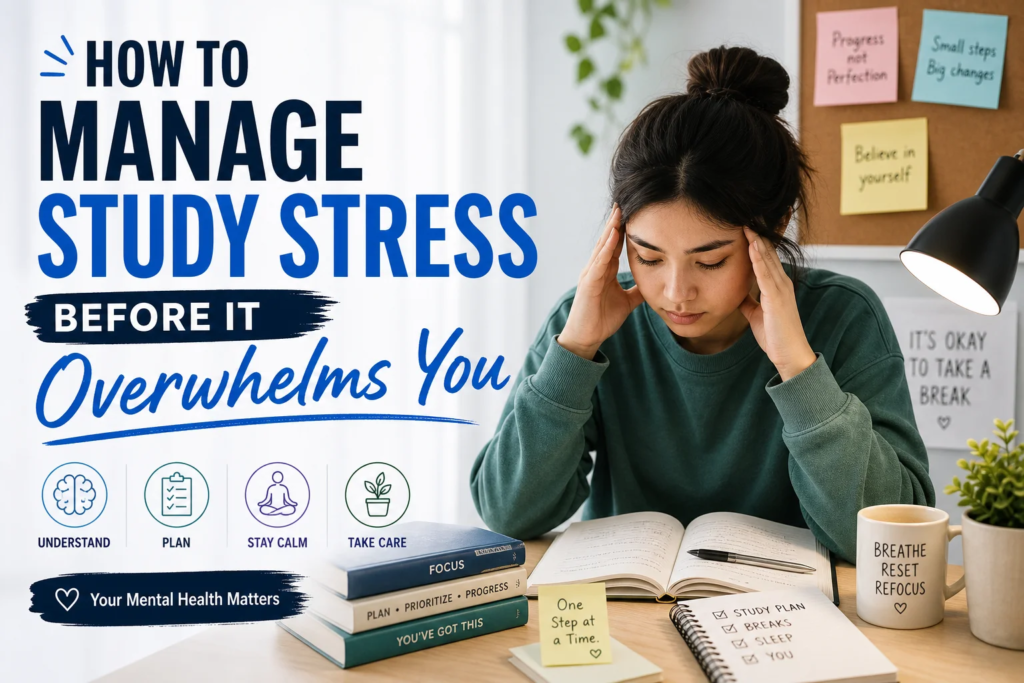
The Ultimate Guide on How to Manage Study Stress Before It Overwhelms You
Introduction: When Studying Starts to Feel Like Survival
There is a specific kind of silence that happens before study stress takes over.
You sit at your desk. Your laptop is open. Notes are scattered around you. A deadline is approaching, an exam is getting closer, and your brain keeps repeating the same unhelpful sentence: I should have started earlier.
At first, study stress feels manageable. A little pressure can even make you alert and focused. But when stress builds quietly over days or weeks, it can turn into procrastination, panic, exhaustion, poor sleep, irritability, and that heavy feeling that you are always behind no matter how much you do.
That is why learning How to Manage Study Stress Before It Overwhelms You is not just a “nice” student skill. It is essential for protecting your mental health, improving academic performance, and keeping your life bigger than your grades.
The goal is not to eliminate stress completely. That would be unrealistic. The goal is to understand stress early, respond wisely, and build systems that keep pressure from becoming panic.
This guide will show you How to Manage Study Stress Before It Overwhelms You using practical strategies, real-world case studies, planning tools, mindset shifts, and recovery techniques that actually fit into student life.
What Study Stress Really Is
Study stress is the physical, mental, and emotional pressure that comes from academic demands. It can be triggered by exams, assignments, competition, parental expectations, financial worries, unclear goals, perfectionism, or simply having too much to do in too little time.
A small amount of stress can be useful. It can motivate you to revise, attend class, meet deadlines, and stay alert. But chronic stress is different. When stress becomes constant, your brain stops treating studying as a challenge and starts treating it as a threat.
That is when learning How to Manage Study Stress Before It Overwhelms You becomes urgent.
Healthy Pressure vs. Harmful Stress
| Type of Pressure | How It Feels | Effect on Studying | What to Do |
|---|---|---|---|
| Healthy pressure | Energizing, focused, slightly nervous | Helps you take action | Use planning and structure |
| Moderate stress | Distracted, tense, rushed | Makes studying inconsistent | Break tasks down and reset |
| Chronic stress | Exhausted, panicked, numb, hopeless | Reduces memory, focus, and motivation | Prioritize recovery and support |
| Burnout | Emotionally drained, detached, unable to function | Studying feels impossible | Seek help, reduce load, restore health |
The earlier you identify stress, the easier it is to manage. Waiting until you are completely overwhelmed usually means you need more time, more support, and more recovery.
Why Study Stress Can Escalate So Quickly
Study stress often grows because students underestimate how many small pressures they are carrying.
One exam may not feel like a crisis. One late night may not seem like a big deal. One missed lecture may feel recoverable. But when these small issues stack together, your nervous system begins to operate in survival mode.
Common stress multipliers include:
- Multiple deadlines in the same week
- Poor sleep
- Unclear expectations
- Fear of failure
- Comparing yourself to classmates
- Family pressure
- Financial concerns
- Part-time work
- Perfectionism
- Lack of breaks
- Social isolation
- Too much screen time
- Not knowing where to start
This is why How to Manage Study Stress Before It Overwhelms You is really about prevention. You are not just managing assignments. You are managing your energy, attention, environment, expectations, and recovery.
Early Warning Signs That Study Stress Is Building
Stress rarely appears out of nowhere. It usually sends signals first. The problem is that many students ignore those signals because they think stress is just part of being successful.
But ignoring stress does not make you stronger. Responding to it early does.
Study Stress Warning Signs
| Warning Sign | What It May Look Like | What It Means |
|---|---|---|
| Mental fog | Reading the same page repeatedly | Your brain needs rest or a clearer plan |
| Procrastination | Avoiding tasks even when they matter | The task feels too big or emotionally loaded |
| Irritability | Snapping at friends or family | Your stress tolerance is shrinking |
| Sleep changes | Staying up late or waking anxious | Your nervous system is overstimulated |
| Physical tension | Headaches, stomach aches, tight shoulders | Stress is affecting your body |
| Loss of motivation | “What’s the point?” thinking | You may be emotionally overloaded |
| Overstudying | Studying nonstop but retaining little | Effort is not being used efficiently |
| Panic | Racing heart, dread, spiraling thoughts | You need immediate grounding and support |
If you recognize several of these signs, it is time to act. The best moment to learn How to Manage Study Stress Before It Overwhelms You is before your body forces you to stop.
The Core Principle: Reduce the Load Before You Increase the Effort
Many students respond to stress by pushing harder. They sleep less, cancel breaks, skip meals, and attempt marathon study sessions. This can work for a day or two, but it often backfires.
The more overwhelmed you become, the less efficiently your brain works. Memory, concentration, decision-making, and emotional control all suffer under chronic stress.
So instead of asking, “How can I study more?” ask:
- What can I simplify?
- What can I start today?
- What can I postpone?
- What can I ask for help with?
- What is the highest-impact task?
- What would make this feel 20% easier?
This is central to How to Manage Study Stress Before It Overwhelms You: you do not win by forcing yourself to carry everything at once. You win by reducing unnecessary pressure and creating a smarter path forward.
Step 1: Do a Stress Audit
Before you can manage study stress, you need to know what is causing it. Many students say, “I’m stressed about school,” but that is too broad to solve.
A stress audit helps you turn a vague cloud of anxiety into specific, manageable problems.
How to Do a 10-Minute Study Stress Audit
Write down everything currently stressing you out. Do not organize it yet. Just list it.
Then sort each item into one of these categories:
| Category | Examples | Action |
|---|---|---|
| Academic tasks | Exams, essays, projects, readings | Schedule and break down |
| Unclear tasks | “I don’t understand the assignment” | Ask teacher, tutor, classmate |
| Time pressure | Too many deadlines | Prioritize and negotiate if needed |
| Emotional pressure | Fear of failure, perfectionism | Use mindset and support tools |
| Lifestyle stress | Sleep, meals, exercise, work | Restore basics |
| Social stress | Group work, conflict, loneliness | Communicate and seek support |
Once you see the real sources, stress becomes less mysterious. This is one of the most powerful techniques in How to Manage Study Stress Before It Overwhelms You, because named problems are easier to solve than unnamed fears.
Step 2: Break Big Tasks Into “Next Actions”
One reason students freeze is that their task list is too vague.
“Study biology” is not a task. It is a category.
“Write essay” is not a task. It is a project.
“Prepare for finals” is not a task. It is a mountain.
Your brain resists vague tasks because they feel endless. To reduce stress, convert every academic demand into a next action.
Examples of Better Next Actions
| Vague Task | Better Next Action |
|---|---|
| Study chemistry | Review chapter 4 summary for 25 minutes |
| Write history paper | Find 3 sources on the library database |
| Prepare presentation | Create a 5-slide outline |
| Catch up on math | Complete problems 1–10 from worksheet |
| Revise for exam | Make flashcards for key definitions |
A next action should be small enough that you can begin it without needing motivation.
If you want to know How to Manage Study Stress Before It Overwhelms You, learn this habit: shrink the task until starting feels possible.
Step 3: Use the “Minimum Effective Study Plan”
A common mistake is creating an unrealistic schedule. You plan to study eight hours, exercise, cook, clean, revise every subject, and sleep early. By noon, the plan collapses, and you feel like a failure.
A better approach is the minimum effective study plan.
This plan asks: What is the smallest realistic amount of focused work that will move me forward today?
Example Minimum Effective Study Plan
| Time | Task | Goal |
|---|---|---|
| 9:00–9:25 | Review lecture notes | Identify weak areas |
| 9:25–9:30 | Break | Reset focus |
| 9:30–9:55 | Practice questions | Test understanding |
| 10:00–10:25 | Flashcards | Strengthen memory |
| 10:25–10:40 | Longer break | Prevent fatigue |
| 10:40–11:05 | Summarize mistakes | Improve next session |
This does not look dramatic, but it works. Focused study beats exhausted study.
A realistic plan is one of the foundations of How to Manage Study Stress Before It Overwhelms You because it helps you rebuild trust with yourself.
Step 4: Prioritize Like a Strategist, Not a Perfectionist
When everything feels important, stress explodes. But not all tasks have equal value.
Some assignments affect your grade more. Some topics appear more often on exams. Some tasks are urgent but not important. Some tasks feel productive but do not actually move you forward.
Use this simple priority filter.
The Study Priority Matrix
| Priority Level | Description | Examples | What to Do |
|---|---|---|---|
| A | Urgent and high impact | Exam tomorrow, major essay due soon | Do first |
| B | Important but not immediate | Research project due in two weeks | Schedule |
| C | Low impact but necessary | Formatting notes, organizing files | Batch together |
| D | Optional or distracting | Perfecting color-coded notes | Limit or skip |
Perfectionism often disguises itself as productivity. Rewriting notes beautifully may feel useful, but if you cannot answer practice questions, it is not the best use of time.
To master How to Manage Study Stress Before It Overwhelms You, you must become comfortable choosing what matters most.
Case Study 1: Maya and the Exam Panic Spiral
Maya was a first-year university student preparing for three exams in one week. She spent hours at her desk but absorbed very little. Her stress came from constantly switching subjects, checking social media, and telling herself she was already too far behind.
She decided to do a stress audit and discovered that her biggest issue was not laziness. It was lack of structure.
Maya created a three-day plan:
- Morning: highest-priority exam topic
- Afternoon: practice questions
- Evening: light review and sleep routine
- No phone during 30-minute study blocks
- One check-in with a classmate each day
She did not study perfectly, but she studied consistently. Her panic decreased because she could see progress.
Analysis
Maya’s story shows that How to Manage Study Stress Before It Overwhelms You often begins with structure, not motivation. Her stress reduced when she stopped trying to hold everything in her head and turned anxiety into a visible plan.
Step 5: Study in Focused Blocks, Not Endless Marathons
Long, unbroken study sessions sound impressive, but they often produce poor results. The brain needs cycles of focus and rest.
A simple method is the 25/5 technique:
- Study for 25 minutes
- Break for 5 minutes
- Repeat 3–4 times
- Take a longer break
If 25 minutes feels too long, start with 10. If you are deeply focused, try 45/10. The exact timing matters less than the rhythm.
Focus Block Rules
- Choose one task only.
- Put your phone away.
- Set a timer.
- Work until the timer ends.
- Take a real break.
- Record what you completed.
This method helps you manage study stress before it overwhelms you because it gives your brain a clear start and finish point.
Step 6: Learn Active Study Methods
Many students spend hours “studying” without actually learning. Passive methods feel comfortable, but they can create false confidence.
Passive methods include:
- Rereading notes
- Highlighting without testing
- Watching lectures without summarizing
- Copying information word-for-word
Active methods require your brain to retrieve, apply, or explain information.
Active Study Techniques
| Technique | How It Works | Best For |
|---|---|---|
| Practice testing | Answer questions without notes | Exams, problem-solving |
| Flashcards | Recall key facts or concepts | Definitions, formulas |
| Teach-back method | Explain topic simply aloud | Deep understanding |
| Blurting | Write everything you remember, then check gaps | Memory recall |
| Past papers | Practice under exam-like conditions | Exam preparation |
| Concept mapping | Connect ideas visually | Complex subjects |
Active studying is a major part of How to Manage Study Stress Before It Overwhelms You because it reduces uncertainty. You stop asking, “Did I study enough?” and start seeing what you actually know.
Step 7: Protect Sleep Like It Is Part of Studying
Sleep is not a reward for finishing work. Sleep is part of the learning process.
During sleep, your brain consolidates memory, processes emotions, and restores attention. Sacrificing sleep may give you more hours awake, but it often reduces the quality of those hours.
Sleep-Supportive Study Habits
- Stop intense studying 30–60 minutes before bed
- Keep a consistent sleep and wake time when possible
- Avoid caffeine late in the day
- Use a wind-down routine
- Keep your phone away from your bed
- Write tomorrow’s tasks before sleeping
- Do light review instead of panic cramming at night
If you are serious about How to Manage Study Stress Before It Overwhelms You, treat sleep as academic equipment. A tired brain is not a weak brain; it is an under-recovered one.
Step 8: Use Movement to Discharge Stress
Stress is not only mental. It is physical. When you sit still for hours while anxious, your body stores tension.
Movement helps release that pressure.
You do not need an intense workout. Even short movement breaks can reset your nervous system.
Quick Movement Options
| Time Available | Movement Idea |
|---|---|
| 2 minutes | Stretch shoulders, neck, and back |
| 5 minutes | Walk around the room or hallway |
| 10 minutes | Go outside for fresh air |
| 20 minutes | Brisk walk, yoga, cycling |
| 30+ minutes | Gym, sport, longer walk, dance |
Movement is one of the simplest ways to manage study stress before it overwhelms you because it changes your body state quickly. When your body calms down, your thoughts often become clearer.
Step 9: Eat and Hydrate for Stable Energy
When students are stressed, meals become random. Some skip food all day and then snack late at night. Others rely on caffeine and sugar to push through.
The problem is that unstable energy makes stress feel worse.
You do not need a perfect diet. Start with consistency.
Simple Student Nutrition Rules
- Eat something with protein in the morning
- Keep water nearby while studying
- Pair carbohydrates with protein or healthy fats
- Avoid relying only on energy drinks
- Keep easy snacks available
- Do not study for long periods while hungry
Good options include yogurt, eggs, oats, nuts, fruit, rice bowls, sandwiches, soups, beans, tuna, hummus, and smoothies.
This may sound basic, but basics matter. How to Manage Study Stress Before It Overwhelms You is not only about planners and revision techniques. It is also about keeping your body steady enough to think clearly.
Step 10: Manage Digital Distractions Before They Manage You
Your phone can turn a 30-minute task into a three-hour struggle. Each notification pulls your attention away and forces your brain to restart.
Digital distraction increases stress because it creates the feeling of being busy without making progress.
Digital Boundaries That Work
| Problem | Solution |
|---|---|
| Constant notifications | Use Do Not Disturb during study blocks |
| Social media scrolling | Remove apps from home screen |
| Online rabbit holes | Use website blockers |
| Phone checking | Keep phone in another room |
| Group chat pressure | Set check-in times |
| Laptop distractions | Use full-screen mode |
A helpful rule: during focus blocks, make distraction inconvenient.
If you want to master How to Manage Study Stress Before It Overwhelms You, protect your attention as carefully as your time.
Case Study 2: Daniel and the “Always Busy, Never Finished” Problem
Daniel was a high-achieving student who studied constantly but still felt behind. He attended every lecture, rewrote notes, joined multiple clubs, worked part-time, and said yes to every group project request.
His stress audit showed that Daniel had too many commitments and no boundaries. His issue was not poor discipline. It was overcommitment.
He made three changes:
- Reduced club responsibilities during exam season
- Switched from rewriting notes to practice questions
- Set a nightly shutdown time at 10:30 p.m.
Within two weeks, Daniel felt less exhausted and performed better on quizzes.
Analysis
Daniel’s example proves that How to Manage Study Stress Before It Overwhelms You sometimes means doing less, not more. Productivity is not about filling every hour. It is about spending your best energy on the right things.
Step 11: Stop Treating Breaks as Laziness
Breaks are not the opposite of studying. They are what make effective studying possible.
The quality of your breaks matters. A five-minute break that turns into 45 minutes of scrolling may leave you more drained. A good break should restore energy, not scatter attention.
Good Break Ideas
- Walk outside
- Drink water
- Stretch
- Tidy your desk
- Breathe deeply
- Listen to one song
- Make tea
- Look out a window
- Do a short body scan
- Talk briefly with a supportive person
Breaks to Use Carefully
- Social media
- Video platforms
- Gaming
- Long texting conversations
- News scrolling
These are not “bad,” but they are designed to keep you engaged. Use them intentionally, not automatically.
Knowing How to Manage Study Stress Before It Overwhelms You includes knowing when to pause before your brain shuts down for you.
Step 12: Build a Calm-Down Routine for Panic Moments
Sometimes stress spikes suddenly. You open an exam timetable, receive feedback, or realize a deadline is closer than you thought. Your heart races, and your mind jumps to worst-case scenarios.
In those moments, you need a reset routine.
The 5-Minute Study Stress Reset
| Minute | Action | Purpose |
|---|---|---|
| 1 | Put both feet on the floor and breathe slowly | Signals safety to the body |
| 2 | Name five things you can see | Grounds attention |
| 3 | Write the exact problem | Makes stress specific |
| 4 | Choose one next action | Restores control |
| 5 | Start for just two minutes | Breaks avoidance |
The goal is not to feel instantly perfect. The goal is to interrupt the spiral.
This reset is a practical tool for How to Manage Study Stress Before It Overwhelms You because it teaches your brain: “I can respond. I do not have to panic.”
Step 13: Challenge Catastrophic Thinking
Study stress often becomes overwhelming because of the stories we attach to it.
A missed assignment becomes “I’m failing.”
A bad grade becomes “I’m not smart.”
A difficult chapter becomes “I’ll never understand this.”
A competitive class becomes “Everyone is better than me.”
These thoughts feel true when you are stressed, but they are often exaggerated.
Reframe Stressful Thoughts
| Stress Thought | Balanced Reframe |
|---|---|
| I’m going to fail everything. | I’m struggling right now, but I can focus on the next task. |
| Everyone else understands except me. | Some people may be ahead, but I can ask questions and practice. |
| I wasted too much time. | I can’t change earlier, but I can use the next hour well. |
| If I don’t get perfect grades, I’m a failure. | Grades matter, but they do not define my entire worth. |
| I can’t handle this. | I feel overwhelmed, so I need support and a smaller plan. |
This mindset work is not empty positivity. It is accuracy. Learning How to Manage Study Stress Before It Overwhelms You means replacing panic-based thinking with problem-solving thinking.
Step 14: Ask for Help Earlier Than You Think You Should
Many students wait too long to ask for help. They believe they should be able to handle everything alone. But academic success is not meant to be a solo mission.
You can ask for help from:
- Teachers
- Professors
- Tutors
- Academic advisors
- Counselors
- Classmates
- Study groups
- Family members
- Disability support services
- Writing centers
- Online learning communities
Ask specific questions. Instead of saying, “I don’t understand anything,” say, “I understand the first two steps, but I get stuck when applying this formula.”
Specific requests get better support.
If your stress is affecting sleep, appetite, mood, safety, or daily functioning, speak with a mental health professional or trusted adult. If you ever feel at risk of harming yourself, seek emergency help immediately.
Understanding How to Manage Study Stress Before It Overwhelms You includes knowing that support is a strength, not a last resort.
Case Study 3: Priya and the Perfectionism Trap
Priya was an excellent student, but every assignment took her twice as long as expected. She could not submit work unless it felt flawless. She reread paragraphs repeatedly, changed formatting for hours, and panicked over small mistakes.
Her grades were high, but her stress was becoming unbearable.
A mentor helped her create “definition of done” rules:
- Essay outline completed before drafting
- Maximum two rounds of editing
- Submit when rubric requirements are met
- No editing after 11 p.m.
- Aim for excellent, not perfect
Priya felt uncomfortable at first, but her stress dropped. She realized perfectionism had been stealing time from rest, relationships, and other subjects.
Analysis
Priya’s case highlights an important truth about How to Manage Study Stress Before It Overwhelms You: high standards are useful, but impossible standards are harmful. Sustainable success requires boundaries.
Step 15: Create a Weekly Review Ritual
A weekly review prevents stress from sneaking up on you. It gives you a regular moment to look ahead, adjust, and prepare.
Set aside 20–30 minutes once a week.
Weekly Study Review Checklist
- What deadlines are coming up?
- What exams or quizzes are ahead?
- What topics confused me this week?
- What tasks can I finish early?
- What commitments may create stress?
- When will I rest?
- Who do I need to contact?
- What is my top priority this week?
This ritual is a powerful method for How to Manage Study Stress Before It Overwhelms You because it shifts you from reactive mode to proactive mode.
Step 16: Use Study Groups Wisely
Study groups can reduce stress by creating accountability and support. But they can also become distracting or intimidating if poorly managed.
A good study group has structure.
Productive Study Group Format
| Time | Activity |
|---|---|
| 5 minutes | Set goals for the session |
| 25 minutes | Silent individual work |
| 15 minutes | Discuss difficult questions |
| 20 minutes | Quiz each other |
| 5 minutes | Decide next steps |
Avoid study groups where everyone complains, compares, or chats for hours without working. Support matters, but the group should leave you calmer and clearer.
This is another practical way to manage study stress before it overwhelms you: surround yourself with people who help you take action, not spiral.
Step 17: Prepare for Exams Without Panic Cramming
Exams are one of the biggest causes of study stress. The problem is not only the exam itself; it is the uncertainty around preparation.
A strong exam plan reduces uncertainty.
7-Day Exam Preparation Plan
| Day | Focus |
|---|---|
| Day 1 | List topics and identify weak areas |
| Day 2 | Review core concepts |
| Day 3 | Practice questions |
| Day 4 | Review mistakes |
| Day 5 | Complete past paper or mock test |
| Day 6 | Target weak areas |
| Day 7 | Light review, sleep, prepare materials |
If you have less time, compress the plan. If you have more time, expand it. The structure matters more than the exact number of days.
Exam success is not just about knowledge. It is about emotional regulation. How to Manage Study Stress Before It Overwhelms You means preparing your mind as well as your notes.
Step 18: Build an Emergency Plan for Overwhelming Weeks
Some weeks are simply heavy. Multiple deadlines, exams, personal issues, and poor sleep may collide. In those moments, do not rely on your normal routine. Use an emergency plan.
The Academic Emergency Plan
- List every deadline.
- Identify what is due first.
- Contact instructors if extensions may be needed.
- Cut nonessential commitments temporarily.
- Choose “good enough” for low-impact tasks.
- Sleep at least enough to function.
- Ask for help.
- Complete one task at a time.
An emergency week is not the time to reinvent your life. It is the time to stabilize.
Learning How to Manage Study Stress Before It Overwhelms You includes knowing how to survive intense periods without letting them become your permanent lifestyle.
Step 19: Make Your Environment Work for You
Your study environment affects your stress more than you may realize.
A cluttered, noisy, distracting space can make studying feel harder before you even begin. You do not need a perfect aesthetic desk, but you do need a space that reduces friction.
Low-Stress Study Environment Checklist
- Clear only the materials needed for the current task
- Keep water nearby
- Use headphones if needed
- Adjust lighting
- Sit comfortably
- Keep phone out of reach
- Use a visible timer
- Have a notebook for distracting thoughts
- Keep a simple task list nearby
If your home is noisy, try libraries, classrooms, cafés, community centers, or campus study rooms.
A supportive environment is a quiet but powerful part of How to Manage Study Stress Before It Overwhelms You.
Case Study 4: Omar and the Burnout Warning Signs
Omar was preparing for final exams while working 20 hours a week. He drank too much caffeine, slept five hours a night, and stopped seeing friends. At first, he felt productive. Then he started forgetting material, getting headaches, and feeling emotionally numb.
A counselor helped him recognize early burnout. Omar reduced his work shifts temporarily, contacted two professors, and created a recovery-based study plan. He studied in shorter blocks, slept more, and used practice tests instead of late-night rereading.
His grades did not collapse as he feared. In fact, his performance improved because he could think clearly again.
Analysis
Omar’s experience is highly relevant to How to Manage Study Stress Before It Overwhelms You because it shows that burnout is not solved by more pressure. Recovery is not weakness. Sometimes rest is the strategy that protects achievement.
Step 20: Separate Your Identity From Your Grades
This may be the most important part.
Grades matter. Education matters. Effort matters.
But you are not a grade, a transcript, an acceptance letter, a scholarship result, or a ranking.
When students attach their entire identity to academic performance, every test becomes a judgment of their worth. That kind of pressure is unbearable.
A healthier identity sounds like this:
- “I am a learner, not a machine.”
- “My performance can improve with strategy.”
- “One bad result is feedback, not a life sentence.”
- “I can care about success without destroying myself.”
- “My value is bigger than school.”
This mindset is at the heart of How to Manage Study Stress Before It Overwhelms You. You can take your goals seriously without treating yourself harshly.
A Practical 24-Hour Plan for Immediate Relief
If you are stressed right now and need a starting point, use this simple plan.
Today’s Reset Plan
| Time | Action |
|---|---|
| Now | Take 5 slow breaths and write down what is stressing you |
| Next 10 minutes | Choose the most urgent academic task |
| Next 25 minutes | Work on one small part only |
| After that | Take a 5–10 minute break |
| Later today | Send one message asking for clarification or support |
| Evening | Prepare tomorrow’s top 3 tasks |
| Before bed | Stop intense work, reduce screens, sleep |
Do not try to fix your entire semester today. Start by creating one pocket of control.
That is the essence of How to Manage Study Stress Before It Overwhelms You: one clear action, repeated consistently, can change the direction of your week.
Common Mistakes That Make Study Stress Worse
Even hardworking students can accidentally increase their own stress. Watch out for these patterns.
Mistake 1: Waiting to Feel Motivated
Motivation often appears after you start, not before. Begin with two minutes.
Mistake 2: Studying Without Testing Yourself
Rereading feels safe, but active recall builds confidence.
Mistake 3: Ignoring Sleep
Sleep loss makes everything feel harder.
Mistake 4: Comparing Constantly
You see other people’s results, not their private struggles.
Mistake 5: Saying Yes to Everything
Every yes costs time and energy.
Mistake 6: Treating Stress as Proof You Are Failing
Stress is information. Use it as a signal, not a verdict.
Avoiding these mistakes is a key part of learning How to Manage Study Stress Before It Overwhelms You in a sustainable way.
Long-Tail Keyword Variations Used Naturally
When discussing this topic, related phrases can include:
- how to manage study stress before exams
- ways to reduce academic stress
- how to stop feeling overwhelmed by studying
- study stress management tips for students
- how to cope with exam pressure
- how to manage school stress effectively
- practical ways to handle study anxiety
- how to avoid burnout while studying
- stress management techniques for students
- how to stay calm during exam season
These variations help broaden the topic while keeping the focus on How to Manage Study Stress Before It Overwhelms You.
Final Checklist: How to Manage Study Stress Before It Overwhelms You
Use this checklist whenever academic pressure starts building.
| Action | Done? |
|---|---|
| I wrote down what is stressing me | ☐ |
| I identified my top priority | ☐ |
| I broke the task into a next action | ☐ |
| I scheduled focused study blocks | ☐ |
| I used active recall or practice questions | ☐ |
| I took real breaks | ☐ |
| I protected sleep | ☐ |
| I moved my body | ☐ |
| I reduced digital distractions | ☐ |
| I asked for help where needed | ☐ |
| I planned recovery time | ☐ |
| I reminded myself that grades do not define me | ☐ |
Conclusion: You Do Not Have to Wait Until You Break
Study stress becomes dangerous when it is ignored, normalized, or treated as a personal failure. But stress is not proof that you are weak. It is a signal that something needs attention.
You can learn How to Manage Study Stress Before It Overwhelms You by noticing early warning signs, breaking tasks into smaller steps, prioritizing wisely, protecting sleep, using active study methods, managing distractions, asking for help, and building recovery into your routine.
The most important lesson is this: you do not need to become a perfect student to feel better. You need a clearer system, kinder self-talk, and the courage to take the next small step.
Start today. Not with a dramatic life overhaul. Not with a perfect schedule. Just with one focused block, one honest stress audit, one message asking for help, or one early night of sleep.
Managing study stress before it overwhelms you is not about doing everything. It is about doing the right next thing before pressure turns into panic.
You are allowed to succeed without sacrificing yourself.
FAQs About How to Manage Study Stress Before It Overwhelms You
1. What is the fastest way to reduce study stress?
The fastest way is to pause, breathe, and write down the exact problem. Then choose one small next action. Stress often feels worse when everything is vague. A clear first step helps your brain regain control.
2. How do I manage study stress before exams?
To manage study stress before exams, create a topic list, identify weak areas, use practice questions, study in focused blocks, and protect sleep. Avoid relying only on last-minute cramming. Active recall and past papers are especially effective.
3. Why do I feel overwhelmed even when I study a lot?
You may be using inefficient methods, studying without breaks, lacking priorities, or trying to do too much at once. More hours do not always mean better learning. Focused, active, well-rested study is usually more effective than exhausted overstudying.
4. How can I stop procrastinating when I am stressed?
Make the task smaller. Instead of “write essay,” choose “write the introduction for 10 minutes” or “find one source.” Procrastination often happens when a task feels too large, unclear, or emotionally threatening.
5. When should I ask for help with study stress?
Ask for help as soon as stress affects your sleep, mood, appetite, concentration, or ability to function. You do not need to wait until things are severe. Teachers, tutors, advisors, counselors, and trusted friends can all be useful support.
6. Can study stress affect physical health?
Yes. Study stress can cause headaches, stomach problems, muscle tension, fatigue, sleep disruption, and changes in appetite. If physical symptoms persist or worsen, consider speaking with a healthcare professional.
7. Is it okay to take breaks when I have a lot to study?
Yes. Breaks are necessary for focus and memory. Short, intentional breaks can make your study sessions more productive. Skipping breaks often leads to fatigue, distraction, and lower retention.
8. How do I know if I am burned out?
Signs of burnout include emotional exhaustion, loss of motivation, poor concentration, sleep problems, irritability, and feeling detached or hopeless about studying. If you suspect burnout, reduce pressure where possible and seek support.
9. What should I do if I have too many deadlines at once?
List all deadlines, rank them by urgency and importance, start with the highest-impact task, and contact instructors early if you need clarification or an extension. Temporarily reduce nonessential commitments until the pressure passes.
10. What is the most important habit for managing study stress?
The most important habit is regular planning combined with realistic action. A weekly review, daily top-three task list, and focused study blocks can prevent stress from building silently.

