


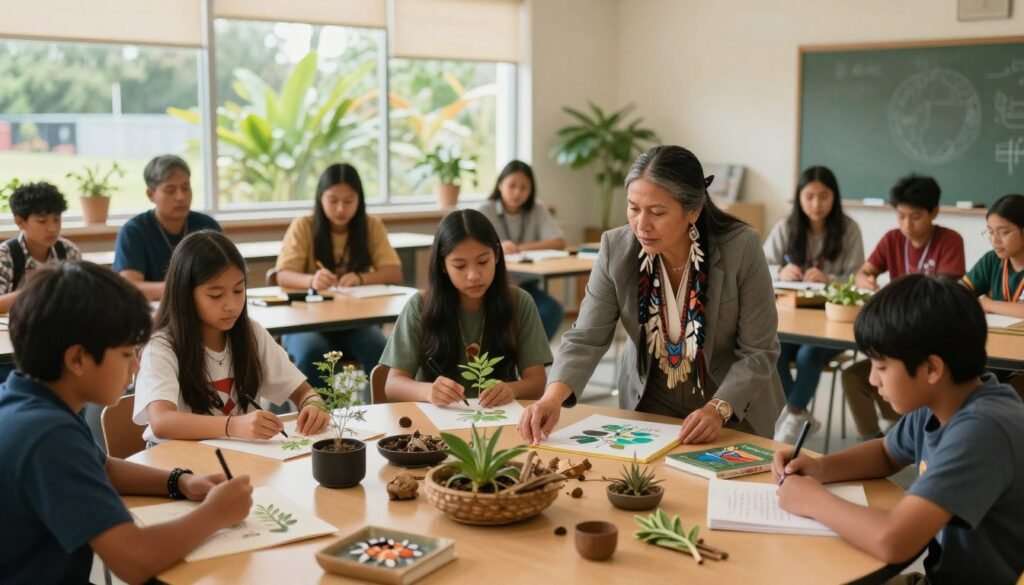
A teacher at Lincoln High School in California noticed something special. Students who learned about ancient Indian math concepts understood abstract problems better. They learned faster and remembered more than those using only textbooks.
This made her wonder: What if we used wisdom from ancient times in our schools? This wisdom has shaped civilizations for thousands of years.
This teacher’s experience is part of a growing trend in American schools. The Indian Knowledge System (IKS) offers deep insights for modern education. IKS focuses on growth in mental, spiritual, and moral areas. The National Education Policy 2020 wants to add IKS to education to keep cultural heritage alive and ensure fair learning for all.
Education should aim for more than just knowing subjects. Students need to be smart, emotionally aware, morally grounded, and socially responsible. IKS helps tackle big educational problems like fragmented learning, student mental health, and disconnection from nature.
IKS comes from deep philosophical and practical knowledge. The Vedas, Puranas, and Aranyakas cover philosophy, astronomy, math, medicine, yoga, languages, and ethics. These ancient texts offer frameworks that fit well with today’s education. Instead of seeing IKS as old, educators see it as a strong system with modern uses.
By adding IKS to education, students become globally competent with deep cultural understanding. This approach truly supports holistic development. It helps students grow in ways that tests alone can’t measure. They learn to be resilient, wise, and connected in today’s complex world.
Key Takeaways
- IKS represents a sophisticated knowledge system addressing mental, spiritual, and moral development in learners
- Holistic development of the learner requires integrating intellectual, emotional, ethical, and social dimensions
- IKS encompasses philosophy, mathematics, astronomy, medicine, yoga, linguistics, and ethics from ancient Indian traditions
- Education frameworks incorporating IKS help students develop resilience, critical thinking, and cultural rootedness
- The National Education Policy 2020 emphasizes the necessity of including IKS in modern educational systems
- IKS offers practical solutions to contemporary educational challenges including fragmented learning and student mental health concerns
- Integration of ancient wisdom with modern education creates globally competent individuals grounded in cultural understanding
Understanding Indigenous Knowledge Systems (IKS)
Indigenous Knowledge Systems are complex ways of understanding the world. They come from generations of living closely with nature and society. These systems are more than just cultural practices. They guide communities to live sustainably and learn deeply.
IKS views the world differently than Western ways. It values experience, oral stories, and connections in all life. This approach is unique and powerful.
The world’s indigenous people make up about 4% of the population. They live in over 70% of Asia. Despite challenges, they keep their knowledge alive, making it relevant today.
Definition of IKS
IKS includes philosophy, astronomy, mathematics, medicine, yoga, linguistics, and ethics. It’s knowledge built in specific cultures and environments. It focuses on living in harmony with the world.
IKS is known for:
- Passing down knowledge through stories and experience
- Seeing connections between people, nature, and the universe
- Using knowledge to meet community needs and protect the environment
- Guiding decisions with ethics
- Combining spiritual, cultural, and scientific knowledge
Historical Context of IKS
IKS has grown over thousands of years. It comes from direct experience with the environment and community. Important texts like the Vedas show the depth of indigenous knowledge.
IKS has faced marginalization in schools. Western science was valued over indigenous knowledge. Now, scholars are recognizing the value of IKS in areas like math and medicine.
Significance in Education
IKS brings new perspectives to education. It helps solve today’s educational problems. It promotes sustainability, diversity, and critical thinking.
IKS in education means:
- Learning environments that value different ways of knowing
- Teaching about the environment and sustainability
- Improving critical thinking with diverse perspectives
- Connecting abstract ideas to real life
- Respecting knowledge from non-Western cultures
IKS is essential in education, not just a cultural add-on. It enriches learning and prepares students for the world.
The Concept of Holistic Development
Holistic Development of the Learner is a new way to think about education. It sees students as full people, not just empty vessels. This idea says that students grow in many ways at once.
It’s different from old ways that only focus on grades and tests. Whole child development aims to grow the whole person.
This new approach fills a big gap in school. Students spend a lot of time in class but often miss out on emotional, physical, and spiritual growth. A complete approach makes sure all aspects of growth are part of learning.
Definition and Key Components
Holistic Development of the Learner combines physical, emotional, and mental growth into one learning experience. It sees students as complex beings needing care in all areas of life.
The Pancha Kosha model from ancient India is a key framework. It breaks down human growth into five layers:
- Annamaya Kosha – Physical body and health
- Pranamaya Kosha – Vital energy and breath
- Manomaya Kosha – Mental and emotional faculties
- Vijnanamaya Kosha – Intellectual and intuitive wisdom
- Anandamaya Kosha – Spiritual bliss and purpose
Whole Child Development uses these layers together. When educators tackle all these areas, students learn more deeply and change in meaningful ways.
The Importance of Holistic Approaches
Studies show that a complete education is very beneficial. Schools that focus on Holistic Development see better student engagement, mental health, and social skills. These benefits go beyond just good grades.
Old education systems often leave students unbalanced. They might do well in school but struggle outside. Whole Child Development fixes this by making learning a complete experience that supports growth in all areas.
| Educational Focus Area | Traditional Approach Outcomes | Holistic Development Outcomes |
|---|---|---|
| Academic Performance | High test scores, limited application | Strong scores with practical application skills |
| Emotional Well-being | Often neglected | Actively cultivated through integrated curriculum |
| Social Skills | Minimal focus on development | Built into daily learning activities |
| Physical Health | Limited to physical education class | Integrated throughout the school day |
| Ethical Development | Rarely addressed | Central to curriculum design |
| Spiritual Growth | Not included in learning | Encouraged through meaning-making activities |
Students who get a Whole Child Development education are more resilient and aware. They also connect better with their communities. These skills are key for success in college and beyond.
Various Models of Holistic Education
Many educational systems focus on Holistic Development of the Learner in different ways. They all share a focus on the learner and a mix of subjects in the curriculum.
The Waldorf education system, started by Rudolf Steiner, values imagination, creativity, and spiritual growth. Arts are woven into every part of a student’s education.
Montessori education is all about self-directed learning in special environments. Kids learn to be independent, think critically, and take responsibility while excelling academically.
Indigenous educational models offer deep insights into Whole Child Development. They teach about connection to land, community, and spirituality as core values.
“Education is the most powerful weapon which you can use to change the world.” – Nelson Mandela
These different models show that Holistic Development of the Learner can be applied in many ways. Each approach sees students as complete beings, deserving of support in all areas of growth.
Integrating IKS into Holistic Development
Indigenous Knowledge Systems (IKS) offer powerful learning strategies that fit well with holistic education. When schools mix IKS with modern learning, students get a richer experience. They learn by connecting old wisdom with new knowledge.
This mix helps students grow in many ways. They learn to think about everything as connected. This way, subjects in school work together better, not alone.
Synergistic Benefits of IKS
Using IKS in schools brings many benefits. Traditional knowledge has been tested for centuries. The Panchapadiya framework is a great example.
- Adhiti: Start with what you see
- Bodha: Go deeper with more talk
- Abhyasa: Keep it by practicing
- Prayoga: Use it in real life
- Pratyavekshana: Think about what you’ve learned
This method helps students think deeply. They see how knowledge solves real problems. It’s about doing, not just listening.
Practical Applications in Educational Settings
Schools use IKS in many ways. Science classes teach about the environment using old ways. Students see how people used to live in harmony with nature.
Wellness classes use ancient practices like meditation. This helps students handle stress and grow emotionally. Language classes use stories to teach about culture. Math classes explore different ways to solve problems.
| Subject Area | IKS Application | Learning Benefit |
|---|---|---|
| Environmental Science | Traditional ecological knowledge and sustainable farming | Practical understanding of resource management |
| Health and Wellness | Yoga, meditation, and traditional healing practices | Enhanced emotional regulation and mental well-being |
| Language Arts | Indigenous storytelling and oral traditions | Improved narrative thinking and cultural literacy |
| Mathematics | Indigenous mathematical systems and geometric patterns | Multiple problem-solving approaches and flexibility in thinking |
Using IKS well means changing how schools teach. Teachers need to learn about IKS and how to mix it with current lessons. Working with indigenous communities ensures respect for their knowledge.
“Integrating Indigenous Knowledge Systems creates learning environments where traditional wisdom and contemporary knowledge systems engage in productive dialogue, enriching students’ experiences and developmental outcomes.”
IKS helps solve today’s educational problems. Students learn about the environment, mental health, and different cultures. They learn to think in a holistic way, ready for today’s complex issues.
The Role of Cultural Context
Cultural context is key for meaningful learning and growth. When learning connects to students’ cultures, their brains work better. Seeing their culture in class materials makes students more engaged and proud of who they are.
Places that value cultural diversity make everyone feel welcome. Students from underrepresented groups do better when their culture is respected. Schools that celebrate different cultures help students grow and succeed in many ways.
Understanding Cultural Relevance
Cultural relevance means linking education to students’ real lives and communities. Indigenous Knowledge Systems (IKS) teach important values for growth. The idea of Vasudhaiva Kutumbakam—the world as one family—teaches global citizenship and cultural pride.
When education includes values like gratitude and respect, students become more emotionally intelligent. This approach makes students feel valued and connected, leading to true success and growth.
Key elements of cultural relevance include:
- Representation of diverse knowledge systems in curriculum materials
- Recognition of students’ home languages and cultural practices
- Incorporation of indigenous wisdom alongside Western perspectives
- Celebration of cultural heritage as an educational asset
- Development of critical consciousness about multiple ways of knowing
Impact on Student Engagement
Studies show that culturally responsive education boosts motivation and participation. When students see their culture in education, they feel more connected. This connection changes how they study and dream about the future.
Learning about different cultures makes students more open-minded and critical. They learn to respect and understand various perspectives. This education prepares them for a global world and values diversity.
| Educational Outcome | Impact of Cultural Context Integration | Student Population Benefit |
|---|---|---|
| Academic Achievement | Significant increase in test scores and grades | Historically marginalized students |
| Student Engagement | Higher participation rates in classroom activities | All learners, including disengaged students |
| Identity Formation | Stronger cultural pride and personal identity | Students from diverse backgrounds |
| Emotional Intelligence | Enhanced empathy, respect, and compassion | All students, across all grades |
| Critical Consciousness | Deeper understanding of social systems and perspectives | Learners developing analytical skills |
Personal growth happens when students see themselves in what they learn. Education that values cultural context creates inclusive places for all learners. By using Indigenous Knowledge Systems and culturally relevant teaching, schools support both academic and personal growth.
IKS in Different Educational Frameworks
Indigenous Knowledge Systems are valuable in all levels of education. The National Education Policy 2020 aims to include IKS in schools and universities. To succeed, we need careful planning, teacher training, and community support. Each level of education requires unique strategies for success and cultural authenticity.
IKS in Early Childhood Education
Young children greatly benefit from learning about Indigenous Knowledge Systems early on. Early childhood programs can incorporate IKS into activities that match how kids learn and grow naturally.
- Storytelling traditions that share cultural values and moral lessons
- Nature-based learning experiences that build environmental awareness
- Traditional games and artistic activities that develop motor skills and creativity
- Community-centered approaches that emphasize belonging and relationships
Introducing IKS in preschool and kindergarten lays a strong foundation for success. Children gain cultural understanding and essential learning skills.
IKS in K-12 Settings
Schools can integrate Indigenous Knowledge Systems into the curriculum in meaningful ways. This integration should balance academic standards with authentic cultural representation.
| Subject Area | IKS Integration Strategies |
|---|---|
| Science | Traditional ecological knowledge, sustainable practices, natural observation methods |
| Mathematics | Indigenous patterns, geometric designs, traditional measurement systems |
| Social Studies | Indigenous history, cultural heritage, community leadership models |
| Language Arts | Traditional narratives, oral storytelling, indigenous literature |
Project-based learning connects classroom knowledge with community wisdom. Field studies, craft workshops, and intergenerational exchanges enhance student success and cultural engagement.
Higher Education and IKS
Universities can advance IKS through dedicated programs and research. Colleges should integrate indigenous perspectives across multiple disciplines.
- Create specialized academic programs in indigenous studies and traditional knowledge
- Develop interdisciplinary research projects examining indigenous systems
- Include indigenous perspectives in professional programs like medicine and environmental management
- Build partnerships with indigenous communities for knowledge collaboration
Higher education institutions strengthen student success by recognizing indigenous knowledge as legitimate academic content. These efforts preserve cultural traditions while enriching educational experiences for all learners.
Empowering Learners through IKS
Indigenous Knowledge Systems (IKS) are key in today’s education. They help students grow personally and stay well. By mixing old wisdom with new learning goals, teachers create a space for growth. Here, students learn not just facts but also how to think and feel deeply.
Skills Development and Critical Thinking
IKS brings ancient wisdom to modern learning. The Nyaya school teaches logical thinking and careful study. Vedanta helps students think about their own thinking and the world around them.
Buddhist teachings on causation and connection help students see how things are linked. This way, they learn to solve problems in a practical and thoughtful way.
Fostering Emotional Intelligence
IKS also builds emotional strength. Yoga and meditation help students understand themselves better. They learn to handle stress and feel more connected to others.
Learning about values like ahimsa and seva makes students think about right and wrong. Studies show that mindfulness boosts grades, mental health, and friendships.
| IKS Practice | Emotional Intelligence Benefit | Student Well-being Outcome |
|---|---|---|
| Yoga and Meditation | Self-awareness and emotional regulation | Stress reduction and improved mental health |
| Contemplative Traditions | Empathy and compassion development | Enhanced social relationships and connection |
| Value-Based Education | Ethical reasoning and moral development | Increased sense of purpose and meaning |
| Mindfulness Practices | Emotional awareness and response flexibility | Academic performance improvement and resilience |
By using IKS, schools help students grow in many ways. They learn to handle their emotions and make a difference in their communities. This approach makes education more than just learning facts. It prepares students to be strong, thoughtful, and caring for their whole lives.
Case Studies in IKS Implementation
Real-world examples show how Indigenous Knowledge Systems change education in American schools and tribal institutions. These examples highlight strategies that honor cultural heritage and boost student success. They show the impact of educators who truly integrate IKS into their teaching.
Successful Programs in the United States
Tribal colleges lead by mixing traditional knowledge with academic rigor. They serve Native American communities by adding indigenous language, ecological knowledge, and cultural practices to curricula. This approach makes students more engaged because it connects to their lives and heritage.
K-12 schools in New Mexico, Alaska, and Montana have started new programs. They mix indigenous language with science and math. Teachers use traditional ecological knowledge in environmental education, showing how indigenous peoples managed resources for centuries. This boosts attendance and graduation rates among indigenous students.
University partnerships with indigenous communities offer research opportunities. These collaborations document traditional practices, preserve oral histories, and let students work on meaningful projects. This strengthens cultural identity and academic skills.
Lessons Learned from Various Initiatives
Effective IKS implementation needs real community collaboration, not just adding indigenous content. Schools that work with tribal elders, indigenous language speakers, and community members see better results. Approaches that don’t involve the community often fail because they lack authenticity.
Several key factors emerge from successful programs:
- Educator professional development focusing on culturally sustaining pedagogies
- Institutional commitment through policy support and adequate resource allocation
- Integration of both standardized assessments and holistic evaluation methods
- Ongoing collaboration with indigenous communities throughout implementation
- Balance between cultural preservation and allowing knowledge systems to evolve
Programs that measure success in many ways show the full impact of IKS integration. Schools say indigenous students are more motivated when curriculum reflects their culture. This leads to better student success in all areas.
Challenges in Integrating IKS
Adding Indigenous Knowledge Systems to modern education faces big hurdles. Schools, communities, and leaders must tackle structural barriers and misconceptions. This helps educators create effective learning strategies and integrate IKS into education.
Barriers to Implementation
Schools face big challenges when trying to add Indigenous Knowledge Systems. These hurdles affect how schools teach and design programs.
Institutional barriers include strict curriculums and tests that focus on Western knowledge. Schools often lack resources and struggle to change their programs to fit diverse knowledge systems. The way knowledge is split into subjects doesn’t match Indigenous ways of learning.
Professional barriers come from teachers not being trained in Indigenous teaching methods. Many teachers don’t have access to real cultural resources or partnerships with Indigenous communities. There are few chances for teachers to learn about new IKS-based learning strategies.
Political and epistemological barriers come from old ways of teaching that ignored Indigenous knowledge. Today’s policies rarely require IKS to be included. Schools mainly value Western knowledge, not seeing Indigenous knowledge as valid.
Practical implementation challenges come from turning oral traditions into written lessons. Teaching through experiences takes a lot of time, and it’s hard to measure how well students are learning.
| Barrier Type | Specific Challenges | Impact on Education |
|---|---|---|
| Institutional | Rigid curriculum frameworks, standardized assessments, limited resources | Restricts flexibility in implementing diverse knowledge systems and learning strategies |
| Professional | Inadequate teacher training, limited community partnerships, insufficient development | Teachers unprepared to deliver IKS-integrated education effectively |
| Political | Non-mandated policies, historical exclusion, Western epistemology preference | Reduces institutional commitment to Indigenous Knowledge Systems integration |
| Epistemological | Disciplinary fragmentation, non-recognition of Indigenous validity | Undermines legitimacy of IKS within academic contexts and education systems |
| Practical | Oral-to-written conversion difficulties, time intensity, assessment challenges | Complicates curriculum design and evaluation of holistic development outcomes |
Addressing Misconceptions about IKS
There are big misconceptions about Indigenous Knowledge Systems in schools. These wrong ideas come from cultural biases that make it hard to include IKS in education.
Many think Indigenous knowledge is primitive or pre-scientific, not seeing it as complex and developed over time. This view makes educators and leaders underestimate the value of IKS in education.
Another wrong idea is that Indigenous knowledge is static and historical, not seeing it as alive and changing. Indigenous communities keep their knowledge systems fresh and relevant, unlike stereotypes suggest.
Some believe IKS is relevant only for Indigenous students, missing how it can help all learners. This limits who can benefit from IKS in education.
Concerns that IKS integration lowers academic standards are not supported by evidence. Studies show that adding diverse knowledge systems can actually improve education quality.
- Indigenous knowledge systems represent sophisticated epistemologies, not primitive approaches
- IKS actively evolves and adapts to contemporary contexts and challenges
- All students benefit from exposure to diverse perspectives and learning strategies
- Integrating IKS enriches education, not lowering academic quality
- Western and Indigenous knowledge systems can be complementary, not incompatible
The idea that Western and Indigenous knowledge systems are incompatible is not supported by evidence. When respected and understood, both systems can enhance education and deepen understanding.
To fix these misconceptions, education needs evidence-based solutions. Schools should teach teachers about Indigenous knowledge and show how IKS improves learning and education.
The Role of Educators
Educators are key to making Indigenous Knowledge Systems work in schools. They do more than just teach. They act as cultural bridges, connecting students to real learning experiences based on IKS. This role requires a deep commitment to growth and learning that goes beyond usual teacher training.
Teachers need both technical skills and cultural awareness to succeed. They must navigate complex educational settings while respecting indigenous views. Their efforts shape how students learn and think critically, using different perspectives.
Educator Training and Professional Development
Teachers need thorough preparation to teach with IKS. This preparation is more than just a few workshops. They need ongoing learning to understand indigenous histories, cultures, and ways of knowing.
Professional development for IKS should cover several key areas:
- Understanding indigenous worldviews and their differences from Western education
- Learning how to teach through experiences, stories, and culturally responsive methods
- Recognizing personal biases and how historical education colonization affects teaching
- Adapting curriculum across different subjects
- Building respectful relationships with indigenous community members
Effective professional development includes mentorship, collaborative learning, and ongoing coaching. Teachers benefit from working with experienced practitioners and indigenous knowledge holders. These partnerships help teachers grow personally and ensure cultural authenticity in their teaching.
Schools should offer ongoing support, not just one-time training. Teachers need cultural resources, consultation, and reflection opportunities to keep using IKS in their teaching. This ongoing effort shows respect for the complexity of culturally responsive education.
Collaborating with Indigenous Communities
Real IKS integration needs true partnerships with indigenous communities. Community members should be the main authorities on their knowledge systems. Schools can’t just take information without working together meaningfully.
Good community collaboration needs clear structures and respect:
- Make formal agreements about roles, responsibilities, and knowledge sharing
- Offer fair pay and recognition for community expertise and help
- Keep open communication channels for more than just sharing knowledge
- Involve community in curriculum decisions and program reviews
- Respect intellectual property and cultural protocols around sacred knowledge
Teachers must see collaboration as a two-way relationship. Indigenous communities should gain from educational partnerships, not just give knowledge. Educators who see this way grow personally and build trust with communities.
“Education rooted in Indigenous Knowledge Systems succeeds when educators become humble learners alongside their students, constantly seeking wisdom from the communities they serve.”
Educators are key in making community knowledge meaningful in classrooms. Their training, cultural understanding, and commitment to real partnerships decide if IKS integration is deep or shallow. Building these abilities needs ongoing professional growth and respect for indigenous wisdom.
Policy Implications for IKS Education
Creating effective education systems that include Indigenous Knowledge Systems needs strong policies. Policies are the base for making IKS a part of schools and universities. Without clear policies, adding Indigenous Knowledge Systems is hard and not consistent.
The National Education Policy 2020 is a big step. It aims to include Indigenous Knowledge to keep cultural heritage alive. It also wants to give all students fair learning chances.
Creating policies for this area needs teamwork. Schools need help with changing curriculums. Teachers need training to teach in a way that respects cultures. Communities should have a say in what education looks like.
When policies work well together, students do better. They learn in ways that mean something to them, improving their well-being.
Current Policies Supporting Indigenous Knowledge
Many policies help Indigenous Knowledge Systems get into education today. The National Education Policy 2020 is a key framework. It tells schools and universities to include Indigenous Knowledge in their work.
This policy has rules for adding Indigenous Knowledge to lessons, teacher training, and research. It helps make sure Indigenous Knowledge is valued in education.
UNESCO and the United Nations Declaration on the Rights of Indigenous Peoples also play big roles. Countries like New Zealand, Canada, and Australia have made big steps in using Indigenous Knowledge in schools.
Good policies have a few key things in common:
- They clearly say that Indigenous Knowledge must be included, with steps to follow
- They give money for making new lessons and training teachers
- They make sure schools follow the policies
- They protect Indigenous knowledge and cultural rules
- They let communities help make policies
Recommendations for Future Policy Development
For the future, we need better policies to help IKS in education. New policies should set clear goals for learning about Indigenous Knowledge. This helps teachers know what to teach and how to teach it in a way that respects cultures.
Teacher training is also key. Teachers should learn how to teach in ways that respect Indigenous Knowledge. When teachers know how to do this, students do better in many ways.
Here are some good ideas for policies:
- Make clear learning goals for Indigenous Knowledge in all subjects
- Make teacher training in culturally responsive teaching a must
- Give special money for programs and research on Indigenous Knowledge
- Make new ways to check if students are learning, not just by tests
- Give schools rewards for creative ways to use Indigenous Knowledge
- Help schools use traditional ways to support mental health
- Make sure schools have counseling that fits the culture
Policies that focus on student well-being through IKS are very helpful. When schools value Indigenous languages and practices, students feel more connected. Traditional ways to support mental health and emotional growth work well with modern education.
Strong policies lead to lasting change. Education systems that work together on curriculum, teaching, checking progress, and training teachers can really make a difference. This benefits all students and respects cultural traditions.
IKS and Lifelong Learning
Indigenous Knowledge Systems show us learning is a lifelong journey. They teach us knowledge grows and changes as we do. This view changes how we see learning and growing in today’s world.
Learning never stops in Indigenous Knowledge Systems. Elders and communities teach us. Learning happens everywhere, not just in school.
Fostering a Culture of Continuous Learning
Shifting our view of education is key to lifelong learning. IKS shows learning touches all parts of our lives. It helps us grow in many ways.
Today’s learning programs can learn from IKS. They can use reflection and hands-on learning. Programs that value local knowledge and sharing between generations work best.
Here’s how to build a culture of lifelong learning:
- Value many kinds of knowledge
- Use practices that help us grow
- Bring together people of all ages
- Link education to helping our communities
- See the value in real-life wisdom
The Impact of IKS on Adult Education
Adult learners bring a wealth of experience to their studies. IKS respects this experience as knowledge. Apprenticeships and storytelling are great ways to learn.
Good adult education programs use IKS. They value life experiences and cultural views. They focus on working together, applying what we learn, and thinking deeply about it.
| Learning Strategy Element | Traditional Approach | IKS-Informed Approach |
|---|---|---|
| Knowledge Sources | Textbooks and formal instruction | Experience, elders, community, observation |
| Learning Environment | Classroom-based only | Community-integrated and daily-life contexts |
| Assessment Methods | Testing and credentialing | Practical demonstration and community recognition |
| Holistic Focus | Primarily intellectual skills | Intellectual, emotional, spiritual, social growth |
| Duration | Time-bounded programs | Continuous throughout lifespan |
Learning environments should focus on our overall well-being. Mindfulness helps us manage stress. Learning connected to community action makes education meaningful.
IKS-based adult education promotes growth in many areas. It goes beyond just professional skills. It helps us grow personally, culturally, and contribute to our communities all our lives. This approach is better than traditional education that only focuses on getting credentials.
Assessing Student Outcomes
Measuring the impact of Indigenous Knowledge Systems (IKS) integration is complex. Schools need to use a wide range of methods to see how students do well. This way, they can show how IKS helps students in many ways.
Assessing IKS programs requires new ways to measure learning. We need tools that show how students grow in all areas, not just grades.
Evaluating the Effectiveness of IKS Integration
To see if IKS helps students, we must look at many areas. Schools should check how well students do in school and how well they understand their culture. They should also see how engaged students are and how happy they are.
Assessment methods should include both numbers and stories. Standard tests show if students do well in school. But, other methods like portfolios and stories show how students grow and learn in a deeper way.
Checking on student well-being means looking at their mental health and how they feel. Schools can see if students are doing well by looking at how often they come to school and how well they do their work. This shows if students feel welcome and valued.
Getting feedback from the community is also important. Family and community members can share insights that tests can’t. Their views on if students are respectful and responsible show the real goals of education.
Metrics for Measuring Holistic Development
Assessment frameworks should cover many areas. Here are key areas to measure student success in IKS programs:
| Developmental Area | Key Indicators | Assessment Methods |
|---|---|---|
| Intellectual Development | Critical thinking, problem-solving, creativity, knowledge integration | Performance tasks, research projects, analytical writing |
| Emotional Development | Self-awareness, emotional regulation, empathy, interpersonal skills | Observation scales, student reflections, peer feedback |
| Social Development | Collaboration, cultural competence, community engagement, civic participation | Group project assessments, service-learning evaluations, community feedback |
| Cultural Identity | Cultural knowledge, heritage pride, navigating multiple contexts | Cultural portfolios, identity interviews, family conversations |
| Physical Development | Health behaviors, body awareness, physical competencies | Health assessments, movement observations, wellness tracking |
| Ethical Development | Moral reasoning, values clarity, sense of purpose, ethical decision-making | Ethical dilemma discussions, case study analysis, service projects |
Measuring success over time is key. Single tests don’t show how students grow. But, tracking them over years shows the lasting effects of IKS.
Getting everyone involved in assessment makes it better. Students, families, and communities help define success. This makes assessment more meaningful and respectful of different cultures.
- Combine standardized instruments measuring academic and emotional intelligence
- Use portfolios documenting cultural projects and reflective learning processes
- Implement performance-based assessments in authentic contexts
- Gather narrative evaluations capturing developmental complexity
- Include community perspectives on successful learning outcomes
Assessment challenges need creative solutions. It’s hard to separate IKS effects from other factors. We need to find ways to mix standard tests with deeper evaluations. This ensures fair and respectful assessment of all students.
When we assess students in a way that values their whole development, they thrive. IKS integration shows its true value when we measure it in a way that respects its unique contributions to education.
Future Trends in IKS and Education
Educational systems worldwide are changing. They are now combining Indigenous Knowledge Systems (IKS) with new technologies. The National Education Policy 2020 wants schools to use technology and IKS together. This mix helps students learn in a way that values both old wisdom and new ideas.
Schools need to prepare teachers and students for this new world. Leaders must understand how new trends affect classrooms and partnerships with communities. It’s important to plan carefully, respecting cultural traditions while using new technology.
Innovations in Curriculum Design
Modern education is focusing on linking indigenous knowledge with today’s learning. Interdisciplinary frameworks connect traditional knowledge with subjects like science and math. This makes learning more meaningful for students.
Place-based education uses local ecosystems and communities. Students learn about indigenous knowledge in their area. This helps them see how knowledge is connected to their surroundings.
Project-based learning lets students tackle real-world problems. They might work on environmental issues or cultural preservation. This approach helps students think critically and see the value of IKS in solving today’s challenges.
| Curriculum Innovation | Primary Focus | Student Benefits | Community Connection |
|---|---|---|---|
| Interdisciplinary Frameworks | Connecting indigenous knowledge across subjects | Broader understanding of knowledge application | Traditional practices inform multiple academic areas |
| Place-Based Education | Local ecosystems and cultural landscapes | Relevant learning tied to home communities | Direct engagement with indigenous knowledge holders |
| Project-Based Learning | Real-world problem solving | Practical skills and critical thinking | Solutions benefit local communities |
| Personalized Learning Pathways | Individual exploration of indigenous knowledge areas | Unique synthesis of traditional and contemporary knowledge | Respect for diverse cultural backgrounds and interests |
Personalized learning lets students explore what interests them. They mix old and new knowledge in a way that feels right to them. Teachers help students find meaningful connections, respecting their unique learning paths.
The Influence of Technology on IKS
Technology is a double-edged sword for preserving indigenous knowledge. Digital documentation and archiving technologies help keep traditions alive. But, schools must think about who owns this knowledge and how it’s shared.
Online platforms connect students with indigenous knowledge holders. But, face-to-face learning is key for some knowledge. Technology should enhance, not replace, traditional teaching.
Multimedia tools like videos and virtual reality share indigenous knowledge in new ways. But, we must avoid simplifying complex cultural ideas. Sacred knowledge should not be treated as entertainment.
Artificial intelligence and data analytics can help understand traditional knowledge. But, these tools must be used with care to keep cultural authenticity. An Individualized Knowledge System that uses AI needs careful design.
- Community control over all digital knowledge resources
- Culturally appropriate access restrictions protecting sacred knowledge
- Technology designs that support direct knowledge transmission
- Digital literacy education enabling critical technology engagement
- Ongoing evaluation of technology impacts on cultural practices
Social media and digital networks help indigenous communities share knowledge. But, they also risk cultural appropriation. Communities must set clear rules for what knowledge is shared publicly.
Technology should support cultural preservation, not replace traditional practices. The success of IKS integration depends on balancing innovation with respect for indigenous wisdom.
Conclusion: The Path Forward for IKS and Holistic Learner Development
Throughout this article, we’ve seen how Indigenous Knowledge Systems (IKS) change education. IKS offers deep ways to understand the world, guiding communities for ages. When mixed with whole child development, they create strong educational models.
This mix helps students grow intellectually, emotionally, and ethically. They become socially responsible too. This is a powerful way to educate.
For a learner to grow fully, we must focus on many areas. Intellectual growth, emotional intelligence, and physical health are key. So are social skills, spiritual connection, and ethics.
IKS naturally addresses these areas as one whole. This is different from old, broken models of education. It tackles today’s big challenges in schools, like student disengagement and mental health issues.
Summary of Key Points
IKS is a valuable tool for today’s education. It offers practical ways to improve learning in schools of all levels. Studies show it boosts grades, cultural identity, and emotional health. It also makes students better at working with others.
For IKS to work, everyone must work together. Teachers need training and to work with Indigenous communities. Curriculum makers must create new, complete plans and tests.
Policymakers should support these changes with policies and money. Schools need to make IKS a priority. This is a big job, but it’s doable.
There are challenges, like getting everyone on board and figuring out how to test for holistic growth. But, with the right approach, we can overcome these hurdles. It’s all about working together and valuing Indigenous knowledge.
Call to Action for Stakeholders
Teachers are at the heart of this change. You need to learn about culturally responsive teaching. Work with Indigenous communities and use IKS in your teaching. Share your successes and learn from your challenges.
Curriculum experts and designers must create resources for IKS. They need to make tests that show how students are growing in all areas. Make learning experiences that include Indigenous knowledge in every subject.
Policymakers have a big role to play. They need to make laws that support culturally responsive teaching. Give money for IKS and teacher training. Make sure schools are held accountable for their progress.
Administrators must support schools in making these changes. Give resources for training, partnerships, and new materials. Celebrate when schools do well with IKS. Help solve problems along the way.
Researchers are key to this effort. They need to study how IKS affects students. Develop tests that show how students are growing in all areas. Share your findings with teachers and policymakers.
Indigenous communities and tribal nations must be involved. They should help teach and evaluate educational programs. Their input ensures that IKS is used correctly and with respect.
Families and community members are also important. Get involved in your child’s school and share your culture. Support policies that help students grow in all areas. Your help makes education better for everyone.
The future of education with IKS is bright and possible. Imagine schools where students learn from many perspectives. Picture students who are smart, emotionally strong, and ethically aware. This is the future of education.

