


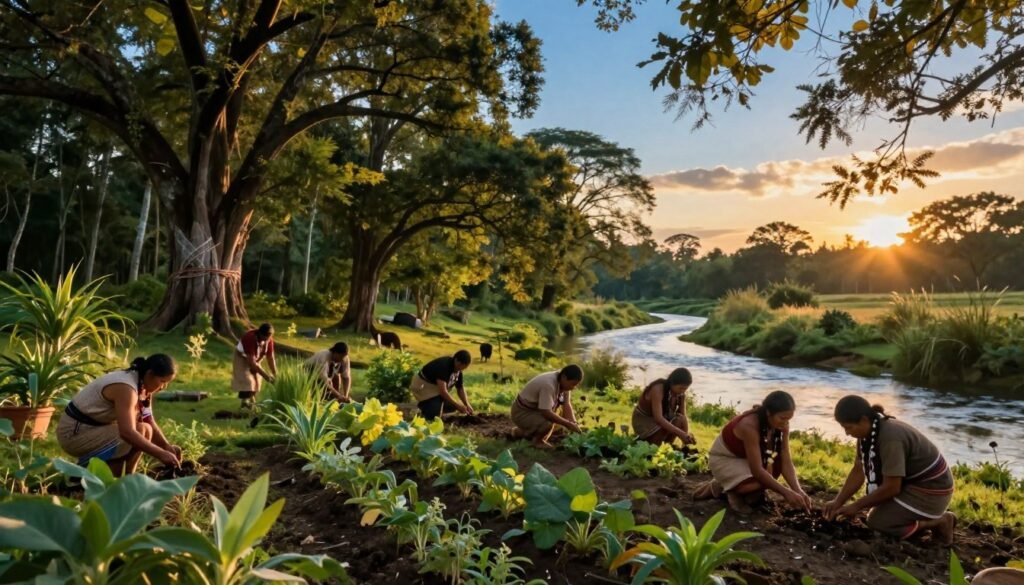
About 80 percent of the world’s people use traditional medicine based on indigenous knowledge. Yet, only a small fraction of environmental policies use indigenous wisdom. This shows a big gap between what we need and what we ignore.
Indigenous Knowledge Systems are ancient and wise. They teach us to live in harmony with nature. These systems have been around for centuries, showing us how to manage the environment sustainably.
These systems come from deep understanding and adaptation. They see humans as part of nature, not just taking from it. The idea of Ṛta, or cosmic order, was important thousands of years ago. It’s about using resources wisely, long before we knew about sustainability.
Indian Knowledge Systems cover many areas, like medicine and architecture. They have 64 kalas and 18 major vidyas. This includes the four Vedas and their uses, like Ayurveda for health and Silpa for building.
These systems offer practical ways to solve today’s problems. They focus on working together and thinking about the future. This is different from Western ways that focus on taking and quick gains.
IKS and sustainable living both aim for balance and strong communities. Indigenous people have deep knowledge of nature and how to care for it. Their wisdom is very relevant today, showing us how to meet our needs without harming the planet.
Key Takeaways
- Indigenous Knowledge Systems are full frameworks that mix caring for the environment, fairness, and economic success over many generations.
- The Vedic idea of Ṛta talked about cosmic order and balancing resources long before we thought about sustainability.
- IKS and sustainable living are not just old ideas but offer real solutions for today’s environmental problems.
- Indian Knowledge Systems have 64 kalas and 18 major vidyas, each with its own environmental wisdom and ethics.
- Sustainable living based on indigenous wisdom focuses on connections and thinking long-term, unlike Western views that focus on taking and quick wins.
- Indigenous communities have deep knowledge of ecosystems from observing and adapting to nature for centuries.
- Indigenous knowledge systems offer real ways to meet our needs while protecting the planet.
Understanding Indigenous Knowledge Systems in Modern Context
Indigenous Knowledge Systems (IKS) are deep ways to understand and work with nature. They go beyond simple methods or old practices. They are complete ways of knowing that have grown over thousands of years through watching, trying, and learning together.
These systems teach us about living in harmony with nature. They share knowledge from one generation to the next. This knowledge is about working together with nature and adapting to changes.
IKS shows how ancient communities mixed different areas of knowledge into one system. Old Indian texts show these ideas in what scholars call knowledge areas. These ideas show that ideas we think are new today have roots in old thinking.
Defining IKS and Its Core Principles
IKS works on key principles that are different from Western science. It looks at the whole picture, not just parts. It mixes knowledge from farming, medicine, taking care of the environment, and philosophy into one system. This system helps people while keeping nature balanced.
The main ideas of IKS are:
- Working with nature and each other
- Watching and learning over many years
- Changing with the environment
- Using resources in a way that is right
- Mixing spiritual and practical knowledge
- Passing on knowledge from one generation to the next
These ideas make sure that the knowledge of traditional communities stays alive and keeps changing.
The Historical Evolution of Indigenous Environmental Wisdom
Indigenous environmental wisdom has grown over thousands of years. Old texts keep these ideas alive. The Vedas, Upanishads, Manusmriti, and Puranas have rules for living with nature.
These texts show ways to protect the environment:
| Ancient Text | Environmental Principle | Contemporary Relevance |
|---|---|---|
| Isha Upanishad | Sustainable consumption and taking only what is necessary | Circular economy and responsible consumption |
| Manusmriti | Prohibitions against river pollution and tree harm | Water protection and forest conservation laws |
| Matsya Purana | Condemnation of unnecessary tree felling | Sustainable forestry practices |
| Vedic Texts | Ecosystem services recognition and reciprocal relationships | Ecosystem-based management approaches |
These examples show that old communities had ways to manage nature long before we thought of sustainability.
The Interconnected Nature of IKS as a Living, Dynamic System
IKS is not just old knowledge. It is a living system that keeps changing. It adapts to new challenges while keeping its core values. This makes IKS different from old records.
IKS is special because it connects different areas of knowledge:
- It links farming, medicine, building, and astronomy
- It uses spiritual knowledge to manage the environment
- It makes decisions with long-term thinking
- It answers environmental problems with knowledge from centuries
- It adds new knowledge to old frameworks without losing values
This way of thinking is different from today’s focus on one area of knowledge. Indigenous wisdom offers important lessons for making sustainable solutions. It shows that IKS is as valuable as Western science, not just extra or less important.
The Intersection of IKS and Sustainable Development Goals
In 2015, the United Nations set seventeen Sustainable Development Goals to guide us toward a better future. These goals aim to balance economic growth, social inclusion, and environmental protection by 2030. They cover issues like poverty, hunger, health, education, and more.
Yet, most development talks focus on Western, technocratic solutions. They overlook valuable indigenous sustainability solutions that have worked for thousands of years.
Indigenous Knowledge Systems offer proven pathways that align with multiple SDGs. Traditional approaches to resource management and community life show how indigenous wisdom can meet global objectives. These systems prioritize living in balance with nature, something modern societies struggle with.
Several SDGs connect closely to environmental concerns and sustainable development practices rooted in indigenous cultures:
- SDG 6 (Clean Water and Sanitation)—Traditional water harvesting systems in India and across Asia provide clean water access to communities
- SDG 11 (Sustainable Cities and Communities)—Indigenous settlement patterns create resilient, livable communities that respect local ecosystems
- SDG 12 (Responsible Consumption and Production)—Traditional agricultural practices minimize waste and maximize soil health
- SDG 13 (Climate Action)—Indigenous climate adaptation strategies build community resilience against environmental changes
- SDG 15 (Life on Land)—Sacred groves and traditional conservation areas protect biodiversity and forest ecosystems
| Sustainable Development Goal | Environmental Focus Area | Indigenous Sustainability Solutions | Time-Tested Duration |
|---|---|---|---|
| SDG 6: Clean Water and Sanitation | Water access and quality | Stepwells, johads, rainwater harvesting | 500–2,000+ years |
| SDG 12: Responsible Consumption and Production | Sustainable agriculture | Crop rotation, natural farming, native seed preservation | 3,000+ years |
| SDG 13: Climate Action | Climate resilience | Community-based adaptation, traditional ecological knowledge | 1,000+ years |
| SDG 15: Life on Land | Biodiversity conservation | Sacred groves, sacred forests, protected natural areas | 2,000+ years |
The SDG framework reflects Western thinking about development and progress. International sustainability discussions often treat indigenous approaches as supplementary. This ignores how indigenous wisdom for sustainable development addresses the same challenges with greater success and lower environmental cost.
Genuine progress toward the SDGs requires recognizing indigenous peoples as knowledge experts. When indigenous communities lead sustainability efforts, they bring centuries of ecological understanding. This shift transforms how we understand both development and sustainability itself.
“The greatest threat to our planet is the belief that someone else will save it.”—Robert Swan, polar explorer and environmental advocate
Moving forward requires valuing indigenous sustainability solutions as equal to Western scientific approaches. Integrating indigenous wisdom into policy means giving indigenous peoples decision-making power in environmental governance. It also means respecting their land rights and supporting their traditional practices with adequate resources and legal protection.
Ancient Indian Ecological Ethics and Environmental Stewardship
Ancient Indian civilizations had deep wisdom about protecting the environment. They used spiritual knowledge and ethics to care for nature. Their ways of living showed how to protect the planet thousands of years ago.
Their teachings on managing resources and keeping nature in balance are profound. Scholars see these teachings as early signs of caring for the environment. They show how ancient wisdom and ethics guided people to live in harmony with nature.
Vedic Principles of Resource Conservation
The Vedic texts, written between 1500 and 500 BCE, teach us to use resources wisely. The Isha Upanishad says we should only take what we need. This idea is similar to today’s ideas about fairness and sustainable use.
Vedic philosophy talks about Ṛta, or the natural order. It teaches us to live in harmony with nature. If we harm nature, we face problems for ourselves and the planet. The Atharvaveda values forests, rivers, and animals, showing their importance.
Here are some Vedic teachings on conservation:
- Instructions to harvest sustainably without depleting natural sources
- Guidelines protecting water sources from contamination
- Reverence for forests as essential to human and environmental wellbeing
- Recognition of animals as worthy of protection and respect
Spiritual Frameworks for Environmental Protection
Hindu, Buddhist, and Jain teachings emphasize caring for the environment. The idea of Ahimsa, or non-violence, protects all living things. This idea shaped how people farmed, ate, and managed resources for centuries.
The Manusmriti law book bans polluting rivers and cutting down trees without reason. It has rules and penalties for breaking these laws. The Matsya Purana warns against cutting down forests, and the Arthashastra has rules for managing forests and wildlife.
The idea of Dharma, or duty, makes caring for the environment a key part of life. It’s not just a good thing to do; it’s a must. This shows how ancient wisdom and ethics are connected to caring for the planet.
| Ancient Indian Text | Environmental Principle | Core Teaching | Modern Application |
|---|---|---|---|
| Isha Upanishad | Sustainable Consumption | Take only what you need; leave for others and future generations | Intergenerational equity and resource management |
| Atharvaveda | Nature Reverence | Forests, rivers, and animals possess intrinsic value | Biodiversity protection and ecosystem preservation |
| Manusmriti | Environmental Law | Prohibits river pollution and tree harm with penalties | Environmental regulations and enforcement mechanisms |
| Matsya Purana | Forest Conservation | Strong condemnation of unnecessary deforestation | Forest protection and reforestation initiatives |
| Arthashastra | Resource Management | Detailed regulations for forest and wildlife management | Sustainable land use and species protection |
These ancient teachings show that caring for the environment needs spiritual values, ethics, and practical actions. They teach us that protecting nature is good for now and for the future. This idea is now recognized by scientists and policymakers today.
Traditional Water Management Systems and SDG 6
Water security is a big challenge for communities worldwide. Indigenous resource management techniques offer effective solutions for Sustainable Development Goal 6, which focuses on clean water and sanitation. Ancient Indian civilizations developed water management approaches that worked well with their climate and geography.
These systems show how community-based resource management can solve today’s water crises. They are effective and sustainable.
Traditional resource management systems in India have centuries of knowledge about water. They show human ingenuity in arid and semi-arid regions. These systems provide clean, sustainable water access with little maintenance and expense.
Stepwells, Johads, and Community-Based Water Harvesting
Stepwells, known as Baolis in northern India and Vavs in Gujarat, are engineering marvels. They capture monsoon rainfall and store water underground, providing access in dry regions. The design keeps water cool and clean, reducing evaporation loss.
The construction and use of stepwells reflect indigenous resource management techniques. They integrated engineering, geology, and social organization. Communities built these structures together and managed them through traditional governance systems.
Beyond their primary function, stepwells served multiple community purposes:
- Water storage and year-round access in arid climates
- Community gathering spaces for social interaction
- Natural cooling centers during extreme heat
- Sites of cultural and religious significance
Johads are earthen check dams built across seasonal streams. They slow water flow, allowing infiltration into groundwater aquifers. Johads prevent soil erosion and require minimal upkeep using local materials. They show how community-based resource management works through low-cost, sustainable solutions.
Tank systems, called erikattams in southern India, show regional variations in traditional resource management systems. Each design adapted to local hydrology and geology. This diversity reveals a sophisticated understanding of watershed management and groundwater recharge cycles, rivaling modern hydrological engineering.
Revival of Traditional Water Structures in Rajasthan
The Alwar district in Rajasthan saw a dramatic transformation through the revival of traditional water harvesting structures. The NGO Tarun Bharat Sangh, working with local communities, restored over 1,000 johads and related structures. This community-based resource management initiative produced remarkable results:
| Outcome | Impact |
|---|---|
| Groundwater Level Increase | 33% rise in water table |
| Land Restoration | 860 square kilometers re-greened |
| River Flow Restoration | Arvari River flows year-round after decades of dryness |
| Seasonal Water Access | Transformed from dry to permanent water availability |
This revival shows that indigenous resource management techniques are viable and effective for today’s water challenges. Communities adopted these solutions because they aligned with traditional knowledge and local practices. The success factors reveal why this approach outperforms expensive modern infrastructure projects:
- Communities owned and maintained the structures
- Solutions aligned with traditional knowledge systems
- Low cost and maintenance requirements
- Integration with broader livelihood and ecological restoration
- Decentralized decision-making and management
The restoration of the Arvari River is a significant achievement. This seasonal river had been dry for decades before the johad revival. Today, it flows year-round, supporting agriculture, livestock, and ecosystems. This transformation shows how traditional resource management systems address climate resilience and ensure equitable water access.
These traditional water structures embody essential principles for sustainable water management. They include decentralization, community participation, ecosystem-based approaches, and integration with land use and biodiversity conservation. The Rajasthan experience offers lessons applicable globally, challenging centralized approaches that often fail to ensure equity or ecological sustainability.
IKS and Sustainable Living
Indigenous Knowledge Systems offer a complete approach to living sustainably. They blend environmental, social, economic, and spiritual aspects. Long before we had global sustainability plans, iks environmental conservation guided how communities lived with their ecosystems.
These systems show that living sustainably is real, not just a concept. It’s part of cultural practices, daily choices, and community values.
The heart of iks environmental conservation is based on giving back and regenerating. Communities see themselves as part of nature’s cycles, not just users of it. This view motivates them to care for the environment, not just for its benefits but for its own sake.
Core Elements of Sustainable Living in Indigenous Frameworks
Native sustainable practices cover many areas of life, showing great integration and efficiency. They tackle food, water, soil, and biodiversity at the same time through connected systems. This way, one action can help many areas of a community and the environment.
- Agricultural systems that preserve native seed varieties while maintaining soil fertility
- Water management structures that capture rainfall and support community needs
- Sacred groves that protect biodiversity corridors and cultural identity
- Dietary practices aligned with seasonal availability and ecological capacity
- Building designs that regulate temperature naturally and reduce resource consumption
Translating Indigenous Principles Into Contemporary Practice
Native sustainable practices show great adaptability, learned over many years. Communities keep improving their methods based on what nature tells them, while keeping their core values. This ability to adapt makes their systems strong, able to handle tough times.
| Traditional Sustainable Practice | Primary Benefit | Secondary Benefits | Sustainability Goal Addressed |
|---|---|---|---|
| Crop rotation and intercropping | Soil regeneration and pest management | Food security, reduced chemical dependency | Responsible consumption and production |
| Johads and stepwells | Water harvesting and groundwater recharge | Community resilience, agricultural support | Clean water and sanitation |
| Sacred groves (devrai, kavu) | Biodiversity conservation | Watershed protection, microclimate regulation, cultural identity | Life on land and climate action |
| Panchagavya organic fertilization | Nutrient cycling without synthetic chemicals | Soil health improvement, reduced pollution | Climate action and sustainable agriculture |
| Native seed preservation | Genetic diversity and food sovereignty | Climate adaptation, reduced input costs | Zero hunger and sustainable agriculture |
Understanding iks environmental conservation means seeing beyond the myths of indigenous peoples. It’s about recognizing Indigenous Knowledge Systems as advanced, adaptable frameworks. These practices are built on deep observation and refinement over generations. They focus on long-term thinking, valuing the health of ecosystems and future generations.
The spiritual and ethical parts of native sustainable practices help protect the environment. Sacred rituals, festivals, and community rules all help manage resources and prevent overuse. These cultural practices are very good at keeping nature in balance while keeping communities strong and their culture alive.
Indigenous Agricultural Practices for Sustainable Production
Indigenous sustainable agriculture offers better ways to farm than industrial methods. It combines old wisdom with new science to make food systems that heal the earth. Farmers around the world are finding that these methods improve soil, cut costs, and help them face climate challenges.
These practices show how farming can be a path to a sustainable future.
Zero Budget Natural Farming and Soil Regeneration
Zero Budget Natural Farming (ZBNF) is a smart use of old farming knowledge today. It doesn’t use chemicals bought from stores. Instead, farmers make natural helpers from what they have.
In Andhra Pradesh, ZBNF has been a huge success. By 2020, over 700,000 farms were using it. The UN FAO (2020) found amazing results:
- Soil microbes grew 50-100% more
- Crops got better at handling drought
- Costs for farming inputs dropped by 90%
- Soil kept more water and got better structure
- Crops grew more than they did before
ZBNF uses special techniques like jeevamrutha and bijamrita. These help soil life and protect seedlings. Mulching keeps moisture in and adds organic matter. This makes soil full of life and good for plants without needing chemicals.
Traditional Crop Rotation and Native Seed Preservation
Crop rotation has been around for centuries. It makes farming sustainable and harmonious. Legumes, cereals, and oilseeds are rotated to keep soil fertile naturally.
Legumes fix nitrogen, so farmers don’t need to buy fertilizer. Different crops take nutrients from different depths, so soil doesn’t lose them.
Keeping native seeds alive is important for farming and culture. Indigenous communities save seeds for their local needs. These seeds are better at surviving tough times like drought or pests.
| Traditional Practice | Agricultural Benefit | Environmental Impact | Cultural Significance |
|---|---|---|---|
| Legume Integration | Natural nitrogen fixation | Reduces synthetic fertilizer need | Food security and nutrition |
| Fallow Periods | Soil recovery and pest control | Regenerates soil biology | Traditional farming rhythm |
| Native Seed Banks | Genetic diversity for resilience | Protects local biodiversity | Preserves cultural knowledge |
| Intercropping Systems | Pest suppression and yield diversity | Reduces pesticide use | Dietary variety and traditions |
Organic Fertilization Methods Using Panchagavya
Panchagavya is a clever use of cow products to make soil better. It’s a mix of dung, urine, milk, curd, and ghee, with some extras. This mix makes soil rich and helps plants grow.
Studies back up what farmers have known for years. Panchagavya boosts soil life and makes nutrients available. It also helps plants fight off diseases.
Other organic ways to fertilize include:
- Green manuring—plowing in plants that fix nitrogen
- Compost preparation—turning organic waste into nutrients
- Plant-based preparations—fermented plant extracts for plant health
- Vermicomposting—using worms to break down organic matter
- Mulching—keeping soil moist and adding organic matter
These methods keep soil healthy and full of life. They don’t harm the environment like synthetic fertilizers do. Indigenous farming shows that growing food and caring for the earth can go hand in hand.
Biodiversity Conservation Through Sacred Groves
Sacred groves are a key example of how indigenous knowledge helps protect biodiversity in India and beyond. These forest patches, known as devrai in Maharashtra, kavu in Kerala, orans in Rajasthan, and sarnas in tribal areas, have been preserved for centuries. They are protected by spiritual beliefs and cultural practices, not just laws.
The power of sacred groves comes from their spiritual significance. Indigenous communities believe these areas are home to deities, ancestors, or sacred forces. They are protected by religious taboos that prevent resource extraction and disturbance.
Research shows that these groves are rich in biodiversity. In Kerala, for example, they have up to 500 plant species per hectare. This is more than forests managed by conventional methods. They preserve rare species, medicinal plants, and support diverse wildlife.
Spiritual Foundations of Grove Protection
The success of sacred groves comes from their spiritual and ecological views. Communities see groves as living beings, not resources. This belief creates strong social rules that protect these areas for generations.
- Religious beliefs create permanent conservation motivation independent of policy changes
- Community rituals and festivals reinforce protection norms regularly
- Traditional governance systems regulate access and resource use
- Cultural identity becomes inseparable from grove protection
Contemporary Challenges and Revival Efforts
Sacred groves face challenges from development, urbanization, and changing beliefs among the young. There are conflicts between traditional and formal governance. Legal recognition is often lacking. Now, efforts focus on documenting ecosystems, integrating groves with protected areas, and supporting traditional governance.
| Sacred Grove Name | Geographic Region | Primary Protection Mechanism | Biodiversity Significance |
|---|---|---|---|
| Devrai | Maharashtra | Deity worship and spiritual beliefs | Endemic plant species preservation |
| Kavu | Kerala | Ancestral reverence and family lineage | Up to 500 plant species per hectare |
| Oran | Rajasthan | Community ritual practices | Arid-adapted native species |
| Sarna | Central India tribal areas | Indigenous spiritual practices | Medicinal plant repositories |
Sacred groves show that community governance based on cultural values can protect biodiversity. These methods offer important lessons for environmental protection. They prove that reverence for nature, rooted in spiritual traditions, can lead to lasting conservation outcomes.
Climate Resilience and Traditional Ecological Knowledge
Indigenous communities around the world have learned to survive environmental changes for centuries. Their traditional ways of living offer valuable lessons for today’s climate challenges. By combining traditional knowledge with climate resilience, communities adapt to changing environments while keeping their lands and cultures alive.
Indigenous strategies for adapting to climate change show how ancient wisdom aligns with modern science. They use principles like redundancy, diversity, flexibility, and continuous learning. These strategies help communities thrive despite harsh weather and other environmental stresses.
Indigenous Adaptation Strategies for Climate Change
Traditional ecological practices show great flexibility in facing climate changes. Indigenous communities use various strategies to build resilience:
- Agricultural diversification that spreads risk across multiple crops with different climate tolerances
- Water harvesting and conservation systems that buffer against rainfall variability
- Flexible livelihood strategies allowing communities to shift activities in response to changing conditions
- Traditional forecasting methods based on observation of plant phenology, animal behavior, and atmospheric patterns
- Place-based knowledge that reflects specific regional climate conditions and local ecosystems
These strategies work with nature, not against it. This approach prevents the vulnerability that comes from relying on external inputs. Traditional crops, flood-adapted farming, and cold-adapted practices from high-altitude communities show the value of local knowledge.
Traditional weather forecasting systems show deep understanding of climate patterns. This knowledge is as accurate as modern science for local conditions. It uses multiple environmental indicators and long-term pattern recognition that outsiders often miss.
Community-Based Climate Action Models
Climate resilience goes beyond just technical solutions. It includes social and governance aspects. Community-based climate action models that use traditional knowledge and resilience show how collective action tackles climate challenges:
| Climate Action Model | Traditional Foundation | Climate Benefits | Community Outcomes |
|---|---|---|---|
| Watershed Restoration Projects | Traditional water management and ecological balance through IKS | Enhanced water security and soil moisture retention | Improved agricultural productivity and food security |
| Participatory Crop Improvement | Traditional seed selection and breeding practices | Climate-adapted crop varieties with improved drought and flood tolerance | Farmer autonomy and cultural preservation of native seeds |
| Community Disaster Risk Reduction | Traditional forecasting integrated with modern early warning systems | Reduced losses from extreme weather events | Stronger community solidarity and mutual support networks |
| Ecosystem Restoration Initiatives | Sacred landscape management and traditional ecological practices | Enhanced biodiversity and carbon sequestration | Cultural continuity and spiritual connection to land |
Community-based approaches often lead to better and fairer outcomes than top-down climate programs. They build on existing knowledge and institutions, ensuring community ownership. They also integrate adaptation with other community priorities like livelihoods and cultural preservation.
Indigenous climate resilience strategies offer many benefits beyond just adapting to climate change. They conserve biodiversity, restore ecosystems, improve food security, and preserve cultures. This holistic approach views humans as part of nature, not separate from it. It shows that effective climate action needs to address social, cultural, and governance factors alongside technical solutions.
To support and scale indigenous adaptation strategies, we need to recognize traditional knowledge in climate policy. We must also secure indigenous land rights and provide resources without undermining community autonomy. Despite their minimal contribution to climate change, indigenous communities have valuable knowledge and strategies for adaptation. They need support to address challenges caused by historical marginalization. Global climate action benefits from embracing diversity, respecting local knowledge, and addressing social and governance factors that affect community resilience.
Integrating IKS with Contemporary Sustainability Frameworks
Bringing indigenous knowledge systems into modern sustainability efforts is a big change. It’s about treating indigenous peoples as equal partners in solving environmental problems. This means more than just saying thanks; it’s about working together to make real change.
The idea of epistemic pluralism is key here. It says there are many ways to know things, and we need them all to tackle big environmental issues. Mixing Western science with indigenous knowledge can make environmental stewardship better.
But, there are big obstacles. Western science being seen as the only truth can silence indigenous voices. Also, institutions and laws often don’t support indigenous knowledge systems.
Institutional Models for Integration
The Centre in Indigenous Knowledge Systems (CIKS) in South Africa shows how to do it right. It’s a partnership of five universities that focuses on research, education, and community work. CIKS makes sure indigenous people have a real say in its work.
To really integrate iks into modern sustainability, we need a few things:
- Legal recognition of indigenous rights and knowledge systems
- Institutional commitment backed by sustained resource allocation
- Genuine power-sharing instead of just talking
- Respect for indigenous intellectual property and cultural protocols
- Long-term engagement, not just short-term projects
Collaborative Approaches and Frameworks
Co-management of protected areas with indigenous and state governance is promising. It makes indigenous communities active partners in research. Also, teaching indigenous knowledge from the start helps build a strong foundation.
Working together across different fields and knowledge systems is essential. Teams of scholars and indigenous researchers are needed. This way, we can make environmental stewardship better by using all kinds of knowledge.
Real integration could change how we manage the environment. It would move from just following rules to building relationships and working together. It’s about seeing ourselves as part of nature, not separate from it. To get there, we need to value indigenous ways of knowing and governing.
Decolonizing Environmental Governance Through Indigenous Wisdom
Environmental governance systems worldwide often follow Western ideas, not universal truths. The Sustainable Development Goals, for example, come from European views. These systems often ignore indigenous environmental practices and wisdom.
Colonialism pushed aside local ecological governance. This shows why we need to decolonize for environmental progress.
Colonial powers undermined indigenous knowledge systems. They replaced traditional governance with European laws. This led to indigenous peoples losing control over their lands.
This loss made it hard for them to practice their cultural conservation and sustainability. The effects of this displacement are felt today.
Challenging Eurocentric Environmental Paradigms
Western environmental views assume certain things about nature and knowledge. They see humans as separate from nature. They also value scientific knowledge over community-based knowledge.
These views overlook indigenous environmental practices. They see them as simple or anecdotal, not as complex knowledge systems. State institutions control resources that were once governed by indigenous communities.
- Human-nature dualism that separates people from ecosystems
- Technocratic orientation favoring expert solutions over community knowledge
- Economic growth prioritized over environmental sustainability
- Centralized state authority replacing community-based governance
- Universalization of Western concepts that exclude indigenous ontologies
Reclaiming Cultural and Environmental Sovereignty
Environmental sovereignty means indigenous peoples have control over their lands and resources. It’s about recognizing their traditional knowledge systems and decision-making power. It’s key for real environmental governance change.
Reviving indigenous ecological ethics is about decolonization. It’s about reclaiming authority, knowledge, and identity lost through colonialism. Cultural conservation and sustainability are intertwined in indigenous contexts.
| Colonial Impact | Environmental Consequence | Sovereignty Reclamation |
|---|---|---|
| Territorial appropriation through legal doctrines | Loss of land necessary for traditional management | Recognition of indigenous land rights and self-governance |
| Criminalization of indigenous resource practices | Suppression of traditional ecological knowledge | Legal recognition of indigenous governance systems |
| Forced displacement of indigenous peoples | Disruption of intergenerational knowledge transmission | Territorial restoration and cultural revitalization initiatives |
| Suppression of indigenous languages and education | Erosion of ecological knowledge embedded in cultural practices | Indigenous-led educational programs and language preservation |
Change needs more than adding indigenous voices to old systems. True decolonization reimagines governance to include many perspectives. Indigenous practices offer new ways to see nature and our place in it.
This requires real commitment to decolonization. It means giving power back, recognizing indigenous rights, and valuing their knowledge. It’s about making sure indigenous peoples have a say in environmental decisions.
Case Studies of Successful IKS Implementation
Indigenous knowledge systems are solving big sustainability problems around the world. Communities have brought back old ways of living and seen big changes in their lands and economies. These stories show how iks help people live sustainably in different places and cultures.
Water Harvesting Revival in Rajasthan
In Rajasthan, the Alwar district is a great example of fixing old water systems. Starting in the 1980s, a group called Tarun Bharat Sangh worked with locals to fix over 1,000 old water spots. These spots, like johads and earthen dams, were ignored when new water systems came in.
Now, the water underground is 33 percent higher. Dry land turned green, covering 860 square kilometers. The Arvari River, once dry, now flows all year. Wildlife came back, and farmers are growing more food and making more money.
This success came from using local knowledge, not outside ideas. The community managed their water. It was cheap to keep up, so it lasted without needing constant help.
Zero Budget Natural Farming in Andhra Pradesh
In Andhra Pradesh, Zero Budget Natural Farming (ZBNF) is changing farming on a huge scale. It was created by Subhash Palekar to avoid chemicals and use old farming ways. By 2020, over 700,000 farms in the state were using ZBNF.
Farmers using ZBNF see big improvements:
- Soil microbes are 50 to 100 percent more active
- Soil can hold more water, helping during droughts
- Costs for farming inputs can drop by up to 90 percent
- Crops may grow more or stay the same after starting ZBNF
- Farmers are healthier because they use fewer chemicals
ZBNF uses natural farm-made products, mulching, animals, and focuses on soil health. The state helped, and farmers helped each other, making this big change happen.
Sacred Groves: Biodiversity Hotspots in Kerala
In Kerala, sacred groves are a big win for nature. These forests, kept safe by local beliefs, have up to 500 plant species per hectare. They have more biodiversity than other forests managed by the government.
Sacred groves work because:
- They are fully protected by local beliefs
- They keep their natural structure and processes
- They are homes for species that have disappeared elsewhere
- They are managed by the community, keeping their values
But, they face threats from development and weakening beliefs. Efforts to save them include studying biodiversity, legally protecting community rights, and supporting their traditional ways.
Institutional Integration: The South African Model
In South Africa, the Centre in Indigenous Knowledge Systems (CIKS) shows how to work together. It’s a partnership of five universities working on indigenous knowledge. They do research, education, and community projects together.
| Case Study Region | Primary Focus | Key Outcome | Impact Area |
|---|---|---|---|
| Alwar, Rajasthan | Water Harvesting Structures | 33% increase in groundwater levels | 860 sq. km re-greened |
| Andhra Pradesh | Zero Budget Natural Farming | 700,000+ farms adopted by 2020 | 90% input cost reduction |
| Kerala | Sacred Grove Conservation | 500 plant species per hectare | Biodiversity protection |
| South Africa | Institutional Integration | Five-university partnership | Research and education infrastructure |
These examples show what works. They use local knowledge, let communities lead, and offer real benefits. Working together and adapting to local needs is key. This way, we can make a big difference.
These stories prove that community-based sustainable living through iks is not just old-fashioned. It’s a smart, effective way to live sustainably. Old ways of managing resources are better than new, expensive systems. To make a big impact, we need to work together, commit for the long term, and respect each place’s unique needs.
Policy Recommendations for IKS Integration
To integrate indigenous knowledge systems into governance, we need clear policies at all levels. We must legally recognize indigenous rights and allocate resources for their participation. It’s also important to respect their protocols and intellectual property. We should engage with them in the long term.
Policy changes are needed to make sustainable living through IKS a reality. Organizations like the Center for Indigenous Knowledge Systems suggest starting this in schools. This way, we can build a future where indigenous knowledge is valued in education and beyond.
Educational System Integration Strategies
We need to teach traditional knowledge in schools at every level. This way, we keep indigenous wisdom alive as elders pass on. Schools should use materials that include indigenous knowledge in subjects like science and math.
Teachers need training to teach this knowledge well. They should learn how to teach in a way that respects indigenous cultures.
Successful integration involves:
- Working with indigenous communities and elders for real perspectives
- Using indigenous languages to teach knowledge
- Field experiences and community-based learning
- Assessment methods that honor indigenous learning
- Phased implementation for better adaptation
Universities should offer special programs that include indigenous knowledge. This knowledge should be part of courses in environmental science and agriculture. It’s also important to have faculty who understand and value indigenous knowledge.
Research must respect indigenous protocols and involve them in the process. This ensures that knowledge is shared fairly and not taken without permission.
Building Collaborative Governance Models
Working together between indigenous communities and state institutions is key for environmental management. This partnership combines different knowledge systems and addresses past injustices. Co-management needs legal frameworks, clear decision-making, and resources for indigenous participation.
| Governance Element | Key Requirements | Expected Outcomes |
|---|---|---|
| Legal Recognition | Constitutional protection of indigenous rights, territorial recognition, intellectual property safeguards | Formal authority in resource management decisions |
| Participatory Research | Community involvement in research design, data analysis, and benefit-sharing agreements | Equitable knowledge exchange and capacity building |
| Resource Allocation | Funding, technical support, and capacity building for indigenous participation | Effective indigenous engagement in governance processes |
| Conflict Resolution | Mediation mechanisms respecting different decision-making traditions | Sustainable partnerships and dispute management |
| Accountability Systems | Monitoring partnership equity and effectiveness regularly | Continuous improvement and transparency |
We need policies that include indigenous knowledge in environmental planning. Having indigenous people in decision-making bodies is important. We must also protect their intellectual property and support their traditional leaders.
Challenges include power imbalances and differences in knowledge views. We also face resource issues and concerns about knowledge misuse. To overcome these, we need to build capacity, reform laws, and support partnerships.
International agreements like the United Nations Declaration on the Rights of Indigenous Peoples help. They guide national policies to respect indigenous rights. Sustainable living through IKS requires changing institutions and ensuring accountability to indigenous peoples.
Good policies come from listening to indigenous communities, not telling them what to do. We must be flexible and adapt to their needs while staying committed to sustainability and fairness.
Challenges and Opportunities in Scaling IKS Practices
Indigenous Knowledge Systems have the power to change the world for the better. But, making them a big part of our lives is hard. It’s important to know what gets in the way and what helps us move forward.
Legal and Political Barriers to Implementation
Expanding indigenous resource management is tough because of laws and politics. Governments often don’t recognize the rights of indigenous peoples. This makes it hard for them to manage their lands and resources.
Big projects like mining and building roads harm indigenous lands. Laws and rules don’t always match the ways of indigenous peoples. This leads to confusion and less power for them.
Even though the world has made promises to help, not enough is done. Governments often choose quick money over long-term plans that indigenous communities have followed for years. This power imbalance makes it hard to really use indigenous knowledge.
Socio-Cultural and Economic Challenges
Younger generations are moving away, taking their knowledge with them. Schools that don’t teach indigenous ways make it harder to pass down traditions. This weakens the beliefs that help protect nature.
Being poor makes it hard for indigenous communities to have a say in how they live. The market doesn’t value the sustainable ways of indigenous peoples. This makes it hard for them to make a living.
Knowledge System Integration Challenges
Many people don’t see indigenous knowledge as science. This makes it hard to mix it with Western science. The knowledge of indigenous peoples is very specific to their places and cultures.
When indigenous knowledge is used without their control, it raises big questions. It’s important to work together in a way that respects indigenous ways of knowing. This means not forcing their knowledge into systems that don’t fit.
Sectoral Implementation Obstacles
| Sector | Primary Challenge | Impact on Scaling |
|---|---|---|
| Agriculture | Industrial agriculture dominance with government subsidies and infrastructure support | Traditional farming methods lack competitive advantages and extension services |
| Water Management | Centralized governance systems marginalizing community-based approaches | Limited legal recognition for traditional water rights and governance structures |
| Biodiversity Conservation | Development pressures on sacred groves and traditional conservation areas | Weakening cultural foundations for conservation and inadequate legal protection |
| Climate Adaptation | Water availability changes exceeding traditional adaptive capacity | Traditional knowledge requires integration with contemporary climate science |
Emerging Opportunities for Growth
More people are starting to see the value of indigenous ways. International agreements and research are helping. This shows that traditional ways can work well today.
Stories of success inspire others to try. There’s a growing demand for products made in sustainable ways. New tools help keep knowledge alive and connect communities.
Strategic Pathways Forward
- Focus initial scaling in contexts with favorable legal recognition and community interest
- Build on documented successes by analyzing and sharing implementation lessons
- Invest in capacity building for indigenous organizations and supporting institutions
- Develop appropriate monitoring systems demonstrating traditional sustainability practices effectiveness
- Create networks enabling knowledge exchange among indigenous communities
- Pursue policy advocacy addressing legal and institutional barriers
- Build strategic partnerships joining indigenous communities, researchers, and sympathetic agencies
Scaling traditional sustainability practices needs time and respect for indigenous ways. It’s not just about using their practices. It’s about creating a space where they can grow and contribute to the world’s well-being.
Conclusion
Indigenous knowledge systems are ancient ways of living that help us care for the environment. They mix nature understanding with cultural and spiritual values. These systems offer practical answers to today’s big sustainability questions.
For generations, communities have lived in harmony with nature using these methods. This article shows how indigenous knowledge helps us reach global sustainability goals.
Water, food, biodiversity, and climate all get better with traditional ecological knowledge. Sacred groves protect ecosystems, and zero-budget farming makes soil healthy. Traditional water systems give us clean water.
These efforts help meet many United Nations Sustainable Development Goals. They show that caring for the environment and people can go hand in hand. Indigenous peoples manage a lot of Earth’s biodiversity while keeping their communities strong.
To use indigenous knowledge in today’s world, we must respect their rights and decisions. Non-indigenous groups should support, not control, indigenous-led projects. Everyone involved must work together to make this happen.
Traditional ecological knowledge is at risk due to elder deaths and cultural loss. We must act fast to save the wisdom of past generations. This is not just a technical fix but a moral duty to recognize indigenous contributions.
We need to keep working together and change institutions to make progress. Indigenous knowledge and sustainable living are deeply connected. The wisdom in traditional ecological knowledge can solve many of today’s environmental problems.
By valuing and supporting indigenous ways, we show respect and justice. We honor the communities that have lived sustainably with nature for thousands of years.

