


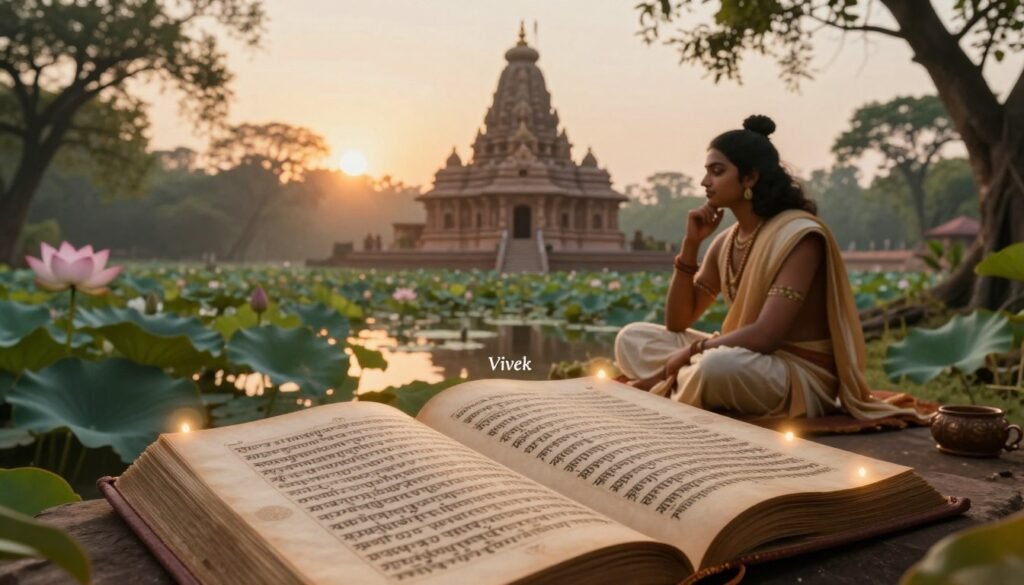
A student sits in a traditional gurukul in southern India. She has memorized countless verses from the Upanishads, yet something feels incomplete. Her teacher observes her struggle and asks a simple question: “Do you know the words, or do you know the truth they point toward?” This moment captures the essence of indian philosophy of knowledge. The distinction between different types of knowing shapes how we understand reality, consciousness, and our own transformation.
The ancient traditions of hinduism and buddhism developed sophisticated frameworks for understanding how we acquire knowledge. These frameworks go far beyond memorization or intellectual study. Indian philosophical systems recognized that knowledge exists in multiple dimensions. Each dimension serves a distinct purpose in our journey toward wisdom and liberation.
Sanskrit knowledge concepts reveal this complexity through four cardinal terms: jnana, vidya, prajna, and viveka. Each word points to a unique pathway of knowing. Jnana represents absolute knowledge gained through study and reflection. Vidya speaks to sacred knowledge that transforms the knower. Prajna embodies discriminative wisdom that cuts through illusion. Viveka describes the power of discernment that separates truth from falsehood.
Epistemology in hinduism asks fundamental questions about how we know what we know. These questions remain relevant today. Our modern world struggles with information overload, misinformation, and the difference between data and wisdom. Indian philosophy addresses these challenges with surprising clarity and depth.
This exploration examines how ancient thinkers grappled with consciousness, reality, and the nature of understanding itself. We will unpack each concept systematically. We will show how they connect and reinforce one another. Most importantly, we will reveal why these teachings matter for anyone seeking genuine wisdom in the twenty-first century.


Key Takeaways
- Indian philosophy of knowledge encompasses four distinct pathways: jnana (absolute knowledge), vidya (sacred wisdom), prajna (discriminative insight), and viveka (discernment)
- Epistemology in hinduism developed theories about valid means of knowledge called pramanas that validate truth claims
- Sanskrit knowledge concepts distinguish between intellectual understanding and transformative wisdom that changes consciousness
- Indian philosophical systems emphasize that true knowledge leads to liberation and self-realization, not mere intellectual accumulation
- These ancient frameworks address modern challenges of information, truth-seeking, and the pursuit of meaningful understanding
- The interconnection of jnana, vidya, prajna, and viveka creates a complete epistemological system for human development
Understanding the Foundations of Indian Epistemology
Indian epistemology is a unique way to understand knowledge and truth. It differs from Western philosophy by including the observer in the knowing process. This approach came from centuries of thinking about reality and how we understand it.
The hindu knowledge systems have developed ways to find truth through different paths. These paths help us understand the world and our inner selves.
The roots of these systems are in the earliest Vedic texts. Ancient thinkers saw that knowing involves the whole being, not just the mind. This idea shaped how they studied consciousness and awareness.
Scholars and seers valued both direct experience and rational thinking. This mix helped them grasp truth and reality more fully.

The Ancient Roots of Knowledge Systems in Hindu Thought
The Vedic period laid the groundwork for knowledge inquiry in India. Ancient texts divided knowledge into two types:
- Para vidya (higher knowledge): direct awareness of ultimate reality and the self
- Apara vidya (lower knowledge): practical understanding of the physical world and daily life
This division is key to vedantic wisdom traditions. The Upanishads refined these ideas by focusing on direct experience. They saw knowing as a transformative process, not just abstract information.
This view shaped later philosophers’ understanding of the relationship between the knower, the known, and the act of knowing. Vedic epistemology values both intellectual rigor and contemplative realization.
How Eastern Philosophy Approaches Consciousness and Awareness
Eastern philosophy sees consciousness as the fundamental reality, not just a product of matter. This view sets it apart from Western philosophy. In Indian thought, consciousness and awareness are the basic reality from which everything else comes.
Philosophers developed ways to directly investigate subjective experience. The hindu knowledge systems recognized that awareness can be studied systematically.
This insight led to unique features of vedantic wisdom traditions:
- Integration of practice with theoretical understanding
- Recognition of multiple valid means of knowing
- Emphasis on transformation alongside the gathering of information
- Direct investigation of subjective experience through disciplined methods
Indian philosophy is diverse, with different schools having their own views on consciousness, reality, and valid cognition. This diversity enriches the tradition. Each school offers unique insights while upholding rigorous investigation.
The upanishadic concepts of knowing continue to influence modern studies of the mind and reality. These ancient frameworks remain relevant today for exploring consciousness.
Indian Philosophy of Knowledge: Jnana, Vidya, Prajna, Viveka
Classical Indian epistemology is built on four key concepts. These are jnana, vidya, prajna, and viveka. They are different yet connected ways to understand knowledge in Hindu philosophy.
These concepts deal with various aspects of knowledge. They range from what knowledge is to how it’s realized in our minds.
Indian theories of cognition are very different from Western ones. Instead of just collecting information, they focus on deep understanding. This understanding changes how we see the world and ourselves.
This approach values direct experience over learning from others. It leads to true freedom and self-discovery.
The four concepts together form a complete view of consciousness and awareness. Even though they sometimes mean similar things, each has its own weight and use in Indian thought.
| Concept | Primary Focus | Nature of Knowledge | Philosophical Emphasis |
|---|---|---|---|
| Jnana | Absolute Knowledge | Ultimate realization of truth | Culmination and content of knowledge |
| Vidya | Sacred Wisdom | Transformative spiritual understanding | Sacred and transformative dimensions |
| Prajna | Discriminative Insight | Penetrative wisdom and clarity | Direct perception and discernment |
| Viveka | Discrimination | Capacity to distinguish real from unreal | Analytical discernment and judgment |
Indian epistemology divides knowledge into two main types. Paroksha jnana is knowledge gained through study and reflection. Aparoksha jnana is direct knowledge from personal experience. This shows Indian philosophy values direct experience over just thinking.
Different schools have their own ways of using these concepts. Nyaya focuses on logic and reasoning. Samkhya emphasizes knowing the difference between consciousness and matter. Yoga uses these concepts in spiritual practices. Buddhism makes prajna key to enlightenment. This variety shows the depth of Indian thought.
These four concepts lay the groundwork for deeper philosophical ideas. They help us understand different kinds of knowledge and paths to freedom in Hindu philosophy.
Jnana: The Path of Absolute Knowledge Through Study
Jnana is a deep concept in Indian philosophy. It’s not just about learning facts. It’s about gaining wisdom that changes how we see the world and our place in it. This path is unique among the ways to gain knowledge in India.
To reach jnana, one must study deeply and think deeply. It’s not just about knowing things. It’s about understanding everything deeply. This way of learning helps people understand themselves better in Hindu and Buddhist traditions.
Defining Jnana in Classical Indian Philosophy
In classical Indian philosophy, jnana is about knowing everything through study. Dictionary.com says it’s “absolute knowledge through study.” This shows jnana is more than just knowing facts.
Jnana touches many areas in philosophy:
- Sravana jnana: knowledge gained by listening to sacred teachings
- Manana jnana: knowledge deepened by thinking and analyzing
- Nididhyasana jnana: knowledge perfected through meditation
This structure shows how knowledge grows in India. It starts with listening and ends with direct experience. Each step helps us understand ourselves better.
| Type of Jnana | Method | Focus | Outcome |
|---|---|---|---|
| Sravana Jnana | Listening to teachings | Reception of wisdom | Intellectual foundation |
| Manana Jnana | Reflection and analysis | Questioning and understanding | Clarified knowledge |
| Nididhyasana Jnana | Meditation and contemplation | Direct experience | Realized truth |
Jnana is different from vijnana, or partial knowledge. While vijnana is just bits of information, jnana is a complete understanding. This difference is key to understanding eastern philosophy.
The Role of Jnana in Self-Realization and Liberation
In Indian traditions, jnana is key to spiritual freedom. The idea that “knowledge alone liberates” is central to Vedantic philosophy. This idea means that knowing who we truly are frees us from ignorance.
Jnana is both the journey and the goal:
- Discriminative inquiry removes false identifications
- Contemplation dissolves mental obstacles
- Direct realization reveals non-dual consciousness
- Liberation manifests as permanent freedom from suffering
The goal of moksha, or liberation, is the end of jnana. Through wisdom, we overcome ignorance and find true freedom. Jnana yoga is a complete path for those who seek knowledge and transformation.
This knowledge goes beyond just knowing. It’s about directly experiencing our true nature. In this way, eastern philosophy offers a path to freedom and awareness.
Vidya: Sacred Knowledge and Spiritual Wisdom
Vidya is a special kind of knowledge in spiritual systems. It’s not just any information. It’s sacred wisdom that helps people find spiritual freedom. This idea is key in vedantic knowledge systems, where knowledge changes lives.
The Upanishads create a big difference in Indian thought. They divide knowledge into two types. Each type has its own role in personal growth.
| Knowledge Type | Definition | Focus Area | Outcome |
|---|---|---|---|
| Para Vidya (Supreme Knowledge) | Direct knowledge of Brahman and ultimate reality | Self-realization and spiritual truth | Liberation and enlightenment |
| Apara Vidya (Lower Knowledge) | Knowledge of empirical phenomena and worldly matters | Practical skills and secular learning | Competence in material affairs |
Vedantic systems value self-knowledge more than worldly skills. This shows a deep value in Sanskrit wisdom. The word adhikara means you need more than just brains to learn vidya. You also need good character, focus, and the ability to make choices.
Indian teaching focuses on certain types of vidya:
- Brahma Vidya: Knowledge of Brahman as the ultimate reality
- Atma Vidya: Knowing the Self as part of universal consciousness
- Kundalini Vidya: Understanding energy changes in the body
- Mantra Vidya: The power of sacred sounds
Spiritual knowledge systems see vidya as more than just passing on facts. It’s about real connection between teacher and student. This connection goes beyond just reading books.
The fight between vidya and avidya (ignorance) is key to freedom. Avidya makes us think we’re not free. Vidya shows us who we really are. This knowledge sets us free from suffering.
Sanskrit wisdom says vidya must be tested through experience. You need to practice, follow rules, and experience it yourself. Only then is knowledge truly sacred and changes how we see the world and live our lives.
Prajna: Discriminative Wisdom in Buddhist and Vedantic Traditions
Prajna is a key concept in Eastern philosophy. It cuts through delusion to reveal reality’s true nature. Both Buddhist and Vedantic traditions see it as vital for spiritual growth.
This wisdom is not just knowing facts. It’s about seeing things as they really are. It’s a practice and a direct experience of ultimate truth.
Exploring prajna shows how different philosophies view this insight. Both Buddhism and Hinduism see it as the path to freedom. It’s not just thinking; it’s seeing reality without filters.
Buddhist Prajna Wisdom and Its Transformative Power
In Buddhism, prajna is the highest wisdom. It’s like a sharp sword that cuts through ignorance. It’s the eye that sees reality as it is.
Practitioners gain this insight through meditation and studying sacred texts. Different schools focus on different aspects of prajna:
- Theravada Buddhism looks at the three marks of existence: impermanence, suffering, and non-self
- Mahayana Buddhism sees prajna as understanding emptiness, or shunyata
- Vajrayana Buddhism uses visualization to speed up enlightenment
Buddhist wisdom teaches that prajna sees emptiness. This doesn’t mean nothingness. It means understanding that things don’t exist independently. The Prajnaparamita texts explain this wisdom well. It also guides compassionate teaching.
Prajna in Advaita Vedanta Philosophy
In Advaita Vedanta, prajna is immediate awareness of reality. It knows the eternal Self and temporary things. Shankara and others say it’s direct knowledge of Brahman, the ultimate reality.
Vedanta sees prajna in specific states of consciousness:
| State of Consciousness | Characteristics | Relationship to Prajna |
|---|---|---|
| Waking State | Sensory perception and logical thinking | Prajna remains hidden by sensory awareness |
| Dream State | Subtle mental impressions and imagination | Prajna begins to emerge beyond gross mind |
| Deep Sleep State | Undifferentiated consciousness without objects | Prajna closely approaches pure awareness |
| Turiya (Fourth State) | Pure consciousness beyond all states | Prajna fully realizes this transcendental state |
Prajna is both a practice and realization in Vedanta. Students use discriminative inquiry to develop it. Through self-inquiry, they learn to see their true nature as Brahman.
Both Buddhism and Vedanta value prajna as key to enlightenment. This wisdom changes how we see ourselves and the world. It goes beyond thinking to direct experience of truth.
Viveka: The Art of Discrimination and Discernment
Viveka is a key concept in Indian philosophy and spiritual practices. It means “discrimination” or “discernment.” In yoga and Vedantic traditions, it’s about knowing what’s real and what’s not.
Discrimination in yoga is about seeing beyond the surface. It’s about understanding deeper truths. This skill helps on the path to spiritual awakening and self-realization.
Patanjali’s Yoga Sutras talk about viveka-khyati, or the highest knowledge gained through discrimination. This insight helps see the difference between pure consciousness and material nature. When we understand this, freedom comes naturally.
Shankara, a great philosopher, said viveka is the first step for serious spiritual study. He talked about knowing the difference between what lasts forever and what doesn’t. This helps the mind focus on what truly endures.
Developing Discriminative Wisdom Practices
To grow in discrimination and wisdom, we need to work hard. Here are some steps:
- Study scriptures with teachers who explain their deeper meanings.
- Think deeply about existence and consciousness.
- Use meditation to calm the mind and clear thoughts.
- Watch your own habits and reactions.
- Live ethically and serve others to purify your heart and mind.
Viveka is more than just thinking. It’s about direct experience and deep contemplation. The mind is a tool, but viveka goes beyond thoughts to direct knowing.
Viveka and vairagya (non-attachment) are closely linked. As we grow in discrimination, we naturally feel less attached. Seeing the fleeting nature of worldly things leads to detachment. This is not forced but comes from wisdom.
In everyday life, discriminative wisdom guides our choices and actions. We make decisions based on our highest understanding. This way, our daily life becomes a journey of growth and spiritual discovery.
Pramana Theory: Valid Means of Knowledge in Indian Philosophy
Indian philosophy developed a system to check what knowledge is reliable. The pramana theory is a detailed way to figure out what is true. It asks, “How do we know what is true?” Indian thinkers set up rules to tell real knowledge from just guesses or wrong ideas.
Pramanas and valid knowledge are key in Indian philosophy. A pramana is a way to get true knowledge. Different schools have different pramanas, leading to debates on what knowledge to trust. This helps separate real understanding from just guessing.
The Six Pramanas of Classical Indian Epistemology
Classical Indian philosophy lists six main pramanas for knowledge. Let’s look at each:
- Pratyaksha (Perception): Direct sensory experience through sight, sound, touch, taste, and smell
- Anumana (Inference): Logical deduction based on observed patterns and relationships
- Upamana (Comparison): Knowledge gained by recognizing similarities between familiar and unfamiliar things
- Arthapatti (Postulation): Understanding that requires assuming something unstated to make sense of what is observed
- Anupalabdhi (Non-apprehension): Knowledge derived from the absence or non-perception of something expected
- Shabda (Testimony): Reliable knowledge from trustworthy sources and established texts
Different schools have different views on these pramanas. The Charvaka materialists only trust perception. The Nyaya school accepts four pramanas. The Mimamsa tradition believes in all six, seeing each as vital for full understanding.
How Pramanas Establish Valid Knowledge and Truth
The pramana theory is based on strict logic. Each pramana must meet certain criteria to be considered true knowledge. True knowledge must match reality, be consistent, and work in practice.
| Pramana Type | Primary Function | Key Strength | Main Limitation |
|---|---|---|---|
| Pratyaksha | Direct observation | Immediate and certain | Limited to present objects |
| Anumana | Logical inference | Extends knowledge beyond perception | Depends on correct reasoning |
| Upamana | Comparative knowledge | Builds on familiar understanding | Requires previous experience |
| Arthapatti | Assumption-based deduction | Reveals hidden connections | Requires logical necessity |
| Anupalabdhi | Knowledge from absence | Explains what is not present | Depends on appropriate context |
| Shabda | Scriptural and verbal authority | Accesses knowledge beyond experience | Requires source credibility |
Pramanas and valid knowledge help correct mistakes and clear doubts. They help spot illusions or wrong views. Indian epistemology knows that knowledge claims can be wrong or incomplete. The pramana system has ways to check and confirm truth claims.
This detailed approach to knowledge sets Indian philosophy apart. Each pramana has its own strengths and weaknesses. The mix of pramanas offers a complete way to understand reality. When one pramana fails, another takes over, showing great intellectual depth in knowing what we can really know.
Consciousness and Awareness in Upanishadic Philosophy
The upanishadic philosophy sees consciousness as the base of all existence and knowledge. It differs from today’s views, which see consciousness as a brain product. Instead, ancient Indian wisdom sees it as self-awareness that makes all experiences possible without needing outside proof.
This philosophy says we don’t own consciousness. It’s our true nature. The mahavakyas, or great declarations, show this truth directly. They connect intellectual understanding with direct experience.
- Prajnanam Brahma — Consciousness is Brahman (absolute reality)
- Tat Tvam Asi — That Thou Art (identity between individual and universal consciousness)
- Ayam Atma Brahma — This Self is Brahman (direct recognition of one’s true nature)
These say consciousness is both the knower and the known. It changes how we think about knowing things.
The Three States of Consciousness
Ancient Indian wisdom looks at consciousness in three ways: waking, dreaming, and deep sleep. Each shows a different side of awareness and its role in experience.
| State of Consciousness | Characteristics | Knowledge Access |
|---|---|---|
| Waking (Jagrat) | Engagement with external objects through five senses | Sensory knowledge and objective experience |
| Dreaming (Swapna) | Internal mental projections without external objects | Subjective experience and imagination |
| Deep Sleep (Sushupti) | Absence of mental modifications and objects | Pure consciousness witnessing all states |
The upanishadic philosophy also talks about a fourth state, Turiya. It’s a state beyond the three, witnessing all without being changed by them. Turiya is pure consciousness, the base of all knowing.
This philosophy says we don’t need outside proof for consciousness. It’s self-aware and self-established. We can’t check consciousness from outside because we use it to question itself.
This new way of thinking about knowledge changes how we seek it. Instead of looking outside, we look within to find our true nature as pure awareness.
The Relationship Between Knowledge and Moksha in Vedantic Wisdom Traditions
Vedantic wisdom traditions teach a bold idea: knowledge sets us free. This idea is at the core of moksha through knowledge liberation. They say bondage is just a misunderstanding of who we truly are. Freedom isn’t about gaining something new. It’s about seeing what’s always been true about us.
The Vedantic view is simple yet profound. If ignorance binds us, then knowledge frees us. Just as light chases away darkness, true knowledge dispels spiritual ignorance. This understanding guides the spiritual journey in vedantic wisdom traditions.
Different Vedanta schools see this connection in their own ways. The bond between knowledge and liberation is explored at various levels in Indian philosophy:
- Intellectual understanding of spiritual truths
- Contemplative reflection on deeper meanings
- Direct experiential realization of the Self
- Stable establishment in Self-knowledge
Knowledge as the Path to Liberation
The journey to liberation through knowledge unfolds in stages. It starts with learning and studying. Then, comes reflection and contemplation. Meditation brings direct insight into our true nature. This journey shifts from abstract understanding to real experience.
Vedanta talks about two kinds of knowledge: indirect and direct. Indirect knowledge stays in the mind. Direct knowledge is immediate recognition of who we are. This direct knowing is freedom itself.
Vedanta answers common questions about spiritual practice. Ethical growth and devotion prepare the mind for liberating knowledge. These steps support the journey, not compete with it. When we understand our true nature, fear, desire, and suffering fade away.
Discriminative Knowledge in Advaita Vedanta
Discriminative knowledge in advaita vedanta is key to seeing reality as non-dual. This method, called viveka, helps us tell what’s eternal from what’s temporary. It teaches that our true Self, or Atman, never changes, while everything else does.
Shankara, an ancient sage, made this knowledge systematic. He taught us to see the difference between our eternal Self and our changing body, mind, and ego. This isn’t about physical separation but about understanding our true nature.
The method of neti-neti, or “not this, not this,” is at the heart of this inquiry. By saying no to everything that’s not the Self, we clear away false ideas. This leaves us with pure consciousness, untouched by our experiences.
Discriminative knowledge works on several levels:
- Distinguishing the subject (witness) from objects (witnessed)
- Separating consciousness from its contents and movements
- Recognizing the difference between real and apparent reality
- Understanding the eternal nature of awareness versus temporary experiences
Advaita vedanta wisdom shows a key paradox. The Self is already clear, but we need to discriminate because it gets mixed up with non-Self. This knowledge is the final step that clears all thoughts, showing us our true nature.
This knowledge is more than just knowing facts. It’s about deep contemplation that goes beyond words. It connects with meditation, helping us see our true self. Through viveka, advaita vedanta is not just a theory but a way to experience reality as one.
Applying Ancient Indian Wisdom in Modern Life
Bringing ancient wisdom into today’s world is more than just translating words. Advaita Vedanta offers deep insights into consciousness and reality. These ideas are as relevant today as they were thousands of years ago. Swami Vivekananda wanted to make this wisdom easy for everyone to understand.
Applying ancient wisdom to everyday life is key. It helps with work, relationships, and finding life’s meaning. Vedanta teaches us to see the difference between what’s eternal and what’s temporary.
Making Vedantic Ideas Practical and Accessible
Turning complex ideas into simple language doesn’t lose their depth. It shows how timeless wisdom meets today’s needs. Here are ways to make Vedantic concepts relatable:
- Use examples from daily life to explain non-duality
- Link consciousness to modern psychology and wellness
- See liberation as freedom in the world, not escape
- Use discriminative wisdom to make tough decisions
- View spiritual knowledge as practical psychology
Changing theory into practice takes effort. Today, we have digital tools and communities to help. They make deep learning accessible worldwide.
Transforming Dry Philosophy into Living Spiritual Practice
Turning abstract ideas into daily practice is essential. Vedantic wisdom grows through regular use, not just understanding.
| Practice Area | Traditional Approach | Modern Application | Daily Time Commitment |
|---|---|---|---|
| Morning Contemplation | Meditation on “I am not the body” | Mindful awareness before work | 15-20 minutes |
| Discriminative Inquiry | Questioning the nature of the perceiver | Watching reactions to discern ego | Ongoing throughout day |
| Study and Reflection | Reading scriptures and commentaries | Engaging with Vedantic teachings online | 30-45 minutes |
| Self-Inquiry Practice | Formal meditative self-questioning | Contemplative journaling | 20-30 minutes |
| Service and Application | Karma yoga in ashram settings | Applying spiritual principles in daily life | Throughout daily activities |
Integrating Vedanta into our busy lives is a challenge. Many think spiritual practice means leaving the world behind. But, it’s possible to grow spiritually while living fully engaged.
Challenges come when trying to apply ancient wisdom today. Time, skepticism, and daily tasks can make it hard. But, with small routines, supportive communities, and patience, we can make progress.
At the heart of it, people’s questions about life haven’t changed. We all seek meaning, wonder about our nature, and want true happiness. Advaita Vedanta offers clear answers to these timeless questions. When shared in ways we can understand, its wisdom continues to inspire across time and cultures.
The Synthesis of Vedantic Schools: Shankara, Ramanuja, and Madhva
Indian philosophy has three main Vedanta schools. Each views knowledge and reality in its own way. They offer different paths to understanding consciousness and the nature of Brahman.
These schools come from studying the Upanishads, Brahma Sutras, and Bhagavad Gita. Scholars developed ways to know ultimate reality. Each school gives unique insights into knowledge, consciousness, and spiritual freedom.
Swami Vivekananda told his followers to study all Vedantic schools. He believed studying Shankara’s Advaita, Ramanuja’s Vishishtadvaita, and Madhva’s Dvaita would deepen understanding. This study showed how different views can complement each other.
Core Distinctions Between the Three Schools
Each Vedantic tradition has its own way of answering big questions. They differ in their views of Brahman, the self, and how to achieve liberation through knowledge.
| Vedantic School | View of Reality | Nature of Self | Path to Liberation | Role of Knowledge |
|---|---|---|---|---|
| Advaita Vedanta (Shankara) | Brahman alone is ultimately real; world is appearance | Individual self is identical with Brahman | Direct non-dual knowledge of Brahman | Recognition of identity between Atman and Brahman |
| Vishishtadvaita (Ramanuja) | Brahman is real; individual selves and world are real as modes of Brahman | Individual self is eternally distinct yet dependent on Brahman | Knowledge combined with devotional relationship to God | Understanding of self’s dependent relationship and loving devotion |
| Dvaita Vedanta (Madhva) | God, souls, and matter are fundamentally distinct | Individual soul is eternal and irreducibly separate from God | Knowledge of difference plus dependence on divine grace | Recognition of eternal distinctions and God’s supremacy |
Advaita Vedanta by Shankara says Brahman is the only true reality. The self finds freedom by seeing its complete unity with Brahman. This is more than just knowing; it’s a direct experience of unity.
Vishishtadvaita by Ramanuja sees the world and selves as real but as parts of Brahman. The self is forever different from God. Freedom comes from understanding this and deep devotion.
Dvaita Vedanta by Madhva believes in a clear difference between God, souls, and matter. The soul can’t merge with God but finds freedom by knowing this and getting God’s grace. This knowledge is about understanding these differences and our need for God.
Toward Integration and Synthesis
Today, scholars see these schools as different ways to understand reality and human experience. They all agree on the ultimate truth of non-duality. But, they also see value in the dualistic and qualified non-dualistic views for different spiritual needs.
- Different temperaments benefit from different approaches to knowledge
- Devotional practitioners find Ramanuja’s framework spiritually effective
- Those emphasising distinction and grace resonate with Madhva’s teaching
- Seekers of direct non-dual knowledge follow Shankara’s path
- Synthesis recognises validity at each level of understanding
Exploring multiple Vedantic schools deepens our understanding. Each school offers important insights into consciousness, knowledge, and freedom. By studying these schools, we see the rich complexity of reality and how we can understand ultimate truth in many ways.
Ramakrishna-Vivekananda Teachings on Knowledge Systems
Sri Ramakrishna Paramahamsa and Swami Vivekananda changed how we see knowledge in Indian philosophy. They made old wisdom fit into today’s world. Ramakrishna showed that many spiritual paths lead to the same truth. He didn’t just read books; he lived different traditions and found truth in them.
Vivekananda built on Ramakrishna’s ideas. He wanted to use Vedantic knowledge in all parts of life. He believed learning should connect to real life. He combined three paths: knowledge, devotion, and action. This way, he covered the whole person, not just the mind or spirit.
Swami Vivekananda’s Vision for Vedantic Civilization
Vivekananda gave a new view of civilization. He said true civilization is the manifestation of divinity in man. He believed a society is advanced when the highest ideas are made practical.
Vivekananda didn’t see sacred and secular work as separate. He thought the workshop, farm, and study were as spiritual as temples or monasteries. Helping others became a form of worship. He saw strength and manliness as key to true spirituality.
| Knowledge Path | Focus Area | Practical Application | Spiritual Outcome |
|---|---|---|---|
| Jnana (Knowledge) | Study and Inquiry | Research and Understanding | Intellectual Realization |
| Bhakti (Devotion) | Heart and Emotion | Service and Worship | Emotional Union |
| Karma (Action) | Work and Service | Dutiful Action for Society | Transformative Practice |
Vivekananda’s teachings said knowledge is real when it changes our lives. The workshop and farm become spiritual places. Helping others is worship. This view makes spirituality part of every human activity.
- Knowledge must address practical human needs and challenges
- Spiritual development requires engagement with the world, not escape from it
- All work becomes worship through right understanding and intention
- Strength, courage, and service express spiritual realization
- Civilization advances when highest ideas become practical reality
This tradition shows Indian philosophy is alive and relevant today. It answers today’s educational, social, and civilizational questions. Knowledge here is not just study but action that changes the world.
Yoga and Knowledge: Integrating Practice with Philosophical Understanding
Yoga is more than just physical exercise. It’s a way to change how we think and feel. In Indian traditions, yoga is a complete system for improving our consciousness. It combines practice and knowledge to help us understand ourselves better.
The eight limbs of yoga are like steps to freedom. Each step prepares us for deeper knowledge and spiritual growth. This shows how practice and understanding support each other.
The Eight Limbs as Knowledge-Building Steps
Let’s look at how each limb helps us gain knowledge:
- Yama and Niyama teach us to live ethically, making our minds ready for deep knowledge
- Asana makes our bodies strong for long meditation sessions
- Pranayama calms our minds, helping us understand better
- Pratyahara helps us focus on our inner self
- Dharana sharpens our focus for deep thinking
- Dhyana lets us experience teachings through meditation
- Samadhi gives us the ultimate knowledge that yoga and philosophy share
Today, yoga education is changing. It now mixes theory with practice in pranayama, asana, and dhyana. This way, it respects the old traditions while meeting today’s needs.
Separating yoga practice from philosophy weakens both. Doing postures without knowing their purpose only gives physical benefits. Philosophy without practice is just empty words. True yoga education combines both for real change.
Contemporary Research in Indian Theories of Cognition
Today, scholars use modern methods to study ancient Indian knowledge. Universities and research centers around the world focus on this. They explore how ancient Indian philosophy connects to today’s cognitive science.
This effort shows the depth of the indian theory of consciousness. It has been developed over thousands of years in Eastern traditions.
Academic centers study Vedantic and yogic frameworks deeply. They publish journals that meet global standards. They also create online learning materials.
This work ensures the indian theory of consciousness gets the respect it deserves. It’s treated as seriously as Western philosophy.
- Comparative studies examining Indian epistemology alongside Western cognitive philosophy
- Interdisciplinary investigations connecting concepts like prajna and viveka to modern neuroscience findings
- Analysis of meditation practices and their measurable effects on brain function
- Digital preservation and accessibility of Sanskrit philosophical texts through searchable databases
- Development of Massive Open Online Courses making serious philosophical study globally available
Digital technologies are changing how we access ancient texts. Online platforms allow for deep scholarly engagement. Researchers can now use modern tools to study ancient texts.
Today, scholars face the challenge of balancing tradition and modernity. The indian theory of consciousness must avoid being too traditional or too modern. This balance keeps ancient wisdom relevant in today’s discussions about consciousness and knowledge.
Conclusion
Indian philosophy offers a deep understanding of knowledge through four key concepts: jnana, vidya, prajna, and viveka. These concepts are connected and form the core of Eastern thought on knowledge. Jnana is about absolute knowledge gained through study. Vidya is sacred wisdom from spiritual experiences. Prajna helps us see beyond illusions. Viveka lets us tell truth from falsehood.
These systems together help us understand how we know what we know. The power of Indian knowledge traditions is in their ongoing relevance today. They blend intellectual study with spiritual practice and ethical growth. This approach is different from just using reason.
The pramana theory shows that valid knowledge comes from direct experience, inference, comparison, and testimony. It says truth can’t just be found through reason. Learning from qualified teachers is key to grasping these teachings fully. Swami Vivekananda wanted to make philosophy a living part of our lives.
Different schools in Indian thought offer different views but are not in conflict. Advaita Vedanta, Vishishtadvaita, and Dvaita each give unique insights into reality and consciousness. These traditions help us understand knowledge and self-realization better.
The journey into Indian epistemology is a journey into knowing ourselves. Consciousness is both the source and the goal of all knowledge. By studying, meditating, and practicing, we can turn abstract ideas into real truth.
Exploring Indian knowledge systems invites us to dive deep into these ancient teachings. Research shows how these teachings answer today’s questions about consciousness and learning. The path ahead requires hard work, practice, and a willingness to change. This is the challenge and the chance for those studying Indian thought today.

