


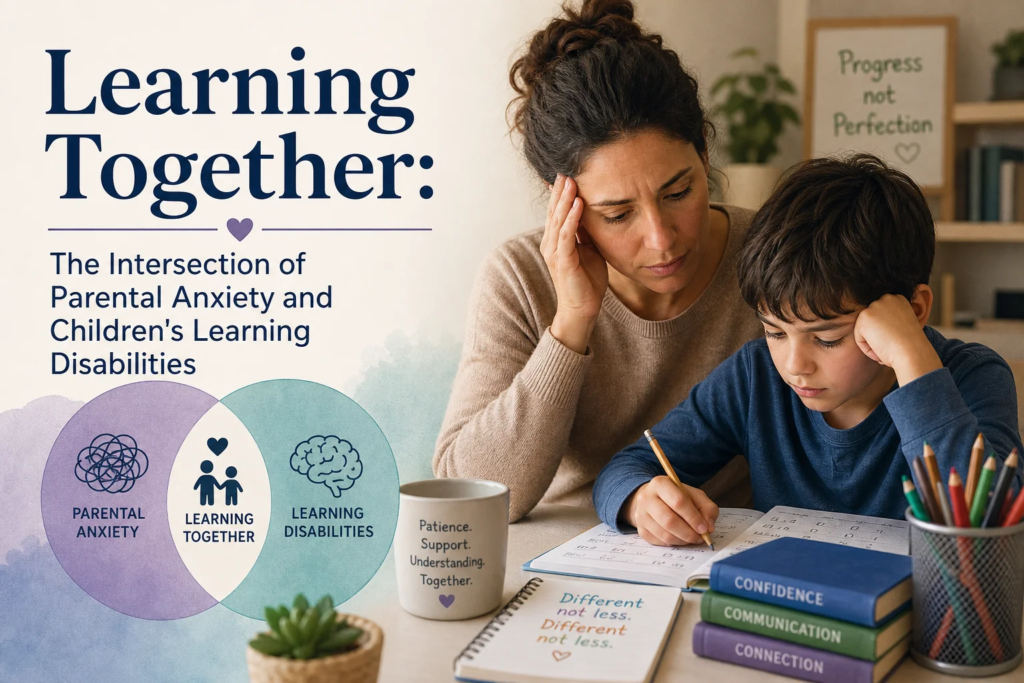
The Essential Guide to Learning Together: The Intersection of Parental Anxiety and Children’s Learning Disabilities
Introduction: When Homework Becomes a Family Weather System
It often starts at the kitchen table.
A child stares at a worksheet, shoulders tense, pencil unmoving. A parent watches the clock, trying to stay calm while thinking, Why is this still so hard? Are we falling behind? What if school never gets easier? Within minutes, the room shifts. The child feels pressure. The parent feels panic. The worksheet becomes more than a worksheet—it becomes a symbol of worry, love, fear, hope, and exhaustion.
This is the heart of Learning Together: The Intersection of Parental Anxiety and Children’s Learning Disabilities.
Children with learning disabilities often need extra support, patience, specialized strategies, and time. Parents, meanwhile, may carry deep anxiety about their child’s future, academic confidence, social acceptance, and emotional well-being. When these two realities meet, families can either get trapped in a cycle of stress—or learn how to grow together with compassion, structure, and evidence-informed support.
The good news? Parental anxiety does not make someone a bad parent. A child’s learning disability does not define their potential. And the intersection of parental anxiety and children’s learning disabilities can become a powerful place for connection, advocacy, and resilience.
This article explores Learning Together: The Intersection of Parental Anxiety and Children’s Learning Disabilities in depth: what happens emotionally, how anxiety affects learning, how parents can support their children without becoming overwhelmed, and how families can build healthier routines that honor both the child’s needs and the parent’s nervous system.
Understanding the Landscape: What Learning Disabilities Are—and Are Not
Before exploring parental anxiety, it helps to clarify what learning disabilities actually mean.
A learning disability is not a lack of intelligence, laziness, poor parenting, or a character flaw. Learning disabilities are neurologically based differences that affect how a person receives, processes, stores, retrieves, or expresses information.
Common learning disabilities include:
| Learning Disability | Common Challenges | Strengths Often Seen |
|---|---|---|
| Dyslexia | Reading accuracy, decoding, spelling, reading fluency | Big-picture thinking, creativity, verbal reasoning |
| Dysgraphia | Handwriting, written expression, spelling, organizing ideas on paper | Storytelling, oral communication, visual thinking |
| Dyscalculia | Number sense, math facts, sequencing, time/money concepts | Pattern recognition in non-numeric contexts, creative problem-solving |
| Auditory processing challenges | Following verbal directions, distinguishing sounds, processing speech quickly | Visual learning, empathy, observational skills |
| ADHD-related learning difficulties | Attention, working memory, task completion, planning | Energy, originality, curiosity, rapid idea generation |
Many children with learning disabilities are bright, insightful, and capable. But when school systems rely heavily on reading speed, written output, memorization, and timed performance, these children may appear less capable than they truly are.
This mismatch is one reason Learning Together: The Intersection of Parental Anxiety and Children’s Learning Disabilities matters so much. Parents often see their child’s intelligence at home but watch them struggle in school. That gap can feel confusing and frightening.
A parent might think:
- “She understands the story when I read it aloud, so why can’t she read it herself?”
- “He explains his ideas beautifully, but his writing looks years behind.”
- “They know the math concept today and forget it tomorrow.”
- “Is this a phase, or are we missing something serious?”
These questions are not overreactions. They are signals that a family may need better information, better support, and a more compassionate framework.
Parental Anxiety: Love With the Volume Turned Too High
Parental anxiety usually begins with care. Parents worry because they love their children and want to protect them from pain, failure, embarrassment, and missed opportunities.
But anxiety can turn love into urgency.
When a child has a learning disability, parents may become hyper-aware of every grade, every teacher comment, every unfinished assignment, and every sign of frustration. The parent’s nervous system starts scanning for danger:
- “Will my child be bullied?”
- “Will they hate school?”
- “Will they fall further behind?”
- “Will they get into college?”
- “Will they be independent?”
- “Did I do something wrong?”
- “Am I doing enough?”
This is where the intersection of parental anxiety and children’s learning disabilities becomes complex. The parent is not simply worried about homework. They are worried about identity, belonging, and the future.
And children notice.
Even when parents try to hide anxiety, children often pick it up through facial expressions, tone of voice, pacing, sighing, repeated reminders, or sudden tension during school-related tasks. A child may begin to associate learning with emotional danger—not only because the work is hard, but because the parent seems scared too.
That is why Learning Together: The Intersection of Parental Anxiety and Children’s Learning Disabilities is not just an academic topic. It is a family systems topic.
The Feedback Loop: How Anxiety and Learning Struggles Reinforce Each Other
One of the most important insights in Learning Together: The Intersection of Parental Anxiety and Children’s Learning Disabilities is that stress can become circular.
Here is a common pattern:
| Step | What Happens | Emotional Impact |
|---|---|---|
| 1. Child struggles | Reading, writing, math, or attention task feels difficult | Child feels confused or embarrassed |
| 2. Parent notices | Parent becomes worried about progress | Parent feels anxious and urgent |
| 3. Parent increases pressure | More reminders, corrections, monitoring, or extra practice | Child feels watched or judged |
| 4. Child avoids | Complains, shuts down, rushes, argues, or freezes | Parent feels more alarmed |
| 5. Conflict grows | Homework becomes a battle | Learning feels unsafe |
| 6. Confidence drops | Child believes, “I’m bad at this” | Parent believes, “Nothing is working” |
This loop does not mean the parent caused the learning disability. It means the family’s stress response can unintentionally make learning harder.
When the brain is under threat, it prioritizes survival over higher-order thinking. Anxiety can reduce working memory, flexible thinking, attention, and problem-solving—all skills children with learning disabilities may already find challenging.
So a child who struggles with dyslexia may decode even less effectively when anxious. A child with dyscalculia may forget math steps under pressure. A child with dysgraphia may produce shorter, messier writing when they feel rushed or watched.
In other words, parental anxiety and children’s learning disabilities can interact in ways that intensify both emotional and academic difficulties.
Signs Parental Anxiety May Be Affecting the Learning Environment
Most parents will feel worried at times. That is normal. The key question is whether anxiety is shaping the child’s learning experience in ways that increase stress.
Here are signs to watch for:
| Parent Anxiety Sign | How It May Show Up | Child’s Possible Response |
|---|---|---|
| Repeated checking | “Did you finish? Are you sure? Let me see again.” | Irritation, dependence, hiding mistakes |
| Catastrophic thinking | “If you fail this test, you’ll never catch up.” | Panic, avoidance, hopelessness |
| Over-helping | Parent completes or heavily directs work | Reduced independence, learned helplessness |
| Emotional reactivity | Tears, anger, visible distress during homework | Shame, guilt, shutdown |
| Comparing | “Your sister never had trouble with this.” | Low self-worth, resentment |
| Perfectionism | Rewriting, correcting every error | Fear of trying, slow completion |
| School distrust | Assuming teachers are ignoring the child | Child feels caught between adults |
The goal is not to shame parents. It is to notice patterns with honesty and kindness.
In Learning Together: The Intersection of Parental Anxiety and Children’s Learning Disabilities, awareness is the first intervention. Once parents can say, “My anxiety is entering the room,” they can begin to respond differently.
Case Study 1: Maya, Dyslexia, and the Nightly Reading Battle
Background
Maya, age 8, was bright, talkative, and loved science documentaries. But reading aloud was painful. She guessed words, skipped lines, and became upset whenever her mother asked her to practice.
Maya’s mother, Elena, had always been a high-achieving student. When Maya struggled, Elena felt terrified. She worried Maya would fall behind permanently. Every night, Elena sat beside Maya and corrected each mistake immediately.
Reading practice sounded like this:
“No, look again.”
“You just read that word.”
“Focus.”
“We have to get through this.”
Maya began saying she hated books.
What Changed
After an evaluation, Maya was diagnosed with dyslexia. Elena learned that Maya needed structured literacy instruction, not more pressure. She also recognized her own anxiety. Instead of correcting every error, Elena shifted to a calmer routine:
- 10 minutes of reading only
- Decodable texts matched to Maya’s skill level
- Praise for effort and strategy use
- Parent read-aloud time afterward for enjoyment
- No reading practice when either person was emotionally flooded
Elena also began saying:
“Your brain learns reading differently. We are going to learn what helps it.”
Analysis
This case illustrates Learning Together: The Intersection of Parental Anxiety and Children’s Learning Disabilities beautifully. Maya’s dyslexia required specialized instruction, but Elena’s anxiety was turning practice into emotional threat. Once Elena understood the learning disability and regulated her own fear, reading became safer.
The key insight: children with learning disabilities do not need parents to become perfect tutors. They need parents to become calm allies.
Why Parents Often Feel Responsible
Parents of children with learning disabilities often carry invisible guilt.
They may wonder:
- “Did I miss early signs?”
- “Should I have pushed harder?”
- “Did screen time cause this?”
- “Was I too relaxed?”
- “Was I too strict?”
- “Is this genetic?”
- “Am I failing my child?”
This self-blame can fuel anxiety. And anxiety can lead to frantic action: more worksheets, more lectures, more late-night research, more second-guessing.
But learning disabilities are not caused by ordinary parenting mistakes. They are brain-based differences. Parenting can influence how supported, confident, and emotionally safe a child feels—but it does not create dyslexia, dyscalculia, or dysgraphia.
In the context of Learning Together: The Intersection of Parental Anxiety and Children’s Learning Disabilities, parents need a crucial reframe:
“I am not the cause of my child’s learning disability. I am part of the support system.”
That shift can be deeply healing.
The Child’s Inner World: What Learning Struggles Feel Like
Adults often focus on performance: grades, homework, test scores, reading level. Children focus on experience: embarrassment, confusion, fairness, comparison, and belonging.
A child with a learning disability may think:
- “Everyone else gets it faster.”
- “I’m stupid.”
- “The teacher thinks I’m not trying.”
- “My parents are disappointed.”
- “If I don’t start, I can’t fail.”
- “If I act like I don’t care, no one will know I’m scared.”
Avoidance is often misunderstood. A child who refuses homework may not be lazy. They may be protecting themselves from shame.
This is especially important in the intersection of parental anxiety and children’s learning disabilities. When parents respond to avoidance with urgency or anger, the child’s shame may deepen. When parents respond with curiosity, the child may begin to open up.
Instead of asking, “Why won’t you just do it?” try:
- “What part feels hardest to start?”
- “Do you need help understanding, organizing, or staying with it?”
- “Is your brain tired or confused?”
- “Would it help if I read the directions aloud?”
- “Should we take a two-minute reset?”
These questions communicate partnership.
That is the spirit of Learning Together: The Intersection of Parental Anxiety and Children’s Learning Disabilities: not parent versus child, but parent and child versus the problem.
A Better Model: Parent as Co-Regulator, Advocate, and Coach
Parents do not need to become reading specialists, occupational therapists, psychologists, and case managers all at once. That is too much.
A healthier model has three roles.
1. Parent as Co-Regulator
Children borrow calm from adults. Before learning can happen, the nervous system needs enough safety.
Co-regulation might look like:
- Speaking slowly
- Sitting beside, not hovering over
- Taking breaks before frustration peaks
- Naming feelings without judgment
- Lowering the emotional stakes
Helpful phrase:
“This is hard, and we can take it one step at a time.”
2. Parent as Advocate
Advocacy means ensuring the child receives appropriate evaluation, accommodations, instruction, and respect.
This may include:
- Requesting a psychoeducational evaluation
- Asking about structured literacy for dyslexia
- Exploring occupational therapy for writing challenges
- Discussing assistive technology
- Requesting an IEP, 504 plan, or school support plan
- Communicating regularly with teachers
Advocacy is central to Learning Together: The Intersection of Parental Anxiety and Children’s Learning Disabilities because anxiety often decreases when parents have a clear plan.
3. Parent as Coach
A coach does not play the game for the athlete. A coach teaches strategies, encourages effort, and helps the learner reflect.
Coaching language includes:
- “What strategy helped last time?”
- “Let’s break this into smaller pieces.”
- “Which tool do you want to use?”
- “What is your first step?”
- “What should we ask your teacher?”
This approach builds independence.
Practical Strategies for Home Learning Without the Meltdown
The home environment matters, but it does not need to become a miniature school. In fact, for many children with learning disabilities, home must remain emotionally safe.
Here are practical strategies that support both learning and anxiety reduction.
Strategy 1: Start With Regulation, Not Correction
Before homework, check the child’s state.
Ask:
- “How tired is your brain from 1 to 10?”
- “Do you need food, movement, quiet, or help getting started?”
- “Would a timer make this easier or harder?”
A dysregulated child cannot learn efficiently. A dysregulated parent cannot teach calmly.
Strategy 2: Use Short, Predictable Work Blocks
Long sessions often backfire. Try:
| Age/Need | Work Block | Break |
|---|---|---|
| Young child or high frustration | 5–10 minutes | 3–5 minutes |
| Elementary student | 10–15 minutes | 5 minutes |
| Middle school student | 20 minutes | 5–10 minutes |
| Teen with independence goals | 25–30 minutes | 5–10 minutes |
Short blocks reduce dread and give the brain a finish line.
Strategy 3: Separate Skill Practice From Emotional Connection
If every interaction becomes academic, children may feel valued only for performance.
Protect connection through:
- Bedtime read-alouds with no quizzing
- Walks
- Cooking together
- Music
- Games
- Shared humor
- Conversations unrelated to school
This is vital in Learning Together: The Intersection of Parental Anxiety and Children’s Learning Disabilities. The relationship must be bigger than the struggle.
Strategy 4: Praise Process, Not Just Outcomes
Instead of:
“Great, you got an A.”
Try:
“You used your checklist even when writing felt hard.”
“You asked for help before giving up.”
“You noticed the mistake and fixed it.”
“You stuck with a hard word.”
Process praise builds resilience.
Strategy 5: Create a “When Stuck” Menu
Many children panic because they do not know what to do when they hit difficulty.
Create a visible list:
| When I’m Stuck, I Can… |
|---|
| Reread the directions |
| Circle the confusing part |
| Ask someone to read it aloud |
| Use text-to-speech |
| Try the first problem only |
| Take a two-minute break |
| Use my graphic organizer |
| Email or ask the teacher |
| Say, “I need help starting” |
This reduces helplessness and lowers parental anxiety too.
Case Study 2: Leo, Dysgraphia, ADHD, and the Parent Who Became the Executive Function
Background
Leo, age 11, had ADHD and dysgraphia. He was funny, inventive, and could explain complex ideas out loud. But written assignments were a nightmare. He forgot due dates, lost papers, wrote very little, and became defensive when reminded.
His father, Marcus, responded by taking over. He checked the online portal six times a day, packed Leo’s bag, emailed teachers constantly, and sat beside Leo for every assignment.
Leo’s grades improved temporarily, but his independence dropped. He began saying:
“Dad knows what I have to do. Ask him.”
Marcus felt trapped. If he backed off, Leo missed assignments. If he stayed involved, Leo became dependent.
What Changed
A school meeting led to a support plan:
- Speech-to-text for drafting
- Graphic organizers for essays
- Reduced copying demands
- Weekly teacher check-in
- Visual homework planner
- Parent check-in once per evening, not constantly
- Sunday planning routine with Leo leading
Marcus also worked on his anxiety. He practiced allowing small, recoverable mistakes. Instead of rescuing immediately, he asked:
“What is your plan?”
“What tool could help?”
“Do you want advice or just a body double while you start?”
Analysis
This case highlights a common pattern in Learning Together: The Intersection of Parental Anxiety and Children’s Learning Disabilities: parents become the child’s external brain. This is understandable, especially when schools penalize missing work quickly. But long-term growth requires scaffolding, not takeover.
The key insight: support should gradually transfer responsibility to the child in developmentally appropriate ways.
How Schools Can Either Reduce or Increase Family Anxiety
Schools play a powerful role in the intersection of parental anxiety and children’s learning disabilities. A supportive school can help families feel informed and hopeful. A dismissive school can intensify fear.
Parents often become more anxious when they hear:
- “They just need to try harder.”
- “They’re too smart to have a learning disability.”
- “Let’s wait and see.”
- “They’re not low enough for help.”
- “They’re choosing not to do the work.”
- “Everyone struggles with this.”
These statements may be intended to reassure, but they often invalidate real concerns.
More helpful school responses include:
- “Let’s look at the data.”
- “Here are the interventions we’ve tried.”
- “Here is how we’ll monitor progress.”
- “Your child has strengths we can build on.”
- “Let’s discuss whether evaluation is appropriate.”
- “We’ll coordinate home and school expectations.”
A Productive Parent-School Communication Template
| Parent Concern | Helpful Question to Ask |
|---|---|
| Reading is not improving | “What specific reading skills are being targeted?” |
| Homework takes too long | “What is the expected time for this assignment?” |
| Child avoids writing | “Can we separate idea generation from handwriting?” |
| Math facts are not sticking | “Can we assess number sense and working memory demands?” |
| Child melts down at home | “What does effort look like at school, and where might fatigue build up?” |
| Parent feels overwhelmed | “Who is our main point of contact for support planning?” |
Clear communication reduces uncertainty. Reduced uncertainty reduces anxiety.
The Hidden Burden of Homework
Homework is one of the most common flashpoints in Learning Together: The Intersection of Parental Anxiety and Children’s Learning Disabilities.
For a child with learning disabilities, homework can take two to four times longer than it does for peers. After a full day of masking, compensating, and trying to keep up, the child may come home depleted.
Parents may see resistance and assume defiance. But the child may be experiencing cognitive fatigue.
Ask these questions:
- Is the homework practicing a skill the child can already do, or requiring a skill they have not mastered?
- Is handwriting making the assignment harder than the actual concept?
- Is reading load interfering with math or science understanding?
- Is the child spending unreasonable time compared with classmates?
- Does homework measure knowledge—or endurance?
If homework consistently causes tears, panic, rage, or hours of conflict, it is time to discuss accommodations.
Possible accommodations include:
- Reduced number of problems
- Audiobooks
- Text-to-speech
- Speech-to-text
- Extra time
- Alternative ways to show knowledge
- No penalty for spelling on non-spelling assignments
- Chunked long-term projects
- Teacher-provided notes
- Typing instead of handwriting
The goal is not to remove challenge. The goal is to remove unnecessary barriers.
Parent Anxiety Management: Not Optional, Not Selfish
A major truth in Learning Together: The Intersection of Parental Anxiety and Children’s Learning Disabilities is this: supporting the parent’s mental health supports the child’s learning.
Parents often put themselves last. They may think, “I’ll deal with my stress after my child is okay.” But children benefit when parents have tools for managing anxiety now.
Parent Anxiety Reset Plan
| Trigger | Anxiety Thought | Grounding Response | Helpful Action |
|---|---|---|---|
| Low test grade | “They’ll never catch up.” | “One score is data, not destiny.” | Ask what skill needs support |
| Homework refusal | “They’re not motivated.” | “Avoidance may mean overwhelm.” | Break task into first step |
| Teacher email | “We’re in trouble.” | “This is information, not a verdict.” | Respond when calm |
| Child says “I’m stupid” | “This is my fault.” | “They need connection first.” | Validate, then reframe |
| Slow progress | “Nothing is working.” | “Learning differences need time.” | Review intervention quality |
A 60-Second Parent Regulation Tool
When you feel panic rising:
- Put both feet on the floor.
- Exhale slowly.
- Relax your jaw and shoulders.
- Name the feeling: “This is anxiety.”
- Name the goal: “My child needs my calm more than my fear.”
- Choose one next step only.
This sounds simple, but it can change the emotional temperature of a room.
Case Study 3: Sofia, Dyscalculia, and the Fear of “Falling Behind Forever”
Background
Sofia, age 9, loved art and storytelling but struggled with math. She counted on her fingers, confused signs, forgot math facts, and panicked during timed tests. Her parents, Priya and Daniel, were both engineers. They valued math and felt alarmed by Sofia’s difficulties.
They hired a tutor who assigned speed drills. Sofia’s anxiety worsened. She began crying before tutoring sessions and saying:
“I’m not a math person.”
What Changed
A specialist identified signs of dyscalculia. The family shifted away from speed and toward conceptual understanding.
Supports included:
- Manipulatives
- Number lines
- Visual models
- Untimed practice
- Real-life math through cooking and shopping
- Reduced emphasis on memorization
- Anxiety-sensitive tutoring
Priya and Daniel also changed their language. Instead of saying, “Math is important; you have to get this,” they said:
“Math is a language. Your brain needs it taught in a more visual, hands-on way.”
Analysis
Sofia’s case shows how parental anxiety can unintentionally push families toward the wrong intervention. Speed drills seemed productive, but they targeted performance under pressure—not Sofia’s underlying needs.
This is a core lesson in Learning Together: The Intersection of Parental Anxiety and Children’s Learning Disabilities: more intensity is not always better. The right support matters more than the loudest support.
The Role of Diagnosis: Relief, Grief, and Direction
When a child receives a diagnosis, parents often feel mixed emotions.
Relief:
“Finally, we understand.”
Grief:
“This may not go away.”
Anger:
“Why didn’t anyone catch this sooner?”
Fear:
“What does this mean for the future?”
Hope:
“Now we know what to do.”
All of these reactions are valid.
A diagnosis should not become a label that limits the child. It should become a map. In Learning Together: The Intersection of Parental Anxiety and Children’s Learning Disabilities, diagnosis can reduce anxiety because it replaces vague worry with targeted action.
Instead of “My child is failing,” the story becomes:
“My child has dyslexia and needs structured literacy.”
“My child has dysgraphia and needs writing accommodations.”
“My child has dyscalculia and needs explicit, visual math instruction.”
“My child has ADHD and needs executive function supports.”
Clarity gives families a starting point.
Strength-Based Support: Seeing the Whole Child
Children with learning disabilities often receive a steady stream of correction. Over time, they may believe their weaknesses are the most important thing about them.
Parents can counter this by intentionally naming strengths.
Strengths may include:
- Creativity
- Empathy
- Humor
- Curiosity
- Mechanical skill
- Verbal reasoning
- Leadership
- Persistence
- Visual thinking
- Music or art
- Athletic ability
- Problem-solving
- Emotional insight
A strength-based approach does not deny struggle. It balances the picture.
Try saying:
- “Reading is hard, and your ideas are powerful.”
- “Writing takes effort, and your imagination is strong.”
- “Math facts are tricky, and you are great at noticing patterns.”
- “School is one place where you learn. It is not the only measure of who you are.”
This mindset is central to Learning Together: The Intersection of Parental Anxiety and Children’s Learning Disabilities because anxiety narrows attention to deficits. Strengths widen the lens.
Siblings, Family Dynamics, and Fairness
Learning disabilities can affect the whole family. Siblings may notice that one child gets more attention, more patience, or different rules. Parents may feel guilty about uneven time and energy.
Fair does not always mean identical. Fair means each child gets what they need.
A helpful family explanation might be:
“Everyone in this family gets support in the way their brain and body need it. Sometimes that means different tools, different time, or different kinds of help.”
Siblings may also need:
- One-on-one time with parents
- Age-appropriate explanations
- Permission to feel frustrated
- Reassurance that their needs matter too
- Clear boundaries around teasing or comparison
Family balance is an important part of the intersection of parental anxiety and children’s learning disabilities. When one child’s school struggles dominate family life, everyone’s stress can rise.
Technology as a Bridge, Not a Shortcut
Assistive technology can be life-changing for children with learning disabilities. Unfortunately, some parents worry that tools like audiobooks or speech-to-text are “cheating.”
They are not.
Glasses do not cheat vision. Ramps do not cheat mobility. Audiobooks do not cheat comprehension. Speech-to-text does not cheat writing ideas.
Useful tools may include:
| Challenge | Helpful Technology |
|---|---|
| Dyslexia | Audiobooks, text-to-speech, dyslexia-friendly fonts, reading pens |
| Dysgraphia | Speech-to-text, typing, word prediction, graphic organizer apps |
| Dyscalculia | Visual math apps, calculators when appropriate, digital number lines |
| ADHD/executive function | Timers, reminder apps, digital planners, task management tools |
| Slow processing | Recorded lessons, captions, pause-and-review tools |
In Learning Together: The Intersection of Parental Anxiety and Children’s Learning Disabilities, technology can reduce unnecessary strain and allow children to show what they know.
The goal is access.
Building a Family Learning Plan
A family learning plan keeps everyone focused and reduces reactive decision-making.
Sample Family Learning Plan
| Area | Plan |
|---|---|
| Child’s strengths | Storytelling, science knowledge, humor, visual memory |
| Main challenge | Reading fluency and spelling |
| School support | Structured literacy 4x/week, extra time, audiobook access |
| Home support | 10-minute reading practice, parent read-aloud, no late-night homework battles |
| Parent anxiety plan | Pause before correcting, weekly school check-in only, therapy/support group if needed |
| Child self-advocacy goal | Ask for directions to be repeated or read aloud |
| Progress measure | Confidence, reduced tears, skill growth, teacher data |
| Review date | Every 6–8 weeks |
A plan like this supports Learning Together: The Intersection of Parental Anxiety and Children’s Learning Disabilities because it turns fear into structure.
What Progress Really Looks Like
Progress is not always a straight line. Children with learning disabilities may improve slowly, plateau, regress under stress, or make sudden leaps after months of groundwork.
Parents often look only at grades. But meaningful progress includes:
- Fewer meltdowns
- More willingness to try
- Better self-advocacy
- Increased stamina
- Improved strategy use
- More accurate decoding
- Less shame
- Stronger parent-child communication
- Better school collaboration
- Greater independence over time
A child who says, “I need help with this paragraph,” instead of throwing the paper is making progress.
A child who uses speech-to-text to complete an essay is making progress.
A parent who pauses before panicking is making progress.
This is the deeper meaning of Learning Together: The Intersection of Parental Anxiety and Children’s Learning Disabilities. Everyone is learning—not just the child.
When to Seek Professional Help
Families should consider additional support when:
- Homework causes frequent tears, panic, or rage
- The child calls themselves stupid or worthless
- School avoidance increases
- The parent feels constantly overwhelmed
- Family conflict centers around academics
- The child’s progress remains limited despite intervention
- Anxiety symptoms affect sleep, appetite, or daily functioning
- The child shows signs of depression
- Parents feel unable to regulate their own fear
Helpful professionals may include:
- Educational psychologists
- Neuropsychologists
- School psychologists
- Special education advocates
- Occupational therapists
- Speech-language pathologists
- Reading specialists
- Math interventionists
- Child therapists
- Parent coaches
- Family therapists
Seeking help is not failure. It is wise support.
Common Myths That Keep Families Stuck
Myth 1: “If my child tries harder, they’ll catch up.”
Effort matters, but effort without the right instruction can lead to burnout.
Myth 2: “Accommodations will make my child dependent.”
Good accommodations provide access while skills develop. They can actually increase independence.
Myth 3: “My anxiety motivates my child.”
Anxiety may create short-term compliance, but it often harms confidence and long-term motivation.
Myth 4: “A diagnosis is an excuse.”
A diagnosis is information. It explains needs and guides support.
Myth 5: “Good parents should be able to fix this.”
Good parents seek support, learn, adjust, and stay connected. They do not have to fix everything alone.
These myths are why conversations about Learning Together: The Intersection of Parental Anxiety and Children’s Learning Disabilities are so important. Families need truth, not shame.
Creating a Home Culture of Courage
Children with learning disabilities need more than interventions. They need a family culture where mistakes are survivable and effort is meaningful.
A courage-based home sounds like:
- “Mistakes help us find the next step.”
- “Your brain is not broken.”
- “We can use tools.”
- “Hard does not mean impossible.”
- “You are more than your grades.”
- “We solve problems together.”
- “Rest is part of learning.”
- “Asking for help is a strength.”
This is not empty positivity. It is emotional architecture. It teaches children how to face difficulty without being defined by it.
And it teaches parents that their calm presence is often more powerful than their perfect solution.
Conclusion: Learning Together With Hope, Skill, and Compassion
Learning Together: The Intersection of Parental Anxiety and Children’s Learning Disabilities is not just about academic struggle. It is about the emotional bond between parent and child when learning becomes hard.
Children with learning disabilities need targeted instruction, accommodations, patience, and belief. Parents need accurate information, emotional support, practical tools, and permission to be human.
The most powerful shift is moving from panic to partnership.
Instead of asking, “How do I make my child normal?” ask:
“How does my child learn best, and how can I support that with calm confidence?”
Instead of thinking, “We are behind,” try:
“We are building a path that fits this child.”
Instead of letting anxiety lead, let connection lead.
Because at its best, Learning Together: The Intersection of Parental Anxiety and Children’s Learning Disabilities becomes a story of resilience. A child learns that struggle does not equal failure. A parent learns that worry can soften into wisdom. And a family learns that progress is not only measured in grades, but in courage, trust, and the ability to keep going—together.
FAQs About Learning Together: The Intersection of Parental Anxiety and Children’s Learning Disabilities
1. Can parental anxiety make a child’s learning disability worse?
Parental anxiety does not cause learning disabilities, but it can make learning situations more stressful. When children feel pressure, criticism, or panic from adults, they may become more anxious, avoidant, or emotionally overwhelmed. Calm support, clear routines, and appropriate interventions can reduce this stress.
2. How do I know if my child has a learning disability or is just unmotivated?
A child with a learning disability often struggles despite effort, support, and repeated practice. Signs include slow reading progress, persistent spelling issues, difficulty with number sense, extreme writing frustration, or a large gap between verbal ability and written work. If concerns persist, request an evaluation through the school or a qualified specialist.
3. What should I do when homework causes daily meltdowns?
First, reduce the emotional intensity. Use short work blocks, breaks, and calm language. Then contact the teacher to discuss how long homework is taking and whether accommodations are needed. Daily meltdowns are usually a sign that the task demands exceed the child’s current capacity or support level.
4. Are accommodations like audiobooks, calculators, or speech-to-text unfair?
No. Accommodations provide access. They help children work around barriers so they can demonstrate knowledge. For example, an audiobook can allow a child with dyslexia to understand grade-level content while still receiving reading instruction separately.
5. How can I manage my own anxiety while supporting my child?
Start by noticing your triggers. Use grounding strategies before helping with schoolwork, limit constant grade-checking, and focus on one next step rather than worst-case scenarios. If anxiety feels unmanageable, therapy, parent coaching, or support groups can be extremely helpful.
6. Should I tell my child about their learning disability diagnosis?
Yes, in an age-appropriate and strengths-based way. Children often already know they struggle. A clear explanation can reduce shame. You might say, “Your brain learns reading differently. That’s called dyslexia. It means we need to use specific tools and teaching methods.”
7. How can I advocate at school without seeming difficult?
Use collaborative, specific language. Ask about data, interventions, progress monitoring, and accommodations. For example: “Can we review which reading skills are being targeted and how progress is being measured?” Advocacy is not being difficult; it is helping your child access what they need.
8. What is the most important takeaway for parents?
Your child needs your connection more than your panic. With the right support, children with learning disabilities can grow in skill, confidence, and independence. The journey is easier when families focus on learning together—one calm, informed, compassionate step at a time.

