


Introduction: The Workplace Safety Question No Employer Can Afford to Ignore
A workplace should never feel like a place where someone must choose between earning a living and staying safe.
Yet across offices, hospitals, warehouses, schools, government buildings, retail stores, transportation hubs, and remote work environments, violence remains a real and growing concern. It can appear as a physical assault, a credible threat, harassment, stalking, intimidation, customer aggression, domestic violence spilling into the workplace, or an active shooter incident. Some cases make national headlines. Many more are quietly handled by HR, security, managers, or employees who simply “try to get through the day.”
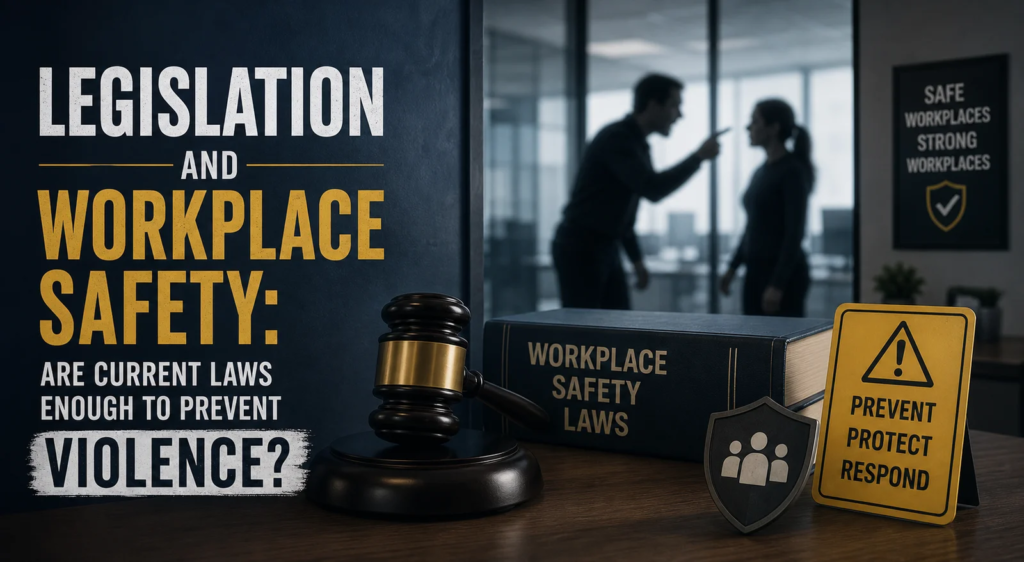
That brings us to a critical question: Legislation and Workplace Safety: Are Current Laws Enough to Prevent Violence?
The short answer is: not always.
Current laws provide important protections. They establish employer duties, anti-harassment standards, reporting requirements, workers’ compensation systems, criminal penalties, and in some places, specific workplace violence prevention mandates. But laws alone do not prevent violence. They set the floor, not the ceiling.
The real challenge is whether employers, regulators, policymakers, and employees can turn legal requirements into practical prevention systems that work before harm occurs.
This article explores Legislation and Workplace Safety: Are Current Laws Enough to Prevent Violence? in depth. We’ll look at existing legal frameworks, case studies, gaps in current protections, industry-specific risks, and practical solutions for building safer workplaces.
Understanding Workplace Violence: More Than Physical Assault
Before asking whether current laws are enough, we need to understand what workplace violence actually includes.
Workplace violence is often imagined as a dramatic physical attack. But many incidents begin long before violence becomes visible. Threats, bullying, stalking, intimidation, aggressive customers, coercive control, harassment, and repeated hostile behavior can all form part of the risk landscape.
Common Categories of Workplace Violence
| Type of Workplace Violence | Description | Common Examples |
|---|---|---|
| Criminal intent | The offender has no legitimate relationship with the workplace | Robbery, trespassing, assault during theft |
| Customer/client/patient violence | Violence from someone receiving services | Patient assaulting nurse, customer threatening cashier |
| Worker-on-worker violence | Conflict between employees, supervisors, contractors, or former workers | Threats, fights, retaliation, active shooter risk |
| Personal relationship violence | Domestic or personal conflict entering the workplace | Abusive partner stalking employee at work |
| Harassment-based violence | Violence or threats linked to discrimination, bullying, or targeted hostility | Gender-based threats, racial intimidation, sexual harassment escalation |
When discussing Legislation and Workplace Safety: Are Current Laws Enough to Prevent Violence?, this broad definition matters. Some laws address physical assault. Others address discrimination or harassment. Some focus on criminal prosecution after violence occurs. Fewer laws require proactive prevention across all categories.
That is one of the biggest weaknesses in the current system.
The Current Legal Landscape: What Laws Already Exist?
Workplace safety laws vary by country, state, province, and industry. In the United States, workplace violence prevention is covered through a patchwork of federal standards, state laws, agency guidance, criminal laws, civil rights protections, and employer policies.
The issue with Legislation and Workplace Safety: Are Current Laws Enough to Prevent Violence? is not that there are no laws. There are many. The issue is that they are fragmented.
Key Legal Tools Affecting Workplace Violence Prevention
| Legal Area | What It Does | Strength | Limitation |
|---|---|---|---|
| Occupational safety laws | Require employers to provide a safe workplace | Broad duty of care | Often lacks specific workplace violence rules |
| OSHA General Duty Clause | Requires workplaces free from recognized serious hazards | Can apply to workplace violence risks | Enforcement can be reactive and case-specific |
| State workplace violence laws | Some states mandate prevention plans, especially in healthcare or general industry | More specific requirements | Coverage varies widely |
| Anti-discrimination laws | Address harassment, hostile work environments, retaliation | Strong employee rights framework | Does not cover every violence risk |
| Criminal law | Punishes assault, threats, stalking, weapons offenses | Strong after-the-fact accountability | Usually activates after harm or threat occurs |
| Workers’ compensation | Provides benefits for work-related injuries | Supports injured workers | Does not prevent violence by itself |
| Domestic violence leave/protection laws | Help victims seek safety and legal protection | Important for personal relationship violence | Not universal or always workplace-integrated |
| Industry regulations | Apply to healthcare, education, transportation, public service | Tailored to known risks | Often limited to high-risk sectors |
This patchwork is why the question Legislation and Workplace Safety: Are Current Laws Enough to Prevent Violence? is so urgent. A hospital nurse, a convenience store worker, a teacher, a warehouse supervisor, and a remote employee may all face violence risks—but they may not receive the same legal protections.
OSHA and the General Duty Clause: Helpful, But Not Always Enough
In the United States, the Occupational Safety and Health Administration plays a major role in workplace safety. OSHA does not currently have one universal federal workplace violence prevention standard for all industries. Instead, it often relies on the General Duty Clause, which requires employers to provide a workplace free from recognized hazards that are likely to cause death or serious physical harm.
Workplace violence can qualify as a recognized hazard, especially in industries where risk is well documented, such as healthcare, social services, late-night retail, correctional work, and public transportation.
Why OSHA’s Approach Matters
The OSHA framework is important because it allows regulators to act when an employer knew or should have known about a serious violence risk. For example, if a hospital has repeated patient assaults and fails to improve staffing, security, training, or reporting systems, OSHA may intervene.
However, the General Duty Clause has limitations.
It usually requires proof that:
- A hazard existed.
- The hazard was recognized.
- The hazard was likely to cause serious harm.
- There were feasible ways to reduce the hazard.
- The employer failed to act.
That can be difficult to prove before violence occurs.
So when evaluating Legislation and Workplace Safety: Are Current Laws Enough to Prevent Violence?, OSHA’s role is both essential and incomplete. It can support enforcement, but it does not automatically require every employer to maintain a comprehensive workplace violence prevention program.
State Laws Are Changing the Conversation
Some states have moved further than federal law by creating specific workplace violence prevention requirements.
California is one of the most important examples. California Senate Bill 553 requires most employers to establish workplace violence prevention plans, maintain incident logs, train employees, and identify workplace violence hazards. The law represents a major shift from reactive compliance to proactive planning.
Other states have adopted requirements in healthcare, public sector work, education, or social services.
Why State Action Matters
State legislation shows that lawmakers increasingly recognize violence as a predictable and preventable occupational hazard.
The debate over Legislation and Workplace Safety: Are Current Laws Enough to Prevent Violence? is therefore changing. Instead of asking only whether employers should respond after an incident, many policymakers now ask whether employers should be legally required to anticipate risks.
That is a major evolution.
Still, state-by-state lawmaking creates uneven protection. An employee in one state may be covered by a strong workplace violence prevention law, while a similar employee in another state may depend mostly on general safety duties and internal employer policies.
Case Study 1: California’s Workplace Violence Prevention Law
California’s SB 553 is one of the most significant workplace violence prevention laws in the United States. Effective in 2024, it requires many employers to create and maintain a written workplace violence prevention plan.
Key requirements include:
- Identifying workplace violence hazards.
- Training employees.
- Creating procedures for reporting incidents.
- Maintaining violent incident logs.
- Responding to workplace violence risks.
- Involving employees in prevention efforts.
Brief Analysis
This case study is highly relevant to Legislation and Workplace Safety: Are Current Laws Enough to Prevent Violence? because it shows what more proactive legislation can look like.
Instead of waiting for a violent incident, California’s model pushes employers to evaluate risks in advance. It also recognizes that workplace violence is not limited to healthcare or public service. Offices, warehouses, stores, and many other workplaces may need prevention systems.
The strength of this approach is prevention. The challenge is implementation. A written plan is only useful if it is practical, updated, communicated, and supported by leadership.
Healthcare: The Industry That Shows Why Laws Matter
Healthcare workers face some of the highest rates of workplace violence. Nurses, emergency room staff, behavioral health workers, home health aides, and social workers regularly encounter patients or family members in distress, crisis, pain, confusion, or anger.
Violence in healthcare is not always intentional in the criminal sense. A patient may be impaired, frightened, mentally ill, or medically unstable. But the harm to workers is still real.
Common Healthcare Violence Risks
| Risk Factor | Why It Matters |
|---|---|
| Long wait times | Frustration can escalate into aggression |
| Understaffing | Fewer workers available to de-escalate or respond |
| Behavioral health crises | Higher likelihood of unpredictable behavior |
| Substance use | Increased agitation or impaired judgment |
| Access to isolated areas | Workers may be alone with aggressive individuals |
| Inadequate reporting | Repeated incidents become normalized |
The topic Legislation and Workplace Safety: Are Current Laws Enough to Prevent Violence? is especially important in healthcare because violence has too often been treated as “part of the job.”
It is not.
Laws that require violence prevention plans, staff training, security assessments, incident reporting, and post-incident support can make a measurable difference. But only if healthcare organizations invest in staffing, environmental design, communication, and leadership accountability.
Case Study 2: Violence Prevention in Hospitals
Many hospitals have adopted workplace violence prevention programs that include panic buttons, visitor management systems, security presence, behavioral emergency response teams, employee training, and flagging systems for patients with a history of violent behavior.
In some states, healthcare-specific laws require hospitals to assess violence risks, develop prevention plans, and train employees.
Brief Analysis
This case study illustrates the practical side of Legislation and Workplace Safety: Are Current Laws Enough to Prevent Violence?
Healthcare laws can push hospitals to create formal systems. But the difference between a paper program and a real prevention culture is enormous. Strong programs include frontline staff input, reliable reporting, leadership follow-up, and trauma-informed care.
The key lesson: legislation can open the door, but operational discipline keeps workers safe.
Retail and Service Work: The Overlooked Front Line
Retail employees, restaurant workers, delivery drivers, hotel staff, and gas station clerks often face aggression from customers. These workers may deal with intoxicated individuals, shoplifters, angry customers, late-night shifts, cash handling, and minimal staffing.
Yet retail and service violence often receives less attention than violence in healthcare or law enforcement.
When discussing Legislation and Workplace Safety: Are Current Laws Enough to Prevent Violence?, retail is a crucial test case. If laws only focus on traditionally high-risk sectors, they may miss millions of workers who face daily threats.
Risk Factors in Retail and Service Settings
| Workplace Condition | Violence Risk |
|---|---|
| Working alone | No immediate support during escalation |
| Late-night hours | Higher crime and intoxication exposure |
| Cash handling | Robbery risk |
| Customer disputes | Verbal aggression can escalate |
| Lack of security | Employees forced to manage dangerous situations |
| Poor reporting culture | Incidents dismissed as normal customer behavior |
Employers can reduce risk through better staffing, security cameras, cash controls, safe exits, de-escalation training, emergency communication tools, and policies that do not require employees to physically intervene during theft.
The law can encourage or require these steps, but many current laws still leave too much discretion to employers.
Case Study 3: Late-Night Retail Safety
Convenience stores and gas stations have long been associated with elevated robbery and assault risks, particularly when employees work alone overnight. Some jurisdictions have considered or adopted rules requiring safety measures such as visibility standards, cash drop procedures, security systems, and multiple employees during high-risk hours.
Brief Analysis
This case study matters because Legislation and Workplace Safety: Are Current Laws Enough to Prevent Violence? is not only about dramatic, headline-grabbing incidents. It is also about predictable risks in ordinary jobs.
Where laws require specific controls, employers are more likely to act consistently. Where laws are vague, safety may depend on whether management sees prevention as a priority—or merely as a cost.
Worker-on-Worker Violence: The Hardest Risk to Confront
Worker-on-worker violence can be among the most difficult forms of workplace violence to prevent. It may involve bullying, threats, retaliation, performance disputes, harassment, termination-related anger, or interpersonal conflict.
Employers often hesitate to intervene early because the behavior may appear ambiguous. A person may be “difficult” but not clearly dangerous. A threat may be indirect. A manager may dismiss warning signs as personality issues.
But many serious incidents are preceded by concerning behavior.
Warning Signs That Require Attention
| Warning Sign | Why It Should Not Be Ignored |
|---|---|
| Direct or indirect threats | May indicate escalation |
| Obsession with grievance | Can fuel retaliatory behavior |
| Stalking or fixation | Creates targeted risk |
| Sudden behavioral changes | May signal crisis |
| Intimidation or bullying | Can normalize aggression |
| Weapon references | Requires immediate assessment |
| Domestic conflict affecting work | Can endanger coworkers too |
The challenge for Legislation and Workplace Safety: Are Current Laws Enough to Prevent Violence? is that laws do not always provide clear instructions for early intervention.
Employers need policies that allow reporting, assessment, and action before behavior crosses into criminal conduct.
Case Study 4: Public Transportation and Workplace Violence
Public transportation workers, including bus drivers, train operators, station staff, and maintenance personnel, often interact with the public in uncontrolled environments. They may face assaults, threats, fare disputes, mental health crises, and random aggression.
Several transportation agencies have responded with barriers, surveillance, emergency communication systems, law enforcement partnerships, and employee training.
Brief Analysis
This example highlights another important dimension of Legislation and Workplace Safety: Are Current Laws Enough to Prevent Violence?: environmental control.
Some workplaces cannot simply lock the door or screen every person. Public-facing roles require layered prevention. Laws must account for real conditions, not idealized office settings.
For transportation workers, practical prevention may include physical barriers, rapid response systems, staffing strategies, public behavior rules, and penalties for assaulting workers.
Domestic Violence and the Workplace: A Hidden Safety Issue
Domestic violence does not stop at the workplace door. Abusers may call repeatedly, stalk victims at work, threaten coworkers, show up at job sites, or use workplace schedules to track victims.
This creates risk not only for the targeted employee but also for colleagues, customers, and visitors.
Some laws provide leave for victims of domestic violence, allow workplace restraining orders, or require reasonable accommodations. But protections vary significantly.
This is a major reason the question Legislation and Workplace Safety: Are Current Laws Enough to Prevent Violence? cannot be answered with a simple yes.
If an employee is being stalked by an abusive partner, a general workplace safety policy may not be enough. Employers need procedures for confidentiality, safety planning, parking arrangements, schedule changes, reception alerts, security notifications, and emergency response.
Legal protections can help, but they must be integrated into workplace practice.
Are Current Laws Enough? The Five Biggest Gaps
So, Legislation and Workplace Safety: Are Current Laws Enough to Prevent Violence?
In many workplaces, current laws are not enough by themselves. Here are the five biggest gaps.
1. Laws Are Often Reactive
Many legal systems respond after a threat, injury, complaint, or tragedy. Criminal law punishes violence. Workers’ compensation supports injured employees. OSHA may investigate after serious incidents.
But prevention requires earlier action.
2. Coverage Is Inconsistent
Some industries have detailed requirements. Others do not. Some states require workplace violence prevention plans. Others rely on general obligations.
This inconsistency leaves workers unevenly protected.
3. Underreporting Weakens Prevention
Employees often do not report threats because they fear retaliation, believe nothing will change, or think aggression is “part of the job.”
If incidents are not reported, employers cannot identify patterns.
4. Enforcement Resources Are Limited
Even strong laws need enforcement. Regulators may lack enough inspectors, funding, or data to monitor every workplace.
5. Compliance Can Become a Paper Exercise
A written policy does not stop violence unless it is used, tested, improved, and supported by leadership.
This is one of the most important insights in Legislation and Workplace Safety: Are Current Laws Enough to Prevent Violence? Laws matter, but culture determines whether prevention becomes real.
What Strong Workplace Violence Legislation Should Include
If policymakers want to strengthen workplace violence prevention, legislation should be practical, flexible, and enforceable.
Essential Elements of Strong Workplace Violence Laws
| Legislative Requirement | Why It Matters |
|---|---|
| Written prevention plan | Creates accountability |
| Hazard assessment | Identifies specific workplace risks |
| Employee participation | Frontline workers know real hazards |
| Incident reporting system | Builds data for prevention |
| Anti-retaliation protections | Encourages honest reporting |
| Training requirements | Helps employees recognize and respond |
| Emergency response procedures | Reduces confusion during crisis |
| Post-incident support | Addresses trauma and recovery |
| Regular review | Keeps plans current |
| Recordkeeping | Allows trend analysis and enforcement |
When evaluating Legislation and Workplace Safety: Are Current Laws Enough to Prevent Violence?, these elements provide a useful benchmark. If a law does not require assessment, reporting, training, and follow-up, it may not be strong enough to prevent violence effectively.
Employer Responsibility: Going Beyond Minimum Compliance
The best employers do not ask, “What is the least we must do legally?”
They ask, “What would actually keep our people safe?”
That mindset is essential because legislation and workplace safety standards are often minimum requirements. Employers can and should go further.
Practical Steps Employers Can Take Now
-
Conduct a workplace violence risk assessment.
Look at job roles, locations, work hours, past incidents, customer interactions, staffing levels, and security gaps. -
Create a clear reporting system.
Employees should know how to report threats, harassment, stalking, intimidation, or aggressive behavior. -
Train managers and employees.
Training should include de-escalation, warning signs, emergency procedures, reporting obligations, and trauma-informed response. -
Form a threat assessment team.
This may include HR, legal, security, operations, mental health professionals, and leadership. -
Improve physical security.
Consider lighting, access controls, cameras, panic buttons, safe rooms, reception protocols, and emergency communications. -
Address bullying and harassment early.
Workplace violence prevention includes culture, not just security. -
Support employees affected by domestic violence.
Provide confidential reporting, flexible scheduling, security coordination, and leave options when legally required or appropriate. - Review every incident.
Near misses matter. A threat that did not result in injury still provides valuable information.
This is where the answer to Legislation and Workplace Safety: Are Current Laws Enough to Prevent Violence? becomes practical. Laws may require action, but employers decide whether safety becomes a living system.
The Role of Employees: Reporting, Participation, and Awareness
Employees are not responsible for creating safe systems—that is primarily an employer duty. But employees play a vital role in prevention.
They often notice warning signs first. They know which parking areas feel unsafe, which customers repeatedly become aggressive, which coworkers are escalating, and which procedures fail in real life.
A strong prevention culture encourages employees to speak up without fear.
Employees Should Be Encouraged To Report:
- Threats, even if indirect.
- Stalking or unwanted contact.
- Aggressive customer behavior.
- Harassment or bullying.
- Domestic violence concerns affecting work.
- Weapons at work.
- Unsafe staffing or isolated work conditions.
- Security equipment failures.
- Near misses.
For Legislation and Workplace Safety: Are Current Laws Enough to Prevent Violence?, employee participation is a key point. The best laws require employers to involve workers in prevention planning because safety cannot be designed only from a corporate office.
The Culture Problem: Why Policies Fail
Many workplaces have policies that look strong on paper. But employees still feel unsafe.
Why?
Because culture undermines policy.
A company may say it has zero tolerance for violence, but if managers ignore threats, discourage reporting, tolerate abusive customers, or punish employees who speak up, the policy is meaningless.
Signs of a Weak Safety Culture
| Warning Sign | What It Reveals |
|---|---|
| “That’s just part of the job” | Violence is normalized |
| Reports disappear without follow-up | Employees lose trust |
| Managers minimize threats | Risk escalates |
| Safety training is rushed or generic | Compliance is prioritized over prevention |
| Employees fear retaliation | Hazards stay hidden |
| Only physical assaults are tracked | Early warning signs are missed |
This is central to Legislation and Workplace Safety: Are Current Laws Enough to Prevent Violence? Even excellent laws cannot compensate for leadership indifference.
Safety culture starts when leaders treat every threat as information, not inconvenience.
Data and Reporting: The Prevention Tool Too Many Employers Underuse
Data is one of the most powerful tools in workplace violence prevention. But many organizations fail to collect meaningful information.
They may track injuries but not threats. They may record police calls but not verbal abuse. They may investigate major events but ignore near misses.
That leaves employers blind to patterns.
What Employers Should Track
| Data Point | Prevention Value |
|---|---|
| Date and time of incident | Identifies high-risk shifts |
| Location | Shows physical hot spots |
| Type of violence | Helps tailor controls |
| People involved | Reveals repeat offenders |
| Triggering event | Identifies preventable causes |
| Response time | Measures emergency readiness |
| Injuries or trauma | Supports recovery planning |
| Corrective actions | Tracks accountability |
A serious discussion of Legislation and Workplace Safety: Are Current Laws Enough to Prevent Violence? must include reporting. Without data, lawmakers and employers cannot know what is working.
Technology: Helpful Tool or False Sense of Security?
Technology can improve workplace safety, but it is not a complete solution.
Security cameras, panic buttons, access badges, visitor management systems, AI-enabled threat monitoring, and emergency alert apps can all help. But technology must support a broader safety strategy.
A panic button is useful only if someone responds. A camera is useful only if footage is monitored or reviewed. An access control system is useful only if employees do not prop doors open.
Technology Best Practices
- Match tools to actual risks.
- Train employees on how to use systems.
- Test emergency alerts regularly.
- Protect privacy and avoid over-surveillance.
- Combine technology with staffing and procedures.
- Review failures after drills or incidents.
In the debate over Legislation and Workplace Safety: Are Current Laws Enough to Prevent Violence?, technology should be seen as one layer of prevention, not a substitute for leadership, staffing, training, and culture.
Remote and Hybrid Work: A New Frontier for Workplace Violence Laws
Workplace violence is not limited to physical offices. Remote and hybrid work have created new safety questions.
Employees may face online harassment, cyberstalking, video meeting intimidation, threats through messaging platforms, or domestic violence while working from home.
Current workplace violence laws were often written with traditional worksites in mind. That creates uncertainty.
If an employee is threatened by a coworker through company communication tools, is that workplace violence? Usually, employers should treat it as a workplace safety issue. If domestic violence affects an employee working from home, what accommodations are appropriate? If a terminated employee harasses staff online, what response is required?
These questions show why Legislation and Workplace Safety: Are Current Laws Enough to Prevent Violence? must evolve with modern work.
Future laws may need clearer standards for digital threats, remote worker safety planning, and employer responsibilities in virtual environments.
International Perspective: What Can We Learn?
Different countries approach workplace violence through occupational health and safety laws, labor standards, anti-harassment rules, criminal law, and human rights frameworks.
Some jurisdictions have stronger psychological safety requirements, including protections against bullying, harassment, and psychosocial hazards. Others emphasize employer risk assessments and prevention planning.
The global trend is clear: workplace violence is increasingly viewed not just as a criminal issue but as an occupational health and safety issue.
That shift matters. It supports the idea that Legislation and Workplace Safety: Are Current Laws Enough to Prevent Violence? should not be answered only by asking whether assault is illegal. Of course assault is illegal. The deeper question is whether the law requires enough prevention before assault happens.
A Practical Framework: The Prevention Pyramid
Workplace violence prevention works best as a layered system.
| Prevention Level | Goal | Examples |
|---|---|---|
| Primary prevention | Stop violence before warning signs appear | Safe staffing, respectful culture, environmental design |
| Secondary prevention | Intervene when risk emerges | Reporting systems, threat assessment, de-escalation |
| Tertiary prevention | Respond after an incident | Emergency response, medical care, investigations |
| Recovery and learning | Prevent recurrence | Trauma support, corrective action, policy updates |
This framework helps answer Legislation and Workplace Safety: Are Current Laws Enough to Prevent Violence?
Current laws often focus heavily on secondary and tertiary responses. Stronger laws should push more employers toward primary prevention.
What Policymakers Should Do Next
If lawmakers want to reduce workplace violence, they should focus on clear, prevention-oriented legislation that applies broadly but allows industry-specific flexibility.
Policy Recommendations
-
Adopt comprehensive workplace violence prevention standards.
Laws should require risk assessments, written plans, training, reporting, and review. -
Strengthen anti-retaliation protections.
Workers must be able to report threats without fear. -
Require incident data collection.
Better data leads to better prevention. -
Address high-risk industries first—but not only high-risk industries.
Healthcare, retail, transportation, education, and social services need urgent attention, but office and remote workers also need protection. -
Integrate domestic violence protections.
Workplace safety laws should recognize personal relationship violence as a workplace risk. -
Fund enforcement and education.
Laws without enforcement become symbolic. - Support small businesses.
Smaller employers need templates, training resources, and technical assistance.
When asking Legislation and Workplace Safety: Are Current Laws Enough to Prevent Violence?, the policy answer is clear: current laws are a foundation, but many need modernization, consistency, and stronger prevention requirements.
What Businesses Should Do Before the Law Forces Them To
Forward-thinking organizations should not wait for a new regulation, lawsuit, tragedy, or OSHA citation.
They should act now.
Workplace Violence Prevention Checklist
| Action | Completed? |
|---|---|
| Conducted workplace violence risk assessment | ☐ |
| Created written prevention policy | ☐ |
| Established confidential reporting process | ☐ |
| Trained employees and managers | ☐ |
| Reviewed physical security risks | ☐ |
| Created emergency response procedures | ☐ |
| Formed threat assessment team | ☐ |
| Added domestic violence response protocol | ☐ |
| Maintained incident logs | ☐ |
| Reviewed and updated plan annually | ☐ |
This checklist turns Legislation and Workplace Safety: Are Current Laws Enough to Prevent Violence? into action. Regardless of legal minimums, these steps help protect people.
The Business Case for Prevention
Some employers view workplace violence prevention as a compliance burden. That is shortsighted.
Violence affects morale, retention, productivity, reputation, insurance costs, legal exposure, and trust. Employees who feel unsafe are less engaged and more likely to leave. Customers and clients also notice unsafe environments.
Prevention is not just the right thing to do. It is a business necessity.
Benefits of Strong Prevention Programs
- Fewer injuries.
- Lower turnover.
- Better employee trust.
- Reduced legal risk.
- Improved emergency readiness.
- Stronger reputation.
- Better regulatory compliance.
- Healthier workplace culture.
The debate around Legislation and Workplace Safety: Are Current Laws Enough to Prevent Violence? should not frame safety as a cost. It is an investment in people and organizational resilience.
Conclusion: Laws Matter, But Prevention Requires More
So, Legislation and Workplace Safety: Are Current Laws Enough to Prevent Violence?
Current laws are necessary, but they are not always enough.
They provide essential duties, rights, penalties, and frameworks. They help define employer responsibility. They support injured workers. They punish offenders. In some jurisdictions, they require proactive violence prevention plans.
But workplace violence prevention cannot rely on law alone.
The safest workplaces are built through leadership commitment, employee trust, early reporting, practical training, thoughtful security, strong culture, and continuous improvement. Legislation can require the foundation, but people must build the structure.
The future of workplace safety depends on moving from reaction to prevention.
Every employer should ask:
Are we merely compliant, or are we truly protecting our people?
That question may save lives.
1. Are employers legally required to prevent workplace violence?
In many jurisdictions, employers have a general duty to provide a safe workplace. Some states or industries also have specific workplace violence prevention requirements. However, laws vary, so employers should review applicable federal, state, and local rules.
2. Does OSHA have a specific workplace violence standard?
At the federal level in the United States, OSHA does not currently have one universal workplace violence standard for all industries. OSHA may use the General Duty Clause when workplace violence is a recognized hazard. Some states have more specific rules.
3. What should a workplace violence prevention plan include?
A strong plan should include risk assessment, reporting procedures, employee training, emergency response steps, incident tracking, anti-retaliation protections, post-incident support, and regular review.
4. Is verbal abuse considered workplace violence?
It can be. Workplace violence is not limited to physical assault. Threats, intimidation, harassment, stalking, and aggressive verbal behavior may all be part of a workplace violence risk, especially if they create fear or signal escalation.
5. How can employees report workplace violence concerns safely?
Employers should provide confidential or protected reporting channels. Employees can usually report concerns to supervisors, HR, security, compliance teams, or designated safety officers. Anti-retaliation protections may apply depending on the situation and jurisdiction.
6. Why is workplace violence underreported?
Employees may fear retaliation, believe nothing will change, worry about being blamed, or think aggression is normal in their job. A strong safety culture makes reporting simple, trusted, and free from punishment.
7. Are current laws enough to prevent workplace violence?
Current laws help, but they are often incomplete, inconsistent, or reactive. Strong prevention requires both legal compliance and proactive employer action, including training, reporting systems, risk assessment, security planning, and leadership accountability.


The PsyForU Editorial Collective is the research and editorial team of PsyForU Research International. The collective prepares educational, psychological, mental-health-awareness, inclusion, neurodiversity, and research-methodology content for students, parents, educators, researchers, and general readers. PsyForU content is intended for awareness, education, and capacity-building and should not be treated as clinical diagnosis, therapy, medical advice, legal advice, or emergency mental-health support.