


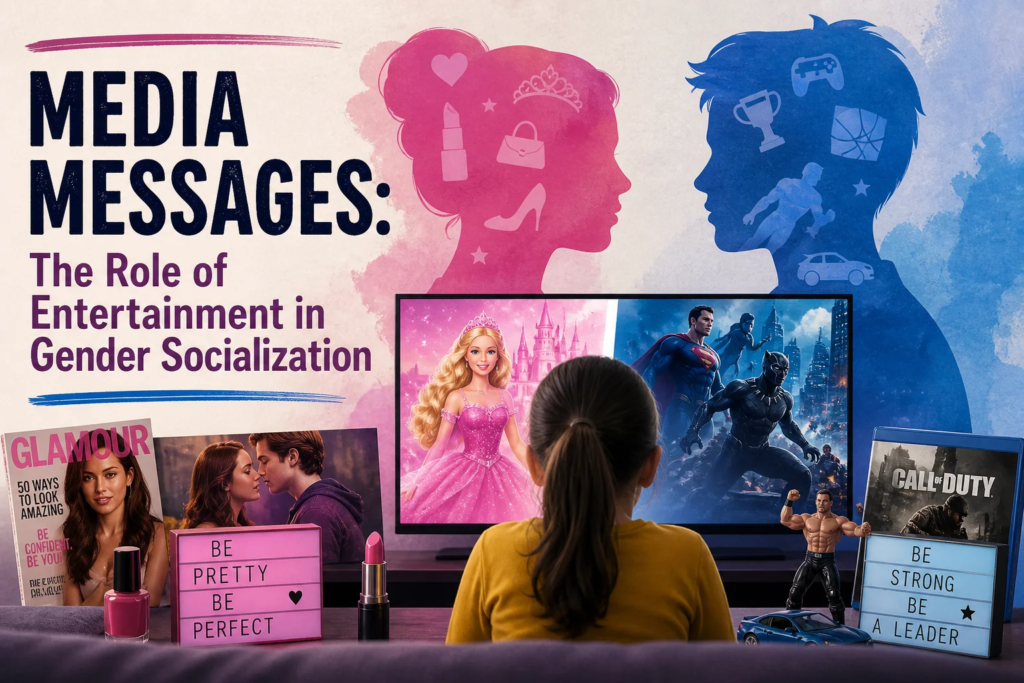
Introduction: The Stories We Watch Become the Scripts We Live
A child does not need a lecture to learn what society expects from boys and girls. Sometimes, all it takes is a cartoon hero, a princess dress, a superhero lunchbox, a music video, a sitcom joke, or a video game avatar.
Entertainment is never “just entertainment.” It is a powerful cultural classroom.
From Disney films and streaming series to TikTok trends, reality TV, sports broadcasts, music lyrics, and gaming worlds, media quietly teaches people what masculinity and femininity should look like. It shows who gets to be brave, beautiful, emotional, powerful, funny, desirable, intelligent, or in charge. These messages shape how children imagine themselves, how teenagers perform identity, and how adults judge others.
That is why Media Messages: The Role of Entertainment in Gender Socialization matters so deeply. It is not simply an academic topic. It affects confidence, career choices, body image, relationships, leadership, parenting, and even mental health.
The good news? Media can reinforce limiting stereotypes, but it can also challenge them. Entertainment has the power to normalize girls in science, boys expressing emotions, women leading nations, men caregiving, nonbinary people existing fully, and everyone having more freedom to become who they are.
This article explores Media Messages: The Role of Entertainment in Gender Socialization in depth: how entertainment shapes gender expectations, where stereotypes appear, what real-world case studies reveal, and how audiences, parents, educators, and creators can respond with awareness and intention.
What Does Gender Socialization Mean?
Gender socialization is the process through which people learn society’s expectations about gender. These expectations can include how people should dress, speak, behave, work, love, parent, lead, and express emotion.
This learning begins early. A baby may be wrapped in pink or blue before they can speak. Toys may be labeled “for boys” or “for girls.” Adults may praise girls for being pretty and boys for being strong. Over time, these repeated signals become a social map.
Entertainment is one of the most influential parts of that map.
When we talk about Media Messages: The Role of Entertainment in Gender Socialization, we are asking: What do movies, shows, games, ads, songs, and online content teach people about gender?
They may teach that:
- Boys should be tough, competitive, and emotionally restrained.
- Girls should be attractive, nurturing, and agreeable.
- Men should lead while women support.
- Women’s value is tied to beauty and youth.
- Men’s value is tied to strength and success.
- LGBTQ+ and nonbinary identities are invisible, comic relief, or “other.”
- Certain careers are naturally masculine or feminine.
These messages are not always obvious. Often, they are embedded in casting, costume design, dialogue, camera angles, plotlines, jokes, music videos, and advertising.
Why Entertainment Is Such a Powerful Teacher
Entertainment works because it bypasses resistance. People may question a textbook, but they often absorb a beloved movie emotionally. A song can repeat a message hundreds of times. A character can become a role model. A storyline can make an unfamiliar identity feel human and relatable.
The power of Media Messages: The Role of Entertainment in Gender Socialization lies in repetition and emotional connection.
Children may watch the same film dozens of times. Teenagers may follow influencers daily. Adults may spend years with characters in long-running shows. This repetition builds familiarity, and familiarity often feels like truth.
How Entertainment Shapes Gender Beliefs
| Entertainment Feature | Gender Message It Can Send | Possible Impact |
|---|---|---|
| Hero is usually male | Boys are natural leaders and protectors | Girls may see leadership as less available to them |
| Female characters are praised for beauty | Appearance is central to female worth | Body image pressure may increase |
| Boys mocked for crying | Vulnerability is unmasculine | Boys may suppress emotions |
| Mothers shown as default caregivers | Care work is women’s responsibility | Unequal household expectations may continue |
| Women underrepresented in STEM roles | Science and technology are masculine | Girls may feel less encouraged in STEM fields |
| LGBTQ+ characters shown as jokes | Queerness is abnormal or unserious | Stigma and exclusion may grow |
| Diverse gender roles normalized | Identity is flexible and expansive | Viewers may feel freer and more accepting |
This is why Media Messages: The Role of Entertainment in Gender Socialization should be understood not as a niche concern, but as a daily social force.
The Hidden Curriculum of Movies, TV, Music, and Games
Schools have formal curricula. Entertainment has hidden curricula.
The hidden curriculum includes the values and norms people learn without being directly taught. In media, this might involve who speaks the most, who gets interrupted, who makes decisions, who is sexualized, who sacrifices, and who survives.
For example, a fantasy film may never say “men are better leaders,” but if every king, warrior, mentor, and chosen hero is male, the message is still there. A romantic comedy may never say “women must be beautiful to be loved,” but if every female lead is thin, young, and conventionally attractive, the message is repeated.
Understanding Media Messages: The Role of Entertainment in Gender Socialization means learning to notice what is present and what is missing.
Key Questions to Ask While Watching
- Who has power in the story?
- Who gets to be funny, smart, brave, or flawed?
- Who is rewarded, punished, or ignored?
- Whose body is shown for pleasure?
- Who speaks the most?
- What kind of masculinity is celebrated?
- What kind of femininity is celebrated?
- Are gender-diverse characters visible and complex?
- Does the story challenge stereotypes or recycle them?
- What would a child learn from this?
These questions turn passive viewing into media literacy.
Early Childhood Entertainment: The First Gender Lessons
Children’s entertainment is one of the most important areas in Media Messages: The Role of Entertainment in Gender Socialization because young children are still forming basic ideas about identity.
Cartoons, animated films, toys tied to shows, and children’s books often communicate gender roles in simplified ways. A brave boy rescues. A sweet girl cares. A male villain seeks power. A female character seeks love. A father works. A mother comforts.
Of course, children do not absorb every message automatically. Families, culture, personality, and peer groups also matter. But media offers repeated examples of what is “normal.”
Common Gender Messages in Children’s Media
| Message | Example Pattern | Possible Socialization Effect |
|---|---|---|
| Boys are active | Male characters go on quests | Boys may be encouraged toward adventure |
| Girls are decorative | Female characters wear elaborate outfits | Girls may focus more on appearance |
| Caregiving is feminine | Mothers and girls comfort others | Boys may avoid nurturing roles |
| Risk-taking is masculine | Boys fight, explore, or compete | Girls may be discouraged from boldness |
| Beauty equals goodness | Pretty characters are kind; ugly characters are evil | Children may connect appearance with morality |
The topic of Media Messages: The Role of Entertainment in Gender Socialization becomes especially urgent when we realize that these lessons begin before children can critically analyze them.
Case Study 1: Disney Princesses and the Evolution of Femininity
Few entertainment brands have shaped gender imagination as strongly as Disney. For decades, Disney princess films have influenced how children understand femininity, romance, beauty, bravery, and independence.
Early princesses such as Snow White, Cinderella, and Aurora were often gentle, beautiful, patient, and rescued by men. Their stories reflected the gender norms of their time: kindness and beauty were rewarded, while agency was limited.
Later characters began to shift. Ariel pursued curiosity, Belle loved books, Mulan challenged gender expectations, Tiana pursued entrepreneurship, Merida rejected arranged marriage, Moana led a voyage, and Elsa’s story centered more on self-acceptance than romance.
Brief Analysis
This case study is highly relevant to Media Messages: The Role of Entertainment in Gender Socialization because it shows that media messages are not fixed. They evolve with social values.
Disney did not simply entertain children; it participated in defining girlhood. As gender expectations changed, princess narratives became more complex. Yet tensions remain. Many princesses still meet narrow beauty standards, and merchandise often emphasizes gowns and glamour over courage and leadership.
The lesson: representation can improve, but progress must be examined carefully. A character can be independent in the story and still be marketed primarily through beauty.
Teen Media and the Pressure to Perform Gender
Teenagers are especially sensitive to media messages because adolescence is a period of identity formation. Teens are asking: Who am I? Am I attractive? Do I fit in? What kind of person should I become?
Teen dramas, reality shows, social platforms, music videos, and celebrity culture often intensify gender expectations.
Girls may encounter messages that they should be effortlessly beautiful, sexually appealing but not “too sexual,” confident but not intimidating, smart but still likable. Boys may be told to be muscular, emotionally controlled, sexually successful, dominant, and financially ambitious.
This is a central concern in Media Messages: The Role of Entertainment in Gender Socialization: gender expectations often become contradictory and impossible.
The Double Bind in Entertainment
| For Girls and Women | For Boys and Men |
|---|---|
| Be attractive, but not vain | Be strong, but not aggressive |
| Be confident, but not bossy | Be emotional, but not weak |
| Be sexy, but not “too sexual” | Be successful, but not vulnerable |
| Be independent, but still nurturing | Be caring, but still dominant |
| Be ambitious, but not intimidating | Be competitive, but not cruel |
Entertainment often presents these impossible standards as normal. The result can be anxiety, shame, self-monitoring, and reduced authenticity.
Social Media Influencers as Entertainment Educators
Today, entertainment is not limited to film and television. Social media platforms have transformed ordinary people into daily performers of lifestyle, beauty, humor, parenting, fitness, romance, and success.
Influencers shape gender socialization through:
- Makeup tutorials
- Fitness routines
- Dating advice
- “Day in the life” videos
- Fashion hauls
- Parenting content
- Masculinity coaching
- Relationship commentary
- Comedy skits
- Reaction videos
The key difference is intimacy. Viewers may feel like influencers are friends. This makes Media Messages: The Role of Entertainment in Gender Socialization even more personal.
A traditional advertisement may say, “Buy this product.” An influencer says, “This is how I live, look, date, parent, and succeed.” That lifestyle can become a gender template.
Positive and Negative Influencer Messages
| Influencer Content Type | Potentially Limiting Message | Potentially Empowering Message |
|---|---|---|
| Beauty content | Women must constantly improve appearance | Self-expression can be creative and joyful |
| Fitness content | Masculinity requires extreme muscularity | Strength supports health and confidence |
| Dating advice | Men should dominate; women should please | Healthy relationships require respect |
| Parenting content | Mothers must do everything perfectly | Caregiving should be shared |
| Career content | Success requires sacrificing identity | Many paths to success are valid |
| Fashion content | Gender expression must fit norms | Style can be fluid and personal |
In the digital age, Media Messages: The Role of Entertainment in Gender Socialization is not only about what studios produce. It is also about what algorithms amplify.
Algorithms and the Gender Feedback Loop
Algorithms are not neutral storytellers. They learn what users watch and then recommend more of the same. If a teenager watches one video about “how to be more feminine” or “how to become an alpha male,” the platform may serve dozens more.
This creates a gender feedback loop:
- User clicks gender-coded content.
- Algorithm recommends similar content.
- Repetition makes the message feel common.
- Common begins to feel normal.
- Normal begins to feel expected.
This algorithmic repetition makes Media Messages: The Role of Entertainment in Gender Socialization more intense than in earlier media eras. People no longer just watch a weekly episode; they may consume hundreds of short videos reinforcing the same gender message in a single day.
The entertainment environment has become personalized, constant, and persuasive.
Music Videos and Gender Performance
Music has always influenced identity, but music videos add visual scripts to lyrics. They show how gender should move, dress, flirt, dominate, desire, and perform status.
Some music videos challenge norms by celebrating queer identity, female power, emotional vulnerability, or gender-fluid fashion. Others reinforce objectification, hypermasculinity, or narrow beauty standards.
The importance of Media Messages: The Role of Entertainment in Gender Socialization becomes clear when we consider how songs and images become part of everyday life. People repeat lyrics, imitate dances, copy aesthetics, and internalize romantic ideals.
Repeated Gender Themes in Music Entertainment
| Theme | Common Message | Possible Effect |
|---|---|---|
| Male dominance | Men control money, women, and space | Dominance may be linked to masculinity |
| Female desirability | Women are valued for sexual appeal | Self-worth may become appearance-based |
| Heartbreak femininity | Women suffer beautifully | Pain may be romanticized |
| Emotional masculinity | Men express sadness through music | Can expand emotional permission for boys |
| Queer celebration | Gender and desire are diverse | Can increase visibility and acceptance |
| Luxury status | Wealth equals attractiveness | Success may be narrowly defined |
Music can be liberating or limiting. Often, it is both.
Video Games: Gender Roles in Interactive Worlds
Video games are especially powerful because players do not merely watch; they participate. They choose characters, make decisions, compete, explore, and identify with avatars.
For years, many mainstream games centered male protagonists and sexualized female characters. Women were often side characters, rewards, victims, or hyper-stylized fighters. Male heroes were frequently muscular, violent, emotionally stoic, and mission-driven.
But gaming has changed. More games now feature complex female protagonists, customizable gender expression, queer storylines, and emotional narratives.
This makes gaming a fascinating area of Media Messages: The Role of Entertainment in Gender Socialization because it combines representation with agency.
Case Study 2: “The Last of Us” and Complex Gender Representation
“The Last of Us” franchise, especially through the character Ellie, offers a notable example of more layered representation. Ellie is not presented as a decorative female character. She is brave, flawed, funny, angry, vulnerable, loving, and morally complex. Her identity includes queerness, but her character is not reduced to it.
Brief Analysis
This case study matters to Media Messages: The Role of Entertainment in Gender Socialization because it shows how entertainment can broaden gender expectations. Ellie’s character challenges the idea that female characters must be passive, polished, or secondary. The game also allows emotional depth in male characters, particularly through themes of grief, protection, fear, and attachment.
The relevance is clear: when players inhabit complex characters, they may develop more flexible ideas about gender, strength, and vulnerability.
Sitcoms, Comedy, and the “Just a Joke” Problem
Comedy is one of the most overlooked areas in Media Messages: The Role of Entertainment in Gender Socialization. Jokes often carry social rules. They tell audiences what is ridiculous, acceptable, embarrassing, or desirable.
For decades, sitcoms relied on familiar gender humor:
- The clueless husband
- The nagging wife
- The overprotective father
- The vain teenage girl
- The nerdy boy who cannot get girls
- The masculine woman as a punchline
- The feminine man as a punchline
Comedy can normalize stereotypes because laughter lowers defenses. If a joke is repeated often enough, it can make inequality seem harmless.
However, comedy can also expose stereotypes. Shows that parody toxic masculinity, gender expectations, or beauty standards can help viewers see how absurd those norms are.
The question is not whether comedy should be serious. The question is whether the joke punches up at the stereotype or punches down at the person.
Reality TV and the Performance of Gender
Reality television often presents itself as unscripted, but it is heavily edited and produced. Contestants are cast into roles: the diva, the bachelor, the jealous girlfriend, the alpha male, the innocent girl, the career woman, the villain mother.
Dating shows are especially important in Media Messages: The Role of Entertainment in Gender Socialization because they dramatize romance, desirability, competition, and gender roles.
Many dating formats still rely on traditional scripts: men pursue, women compete, beauty is currency, jealousy proves passion, and marriage is the ultimate prize. Yet newer shows sometimes experiment with queer dating, emotional openness, and more diverse body types or relationship models.
Reality TV teaches not just what gender is, but how gender should be performed under social pressure.
Advertising Within Entertainment
Entertainment and advertising are deeply connected. Product placement, sponsorships, branded content, and influencer partnerships all carry gender messages.
A superhero film may sell boys action figures and girls beauty products. A cooking show may target women with household goods. A sports broadcast may market trucks, beer, and financial services to men. A beauty reality show may turn self-improvement into an endless purchasing cycle.
This commercial layer is central to Media Messages: The Role of Entertainment in Gender Socialization because gender stereotypes are profitable. If companies convince people that femininity requires constant beauty maintenance and masculinity requires status products, consumption increases.
Gendered Marketing Patterns
| Product Category | Traditional Target | Common Gender Message |
|---|---|---|
| Beauty products | Women and girls | Your appearance needs improvement |
| Cars and tools | Men and boys | Power and control define masculinity |
| Cleaning products | Women | Domestic labor is feminine |
| Protein supplements | Men | Bigger bodies mean stronger identity |
| Toys | Children by gender | Boys build; girls care |
| Fashion | Women | Identity depends on presentation |
Entertainment does not simply reflect culture. It sells culture back to us.
Case Study 3: LEGO and the Gendering of Play
LEGO has long been associated with building, creativity, engineering, and problem-solving. However, like many toy brands, it has also faced criticism for gendered marketing.
Some LEGO sets have historically been marketed more toward boys through themes of construction, combat, vehicles, and adventure. LEGO Friends, introduced with pastel colors and social settings, was designed partly to attract girls. Critics argued that this reinforced gender divisions; supporters argued it brought more girls into building play.
Over time, LEGO has made efforts to promote creativity beyond rigid gender categories, including campaigns encouraging all children to build.
Brief Analysis
This case study is directly tied to Media Messages: The Role of Entertainment in Gender Socialization because toys linked to entertainment franchises are part of the media ecosystem. Children do not only watch gender roles; they play them.
If boys are encouraged to build cities and girls are encouraged to build cafés, children may internalize different visions of competence and imagination. The most valuable lesson is that play should expand possibilities, not narrow them.
Representation Matters, But Quality Matters More
A common response to concerns about Media Messages: The Role of Entertainment in Gender Socialization is: “At least there is representation now.” That is true, and it matters. But representation alone is not enough.
The quality of representation is just as important.
A female character can be present but silent. A queer character can appear but be stereotyped. A male caregiver can exist but be mocked. A woman leader can be powerful but punished by the storyline for ambition.
Better Questions About Representation
| Basic Question | Deeper Question |
|---|---|
| Is there a woman in the story? | Does she have agency, complexity, and goals? |
| Is there a male character who cries? | Is his vulnerability respected or mocked? |
| Is there LGBTQ+ representation? | Is the character fully human or tokenized? |
| Are girls shown in STEM? | Are they competent without being treated as unusual? |
| Are men shown as caregivers? | Is caregiving portrayed as valuable masculinity? |
| Is there diversity? | Do characters avoid stereotypes across race, class, body, and gender? |
This deeper approach makes Media Messages: The Role of Entertainment in Gender Socialization more meaningful. The goal is not box-checking. The goal is richer human possibility.
Intersectionality: Gender Is Never Alone
Gender socialization does not happen in isolation. Race, class, sexuality, disability, religion, body size, nationality, and age all shape how gender is represented.
For example:
- Black women may be portrayed as strong but denied softness.
- Asian men may be desexualized or stereotyped as nerdy.
- Latina women may be hypersexualized.
- Disabled women may be infantilized.
- Working-class men may be portrayed as rough or unintelligent.
- Older women may disappear from romantic storylines.
- Trans people may be sensationalized rather than humanized.
Any serious discussion of Media Messages: The Role of Entertainment in Gender Socialization must include intersectionality. Otherwise, we risk talking about “women” or “men” as if everyone experiences gender the same way.
Entertainment can either flatten identity or illuminate its richness.
Case Study 4: “Hidden Figures” and Women in STEM
The film “Hidden Figures” tells the story of Black women mathematicians Katherine Johnson, Dorothy Vaughan, and Mary Jackson, whose work was crucial to NASA during the Space Race.
The film challenged multiple stereotypes at once. It showed women as brilliant scientists, Black women as intellectual leaders, and mothers as professionals with ambition and skill. It also highlighted systemic barriers without reducing the characters to victimhood.
Brief Analysis
“Hidden Figures” is a powerful case study in Media Messages: The Role of Entertainment in Gender Socialization because it demonstrates how entertainment can correct cultural memory. Many viewers had not learned these women’s stories in school.
The film expanded the image of who belongs in science, mathematics, engineering, and national achievement. It also offered young viewers, especially girls of color, a visible counter-message to decades of underrepresentation.
The impact of such stories goes beyond inspiration. They help rewrite the public imagination.
Positive Media Messages That Expand Gender Possibility
Not all gender socialization through entertainment is harmful. Many media messages are empowering, compassionate, and transformative.
Positive entertainment can teach that:
- Girls can lead without losing warmth.
- Boys can cry without losing strength.
- Women can be ambitious without being villains.
- Men can be caregivers without being weak.
- Beauty comes in many forms.
- Romance should include respect.
- Gender expression can be creative.
- Friendship matters as much as romance.
- LGBTQ+ people deserve joy, not just trauma.
- Power can be collaborative, not dominating.
This is the hopeful side of Media Messages: The Role of Entertainment in Gender Socialization. Media can be a tool of liberation as much as limitation.
The Role of Parents and Caregivers
Parents and caregivers do not need to ban every problematic movie or show. In fact, shielding children from all stereotypes is nearly impossible. A more effective approach is conversation.
Media literacy can begin with simple questions:
- “Who got to be the hero?”
- “Was that joke fair?”
- “Do you think boys can like that too?”
- “Why do you think the girl character was dressed differently?”
- “What would you change about the story?”
- “How did that character show courage?”
- “Can someone be strong and kind?”
When families discuss Media Messages: The Role of Entertainment in Gender Socialization, children learn to think critically rather than absorb passively.
Practical Tips for Families
| Strategy | How It Helps |
|---|---|
| Watch together when possible | Creates opportunities for discussion |
| Offer diverse stories | Expands children’s sense of possibility |
| Question stereotypes gently | Builds critical thinking |
| Avoid shaming children’s preferences | Keeps conversation open |
| Balance fantasy with real examples | Connects media to real life |
| Encourage mixed-gender play and interests | Reduces rigid identity boxes |
The goal is not to make children suspicious of everything. The goal is to help them become thoughtful viewers.
The Role of Educators
Teachers can use entertainment as a gateway to critical thinking. Students are often more engaged when lessons connect to shows, films, games, and music they already know.
In classrooms, Media Messages: The Role of Entertainment in Gender Socialization can be explored through:
- Character analysis
- Advertising breakdowns
- Film comparisons
- Music video discussions
- Social media literacy projects
- Gender representation audits
- Creative rewriting exercises
- Debates about stereotypes and agency
For example, students might compare an older princess film with a newer one. They could track who speaks, who makes decisions, who solves problems, and who is rewarded. This turns entertainment into evidence.
Media literacy should not be an optional skill in the modern world. It is a civic necessity.
The Responsibility of Entertainment Creators
Writers, directors, producers, game designers, casting teams, advertisers, and influencers all participate in gender socialization. Whether they intend to or not, they create templates for identity.
Creators should ask:
- Am I relying on lazy gender stereotypes?
- Does this character have agency?
- Who is being objectified?
- Who is missing from the story?
- Are emotional traits gendered unnecessarily?
- Does the plot punish someone for breaking gender norms?
- Are diverse voices included behind the scenes?
- Would this portrayal feel truthful to people with lived experience?
The future of Media Messages: The Role of Entertainment in Gender Socialization depends heavily on creative responsibility. Audiences are becoming more media literate, and shallow representation is easier to spot than ever.
Good storytelling does not suffer when stereotypes are challenged. It becomes better.
A Simple Framework for Analyzing Gender in Entertainment
To make Media Messages: The Role of Entertainment in Gender Socialization practical, use the “VOICE” framework:
| Letter | Meaning | Question |
|---|---|---|
| V | Visibility | Who is present and who is missing? |
| O | Ownership | Who controls the story and decisions? |
| I | Identity | How are gender, race, class, sexuality, and body represented? |
| C | Complexity | Are characters multidimensional or stereotyped? |
| E | Effect | What might viewers learn from this portrayal? |
This framework works for films, shows, games, ads, music videos, and influencer content. It is simple enough for classrooms and families, but deep enough for professional analysis.
How Audiences Can Push for Better Media
Audiences are not powerless. Entertainment industries respond to attention, money, criticism, and demand.
You can support healthier gender messages by:
- Watching and sharing media with nuanced representation.
- Discussing stereotypes publicly and respectfully.
- Supporting creators from underrepresented groups.
- Asking schools to include media literacy.
- Encouraging children to explore diverse interests.
- Avoiding content that promotes harmful gender ideals.
- Praising stories that show emotional range and equality.
- Questioning gendered marketing.
- Creating your own alternative media.
- Staying curious rather than judgmental.
The conversation around Media Messages: The Role of Entertainment in Gender Socialization is not about canceling joy. It is about expanding freedom.
We can still love films, songs, shows, and games while asking better questions about them.
The Future of Gender Socialization in Entertainment
The future is already shifting. Streaming platforms have opened space for more niche stories. Independent creators can reach global audiences. Young viewers are more vocal about representation. Gender-fluid fashion, queer storytelling, women-led action films, male vulnerability, and diverse family structures are more visible than before.
Still, backlash exists. Some audiences resist change, arguing that inclusion is forced or that traditional gender roles are under attack. But gender diversity in entertainment is not about removing anyone’s identity. It is about making room for more people to be seen.
The next stage of Media Messages: The Role of Entertainment in Gender Socialization will likely involve deeper questions:
- Can media move beyond “strong female characters” into fully human female characters?
- Can boys see masculinity modeled through care, honesty, and cooperation?
- Can nonbinary and trans characters exist in ordinary genres, not only issue-driven stories?
- Can beauty standards become genuinely diverse?
- Can entertainment stop treating equality as a trend and start treating it as reality?
The best media of the future will not simply reverse stereotypes. It will make them less necessary.
Conclusion: Better Stories Create Bigger Lives
Entertainment shapes us because stories shape what we believe is possible.
A child who sees girls saving kingdoms, boys caring for siblings, women solving equations, men speaking tenderly, queer people finding joy, and families sharing labor receives a wider map of life. A teenager who sees beauty in many bodies, courage in vulnerability, and leadership in many genders may feel less trapped by impossible expectations. An adult who learns to notice media messages may become a better parent, teacher, creator, partner, or citizen.
That is the heart of Media Messages: The Role of Entertainment in Gender Socialization. Media does not control us completely, but it does influence the scripts available to us. When those scripts are narrow, people shrink themselves to fit. When those scripts are expansive, people breathe more freely.
The action step is simple: watch with curiosity. Ask what a story is teaching. Share better stories. Challenge lazy stereotypes. Support creators who widen the human picture.
Because when entertainment changes, imagination changes. And when imagination changes, society can change with it.
1. What is the main idea behind Media Messages: The Role of Entertainment in Gender Socialization?
Media Messages: The Role of Entertainment in Gender Socialization refers to how entertainment teaches people gender norms, roles, and expectations. Movies, TV shows, music, games, ads, and social media all communicate ideas about masculinity, femininity, beauty, power, emotion, work, and relationships.
2. Does entertainment really influence how children understand gender?
Yes. Entertainment is one of many influences, alongside family, school, peers, and culture. Children often learn through repetition and imitation. When they repeatedly see boys as heroes and girls as helpers, or women as beautiful and men as powerful, those patterns can shape their assumptions about what is normal or expected.
3. Is all gendered entertainment harmful?
No. Gendered entertainment is not automatically harmful. The concern is when media repeatedly limits people to narrow stereotypes. Entertainment can also offer positive gender socialization by showing diverse, complex, and empowering characters across all genders.
4. How can parents talk to children about gender stereotypes in media?
Parents can ask simple, open-ended questions while watching shows or movies. For example: “Who made the decisions in this story?” “Could a boy or girl both do that?” “Was that character treated fairly?” These conversations help children develop media literacy without making entertainment feel like homework.
5. Why is representation not enough by itself?
Representation matters, but quality matters too. A character from an underrepresented group can still be stereotyped, tokenized, or given little agency. Strong representation means characters are complex, meaningful, and allowed to have full human experiences.
6. How does social media affect gender socialization differently from traditional media?
Social media is more constant, personalized, and interactive. Algorithms can repeatedly show users similar gender-related content, creating a feedback loop. Influencers may also feel more relatable than celebrities, making their gender messages especially persuasive.
7. What can entertainment creators do to improve gender representation?
Creators can avoid lazy stereotypes, develop complex characters, include diverse voices behind the scenes, question gendered assumptions, and portray emotional range across all genders. Better representation usually leads to better storytelling.
8. What is one practical way to analyze gender messages in entertainment?
Use the VOICE framework: Visibility, Ownership, Identity, Complexity, and Effect. Ask who is present, who controls the story, how identity is represented, whether characters are complex, and what viewers may learn from the portrayal. This makes Media Messages: The Role of Entertainment in Gender Socialization easier to evaluate in everyday viewing.


The PsyForU Editorial Collective is the research and editorial team of PsyForU Research International. The collective prepares educational, psychological, mental-health-awareness, inclusion, neurodiversity, and research-methodology content for students, parents, educators, researchers, and general readers. PsyForU content is intended for awareness, education, and capacity-building and should not be treated as clinical diagnosis, therapy, medical advice, legal advice, or emergency mental-health support.