


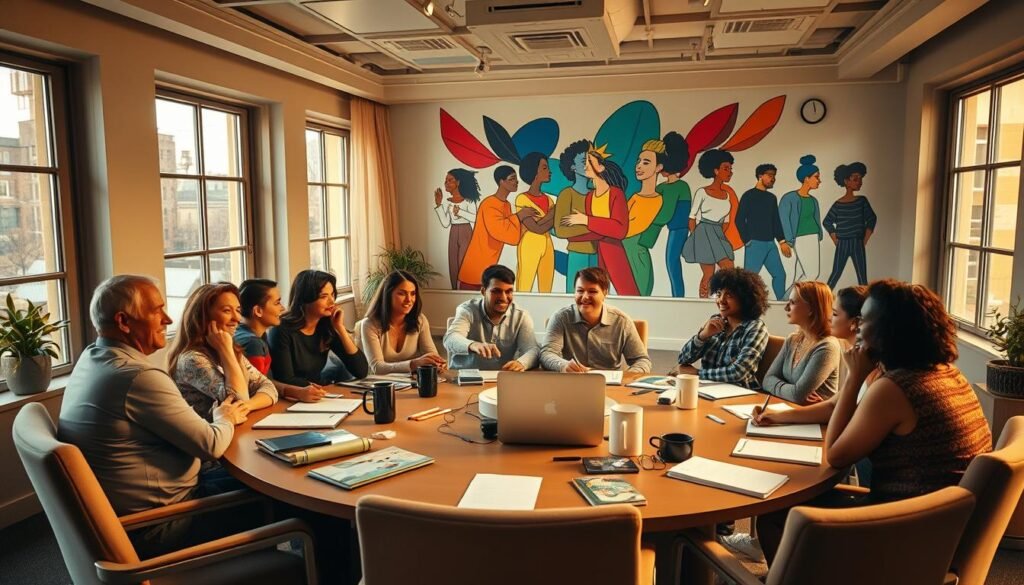
What makes team meetings powerful? It’s not just about how often or how they’re set up. It’s about making sure everyone’s voice is heard.
Today’s workplaces face big challenges. Teams work from all over, and schedules vary. Communication styles differ too, making it hard to connect.
Sociologist Émile Durkheim said communal practices are key to social unity. His work showed that shared experiences help people feel connected. This idea is true for work teams too.
But, research shows that bad team rituals can harm. When people feel left out or forced to join in, it doesn’t work. Forcing people to join in without meaning makes them resentful, not united.
Good team work comes from being inclusive. Leaders need to make sure everyone feels safe and respected. This way, team rituals can really bring people together.
Key Takeaways
- Workplace ceremonies help connect teams in today’s world, bridging gaps between people.
- Forced team activities can actually make people feel more alone, not part of a team.
- Durkheim’s work shows that shared experiences are key to team success.
- Psychological safety and fair participation are must-haves, not extras, for team success.
- Good team rituals respect everyone’s communication style, needs, and culture.
- Organizations should focus on meaningful design, not just mandates, to build unity.
- Keeping teams together requires intentional, inclusive interactions, no matter where they work.
Why Inclusive Meetings Matter for Team Success
Inclusive meetings boost retention, innovation, and team performance. Studies show that inclusive team collaboration leads to happier employees and better problem-solving. Yet, many leaders see inclusivity as a nice-to-have, not a must-have for success.
The modern workplace is changing fast. Few want to go back to the office full-time. Remote workers feel more engaged but also more stressed than office workers.
Remote work lacks the connection found in offices. Sharing meals and stories, making friends, and getting help quickly are key. These moments help prevent burnout and keep teams strong.

Remote workers often look for new jobs, even if they like their current setup. This shows that being alone can’t replace the connection found in offices.
Bad meeting practices hurt teams. Meetings that are hard to join, don’t let everyone speak, or are insensitive can harm everyone. This leads to:
- People not contributing their best ideas
- Less innovation and less competitive edge
- Less trust and less willingness to try new things
- Leadership and team members not trusting each other
Workplace inclusivity practices help solve the remote work problem. They create the social support found in offices. Inclusive meetings help teams feel connected and support each other’s well-being.
Effective team communication helps everyone, not just some. Meetings that respect different ways of communicating and participating make everyone feel valued. This way, everyone can contribute fully.
Introverts and those who think differently can share their ideas without feeling rushed. This makes teams smarter and more diverse. Everyone’s voice is heard, leading to better decisions.
Teams that use inclusive meeting strategies do better. They innovate more, keep employees longer, and complete projects better. This shows how important it is to feel safe and valued in meetings.
Organizations have a choice: keep meetings the same or make them inclusive. Inclusive meetings help teams work better, innovate more, and keep employees happy. It’s a smart choice for any business.
Research shows that inclusive meetings are key to success. They improve how teams work, innovate, and keep employees. It’s time for leaders to see meetings as a chance to build a better workplace.
The Foundation: Understanding What Makes Meetings Truly Inclusive
True inclusivity in workplace meetings is more than just inviting diverse people. It’s about understanding the factors that let everyone contribute. Organizations often confuse diversity with inclusivity, but they’re not the same. Diversity is about who’s in the room, while inclusivity is about whose voice matters.
Research shows that diverse teams without inclusive practices don’t perform as well as homogeneous ones. This is because diverse views need intentional ways to work together, not just to clash.
To understand inclusive collaboration, we must look at the social and psychological environment of work. This includes how people interact, their cultural backgrounds, and the support systems they have. Theories like Bandura’s Social Cognitive Theory and Bronfenbrenner’s Social Ecological Model show that changing behavior needs a supportive environment.

Defining Inclusive Collaboration in Modern Workplaces
Inclusive collaboration means creating a space where everyone can contribute, no matter their background or ability. It’s about designing meetings to fit different needs, just like architects design buildings for everyone. This approach makes collaboration a goal, not just a wish.
Today’s workplaces are complex due to differences in age, location, and culture. Traditional meetings often leave out people who communicate differently or use technology in unique ways. So, we need to find ways to include everyone’s perspectives.
Self-Determination Theory helps us understand what makes meetings inclusive. It says people need autonomy, competence, and relatedness to contribute fully. Meetings that respect these needs spark creativity and effort, while those that don’t lead to withdrawal.
Looking at common barriers in meetings shows why inclusivity matters. Meetings that favor quick talk over written input ignore some people’s needs. Meetings in one language exclude others, and ignoring power dynamics silences some voices. These barriers make meetings seem inclusive but aren’t.
The Four Dimensions of Meeting Inclusivity
Inclusive meetings have four key areas: accessibility, participation, psychological safety, and cultural responsiveness. Understanding these areas as a whole is key to making meetings inclusive. This approach comes from decades of research and best practices in communication.
Each dimension is important but not enough on its own. A meeting might be accessible but not safe, or inclusive but not culturally responsive. Meeting design must address all these areas to be truly inclusive.
| Dimension | Primary Focus | Key Mechanisms | Common Barriers |
|---|---|---|---|
| Accessibility and Accommodation | Physical and technological prerequisites | Captioning, screen readers, adjustable formats | Lack of assistive technology, inflexible platforms |
| Equitable Participation and Voice | Power dynamics and conversational structures | Structured turn-taking, balanced speaking time | Dominant personalities, hierarchical deference |
| Psychological Safety and Belonging | Emotional conditions for risk-taking | Leader vulnerability, collaborative norms | Fear of judgment, past negative experiences |
| Cultural Responsiveness | Recognition of communication norm variation | Multiple interaction styles, cultural bridging | Monocultural assumptions, unstated expectations |
Accessibility and Accommodation
Accessibility is the foundation of inclusive meetings. It ensures everyone can participate by addressing physical and technological barriers. This dimension is about creating a basic level of participation for all.
Common barriers include meetings without captions, visual materials without descriptions, and platforms not compatible with screen readers. These barriers exclude certain groups and are often invisible to those not affected. Together, they create environments that seem inclusive but aren’t.
Effective accessibility follows universal design principles. Features that help specific needs often benefit everyone. Captions help not just deaf people but also those in noisy places or with auditory processing issues. Sharing agenda materials in advance helps everyone, not just those who need more time.
Equitable Participation and Voice
Equitable participation ensures everyone has a chance to speak and influence decisions. It’s about more than just being able to speak; it’s about being heard and valued. Without intentional effort, meetings often favor certain voices over others.
Research shows that conversations often favor certain groups, like men or those in positions of power. This is not because of any inherent ability but because of learned behaviors. To change this, we need to actively work against these patterns.
Creating equitable participation requires specific facilitation techniques. Structured turn-taking and tracking speaking time help ensure everyone has a chance to contribute. Asking specific people to contribute helps avoid self-selection bias.
The concept of conversational justice is useful here. It’s like legal justice, needing both fair procedures and equal outcomes. Facilitators must focus on both the rules and how they play out in practice.
Psychological Safety and Belonging
Psychological safety means feeling safe to share ideas and opinions without fear of judgment. It’s about creating an environment where everyone feels valued and respected. Without this, people may hold back, depriving teams of valuable insights.
Amy Edmondson’s research shows that psychological safety is key to team success. Teams that feel safe learn faster, innovate more, and perform better. This is even more important in diverse teams where differences can lead to misunderstandings.
Building psychological safety requires leaders who are open to challenges and uncertainty. Leaders who show vulnerability and respond well to disagreements create a safe space for others. On the other hand, leaders who react defensively or dismiss ideas quickly can destroy this safety.
Belonging goes beyond safety by making people feel valued as themselves, not just tolerated. It’s about feeling included and appreciated. When people feel their unique perspectives are valued, they contribute more and feel part of the team.
Cultural Responsiveness
Cultural responsiveness recognizes that communication styles vary across cultures. It’s about adapting meeting styles to honor different ways of interacting. Cultural differences affect how we communicate, from directness to comfort with silence.
Geert Hofstede’s cultural dimensions framework helps understand these differences. Cultures vary in power distance, individualism versus collectivism, and uncertainty avoidance. These differences shape how we expect meetings to be conducted.
High power distance cultures value deference, while low power distance ones favor open discussion. Collectivist cultures prefer indirect communication, while individualist ones value directness. Both approaches have their place in different cultural contexts.
Effective cultural responsiveness avoids imposing one culture over others. Instead, it aims for cultural bridging: combining elements from different cultures to create inclusive interactions. This might involve using both direct feedback and written reflection periods to engage everyone.
The four dimensions of inclusive meetings interact throughout the meeting process. Accessibility, participation, psychological safety, and cultural responsiveness work together to make meetings truly inclusive. Together, they turn diversity into a competitive advantage by unlocking everyone’s intelligence.
Running Inclusive Meetings and Collaboration Rituals That Work
To build inclusive collaboration rituals, we need more than good intentions. We need systems that make equity a part of every meeting. This shift from understanding inclusivity to making it happen is key. It turns inclusive meetings from a dream into a real practice.
Team rituals are like environments where we practice being inclusive regularly. They are different from habits or routines. Good team rituals come from the team itself, not from someone telling them to do it.
The best inclusive practices need everyone to participate willingly. They show what the organization believes by what they do every day. When teams work together to make meetings better, everyone gets on board.
Core Principles of Effective Inclusive Facilitation
Good facilitators are both planners and quick responders. They make sure meetings are fair but can change when needed. This balance is key.
Four main principles help make meetings inclusive for everyone:
- Intentionality: Every part of the meeting has a purpose that fits with inclusivity goals. Facilitators choose how to run the meeting carefully, not just do it the usual way.
- Transparency: Everyone knows how decisions are made and how to contribute. This makes sure everyone feels included.
- Accountability: Facilitators watch who is talking and make sure everyone gets a chance. They step in if some voices are not heard.
- Iteration: Teams keep improving how they meet based on feedback. This means meetings get better as the team grows and changes.
These principles work together, not one after another. Without transparency, people get confused about how to participate. Not changing how you meet can make it feel too rigid.
Using these principles makes a facilitator more than just someone who manages meetings. They learn to see when certain principles need more focus based on the team and the meeting’s goals.
The Complete Lifecycle: Before, During, and After Meetings
Inclusive meetings need careful planning, skilled facilitation, and follow-up. Each part of the meeting cycle offers chances to be inclusive. But, there are also risks of excluding some people.
The before-during-after approach helps keep meetings inclusive, whether they’re in person or online. It makes sure everyone is treated fairly, no matter the meeting format.
| Lifecycle Phase | Core Inclusive Practices | Common Pitfalls to Avoid | Success Indicators |
|---|---|---|---|
| Before Meetings | Distribute agendas 24+ hours in advance; clarify participation expectations; provide necessary context and pre-reading materials; identify accommodation needs; confirm technology access | Last-minute agenda sharing; assuming universal context knowledge; neglecting accessibility requirements; unclear contribution expectations | Participants arrive prepared; questions submitted in advance; accommodation requests addressed proactively |
| During Meetings | Actively manage speaking time; create multiple contribution channels; monitor psychological safety indicators; use structured turn-taking; acknowledge diverse perspectives; adapt facilitation in real-time | Allowing dominant voices to monopolize; relying solely on verbal contributions; ignoring participation imbalances; rigid adherence to agenda despite emergent needs | Balanced participation across team members; multiple contribution types utilized; participants express ideas comfortably; meeting objectives achieved |
| After Meetings | Distribute accessible documentation within 24 hours; clarify action item ownership; create opportunities for asynchronous input; solicit feedback on facilitation effectiveness; follow up on commitments | Delayed or incomplete documentation; ambiguous accountability; no mechanism for post-meeting contributions; ignoring process feedback | Clear action item tracking; reflective processors contribute ideas post-meeting; continuous improvement in facilitation approach; commitments fulfilled |
This approach recognizes that people process information at different speeds. Some think best in the moment, while others need time to reflect.
The after-meeting phase is key for inclusive collaboration. It lets everyone contribute, even if they need more time to think.
Adapting Your Approach to Different Meeting Types
Different meetings need different strategies. Using the same approach for all doesn’t work. Facilitators need to adjust based on the meeting’s purpose and how people will participate.
Brainstorming and ideation sessions need to encourage many ideas. Good facilitation uses silent brainstorming and round-robin methods. This way, everyone can share without fear of being judged too soon.
Decision-making meetings must be clear about how decisions are made. Facilitators should explain if the meeting is for input, building consensus, or making decisions. Being unclear can make people frustrated and less likely to participate.
Information-sharing gatherings should use different ways to share information. Good facilitation combines talking, visuals, and writing. This way, everyone can understand, no matter how they learn best.
Retrospectives and reflection sessions need to be safe for honest feedback. Facilitators must manage any defensiveness and make sure everyone’s voice is heard. Using structured formats helps keep the conversation balanced.
Cross-functional meetings are challenging because of different expertise levels. Facilitators must manage knowledge differences to make sure everyone contributes. This is important for solving problems fully.
Virtual meetings add extra challenges. Facilitators need to make sure technology is fair and everyone can participate. They must also keep the meeting engaging, as video calls can make people feel less involved.
Using these adapted approaches makes facilitation a skill that can be learned. While experience and sensitivity are helpful, these frameworks provide a way for teams to improve, no matter who is leading the meeting.
Step 1: Design Clear Agendas That Set Everyone Up for Success
Meeting productivity starts with a simple truth: everyone needs to know what’s expected. Clear agendas help make meetings inclusive, not just a waste of time. They give everyone a chance to contribute, no matter their background or how they process information.
Good meeting agendas are key to teamwork success. When everyone knows the meeting’s goals and their role, they can really participate. This makes meetings more productive and less reactive.
Studies show clear agendas can cut meeting time by 20-30%. They also make people happier and more likely to follow up on tasks. This is because clear agendas avoid confusion and unnecessary questions.
Essential Elements Every Inclusive Agenda Needs
Good meeting agendas include many important parts. They help teams work together well by making goals clear and giving everyone a chance to prepare. This makes meetings fair and productive.
Effective agendas do more than just list topics. They help people prepare, assign tasks clearly, and respect everyone’s time. This makes meetings more efficient and respectful.
Every good agenda starts with a clear reason for the meeting. This helps everyone know what to expect. It makes meetings focused and productive.
Outcomes tell everyone what the meeting aims to achieve. Instead of vague goals, agendas have clear tasks. For example, “finalize timeline for Q3 deliverables and assign ownership for each milestone.”
Success criteria make it clear what makes a meeting successful. This can include things like everyone contributing ideas, reaching a decision, or having clear next steps. This clarity helps everyone know what to aim for.
- All participants contribute at least one substantive idea or perspective
- Team reaches consensus on the proposed approach or identifies specific decision points requiring additional input
- Action items include clear ownership, deadlines, and success metrics
- Meeting concludes with documented next steps accessible to all team members
This clarity turns meetings into useful collaborations. People can prepare and contribute meaningfully.
Time Allocations and Topic Ownership
Time slots for each agenda item help everyone. They help those who need structure and signal what’s important. This makes meetings more inclusive and focused.
Assigning topics to specific people makes meetings more inclusive. This way, everyone gets a chance to lead and contribute. It prevents one person from dominating the discussion.
Tools that show the agenda in real-time help keep meetings on track. They balance structure with flexibility, making meetings productive and collaborative.
Preparation Materials and Pre-Reading
Good agendas include all the materials needed for participation. This way, everyone can contribute based on their own process. Some people think better in discussions, others through written materials.
Pre-reading ensures everyone has the same information. This prevents discussions that favor those who already know the topic. It makes meetings more inclusive.
Best practices for materials include:
- Estimated reading time: Tell participants how long it will take to read, respecting their time
- Tiered options: Offer summaries for quick orientation and detailed documents for deeper preparation
- Accessibility standards: Make sure materials are compatible with screen readers and easy to understand
- Guidance on focus areas: Highlight specific sections or questions to consider
Creating these practices with employees improves meetings. It makes them more productive and inclusive. It respects everyone’s unique contributions.
Sharing Agendas in Advance: The 24-Hour Rule
Sharing agendas at least 24 hours in advance is a minimum. Research shows 48-72 hours is better for inclusivity. It helps people from different time zones and with different needs.
Advance distribution lets participants prepare. It helps them formulate ideas, translate concepts, and consult with others. It also helps identify any scheduling conflicts early.
This approach makes meetings more engaging. Participants come prepared, ready to contribute. It turns meetings into meaningful collaborations.
Effective meeting techniques focus on voluntary adoption. When leaders lead by example, the practice spreads. It becomes part of the company culture.
Building in Flexibility for Different Processing Styles
Good agendas are flexible, allowing for new ideas and authentic dialogue. Being too rigid can stifle creativity. It’s important to balance structure with flexibility.
Facilitators should have buffer time for unexpected topics. This allows for deeper discussions and more valuable insights. It makes meetings more productive and inclusive.
Collaborative decision-making often doesn’t follow a straight path. Agendas should be flexible enough to accommodate this. This way, discussions can explore complex topics without feeling rushed.
Agendas should also offer different ways for people to participate. This can include silent reflection, written input, or small group discussions. It respects different ways of thinking and contributing.
- Silent reflection periods before discussion begins
- Written input through collaborative documents or chat channels alongside verbal contributions
- Small breakout discussions before large group synthesis
- Post-meeting input windows for participants who formulate perspectives after initial conversations
This approach values different cognitive processes. It aims for equitable participation, not uniformity. It makes meetings more inclusive and productive.
Organizations that adopt these agenda principles see big improvements. Meetings become more productive and inclusive. They respect everyone’s unique contributions and needs.
Step 2: Establish Psychological Safety as Your Meeting Foundation
Creating a safe space for team members to share thoughts and ideas is key. This approach changes how meetings work. It’s more important than any agenda or technique.
Amy Edmondson’s research shows that psychological safety means feeling safe to take risks. This feeling comes from consistent experiences, not just words. When everyone feels heard, they start to contribute more freely.
To build psychological safety, leaders need to act in certain ways. They must create practices and norms that make everyone feel included. This helps teams work better together.
What Psychological Safety Looks Like in Practice
Psychological safety is seen in how team members act. They share ideas without fear of being judged. They also ask questions to learn more.
In safe meetings, people can disagree without fear. They question decisions and explore different views. This leads to better outcomes than just agreeing for the sake of it.
Admitting mistakes is another sign of safety. When someone makes a mistake, they share it openly. This openness helps everyone learn and grow.
Regular check-ins help team members feel heard. They can share concerns and get support. This shows the team is committed to solving problems together.
Leader Behaviors That Build Trust and Openness
Leaders set the tone for meetings. They show openness to different ideas and opinions. This encourages others to do the same.
There are specific ways leaders can build trust. By doing these things, they create a safe space for everyone to contribute.
Modeling Vulnerability and Admitting Uncertainty
Leaders who show vulnerability set a good example. They talk about their own doubts and decisions. This shows that it’s okay to not have all the answers.
Sharing the reasons behind decisions helps team members understand. It shows that decisions are complex and often imperfect.
Leaders who admit they’re learning something new inspire the team. This is important in fields that change fast. It shows that growth is expected and valued.
Responding Constructively to Dissent
How leaders handle disagreement is key. They should value different opinions and show appreciation for them. This encourages open discussion.
Pausing before responding to criticism helps keep meetings calm. It shows that the leader is thinking carefully. This creates a space for productive conversation.
Asking questions about opposing views shows genuine interest. It invites more discussion and helps find better solutions. This approach leads to stronger decisions.
Thanking people for sharing difficult opinions helps build trust. It shows that their contributions are valued. This encourages more open discussion in the future.
Setting Ground Rules Collaboratively
Creating ground rules together makes them more meaningful. It shows that everyone is invested in the meeting’s success. Ground rules are best set when the team is new or starting a new project.
Good ground rules cover both how to talk and how to work together. They include rules for taking turns and respecting each other’s space. These rules help everyone know what to expect.
Relational ground rules are about how to work together well. They include things like assuming good intentions and respecting different opinions. These rules help the team work together smoothly.
- Assume positive intent: Interpret comments charitably
- Separate ideas from identities: Critique proposals without criticizing the people who suggest them
- Distinguish brainstorming from decision-making: Clarify when generating options versus evaluating them
- Make space, take space: Encourage dominant speakers to create room while inviting quieter members to contribute
- Acknowledge impact over intent: Recognize that well-intentioned comments can cause harm
Talking about meeting culture helps everyone understand each other better. It brings out different expectations and needs. This helps the team work together better.
Reviewing ground rules regularly helps them stay relevant. A quarterly review is a good time to check if they’re working. This keeps the rules flexible and useful as the team changes.
If someone breaks a rule, talking about it in terms of the rule helps. It avoids personal attacks. This keeps the team working together without hurting feelings.
Step 3: Create Equitable Turn-Taking and Speaking Time
Meetings often show who gets to talk and who doesn’t. This can be unfair, based on who is most outgoing or has the most power. It’s important for teams to hear from everyone to solve problems well.
Using equitable participation strategies helps everyone get a chance to speak. By setting rules for talking, meetings become more fair. This builds trust and makes sure everyone’s voice is heard.
Structured Turn-Taking Methods That Work
There are ways to make sure everyone gets a turn. These equitable participation techniques help teams work better together. The right method depends on what the team needs to do.
Round-Robin and Popcorn Styles
Round-robin means everyone gets a turn in order. It stops people from interrupting. This way, everyone has a chance to share their thoughts.
Popcorn style lets people choose when to speak. It’s good for brainstorming because it keeps the ideas flowing. It’s fair because everyone knows who has spoken.
These methods respect different ways of communicating. They help introverts and people from different cultures. They make meetings more of a team effort.
Hand-Raising and Digital Queue Systems
Technology helps make meetings fair by showing who gets to speak first. This stops loud people from always talking. It’s clear and fair for everyone.
In person, it’s up to the leader to keep track of who wants to speak. They use lists to make sure everyone gets a turn. This makes sure everyone has a say, no matter who they are.
Silent brainstorming lets everyone write down ideas first. This way, everyone can contribute without feeling nervous. It’s good for people who think better in writing.
This method helps everyone, including those who speak different languages. It gives time for careful thinking before sharing. It makes sure everyone’s ideas are heard.
It also keeps a record of ideas. This is useful for making decisions later. It helps teams make better choices by considering all ideas.
Tracking and Balancing Speaking Time
Keeping track of who talks helps make meetings fair. It shows if some people are talking too much. This helps fix the problem.
Facilitators can keep track by hand or use tools. This way, they can make sure everyone gets a chance to speak. It helps meetings run smoothly.
It’s not just about fairness. It’s about making sure the right people are talking. Some ideas need more explanation. But if one person talks too much, it’s not fair.
Managing Dominant Voices Without Shutting Down Engagement
It’s important to balance talking so everyone gets a chance. This means finding ways to let quieter people speak. It’s about being fair without stopping the conversation.
Private talks with loud speakers can help. They learn to let others speak. This makes meetings more inclusive.
Pauses help people think before speaking. This lets everyone contribute. It’s simple but makes a big difference.
Asking specific people to speak shows you value their input. It encourages everyone to participate. It makes meetings more inclusive.
If someone interrupts, it’s okay to stop them. It’s important to be firm but polite. This sets a good example and makes meetings better for everyone.
Studies show diverse teams are more creative. They solve problems better. By making meetings fair, teams can be more innovative.
Step 4: Leverage Multiple Communication Channels for Full Participation
Meetings can now include everyone, not just those who speak up. This is thanks to new ways of talking and sharing ideas. It’s not just about speaking anymore.
Today’s digital tools let everyone share in different ways. You can text, talk, or show things on screens. This makes meetings better for everyone, no matter where they are.
The Power of Chat Backchannels in Meetings
Chat backchannels are like side conversations in meetings. They let people share ideas without interrupting. This is great for those who need time to think or have trouble hearing.
But, it’s up to the meeting leader to make sure everyone sees these ideas. This way, everyone’s thoughts are heard and valued.
When to Monitor and Amplify Chat Contributions
Leaders should stop the meeting now and then to talk about what’s been said in chat. For example, they might say: “Sarah suggested we do things step by step, and Marcus is worried about the cost.”
This shows that written ideas are just as important as spoken ones. It helps everyone’s opinions count, not just the loudest voices.
Using Verbal, Written, and Visual Contributions
Meetings can include many ways of sharing ideas. You can write together, use pictures, or even draw. This helps people who think better in writing or pictures.
Visual tools like diagrams help people share ideas without having to speak. They make it easier for everyone to contribute, no matter how they think.
Sketch-noting and visual notes help keep track of what’s said. They make it easy for everyone to review and remember important points later.
Tools like HeyTaco make it easy to say thanks and connect with each other. They’re perfect for teams that are far apart. They make it fun and easy to connect.
Polling, Reactions, and Real-Time Feedback Tools
Tools that let you give feedback in real-time help keep everyone on the same page. They can be as simple as a thumbs up or as detailed as a survey. This keeps everyone involved and engaged.
Quick polls help make decisions together. For example, a leader might ask: “Are we ready to move forward with this plan, or do we need more time?”
Features like thumbs up or raised hands let people show they agree without interrupting. They keep everyone involved without needing to speak up all the time.
The table below shows how different ways of sharing ideas help everyone:
| Communication Channel | Primary Inclusion Benefit | Best Used For | Implementation Consideration |
|---|---|---|---|
| Chat Backchannel | Enables contribution without interruption | Sharing resources, asking clarifying questions, and suggesting alternatives | Requires active monitoring and amplification |
| Collaborative Documents | Accommodates processing through writing | Brainstorming, building shared understanding, and capturing ideas | Establish editing permissions and version control |
| Visual Frameworks | Reduces reliance on verbal persuasion | Decision-making, prioritization, and categorization activities | Provide templates and clear instructions |
| Polling and Reactions | Gathers input efficiently from all participants | Quick temperature checks, decision validation, and engagement monitoring | Use strategically to avoid survey fatigue |
This way of communicating recognizes that people think and share ideas in different ways. It’s not just about what you think, but how you share it. This approach makes meetings better for everyone.
Using many ways to share ideas makes meetings more inclusive. It shows that everyone’s ideas are valuable. This way, meetings become places where everyone can contribute and grow together.
Step 5: Make Meetings Accessible for Everyone
Creating accessible meeting design is key to removing barriers for everyone. It’s not just about following rules. It’s about making meetings inclusive for all. When we make accessibility a core part of our meetings, everyone can contribute fully.
Accessible meetings are about more than just what you see. For someone who is deaf, not having captions is a big barrier. For someone with ADHD, meetings without agendas can be overwhelming. Meeting accessibility covers physical, sensory, cognitive, and situational needs.
Studies show that remote work can be both good and bad. People working from home feel more engaged but also stressed. This is because they miss out on the support and help they get in the office.
Captioning and Recording: Non-Negotiable Accessibility Features
Live captions and recordings are essential for meetings. They help people who are deaf or hard of hearing, and also those who speak different languages. They also help parents who need to watch recordings later.
Using captioning/recordings shows that accessibility is important. It helps everyone, not just those with disabilities. It also helps in sharing knowledge and improving understanding during meetings.
There are tools like Otter.ai and Microsoft Teams’ captioning that make meetings accessible. They work well for most business English. But for technical terms or fast speakers, human captioners are better.
Professional captioners are more accurate but cost more. They’re best for important meetings. The choice depends on the meeting’s purpose and the audience.
Accessibility is not just an add-on. It’s a fundamental part of making meetings inclusive for everyone, regardless of their abilities.
| Captioning Solution | Accuracy Range | Best Use Cases | Implementation Complexity |
|---|---|---|---|
| Microsoft Teams Auto-Captions | 85-90% | Internal team meetings, standard business discussions | Low – built into platform |
| Otter.ai | 80-90% | Brainstorming sessions, informal collaboration, note-taking support | Low – simple integration |
| Zoom Live Transcription | 85-92% | Webinars, virtual conferences, educational sessions | Low – platform native feature |
| Professional CART Services | 98-99% | Legal proceedings, board meetings, high-stakes presentations | High – requires scheduling and coordination |
Recording, Storage, and Sharing Protocols
Clear recording protocols are important. They help with both technical and cultural aspects of meetings. Cloud storage makes it easy for everyone to access recordings.
Recording protocols should balance accessibility with storage and privacy. Routine meetings should be kept for 30-90 days. Strategic planning sessions and training materials should be kept forever.
Sharing recordings should be easy for new team members. This ensures that everyone can access important information. Privacy is important, so consent should always be given.
Visual Aids and Screen Sharing Best Practices
Visual aids can help or hinder understanding. Screen sharing should be done with care. Describe what’s on the screen and provide text alternatives.
Use clear fonts and colors in presentations. Avoid relying on color alone. Describe data visualizations to ensure everyone understands.
Be mindful of cursor movements and window changes. This helps avoid distractions. Announce when switching between windows to help participants focus.
Accommodating Different Cognitive and Sensory Needs
Everyone processes information differently. Meeting accessibility practices help everyone, not just those with special needs. These practices improve focus and understanding for all.
Considerations include audio quality and visual complexity. Poor audio or too much visual information can be overwhelming. Unexpected changes can disrupt focus.
Focus Aids and Attention Management Strategies
Tools like agendas and note-taking templates help with focus. They reduce cognitive load. This is helpful for everyone, not just those with ADHD.
Use visual timers and clear announcements to manage attention. This helps participants adjust to new topics. It also helps with decision-making.
Minimize multitasking to improve focus. Tell participants to focus on the discussion. This helps those with attention issues or high cognitive loads.
Strategic Break Timing and Duration
Long meetings can be tiring. Breaks help prevent fatigue. They also help with biological needs.
Breaks should match the intensity of the meeting. Longer breaks are needed for intense discussions. Short breaks are enough for brief meetings.
Make breaks a normal part of meetings. This removes stigma around needing breaks. It helps everyone, not just those with special needs.
Breaks are important for remote workers too. They help manage stress and negative emotions. These breaks are essential for well-being and accessibility.
Creating accessible meetings is an ongoing effort. It’s not just about checking boxes. It’s about making meetings inclusive for everyone. Regular audits help improve accessibility over time.
Step 6: Navigate Cross-Cultural Team Dynamics
Cross-cultural team dynamics are complex but rewarding. As teams span borders and cultures, meeting facilitators must adapt. They need to honor different ways of interacting.
Traditional meetings often favor one culture over others. This can make some participants feel left out. When meetings don’t feel inclusive, they can lead to low engagement and high turnover.
Understanding Cultural Communication Differences
Communication styles reflect deep cultural values, not just personal traits. What looks like hesitation might be respect for hierarchy. Detail-orientation could be a sign of a culture that values clarity.
Effective communication strategies start with respect for different styles. Directness, formality, and time orientation vary across cultures. Facilitators who respect these differences create a safe space for everyone.
The best teams openly discuss their communication styles. They avoid assumptions and turn differences into learning opportunities.
Adapting to Different Norms Around Time, Hierarchy, and Directness
Cultural norms affect meeting success. Time, hierarchy, and directness are key areas to negotiate. Teams that discuss these differences build stronger foundations.
Time orientation varies widely. Some cultures value punctuality, while others prioritize relationships. Flexibility is seen as professionalism in some cultures, but not in others.
Hierarchy shapes who speaks and how openly. Some cultures need permission to share ideas. This ensures everyone’s voice is heard.
Directness in communication also varies. Some cultures value directness, while others prefer indirectness. Facilitators must recognize these differences and find ways to bridge them.
High-Context vs. Low-Context Communication
High-context and low-context communication are key to inclusive facilitation. High-context communicators rely on shared understanding, while low-context communicators prefer clear, detailed messages.
Meeting facilitators should offer multiple ways to communicate. This includes verbal discussion, written summaries, and visual aids. This approach ensures everyone understands without favoring one style over another.
Varying Comfort Levels with Debate and Disagreement
Comfort with debate varies across cultures. What one person sees as intellectual discourse, another might see as argument. Facilitators must create a safe space for all perspectives.
Inclusive facilitators separate brainstorming, debate, and decision-making. They clarify expectations for each phase. This helps participants feel comfortable sharing their ideas.
Direct contradiction is valued in some cultures, while others prefer harmony. Both approaches have value. The key is to create space for diverse expression styles.
Creating Space for Diverse Communication Styles
Inclusive meetings offer various ways to participate. They name cultural differences as valuable diversity. This ensures no single style dominates.
Practical techniques include rotating discussions and providing time to think. This accommodates different communication styles and languages. Documentation practices capture all contributions, valuing diverse participation.
The table below shows key cultural dimensions and how to adapt facilitation:
| Cultural Dimension | Variation Spectrum | Impact on Meetings | Adaptive Facilitation Strategy |
|---|---|---|---|
| Time Orientation | Monochronic (linear, punctual) to Polychronic (flexible, relationship-focused) | Expectations around start times, agenda adherence, and meeting duration | Negotiate time norms explicitly; build buffer time; clarify hard vs. soft deadlines |
| Power Distance | Low (flat hierarchy) to High (deference to authority) | Who speaks first, frequency of challenging ideas, decision-making approaches | Explicitly invite junior voices; use anonymous input tools; rotate facilitation roles |
| Communication Context | Low-context (explicit) to High-context (implicit) | Expectations for directness, reading between lines, background knowledge assumptions | Provide multiple communication channels; summarize explicitly; use visual aids |
| Conflict Approach | Direct confrontation to Indirect harmony preservation | Comfort with open disagreement, methods of expressing concerns | Label discussion phases; offer private feedback channels; distinguish ideas from identity |
Leaders who develop strong cross-cultural strategies recognize cultural responsiveness. It’s not about relativism, but about creating shared norms. The best teams blend cultural traditions to create hybrid protocols.
This approach to cross-cultural dynamics turns diversity into a strength. Teams that navigate cultural differences well achieve better outcomes. They access broader perspectives and more creative solutions.
Step 7: Establish Remote and Hybrid Meeting Norms That Level the Playing Field
As more teams work from home, it’s key to make sure everyone gets a say. Few want to go back to the office full-time, but remote teams often feel left out. This shows we need remote collaboration strategies that make everyone feel included, no matter where they are.
Success in virtual teams comes from setting clear rules. These rules help with both tech and how teams work together. Companies that do this well see better teamwork and more engagement from everyone.
Avoiding the Two-Tier Meeting Trap
One big problem in hybrid work is when some people are in the room and others are not. This makes it hard for remote workers to join in fully. They miss out on important conversations and can’t read body language.
People in the room often talk more because they’re there in person. This leaves remote workers feeling like they’re not part of the team. It’s a big challenge for remote meeting facilitation.
To fix this, we need to make sure everyone has a fair chance to speak up. This means finding ways to make remote meetings just as good as in-person ones.
The All-Remote Approach for Hybrid Meetings
One way to solve this problem is to make all meetings remote. Even if people are in the same building, they join from their own devices. This way, everyone has the same chance to participate.
This method makes sure everyone is treated equally. No one gets an advantage just because they’re in the same room. Everyone sees and hears the same thing.
This approach might not be perfect for spontaneous talks. But it’s great for making sure everyone has a say, no matter where they are.
For teams that can’t meet all remotely, they need good tech to bridge the gap. Good virtual meeting best practices mean having the right equipment and knowing how to run meetings well.
Good tech includes cameras that show everyone clearly and microphones that pick up all voices. Screen-sharing should be easy for everyone to see.
Someone in the room should help make sure remote workers get a chance to speak. They should watch for digital signals that show someone wants to talk. Without this help, remote workers might feel left out.
Camera Usage Policies That Respect Privacy and Equity
Deciding when to use cameras is tricky. Video helps teams feel connected, but it can make some people uncomfortable. It’s important to find a balance that respects everyone’s privacy.
Some people might not have good internet for video calls. Others might not want to be seen on camera. It’s important to let people choose when to use their camera.
Camera policies should be clear but flexible. They should make video calls optional, not mandatory. This way, everyone can choose how they want to participate.
Camera use should be just one way to join in. People can also contribute through chat or by following up on tasks. This way, everyone can feel included, even if they’re not on camera.
Virtual Meeting Etiquette for Inclusive Collaboration
Good behavior is key for successful remote meetings. Simple rules can make a big difference. They help make sure everyone feels heard and valued.
People should mute their mics when not speaking to avoid background noise. They should use raise-hand features to take turns. This helps everyone get a chance to speak without interruptions.
Good audio and video quality are important. They show respect for everyone’s time. Testing equipment and using headphones can help avoid problems.
Building rapport through casual meetings helps teams work better together. Things like virtual coffee breaks can make everyone feel more connected. This helps build strong relationships, even when teams are apart.
| Meeting Format | Primary Advantages | Inclusion Challenges | Recommended Technology |
|---|---|---|---|
| All-Remote (Individual Devices) | Equal access to visuals, uniform audio quality, standardized participation tools | Reduced spontaneous interaction, limited high-bandwidth communication | Individual headsets, screen-sharing software, digital whiteboards |
| Hybrid (Some In-Room) | Physical presence benefits for co-located members, preserves office culture | Two-tier participation, sidebar conversations, remote invisibility | Conference cameras, omnidirectional microphones, in-room facilitation screens |
| Fully In-Person | Maximum nonverbal communication, spontaneous collaboration, social connection | Excludes remote workers entirely, limits geographic diversity | Standard conference room setup, optional recording equipment |
| Asynchronous Collaboration | Time zone flexibility, thoughtful contributions, documentation-first approach | Slower decision-making, reduced social connection, coordination complexity | Collaborative documents, video messaging tools, project management platforms |
Managing Time Zones and Asynchronous Participation
Teams spread across the world can’t always meet at the same time. We need to make sure everyone can contribute, even if they can’t be there live.
Meeting times should rotate so no one is always out of sync. This way, everyone gets a turn to participate, no matter where they are.
Recording meetings helps everyone catch up later. They can see key moments without having to watch the whole thing. This makes it easier for everyone to stay involved.
Using documents for input lets people contribute anytime. This way, everyone can have a say, even if they can’t make it to live meetings. It makes sure everyone’s voice is heard.
Testing new ideas and adjusting based on feedback helps teams work better together. The engineering team at Deputy started with Taco Tuesday, then changed it to a Gratitude channel. They even had annual “Taco Wrapped” celebrations to keep the team spirit alive.
By setting clear rules, using the right tech, and being flexible, we can make meetings better for everyone. This way, everyone can contribute, no matter where they are. It’s all about making sure everyone has a say.
Step 8: Build Consistent Rituals That Stick
Repetition makes things predictable, which is key for real team engagement through rituals. Throughout history, rituals have been vital for social bonds, marking roles and values in communities. Today, companies can use this power to make meetings meaningful.
Rituals differ from one-off techniques because they’re consistent and owned by the team. They become part of the team’s culture when they’re regular, meaningful, and align with the team’s values. Unlike forced rules, good team engagement comes from practices that start small and grow naturally.
Research shows that feeling included is key in the workplace. When employees feel left out or pressured, the benefits of rituals vanish. Companies must design rituals that touch on emotions as much as logistics. The design of the workspace should also include how teams connect over time.
Starting Rituals: Check-Ins and Warm-Ups
Starting rituals signal the shift from solo work to teamwork. They help team members focus and share their current state before diving into work. Check-ins are a great way to do this.
The best starting rituals are structured yet real. They offer ways to participate without making people uncomfortable.
Personal and Professional Check-In Formats
Check-ins can be about personal or work life, depending on the team. Personal check-ins might cover weekend activities or current feelings. Professional check-ins focus on work updates or recent successes.
Virtual teams benefit from structured check-ins that fit different communication styles. Here are some ideas:
- One-word weather reports: Describe your current state with weather metaphors (sunny, cloudy, stormy)
- Scale responses: Rate your energy or focus on a 1-10 scale with optional brief explanation
- Highlight and challenge: Share one positive moment and one challenge from recent work
- Silent reflection first: Take 60 seconds of quiet thinking before sharing
- Chat-based check-ins: Type responses together, then highlight themes
The key to inclusive check-ins is optional elaboration. People should feel invited to share, not interrogated.
Icebreakers are a mixed bag in the workplace. Done poorly, they waste time and feel forced. Done well, they build real connections and boost team spirit.
Good icebreakers respect everyone’s comfort and fit the meeting’s purpose. They don’t force people to share too much or in ways that feel awkward.
The best rituals grow from genuine, employee-driven practices, not top-down mandates, starting small and organic.
Here are some ways to build connections safely:
- Work-related preferences: “What’s your preferred method for receiving feedback?” or “Do you like processing ideas aloud or in writing first?”
- Low-stakes favorites: “What’s a tool or app that’s made your work easier recently?” or “What’s the best meeting you attended this month?”
- Future-focused questions: “What skill do you want to develop this quarter?” or “What outcome would make this project feel successful?”
- Creative prompts: “If this project were a movie genre, what would it be?” or “What emoji best represents your current workload?”
Choose icebreakers that are relevant, not just new. Ones that connect to real work feel meaningful.
Mid-Meeting Rituals: Pulse Checks and Transitions
Long meetings can lose people’s attention. Mid-meeting rituals help keep teams focused. They acknowledge that people’s concentration changes and need to be managed.
Pulse checks are quick surveys or show-of-hands to check understanding or energy. They help adjust the meeting’s pace. Simple questions like “Are we ready to move forward or do we need more discussion?” or “How is everyone’s energy right now?” help steer the meeting.
Clear verbal cues are key for inclusive transitions. Saying “We’re now moving from brainstorming to decision-making” helps everyone adjust. Different parts of the meeting need different approaches, and announcing these changes prevents confusion.
Breaks are essential for meetings over 60 minutes. A two-minute stretch, a silent moment, or changing the speaker can refresh everyone’s focus. Virtual teams, in particular, need these breaks to avoid screen fatigue.
Consider these mid-meeting rituals:
- Scheduled transition announcements: “We’ve completed our update section; now we’ll shift to problem-solving”
- Quick polls: Use meeting platform features to gauge consensus or understanding
- Silent processing time: Pause for individual note-taking or reflection between major topics
- Rotation of speakers: Intentionally shift who’s leading discussion to vary vocal patterns
- Energy check-ins: “Show thumbs up if you’re following, thumbs sideways if you’re confused, thumbs down if we need to slow down”
Closing Rituals: Action Items, Ownership, and Appreciation
Meetings that end without clear next steps leave people confused. Closing rituals help by creating a sense of completion. They reinforce the value of teamwork.
Systematically reviewing action items ensures nothing is forgotten. This review should outline what needs to happen, who’s responsible, and when it’s due. Being specific is key—vague plans rarely lead to action.
A structured closing ritual might follow this sequence:
- Action item recap: Note-taker reads each decision and assigned task aloud
- Ownership confirmation: Named individuals verbally confirm their understanding and commitment
- Deadline agreement: Team establishes realistic completion timeframes
- Progress acknowledgment: Facilitator highlights what the meeting accomplished
- Specific appreciation: Team members recognize particular contributions that moved work forward
Showing appreciation for individual contributions strengthens team engagement. Instead of generic thanks, name specific actions: “Thanks to Jordan for researching those examples” or “I appreciated how Sam asked the question that helped us find our solution.”
Final reflection questions can also serve as closing rituals. Questions like “What’s one thing you’re taking away from this conversation?” or “What should we do differently in our next meeting?” create continuous improvement loops while signaling the meeting’s end.
Rituals stick through consistent repetition, meaningful connection to team values, and voluntary participation. When teams invest in these rhythms, abstract values become real, daily experiences that shape collaboration.
Organizations that excel at diverse team engagement see rituals as key. Each check-in, transition, and closing appreciation either strengthens or weakens the inclusive environment leaders aim for. Building rituals that stick requires patience, experimentation, and genuine commitment to making practices meaningful.
Step 9: Assign Clear Roles for Better Meeting Outcomes
Effective meetings need clear roles for everyone. This way, everyone knows their part and works together better. Instead of one person leading, many can help out.
Clear roles mean everyone knows their job in meetings. This helps team members grow as leaders. It makes meetings more of a team effort, not just one person’s show.
When roles are clear, meetings are more engaging and fair. Each person has a role that helps the team work well together. This makes meetings more productive and the team stronger over time.
The Facilitator Role and Responsibilities
The facilitator leads the meeting, not just talks. They make sure everyone gets a chance to speak. This helps the meeting run smoothly.
Facilitators keep the meeting on track and make sure everyone is heard. They also help keep the meeting friendly and focused. The facilitator’s main job is to help everyone work together, not to dominate the conversation.
Leaders focus on the meeting’s goals but also let discussions flow freely. They help the team see connections and patterns. The facilitator’s main job is to help everyone work together, not to dominate the conversation.
The task of leadership is not to put greatness into people, but to elicit it, for the greatness is there already.
Separating facilitation from leadership helps meetings run better. It lets experts focus on their areas without worrying about the meeting’s flow. This way, more people can practice leading and improve teamwork.
Note-Taker, Timekeeper, and Inclusion Observer Roles
These roles help share the work of leading meetings. The note-taker keeps track of what’s said. The timekeeper keeps the meeting on schedule. The inclusion observer makes sure everyone gets a chance to speak.
Note-takers document the meeting so everyone can stay focused. Timekeepers make sure the meeting stays on track but also let important discussions go longer. Inclusion observers watch to make sure everyone is heard.
Inclusion observers keep an eye on who’s speaking and make sure everyone gets a turn. They help keep the meeting fair. This makes sure everyone’s voice is heard.
| Role | Primary Responsibility | Key Actions | Skills Developed |
|---|---|---|---|
| Facilitator | Process leadership and participation structure design | Manage conversational flow, intervene for psychological safety, synthesize themes | Group dynamics awareness, conflict navigation, synthesis thinking |
| Note-Taker | Real-time documentation for collective memory | Capture decisions and reasoning, document diverse perspectives, track action items | Active listening, information synthesis, clarity in written communication |
| Timekeeper | Agenda adherence with strategic flexibility | Monitor time allocation, provide gentle notifications, recommend adjustments | Judgment development, diplomatic communication, priority assessment |
| Inclusion Observer | Participation equity monitoring | Track speaking time, identify quiet voices, surface equity concerns | Pattern recognition, data observation, advocacy skills |
| Buddy | Structured support for new members | Provide context, answer questions, debrief after sessions | Mentorship capabilities, cultural interpretation, empathy building |
Using the Buddy System for New Team Members
The buddy system helps new team members feel welcome. It’s great for learning about the team and its culture. Buddies make sure new members feel included from the start.
Buddies give new members a heads-up on what to expect. They help during meetings and talk things over after. This makes new members feel supported and understood.
Companies that use buddy systems help new employees get settled in. This approach makes sure everyone feels part of the team. It shows the company cares about making new members feel at home.
Good buddy pairs match well, not just by background. Buddies and new members both learn from each other. This helps remote workers feel connected too.
Rotating Roles to Build Team Capability and Shared Ownership
Switching up roles helps everyone learn and grow. It makes sure meetings are good, no matter who’s leading. This way, meetings are more about teamwork than one person’s effort.
When roles change, everyone gets a chance to lead. This builds confidence and shows that leadership is for everyone. It also brings out different ways of leading, making meetings better for everyone.
Teams that rotate roles understand the importance of inclusive leadership. They learn to appreciate the effort it takes to lead well. This learning makes the team stronger and meetings more effective.
Organizations should plan out role changes carefully. Pairing experienced leaders with newcomers helps everyone learn. This way, meetings stay good, even when the team changes.
Shifting from one person leading to everyone working together is key. By sharing roles, teams become more resilient and skilled. This ensures meetings stay productive, even when the team changes.
Step 10: Implement Documentation and Follow-Up That Keeps Everyone Aligned
Documentation turns meeting talks into lasting knowledge that drives action. Without it, decisions fade away, and absent team members miss out. Meeting equity goes beyond the meeting itself to how we document decisions.
Many groups overlook documentation as a key part of teamwork. Notes scattered in emails or notebooks don’t help teams work together. Good documentation lets everyone, whether they were there or not, understand decisions and actions.
Meeting outcomes often fail to translate into action because of poor follow-up. Teams put a lot of effort into meetings but forget to follow up. Good communication strategies need to document and follow up to make meetings effective.
Creating Accessible Meeting Notes and Action Items
Good meeting notes are more than just bullet points. They capture decisions and the reasons behind them. This way, everyone can understand decisions, even if they missed the meeting.
Meeting equity means using different formats for documentation. This includes text, audio, and visual summaries for everyone. This way, everyone can access information in a way that works for them.
Action items need to be clear to keep everyone on track. Each item should state what needs to be done, who is doing it, and when. Clear tasks help avoid confusion and keep everyone focused.
Tools like automated transcription and AI summarization make documentation easier. They save time and make sure everything is recorded accurately. This helps teams work together better.
Templates and Standardized Formats
Templates make documentation easier and consistent. They help teams find information quickly. This makes meetings more inclusive by making information easy to access.
Effective templates have sections for meeting goals, decisions, and action items. They help keep track of important information. This ensures nothing important is missed.
Templates should be flexible for different types of meetings. A daily standup needs less documentation than a big planning meeting. The goal is to help, not to be too strict.
Visual Documentation and Collaborative Boards
Visual documentation makes meetings more concrete. Tools like Miro and Microsoft Whiteboard capture brainstorming sessions. This helps teams work together better.
Collaborative boards are great for teams that prefer visual information. They make it easy to add ideas and track progress. This helps teams work together better.
These visual tools support teamwork by allowing everyone to contribute. They make meetings more inclusive and help teams improve together.
Where and How to Store Collaboration Materials
Where you store meeting materials is key. Scattered emails and computers make it hard to find what you need. A central place for all materials makes teamwork easier.
Clear storage practices help teams work together. Meeting notes and visual boards should be easy to find. This makes teamwork more efficient.
Tools like Microsoft Teams and Slack are great for storing meeting materials. They make it easy to find what you need. This helps teams work together better.
Meeting equity means making sure everyone can find what they need. Clear names and tags help find information. This makes teamwork more inclusive.
Access to meeting materials needs to be balanced. Most should be open to everyone. But sensitive information needs to be kept private. Clear rules help keep information safe and accessible.
Follow-Up Practices That Close the Loop
Follow-up is key to making meetings effective. Without it, decisions don’t get done. Good communication strategies include tracking progress.
Sharing meeting notes quickly helps keep everyone on track. This makes sure everyone knows what to do next. It also shows that the meeting was important.
Regular updates on action items keep teams moving. Starting meetings with a review of previous tasks helps keep everyone accountable. Celebrating progress helps teams stay motivated.
Reviewing documentation practices regularly helps improve teamwork. This ensures that documentation stays useful as teams change. It keeps meetings effective.
Good communication strategies make meetings more inclusive. Sharing updates and celebrating progress helps teams work together. It doesn’t need to cost a lot to make a big difference.
Conclusion
Rituals give meaning at work by answering big questions. They tell us why we’re working and why it matters. They show us how to connect with each other, whether we’re in the same room or far apart.
These practices are more than just being nice. They are the base for teamwork in today’s world. They help us work together better.
A ten-step guide was shared to help teams. It’s not a strict rulebook. It’s a starting point for making teams better.
First, find out what’s holding your team back. Then, work on those things. Slowly add more ways to make your workplace inclusive. This way, your team can grow and improve.
Teams that include everyone do better. They solve problems and come up with new ideas. This is because they use all kinds of thinking and ideas.
Inclusive teamwork shapes the culture of a workplace. It shows what’s valued and helps everyone feel safe. It helps tackle big challenges in the organization.
Leaders should make rituals with care and a personal touch. They should not stick to old ways or give up on structure. This approach works best.
This effort is not just a one-time thing. It’s an ongoing journey of learning together. Teams keep improving their ways of working together. They do this based on new research and what works best.
At their best, these rituals turn workers into dedicated team members. They create a space where everyone can be themselves. They can use their full talents to work towards common goals.
FAQ
What exactly are “collaboration rituals that stick” and how do they differ from regular meetings?
Why should organizations prioritize inclusive meeting practices beyond ethical considerations?
What are the four dimensions of meeting inclusivity and why do they all matter?
How far in advance should agendas be distributed, and what makes an agenda truly inclusive?
What specific leader behaviors create psychological safety in meetings?
How can facilitators manage dominant voices without shutting down valuable engagement?
Why are chat backchannels important for inclusive meetings, and how should facilitators use them effectively?
What accessibility features should be considered non-negotiable for inclusive meetings?
How can facilitators navigate cultural differences in communication styles during meetings?
What is the “two-tier meeting trap” in hybrid work, and how can it be avoided?
Should camera usage be mandatory in virtual meetings to support inclusion?
What effective starting rituals for meetings beyond standard introductions?
Why should facilitation roles rotate among team members instead of remaining with designated leaders?
What follow-up practices actually ensure meeting decisions translate into coordinated action?
How can teams implement inclusive meeting practices when facing time constraints and competing priorities?
What role does documentation play in making meetings truly inclusive beyond the meeting itself?
How can organizations measure whether their inclusive meeting practices are actually working?

