


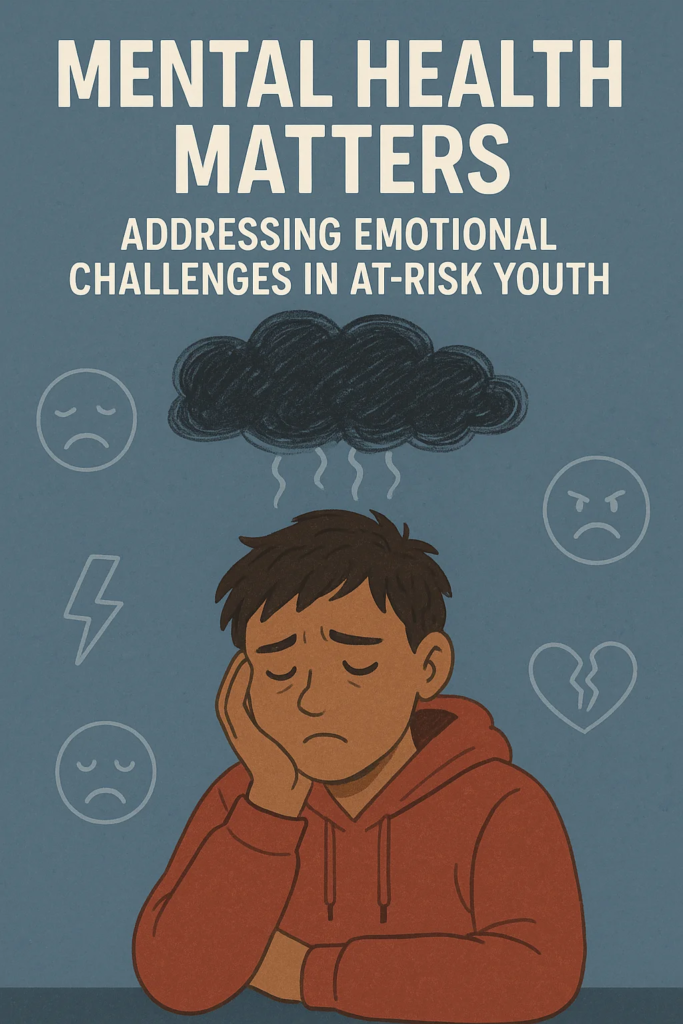
Introduction: Why This Conversation Cannot Wait
A teenager stops showing up to school. A 12-year-old becomes aggressive after months of silence. A young person in foster care laughs with friends during the day but cries alone at night. Another youth is “high-functioning” on paper—good grades, polite behavior, no discipline record—yet feels completely invisible.
These stories are not rare. They are happening in classrooms, homes, shelters, detention centers, community programs, and online spaces every day. That is why Mental Health Matters: Addressing Emotional Challenges in At-Risk Youth is more than a topic—it is an urgent responsibility.
At-risk youth often carry emotional burdens that adults do not immediately see. Poverty, abuse, neglect, discrimination, family instability, grief, bullying, community violence, academic pressure, homelessness, substance exposure, and social isolation can all shape how young people think, feel, behave, and connect with others.
When these challenges go unaddressed, they can become lifelong barriers. But when caring adults, schools, families, community organizations, and mental health professionals respond early and compassionately, the story can change.
Mental Health Matters: Addressing Emotional Challenges in At-Risk Youth means recognizing that emotional pain is not “bad behavior,” that trauma is not a character flaw, and that young people need support before they reach a crisis point.
This article explores what at-risk youth face, how emotional challenges show up, what interventions work, and how communities can build stronger systems of care.
What Does “At-Risk Youth” Really Mean?
The phrase “at-risk youth” is commonly used, but it is often misunderstood. It does not mean a young person is destined to fail. It means they are exposed to circumstances that may increase the likelihood of emotional distress, academic struggles, behavioral concerns, health problems, or unsafe outcomes.
In the context of Mental Health Matters: Addressing Emotional Challenges in At-Risk Youth, the phrase should never be used as a label that defines a child. Instead, it should help adults identify where extra support, protection, and opportunity are needed.
Common Risk Factors for Youth Mental Health Challenges
| Risk Factor | Possible Emotional Impact | What Support May Help |
|---|---|---|
| Family conflict or instability | Anxiety, anger, fear, sadness | Family counseling, stable routines, mentorship |
| Poverty or housing insecurity | Chronic stress, shame, hopelessness | School-based support, food/housing resources |
| Abuse or neglect | Trauma symptoms, distrust, emotional shutdown | Trauma-informed therapy, safety planning |
| Bullying or cyberbullying | Depression, isolation, self-harm risk | Peer support, school intervention, digital safety |
| Community violence | Hypervigilance, aggression, nightmares | Safe spaces, trauma screening, counseling |
| Foster care involvement | Attachment struggles, grief, identity confusion | Consistent relationships, case coordination |
| Discrimination or marginalization | Low self-worth, anxiety, anger | Culturally responsive care, advocacy |
| Academic failure or exclusion | Shame, avoidance, disengagement | Tutoring, strengths-based learning plans |
| Substance use exposure | Confusion, instability, risk-taking | Prevention education, family support |
| Loss or bereavement | Depression, withdrawal, emotional numbness | Grief counseling, supportive adults |
The key point is this: risk is not identity. A youth may be at risk because of their environment, not because of who they are.
That distinction is central to Mental Health Matters: Addressing Emotional Challenges in At-Risk Youth. It shifts the conversation from blame to support.
Why Mental Health Challenges Are Often Missed in At-Risk Youth
Many young people do not say, “I am depressed,” or “I am overwhelmed by trauma.” Instead, emotional pain may appear as defiance, withdrawal, irritability, perfectionism, aggression, risky behavior, or chronic fatigue.
Adults may focus only on what the youth is doing rather than what the youth is experiencing.
A student who refuses to complete assignments may be grieving. A teen who curses at teachers may be living with domestic violence. A child who sleeps in class may not have a safe place to sleep at night. A young person who constantly jokes may be hiding anxiety.
Mental Health Matters: Addressing Emotional Challenges in At-Risk Youth requires adults to ask better questions:
- What happened to this young person?
- What stressors are they carrying?
- What strengths have helped them survive?
- What support would make them feel safe?
- Who do they trust?
- What does healing look like for them?
When we move beyond surface behavior, we begin to see the whole person.
Emotional Challenges Commonly Seen in At-Risk Youth
At-risk youth may experience many emotional and behavioral challenges. These conditions can overlap, and symptoms may change depending on age, culture, personality, and environment.
1. Anxiety
Anxiety may show up as constant worry, avoidance, perfectionism, stomachaches, panic attacks, irritability, or difficulty sleeping. Youth experiencing instability may become hyper-alert because their nervous system is always scanning for danger.
2. Depression
Depression in youth is not always obvious sadness. It may appear as anger, boredom, low motivation, isolation, changes in appetite, declining grades, or loss of interest in activities.
3. Trauma Responses
Trauma can affect memory, emotional regulation, trust, learning, and relationships. A traumatized young person may appear oppositional when they are actually trying to protect themselves.
4. Grief and Loss
Many at-risk youth experience repeated losses: death of loved ones, separation from caregivers, loss of housing, changing schools, or disrupted friendships. Unprocessed grief can become emotional numbness or explosive anger.
5. Low Self-Worth
When youth repeatedly experience rejection, failure, racism, bullying, neglect, or exclusion, they may internalize the belief that they are not valuable. This can lead to self-sabotage, people-pleasing, or hopelessness.
6. Substance Use and Risk-Taking
Some young people use substances or risky behaviors to numb pain, gain social acceptance, escape stress, or feel in control. Punishment alone rarely addresses the emotional need underneath.
7. Suicidal Thoughts or Self-Harm
Self-harm and suicidal thoughts require immediate attention. They may reflect intense emotional pain, isolation, trauma, or a desperate attempt to cope. Any mention of suicide should be taken seriously.
If a young person is in immediate danger or may harm themselves or someone else, contact emergency services or a local crisis line immediately. In the United States, call or text 988 for the Suicide & Crisis Lifeline.
The Science Behind Emotional Distress in At-Risk Youth
To understand Mental Health Matters: Addressing Emotional Challenges in At-Risk Youth, it helps to understand how chronic stress affects the developing brain.
Young people’s brains are still growing. The areas involved in decision-making, impulse control, emotional regulation, and long-term planning continue developing into early adulthood. When a young person experiences chronic stress or trauma, the brain may adapt for survival rather than learning, reflection, or calm connection.
How Chronic Stress Can Affect Youth
| Area Affected | Possible Impact |
|---|---|
| Emotional regulation | Mood swings, anger, shutdown, panic |
| Attention and memory | Difficulty focusing, forgetfulness, learning gaps |
| Trust and attachment | Fear of closeness, rejection sensitivity |
| Decision-making | Impulsivity, risk-taking, poor judgment |
| Physical health | Headaches, fatigue, stomach pain, sleep issues |
| Identity development | Shame, low confidence, confusion |
| Social relationships | Conflict, isolation, clinginess, distrust |
This does not mean young people are permanently damaged. The brain is also capable of healing and adaptation. Safe relationships, therapy, predictable routines, healthy sleep, supportive school environments, and positive community connections can help restore a sense of safety.
That is why Mental Health Matters: Addressing Emotional Challenges in At-Risk Youth must include both emotional support and environmental change.
Protective Factors: What Helps Youth Become Resilient?
Resilience is not simply “toughness.” It is the ability to recover, adapt, and keep growing despite hardship. At-risk youth are often incredibly resilient, but resilience should not be used as an excuse to leave them unsupported.
Protective factors reduce risk and increase well-being.
Key Protective Factors
| Protective Factor | Why It Matters |
|---|---|
| At least one stable, caring adult | Builds trust, safety, and emotional security |
| Positive peer connections | Reduces isolation and improves belonging |
| Safe school environment | Encourages learning and emotional expression |
| Access to mental health care | Provides tools for coping and healing |
| Cultural identity and community pride | Strengthens self-worth and belonging |
| Healthy routines | Supports emotional regulation |
| Opportunities for leadership | Builds confidence and agency |
| Creative expression | Helps process emotions nonverbally |
| Physical activity | Reduces stress and supports mood |
| Family support when possible | Strengthens long-term stability |
One caring adult can change a young person’s life. A mentor, coach, teacher, counselor, relative, neighbor, youth worker, or faith leader can become a protective anchor.
In practical terms, Mental Health Matters: Addressing Emotional Challenges in At-Risk Youth means creating more of these anchors.
Trauma-Informed Care: A Foundation for Healing
Trauma-informed care is not a program. It is an approach that asks adults and systems to respond to youth with safety, empathy, consistency, and respect.
Instead of asking, “What is wrong with you?” trauma-informed care asks, “What happened to you, and what do you need now?”
Core Principles of Trauma-Informed Support
| Principle | What It Looks Like in Practice |
|---|---|
| Safety | Predictable routines, calm spaces, clear expectations |
| Trustworthiness | Adults follow through and avoid empty promises |
| Choice | Youth have age-appropriate control over decisions |
| Collaboration | Adults work with youth, not just over them |
| Empowerment | Strengths are recognized and built upon |
| Cultural humility | Identity, language, and lived experience are respected |
Mental Health Matters: Addressing Emotional Challenges in At-Risk Youth becomes far more effective when trauma-informed principles are embedded in schools, community programs, child welfare systems, juvenile justice settings, and family services.
A trauma-informed approach does not excuse harmful behavior. It explains behavior so adults can respond in ways that teach, repair, and support rather than escalate harm.
The Role of Schools in Youth Mental Health
Schools are often the first place emotional challenges become visible. Teachers may notice changes in attendance, grades, friendships, mood, or behavior before anyone else does.
Because youth spend so much time in school, school-based mental health support can be powerful.
What Schools Can Do
- Train staff to recognize warning signs
- Create safe referral pathways
- Offer school counseling and social work services
- Use restorative discipline instead of purely punitive discipline
- Build social-emotional learning into the curriculum
- Partner with families and community providers
- Support students after trauma, loss, or crisis
- Reduce stigma through mental health education
For many young people, the school counselor may be the first mental health professional they ever meet. That first experience matters. If it feels respectful and safe, the student may be more willing to seek help again.
School-Based Support Model
| Level of Support | Example | Who Benefits |
|---|---|---|
| Universal support | Mental health awareness lessons, anti-bullying programs | All students |
| Targeted support | Small groups for grief, anxiety, social skills | Students with emerging needs |
| Intensive support | Individual counseling, crisis intervention, outside referrals | Students with significant distress |
In school settings, Mental Health Matters: Addressing Emotional Challenges in At-Risk Youth means treating emotional wellness as essential to learning—not separate from it.
A student cannot focus on algebra if their body is in survival mode.
The Role of Families and Caregivers
Families can be a major source of healing, but some families are also under intense stress. Caregivers may be dealing with financial hardship, untreated trauma, mental illness, addiction, immigration stress, incarceration, domestic violence, or lack of support.
Supporting youth often means supporting the adults around them.
Caregiver Strategies That Help
- Listen without immediately lecturing.
- Validate emotions before correcting behavior.
- Create predictable routines.
- Set limits calmly and consistently.
- Notice effort, not just achievement.
- Avoid shaming language.
- Ask open-ended questions.
- Spend small moments of positive time together.
- Seek help early rather than waiting for crisis.
A young person may not always show appreciation for support. They may test boundaries or push adults away. But consistent, caring presence can slowly rebuild trust.
Mental Health Matters: Addressing Emotional Challenges in At-Risk Youth also means helping caregivers understand that they do not have to be perfect. They need support, tools, and encouragement too.
Community Programs: Meeting Youth Where They Are
Community-based programs are often lifelines for at-risk youth. After-school programs, sports teams, arts organizations, mentoring programs, youth centers, faith communities, and outreach services can provide safety, belonging, and purpose.
Some young people are more willing to talk to a youth worker or coach than a therapist. That relationship can become a bridge to deeper care.
Effective Community-Based Supports
| Program Type | Benefit |
|---|---|
| Mentoring programs | Builds connection and long-term guidance |
| Arts and music programs | Supports emotional expression and identity |
| Sports and recreation | Promotes discipline, teamwork, and stress relief |
| Youth leadership programs | Builds agency and confidence |
| Peer support groups | Reduces isolation and shame |
| Street outreach | Reaches youth disconnected from formal systems |
| Culturally specific programs | Supports identity, belonging, and trust |
| Family resource centers | Helps address practical stressors |
The most effective programs do not treat youth as problems to fix. They treat them as people with potential, voice, and dignity.
That is the heart of Mental Health Matters: Addressing Emotional Challenges in At-Risk Youth.
Case Study 1: Rebuilding Trust After School Disengagement
Background
Malik, age 15, had missed 37 days of school in one semester. Teachers described him as “unmotivated” and “disrespectful.” He rarely completed assignments and often put his head down in class.
A school social worker eventually learned that Malik’s family had been evicted twice in one year. He was sleeping on a cousin’s couch and caring for younger siblings in the morning while his mother worked early shifts.
Intervention
The school team shifted from punishment to support. They connected the family with housing resources, arranged a flexible morning check-in, provided transportation assistance, and paired Malik with a mentor. A counselor also met with him weekly to discuss stress and goals.
Outcome
Malik’s attendance improved gradually. He still had difficult days, but he began completing assignments and joined a music production club. His mentor helped him apply for a summer job.
Analysis
This case shows why Mental Health Matters: Addressing Emotional Challenges in At-Risk Youth must include practical support. Malik did not need more lectures about responsibility. He needed adults to understand the barriers affecting his emotional and academic life.
His behavior was not laziness. It was survival.
Case Study 2: Supporting a Youth in Foster Care Through Grief
Background
Aaliyah, age 13, had been placed in three foster homes in two years. She was polite but emotionally distant. Her foster caregiver noticed that Aaliyah became angry around holidays and refused to talk about her biological family.
At school, she excelled academically but had no close friends. She often said, “I’m fine,” even when visibly upset.
Intervention
A trauma-informed therapist helped Aaliyah explore grief, loyalty conflicts, and fear of abandonment. Her foster caregiver received coaching on how to respond to emotional withdrawal without pressure. Aaliyah was also encouraged to create a memory box with photos, letters, and meaningful objects.
Outcome
Over time, Aaliyah began naming her feelings more openly. She asked to join a support group for youth in foster care. Her caregiver learned to give her space while remaining emotionally available.
Analysis
This example highlights that at-risk youth may appear “fine” while carrying deep emotional pain. Mental Health Matters: Addressing Emotional Challenges in At-Risk Youth means looking beyond performance and compliance.
Good grades do not always mean good mental health.
Case Study 3: Preventing Crisis Through Peer Support
Background
Sofia, age 16, was experiencing cyberbullying after a private photo was shared without consent. She stopped attending soccer practice, deleted social media accounts, and began eating lunch alone. Her friends noticed she was making comments like, “Everyone would be better off without me.”
Intervention
One friend told a trusted teacher, who immediately connected Sofia with the school counselor. The school addressed the cyberbullying, involved caregivers, and created a safety plan. Sofia began therapy and joined a small peer support group for girls dealing with online harassment.
Outcome
Sofia’s distress did not disappear overnight, but she reported feeling less alone. The school disciplined the students involved and provided digital consent education to the broader student body.
Analysis
This case demonstrates the importance of peer awareness and rapid response. Mental Health Matters: Addressing Emotional Challenges in At-Risk Youth includes teaching young people how to recognize warning signs in friends and how to seek adult help.
A peer’s courage can save a life.
Case Study 4: Culturally Responsive Support for an Immigrant Youth
Background
Diego, age 14, recently immigrated with his family. He was learning English, missing relatives, and struggling with anxiety. His parents worked long hours and were hesitant to seek counseling because of stigma and fear of being judged.
At school, Diego was quiet and often complained of headaches.
Intervention
A bilingual school counselor met with Diego and his family. Rather than framing therapy as “something is wrong,” the counselor described it as support for stress, adjustment, and family strength. The school connected Diego with a peer buddy and a community soccer league.
Outcome
Diego became more engaged at school and reported fewer physical symptoms. His parents became more comfortable communicating with school staff.
Analysis
This case shows that Mental Health Matters: Addressing Emotional Challenges in At-Risk Youth must be culturally responsive. Language access, trust, family values, and stigma all influence whether youth receive help.
Support works best when it respects culture rather than ignoring it.
Warning Signs Adults Should Never Ignore
Not every mood change is a crisis. Adolescence naturally includes emotional ups and downs. However, certain warning signs should prompt immediate attention.
Emotional and Behavioral Warning Signs
| Warning Sign | Why It Matters |
|---|---|
| Talking about wanting to die | May indicate suicide risk |
| Self-harm marks or behaviors | Signals emotional distress |
| Sudden withdrawal from friends | Can indicate depression, bullying, trauma |
| Extreme mood swings | May signal emotional dysregulation |
| Giving away possessions | Possible suicide warning sign |
| Increased substance use | May be coping with pain |
| Violent threats | Requires safety assessment |
| Eating or sleeping changes | Common signs of distress |
| Declining hygiene | Possible depression or trauma |
| Risky online behavior | May indicate exploitation, distress, or impulsivity |
When in doubt, ask directly and calmly. Asking about suicide does not “put the idea” in a young person’s head. It opens a door for honesty.
A helpful question might be: “Sometimes when people feel overwhelmed, they think about hurting themselves. Has that been happening for you?”
This is another reason Mental Health Matters: Addressing Emotional Challenges in At-Risk Youth must be discussed openly. Silence increases danger. Compassionate conversation reduces it.
Practical Strategies for Supporting At-Risk Youth
Adults often want to help but fear saying the wrong thing. The good news is that support does not always require perfect words. It requires presence, patience, and consistency.
1. Build Trust Before Giving Advice
Youth who have been hurt may not trust quickly. Do not force disclosure. Show up consistently. Keep promises. Respect boundaries.
2. Validate Feelings
Validation does not mean agreement with every behavior. It means acknowledging emotional reality.
Instead of: “You’re overreacting.”
Try: “That sounds really painful. I can see why you’re upset.”
3. Create Predictability
Routines help calm the nervous system. Predictable check-ins, clear expectations, and stable schedules can reduce anxiety.
4. Teach Coping Skills
Helpful coping tools include breathing exercises, journaling, music, physical activity, grounding techniques, art, prayer or meditation, talking to a trusted person, and taking breaks from social media.
5. Focus on Strengths
At-risk youth are often told what they are doing wrong. They also need adults to notice courage, humor, creativity, loyalty, intelligence, leadership, and persistence.
6. Encourage Professional Help
Therapy is not only for crisis. It can help youth process emotions, learn coping skills, strengthen relationships, and plan for the future.
7. Reduce Shame
Shame says, “I am bad.” Accountability says, “I made a choice, and I can repair it.” Youth need accountability without humiliation.
8. Support Identity and Belonging
Young people need spaces where they feel seen and accepted. This is especially important for LGBTQ+ youth, youth of color, immigrant youth, disabled youth, and youth experiencing poverty or foster care involvement.
9. Coordinate Care
Youth may be involved with multiple systems: school, courts, child welfare, healthcare, community programs. Communication among trusted adults can prevent gaps in support.
10. Celebrate Small Wins
Healing is rarely linear. Attendance improving from two days a week to three matters. A teen naming one feeling matters. A child asking for help instead of running away matters.
These everyday practices bring Mental Health Matters: Addressing Emotional Challenges in At-Risk Youth to life.
Digital Life and Youth Mental Health
For today’s youth, emotional life and digital life are deeply connected. Social media can offer belonging, creativity, education, and activism. It can also expose young people to cyberbullying, comparison, exploitation, misinformation, and constant pressure.
At-risk youth may be especially vulnerable online if they are seeking validation, escape, income, friendship, or identity.
Healthy Digital Support Strategies
| Challenge | Supportive Response |
|---|---|
| Cyberbullying | Document, report, block, involve school/caregivers |
| Social comparison | Discuss edited realities and self-worth |
| Online exploitation | Teach consent, boundaries, and safety planning |
| Doomscrolling | Encourage screen breaks and calming routines |
| Harmful content | Use safety settings and open conversations |
| Isolation | Balance online connection with in-person support |
Adults should avoid simply saying, “Get off your phone.” Digital spaces may be where youth find support. The better approach is curiosity:
- “What do you like about that app?”
- “Do you ever feel worse after being online?”
- “Who do you talk to when you’re upset?”
- “Have you ever felt pressured to send something?”
Mental Health Matters: Addressing Emotional Challenges in At-Risk Youth includes helping young people build digital resilience, not just digital restrictions.
The Importance of Culturally Responsive Mental Health Care
Mental health support is not one-size-fits-all. Culture shapes how youth express distress, how families understand therapy, what coping strategies feel acceptable, and whether professional help feels safe.
Culturally responsive care recognizes that identity matters.
Elements of Culturally Responsive Support
- Language access
- Respect for family structure and traditions
- Awareness of racism, discrimination, and historical trauma
- Inclusion of community strengths
- Avoiding stereotypes
- Asking rather than assuming
- Honoring spiritual or cultural coping practices
- Representation among providers when possible
For example, some youth may express emotional pain through physical symptoms. Others may avoid discussing family conflict because loyalty is deeply valued. Some families may fear systems because of past harm.
In this context, Mental Health Matters: Addressing Emotional Challenges in At-Risk Youth requires humility. Professionals and adults must be willing to learn from youth and families, not just instruct them.
Barriers That Prevent At-Risk Youth from Getting Help
Even when services exist, youth may not access them. Understanding barriers is essential.
Common Barriers
| Barrier | Example | Possible Solution |
|---|---|---|
| Stigma | “Only crazy people go to therapy.” | Normalize counseling as support |
| Cost | Family cannot afford care | Connect to school/community services |
| Transportation | No way to attend appointments | Offer telehealth or school-based care |
| Lack of trust | Youth fears being judged | Build relationships first |
| Cultural mismatch | Provider does not understand background | Use culturally responsive referrals |
| Long waitlists | Months before appointment | Provide interim support and crisis planning |
| Caregiver resistance | Parent denies problem | Offer education and family engagement |
| Fear of punishment | Youth hides symptoms | Create confidential, safe conversations |
| System fragmentation | Services do not communicate | Use coordinated care teams |
Addressing these barriers is part of Mental Health Matters: Addressing Emotional Challenges in At-Risk Youth. Awareness alone is not enough if help remains unreachable.
Access must be practical, affordable, respectful, and timely.
What Effective Youth Mental Health Programs Have in Common
Programs that work tend to share several qualities. They are not built around quick fixes. They are relationship-centered, evidence-informed, and flexible.
Features of Strong Programs
- Youth voice is included
- Families are engaged when safe and appropriate
- Services are accessible
- Staff are trained in trauma-informed care
- Programs are culturally responsive
- Progress is measured
- Crisis support is available
- Youth strengths are emphasized
- Community partnerships are strong
- Support continues after the immediate crisis
Program Planning Chart
| Program Component | Strong Example | Weak Example |
|---|---|---|
| Intake process | Welcoming, youth-friendly, private | Long forms with little explanation |
| Staff approach | Calm, consistent, respectful | Punitive or dismissive |
| Youth involvement | Youth help set goals | Adults decide everything |
| Family engagement | Supportive and flexible | Blaming or excluding caregivers |
| Cultural responsiveness | Language and identity respected | “Same approach for everyone” |
| Crisis planning | Clear steps and contacts | No plan until emergency |
| Follow-up | Regular check-ins | One-time intervention |
Mental Health Matters: Addressing Emotional Challenges in At-Risk Youth should be the foundation for program design, not an afterthought added after problems arise.
The Role of Policy and Funding
Individual compassion matters, but systems also shape outcomes. A caring teacher can help one student. A well-funded school mental health program can help hundreds. A strong community policy can reduce barriers for thousands.
Policy Priorities That Support Youth Mental Health
- Expand school-based mental health services
- Increase funding for community mental health clinics
- Reduce counselor-to-student ratios
- Support trauma-informed training for educators and youth workers
- Increase access to affordable housing and food security
- Fund culturally specific mental health programs
- Improve crisis response systems for youth
- Expand telehealth access
- Support family stabilization programs
- Reduce punitive discipline that pushes youth out of school
At-risk youth are often affected by overlapping systems. Mental health cannot be separated from housing, safety, education, healthcare, discrimination, and economic opportunity.
That is why Mental Health Matters: Addressing Emotional Challenges in At-Risk Youth must include advocacy.
Mistakes Adults Commonly Make—and What to Do Instead
Even well-meaning adults can unintentionally shut young people down.
Common Mistakes
| Mistake | Better Approach |
|---|---|
| “You’re just being dramatic.” | “Help me understand what this feels like for you.” |
| Punishing every reaction | Teach regulation and repair |
| Forcing youth to talk | Offer time, safety, and choice |
| Comparing pain | “Others have it worse” increases shame |
| Ignoring culture | Ask about identity, family, and values |
| Focusing only on problems | Notice strengths and progress |
| Making promises you cannot keep | Be honest and reliable |
| Waiting for crisis | Intervene early |
| Treating behavior as identity | Separate the young person from the action |
| Talking more than listening | Let silence and reflection happen |
One of the most powerful shifts in Mental Health Matters: Addressing Emotional Challenges in At-Risk Youth is learning to respond rather than react.
A calm adult nervous system can help calm a young person’s nervous system.
A Practical Action Plan for Parents, Schools, and Communities
Here is a simple framework for turning concern into action.
Step 1: Notice
Pay attention to changes in mood, behavior, attendance, sleep, appetite, peer relationships, or academic performance.
Step 2: Ask
Use calm, open-ended questions:
- “I’ve noticed you seem different lately. Do you want to talk?”
- “What has been hardest this week?”
- “Who feels safe to you right now?”
- “What do you wish adults understood?”
Step 3: Listen
Avoid rushing to fix. Reflect back what you hear. Validate the feeling.
Step 4: Support
Offer practical help, coping tools, connection, and reassurance.
Step 5: Connect
Refer to counselors, therapists, crisis lines, mentors, support groups, or community resources.
Step 6: Follow Up
Do not assume one conversation solves everything. Check in consistently.
Step 7: Build a Safety Plan When Needed
If there is any risk of self-harm, suicide, violence, exploitation, or abuse, involve appropriate professionals immediately.
This action plan captures the spirit of Mental Health Matters: Addressing Emotional Challenges in At-Risk Youth: notice early, respond compassionately, and stay connected.
Long-Tail Keyword Variations for Contextual Use
For SEO and content planning, related long-tail variations may include:
- Why mental health matters for at-risk youth
- Addressing emotional challenges in vulnerable teenagers
- Mental health support for at-risk adolescents
- Trauma-informed care for at-risk youth
- Emotional wellness strategies for high-risk youth
- School-based mental health support for vulnerable students
- Helping at-risk teens cope with anxiety and depression
- Youth mental health intervention strategies
- Supporting emotionally distressed youth
- Community mental health programs for at-risk youth
These variations support the broader theme of Mental Health Matters: Addressing Emotional Challenges in At-Risk Youth while helping readers find practical, relevant guidance.
Measuring Progress: What Healing Can Look Like
Healing is not always dramatic. Sometimes it looks quiet.
A young person starts attending class more often. A teen says, “I’m angry” instead of throwing a chair. A child sleeps through the night. A student asks for help before skipping school. A youth begins trusting one adult. A family has one honest conversation without yelling.
Signs of Positive Progress
| Area | Possible Sign of Improvement |
|---|---|
| Emotional awareness | Youth can name feelings |
| Coping | Uses healthier strategies during stress |
| Relationships | Builds trust with at least one adult |
| School engagement | Improved attendance or participation |
| Safety | Reduced self-harm or risky behavior |
| Identity | Increased confidence and self-worth |
| Future orientation | Talks about goals or possibilities |
| Communication | Asks for help more directly |
| Regulation | Recovers faster after emotional triggers |
Progress is rarely a straight line. Setbacks are part of healing. The goal is not perfection. The goal is support, safety, and growth.
This is why Mental Health Matters: Addressing Emotional Challenges in At-Risk Youth must be rooted in patience.
Conclusion: Every Young Person Deserves a Chance to Heal
At-risk youth are not broken. They are young people responding to difficult circumstances, often with limited tools and too few safe places to turn.
Their emotional challenges may appear as anger, silence, avoidance, perfectionism, sadness, impulsivity, or disconnection. But beneath those behaviors are stories that deserve to be heard with compassion.
Mental Health Matters: Addressing Emotional Challenges in At-Risk Youth reminds us that prevention is better than crisis response, that relationships are powerful medicine, and that healing requires both personal support and systemic change.
If you are a parent, teacher, counselor, youth worker, coach, policymaker, or community member, your role matters. You do not need to have every answer. You can start by noticing, listening, validating, connecting, and following up.
A single conversation can open a door. A consistent relationship can rebuild trust. A supportive program can change a life. A compassionate community can help a young person imagine a future they once thought was impossible.
Mental health matters because young people matter.
And when we truly commit to Mental Health Matters: Addressing Emotional Challenges in At-Risk Youth, we give vulnerable youth something priceless: the chance to feel safe, seen, supported, and hopeful.
1. What does “at-risk youth” mean?
“At-risk youth” refers to young people who face circumstances that may increase their chances of emotional, behavioral, academic, or social difficulties. These circumstances may include poverty, trauma, family instability, bullying, discrimination, foster care involvement, homelessness, or exposure to violence.
The term should not be used to label or limit a young person. In Mental Health Matters: Addressing Emotional Challenges in At-Risk Youth, it is used to identify where support is needed.
2. What are the most common mental health challenges among at-risk youth?
Common challenges include anxiety, depression, trauma symptoms, grief, low self-esteem, substance use, emotional dysregulation, self-harm, and suicidal thoughts. These issues may appear as withdrawal, anger, school refusal, risky behavior, sleep problems, or sudden changes in mood.
3. How can adults tell the difference between normal teen behavior and serious distress?
Normal adolescence includes mood changes and a desire for independence. Serious distress is more likely when changes are intense, long-lasting, harmful, or interfere with daily life.
Warning signs include talk of death, self-harm, major withdrawal, extreme anger, substance use, giving away possessions, sudden academic decline, or hopeless statements. When unsure, ask directly and seek professional guidance.
4. What should I say to a young person who seems emotionally overwhelmed?
Start with calm concern. You might say:
“I’ve noticed you seem really stressed lately. I care about you, and I’m here to listen.”
Avoid judgment, lectures, or quick fixes. Listen first. Validate feelings. If safety is a concern, involve a mental health professional or crisis service immediately.
5. Why is trauma-informed care important?
Trauma-informed care helps adults understand that challenging behavior may be connected to past or ongoing stress. It emphasizes safety, trust, choice, collaboration, empowerment, and cultural respect.
In Mental Health Matters: Addressing Emotional Challenges in At-Risk Youth, trauma-informed care is essential because many at-risk youth have experienced instability, loss, violence, neglect, or other forms of trauma.
6. Can schools really make a difference in youth mental health?
Yes. Schools can identify concerns early, provide counseling, teach social-emotional skills, reduce bullying, connect families to resources, and create safe environments. School-based mental health support is especially important for youth who may not otherwise access care.
7. When should professional help be involved?
Professional help should be involved when emotional distress persists, worsens, affects daily functioning, or includes self-harm, suicidal thoughts, trauma symptoms, substance use, aggression, or major withdrawal.
Early support is best. A young person does not need to be in crisis to benefit from counseling or therapy.
8. What is the most important thing adults can do for at-risk youth?
The most important thing is to become a safe, consistent, caring presence. Youth heal through relationships. Practical help, therapy, school support, and community programs all matter, but trust is often the first step.
That is the lasting message of Mental Health Matters: Addressing Emotional Challenges in At-Risk Youth: young people thrive when they are not left to struggle alone.

