


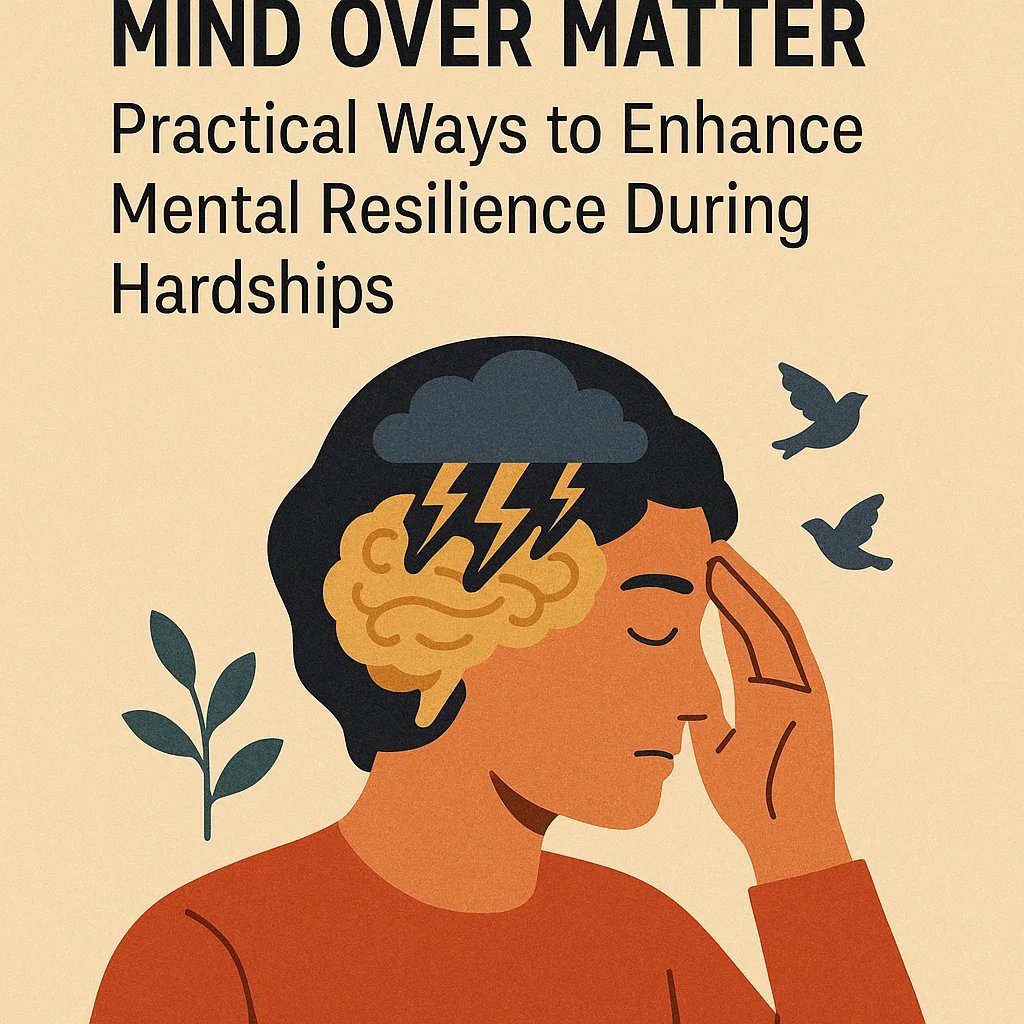
Mind Over Matter: Practical Ways to Enhance Mental Resilience During Hardships — The Ultimate Guide to Staying Strong When Life Gets Heavy
Introduction: When Life Pushes Hard, Your Mind Can Push Back
Hardship has a way of arriving without asking permission.
One day, life feels manageable. The next, you may be dealing with grief, financial pressure, illness, job loss, burnout, family conflict, uncertainty, or a private emotional battle nobody else can see. In those moments, people often say, “Stay strong,” but strength is not as simple as forcing a smile or pretending everything is fine.
True strength is built in the mind, practiced in the body, supported by community, and reinforced by daily choices.
That is the heart of Mind Over Matter: Practical Ways to Enhance Mental Resilience During Hardships. It is not about denying pain. It is not about toxic positivity. It is not about acting invincible. Instead, it is about learning how to respond to difficult circumstances with clarity, courage, flexibility, and hope.
Mental resilience is the ability to bend without breaking. It is the skill of getting knocked down and gradually finding your footing again. It is what helps people continue parenting during exhaustion, rebuild after loss, keep going through uncertainty, and make wise decisions when emotions are loud.
The good news? Resilience is not reserved for naturally “tough” people. It can be developed.
This article explores Mind Over Matter: Practical Ways to Enhance Mental Resilience During Hardships through practical tools, real-world case studies, science-backed strategies, reflective exercises, and everyday habits you can begin using immediately.
What “Mind Over Matter” Really Means
The phrase “mind over matter” is often misunderstood.
Some people interpret it as “ignore the problem” or “just think positive.” But real resilience is not denial. It is disciplined awareness.
Mind Over Matter: Practical Ways to Enhance Mental Resilience During Hardships means using your thoughts, habits, values, and emotional regulation skills to influence how you experience and respond to difficult situations.
You may not control the hardship itself, but you can influence:
- How you interpret the situation
- How you speak to yourself
- How you regulate stress
- How you ask for support
- How you recover after setbacks
- How you make meaning from pain
- How you keep moving without losing yourself
Mental resilience does not remove suffering, but it can reduce unnecessary suffering.
A resilient person still feels fear, sadness, anger, and doubt. The difference is that they learn not to let those emotions fully take the steering wheel.
Why Mental Resilience Matters During Hardships
Hardships test more than patience. They test identity, relationships, health, beliefs, and hope.
When stress becomes intense or prolonged, the brain naturally shifts into survival mode. This can make it harder to think clearly, sleep well, communicate kindly, or make long-term decisions.
That is why practical ways to enhance mental resilience during hardships are so important. Resilience gives you a framework when life feels chaotic.
Common Effects of Hardship on the Mind and Body
| Hardship Response | What It May Feel Like | Resilience-Based Response |
|---|---|---|
| Overthinking | “I can’t stop replaying this.” | Grounding, journaling, problem-solving |
| Emotional numbness | “I feel disconnected from everything.” | Gentle routines, connection, therapy if needed |
| Anxiety | “Something bad is going to happen.” | Breathwork, thought reframing, present-moment focus |
| Hopelessness | “Nothing will change.” | Small goals, meaning-making, support systems |
| Irritability | “Everyone is getting on my nerves.” | Nervous system regulation, rest, boundaries |
| Avoidance | “I don’t want to deal with this.” | One small action, accountability, self-compassion |
| Exhaustion | “I can’t keep doing this.” | Recovery habits, sleep, asking for help |
The goal of Mind Over Matter: Practical Ways to Enhance Mental Resilience During Hardships is not to eliminate every difficult feeling. The goal is to help you meet those feelings with skill instead of panic.
The Foundation: Accept Reality Without Surrendering Hope
One of the most powerful resilience skills is acceptance.
Acceptance does not mean liking what happened. It does not mean approving of injustice, loss, pain, or disappointment. It means telling the truth about reality so you can respond wisely.
Many people lose precious energy fighting facts:
- “This should not have happened.”
- “I cannot believe this is my life.”
- “If only things were different.”
- “Why me?”
These thoughts are human. But if we stay there too long, we become trapped in resistance.
A healthier response is:
“This is happening. I do not like it. I may not have chosen it. But I can choose my next step.”
This is one of the most essential principles in Mind Over Matter: Practical Ways to Enhance Mental Resilience During Hardships: peace begins when we stop arguing with reality and start working with it.
Practice: The Acceptance Statement
Try writing:
- “The reality I am facing is…”
- “The emotion I feel about it is…”
- “One thing I can control today is…”
- “One thing I need to release for now is…”
This simple exercise helps separate facts from fear.
Build a Circle of Control
During hardship, the mind often focuses on what is uncontrollable. That is natural, but it can quickly lead to helplessness.
A core method in mind over matter resilience strategies is learning to identify what is within your control, what you can influence, and what you must release.
Circle of Control Table
| Category | Examples | Healthy Response |
|---|---|---|
| Things I control | My actions, words, habits, boundaries, effort | Focus energy here |
| Things I influence | Relationships, work outcomes, team morale, family routines | Communicate and contribute |
| Things I do not control | Other people’s choices, the past, global events, weather, timing | Practice release and acceptance |
Quick Exercise
Draw three circles:
- Inner circle: Control
- Middle circle: Influence
- Outer circle: Concern
Write your worries into the correct circle. Then choose one action from the control circle.
This practice is central to Mind Over Matter: Practical Ways to Enhance Mental Resilience During Hardships because it helps the brain move from helpless rumination to meaningful action.
Regulate Your Nervous System Before Solving the Problem
When stress is high, your nervous system may interpret hardship as danger. Your heart races. Your breathing changes. Your muscles tighten. Your thoughts speed up.
In that state, it is difficult to think rationally.
This is why building mental resilience in hard times begins with calming the body. A regulated body supports a clearer mind.
The 90-Second Reset
When emotions surge, try this:
- Pause and name the emotion: “This is fear,” or “This is anger.”
- Place both feet on the floor.
- Inhale for four counts.
- Exhale for six counts.
- Repeat five times.
- Ask: “What is the next wise action?”
This short practice helps your body exit emergency mode.
Nervous System Tools for Mental Resilience
| Tool | Time Needed | Why It Works |
|---|---|---|
| Slow exhale breathing | 1–3 minutes | Signals safety to the body |
| Cold water on hands or face | 30 seconds | Interrupts panic response |
| Walking | 10–20 minutes | Processes stress hormones |
| Progressive muscle relaxation | 5–10 minutes | Releases physical tension |
| Grounding through senses | 2 minutes | Brings attention to the present |
| Gentle stretching | 5 minutes | Reduces stress-related tightness |
A practical approach to Mind Over Matter: Practical Ways to Enhance Mental Resilience During Hardships always includes the body. You cannot think your way out of every stress response. Sometimes you must breathe, move, rest, and reset first.
Reframe Your Inner Dialogue
Your inner voice matters.
During hardship, self-talk can either become an ally or an enemy. Many people speak to themselves in ways they would never speak to a friend.
They say:
- “I am failing.”
- “I should be stronger.”
- “I cannot handle this.”
- “Everything is falling apart.”
- “I always mess things up.”
These thoughts may feel true in the moment, but they often increase distress.
Resilient self-talk does not lie. It does not say, “Everything is perfect.” Instead, it says, “This is hard, but I can take one step.”
Reframing Examples
| Harsh Thought | Resilient Reframe |
|---|---|
| “I can’t handle this.” | “I am overwhelmed, but I can handle the next five minutes.” |
| “I failed.” | “This did not go how I hoped, but I can learn from it.” |
| “Nothing will ever change.” | “I do not know the future. I can influence today.” |
| “I should be over this.” | “Healing takes time. I can be patient with myself.” |
| “I am weak.” | “I am struggling, and struggling does not make me weak.” |
This is one of the most practical parts of Mind Over Matter: Practical Ways to Enhance Mental Resilience During Hardships. The mind believes what it hears repeatedly. Speak to yourself in a way that builds endurance.
Case Study 1: Viktor Frankl and Meaning in Suffering
A powerful real-world example of Mind Over Matter: Practical Ways to Enhance Mental Resilience During Hardships comes from Viktor Frankl, an Austrian psychiatrist and Holocaust survivor.
Frankl endured unimaginable suffering in Nazi concentration camps. In his book Man’s Search for Meaning, he described how people could be stripped of nearly everything, yet still retain one final freedom: the ability to choose their attitude toward their circumstances.
Frankl did not suggest suffering was good. Instead, he emphasized that meaning can help people survive suffering.
He observed that those who had a reason to keep going, such as love, faith, duty, or unfinished work, often had a stronger will to endure.
Analysis: Why This Matters
Frankl’s story is one of the clearest examples of mind over matter during difficult times. His resilience was not built on comfort. It was built on meaning.
The lesson is practical: when hardship feels unbearable, ask:
- “Who needs me?”
- “What value do I want to live by today?”
- “What meaning can I create from this pain?”
- “What would make this struggle not wasted?”
Meaning does not erase suffering, but it can give suffering direction.
Develop Meaning Anchors
A meaning anchor is anything that reminds you why you keep going.
It may be:
- Your children
- Your faith
- Your future self
- A promise you made
- A creative dream
- A cause you care about
- A loved one’s memory
- A value such as courage, service, honesty, or compassion
In Mind Over Matter: Practical Ways to Enhance Mental Resilience During Hardships, meaning anchors are essential because hardship often narrows perspective. Pain says, “This moment is everything.” Meaning says, “This moment is part of a larger story.”
Meaning Anchor Exercise
Complete these sentences:
- “Even though this season is hard, I want to remain the kind of person who…”
- “The people or values worth enduring for are…”
- “If I look back one year from now, I want to be proud that I…”
- “Today, I can live my values by…”
Purpose is not always dramatic. Sometimes purpose is getting out of bed, making one honest phone call, or refusing to give up on yourself.
Create Micro-Routines When Life Feels Chaotic
When hardship disrupts life, routines often disappear. Sleep changes. Meals become irregular. Exercise stops. Social connection fades.
But routines are psychological scaffolding. They hold you up when motivation is low.
You do not need a perfect routine. You need a repeatable one.
The 3-Part Resilience Routine
| Time of Day | Micro-Habit | Purpose |
|---|---|---|
| Morning | Drink water, open curtains, write one intention | Creates direction |
| Midday | Take a 10-minute walk or breathing break | Resets stress |
| Evening | Write one thing you handled well | Reinforces strength |
This small structure supports practical mental toughness habits for hardships because it reduces decision fatigue.
The “Minimum Viable Day”
On very hard days, lower the bar without dropping it completely.
A minimum viable day might include:
- Eat something nourishing
- Shower or wash your face
- Reply to one important message
- Step outside for five minutes
- Do one necessary task
- Rest without guilt
This is a deeply compassionate part of Mind Over Matter: Practical Ways to Enhance Mental Resilience During Hardships: resilience is not always about doing more. Sometimes it is about doing enough to stay connected to life.
Case Study 2: Bethany Hamilton and Resilience After Trauma
Surfer Bethany Hamilton lost her left arm in a shark attack at age 13. For many people, such a traumatic event would have ended not only a sport but a sense of identity.
Yet Hamilton returned to surfing just weeks later and went on to compete professionally.
Her recovery was not simply physical. It required mental adaptation, emotional courage, support, faith, and relentless practice.
Analysis: Why This Matters
Hamilton’s story illustrates how to stay mentally strong during adversity without pretending adversity is easy.
Her resilience involved several key factors:
- She accepted a new reality.
- She adapted her technique.
- She leaned on support.
- She stayed connected to purpose.
- She allowed courage to coexist with fear.
This case study fits the theme of Mind Over Matter: Practical Ways to Enhance Mental Resilience During Hardships because it shows that resilience is not returning to exactly who you were before. Sometimes resilience means becoming someone new.
Strengthen Social Resilience: Do Not Suffer Alone
One of the biggest myths about resilience is that strong people handle everything alone.
In reality, isolation makes hardship heavier.
Human beings are wired for connection. Supportive relationships help regulate stress, provide perspective, and remind us we are not alone.
Types of Support You May Need
| Type of Support | What It Sounds Like | Who Might Provide It |
|---|---|---|
| Emotional support | “I am here with you.” | Friend, partner, family member |
| Practical support | “I can bring food or help with errands.” | Neighbor, coworker, community group |
| Professional support | “Let’s work through this safely.” | Therapist, counselor, coach |
| Informational support | “Here are your options.” | Mentor, doctor, financial advisor |
| Spiritual support | “Let’s pray, reflect, or sit together.” | Faith leader, spiritual community |
A key principle of Mind Over Matter: Practical Ways to Enhance Mental Resilience During Hardships is that asking for help is not weakness. It is strategy.
Try This: The Three-Name Rule
Write down:
- One person who helps you feel emotionally safe
- One person who gives practical advice
- One person who can help in an emergency
Keep this list visible. During stress, the brain forgets options. Prepare support before you need it.
Learn the Skill of Emotional Flexibility
Resilience does not mean always being calm. It means being emotionally flexible.
Emotional flexibility is the ability to feel what is real without becoming trapped by it.
You can be sad and still make dinner.
You can be afraid and still attend the appointment.
You can be disappointed and still try again.
You can grieve and still laugh.
You can rest and still be resilient.
This is an important truth in Mind Over Matter: Practical Ways to Enhance Mental Resilience During Hardships: emotional strength is not emotional suppression.
The “Both/And” Technique
Instead of saying:
- “I am scared, so I cannot move forward.”
Try:
- “I am scared, and I can take one step.”
- “I am grieving, and I can receive support.”
- “I am tired, and I can choose rest.”
- “I am uncertain, and I can make a plan.”
“Both/and” thinking helps the mind escape all-or-nothing patterns.
Build Cognitive Flexibility
Hardship often makes thinking rigid.
You may start believing:
- “There is only one way this can work.”
- “If this fails, everything is over.”
- “I will never recover.”
- “People always leave.”
- “I am permanently broken.”
Cognitive flexibility is the ability to consider alternative interpretations and possibilities.
It is a cornerstone of mental resilience during hardship because flexible thinking creates more options.
Questions That Build Cognitive Flexibility
Ask yourself:
- What else could be true?
- What would I tell a friend in this situation?
- Is this thought a fact or a fear?
- What evidence supports this thought?
- What evidence challenges it?
- What is one small possibility I have not considered?
- If I cannot solve everything, what can I improve by 5%?
A resilient mind is not a mind that never worries. It is a mind that questions worry instead of obeying it blindly.
Case Study 3: A Healthcare Worker Facing Burnout
Consider a realistic case based on common experiences among healthcare professionals.
Maria, a nurse, spent years working long shifts in a high-pressure hospital environment. After months of emotional exhaustion, staff shortages, and repeated exposure to suffering, she began feeling detached and irritable. She loved helping patients, but she dreaded going to work.
At first, Maria thought resilience meant pushing harder. She skipped meals, stopped exercising, and avoided talking about her feelings because she did not want to burden her family.
Eventually, she reached a breaking point and spoke with a supervisor and therapist. She began using short breathing practices between shifts, set boundaries around overtime, reconnected with coworkers for peer support, and created a decompression ritual after work.
She did not eliminate stress, but she changed her relationship with it.
Analysis: Why This Matters
Maria’s story shows why Mind Over Matter: Practical Ways to Enhance Mental Resilience During Hardships must include boundaries and recovery.
Resilience is not endless endurance. It is sustainable endurance.
Her progress came from:
- Naming burnout honestly
- Seeking support
- Regulating her nervous system
- Creating recovery rituals
- Setting limits
- Reconnecting with meaning
The lesson: if you are constantly depleted, the resilient choice may not be to “push through.” It may be to pause, repair, and protect your capacity.
Protect Your Energy With Boundaries
Hardship can make people vulnerable to overgiving, overexplaining, and overcommitting.
Boundaries are not walls. They are doors with locks.
They help you decide what you can give without abandoning yourself.
Boundary Scripts for Difficult Seasons
| Situation | Boundary Script |
|---|---|
| You are overwhelmed | “I cannot take that on right now.” |
| Someone wants details | “I am not ready to talk about it yet.” |
| You need rest | “I need some quiet time tonight.” |
| You cannot attend an event | “Thank you for inviting me, but I need to pass.” |
| A conversation is harmful | “I want to continue this later when we are calmer.” |
| You need help | “I am struggling and could use support with…” |
Healthy boundaries are a practical expression of Mind Over Matter: Practical Ways to Enhance Mental Resilience During Hardships because they protect your mental and emotional resources.
Practice Gratitude Without Denying Pain
Gratitude can strengthen resilience, but only when practiced honestly.
Forced gratitude sounds like:
- “Other people have it worse, so I should not feel bad.”
- “I should just be thankful.”
- “I have no right to struggle.”
That is not gratitude. That is emotional dismissal.
Healthy gratitude says:
- “This is painful, and I can still notice what supports me.”
- “I am struggling, and there are small moments of goodness.”
- “I can honor my pain without letting it become my entire world.”
A Balanced Gratitude Practice
Each evening, write:
- One hard thing I am acknowledging
- One thing that helped me today
- One strength I used
- One small hope for tomorrow
This practice supports practical ways to enhance mental resilience during hardships because it trains the brain to hold pain and possibility together.
Use Setbacks as Information, Not Identity
Everyone stumbles during hard seasons.
You may lose your temper, miss a deadline, relapse into an old habit, avoid a conversation, or spend a day doing nothing. The resilient response is not self-punishment. It is reflection.
Instead of asking, “What is wrong with me?” ask, “What happened, and what do I need?”
Setback Reflection Chart
| Reflection Question | Purpose |
|---|---|
| What triggered the setback? | Identifies patterns |
| What emotion was I avoiding? | Builds awareness |
| What did I need but not ask for? | Reveals unmet needs |
| What can I adjust next time? | Creates a plan |
| What can I forgive myself for? | Reduces shame |
| What is my next small step? | Restores momentum |
This is where Mind Over Matter: Practical Ways to Enhance Mental Resilience During Hardships becomes practical and humane. You do not build resilience by never falling. You build it by learning how to return.
The Resilience Ladder: From Survival to Growth
Hardship often moves in stages. You may not jump straight from crisis to confidence. That is normal.
Here is a simple chart:
text
Growth | Creating meaning, helping others, new identity
Adaptation | Building routines, adjusting expectations
Stabilization | Regulating emotions, seeking support
Survival | Getting through the day, meeting basic needs
Shock | Disbelief, numbness, confusion
If you are in survival mode, do not shame yourself for not feeling inspired. The first goal is stability.
The journey of Mind Over Matter: Practical Ways to Enhance Mental Resilience During Hardships begins wherever you are.
Case Study 4: Community Resilience After Natural Disaster
After major natural disasters, such as hurricanes, floods, or wildfires, communities often experience collective trauma. Homes may be destroyed, routines disrupted, and futures made uncertain.
Yet many communities begin rebuilding through shared meals, volunteer networks, temporary shelters, local leadership, and mutual aid.
In these moments, resilience is not just individual. It is communal.
People recover better when they feel:
- Seen
- Supported
- Useful
- Informed
- Connected
- Part of a shared effort
Analysis: Why This Matters
This example expands Mind Over Matter: Practical Ways to Enhance Mental Resilience During Hardships beyond personal mindset.
Mental resilience is strengthened by systems, relationships, and environments. A person trying to recover alone has a heavier burden than a person surrounded by practical care.
The lesson: if you want to become more resilient, build community before crisis. And if you are already in crisis, look for one safe connection.
Strengthen Spiritual or Philosophical Grounding
Not everyone defines spirituality the same way. For some, it means faith in God. For others, it means connection to nature, moral values, meditation, ancestry, or a sense of purpose larger than the self.
During hardship, spiritual or philosophical grounding can provide stability.
It helps answer:
- What do I believe when life is uncertain?
- What kind of person do I want to be?
- What gives me hope beyond circumstances?
- How do I make peace with what I cannot control?
This dimension is often overlooked in discussions of Mind Over Matter: Practical Ways to Enhance Mental Resilience During Hardships, but it can be deeply powerful.
Grounding Practices
- Prayer
- Meditation
- Reading wisdom literature
- Time in nature
- Silence
- Rituals of remembrance
- Acts of service
- Journaling about values
Resilience grows when life is connected to something deeper than temporary conditions.
Train Attention: What You Focus on Expands
Attention is one of your most valuable mental resources.
During hardship, attention can become consumed by threat. You may scan constantly for bad news, replay conversations, or imagine worst-case scenarios.
This is understandable, but exhausting.
A key practice in Mind Over Matter: Practical Ways to Enhance Mental Resilience During Hardships is learning to direct attention intentionally.
The Attention Audit
Ask:
- What am I consuming daily?
- Does this information help me act, or only panic?
- How often am I checking news, messages, or social media?
- What thoughts keep repeating?
- What deserves more of my attention?
- What deserves less?
Attention Rebalancing
| If You Are Overfocused On… | Try Redirecting Toward… |
|---|---|
| Worst-case scenarios | Next best step |
| Other people’s opinions | Your values |
| The past | Lessons and repair |
| The unknown future | Today’s responsibilities |
| Bad news | Balanced information and recovery |
| Self-criticism | Self-coaching |
The mind is not strengthened by obsessing over danger. It is strengthened by noticing danger while still choosing direction.
Use Physical Health as a Resilience Multiplier
Mental resilience is closely connected to physical health.
When sleep, nutrition, hydration, and movement are neglected, emotional regulation becomes harder. Problems feel bigger. Patience shrinks. Anxiety rises.
You do not need a perfect wellness routine. You need basic support.
Resilience Basics
| Habit | Minimum Goal | Why It Helps |
|---|---|---|
| Sleep | Consistent rest window | Supports emotional regulation |
| Hydration | Water throughout the day | Reduces fatigue and brain fog |
| Nutrition | Protein and regular meals | Stabilizes mood and energy |
| Movement | 10 minutes daily | Releases stress and improves clarity |
| Sunlight | Morning light when possible | Supports circadian rhythm |
| Rest | Short recovery breaks | Prevents burnout |
This is a practical but often underestimated part of Mind Over Matter: Practical Ways to Enhance Mental Resilience During Hardships. The mind has a body. Care for both.
Make a Hardship Plan Before You Need One
Resilient people are not never surprised. But they often have tools ready.
A hardship plan is a written guide for what helps you when life becomes overwhelming.
Personal Resilience Plan
| Question | Your Answer |
|---|---|
| What are my early warning signs of overwhelm? | |
| What helps calm my body? | |
| Who can I contact for support? | |
| What routines keep me stable? | |
| What thoughts usually make things worse? | |
| What truths do I need to remember? | |
| What professional resources can I use? | |
| What is my emergency plan if I feel unsafe? |
This kind of preparation reflects the heart of Mind Over Matter: Practical Ways to Enhance Mental Resilience During Hardships: you cannot prevent every storm, but you can prepare your shelter.
Know When to Seek Professional Help
Mental resilience does not mean handling everything independently.
Sometimes hardship becomes too heavy for self-help alone. Seeking professional support is wise, not shameful.
Consider reaching out to a mental health professional if you experience:
- Persistent hopelessness
- Panic attacks
- Thoughts of self-harm
- Inability to function daily
- Severe sleep disruption
- Substance misuse to cope
- Intense grief that feels unmanageable
- Trauma symptoms such as flashbacks or constant hypervigilance
If you feel in immediate danger or may harm yourself, contact emergency services or a crisis hotline in your country right away.
A responsible guide to Mind Over Matter: Practical Ways to Enhance Mental Resilience During Hardships must say this clearly: resilience includes receiving care.
Daily Practices That Build Mental Resilience
Resilience is built through repetition. Small practices matter more than occasional grand gestures.
10 Daily Resilience Habits
| Habit | Time Needed | Benefit |
|---|---|---|
| Name your emotion | 30 seconds | Reduces emotional confusion |
| Breathe slowly | 2 minutes | Calms nervous system |
| Move your body | 10 minutes | Releases stress |
| Write one intention | 1 minute | Creates direction |
| Limit doom-scrolling | Ongoing | Protects attention |
| Talk to one safe person | 5–20 minutes | Builds connection |
| Practice gratitude honestly | 3 minutes | Balances perspective |
| Complete one small task | Variable | Builds agency |
| Repeat a grounding phrase | 30 seconds | Strengthens self-talk |
| Sleep routine | 20–30 minutes | Restores capacity |
These habits make Mind Over Matter: Practical Ways to Enhance Mental Resilience During Hardships more than an idea. They turn resilience into a lifestyle.
Powerful Grounding Phrases for Hard Times
Words can become anchors.
Try repeating:
- “This is hard, but I can take one step.”
- “I do not need to solve everything today.”
- “My feelings are real, but they are not the whole story.”
- “I can be both struggling and strong.”
- “I have survived difficult days before.”
- “I can ask for help.”
- “Small progress still counts.”
- “I will respond, not just react.”
- “This moment is not my entire life.”
- “I am allowed to rest.”
These phrases support mind over matter resilience strategies by giving your brain a steadier script during distress.
The Difference Between Resilience and Toxic Positivity
This distinction matters.
Toxic positivity says:
- “Just be happy.”
- “Everything happens for a reason.”
- “Do not be negative.”
- “Good vibes only.”
- “Other people have it worse.”
Resilience says:
- “This hurts, and I can face it.”
- “I can feel pain without losing hope.”
- “I can be honest and still move forward.”
- “Support is allowed.”
- “Hard emotions are part of healing.”
Mind Over Matter: Practical Ways to Enhance Mental Resilience During Hardships is not about pretending. It is about staying present and purposeful.
Building Resilience at Work During Hard Seasons
Work can become especially difficult during personal hardship. Deadlines continue. Emails arrive. Meetings happen. People may not know what you are carrying.
Professional resilience includes communication, boundaries, prioritization, and recovery.
Workplace Resilience Strategies
| Challenge | Resilient Strategy |
|---|---|
| Overwhelming workload | Prioritize top three tasks |
| Emotional exhaustion | Take short reset breaks |
| Lack of support | Speak with a manager or HR if appropriate |
| Personal crisis | Request flexibility when possible |
| Conflict | Pause before responding |
| Burnout | Review workload and recovery patterns |
If you are a leader, remember that practical ways to enhance mental resilience during hardships should not be placed only on individuals. Healthy workplaces create cultures where people can ask for help, take breaks, and work sustainably.
Resilience in Relationships
Hardship can either strain relationships or deepen them.
Stress often makes people more reactive. You may withdraw, criticize, become defensive, or expect others to read your mind.
Relational resilience means communicating needs clearly and listening generously.
Helpful Relationship Phrases
- “I am not upset with you; I am overwhelmed.”
- “I need support, not solutions right now.”
- “Can we talk when I am calmer?”
- “I appreciate you being here.”
- “I do not know what I need yet, but I do not want to be alone.”
- “I am sorry I reacted harshly. I am having a hard day.”
This is another essential layer of Mind Over Matter: Practical Ways to Enhance Mental Resilience During Hardships: resilience grows in emotionally safe relationships.
Turning Pain Into Growth Without Rushing the Process
Post-traumatic growth is real, but it should not be forced.
Some people discover new strength, deeper compassion, clearer priorities, or renewed purpose after hardship. But growth takes time. You do not need to find the lesson immediately.
In the early stages, survival is enough.
Later, you may ask:
- What has this taught me about what matters?
- What strengths did I discover?
- What relationships became clearer?
- What boundaries do I need now?
- How has my definition of success changed?
- How can I use this experience to help someone else?
The deeper promise of Mind Over Matter: Practical Ways to Enhance Mental Resilience During Hardships is not that pain becomes easy. It is that pain does not have to be wasted.
A 7-Day Mental Resilience Challenge
If you want a practical starting point, try this seven-day challenge.
| Day | Practice | Goal |
|---|---|---|
| Day 1 | Write your circle of control | Reduce helplessness |
| Day 2 | Practice 5 minutes of slow breathing | Calm the body |
| Day 3 | Reframe three harsh thoughts | Build healthier self-talk |
| Day 4 | Contact one supportive person | Strengthen connection |
| Day 5 | Create a minimum viable routine | Restore structure |
| Day 6 | Write your meaning anchors | Reconnect with purpose |
| Day 7 | Make a hardship plan | Prepare for future stress |
This challenge captures the spirit of Mind Over Matter: Practical Ways to Enhance Mental Resilience During Hardships in a realistic, doable format.
Conclusion: You Are Not Powerless
Hardship may change your plans, your pace, your relationships, or your sense of certainty. But it does not have to take away your agency.
The message of Mind Over Matter: Practical Ways to Enhance Mental Resilience During Hardships is simple but powerful: you may not control everything that happens, but you can strengthen how you respond.
You can breathe before reacting.
You can ask for help.
You can build routines that support you.
You can speak to yourself with compassion.
You can choose one next step.
You can protect your energy.
You can find meaning, even slowly.
You can recover, rebuild, and rise differently.
Mental resilience is not a single heroic moment. It is a collection of small choices repeated during difficult days.
If life feels heavy right now, start small. Drink water. Take a breath. Send the message. Step outside. Write the truth. Rest. Try again tomorrow.
That, too, is resilience.
And sometimes, the most powerful version of mind over matter is not forcing yourself to be unbreakable. It is learning that even when you bend, you can still grow.
FAQs About Mind Over Matter and Mental Resilience During Hardships
1. What does “mind over matter” mean during hardship?
In this context, “mind over matter” means using mental skills such as acceptance, emotional regulation, reframing, focus, and purpose to respond better to difficult situations. Mind Over Matter: Practical Ways to Enhance Mental Resilience During Hardships does not mean ignoring pain. It means facing pain with tools.
2. Can mental resilience really be learned?
Yes. Mental resilience can be developed through repeated habits like healthy self-talk, stress regulation, problem-solving, social support, boundaries, and meaning-making. Some people may naturally seem more resilient, but everyone can strengthen resilience over time.
3. What is the fastest way to calm down during emotional overwhelm?
Start with your body. Slow your breathing, lengthen your exhale, place your feet on the floor, and name what you are feeling. This helps calm the nervous system so your thinking brain can come back online.
4. Is resilience the same as pretending everything is fine?
No. Resilience is not pretending. It is honest coping. Toxic positivity denies pain, while resilience acknowledges pain and still looks for the next wise step.
5. How can I build resilience if I feel completely exhausted?
Begin with basic care. Sleep, hydration, food, rest, and support are not optional extras; they are foundations. Use the “minimum viable day” approach: do the smallest helpful actions that keep you stable.
6. When should I seek professional help?
Seek professional help if you feel persistently hopeless, unable to function, overwhelmed by trauma, dependent on substances to cope, or at risk of harming yourself. Resilience includes knowing when support is needed.
7. What are practical daily habits for mental resilience?
Daily habits include slow breathing, journaling, movement, healthy routines, reaching out to supportive people, limiting negative media, practicing balanced gratitude, and reframing harsh thoughts.
8. How does purpose help during hardship?
Purpose gives pain direction. When you know what matters to you, it becomes easier to endure discomfort, make decisions, and keep going. Meaning is a major part of Mind Over Matter: Practical Ways to Enhance Mental Resilience During Hardships.
9. Can hardship make a person stronger?
Sometimes, yes, but not automatically. Growth depends on support, reflection, coping tools, time, and safety. Hardship alone does not create strength; how we process and respond to hardship matters.
10. What is one thing I can do today to become more resilient?
Choose one small action within your control. Take a walk, call a trusted friend, write down your worries, practice slow breathing, or complete one necessary task. Small actions rebuild confidence.

