


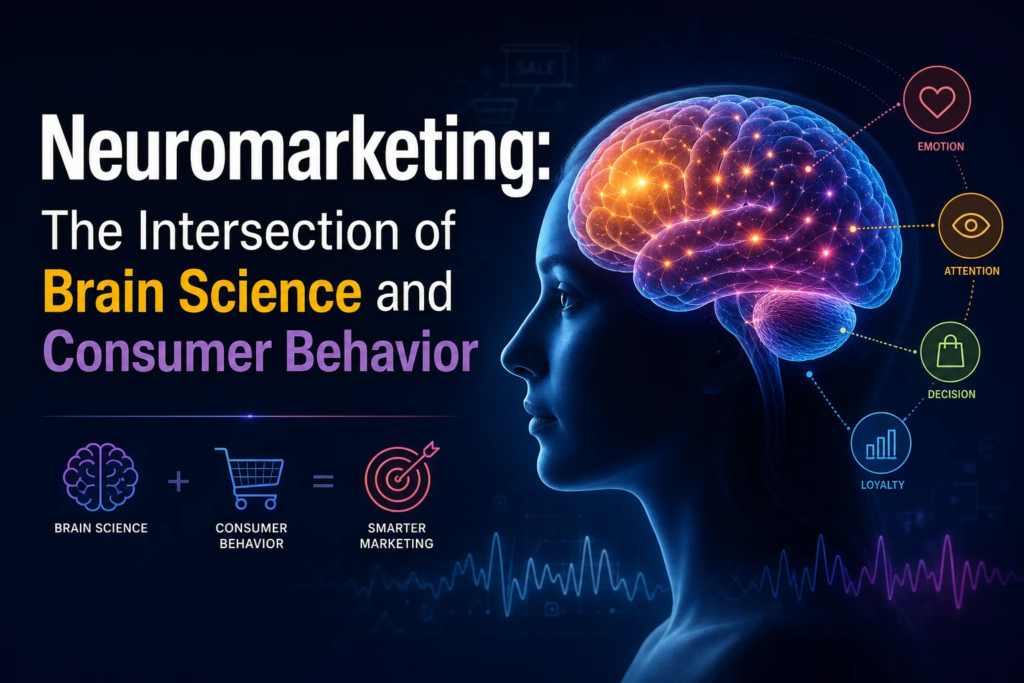
Introduction: Why the Brain Is the New Battleground for Attention
A customer walks into a store, glances at a shelf, touches a package, checks the price, and makes a decision in seconds. Later, if asked why they bought that product, they may say, “It was a good deal,” or “I liked the design.” But beneath that simple explanation, the brain has already processed color, memory, emotion, reward, risk, familiarity, social meaning, and unconscious preference.
That hidden decision-making process is exactly why Neuromarketing: The Intersection of Brain Science and Consumer Behavior has become one of the most fascinating and valuable areas in modern business.
Traditional marketing asks people what they think. Neuromarketing studies what their brains, eyes, bodies, and emotions reveal—often before they can explain it themselves. It does not replace surveys, focus groups, or analytics. Instead, it adds another layer of insight: the biological and psychological signals behind attention, desire, trust, and action.
In a noisy marketplace where consumers scroll quickly, skip ads, compare prices instantly, and forget most brand messages, understanding the mind is no longer optional. Neuromarketing: The Intersection of Brain Science and Consumer Behavior helps brands design better experiences, create more meaningful messages, reduce friction, and build trust without relying on guesswork.
This article explores the science, tools, case studies, ethical questions, and practical applications of neuromarketing in a way that is useful for marketers, founders, product designers, brand strategists, and curious consumers alike.
What Is Neuromarketing?
Neuromarketing: The Intersection of Brain Science and Consumer Behavior refers to the use of neuroscience, psychology, and behavioral research to understand how people respond to marketing stimuli.
These stimuli can include:
- Advertisements
- Product packaging
- Website layouts
- Pricing structures
- Brand logos
- Store environments
- Sounds, colors, and textures
- Customer experiences
- Social proof and reviews
- Product design
At its core, neuromarketing asks one powerful question:
What is happening inside the consumer’s mind when they pay attention, feel something, trust a brand, and decide to buy?
Unlike traditional market research, which often depends on self-reported answers, neuromarketing measures deeper responses. People may not always know why they prefer one product over another. They may also give answers that sound logical or socially acceptable, even when their true motivation is emotional.
That is why Neuromarketing: The Intersection of Brain Science and Consumer Behavior is so important. It helps uncover the gap between what consumers say and what they actually feel, notice, remember, and do.
Why Traditional Marketing Research Is Not Always Enough
Surveys and focus groups are useful, but they have limitations. Consumers are not lying intentionally, but human memory and self-awareness are imperfect.
For example, a person might say they choose a brand because of quality, when in reality their choice is influenced by:
- Familiar packaging
- Childhood memories
- A celebrity endorsement
- Fear of making the wrong choice
- Social identity
- Habit
- Store placement
- Color psychology
- Price anchoring
The brain is efficient. It uses shortcuts, emotions, and associations to make decisions quickly. This is where Neuromarketing: The Intersection of Brain Science and Consumer Behavior becomes especially valuable.
It helps marketers move beyond surface-level opinions and study the emotional and cognitive mechanisms that shape behavior.
The Science Behind Consumer Decisions
Consumers like to believe they make rational choices. Sometimes they do. But many purchasing decisions are influenced by emotion, intuition, and subconscious processing.
Neuroscience shows that decision-making involves several brain systems working together, including areas associated with reward, memory, attention, emotion, and risk evaluation.
Key Brain Processes in Buying Behavior
| Brain/Behavioral Process | Marketing Relevance | Example |
|---|---|---|
| Attention | Determines whether a message is noticed | Bright contrast on a website button |
| Emotion | Increases engagement and memorability | A heartfelt brand story |
| Memory | Helps brands become familiar and trusted | Repeated sonic logo or slogan |
| Reward anticipation | Creates desire and motivation | Limited-time offers |
| Risk evaluation | Affects confidence in purchase | Money-back guarantees |
| Social processing | Influences belonging and status | “Best-selling product” labels |
| Cognitive ease | Makes decisions feel simple | Clear packaging and simple checkout |
The most effective brands understand that consumers do not just buy products. They buy feelings, identities, shortcuts, solutions, and stories.
That is the practical power of Neuromarketing: The Intersection of Brain Science and Consumer Behavior.
The Emotional Brain: Why Feelings Drive Action
Emotion is not the enemy of rational decision-making. In many cases, emotion is what makes decisions possible.
When people feel trust, excitement, relief, curiosity, or belonging, they are more likely to engage. When they feel confusion, fear, overload, or doubt, they hesitate.
This is why emotionally strong advertising often outperforms purely informational advertising. A list of features may inform the consumer, but a meaningful story can move them.
Consider the difference:
- “This running shoe has advanced cushioning technology.”
- “Run farther, recover faster, and feel unstoppable every morning.”
The first message is logical. The second connects product benefits to identity and emotion.
Neuromarketing: The Intersection of Brain Science and Consumer Behavior helps brands identify which emotional triggers are most relevant to their audience. For some products, the key emotion is confidence. For others, it is pleasure, safety, achievement, nostalgia, or freedom.
The Neuromarketing Toolkit: How Brands Measure Consumer Response
Neuromarketing uses several research tools to measure attention, emotion, memory, and physiological response. Each method has strengths and limitations.
Common Neuromarketing Methods
| Method | What It Measures | Best Used For | Limitation |
|---|---|---|---|
| EEG | Brain electrical activity | Ad testing, attention, engagement | Less precise for deep brain regions |
| fMRI | Blood flow in brain areas | Reward, emotion, memory research | Expensive and less practical |
| Eye tracking | Visual attention and gaze patterns | Websites, packaging, shelf design | Shows where people look, not always why |
| Facial coding | Micro-expressions and emotion | Video ads, user reactions | Can miss subtle internal states |
| Galvanic skin response | Emotional arousal | Ads, product experiences | Does not identify positive vs. negative emotion alone |
| Heart rate monitoring | Stress, attention, arousal | Experience testing | Needs context for interpretation |
| Implicit association tests | Automatic preferences | Brand perception, bias, memory | Requires careful design |
| Behavioral experiments | Actual choices and actions | Pricing, layouts, offers | May not explain underlying emotion |
No single tool tells the whole story. The strongest studies combine multiple methods with traditional research and real-world behavioral data.
That balanced approach is central to Neuromarketing: The Intersection of Brain Science and Consumer Behavior.
Neuromarketing and the Customer Journey
Consumers rarely make decisions in one isolated moment. They move through stages: awareness, interest, evaluation, purchase, and loyalty. Neuromarketing can improve each stage.
Neuromarketing Across the Buyer Journey
| Customer Journey Stage | Consumer Question | Neuromarketing Focus | Example Application |
|---|---|---|---|
| Awareness | “Do I notice this?” | Attention and novelty | Strong visual contrast in ads |
| Interest | “Do I care?” | Emotion and relevance | Storytelling based on customer pain points |
| Evaluation | “Can I trust this?” | Risk reduction and credibility | Reviews, guarantees, expert proof |
| Purchase | “Is this easy?” | Cognitive ease and motivation | Simple checkout flow |
| Loyalty | “Do I feel good returning?” | Memory and reward | Personalized follow-up experience |
A useful way to think about Neuromarketing: The Intersection of Brain Science and Consumer Behavior is this: it reduces friction between what people want and what brands communicate.
When marketing feels clear, relevant, and emotionally meaningful, the brain does not have to work as hard.
The Power of Attention: Winning the First Few Seconds
Attention is the gateway to every marketing outcome. If consumers do not notice your message, nothing else matters.
Modern consumers are overwhelmed. They move through crowded feeds, inboxes, shelves, and search results. Neuromarketing research shows that the brain filters information aggressively. It pays attention to what seems novel, emotionally relevant, personally useful, or visually distinct.
Attention Triggers in Marketing
| Trigger | Why It Works | Example |
|---|---|---|
| Contrast | The brain notices differences | A bold call-to-action button |
| Faces | Humans are wired to notice people | A face looking toward a product |
| Motion | Movement signals importance | Animated product demo |
| Novelty | New patterns interrupt autopilot | Unexpected headline |
| Personal relevance | The brain prioritizes self-related information | “For busy parents” messaging |
| Simplicity | Easy processing feels safer | Minimal landing page design |
However, attention alone is not enough. Clickbait may attract attention but damage trust. The goal of Neuromarketing: The Intersection of Brain Science and Consumer Behavior is not just to grab attention—it is to earn meaningful attention.
Memory: The Hidden Engine of Brand Preference
People usually buy brands they remember. Familiarity creates comfort, and comfort often creates trust.
Brand memory is built through repeated, consistent signals, such as:
- Logo
- Color palette
- Tagline
- Sound
- Packaging structure
- Brand voice
- Mascot
- Emotional associations
This is why distinctive brand assets matter. A consumer may not read every detail of an ad, but they may remember the red can, the golden arches, the startup sound, or the shape of the bottle.
In Neuromarketing: The Intersection of Brain Science and Consumer Behavior, memory is especially important because buying often happens after the marketing exposure. A person may see an ad today and make a purchase next week. If the brand is not remembered, the ad loses power.
The best marketing creates mental availability: the brand comes to mind easily when the consumer enters a buying situation.
Pricing and the Brain: Why Perception Matters
Price is not just a number. It is a signal.
The brain interprets price through context. A $50 bottle of wine may seem expensive in a grocery store but reasonable in a fine restaurant. A $99 subscription may feel cheaper than $100, even though the difference is tiny. A premium price can signal quality, while a discount can create urgency.
Neuromarketing Principles in Pricing
| Pricing Principle | Consumer Brain Response | Example |
|---|---|---|
| Anchoring | First number shapes later judgments | “Was $199, now $129” |
| Decoy effect | A third option changes preference | Small $5, medium $8, large $9 |
| Charm pricing | $9.99 feels lower than $10 | Retail pricing |
| Bundling | Reduces pain of individual costs | Software plan packages |
| Framing | Changes perceived value | “Only $1 per day” |
| Loss aversion | Avoiding loss motivates action | “Offer ends tonight” |
Pricing activates both reward and pain-of-payment systems. If the perceived value is strong enough, the purchase feels justified. If the price feels risky or unclear, hesitation increases.
That is why Neuromarketing: The Intersection of Brain Science and Consumer Behavior is useful for pricing strategy. It helps brands understand not only what consumers can afford, but what they feel is worth it.
Case Study 1: Coca-Cola vs. Pepsi and the Power of Brand Memory
One of the most famous examples connected to consumer neuroscience involves Coca-Cola and Pepsi. In blind taste tests, some participants preferred Pepsi. But when they knew they were drinking Coca-Cola, their preferences often changed.
Brain imaging research suggested that brand knowledge activated memory and emotional associations. Coca-Cola was not just a flavor. It was nostalgia, advertising history, identity, holidays, friendship, and cultural familiarity.
Analysis
This case shows why Neuromarketing: The Intersection of Brain Science and Consumer Behavior matters. Consumers do not experience products in isolation. They experience them through layers of memory and meaning.
The lesson for brands is clear: product quality matters, but brand associations can transform perception. A strong brand can make the same sensory experience feel more valuable.
Case Study 2: Frito-Lay and Packaging That Reduced Guilt
Frito-Lay reportedly used neuromarketing research to understand how consumers responded to snack packaging, especially among women. Traditional research suggested certain messages might appeal, but deeper testing revealed emotional reactions related to guilt and indulgence.
The company found that some shiny packaging and certain product cues could increase negative feelings, while more natural-looking packaging and softer visual choices helped reduce guilt.
Analysis
This example highlights the emotional subtlety of Neuromarketing: The Intersection of Brain Science and Consumer Behavior. Packaging is not just decoration. It communicates permission, pleasure, health, indulgence, or restraint.
For marketers, the key takeaway is that visual design should be tested not only for attractiveness but also for emotional meaning.
Case Study 3: Campbell’s Soup and the Shelf Experience
Campbell’s famously explored how consumers responded to its soup packaging and shelf presentation. The brand used methods such as biometric research, eye tracking, and consumer interviews to understand how shoppers navigated soup aisles.
The research reportedly influenced packaging updates, including changes to visual hierarchy, emotional warmth, and shelf organization.
Analysis
This case proves that Neuromarketing: The Intersection of Brain Science and Consumer Behavior is not limited to advertising. It can shape retail environments, product labels, and how easily shoppers find what they want.
The soup aisle may seem ordinary, but for the brain, it can be a complex decision space. Better design reduces confusion and increases confidence.
Case Study 4: Hyundai and EEG in Product Design
Hyundai has been reported to use EEG-based research to study consumer responses to car design concepts. Participants viewed vehicle prototypes while researchers measured brain activity associated with attention and emotional engagement.
This helped the company evaluate design elements before full production decisions.
Analysis
This is a valuable example of Neuromarketing: The Intersection of Brain Science and Consumer Behavior extending beyond ads and packaging into product innovation.
A car is deeply emotional. It can represent safety, freedom, status, family, or performance. Neuromarketing helps designers understand whether a product’s form creates the intended feeling before it reaches the market.
Case Study 5: PayPal and the Emotional Appeal of Speed
PayPal has been associated with research showing that messages around speed and convenience could be more motivating than messages focused only on security. While security matters, consumers also respond strongly to the emotional relief of saving time and avoiding hassle.
Analysis
This case illustrates an important lesson in Neuromarketing: The Intersection of Brain Science and Consumer Behavior: the benefit consumers care about most may not be the one brands assume.
A company may think its core promise is safety, while customers are emotionally drawn to ease, speed, and control. Neuromarketing helps uncover which message creates stronger motivation.
How Neuromarketing Improves Advertising
Advertising is one of the most common applications of neuromarketing. Brands use brain and biometric research to test whether ads are engaging, memorable, emotionally clear, and persuasive.
What Neuromarketing Can Reveal About Ads
| Advertising Element | Neuromarketing Question |
|---|---|
| Opening scene | Does it capture attention quickly? |
| Storyline | Does emotion build or fade? |
| Product placement | Is the brand noticed and remembered? |
| Music | Does it enhance the intended mood? |
| Spokesperson | Does the person create trust? |
| Call to action | Is the next step clear? |
| Ending | Does it leave a memorable impression? |
A common mistake in advertising is creating content people enjoy but do not connect to the brand. A funny commercial is not effective if viewers remember the joke but forget the company.
Neuromarketing: The Intersection of Brain Science and Consumer Behavior helps identify whether emotional engagement and brand memory are working together.
Website Design and Digital Neuromarketing
Digital experiences are full of neurological friction. Every confusing menu, slow page, hidden fee, unclear button, or overloaded form increases cognitive effort.
The brain prefers ease. When something feels difficult, people often abandon it.
Digital neuromarketing focuses on questions such as:
- Where do users look first?
- Do they understand the value proposition?
- Are they overwhelmed by too many choices?
- Does the checkout process create anxiety?
- Are trust signals visible?
- Is the call to action clear?
- Does the design guide attention naturally?
Digital Neuromarketing Improvements
| Problem | Brain Response | Better Approach |
|---|---|---|
| Too many options | Decision fatigue | Curated recommendations |
| Hidden costs | Distrust and frustration | Transparent pricing |
| Weak CTA | Uncertainty | Clear action language |
| Dense text | Cognitive overload | Short sections and visuals |
| No social proof | Risk perception | Reviews and testimonials |
| Slow loading | Impatience | Faster performance |
In e-commerce, Neuromarketing: The Intersection of Brain Science and Consumer Behavior can directly improve conversion rates by making the path to purchase feel easier, safer, and more rewarding.
Product Packaging: The Silent Salesperson
Packaging often makes the first physical impression. It must communicate quickly, especially in retail environments where consumers compare multiple options at once.
Effective packaging uses neuromarketing principles such as:
- Color psychology
- Shape recognition
- Texture and touch
- Visual hierarchy
- Emotional imagery
- Simplicity
- Category cues
- Distinctive brand assets
For example, green may suggest freshness or sustainability. Black may suggest luxury. Rounded shapes may feel softer and friendlier, while sharp angles may feel bold or technical.
But context matters. There is no universal color formula. The best approach is to test how a specific audience responds.
This is another reason Neuromarketing: The Intersection of Brain Science and Consumer Behavior is so practical. It turns design decisions from personal opinions into evidence-based choices.
The Role of Storytelling in Neuromarketing
The human brain loves stories because stories organize information into cause, emotion, conflict, and resolution.
A good brand story helps consumers understand:
- Who the brand is
- What problem it solves
- Why it matters
- How the customer fits into the story
- What transformation is possible
Facts are important, but stories make facts memorable.
For example:
- Fact: “Our mattress uses cooling foam.”
- Story: “Wake up refreshed instead of fighting another restless night.”
The second message places the consumer inside a transformation.
In Neuromarketing: The Intersection of Brain Science and Consumer Behavior, storytelling works because it connects attention, emotion, memory, and motivation.
Social Proof and the Consumer Brain
Humans are social decision-makers. We look to others for cues about what is safe, valuable, popular, or acceptable.
That is why reviews, testimonials, ratings, influencer recommendations, and “best seller” labels can be so persuasive.
Social proof reduces uncertainty. If many people have chosen a product and had a good experience, the brain perceives less risk.
Types of Social Proof
| Type | Example | Why It Works |
|---|---|---|
| Expert proof | Dentist-recommended toothpaste | Authority reduces doubt |
| User proof | 10,000 five-star reviews | Popularity signals safety |
| Celebrity proof | Athlete-endorsed shoes | Aspirational identity |
| Friend proof | Referral from someone you know | Trust transfer |
| Data proof | “Used by 1 million teams” | Scale implies reliability |
However, fake or exaggerated social proof can backfire. Trust is fragile. Ethical Neuromarketing: The Intersection of Brain Science and Consumer Behavior uses authentic proof, not manipulation.
Neuromarketing and Brand Loyalty
Brand loyalty is not just repeat purchase. It is emotional preference reinforced by positive experience.
Loyal customers often feel that a brand understands them. That feeling comes from consistency, reliability, identity alignment, and reward.
Neuromarketing helps brands strengthen loyalty through:
- Personalized experiences
- Familiar brand cues
- Emotional consistency
- Reduced friction
- Reward systems
- Community building
- Surprise and delight
A loyalty program, for example, is not only about points. It activates progress motivation. People like seeing themselves move closer to a goal.
That is why coffee shop stamp cards, airline tiers, and app progress bars can be effective. They make loyalty visible and rewarding.
In this way, Neuromarketing: The Intersection of Brain Science and Consumer Behavior helps brands design relationships, not just transactions.
Ethical Neuromarketing: Where Insight Becomes Responsibility
Neuromarketing can be powerful, which means it must be used responsibly.
The biggest ethical concern is manipulation. If brands understand subconscious triggers, could they exploit consumers? The answer depends on intention, transparency, and application.
Ethical neuromarketing should help consumers make better, easier, and more satisfying decisions. It should not pressure vulnerable people, hide important information, or create false urgency.
Ethical vs. Manipulative Neuromarketing
| Ethical Use | Manipulative Use |
|---|---|
| Making information easier to understand | Hiding costs or conditions |
| Reducing checkout friction | Creating confusing cancellation processes |
| Testing packaging clarity | Misleading consumers about benefits |
| Improving emotional relevance | Exploiting fear or insecurity |
| Building trust with proof | Using fake scarcity or fake reviews |
The future of Neuromarketing: The Intersection of Brain Science and Consumer Behavior depends on trust. Brands that abuse psychological insight may win short-term sales but lose long-term credibility.
Common Myths About Neuromarketing
Neuromarketing is often misunderstood. Some people imagine a “buy button” in the brain. Others think it is mind control. The reality is more nuanced.
Myth 1: Neuromarketing Can Control Consumers
It cannot. People are complex. Neuromarketing can reveal tendencies, reactions, and probabilities, but it cannot force someone to buy.
Myth 2: Brain Scans Always Reveal the Truth
Brain data needs interpretation. Without context, it can be misleading. Good research combines neuroscience with behavioral data and strategic thinking.
Myth 3: Neuromarketing Is Only for Big Brands
Large companies may use expensive tools like fMRI, but smaller businesses can apply neuromarketing principles through A/B testing, eye-tracking software, customer behavior analysis, and psychology-based design.
Myth 4: Emotion Means Irrationality
Emotion is part of good decision-making. Trust, confidence, and satisfaction are emotional signals that help consumers choose.
Myth 5: Neuromarketing Replaces Creativity
It does not. It improves creativity by showing which ideas resonate most deeply.
Understanding these myths makes Neuromarketing: The Intersection of Brain Science and Consumer Behavior more practical and less mysterious.
How Small Businesses Can Use Neuromarketing Without a Lab
You do not need a neuroscience lab to apply neuromarketing. Many principles are accessible and affordable.
Practical Neuromarketing Tactics
| Goal | Simple Tactic |
|---|---|
| Increase attention | Use clear contrast and strong headlines |
| Build trust | Add testimonials, guarantees, and transparent pricing |
| Reduce confusion | Simplify navigation and product choices |
| Improve memory | Use consistent colors, slogans, and visual assets |
| Increase conversions | Make calls to action specific and visible |
| Reduce risk | Offer clear returns and customer support |
| Create emotional connection | Tell customer-centered stories |
Small businesses can also run simple tests:
- Compare two headlines
- Test different product images
- Track scroll depth
- Record user sessions
- Ask customers what almost stopped them from buying
- Analyze cart abandonment points
- Test pricing frames
- Observe in-store behavior
This is the everyday version of Neuromarketing: The Intersection of Brain Science and Consumer Behavior. It is less about expensive machines and more about understanding how humans actually decide.
A Simple Framework for Applying Neuromarketing
To use neuromarketing effectively, brands can follow a five-step framework.
The CLEAR Framework
| Step | Meaning | Key Question |
|---|---|---|
| C | Capture attention | What makes people notice us? |
| L | Lower friction | What makes buying feel difficult? |
| E | Evoke emotion | What should customers feel? |
| A | Anchor memory | What will they remember later? |
| R | Reinforce trust | Why should they believe us? |
This framework turns Neuromarketing: The Intersection of Brain Science and Consumer Behavior into a practical strategy.
For example, a landing page might capture attention with a clear headline, lower friction with simple navigation, evoke emotion through customer stories, anchor memory with consistent visuals, and reinforce trust with reviews and guarantees.
Long-Tail Keyword Variations for SEO Context
Here are useful keyword variations related to Neuromarketing: The Intersection of Brain Science and Consumer Behavior:
- What is neuromarketing in consumer behavior?
- How brain science influences buying decisions
- Neuromarketing strategies for brands
- Consumer neuroscience in advertising
- Neuromarketing examples in real life
- Brain science and consumer decision-making
- Neuromarketing techniques for digital marketing
- Emotional triggers in consumer behavior
- Neuroscience-based marketing strategies
- Ethical concerns in neuromarketing
- Neuromarketing and brand loyalty
- How neuromarketing improves customer experience
Using these variations naturally helps search engines understand the topic while keeping the writing readable.
The Future of Neuromarketing
The future of Neuromarketing: The Intersection of Brain Science and Consumer Behavior will likely be shaped by advances in artificial intelligence, wearable technology, biometric research, and privacy regulation.
We may see more brands using:
- Emotion-aware testing platforms
- Predictive attention tools
- AI-generated creative testing
- Wearable biometric feedback
- Personalized shopping environments
- Voice and sound-based brand analysis
- More ethical data governance
However, the most successful brands will not be the ones that simply collect the most data. They will be the ones that interpret human behavior with empathy.
The next era of Neuromarketing: The Intersection of Brain Science and Consumer Behavior will reward companies that make marketing more useful, respectful, and emotionally intelligent.
Conclusion: The Human Brain Is the Heart of Modern Marketing
Neuromarketing: The Intersection of Brain Science and Consumer Behavior reveals a simple but powerful truth: people do not make decisions as purely rational machines. They choose through emotion, memory, attention, trust, identity, and context.
For marketers, this is not a shortcut to manipulation. It is an invitation to communicate better.
The best neuromarketing helps brands:
- Capture attention honestly
- Build emotional connection
- Reduce confusion
- Strengthen trust
- Improve customer experiences
- Create memorable brand moments
- Make decisions easier and more satisfying
Whether you are designing a website, launching a product, writing an ad, choosing packaging, or building a loyalty program, the lesson is the same: understand the human behind the purchase.
When used ethically, Neuromarketing: The Intersection of Brain Science and Consumer Behavior is not about pushing people into decisions. It is about aligning products, messages, and experiences with how people naturally think, feel, and choose.
The brands that master this intersection will not just sell more. They will matter more.
1. What is neuromarketing in simple terms?
Neuromarketing is the study of how the brain and body respond to marketing. It uses insights from neuroscience, psychology, and behavioral science to understand why consumers notice, trust, remember, and buy certain products.
2. Is neuromarketing the same as manipulation?
No. Ethical neuromarketing is not manipulation. It is about understanding consumer needs and reducing friction. However, it can become unethical if used to mislead people, exploit fear, hide information, or pressure vulnerable audiences.
3. Why is Neuromarketing: The Intersection of Brain Science and Consumer Behavior important?
Neuromarketing: The Intersection of Brain Science and Consumer Behavior is important because many buying decisions are influenced by subconscious emotions, memories, and mental shortcuts. It helps brands understand what consumers truly respond to, not just what they say they prefer.
4. Can small businesses use neuromarketing?
Yes. Small businesses can apply neuromarketing through clear design, emotional storytelling, social proof, simple checkout processes, consistent branding, and A/B testing. Expensive brain-scanning tools are not required to use the principles.
5. What are common neuromarketing tools?
Common tools include EEG, fMRI, eye tracking, facial coding, galvanic skin response, heart rate monitoring, implicit association testing, and behavioral experiments. Many companies combine these with surveys and sales data.
6. How does neuromarketing help advertising?
Neuromarketing helps advertisers understand whether an ad captures attention, creates emotion, communicates clearly, and strengthens brand memory. It can reveal when viewers are engaged, confused, bored, or emotionally moved.
7. What is an example of neuromarketing in real life?
One famous example is the Coca-Cola and Pepsi research showing that brand knowledge can influence taste preference. When people know they are drinking Coca-Cola, emotional memory and brand associations can affect their experience.
8. What is the biggest risk of neuromarketing?
The biggest risk is unethical use. If companies use psychological insights to deceive, pressure, or exploit consumers, they damage trust. Responsible neuromarketing should improve customer experience and support informed decisions.


The PsyForU Editorial Collective is the research and editorial team of PsyForU Research International. The collective prepares educational, psychological, mental-health-awareness, inclusion, neurodiversity, and research-methodology content for students, parents, educators, researchers, and general readers. PsyForU content is intended for awareness, education, and capacity-building and should not be treated as clinical diagnosis, therapy, medical advice, legal advice, or emergency mental-health support.