


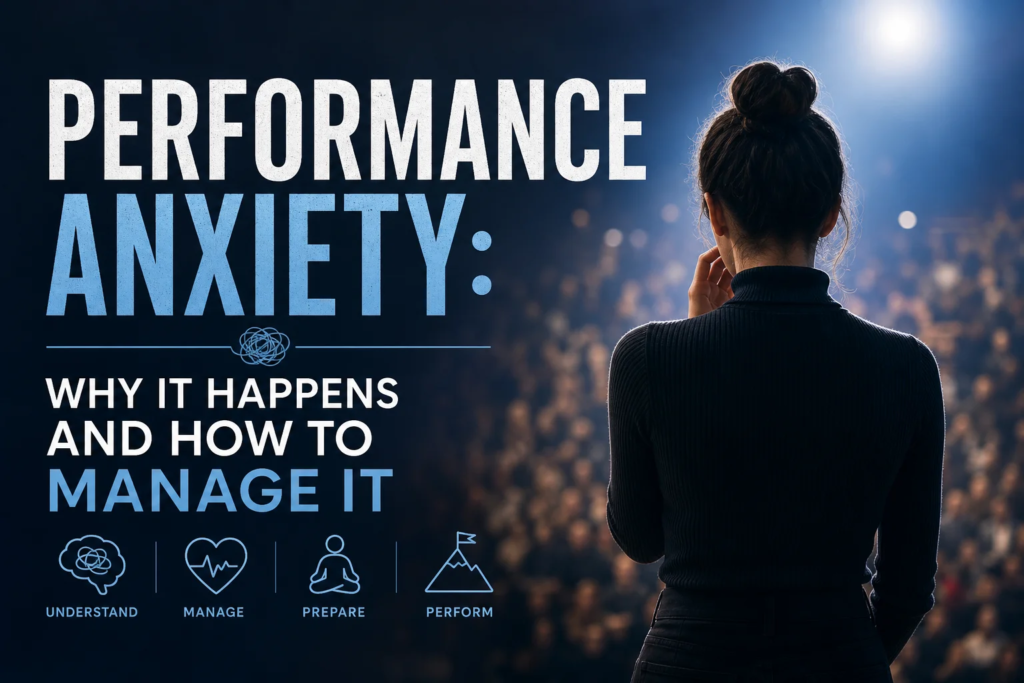
The Ultimate Guide to Performance Anxiety: Why It Happens and How to Manage It with Proven Confidence Strategies
Introduction: When “Just Do Your Best” Isn’t Enough
Your heart pounds. Your mouth goes dry. Your hands feel shaky, your thoughts scatter, and suddenly the thing you practiced a hundred times feels strangely unfamiliar. Maybe you’re about to give a presentation, perform on stage, take an exam, compete in a sport, speak up in a meeting, or be intimate with a partner. You know you’re capable—but your body seems to disagree.
That experience has a name: performance anxiety.
And here’s the important part: performance anxiety is not a character flaw. It does not mean you are weak, unprepared, untalented, or “bad under pressure.” It means your nervous system is treating a meaningful moment as if it were a threat. Understanding Performance Anxiety: Why It Happens and How to Manage It can change everything—not because it magically removes nerves, but because it helps you work with your mind and body instead of fighting them.
This guide explores Performance Anxiety: Why It Happens and How to Manage It in depth: the biology, psychology, real-life examples, practical tools, and mindset shifts that help people perform with steadiness, confidence, and resilience.
Whether you’re a student, athlete, musician, executive, actor, public speaker, healthcare worker, entrepreneur, or someone who simply wants to stop freezing when it matters, this article will give you a practical roadmap.
Contextual Keyword Variations for This Topic
To discuss Performance Anxiety: Why It Happens and How to Manage It naturally, we’ll also use related phrases such as:
- How to manage performance anxiety
- Why performance anxiety happens
- Symptoms of performance anxiety
- Performance anxiety treatment strategies
- Stage fright and performance anxiety
- Test anxiety and performance pressure
- Public speaking performance anxiety
- Sports performance anxiety
- Workplace performance anxiety
- Sexual performance anxiety
- How to calm nerves before performing
- Performance anxiety coping techniques
- Confidence building for high-pressure situations
- Managing fear of failure
- Overcoming performance anxiety naturally
What Is Performance Anxiety?
Performance anxiety is a fear response that occurs before or during situations where you feel evaluated, judged, observed, or expected to succeed. It can happen in obvious performance settings—like concerts, speeches, competitions, and exams—but it can also appear in everyday moments: making a phone call, participating in a meeting, asking a question in class, going on a date, or having an important conversation.
At its core, Performance Anxiety: Why It Happens and How to Manage It is about the gap between ability and access. You may have the skills, knowledge, or preparation, but anxiety temporarily blocks your ability to access them smoothly.
Performance anxiety often includes:
- Racing thoughts
- Fear of embarrassment
- Physical tension
- Shaking, sweating, or nausea
- Avoidance or procrastination
- Over-preparation or perfectionism
- Mental blanking
- Harsh self-criticism
- Panic-like symptoms
- Difficulty staying present
A key insight: performance anxiety is not always caused by lack of preparation. In fact, many high performers experience it precisely because they care deeply and have high standards.
Performance Anxiety: Why It Happens and How to Manage It Starts with the Brain
To understand Performance Anxiety: Why It Happens and How to Manage It, you have to understand your threat system.
The human brain evolved to detect danger quickly. When your brain senses threat, it activates the sympathetic nervous system—the “fight, flight, or freeze” response. This reaction helped our ancestors survive predators, conflict, and physical danger. But today, your nervous system may respond to a job interview, piano recital, exam, or sales pitch as if it were a life-or-death event.
Your body prepares you to survive:
- Heart rate increases to pump blood to muscles
- Breathing becomes faster
- Muscles tense for action
- Digestion slows, causing nausea or stomach discomfort
- Attention narrows toward perceived threats
- Stress hormones like adrenaline and cortisol rise
This is useful if you need to run from danger. It’s less useful if you need to remember your opening line, hit a golf shot, solve an equation, or speak clearly in front of a boardroom.
The paradox of Performance Anxiety: Why It Happens and How to Manage It is that your body is trying to protect you—but the protection can interfere with the performance.
The Performance Anxiety Cycle
Performance anxiety often becomes stronger because it runs in a loop. One anxious moment leads to fear of having another anxious moment, which creates more anxiety.
| Stage | What Happens | Example |
|---|---|---|
| Trigger | A performance situation appears | “I have to present tomorrow.” |
| Threat appraisal | The brain labels it dangerous | “What if I embarrass myself?” |
| Physical symptoms | The body activates stress response | Sweating, shaking, racing heart |
| Catastrophic thoughts | Anxiety interprets symptoms negatively | “Everyone will notice I’m nervous.” |
| Performance interference | Focus shifts from task to fear | Forgetting points, rushing, freezing |
| After-event rumination | You replay mistakes | “I ruined it.” |
| Future fear | The next performance feels scarier | Avoidance or over-preparation |
Understanding this cycle is central to Performance Anxiety: Why It Happens and How to Manage It because each stage gives you a place to intervene.
You don’t have to wait until you feel fearless. You can interrupt the loop at the level of breathing, thinking, preparation, attention, self-talk, exposure, or recovery.
Common Types of Performance Anxiety
Performance anxiety can show up in many forms. The setting changes, but the underlying fear is often similar: “What if I fail, freeze, disappoint people, or prove I’m not good enough?”
1. Public Speaking Anxiety
This is one of the most common forms. People may fear losing their train of thought, sounding unintelligent, being judged, or visibly shaking.
2. Stage Fright
Actors, musicians, dancers, comedians, and performers often experience stage fright, even after years of training. The audience’s presence can amplify self-consciousness.
3. Test Anxiety
Students may understand the material but blank during exams because pressure disrupts memory retrieval.
4. Sports Performance Anxiety
Athletes may struggle with overthinking, fear of choking, or inability to trust muscle memory during competition.
5. Workplace Performance Anxiety
This includes anxiety before meetings, evaluations, interviews, sales calls, negotiations, or leadership responsibilities.
6. Sexual Performance Anxiety
This may involve fear of not satisfying a partner, difficulty maintaining arousal, or becoming trapped in self-monitoring instead of connection.
7. Creative Performance Anxiety
Writers, artists, designers, and entrepreneurs may freeze when their work is visible, judged, published, or monetized.
The reason Performance Anxiety: Why It Happens and How to Manage It matters across so many areas is that performance anxiety is not limited to stages and microphones. It appears anywhere identity, approval, competence, and vulnerability collide.
Why Performance Anxiety Happens: The Deeper Causes
Performance anxiety is rarely caused by one thing. It usually develops from a combination of biology, personality, past experiences, social expectations, and current pressure.
1. Fear of Judgment
Humans are social creatures. For most of history, belonging to a group was essential for survival. Rejection felt dangerous because, in ancient environments, it could be.
So when you stand in front of people, your brain may think:
- “They’re evaluating me.”
- “If I fail, I’ll lose respect.”
- “If they see weakness, I’m unsafe.”
This social threat response is a major piece of Performance Anxiety: Why It Happens and How to Manage It.
2. Perfectionism
Perfectionism often disguises itself as ambition, but it can create impossible standards. If your goal is “I must not make any mistakes,” performance becomes a test of worth instead of an opportunity to communicate, compete, or create.
Perfectionism increases anxiety because it leaves no room for being human.
3. Past Embarrassment or Failure
One painful memory can train the brain to expect danger. A forgotten line, a failed exam, a coach’s criticism, laughter from classmates, or a harsh review can become emotionally stored as “proof” that performance situations are unsafe.
4. High Stakes
The more important the outcome feels, the more pressure your brain attaches to it. A job interview that affects your income, an audition that could change your career, or an exam that determines graduation naturally carries emotional weight.
5. Identity Attachment
Performance anxiety becomes stronger when the result feels like a verdict on who you are.
Instead of “This is a presentation,” it becomes:
- “This proves whether I’m smart.”
- “This determines whether I belong.”
- “This shows whether I’m talented.”
- “This decides whether people respect me.”
A powerful strategy in Performance Anxiety: Why It Happens and How to Manage It is learning to separate performance outcomes from personal worth.
6. Lack of Recovery
Stress accumulates. Poor sleep, caffeine overload, emotional conflict, burnout, and chronic pressure can make the nervous system more reactive. Sometimes what feels like “performance anxiety” is partly an exhausted body running on fumes.
7. Over-Focusing on Yourself
Performance often goes best when attention is outward: toward the music, the audience, the message, the teammate, the problem, or the task.
Anxiety pulls attention inward:
- “How do I sound?”
- “Do I look nervous?”
- “What if my hands shake?”
- “Am I doing well?”
- “Can they tell?”
This self-monitoring consumes mental bandwidth and makes performance feel unnatural.
Symptoms of Performance Anxiety
Performance anxiety affects the body, thoughts, emotions, and behavior.
| Category | Common Symptoms |
|---|---|
| Physical | Racing heart, trembling, sweating, dry mouth, nausea, dizziness, tight chest, shortness of breath |
| Cognitive | Blank mind, intrusive thoughts, catastrophizing, self-doubt, difficulty concentrating |
| Emotional | Fear, shame, dread, irritability, panic, frustration |
| Behavioral | Avoidance, procrastination, rushing, over-rehearsing, quitting, seeking reassurance |
| Social | Withdrawing, comparing, fear of being watched, discomfort with attention |
One important part of Performance Anxiety: Why It Happens and How to Manage It is learning not to fear symptoms themselves. A racing heart is not proof that you will fail. Shaky hands are not proof that people are judging you. Anxiety symptoms are body signals—not destiny.
The Yerkes-Dodson Law: Why Some Anxiety Can Help
Not all anxiety is harmful. A moderate level of arousal can sharpen focus, increase energy, and improve performance. This is sometimes described through the Yerkes-Dodson law: performance tends to improve with physiological arousal up to a point, but too much arousal can impair performance.
| Arousal Level | Likely Effect | Example |
|---|---|---|
| Too low | Low energy, boredom, under-engagement | A speaker sounds flat and disconnected |
| Moderate | Alertness, focus, motivation | An athlete feels “ready” and energized |
| Too high | Panic, freezing, overthinking | A student blanks on an exam |
The goal is not always to eliminate anxiety. The goal is to regulate it.
That distinction is essential to Performance Anxiety: Why It Happens and How to Manage It. You do not need to become a person who never feels nervous. You need to become a person who can perform while nervous.
Case Study 1: The Executive Who Froze During Presentations
Background
Maya, a senior marketing director, was excellent in small meetings. She was strategic, articulate, and respected. But when presenting to the executive board, she experienced intense anxiety. Her throat tightened, she rushed through slides, and she often forgot key points.
After one difficult presentation, she began dreading every board meeting. She spent weeks over-preparing, rewriting slides late at night, and imagining worst-case scenarios.
What Was Happening
Maya’s anxiety was not caused by incompetence. It was caused by threat appraisal. She believed every presentation was a test of whether she deserved her leadership role.
Her internal script was:
- “If I stumble, they’ll think I’m not executive material.”
- “I can’t show nerves.”
- “I have to be flawless.”
This is a classic example of Performance Anxiety: Why It Happens and How to Manage It in the workplace: high ability combined with high self-pressure.
What Helped
Maya used several strategies:
- She changed her goal from “impress everyone” to “help the board make a clear decision.”
- She practiced her opening two minutes until they felt automatic.
- She rehearsed with mild distractions to simulate pressure.
- She used slow exhale breathing before entering the room.
- She stopped apologizing for small pauses and learned to use them intentionally.
Analysis
Maya’s case shows that performance anxiety often decreases when attention moves from self-protection to service. Instead of performing to prove worth, she learned to communicate value. That shift is a core principle of Performance Anxiety: Why It Happens and How to Manage It.
Case Study 2: The Student Who Knew the Material but Failed Tests
Background
Jordan was a university student who studied consistently and understood course concepts during tutoring sessions. But during exams, his mind went blank. He reread questions repeatedly, panicked when others finished early, and often changed correct answers to wrong ones.
What Was Happening
Jordan’s anxiety was triggered by time pressure and fear of disappointing his family. His body entered fight-or-flight mode, which disrupted working memory. He interpreted normal uncertainty as danger.
His anxious thoughts included:
- “If I fail this exam, my future is ruined.”
- “Everyone else is faster than me.”
- “I can’t think. Something is wrong.”
This case reflects Performance Anxiety: Why It Happens and How to Manage It in academic settings: preparation alone may not solve anxiety if the nervous system remains dysregulated.
What Helped
Jordan developed an exam routine:
| Strategy | Purpose |
|---|---|
| Practice tests under timed conditions | Reduce novelty and build tolerance |
| Breathing reset every 20 minutes | Lower physiological arousal |
| Answer easiest questions first | Build momentum |
| Label anxious thoughts | Create distance from panic |
| Post-exam review limits | Reduce rumination |
He also learned to say, “This is anxiety, not inability.”
Analysis
Jordan’s improvement came from training under realistic pressure, not just studying more. His case highlights an important truth about Performance Anxiety: Why It Happens and How to Manage It: you must practice both the skill and the state in which the skill will be used.
Case Study 3: The Musician Who Feared One Wrong Note
Background
Elena, a classically trained violinist, loved playing alone but dreaded auditions. Her hands shook, her bow control changed, and she became painfully aware of each note. The more she tried not to make mistakes, the more mechanical her playing became.
What Was Happening
Elena’s anxiety came from perfectionism and self-monitoring. Music that usually flowed became fragmented because she was mentally checking every movement.
Her mind sounded like:
- “Don’t miss the shift.”
- “Don’t mess up the entrance.”
- “They’ll know you’re nervous.”
- “That note was sharp. You’re done.”
This is a vivid example of Performance Anxiety: Why It Happens and How to Manage It for artists: fear can interrupt the automatic processes that expert performance depends on.
What Helped
Elena began practicing “performance reps”:
- Playing for one friend
- Recording herself
- Performing after light exercise to mimic adrenaline
- Continuing after mistakes instead of stopping
- Focusing on musical expression rather than technical perfection
She also created a “mistake recovery plan”: if she missed a note, she would breathe, return to phrasing, and continue as if the music mattered more than the mistake.
Analysis
Elena’s case shows that confidence is not built by avoiding mistakes. It is built by learning that mistakes are survivable. For musicians and performers, Performance Anxiety: Why It Happens and How to Manage It often involves shifting from error prevention to expressive communication.
Case Study 4: The Athlete Who Choked Under Pressure
Background
Darius was a talented basketball player known for strong performance during practice. But in close games, especially during free throws, he became tense. He started thinking about mechanics he normally performed automatically.
What Was Happening
Darius was experiencing “paralysis by analysis.” Under pressure, he shifted from automatic execution to conscious control. This disrupted rhythm.
His inner dialogue was:
- “Don’t miss.”
- “Bend your knees.”
- “Follow through.”
- “Everyone is watching.”
- “If I miss, we lose.”
This is a sports-based example of Performance Anxiety: Why It Happens and How to Manage It: pressure can move attention away from instinct and into over-control.
What Helped
His coach helped him create a consistent pre-shot routine:
- Bounce the ball twice.
- Exhale slowly.
- Look at the back of the rim.
- Say one cue word: “smooth.”
- Shoot without adding extra thoughts.
He practiced this routine daily, including after sprints when his heart rate was elevated.
Analysis
Darius improved because routines reduce decision fatigue and anchor attention. In sports, Performance Anxiety: Why It Happens and How to Manage It often depends on creating simple cues that keep the athlete connected to the task rather than the outcome.
Why Avoidance Makes Performance Anxiety Worse
Avoidance feels good in the short term. If you cancel the presentation, skip the audition, avoid the exam, or stay silent in the meeting, anxiety drops. Your brain learns, “Avoidance kept me safe.”
But long term, avoidance strengthens fear.
| Avoidance Behavior | Short-Term Relief | Long-Term Cost |
|---|---|---|
| Skipping presentations | Less immediate fear | More fear next time |
| Over-rehearsing endlessly | Temporary sense of control | Burnout and rigidity |
| Avoiding eye contact | Less exposure | More self-consciousness |
| Turning down opportunities | Comfort | Reduced growth |
| Using alcohol or sedatives unsafely | Temporary calming | Dependence risk and reduced confidence |
A major lesson in Performance Anxiety: Why It Happens and How to Manage It is this: confidence grows through safe, repeated contact with the situations you fear—not through waiting until fear disappears.
How to Manage Performance Anxiety: A Practical Toolkit
Now let’s move from understanding to action. Managing performance anxiety requires a combination of body regulation, mental reframing, exposure practice, preparation, and recovery.
1. Reframe Anxiety as Activation
Instead of saying, “I’m anxious,” try:
- “My body is getting ready.”
- “This energy can help me focus.”
- “I don’t need calm; I need direction.”
- “This is adrenaline, not danger.”
Research suggests that reappraising anxiety as excitement can improve performance in some situations. The point is not to lie to yourself. The point is to interpret arousal in a less threatening way.
In the context of Performance Anxiety: Why It Happens and How to Manage It, reframing helps prevent the second wave of anxiety—the fear of anxiety itself.
2. Use Breathing to Regulate the Nervous System
Breathing is one of the fastest ways to influence the body’s stress response.
Try the extended exhale technique:
- Inhale through your nose for 4 seconds.
- Exhale slowly for 6 to 8 seconds.
- Repeat for 2 to 5 minutes.
Longer exhales signal safety to the nervous system and can reduce physical intensity.
Another option is box breathing:
| Step | Count |
|---|---|
| Inhale | 4 |
| Hold | 4 |
| Exhale | 4 |
| Hold | 4 |
Use breathing before performance, but also during practice. The more familiar it becomes, the easier it is to use under pressure.
3. Create a Pre-Performance Routine
Routines reduce uncertainty. They tell the brain, “We know what to do.”
A strong routine might include:
- Light movement
- Breathing
- Reviewing one intention
- Visualizing the first 30 seconds
- Using a cue word
- Grounding through the senses
- Beginning before overthinking takes over
For Performance Anxiety: Why It Happens and How to Manage It, routines are especially powerful because they shift attention from “What if?” to “What now?”
Example routine for public speaking:
- Arrive early.
- Test technology.
- Stand with both feet grounded.
- Take three slow exhales.
- Look at one friendly face.
- Begin with a memorized opening line.
- Focus on the message, not your nerves.
4. Practice Under Pressure
If you only practice in comfortable conditions, your brain may panic when conditions change.
Pressure practice can include:
- Recording yourself
- Practicing in front of friends
- Simulating time limits
- Rehearsing with background noise
- Practicing after exercise
- Doing mock interviews
- Taking timed practice exams
- Performing in low-stakes environments first
This principle is central to Performance Anxiety: Why It Happens and How to Manage It: train the nervous system, not just the skill.
5. Shift from Outcome Goals to Process Goals
Outcome goals depend on results:
- “Get the job.”
- “Win the game.”
- “Get an A.”
- “Receive applause.”
- “Make no mistakes.”
Process goals depend on controllable actions:
- “Speak slowly.”
- “Make eye contact.”
- “Follow my routine.”
- “Stay connected to the music.”
- “Answer one question at a time.”
- “Use my breathing reset.”
Outcome goals create pressure. Process goals create direction.
| Situation | Outcome Goal | Better Process Goal |
|---|---|---|
| Presentation | “Everyone must like it” | “Deliver three clear points” |
| Exam | “I must get 95%” | “Work steadily and check answers once” |
| Audition | “I must be chosen” | “Communicate the character honestly” |
| Sport | “I must win” | “Commit fully to each play” |
| Interview | “I must impress them” | “Answer clearly and ask thoughtful questions” |
One of the most useful ideas in Performance Anxiety: Why It Happens and How to Manage It is that you perform better when you focus on what you can control.
6. Name the Fear Specifically
Vague fear is harder to manage. Specific fear can be challenged.
Instead of “I’m terrified,” ask:
- What exactly am I afraid will happen?
- How likely is that?
- If it happened, how would I respond?
- Have I survived similar moments before?
- What would I tell a friend in this situation?
- Is this a danger—or discomfort?
Performance anxiety often exaggerates consequences. Naming the fear helps shrink it to a realistic size.
7. Develop a Mistake Recovery Plan
Many people don’t fear performing. They fear making a mistake while performing.
Create a plan:
- If I lose my place, I will pause and return to my notes.
- If my voice shakes, I will slow down and keep speaking.
- If I miss a note, I will continue musically.
- If I blank on a question, I will say, “Let me think for a moment.”
- If I make an error, I will recover instead of collapse.
A recovery plan is vital to Performance Anxiety: Why It Happens and How to Manage It because it teaches your brain that mistakes are manageable, not catastrophic.
8. Use Grounding Techniques
Grounding brings attention back to the present moment.
Try the 5-4-3-2-1 method:
- Name 5 things you can see.
- Name 4 things you can feel.
- Name 3 things you can hear.
- Name 2 things you can smell.
- Name 1 thing you can taste.
Or use physical grounding:
- Press your feet into the floor.
- Relax your jaw.
- Drop your shoulders.
- Feel the object in your hand.
- Notice the temperature of the room.
Grounding helps because anxiety pulls you into imagined future failure. Performance happens in the present.
9. Improve Self-Talk
Self-talk matters, but it must be believable. Telling yourself “I am the greatest speaker alive” may not work if you don’t believe it.
Better self-talk is realistic and supportive:
| Anxious Thought | Helpful Replacement |
|---|---|
| “I’m going to fail.” | “I can handle this one step at a time.” |
| “Everyone can tell I’m nervous.” | “Most people are focused on the message.” |
| “I can’t make mistakes.” | “I can recover from mistakes.” |
| “My anxiety means I’m not ready.” | “Anxiety means this matters.” |
| “I must be perfect.” | “I need to be present, not perfect.” |
Self-talk is a major part of Performance Anxiety: Why It Happens and How to Manage It because your interpretation of anxiety often determines whether it escalates or settles.
10. Reduce Physical Stress Before Big Moments
Your baseline matters. If you are sleep-deprived, over-caffeinated, hungry, dehydrated, and emotionally exhausted, your anxiety threshold will be lower.
Before high-pressure situations, consider:
- Sleeping enough when possible
- Eating balanced meals
- Limiting excessive caffeine
- Hydrating
- Stretching or walking
- Avoiding last-minute cramming
- Preparing materials early
- Creating buffer time
Managing Performance Anxiety: Why It Happens and How to Manage It is not just mental. Your body is part of the performance system.
A Simple 7-Day Plan to Reduce Performance Anxiety
Here is a practical week-long plan you can adapt.
| Day | Focus | Action |
|---|---|---|
| Day 1 | Awareness | Write down your triggers, symptoms, and anxious thoughts |
| Day 2 | Breathing | Practice extended exhale breathing for 5 minutes twice |
| Day 3 | Reframing | Replace three catastrophic thoughts with balanced ones |
| Day 4 | Simulation | Practice the performance in a mildly stressful condition |
| Day 5 | Routine | Build and rehearse a pre-performance routine |
| Day 6 | Recovery | Practice making a small mistake and continuing |
| Day 7 | Reflection | Review what helped and plan the next exposure |
This plan reflects the heart of Performance Anxiety: Why It Happens and How to Manage It: progress comes from small, repeated actions that teach the nervous system safety and competence.
Performance Anxiety in the Workplace
Workplace performance anxiety is increasingly common. People face presentations, video calls, deadlines, reviews, leadership visibility, and constant comparison.
Common workplace triggers include:
- Speaking in meetings
- Presenting to senior leaders
- Being evaluated
- Asking for a raise
- Leading a team
- Making mistakes publicly
- Starting a new role
- Handling conflict
To manage workplace anxiety:
- Prepare key points, not scripts.
- Practice concise speaking.
- Ask clarifying questions instead of pretending.
- Use pauses as leadership tools.
- Separate feedback from identity.
- Keep a “wins and evidence” file.
- Request support or coaching when needed.
For professionals, Performance Anxiety: Why It Happens and How to Manage It is not about becoming emotionless. It is about building enough internal stability to contribute even when visibility feels uncomfortable.
Performance Anxiety for Artists and Performers
Artists often face a unique form of anxiety because their work can feel personal. A rejected performance may feel like a rejected self.
Helpful strategies include:
- Practicing in performance conditions
- Building rituals before shows
- Focusing on expression over perfection
- Recording rehearsals to normalize being observed
- Learning to continue after errors
- Creating emotional separation between self and work
- Remembering that audiences want connection, not flawlessness
In creative fields, Performance Anxiety: Why It Happens and How to Manage It often means returning to the reason you perform in the first place: communication, beauty, truth, story, and shared experience.
Performance Anxiety in Sports
Athletes often experience pressure when outcomes are visible and immediate. One mistake can affect a score, a team, or a season.
Sports anxiety management often includes:
- Pre-performance routines
- Visualization
- Cue words
- Breath control
- Trusting training
- Focusing on the next play
- Letting go of previous mistakes
- Practicing under fatigue
The athlete’s version of Performance Anxiety: Why It Happens and How to Manage It is about staying task-focused when stakes rise.
A useful phrase for athletes is: “Next action.”
Not “Why did I miss?”
Not “What if we lose?”
Just: “Next action.”
Sexual Performance Anxiety
Sexual performance anxiety can be especially distressing because it involves vulnerability, intimacy, body image, relationship dynamics, and fear of disappointing someone.
It may include:
- Difficulty becoming or staying aroused
- Premature ejaculation
- Erectile difficulties
- Difficulty reaching orgasm
- Avoidance of intimacy
- Self-consciousness about the body
- Fear of not satisfying a partner
A key part of managing sexual performance anxiety is shifting from performance to connection. Intimacy is not an exam. When someone becomes trapped in self-monitoring—“Am I doing this right?”—they may disconnect from sensation and emotional presence.
Helpful steps include:
- Communicating openly with a trusted partner
- Slowing down
- Reducing goal-oriented pressure
- Focusing on sensation and connection
- Addressing relationship stress
- Speaking with a healthcare provider if symptoms persist
- Considering therapy if anxiety, shame, or trauma is involved
This area of Performance Anxiety: Why It Happens and How to Manage It is deeply human. Compassion matters. Pressure rarely improves intimacy; safety and communication often do.
When Performance Anxiety Becomes a Bigger Problem
Performance anxiety exists on a spectrum. Occasional nerves are normal. But it may be time to seek professional help if anxiety:
- Causes panic attacks
- Leads to repeated avoidance
- Interferes with work, school, relationships, or health
- Causes significant distress for weeks or months
- Leads to substance misuse
- Is connected to trauma or severe shame
- Triggers depression or hopelessness
- Makes daily functioning difficult
Therapy can be very effective. Cognitive behavioral therapy, exposure therapy, acceptance and commitment therapy, mindfulness-based approaches, and performance coaching can all help. In some cases, medication may be appropriate, especially when symptoms are severe. A qualified healthcare professional can guide that decision.
Understanding Performance Anxiety: Why It Happens and How to Manage It is empowering, but you do not have to manage it alone.
What Not to Do When Managing Performance Anxiety
Some common coping strategies accidentally make anxiety stronger.
| Unhelpful Strategy | Why It Backfires | Better Alternative |
|---|---|---|
| Waiting to feel confident | Confidence often comes after action | Take small, planned steps |
| Trying to eliminate all nerves | Creates fear of symptoms | Learn to perform with arousal |
| Over-rehearsing rigidly | Increases pressure and fatigue | Practice flexibly with recovery |
| Avoiding all performance situations | Reinforces threat | Use gradual exposure |
| Comparing yourself constantly | Fuels inadequacy | Track your own progress |
| Catastrophizing mistakes | Makes errors feel dangerous | Build a recovery plan |
| Using substances to cope | Can create dependency | Use breathing, therapy, routines |
A mature approach to Performance Anxiety: Why It Happens and How to Manage It is not about control at all costs. It is about flexibility, recovery, and trust.
The Confidence Myth
Many people believe confidence comes first and action comes second.
In reality, action often comes first.
You do the presentation while nervous.
You take the exam while uncertain.
You audition while your heart pounds.
You speak up while your voice shakes.
You try again after an imperfect attempt.
Then your brain learns: “I can survive this.”
Confidence is not the absence of fear. Confidence is the memory of having handled fear before.
This is one of the most hopeful lessons in Performance Anxiety: Why It Happens and How to Manage It: you do not need to wait until you become fearless to begin. You begin, and fear gradually loses authority.
A Practical Performance Anxiety Checklist
Use this before your next high-pressure moment.
| Question | Your Answer |
|---|---|
| What is the actual task? | |
| What is within my control? | |
| What process goal will I focus on? | |
| What anxious thought might show up? | |
| What will I say back to that thought? | |
| What is my breathing strategy? | |
| What is my first action? | |
| What will I do if I make a mistake? | |
| How will I recover afterward without rumination? |
This checklist turns Performance Anxiety: Why It Happens and How to Manage It from an abstract concept into a practical routine.
Conclusion: You Can Learn to Perform with Courage
Performance anxiety is not proof that you are incapable. It is proof that your brain and body are responding to pressure, meaning, visibility, and uncertainty. Once you understand the system, you can train it.
The essential lessons of Performance Anxiety: Why It Happens and How to Manage It are simple but powerful:
- Anxiety is a protective response, not a personal failure.
- Physical symptoms are uncomfortable but not dangerous.
- Avoidance strengthens fear; gradual exposure builds confidence.
- Preparation matters, but pressure practice matters too.
- Process goals reduce pressure more effectively than perfectionism.
- Mistakes are not disasters when you have a recovery plan.
- Confidence grows through repeated evidence that you can cope.
The next time your heart races before an important moment, try not to treat it as a stop sign. Treat it as energy. Breathe. Ground yourself. Focus on the next action. Let yourself be human.
You do not have to perform perfectly to perform powerfully.
FAQs About Performance Anxiety: Why It Happens and How to Manage It
1. What is performance anxiety?
Performance anxiety is fear or distress that occurs before or during situations where you feel evaluated or pressured to succeed. It can happen during public speaking, exams, sports, music, acting, work presentations, interviews, or intimate moments.
2. Why does performance anxiety happen?
Performance anxiety happens when the brain interprets a performance situation as a threat. This activates the stress response, causing symptoms like racing heart, shaking, sweating, nausea, and racing thoughts. Fear of judgment, perfectionism, past embarrassment, and high stakes can all contribute.
3. How do I manage performance anxiety quickly?
To manage performance anxiety quickly, use slow breathing with longer exhales, ground yourself through your senses, focus on one process goal, and remind yourself that anxiety is activation—not danger. A simple cue like “slow and steady” can help redirect attention.
4. Can performance anxiety go away completely?
For some people, it becomes very mild. For others, nerves still appear, but they become manageable. The goal is not always to eliminate anxiety completely. The goal is to perform effectively even when some anxiety is present.
5. Is performance anxiety the same as social anxiety?
They can overlap, but they are not identical. Social anxiety involves fear of social judgment in many interpersonal situations. Performance anxiety is specifically tied to performing, being evaluated, or needing to succeed in a task. Some people experience both.
6. What is the best therapy for performance anxiety?
Cognitive behavioral therapy, exposure therapy, acceptance and commitment therapy, and mindfulness-based approaches can be helpful. Performance coaching may also help for specific areas like public speaking, sports, or music. If symptoms are severe, consult a licensed mental health professional.
7. How can I stop blanking during presentations or exams?
Practice under realistic conditions, use a structured routine, slow your breathing, and focus on one step at a time. For presentations, memorize only your opening and key transitions rather than every word. For exams, start with easier questions to build momentum.
8. Does preparation reduce performance anxiety?
Preparation helps, but it is not the whole solution. Many people with performance anxiety are already well prepared. You also need to practice managing physical arousal, handling mistakes, and performing under pressure.
9. Can children and teenagers experience performance anxiety?
Yes. Children and teens can experience performance anxiety during tests, sports, recitals, auditions, classroom speaking, or social situations. Supportive coaching, gradual exposure, realistic expectations, and reassurance can help.
10. When should I seek professional help?
Seek help if performance anxiety causes intense distress, panic attacks, avoidance, reduced functioning, relationship problems, or reliance on substances to cope. Professional support can make recovery faster and more sustainable.

