


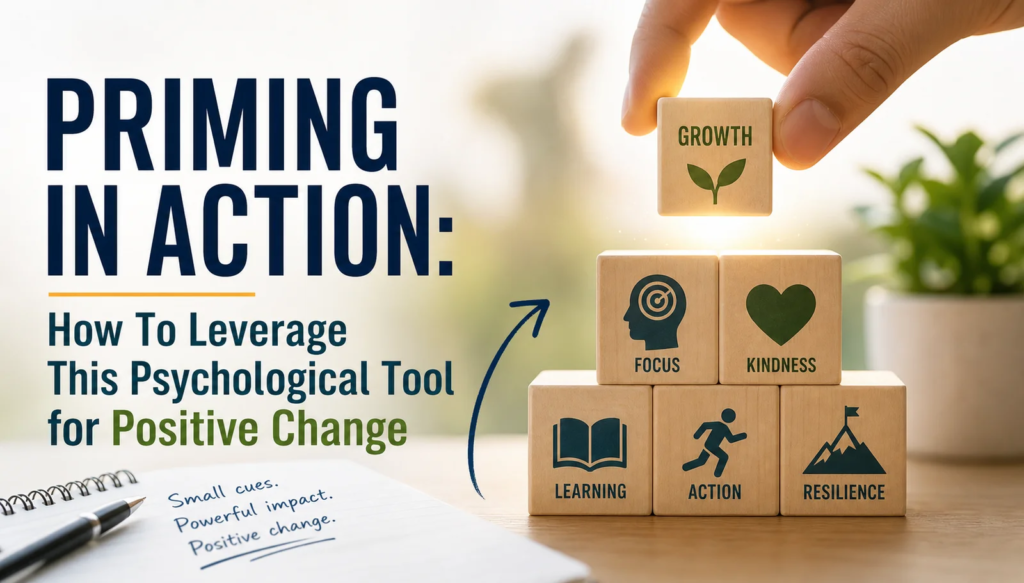
Imagine walking into a room where a single word on a poster makes you more patient, a carefully chosen playlist helps you focus, or the layout of your kitchen nudges you toward healthier food without a lecture, diet plan, or burst of willpower.
That is the power of priming.
Priming is one of psychology’s most fascinating and practical ideas: the things we see, hear, feel, smell, and repeatedly encounter can influence what comes to mind next—and sometimes what we do next. Used wisely, priming can help people make better choices, build healthier habits, communicate more effectively, and create environments that support positive change.
That is why Priming in Action: How To Leverage This Psychological Tool for Positive Change is more than a psychology topic. It is a practical framework for designing better days, better workplaces, better classrooms, and better personal routines.
But there is an important caveat: priming is not mind control. It does not override values, erase free will, or guarantee behavior. The strongest forms of priming work when they support goals people already care about, reduce friction, and make positive actions easier to notice and choose.
In this in-depth guide to Priming in Action: How To Leverage This Psychological Tool for Positive Change, we will explore how priming works, where it shows up in real life, what the science says, how to use it ethically, and how to build your own priming-based change strategy.
What Is Priming?
Priming is a psychological effect in which exposure to one stimulus influences a later thought, feeling, judgment, or behavior.
A stimulus can be almost anything:
- A word
- An image
- A sound
- A smell
- A physical environment
- A social cue
- A memory
- A question
- A symbol
- A repeated routine
For example, if someone reads words like “calm,” “breathe,” and “steady,” they may be more likely to think about patience or self-control shortly afterward. If a gym bag is placed by the front door, it may make exercising feel more mentally available. If a team meeting begins with examples of collaboration, people may be more likely to discuss problems in a cooperative tone.
That is Priming in Action: How To Leverage This Psychological Tool for Positive Change at its simplest: arranging cues so that better thoughts and behaviors become easier to access.
Priming often works through association. The brain stores ideas in networks. When one idea is activated, related ideas become easier to retrieve. If “healthy breakfast” is associated with “energy,” “confidence,” and “preparation,” then seeing overnight oats in the fridge may trigger a chain of helpful associations.
This is why priming can be so useful for behavior change. It does not always require more motivation. Sometimes it simply requires better cues.
Why Priming Matters in Everyday Life
We like to think our decisions come from deliberate reasoning. Sometimes they do. But much of daily life runs on automatic processes.
You do not consciously analyze every object in your home, every word in an email, or every design choice in an app. Your brain filters, interprets, and responds quickly. Priming works within this fast system.
That is why Priming in Action: How To Leverage This Psychological Tool for Positive Change matters so much. If our surroundings are already influencing us, we might as well shape those surroundings intentionally.
Think about these everyday examples:
- A visible water bottle reminds you to drink more water.
- A clean desk makes it easier to begin focused work.
- A gratitude journal on your nightstand prompts reflection.
- A savings app notification reminds you of long-term goals.
- A walking route near a park makes exercise more appealing.
- A phone wallpaper with your family may encourage financial discipline.
- A meeting room with shared goals displayed may reduce conflict.
Priming can turn intention into action by making the right behavior more obvious at the right moment.
The Psychology Behind Priming
To understand Priming in Action: How To Leverage This Psychological Tool for Positive Change, it helps to know what happens beneath the surface.
Priming generally involves three psychological mechanisms.
1. Activation
When you encounter a cue, it activates related concepts in memory.
For instance, the word “ocean” may activate related ideas such as water, vacation, waves, blue, calm, or danger, depending on your past experiences.
2. Accessibility
Once a concept is activated, it becomes more accessible. That means it is easier to think about, notice, and use in judgment.
If you just read about kindness, you may notice kind behavior more easily. If you just reviewed your monthly budget, you may become more sensitive to spending decisions.
3. Behavioral Readiness
Sometimes accessible concepts make certain actions feel more natural.
If an athlete listens to a song associated with training, the body and mind may shift toward performance mode. If a student studies in the same environment where they later take a test, the setting may cue relevant memories.
This is a key lesson in Priming in Action: How To Leverage This Psychological Tool for Positive Change: cues do not simply remind us; they prepare us.
Important Note: Priming Is Powerful, But Not Magical
Some classic priming studies became famous for suggesting dramatic effects from subtle cues. Over time, psychology has taken a more careful view. Certain priming effects are robust, especially in memory, perception, learning, and attention. Other social priming effects are more debated and may depend heavily on context, measurement, and replication quality.
So, how should we use priming responsibly?
Use it as a support tool, not a miracle solution.
The most reliable version of Priming in Action: How To Leverage This Psychological Tool for Positive Change combines priming with:
- Clear goals
- Repeated exposure
- Environmental design
- Personal meaning
- Reduced friction
- Feedback
- Social support
- Habit formation
Priming is strongest when it aligns with what people already value.
A poster that says “Be productive” will not transform a chaotic workplace. But a workspace designed with clear priorities, fewer distractions, visible progress boards, and intentional start-of-day rituals can make focused work more likely.
Types of Priming and How They Work
Priming comes in many forms. Understanding the different types helps you apply Priming in Action: How To Leverage This Psychological Tool for Positive Change more effectively.
| Type of Priming | What It Means | Example | Positive Use |
|---|---|---|---|
| Semantic priming | Words or meanings activate related ideas | Seeing “healthy” before choosing lunch | Encourage nutritious choices |
| Visual priming | Images influence attention or expectations | A photo of nature in a waiting room | Reduce stress and promote calm |
| Goal priming | Cues activate a desired objective | A savings goal image on a banking app | Support financial discipline |
| Social priming | Social norms or group cues influence behavior | “Most guests reuse towels” sign | Encourage sustainable action |
| Emotional priming | Mood-related cues shape interpretation | Uplifting music before a meeting | Improve morale and openness |
| Environmental priming | Physical surroundings cue behavior | Running shoes near the door | Increase exercise consistency |
| Identity priming | Cues remind people of who they want to be | “I am a reader” bookshelf display | Strengthen positive self-concept |
| Procedural priming | A routine cues the next step | Making coffee before writing | Build automatic habits |
Each type can play a role in Priming in Action: How To Leverage This Psychological Tool for Positive Change, especially when combined with thoughtful design.
Priming and Habit Formation
Habits depend on cues. A cue triggers a routine, and the routine produces a reward. Priming can strengthen the cue part of this loop.
If you want to build a habit, ask:
- What cue will make the behavior obvious?
- Where should that cue appear?
- What emotion or identity should the cue activate?
- How can the cue be repeated consistently?
- What reward will make the behavior satisfying?
For example, if your goal is to stretch every morning, you could place a yoga mat beside your bed. The mat primes the behavior. It reminds your brain: “This is what happens next.”
This is Priming in Action: How To Leverage This Psychological Tool for Positive Change in habit design. You are not relying on motivation alone. You are building a physical reminder into your environment.
The Priming Loop: A Practical Framework
Here is a simple framework for using priming intentionally.
| Step | Question | Example |
|---|---|---|
| 1. Choose the change | What behavior do I want to support? | Drink more water |
| 2. Identify the moment | When should it happen? | Mid-morning and afternoon |
| 3. Select the cue | What will prime the action? | Water bottle on desk |
| 4. Add meaning | What positive association matters? | Energy, clarity, health |
| 5. Reduce friction | How can I make it easier? | Fill bottle the night before |
| 6. Repeat | How often will the cue appear? | Daily |
| 7. Review | Is it working? | Track water intake weekly |
This framework turns Priming in Action: How To Leverage This Psychological Tool for Positive Change into a repeatable process rather than a vague idea.
Case Study 1: Hotel Towel Reuse and Social Norm Priming
One of the most cited real-world examples of behavioral influence involves hotel towel reuse.
Hotels traditionally used signs such as:
“Help save the environment. Please reuse your towels.”
But researchers found that signs using social norm language were often more effective. For example:
“Most guests in this hotel reuse their towels.”
This message primes people with a social norm. It suggests that towel reuse is common and expected. Many people want to behave in ways that align with positive group behavior, especially when the action is easy.
Why This Case Matters
This is a strong example of Priming in Action: How To Leverage This Psychological Tool for Positive Change because it shows how a small wording change can shift behavior without force, guilt, or financial incentives.
Brief Analysis
The cue worked because it connected the desired behavior with identity and belonging. People were not just told what to do. They were shown that people like them were already doing it.
Key takeaway: If you want to encourage positive behavior, prime people with evidence that the behavior is normal, valued, and easy.
Case Study 2: Retirement Savings and Future-Self Priming
Saving for retirement is difficult because the reward feels distant. People often prioritize immediate needs over future benefits.
Some financial tools use future-self priming to make long-term consequences feel more real. For example, apps may show projected future balances, retirement lifestyle images, or age-progressed photos of the user. These cues prime connection with the future self.
When people feel emotionally connected to their future selves, they may be more likely to save, invest, or avoid unnecessary spending.
Why This Case Matters
This illustrates Priming in Action: How To Leverage This Psychological Tool for Positive Change in financial decision-making. The cue does not simply provide information; it makes the future feel psychologically closer.
Brief Analysis
Future-self priming works because people often treat their future selves almost like strangers. A vivid cue can close that emotional gap.
Key takeaway: To support long-term goals, prime the future in concrete, personal, emotionally meaningful ways.
Case Study 3: Classroom Growth Mindset Cues
In education, subtle environmental cues can affect how students interpret difficulty.
A classroom that displays messages such as:
- “Mistakes help your brain grow.”
- “Effort builds skill.”
- “Not yet is part of learning.”
- “Questions are welcome here.”
can prime a growth mindset. Students are reminded that struggle is not proof of failure; it is part of improvement.
Of course, posters alone are not enough. Teachers must reinforce the message through feedback, grading practices, and classroom culture.
Why This Case Matters
This is Priming in Action: How To Leverage This Psychological Tool for Positive Change in learning environments. The goal is not to trick students into confidence. The goal is to create consistent cues that support resilience.
Brief Analysis
The priming works best when words, teacher behavior, assignments, and peer norms all align. If the poster says mistakes are welcome but the teacher punishes every error harshly, the cue loses credibility.
Key takeaway: Priming must be supported by real systems and consistent behavior.
Case Study 4: Hospital Hand Hygiene Reminders
Hospitals and clinics rely heavily on hand hygiene to prevent infection. Yet compliance can vary because staff are busy, tired, and interrupted.
Hand sanitizer stations placed at eye level, signs near patient rooms, and visual cues such as bright dispenser colors can prime staff and visitors to clean their hands. Some hospitals use messages that emphasize patient safety rather than rule compliance.
For example:
“Clean hands protect patients.”
This primes care, responsibility, and professional identity.
Why This Case Matters
Healthcare shows Priming in Action: How To Leverage This Psychological Tool for Positive Change in high-stakes settings. A small cue at the right location can support life-protecting behavior.
Brief Analysis
The effectiveness comes from timing and relevance. A reminder at the entrance of a patient room appears exactly when the behavior should happen.
Key takeaway: The best primes are placed at the point of decision.
Case Study 5: Workplace Focus Rituals
Many teams struggle with distraction. Notifications, meetings, unclear priorities, and constant context-switching reduce deep work.
Some organizations use priming rituals to signal focus time. Examples include:
- A shared “deep work” calendar block
- Noise-canceling headphones as a visible focus cue
- A team dashboard showing top priorities
- Meeting rooms with problem-solving templates
- Start-of-day planning prompts
These cues prime attention, structure, and shared expectations.
Why This Case Matters
This is Priming in Action: How To Leverage This Psychological Tool for Positive Change in professional performance. It shows that productivity is not just a personal discipline issue; it is an environmental design issue.
Brief Analysis
Focus rituals work because they reduce ambiguity. People know what mode they are in and what behavior is expected.
Key takeaway: Prime the mental state you want before demanding the output you need.
How to Use Priming for Personal Growth
Personal growth often fails because people depend on inspiration. Inspiration is useful, but it is unreliable. Priming gives you a more practical tool.
Here are several ways to apply Priming in Action: How To Leverage This Psychological Tool for Positive Change in your own life.
1. Prime Your Morning
Your morning environment can influence the rest of your day.
Try:
- Keeping your phone away from the bed
- Placing workout clothes where you can see them
- Writing tomorrow’s top priority the night before
- Starting with light, water, and movement
- Playing music associated with energy or calm
The goal is to reduce decision fatigue. A well-primed morning makes the first good action easier.
2. Prime Your Workspace
Your workspace should tell your brain what kind of work happens there.
For focus, remove clutter and keep only relevant materials visible. For creativity, include visual inspiration, sketches, books, or open-ended prompts. For calm, use plants, natural light, or soft textures.
A workspace is never neutral. It is either priming distraction or priming intention.
3. Prime Healthy Eating
Food choices are highly cue-dependent.
You can prime healthier eating by:
- Placing fruit at eye level
- Preparing vegetables in clear containers
- Keeping water visible
- Using smaller plates if portion size is a concern
- Avoiding snack displays in high-traffic areas
- Creating a weekly meal plan on the fridge
This is Priming in Action: How To Leverage This Psychological Tool for Positive Change in one of the most practical areas of life. You are making the healthier choice easier to see and easier to choose.
4. Prime Emotional Regulation
When emotions run high, subtle cues can help you pause.
Examples:
- A breathing card on your desk
- A calming phrase on your phone lock screen
- A photo that reminds you of perspective
- A short playlist for decompression
- A “pause before reply” email rule
These primes help create space between feeling and reaction.
5. Prime Confidence
Confidence can be supported by cues that remind you of competence.
Before a presentation, review a list of previous wins. Wear something that makes you feel professional. Practice in the room where you will speak. Use a phrase such as “I am prepared to be useful.”
Confidence priming is not pretending. It is reminding yourself of evidence you already have.
How to Use Priming in Leadership
Leaders prime teams constantly, whether they realize it or not.
A leader’s first words in a meeting can prime defensiveness or openness. A company’s dashboard can prime short-term panic or long-term thinking. A manager’s feedback style can prime fear or learning.
To practice Priming in Action: How To Leverage This Psychological Tool for Positive Change as a leader, focus on three areas.
1. Prime Psychological Safety
Teams need to know that honesty is safe.
Useful cues include:
- “What are we missing?”
- “What would change your mind?”
- “Where could this fail?”
- “Thank you for raising that risk.”
- “Let’s challenge the idea, not the person.”
These phrases prime curiosity and reduce threat.
2. Prime Ownership
Ownership increases when people see how their work matters.
Use cues such as customer stories, impact metrics, and visible project progress. Instead of only tracking tasks, show outcomes.
A board that says “tickets closed” primes completion. A board that says “customers helped” primes purpose.
3. Prime Better Meetings
Meetings often fail because people enter them without a clear mental frame.
Prime better meetings with:
- A written objective
- A decision rule
- A time boundary
- Roles
- Pre-reading
- A closing action list
A good meeting agenda is a priming tool. It tells people how to think before the discussion begins.
How to Use Priming in Marketing Without Manipulation
Marketing uses priming constantly. Colors, words, images, testimonials, packaging, and product placement all influence perception.
But ethical marketing should help people make decisions that match their real interests. The goal is not manipulation. The goal is clarity, relevance, and trust.
Ethical Priming in Action: How To Leverage This Psychological Tool for Positive Change in marketing includes:
- Highlighting genuine benefits
- Using honest social proof
- Making important information visible
- Avoiding fear-based pressure
- Supporting informed choice
- Respecting customer autonomy
For example, a fitness brand might prime identity with the phrase “Train for the life you want,” paired with real customer stories. That can be positive if the product genuinely supports the customer’s goals.
Unethical priming would use shame, scarcity tricks, or misleading imagery to push unnecessary purchases.
Ethical vs. Manipulative Priming
Because priming can influence behavior, ethics matter.
| Ethical Priming | Manipulative Priming |
|---|---|
| Supports goals people already value | Pushes goals people did not choose |
| Increases clarity | Creates confusion |
| Makes positive action easier | Exploits fear or urgency |
| Preserves autonomy | Pressures or deceives |
| Uses truthful cues | Uses misleading cues |
| Benefits the person or community | Benefits only the designer |
A helpful rule: If people noticed the prime, would they appreciate it?
If the answer is yes, you are probably using Priming in Action: How To Leverage This Psychological Tool for Positive Change responsibly.
Priming for Mental Health and Well-Being
Priming can support well-being, but it should not replace therapy, medical care, or professional mental health treatment when needed.
That said, intentional cues can help people create more supportive emotional environments.
Examples include:
- Placing medication beside an existing daily routine, if safe
- Using calming scents during relaxation practice
- Keeping supportive messages visible
- Setting reminders for therapy homework
- Creating a sleep routine with consistent lighting and sound
- Using visual trackers for mood, gratitude, or movement
This form of Priming in Action: How To Leverage This Psychological Tool for Positive Change works best when it is gentle and consistent. The aim is to make self-care easier to remember and less emotionally heavy.
Priming and Identity: The Deepest Level of Change
One of the most powerful uses of priming is identity reinforcement.
People often act in ways that match who they believe they are.
If you see yourself as “someone who never finishes things,” you may unconsciously notice evidence that supports that story. If you begin to see yourself as “someone who keeps small promises,” your attention shifts.
Identity primes can include:
- A written personal mission
- Photos connected to meaningful goals
- A visible streak tracker
- Books related to the person you are becoming
- Clothing associated with a role
- Communities that reflect your desired identity
- Language such as “I am a runner” instead of “I am trying to run”
This is Priming in Action: How To Leverage This Psychological Tool for Positive Change at a deeper level. The cue does not just remind you what to do; it reminds you who you are becoming.
Designing a Primed Environment
Your environment is a silent coach. It can coach you toward distraction, stress, and impulse—or toward clarity, health, and purpose.
Here is a practical environmental priming audit.
| Area | Negative Prime to Remove | Positive Prime to Add |
|---|---|---|
| Bedroom | Phone on pillow | Book, journal, soft lighting |
| Kitchen | Sweets on counter | Fruit bowl, filled water bottle |
| Desk | Open social media tabs | Priority list, timer, clean surface |
| Phone | Distracting home screen | Goal-based wallpaper, app limits |
| Car | Fast-food wrappers | Gym bag, water, audiobook |
| Calendar | Undefined free time | Scheduled focus blocks |
| Constant alerts | Batch-checking reminders |
To apply Priming in Action: How To Leverage This Psychological Tool for Positive Change, do not begin by asking, “How can I become more disciplined?” Ask, “What is my environment currently making easy?”
Then redesign from there.
A 7-Day Priming Challenge
If you want to experience Priming in Action: How To Leverage This Psychological Tool for Positive Change, try this one-week challenge.
| Day | Focus | Action |
|---|---|---|
| Day 1 | Awareness | Notice 5 cues that influence your behavior |
| Day 2 | Declutter | Remove one cue that triggers a bad habit |
| Day 3 | Health | Add one visible cue for movement or hydration |
| Day 4 | Focus | Create a work-start ritual |
| Day 5 | Emotion | Add a calming cue for stressful moments |
| Day 6 | Identity | Write and display one identity-based statement |
| Day 7 | Review | Track what changed and adjust your cues |
The goal is not perfection. The goal is evidence. After seven days, you will likely see that small cues can create meaningful shifts.
Common Mistakes When Using Priming
Priming is simple, but it is easy to misuse.
Mistake 1: Expecting Instant Transformation
A single quote on a wall will not change your life. Repetition matters.
Mistake 2: Using Cues That Do Not Match Your Values
If a prime feels fake, forced, or irrelevant, your brain will ignore it.
Mistake 3: Adding Too Many Cues
Too many reminders become noise. Choose a few strong cues.
Mistake 4: Ignoring Friction
A cue can remind you to exercise, but if your shoes are missing and your schedule is packed, the behavior will still be hard.
Mistake 5: Using Priming Without Reflection
Track whether your cues work. Keep what helps. Remove what does not.
Avoiding these mistakes makes Priming in Action: How To Leverage This Psychological Tool for Positive Change much more effective.
How to Measure Whether Priming Is Working
You do not need a laboratory to test priming in your life or organization. You need clear behavior measures.
Ask:
- Did the desired action happen more often?
- Did it happen with less effort?
- Did the cue appear at the right time?
- Did people notice or appreciate the cue?
- Did the behavior continue after a week or month?
- Did any unintended effects appear?
For personal habits, track frequency. For workplaces, track participation, completion, safety, or satisfaction. For classrooms, track engagement, persistence, or help-seeking behavior.
The best approach to Priming in Action: How To Leverage This Psychological Tool for Positive Change is experimental. Make a small change, observe the result, improve the design.
Priming Scripts You Can Use Today
Here are simple priming phrases for different goals.
| Goal | Priming Phrase |
|---|---|
| Focus | “What is the one thing that matters most right now?” |
| Patience | “Pause first. Respond second.” |
| Health | “Choose what gives you energy later.” |
| Learning | “Confusion is the start of understanding.” |
| Confidence | “I have prepared for this moment.” |
| Leadership | “Make it safe to tell the truth.” |
| Creativity | “Generate first. Judge later.” |
| Financial discipline | “Spend for the life you actually want.” |
These phrases are most effective when placed where decisions happen: your desk, phone, calendar, fridge, meeting agenda, or journal.
That is practical Priming in Action: How To Leverage This Psychological Tool for Positive Change—simple cues placed in meaningful moments.
Priming in Digital Life
Digital environments are full of primes. App icons, notification badges, infinite scroll, autoplay, and algorithmic feeds all cue behavior.
If your phone constantly primes distraction, you can redesign it.
Try:
- Removing addictive apps from the home screen
- Turning off nonessential notifications
- Using grayscale mode during focus hours
- Setting your lock screen to a meaningful reminder
- Creating separate work and rest app folders
- Using website blockers during deep work
- Placing learning, meditation, or fitness apps in visible positions
Digital priming is one of the most overlooked areas of Priming in Action: How To Leverage This Psychological Tool for Positive Change. Your screen is an environment. Design it like one.
Priming for Relationships
Relationships are shaped by cues too.
The way a conversation begins can prime connection or conflict. A harsh tone primes defensiveness. A warm greeting primes openness. A question like “What did you appreciate today?” primes gratitude.
Try these relationship primes:
- Begin difficult conversations with shared intention.
- Keep phones away during meals.
- Use appreciation rituals at the end of the day.
- Place photos of positive memories in shared spaces.
- Ask, “What do you need from me right now: listening or advice?”
- Use repair phrases such as “Let me try that again.”
This is Priming in Action: How To Leverage This Psychological Tool for Positive Change in human connection. Small signals can help people feel safer, valued, and more willing to engage.
Priming for Creativity
Creativity is not only about talent. It is also about state, context, and permission.
To prime creativity:
- Use a dedicated idea notebook.
- Start sessions with unusual questions.
- Change locations when stuck.
- Keep inspiring materials nearby.
- Use music that signals creative mode.
- Separate brainstorming from editing.
- Display unfinished drafts to invite continuation.
A blank page can prime pressure. A messy idea board can prime exploration.
When applying Priming in Action: How To Leverage This Psychological Tool for Positive Change to creativity, the goal is to reduce fear and increase play.
Priming for Resilience
Resilience is the ability to recover, adapt, and continue. Priming can help by making coping strategies more available during stress.
Examples:
- A card listing three grounding techniques
- A reminder of past challenges survived
- A playlist associated with strength
- A bracelet or object linked to a personal commitment
- A note that says, “This is hard, and I can take the next step.”
Resilience primes are not about denying difficulty. They are about making resourceful responses easier to access when the nervous system is under pressure.
This is another meaningful form of Priming in Action: How To Leverage This Psychological Tool for Positive Change: preparing your mind before the storm.
A Simple Priming Plan for Any Goal
Use this template.
| Question | Your Answer |
|---|---|
| What positive change do I want? | |
| What behavior would prove progress? | |
| When should that behavior happen? | |
| What currently gets in the way? | |
| What cue could prime the behavior? | |
| Where should the cue be placed? | |
| What positive identity does it reinforce? | |
| How will I measure success? | |
| When will I review and adjust? |
This template brings Priming in Action: How To Leverage This Psychological Tool for Positive Change down to earth. It turns a psychological concept into a design process.
The Future of Priming
As behavioral science, design, education, health technology, and artificial intelligence evolve, priming will become even more relevant.
We will likely see more personalized cues in:
- Health apps
- Online learning platforms
- Financial planning tools
- Workplace software
- Smart homes
- Mental wellness programs
- Public health campaigns
The opportunity is exciting, but it requires care. Personalized priming should be transparent, ethical, and user-controlled.
The future of Priming in Action: How To Leverage This Psychological Tool for Positive Change should not be about manipulating people more efficiently. It should be about helping people align daily behavior with their own values.
Conclusion: Small Cues, Powerful Change
Priming reminds us of a hopeful truth: positive change does not always require a complete personality overhaul. Sometimes it begins with a better cue.
A visible water bottle.
A calmer meeting opener.
A future-self reminder.
A classroom message that makes effort feel safe.
A phone screen that points you back to your priorities.
A ritual that tells your mind, “Now we begin.”
Priming in Action: How To Leverage This Psychological Tool for Positive Change is ultimately about intentional design. It asks us to stop treating our environments as background noise and start seeing them as active participants in our behavior.
Used ethically, priming can support healthier habits, stronger relationships, better leadership, improved learning, wiser spending, and greater resilience.
Start small. Choose one behavior. Place one cue at the point of decision. Repeat it. Observe what happens. Adjust.
Positive change often feels overwhelming because we imagine it must begin with massive effort. But sometimes the first step is beautifully simple: put the right reminder in the right place, and let your environment help you become who you are trying to be.
1. What does priming mean in psychology?
Priming means that exposure to one stimulus influences a later thought, feeling, judgment, or behavior. For example, seeing your running shoes by the door may make you more likely to remember your exercise goal.
2. Is priming the same as manipulation?
Not necessarily. Ethical priming supports goals people already value and preserves choice. Manipulative priming uses misleading, fear-based, or hidden cues to push people toward actions that may not benefit them.
3. Does priming always work?
No. Priming is not guaranteed. It works best when the cue is relevant, repeated, timely, emotionally meaningful, and connected to a behavior the person already has some motivation to perform.
4. How can I use priming to build better habits?
Place cues where the desired behavior should happen. For example, put a book on your pillow if you want to read before bed, or place a filled water bottle on your desk if you want to drink more water.
5. Can priming improve productivity?
Yes, especially when combined with clear goals and reduced distractions. A clean workspace, visible priority list, focus timer, or start-of-work ritual can prime concentration and make deep work easier.
6. Is priming scientifically proven?
Some forms of priming, especially those related to memory, attention, perception, and learning, are well supported. Some social priming claims are more debated. The most practical approach is to test priming in real-life settings and measure whether it improves behavior.
7. What is the best example of Priming in Action: How To Leverage This Psychological Tool for Positive Change?
One strong example is placing hand sanitizer dispensers and patient-safety reminders at hospital room entrances. The cue appears exactly when the action is needed and primes responsibility, care, and hygiene.
8. How quickly can priming create change?
Some cues may influence behavior immediately, but lasting change usually requires repetition. Priming works best as part of a broader habit system that includes motivation, environment design, feedback, and rewards.


The PsyForU Editorial Collective is the research and editorial team of PsyForU Research International. The collective prepares educational, psychological, mental-health-awareness, inclusion, neurodiversity, and research-methodology content for students, parents, educators, researchers, and general readers. PsyForU content is intended for awareness, education, and capacity-building and should not be treated as clinical diagnosis, therapy, medical advice, legal advice, or emergency mental-health support.