


A program can look brilliant on paper, attract enthusiastic partners, and even generate heartwarming stories—yet still fail to produce meaningful, measurable change. That is the hard truth every funder, nonprofit leader, public agency, university partner, and social impact team eventually faces.
Good intentions are not enough.
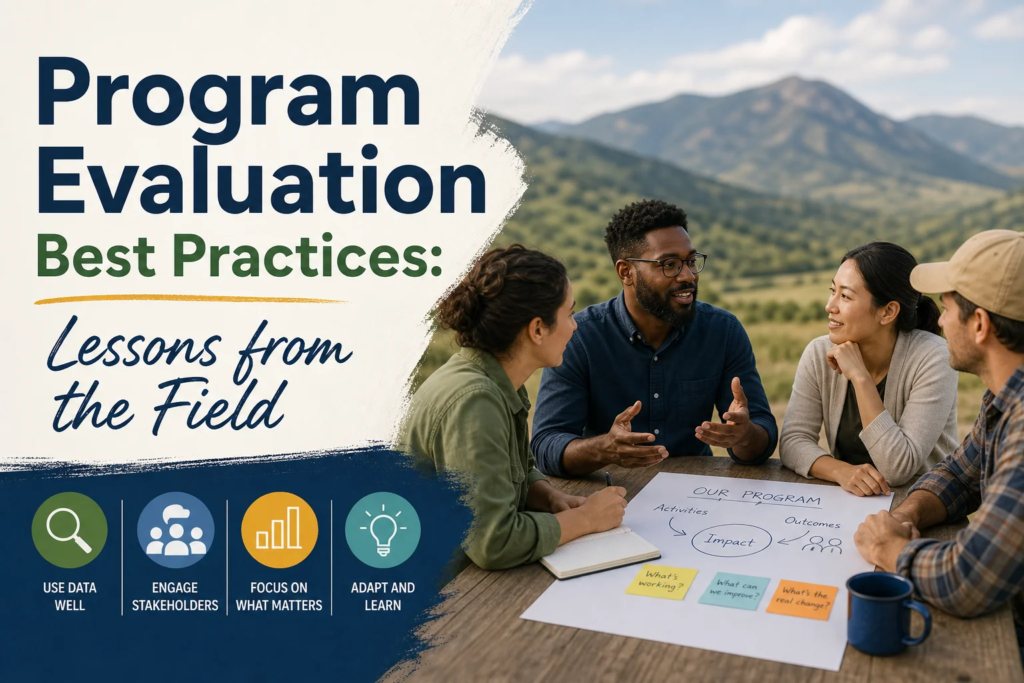
That is why Program Evaluation Best Practices: Lessons from the Field matters so much. Program evaluation is not just a reporting requirement or a box to check for grant compliance. At its best, evaluation is a learning system. It helps organizations understand what is working, what is not, for whom, under what conditions, and why.
The strongest programs are rarely built perfectly from the start. They are improved through disciplined reflection, data-informed decisions, community feedback, and honest conversations about results. In other words, they are shaped by program evaluation best practices learned from the field.
This article explores practical, field-tested strategies for designing and using evaluation in ways that are credible, ethical, realistic, and genuinely useful. You will find real-world case studies, implementation lessons, tables, and frameworks that can help turn evaluation from a stressful obligation into a powerful tool for improvement.
Why Program Evaluation Matters More Than Ever
Organizations today operate in a world of rising expectations. Funders want evidence. Communities want accountability. Staff want clarity. Leaders want to scale what works. Participants want services that truly help them.
That is where Program Evaluation Best Practices: Lessons from the Field becomes essential.
Program evaluation helps answer questions such as:
- Did the program achieve its intended outcomes?
- Were services delivered as planned?
- Which participants benefited most?
- What barriers limited success?
- Was the program worth the investment?
- How can the program be improved?
Without evaluation, organizations often rely on assumptions, anecdotes, or surface-level metrics. For example, a youth mentoring program may proudly report that it served 500 students. But did those students improve school attendance, develop stronger relationships, or gain confidence? Numbers served are important, but they do not tell the whole story.
Strong evaluation moves beyond activity tracking and asks deeper questions about impact, quality, equity, and sustainability.
What Program Evaluation Really Means
Program evaluation is the systematic collection and use of information to understand a program’s design, implementation, outcomes, and value.
That definition may sound technical, but in practice, evaluation is about learning. The best evaluators are not simply auditors. They are sense-makers, facilitators, translators, and improvement partners.
A strong evaluation can examine:
| Evaluation Focus | Key Question | Common Methods |
|---|---|---|
| Needs Assessment | What problem exists, and who is affected? | Community surveys, interviews, secondary data review |
| Process Evaluation | Is the program being implemented as intended? | Observations, service logs, staff interviews |
| Outcome Evaluation | What changed for participants? | Pre/post surveys, assessments, administrative data |
| Impact Evaluation | Did the program cause the change? | Comparison groups, randomized trials, quasi-experimental designs |
| Cost Evaluation | Was the program cost-effective? | Budget analysis, cost-benefit analysis |
| Equity Evaluation | Are outcomes fair across groups? | Disaggregated data, participatory methods |
One of the most important Program Evaluation Best Practices: Lessons from the Field is this: evaluation should match the stage and purpose of the program. A brand-new pilot does not need the same type of evaluation as a long-running national initiative.
Start with Clear Evaluation Questions
Every effective evaluation begins with strong questions.
Too many organizations start by choosing survey tools, dashboards, or software before they clarify what they actually need to know. This often leads to data overload: plenty of numbers, but very little insight.
A better approach is to begin with a small set of priority evaluation questions.
Examples include:
- To what extent did participants complete the program?
- What outcomes changed after participation?
- Which program components were most valuable?
- What implementation challenges affected results?
- Did outcomes differ by race, age, income level, location, or referral source?
- How can the program be improved before expansion?
A core lesson from Program Evaluation Best Practices: Lessons from the Field is that evaluation questions should be useful, answerable, and actionable. If the answer will not influence a decision, the question may not belong in the evaluation plan.
A Simple Test for Strong Evaluation Questions
| Weak Question | Stronger Question |
|---|---|
| Was the program good? | To what extent did the program improve participants’ job readiness within six months? |
| Did people like it? | Which program components did participants find most useful, and why? |
| Did we help families? | How did family stability indicators change after receiving services? |
| Should we continue? | Which outcomes, costs, and stakeholder priorities should guide future funding decisions? |
Clear questions prevent evaluation from becoming vague or unfocused. They also help staff and stakeholders understand why data collection matters.
Build a Practical Theory of Change
A theory of change explains how a program is expected to produce results. It connects resources, activities, outputs, short-term outcomes, long-term outcomes, and assumptions.
In the field, many theories of change become decorative diagrams that sit in a grant proposal and are never used again. That is a missed opportunity.
A useful theory of change should guide evaluation design, program improvement, staff training, and stakeholder communication.
Basic Theory of Change Structure
| Element | Example from a Workforce Program |
|---|---|
| Inputs | Staff, employer partners, training materials, funding |
| Activities | Career coaching, resume workshops, job placement support |
| Outputs | Number of participants trained, number of employer interviews |
| Short-Term Outcomes | Improved job search skills, increased confidence |
| Intermediate Outcomes | Employment placement, job retention at 90 days |
| Long-Term Outcomes | Increased income, career advancement, reduced poverty |
| Assumptions | Employers are hiring; participants can access transportation; training matches market needs |
One of the most practical program evaluation best practices from the field is to revisit the theory of change regularly. If the program changes but the evaluation model does not, the evaluation may measure the wrong things.
Engage Stakeholders Early and Often
Evaluation works best when the people affected by the program have a voice in shaping the evaluation.
Stakeholders may include:
- Program participants
- Frontline staff
- Community members
- Funders
- Agency leaders
- Partner organizations
- Policymakers
- Data managers
- Evaluators
Engagement is not just polite. It improves evaluation quality.
Participants can explain which outcomes matter most in real life. Staff can identify practical data collection challenges. Funders can clarify reporting expectations. Community partners can flag cultural or historical issues that may affect trust.
A critical insight from Program Evaluation Best Practices: Lessons from the Field is that evaluation should not feel like something done “to” people. It should feel like something developed “with” people.
Stakeholder Engagement Matrix
| Stakeholder Group | What They Contribute | How to Engage Them |
|---|---|---|
| Participants | Lived experience, service feedback | Listening sessions, surveys, advisory groups |
| Staff | Implementation knowledge | Planning meetings, reflection sessions |
| Funders | Accountability priorities | Evaluation question review, reporting alignment |
| Community Partners | Context and trust | Collaborative planning, data interpretation |
| Leadership | Strategic direction | Decision meetings, dashboard reviews |
When stakeholders are involved early, they are more likely to trust findings and use results.
Choose the Right Evaluation Design
Not every evaluation needs a randomized controlled trial. Not every evaluation can rely on simple satisfaction surveys.
The design should match the purpose, resources, ethical considerations, and maturity of the program.
Common Evaluation Designs
| Design | Best Used When | Strengths | Limitations |
|---|---|---|---|
| Pre/Post Assessment | Measuring change over time | Simple, affordable | Cannot prove change was caused by program |
| Comparison Group | Comparing participants to similar nonparticipants | Stronger evidence | Requires good matching data |
| Randomized Controlled Trial | Testing causal impact | High credibility | Can be expensive, complex, or impractical |
| Developmental Evaluation | Supporting innovation in complex settings | Flexible, adaptive | Less standardized |
| Participatory Evaluation | Centering community voice | Builds trust and relevance | Requires time and facilitation |
| Mixed-Methods Evaluation | Combining numbers and stories | Rich, balanced insight | More demanding to manage |
One of the central Program Evaluation Best Practices: Lessons from the Field is to avoid over-designing or under-designing the evaluation. A small pilot may need rapid-cycle feedback, not a costly impact study. A mature intervention seeking major public investment may need rigorous impact evidence.
Use Mixed Methods for a Fuller Picture
Quantitative data tells you what happened. Qualitative data helps explain why.
The best evaluations often combine both.
For example, survey data may show that only 55% of participants completed a financial literacy program. Interviews may reveal that sessions were scheduled during work hours, transportation was unreliable, and some participants felt embarrassed asking questions in a group setting.
That combination of numbers and stories leads to better decisions.
Mixed-Methods Example
| Evaluation Question | Quantitative Data | Qualitative Data |
|---|---|---|
| Did participants improve? | Pre/post skill scores | Participant reflections |
| Was the program implemented well? | Attendance logs, completion rates | Staff interviews |
| Why did some participants drop out? | Dropout timing data | Exit interviews |
| Were outcomes equitable? | Disaggregated outcomes | Focus groups with underrepresented groups |
A recurring theme in Program Evaluation Best Practices: Lessons from the Field is that no single data source tells the whole truth. Strong evaluation triangulates evidence.
Measure What Matters, Not Just What Is Easy
Many organizations measure what is convenient: attendance, satisfaction, number of workshops, number of referrals, number of brochures distributed.
These metrics are useful, but they are usually outputs—not outcomes.
Outputs show what the program did. Outcomes show what changed because of the program.
Outputs vs. Outcomes
| Program Type | Output | Outcome |
|---|---|---|
| Parenting Program | 80 parents attended workshops | Parents increased positive discipline practices |
| Housing Program | 120 people received housing navigation | Participants remained stably housed for 12 months |
| Job Training Program | 60 participants completed training | Participants obtained living-wage employment |
| Health Program | 500 screenings completed | Early detection rates improved |
| Education Program | 200 tutoring sessions delivered | Reading scores increased |
One of the most valuable program evaluation lessons from the field is that organizations should not confuse busyness with effectiveness. A program can deliver many services and still fail to achieve meaningful outcomes.
Make Data Collection Realistic for Staff
Evaluation plans often fail because they underestimate staff workload.
Frontline staff are usually focused on serving people, managing crises, documenting services, attending meetings, and meeting deadlines. If evaluation tools are too long, confusing, or disconnected from daily work, data quality suffers.
A practical principle from Program Evaluation Best Practices: Lessons from the Field is this: the best data system is the one people will actually use.
Ways to Reduce Data Burden
- Use short, validated tools when possible.
- Collect only data tied to evaluation questions.
- Build data collection into existing workflows.
- Train staff on why the data matters.
- Pilot tools before full rollout.
- Automate reminders and reports.
- Review data quality regularly.
- Ask staff what is realistic.
A beautifully designed evaluation plan is worthless if no one can implement it consistently.
Prioritize Data Quality from the Beginning
Poor data quality can undermine even the most thoughtful evaluation.
Common problems include:
- Missing data
- Inconsistent definitions
- Duplicate records
- Incorrect dates
- Unclear participant IDs
- Staff entering data differently
- Surveys administered at the wrong time
- Outcomes measured inconsistently across sites
Data quality is not a technical detail. It is central to credibility.
Data Quality Checklist
| Data Quality Area | Key Question |
|---|---|
| Accuracy | Are records correct? |
| Completeness | Are required fields filled in? |
| Consistency | Are definitions used the same way across staff and sites? |
| Timeliness | Is data entered soon after services occur? |
| Relevance | Is the data connected to evaluation questions? |
| Security | Is sensitive information protected? |
One of the overlooked Program Evaluation Best Practices: Lessons from the Field is to invest in data quality before analysis begins. Cleaning messy data at the end is far harder than preventing problems early.
Case Study 1: Housing First and the Power of Clear Outcomes
Housing First programs provide permanent housing to people experiencing chronic homelessness without requiring sobriety or treatment compliance as a precondition. The model has been evaluated in multiple communities and countries, often showing strong housing retention outcomes compared with traditional approaches.
What Was Evaluated
Evaluations typically examined:
- Housing stability
- Emergency service use
- Health outcomes
- Participant quality of life
- Cost offsets in shelters, hospitals, and justice systems
Field Lesson
The Housing First model illustrates a key principle of Program Evaluation Best Practices: Lessons from the Field: define success clearly and measure it consistently.
Traditional homelessness programs sometimes judged success by treatment participation or compliance. Housing First shifted the central outcome to housing stability. That clarity changed both service delivery and evaluation.
Analysis
This case is relevant because it shows how evaluation can challenge assumptions. The traditional belief was that people needed to become “housing ready.” Evaluation evidence helped demonstrate that stable housing itself could be a foundation for improved outcomes. The field lesson is powerful: when evaluation focuses on outcomes that matter, it can reshape policy and practice.
Case Study 2: D.A.R.E. and the Courage to Face Uncomfortable Findings
The Drug Abuse Resistance Education program, widely known as D.A.R.E., became one of the most recognizable school-based prevention programs in the United States. For years, it was popular with schools, families, and law enforcement agencies.
However, multiple evaluations found limited evidence that the original model significantly reduced long-term drug use among students.
What Was Evaluated
Researchers examined:
- Student attitudes toward drugs
- Knowledge gains
- Self-reported substance use
- Long-term behavior change
- Program delivery fidelity
Field Lesson
This example offers one of the most important program evaluation best practices from the field: popularity is not the same as effectiveness.
Programs can be well-liked and still fail to produce intended outcomes. Evaluation gives organizations the evidence needed to adapt.
Analysis
The D.A.R.E. experience is relevant because it shows the value of honest evidence. Rather than relying only on public support, prevention programs needed to examine long-term behavioral outcomes. The broader lesson is that evaluation should not be designed merely to confirm success. It should be designed to discover the truth.
Case Study 3: A Community Health Worker Program Learns Through Rapid-Cycle Evaluation
A regional health coalition launched a community health worker program to support adults with uncontrolled diabetes. Community health workers helped participants schedule appointments, understand medication instructions, access healthy food, and navigate insurance barriers.
At first, the program measured only the number of home visits completed. The numbers looked strong. But clinical outcomes were mixed.
The coalition then adopted rapid-cycle evaluation.
What Changed
The evaluation team began reviewing monthly data on:
- Home visit frequency
- A1C levels
- Missed appointments
- Food insecurity referrals
- Participant-reported barriers
- Emergency department visits
They also held short monthly learning meetings with community health workers.
Field Lesson
This case demonstrates a practical application of Program Evaluation Best Practices: Lessons from the Field: use evaluation as a continuous learning process, not a one-time final report.
The team discovered that participants with transportation challenges were less likely to improve, even when they received regular home visits. The program then partnered with a local transportation service and adjusted appointment reminders.
Analysis
This case is relevant because it shows how evaluation can support real-time improvement. Instead of waiting until the end of the grant period, the coalition used data to refine services while the program was still active. That is one of the most powerful program evaluation lessons from the field.
Case Study 4: A Youth Employment Program Uses Equity Data to Improve Results
A city-funded youth employment program helped teenagers and young adults prepare for summer jobs. The program included resume support, interview coaching, paid internships, and career exploration workshops.
Overall outcomes looked positive. Most participants completed training, and many were placed in jobs.
But when evaluators disaggregated the data, they found disparities. Youth from neighborhoods with limited public transportation had lower internship completion rates. Young parents were more likely to miss workshops. English language learners reported lower confidence in interviews.
What Was Evaluated
The evaluation examined:
- Enrollment patterns
- Workshop attendance
- Job placement rates
- Internship completion
- Participant satisfaction
- Outcomes by neighborhood, language, age, and caregiving status
Field Lesson
This example highlights an essential part of Program Evaluation Best Practices: Lessons from the Field: average results can hide unequal experiences.
Once the program saw the pattern, it added transit passes, flexible workshop times, childcare partnerships, and bilingual interview coaching.
Analysis
This case is especially relevant because many programs celebrate overall success while missing inequities. Evaluation can help organizations move from “Did the program work?” to “For whom did it work, and who was left behind?” That shift is central to modern program evaluation best practices.
Build Evaluation into Program Culture
The best evaluation systems are not isolated projects. They are part of organizational culture.
In a strong learning culture, staff regularly ask:
- What are we seeing in the data?
- What surprises us?
- What are participants telling us?
- Where are outcomes improving?
- Where are people falling through the cracks?
- What should we test next?
A core insight from Program Evaluation Best Practices: Lessons from the Field is that evaluation should not live only with the evaluator. Program managers, frontline staff, executives, board members, and participants all have roles to play.
Signs of a Healthy Evaluation Culture
| Weak Evaluation Culture | Strong Evaluation Culture |
|---|---|
| Data is collected only for funders | Data is used for learning and decisions |
| Staff fear negative findings | Staff discuss challenges openly |
| Reports sit unread | Findings shape program changes |
| Participants are rarely consulted | Participant voice guides interpretation |
| Evaluation happens at the end | Evaluation is built into implementation |
Culture matters because evaluation often reveals uncomfortable truths. Organizations need trust, humility, and curiosity to use findings well.
Communicate Findings Clearly
Even excellent evaluation findings can fail to make a difference if they are not communicated well.
Long technical reports have their place, but decision-makers often need concise, visual, actionable summaries. Community members may need plain-language explanations. Staff may need practical recommendations. Funders may need evidence tied to grant outcomes.
A key principle in Program Evaluation Best Practices: Lessons from the Field is to tailor communication to the audience.
Evaluation Reporting Options
| Format | Best For |
|---|---|
| Executive Summary | Senior leaders and board members |
| Dashboard | Ongoing performance monitoring |
| Slide Deck | Meetings and decision sessions |
| Full Technical Report | Researchers, evaluators, compliance needs |
| Community Brief | Participants and local partners |
| Infographic | Public communication |
| Learning Memo | Internal improvement discussions |
The goal is not just to present data. The goal is to support understanding and action.
Turn Findings into Decisions
Evaluation is only valuable if findings are used.
Too often, organizations invest time and money in evaluation, receive a final report, thank the evaluator, and continue operating exactly as before.
That is not learning. That is documentation.
One of the most important Program Evaluation Best Practices: Lessons from the Field is to create intentional decision points. Before the evaluation begins, leaders should ask: “What decisions will this evaluation inform?”
Possible decisions include:
- Continue, expand, revise, or discontinue a program
- Reallocate staff or resources
- Change eligibility criteria
- Modify curriculum or service delivery
- Strengthen partnerships
- Improve outreach
- Address equity gaps
- Seek additional funding
- Scale to new sites
From Findings to Action
| Finding | Possible Decision |
|---|---|
| Completion rates are low among working adults | Offer evening or weekend sessions |
| Participants improve knowledge but not behavior | Add coaching or follow-up support |
| One site outperforms others | Study implementation practices at that site |
| Outcomes differ by language group | Provide translated materials and bilingual staff |
| Staff report duplicate data entry | Streamline forms and integrate systems |
Evaluation should create movement, not just measurement.
Protect Ethics, Privacy, and Trust
Evaluation often involves sensitive information about people’s lives, health, income, education, housing, immigration status, trauma, or family circumstances.
Ethical evaluation requires care.
Important ethical principles include:
- Informed consent
- Confidentiality
- Data security
- Cultural respect
- Minimizing harm
- Transparency about how data will be used
- Avoiding extractive practices
- Sharing findings with communities
A vital lesson from Program Evaluation Best Practices: Lessons from the Field is that trust is part of data quality. If participants do not trust the process, they may decline to participate or provide incomplete information.
Ethics is not separate from rigor. Ethical evaluation is better evaluation.
Use Equity-Centered Evaluation
Equity-centered evaluation examines whether programs are fair, accessible, inclusive, and effective across different groups.
It asks:
- Who benefits most?
- Who faces barriers?
- Whose voices are missing?
- Are outcomes different across demographic groups?
- Are evaluation tools culturally appropriate?
- Are communities involved in interpreting findings?
- Could the evaluation process itself cause harm?
This approach is increasingly central to Program Evaluation Best Practices: Lessons from the Field because programs do not operate in neutral environments. Historical inequities, structural barriers, and power dynamics shape both program access and outcomes.
Equity-Centered Evaluation Practices
| Practice | Why It Matters |
|---|---|
| Disaggregate data | Reveals differences hidden by averages |
| Include lived experience | Improves relevance and trust |
| Review tools for bias | Prevents misleading conclusions |
| Share power in interpretation | Reduces evaluator-only assumptions |
| Examine access barriers | Supports fairer program design |
| Report inequities honestly | Encourages accountability |
Equity-centered evaluation does not lower standards. It deepens the questions and improves the usefulness of findings.
Avoid Common Program Evaluation Mistakes
Field experience shows that many evaluation problems are predictable—and preventable.
Common Mistakes and Better Practices
| Common Mistake | Better Practice |
|---|---|
| Starting evaluation too late | Plan evaluation during program design |
| Measuring too many things | Focus on priority questions |
| Ignoring implementation | Study how the program was delivered |
| Relying only on satisfaction surveys | Measure outcomes and experiences |
| Using unclear definitions | Create a data dictionary |
| Reporting only positive findings | Present balanced, honest results |
| Excluding participant voice | Include feedback from those served |
| Treating evaluation as compliance | Use evaluation for learning and improvement |
| Failing to act on findings | Build decision points into the process |
A recurring message in Program Evaluation Best Practices: Lessons from the Field is that evaluation should be practical. It should help real people make better decisions in real conditions.
The Role of Technology in Program Evaluation
Technology can make evaluation easier, faster, and more visual—but it cannot replace judgment.
Dashboards, customer relationship management systems, survey platforms, mobile data collection tools, and data visualization software can all support evaluation. However, technology only helps when the underlying questions, measures, and processes are sound.
A dashboard filled with poorly defined metrics is not useful. A beautiful chart based on incomplete data can mislead decision-makers.
Smart Uses of Evaluation Technology
- Automating routine reports
- Tracking participant progress
- Sending survey reminders
- Reducing duplicate data entry
- Visualizing trends over time
- Monitoring outcomes by site or population
- Flagging missing data
- Supporting real-time learning meetings
One of the modern Program Evaluation Best Practices: Lessons from the Field is to choose technology after clarifying the evaluation strategy—not before.
How to Create a Strong Evaluation Plan
A practical evaluation plan does not have to be overly complicated. It should clearly explain what will be evaluated, how, by whom, and when.
Essential Components of an Evaluation Plan
| Component | Description |
|---|---|
| Program Description | What the program does and whom it serves |
| Theory of Change | How activities are expected to lead to outcomes |
| Evaluation Purpose | Why the evaluation is being conducted |
| Evaluation Questions | What the evaluation will answer |
| Indicators | What will be measured |
| Data Sources | Where information will come from |
| Methods | Surveys, interviews, administrative data, observations, etc. |
| Timeline | When data will be collected and reported |
| Roles | Who is responsible for each task |
| Data Management | How data will be stored, protected, and cleaned |
| Analysis Plan | How data will be interpreted |
| Use Plan | How findings will inform decisions |
The “use plan” is especially important. In the spirit of Program Evaluation Best Practices: Lessons from the Field, evaluation should be designed with the end use in mind.
A Field-Tested Evaluation Planning Template
Here is a simplified template organizations can adapt.
| Evaluation Question | Indicator | Data Source | Collection Timing | Responsible Person | How Findings Will Be Used |
|---|---|---|---|---|---|
| Did participants complete the program? | Completion rate | Attendance records | Weekly | Program coordinator | Identify retention issues |
| Did skills improve? | Pre/post assessment scores | Participant assessments | Start and end | Facilitators | Improve curriculum |
| Were services delivered as intended? | Fidelity checklist score | Staff observation | Monthly | Evaluation lead | Support training |
| What barriers did participants face? | Reported barrier themes | Interviews/surveys | Midpoint and end | Evaluator | Adjust service design |
| Did outcomes differ by group? | Outcomes by demographics | Program database | Quarterly | Data analyst | Address equity gaps |
This kind of structure keeps evaluation grounded and manageable.
Lessons from the Field: What Experienced Evaluators Know
After years of evaluation work across nonprofits, schools, health systems, government agencies, and foundations, several lessons come up again and again.
1. Relationships Matter as Much as Methods
Technical skill is important, but trust determines whether people share honest information and use findings.
2. Context Explains Results
A program’s outcomes are shaped by staffing, leadership, funding, community conditions, policy changes, and participant realities.
3. Negative Findings Can Be Gifts
A disappointing result can prevent wasted resources and point the way toward improvement.
4. Simple Measures Can Be Powerful
Not every evaluation requires complex statistics. A well-chosen indicator, tracked consistently, can drive meaningful change.
5. Evaluation Should Support Action
The best evaluation reports lead to decisions, experiments, improvements, and deeper questions.
These are the heart of Program Evaluation Best Practices: Lessons from the Field: be rigorous, be practical, be ethical, and be useful.
Program Evaluation Best Practices: Lessons from the Field for Funders
Funders play a major role in shaping evaluation quality. When funders require unrealistic metrics, underfund evaluation, or prioritize polished success stories over honest learning, they weaken the field.
Better funding practices include:
- Providing dedicated evaluation budgets
- Supporting capacity building
- Encouraging learning, not just accountability
- Allowing grantees to report challenges honestly
- Aligning reporting requirements with program goals
- Funding long-term outcome tracking when appropriate
- Valuing qualitative evidence and community voice
A major lesson from Program Evaluation Best Practices: Lessons from the Field is that evaluation quality depends on the ecosystem. Grantees cannot build strong evaluation systems without time, resources, and supportive expectations.
Program Evaluation Best Practices: Lessons from the Field for Nonprofit Leaders
Nonprofit leaders often face pressure to prove impact while managing limited resources. The key is to build evaluation gradually and strategically.
Start with:
- A clear theory of change
- A few meaningful outcomes
- Consistent data collection
- Staff training
- Regular review meetings
- Participant feedback loops
- Honest reporting
Leaders should also model curiosity. If executives react defensively to negative findings, staff may hide problems. If leaders ask thoughtful questions and support improvement, evaluation becomes a shared learning tool.
For nonprofit leaders, Program Evaluation Best Practices: Lessons from the Field means making evaluation part of leadership—not an afterthought.
Program Evaluation Best Practices: Lessons from the Field for Public Agencies
Public agencies often evaluate programs at large scale, across multiple sites, and under political scrutiny. This creates unique challenges.
Best practices include:
- Standardizing definitions across sites
- Balancing accountability with learning
- Building data-sharing agreements early
- Protecting privacy and legal compliance
- Reporting findings transparently
- Engaging community stakeholders
- Using evaluation to improve implementation, not only justify budgets
Public agencies can use evaluation to strengthen public trust. When findings are clear, honest, and tied to action, communities are more likely to see government programs as accountable and responsive.
Program Evaluation Best Practices: Lessons from the Field for Internal Teams
Not every organization can hire an external evaluator. Internal teams can still apply strong evaluation practices.
Practical steps include:
- Start small.
- Use existing data.
- Create clear definitions.
- Train staff consistently.
- Combine surveys with conversations.
- Review data monthly or quarterly.
- Document changes made because of findings.
- Ask for outside support when rigor or neutrality is needed.
Internal evaluation works best when teams are honest about limitations. A simple internal evaluation can be highly useful, even if it does not prove causal impact.
That is another grounded lesson from Program Evaluation Best Practices: Lessons from the Field: usefulness matters.
The Future of Program Evaluation
The field of evaluation is evolving. Several trends are shaping the future:
- Greater emphasis on equity and justice
- More participatory and community-led evaluation
- Increased use of real-time data dashboards
- Stronger integration of qualitative evidence
- More focus on implementation science
- Growing demand for cost-effectiveness analysis
- Better use of administrative data
- Increased attention to data ethics and privacy
- Movement away from one-size-fits-all evidence standards
Future-focused program evaluation best practices from the field will require evaluators and organizations to balance rigor with responsiveness. The question will not only be “Does it work?” but also “Does it work fairly, sustainably, and in ways communities value?”
Quick Reference: Program Evaluation Best Practices Checklist
| Best Practice | Why It Matters |
|---|---|
| Define clear evaluation questions | Keeps evaluation focused |
| Build a theory of change | Connects activities to outcomes |
| Engage stakeholders | Improves relevance and trust |
| Match design to purpose | Avoids over- or under-evaluation |
| Use mixed methods | Provides richer insight |
| Measure outcomes, not just outputs | Shows meaningful change |
| Prioritize data quality | Protects credibility |
| Disaggregate data | Reveals equity issues |
| Communicate clearly | Supports understanding |
| Use findings for decisions | Turns evaluation into improvement |
| Protect ethics and privacy | Builds trust |
| Review and adapt regularly | Supports continuous learning |
This checklist captures the essence of Program Evaluation Best Practices: Lessons from the Field in a practical format.
Conclusion: Evaluation Is a Pathway to Better Impact
At its best, program evaluation is not about judgment from a distance. It is about learning close to the work.
The strongest organizations use evaluation to ask better questions, listen more deeply, improve services, allocate resources wisely, and stay accountable to the people they serve. They do not fear findings. They use them.
The central message of Program Evaluation Best Practices: Lessons from the Field is simple but powerful: evaluation should help programs become more effective, equitable, and responsive.
Start with clear questions. Build a practical theory of change. Engage stakeholders. Measure what matters. Protect trust. Use mixed methods. Look honestly at results. Then act.
Because the real value of evaluation is not the report.
It is what changes because of what you learn.
1. What is the most important best practice in program evaluation?
The most important best practice is to begin with clear, useful evaluation questions. Without strong questions, data collection can become unfocused and overwhelming. Clear questions help determine what to measure, which methods to use, and how findings will support decisions.
2. How often should a program be evaluated?
It depends on the program’s stage and purpose. New programs may benefit from frequent rapid-cycle evaluation to support improvement. Established programs may conduct annual outcome evaluations, periodic impact studies, or ongoing performance monitoring. The best approach is to build evaluation into regular learning and decision-making.
3. What is the difference between outputs and outcomes?
Outputs describe what a program does, such as the number of workshops delivered or participants served. Outcomes describe what changes because of the program, such as improved skills, better health, increased employment, or greater housing stability. Strong evaluation measures both, but outcomes are usually more meaningful.
4. Do small nonprofits need formal program evaluation?
Yes, but evaluation can be scaled to fit capacity. Small nonprofits do not always need complex studies. They can start with a basic theory of change, a few meaningful indicators, participant feedback, and regular data review. Practical evaluation is better than no evaluation.
5. How can organizations make evaluation less burdensome for staff?
Organizations can reduce burden by collecting only essential data, using short tools, integrating evaluation into existing workflows, automating reports when possible, and training staff on how data will be used. Staff are more likely to support evaluation when they see its value.
6. Why is stakeholder engagement important in evaluation?
Stakeholder engagement improves relevance, trust, and use. Participants, staff, funders, and community partners can help shape better questions, interpret findings more accurately, and identify practical recommendations. Evaluation is stronger when it includes the people closest to the program.
7. What should organizations do with negative evaluation findings?
They should treat negative findings as learning opportunities. Disappointing results can reveal design flaws, implementation barriers, inequities, or unrealistic assumptions. The goal is not to hide problems but to use evidence to improve programs and make better decisions.
8. How does equity fit into program evaluation?
Equity-centered evaluation examines whether programs are accessible, fair, and effective for different groups. This includes disaggregating data, listening to underrepresented voices, reviewing tools for bias, and identifying barriers that affect outcomes. Equity is now a core part of modern program evaluation best practices.


The PsyForU Editorial Collective is the research and editorial team of PsyForU Research International. The collective prepares educational, psychological, mental-health-awareness, inclusion, neurodiversity, and research-methodology content for students, parents, educators, researchers, and general readers. PsyForU content is intended for awareness, education, and capacity-building and should not be treated as clinical diagnosis, therapy, medical advice, legal advice, or emergency mental-health support.