


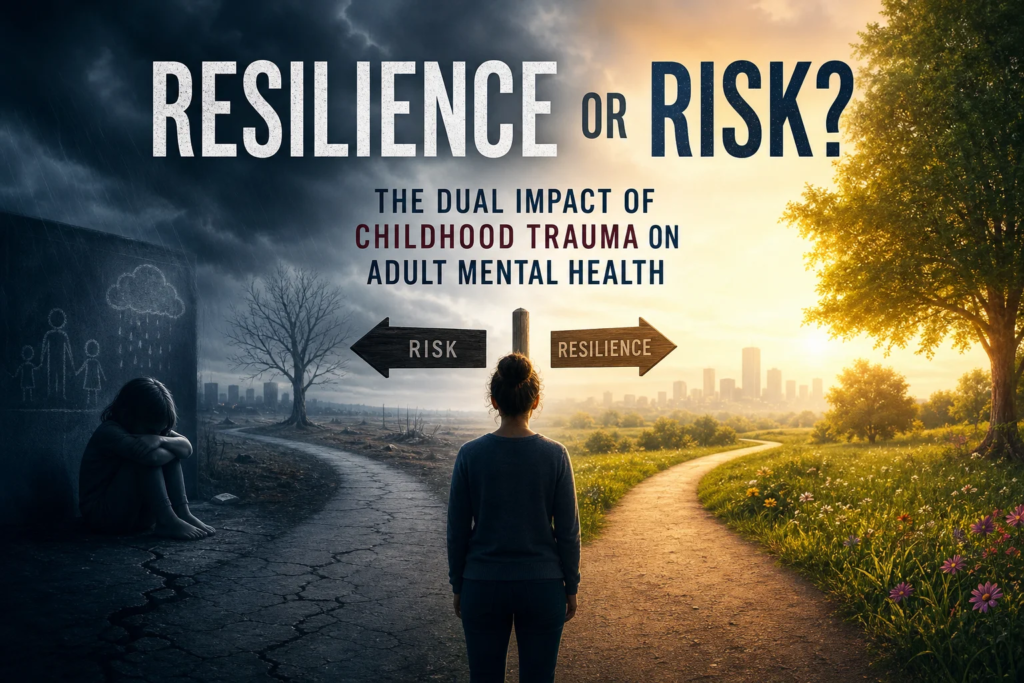
The Essential Guide to “Resilience or Risk? The Dual Impact of Childhood Trauma on Adult Mental Health”
Introduction: The Past Does Not Stay in the Past—But It Does Not Have to Decide the Future
A child learns the world before they can explain it.
Long before adulthood brings words like anxiety, depression, burnout, trust issues, or emotional regulation, the nervous system has already been taking notes. It remembers whether home felt safe or unpredictable. It remembers whether comfort came after fear—or whether fear came from the people who were supposed to provide comfort. It remembers hunger, shouting, neglect, humiliation, violence, loss, and loneliness.
But here is the remarkable truth: childhood trauma can become either a lifelong risk factor or, with the right support, a foundation for hard-earned resilience.
That is the heart of Resilience or Risk? The Dual Impact of Childhood Trauma on Adult Mental Health. Trauma can increase vulnerability to depression, anxiety, post-traumatic stress, substance use, relationship struggles, and chronic stress. Yet many adults with painful childhood histories also develop extraordinary empathy, determination, creativity, emotional insight, and a deep desire to break harmful cycles.
The story is not simple. It is not “trauma makes you broken,” and it is not “everything happens for a reason.” The real story is more human: early adversity changes people, but change can move in more than one direction.
This article explores Resilience or Risk? The Dual Impact of Childhood Trauma on Adult Mental Health through psychology, neuroscience, real-world case studies, protective factors, recovery strategies, and practical insights. Whether you are a survivor, clinician, caregiver, educator, partner, or simply someone trying to understand your own patterns, the goal is clear: to illuminate risk without removing hope—and to celebrate resilience without minimizing pain.
Understanding Childhood Trauma: More Than “Bad Memories”
Childhood trauma is not just an event. It is an experience that overwhelms a child’s ability to cope, especially when support, safety, and repair are missing.
Trauma may include:
- Physical, emotional, or sexual abuse
- Emotional or physical neglect
- Domestic violence in the home
- Parental substance misuse
- Parental mental illness
- Loss of a parent or caregiver
- Bullying, discrimination, or community violence
- Chronic poverty or housing instability
- Medical trauma
- Family separation, incarceration, or abandonment
One of the most influential frameworks for understanding trauma is the Adverse Childhood Experiences, or ACEs, model. The original ACE study found a strong connection between the number of early adversities a person experienced and later physical and mental health outcomes.
But ACEs do not tell the whole story.
Two children can experience similar adversity and develop very different adult outcomes. One may struggle with chronic anxiety and unstable relationships. Another may become highly driven, emotionally perceptive, and deeply compassionate—while still carrying hidden wounds.
That is why Resilience or Risk? The Dual Impact of Childhood Trauma on Adult Mental Health is such an important lens. It helps us ask better questions:
- What happened to the person?
- What support did they receive afterward?
- What meaning did they make of it?
- What coping strategies helped them survive?
- Which of those strategies now help—or harm—their adult life?
- What conditions allow healing to happen?
Why Childhood Trauma Shapes Adult Mental Health
Childhood is a period of rapid brain development. During this time, children form expectations about safety, attachment, trust, emotion, and self-worth.
When a child grows up in a threatening or unpredictable environment, the brain and body adapt for survival. These adaptations are often intelligent and protective at the time. The problem is that survival strategies developed in childhood may become mental health challenges in adulthood.
For example:
- Hypervigilance may once have helped a child detect danger. In adulthood, it may become chronic anxiety.
- Emotional numbness may have protected a child from overwhelming pain. Later, it may appear as depression or disconnection.
- People-pleasing may have prevented punishment. As an adult, it may lead to burnout and unhealthy relationships.
- Avoidance may have reduced fear. Over time, it may limit intimacy, career growth, and self-expression.
This is the central tension in Resilience or Risk? The Dual Impact of Childhood Trauma on Adult Mental Health: the same adaptation can be both protective and costly.
The Trauma Response: A Survival System, Not a Character Flaw
Many adults blame themselves for trauma-related patterns.
They say:
- “Why am I so sensitive?”
- “Why can’t I just move on?”
- “Why do I push people away?”
- “Why do I panic when nothing is wrong?”
- “Why do I feel empty even when life is good?”
These reactions often make sense when viewed through the nervous system.
The body has several major threat responses:
| Trauma Response | What It Looks Like in Childhood | How It May Appear in Adulthood |
|---|---|---|
| Fight | Anger, defiance, aggression | Irritability, conflict, defensiveness |
| Flight | Avoidance, hiding, perfectionism | Overworking, anxiety, restlessness |
| Freeze | Shutdown, dissociation, silence | Numbness, depression, indecision |
| Fawn | Pleasing, appeasing, compliance | Weak boundaries, fear of rejection |
| Attach/Cry for help | Clinging, distress, need for reassurance | Dependency, panic in relationships |
These responses are not signs of weakness. They are evidence that the mind and body tried to survive.
In conversations about Resilience or Risk? The Dual Impact of Childhood Trauma on Adult Mental Health, this distinction matters. Trauma responses can create risk, but understanding them can become the first step toward resilience.
The Risk Side: How Childhood Trauma Can Affect Adult Mental Health
Childhood trauma can increase the likelihood of several mental health challenges. It does not guarantee them, but it raises vulnerability—especially when trauma is chronic, severe, interpersonal, or unsupported.
1. Depression
Adults with childhood trauma histories may carry deeply rooted beliefs such as:
- “I am not lovable.”
- “Nothing I do matters.”
- “People always leave.”
- “I am a burden.”
- “There is something wrong with me.”
These beliefs can feed depressive symptoms, including hopelessness, low motivation, shame, fatigue, and emotional numbness.
Depression after trauma is often not just sadness. It may be grief for the childhood that was missing, anger that had nowhere to go, or exhaustion from years of pretending to be okay.
2. Anxiety Disorders
Children raised in unpredictable environments often become experts at scanning for danger. In adulthood, this can turn into:
- Generalized anxiety
- Panic attacks
- Social anxiety
- Health anxiety
- Obsessive worry
- Fear of abandonment
The adult mind may know, “I am safe now,” while the body still behaves as if danger is near.
This is one of the clearest examples of Resilience or Risk? The Dual Impact of Childhood Trauma on Adult Mental Health. Hyperawareness may have once helped a child survive, but later it may become exhausting.
3. Post-Traumatic Stress Disorder and Complex PTSD
PTSD can occur after terrifying or overwhelming events. Complex PTSD, often associated with repeated interpersonal trauma, may include:
- Emotional flashbacks
- Shame and self-blame
- Difficulty trusting others
- Chronic feelings of threat
- Relationship instability
- Dissociation or emotional shutdown
- A fragmented sense of identity
People with complex trauma may not always have clear visual flashbacks. Instead, they may suddenly feel small, trapped, ashamed, terrified, or powerless without understanding why.
4. Substance Use and Addictive Behaviors
Substances and compulsive behaviors often begin as attempts to regulate pain.
Alcohol, drugs, food, gambling, sex, shopping, work, or digital distraction can become ways to numb distress or create temporary control.
The question should not simply be, “Why the addiction?” A more trauma-informed question is, “What pain was this behavior trying to soothe?”
5. Relationship Difficulties
Childhood trauma often affects attachment—the way people experience closeness, trust, and emotional safety.
Some adults become anxious in relationships, fearing abandonment. Others become avoidant, fearing dependence. Some move between both patterns, craving intimacy but feeling threatened by it.
Common relationship struggles include:
- Fear of rejection
- Difficulty setting boundaries
- Choosing emotionally unavailable partners
- Feeling responsible for others’ emotions
- Expecting betrayal
- Conflict avoidance
- Intense reactions to perceived criticism
Again, Resilience or Risk? The Dual Impact of Childhood Trauma on Adult Mental Health reminds us that these patterns are not random. They are often learned survival strategies.
The Resilience Side: Why Some Adults Grow Stronger After Trauma
Resilience does not mean trauma did not hurt. It does not mean someone is always strong, calm, grateful, or healed.
Resilience means the capacity to adapt, recover, rebuild, and create meaning despite adversity.
Some trauma survivors develop powerful strengths, including:
- Deep empathy
- Emotional intelligence
- Strong intuition
- Independence
- Persistence
- Advocacy for others
- Creativity
- Spiritual depth
- Commitment to breaking cycles
- Ability to detect emotional nuance
However, resilience should never be used to romanticize trauma. Pain is not required for strength. No child should have to suffer in order to become compassionate or capable.
The healthiest view of Resilience or Risk? The Dual Impact of Childhood Trauma on Adult Mental Health is balanced: trauma may create wounds and strengths, but healing requires honoring both.
Risk and Resilience Are Not Opposites
A common misconception is that people are either damaged by trauma or resilient after trauma.
In reality, most survivors are both.
A person can be professionally successful and privately anxious. They can be loving parents and still struggle with emotional flashbacks. They can have strong friendships and still fear abandonment. They can be resilient and still need therapy.
This matters because society often recognizes only two trauma narratives:
- The visibly struggling survivor
- The inspirational survivor who “overcame everything”
But many people live somewhere in the middle.
They function. They achieve. They laugh. They care for others. And they still carry pain.
That is why the phrase Resilience or Risk? The Dual Impact of Childhood Trauma on Adult Mental Health is so accurate. Childhood trauma can increase risk while also shaping resilience. The two can exist in the same person, at the same time.
A Simple Chart: How Trauma Can Become Risk or Resilience
| Childhood Adaptation | Adult Risk | Adult Resilience Potential |
|---|---|---|
| Watching others’ moods closely | Anxiety, people-pleasing | Emotional intelligence, empathy |
| Becoming self-reliant early | Isolation, difficulty asking for help | Independence, problem-solving |
| Suppressing emotions | Depression, numbness | Calm under pressure when balanced |
| Seeking control | Perfectionism, burnout | Organization, discipline |
| Avoiding conflict | Weak boundaries | Diplomacy, sensitivity |
| Questioning safety | Hypervigilance | Strong intuition, preparedness |
| Escaping through imagination | Dissociation, avoidance | Creativity, storytelling |
The goal of healing is not to erase these adaptations. It is to update them.
A trauma survivor does not need to lose their sensitivity, independence, or intuition. They may simply need to learn when those skills are useful and when they are no longer necessary for survival.
Case Study 1: Maya—The High Achiever Who Could Not Rest
Background:
Maya, 34, grew up with a father whose anger dominated the household. He rarely hit anyone, but his shouting, criticism, and unpredictable moods made the home feel unsafe. Maya learned to be perfect: perfect grades, perfect behavior, perfect smile.
As an adult, she became a successful attorney. Colleagues admired her discipline. Friends called her “unstoppable.” But Maya could not relax. She checked emails at midnight, felt sick before performance reviews, and experienced panic whenever someone sounded disappointed.
Adult mental health impact:
Maya struggled with chronic anxiety, perfectionism, insomnia, and emotional exhaustion. Her nervous system treated mistakes as threats.
Resilience factors:
She was disciplined, observant, intelligent, and highly capable. These strengths helped her build a meaningful career.
Analysis:
Maya’s story captures Resilience or Risk? The Dual Impact of Childhood Trauma on Adult Mental Health beautifully. Her childhood adaptation—perfectionism—protected her from criticism and helped her succeed. But it also became a source of anxiety and burnout. Healing for Maya involved learning that safety did not require flawlessness.
Case Study 2: Jordan—The Charmer Who Feared Being Known
Background:
Jordan, 41, grew up with emotional neglect. His parents provided food and shelter but rarely affection, comfort, or interest. When he cried, he was told to toughen up. When he succeeded, no one celebrated.
As an adult, Jordan was funny, charming, and popular. He could make anyone laugh, but his romantic relationships rarely lasted. When partners wanted emotional closeness, he withdrew. He often said, “I just don’t like drama.”
Adult mental health impact:
Jordan experienced loneliness, emotional avoidance, and low-level depression. He did not know how to ask for support because he had never expected it.
Resilience factors:
His humor, social awareness, and independence helped him navigate life. He was highly adaptable.
Analysis:
Jordan shows another side of the dual impact of childhood trauma on adult mental health. Emotional neglect taught him not to need anyone. That reduced disappointment in childhood but blocked intimacy in adulthood. His resilience emerged when he began practicing vulnerability in safe relationships.
Case Study 3: Elena—The Cycle Breaker
Background:
Elena, 29, was raised by a mother with untreated addiction. She often cooked for her younger siblings, managed school forms, and lied to neighbors to protect the family. She became “the responsible one” before she was old enough to understand what responsibility meant.
As an adult, Elena became a nurse. She was compassionate and calm in crisis. But in her personal life, she felt guilty saying no. She dated partners who needed rescuing and felt anxious when others were upset.
Adult mental health impact:
Elena struggled with codependency, guilt, and emotional over-responsibility.
Resilience factors:
She was caring, dependable, emotionally strong, and committed to building a healthier family environment for her own child.
Analysis:
Elena’s experience reflects Resilience or Risk? The Dual Impact of Childhood Trauma on Adult Mental Health in a deeply human way. Parentification gave her competence and compassion, but it also taught her to ignore her own needs. Her healing involved learning that love does not require self-abandonment.
Case Study 4: Marcus—From Anger to Advocacy
Background:
Marcus, 46, experienced physical abuse throughout childhood. In school, he was labeled aggressive and difficult. No one asked what was happening at home. As a teenager, he got into fights and later developed problems with alcohol.
In his thirties, after becoming a father, Marcus began therapy. For the first time, he connected his anger to fear, grief, and humiliation. He later became involved in community mentoring for boys exposed to violence.
Adult mental health impact:
Marcus faced substance misuse, anger, shame, and trauma symptoms.
Resilience factors:
He had courage, leadership, emotional honesty, and a strong protective instinct.
Analysis:
Marcus demonstrates that childhood trauma can lead to adult mental health risk and resilience simultaneously. His anger was once a shield. With support, that same energy became advocacy. He did not become resilient because trauma was good; he became resilient because healing gave his survival energy a new direction.
The Role of Protective Factors
Not every child exposed to trauma develops severe adult mental health difficulties. Protective factors can reduce risk and support resilience.
Key Protective Factors
| Protective Factor | Why It Matters |
|---|---|
| At least one safe adult | Helps the child feel seen, protected, and valued |
| Emotional validation | Teaches that feelings are understandable and manageable |
| Stable routines | Creates predictability in an unpredictable environment |
| Positive school experiences | Builds competence and belonging |
| Peer support | Reduces isolation |
| Therapy or early intervention | Helps process trauma before patterns harden |
| Cultural or spiritual connection | Offers identity, meaning, and community |
| Safe housing and resources | Reduces ongoing stress |
| Opportunities for mastery | Builds confidence and agency |
One caring adult can change a child’s developmental path. A teacher, grandparent, coach, neighbor, counselor, or older sibling may become a lifeline.
This is vital to understanding Resilience or Risk? The Dual Impact of Childhood Trauma on Adult Mental Health. Trauma increases risk, but supportive relationships can buffer its impact.
Trauma and the Brain: What Changes—and What Can Heal
Childhood trauma can affect brain systems involved in stress, memory, emotion, and decision-making.
Areas Commonly Discussed in Trauma Research
| Brain/System Area | Role | Possible Trauma Impact |
|---|---|---|
| Amygdala | Detects threat | May become overactive or highly sensitive |
| Hippocampus | Memory and context | May struggle to distinguish past from present threat |
| Prefrontal cortex | Planning, impulse control, reasoning | May be less available during stress |
| HPA axis | Stress hormone regulation | May become chronically activated or dysregulated |
| Nervous system | Survival responses | May shift quickly into fight, flight, freeze, or fawn |
This does not mean the brain is permanently damaged. The brain is plastic, meaning it can change through experience, relationships, therapy, learning, and repeated safety.
Healing often involves helping the body experience what the mind may already know: the danger is over now.
Emotional Flashbacks: When the Past Feels Present
Many adults with childhood trauma do not realize they have flashbacks because they do not see images or hear sounds from the past. Instead, they experience emotional flashbacks.
An emotional flashback may feel like:
- Sudden shame
- Panic after minor criticism
- Feeling abandoned when someone is busy
- Rage that feels bigger than the situation
- Freezing during conflict
- Feeling like a helpless child
- A wave of loneliness with no clear cause
The body reacts as if the old threat has returned.
Understanding emotional flashbacks is essential in Resilience or Risk? The Dual Impact of Childhood Trauma on Adult Mental Health because it shifts the question from “What is wrong with me?” to “What is being activated in me?”
That shift alone can reduce shame.
The Hidden Cost of “I’m Fine”
Some survivors become experts at functioning.
They perform well at work. They care for others. They remember birthdays. They answer messages. They appear calm. They say, “It wasn’t that bad.”
But the cost may show up as:
- Chronic fatigue
- Digestive issues
- Migraines
- Sleep problems
- Emotional numbness
- Difficulty enjoying success
- Feeling disconnected from the body
- Quiet resentment
- Sudden breakdowns after years of coping
This is why conversations about Resilience or Risk? The Dual Impact of Childhood Trauma on Adult Mental Health must include high-functioning trauma survivors. Strength can hide suffering. Competence does not cancel pain.
How Childhood Trauma Affects Self-Identity
Children build identity through reflection. They learn who they are partly by how caregivers respond to them.
If a child receives warmth, curiosity, and care, they may internalize:
- “I matter.”
- “My feelings make sense.”
- “I can ask for help.”
- “I am worthy of love.”
If a child receives rejection, neglect, criticism, or fear, they may internalize:
- “I am too much.”
- “I am not enough.”
- “My needs are dangerous.”
- “Love must be earned.”
- “I have to handle everything alone.”
These beliefs can become the invisible architecture of adult mental health.
A central task of healing is rebuilding identity. Trauma may be part of your story, but it is not your entire self.
Trauma, Shame, and the Inner Critic
Shame is one of the most damaging emotional legacies of childhood trauma.
A child often cannot think, “My caregiver is unsafe,” because that is too threatening. Instead, the child may think, “I must be bad.” This creates an illusion of control: if the child can become better, maybe the pain will stop.
In adulthood, this can become an inner critic:
- “You’re lazy.”
- “You’re needy.”
- “You ruin everything.”
- “No one really likes you.”
- “You should be over this by now.”
Healing requires replacing shame with compassionate truth.
Not: “Nothing bad happened.”
But: “Something bad happened, and it was not my fault.”
This distinction is central to Resilience or Risk? The Dual Impact of Childhood Trauma on Adult Mental Health. Shame increases risk. Self-compassion supports resilience.
Intergenerational Trauma: When Pain Travels Through Families
Childhood trauma often does not begin with one person. It can travel through generations.
A parent who was neglected may struggle to provide emotional warmth. A caregiver raised with violence may normalize harsh punishment. A family shaped by poverty, racism, war, displacement, addiction, or untreated mental illness may pass down survival patterns.
Intergenerational trauma does not excuse harm, but it helps explain context.
The hopeful part is this: healing can also travel through generations.
When one adult learns emotional regulation, seeks therapy, apologizes, sets boundaries, or parents differently, the family story can begin to shift.
This makes Resilience or Risk? The Dual Impact of Childhood Trauma on Adult Mental Health not only a personal issue but a family and community issue.
The Social Side: Trauma Is Not Just Individual
Many discussions about trauma focus on personal coping skills. Those matter, but trauma also exists in social environments.
Adult mental health is shaped by:
- Access to therapy
- Economic stability
- Safe housing
- Community support
- Discrimination or social exclusion
- Healthcare access
- Education
- Workplace culture
- Social connection
A person cannot simply “mindset” their way out of unsafe conditions.
Resilience is not just an individual trait. It is also supported—or undermined—by systems.
When we ask Resilience or Risk? The Dual Impact of Childhood Trauma on Adult Mental Health, we must also ask: What resources were available? Who believed the child? Who protected them? Who supports the adult now?
Healing Is Possible: Evidence-Informed Pathways to Recovery
Healing from childhood trauma is not about erasing the past. It is about changing the relationship to the past so it no longer controls the present.
Common trauma-informed approaches include:
1. Trauma-Focused Therapy
Therapies that may help include:
- EMDR
- Trauma-focused cognitive behavioral therapy
- Somatic therapy
- Internal Family Systems-informed approaches
- Dialectical behavior therapy skills
- Compassion-focused therapy
- Psychodynamic therapy
- Group therapy for trauma survivors
The best therapy depends on the person, the trauma history, current symptoms, safety, and preference.
2. Nervous System Regulation
Because trauma lives partly in the body, healing often involves body-based tools.
Examples include:
- Slow breathing
- Grounding exercises
- Gentle movement
- Yoga or stretching
- Walking
- Cold water on hands or face
- Noticing five things you can see
- Progressive muscle relaxation
- Safe touch, such as a weighted blanket
These practices help teach the body that the present is safer than the past.
3. Relationship Repair
Safe relationships are powerful medicine.
This may include:
- A trustworthy therapist
- Supportive friends
- Healthy romantic relationships
- Peer support groups
- Mentors
- Faith or community groups
- Chosen family
Trauma often happens in relationship. Healing often happens in relationship too.
4. Boundary Work
Boundaries are not walls. They are instructions for safe connection.
For trauma survivors, boundary work may include:
- Saying no without overexplaining
- Leaving conversations that become abusive
- Asking for time before responding
- Limiting contact with harmful relatives
- Naming needs clearly
- Recognizing guilt without obeying it
Boundaries are especially important in Resilience or Risk? The Dual Impact of Childhood Trauma on Adult Mental Health because they transform survival patterns into adult agency.
5. Meaning-Making
Many survivors need to make sense of what happened—not to justify it, but to integrate it.
Meaning-making may involve:
- Writing
- Art
- Spiritual reflection
- Advocacy
- Helping others
- Reclaiming cultural identity
- Telling one’s story safely
- Creating a life that contradicts the trauma
Meaning does not make trauma good. It makes the survivor more than what happened.
Practical Self-Reflection: Questions That Build Awareness
If you are exploring your own trauma history, these questions may help:
- What did I have to do as a child to feel safe?
- Do I still do that now, even when I am not in danger?
- What emotions were allowed in my family? Which were punished or ignored?
- How do I respond to conflict—fight, flight, freeze, fawn, or shut down?
- What do I believe I must do to be loved?
- What strengths did I develop because I had to survive?
- Which strengths are now overused?
- What would safety feel like in my body?
- Who in my life helps me feel more like myself?
- What is one small act of care I can practice today?
These questions are not a substitute for therapy, but they can open the door to insight.
A Trauma-Informed Reframe Table
| Old Self-Critical Thought | Trauma-Informed Reframe |
|---|---|
| “I’m too sensitive.” | “My nervous system learned to detect danger early.” |
| “I’m bad at relationships.” | “I learned attachment patterns that can be healed.” |
| “I should be over it.” | “Healing takes time, especially from repeated harm.” |
| “I’m weak.” | “I survived situations that overwhelmed me.” |
| “I always ruin things.” | “I use protective strategies that may need updating.” |
| “I can’t trust anyone.” | “Trust can be rebuilt slowly with safe people.” |
| “My needs are too much.” | “My needs are human.” |
This kind of reframing is a key resilience practice in Resilience or Risk? The Dual Impact of Childhood Trauma on Adult Mental Health.
Post-Traumatic Growth: Real—but Often Misunderstood
Post-traumatic growth refers to positive psychological change that can occur after struggle. It may include:
- Greater appreciation for life
- Stronger relationships
- Increased personal strength
- Spiritual growth
- New priorities
- Deeper compassion
But post-traumatic growth should be handled carefully. Survivors should never feel pressured to turn pain into inspiration.
Growth is not mandatory. Healing does not have to look impressive. Sometimes resilience is simply getting through the day without abandoning yourself.
The healthiest view of Resilience or Risk? The Dual Impact of Childhood Trauma on Adult Mental Health allows for grief and growth, anger and gratitude, vulnerability and strength.
Long-Tail Keyword Variations for Contextual SEO
Here are natural long-tail variations related to the focus keyword:
- Resilience or Risk? The Dual Impact of Childhood Trauma on Adult Mental Health
- childhood trauma and adult mental health outcomes
- how childhood trauma affects adult relationships
- resilience after childhood trauma
- long-term effects of childhood trauma in adults
- childhood trauma risk factors for depression and anxiety
- trauma-informed healing for adult survivors
- emotional neglect and adult mental health
- complex PTSD from childhood trauma
- protective factors after adverse childhood experiences
- childhood trauma recovery and resilience
- adult anxiety linked to childhood trauma
- breaking cycles of intergenerational trauma
- trauma resilience and mental health recovery
Used thoughtfully, these phrases help readers and search engines understand the article’s focus without making the writing feel forced.
Warning Signs That Childhood Trauma May Be Affecting Adult Mental Health
Not everyone with trauma remembers it clearly. Some people minimize it. Others remember events but disconnect emotionally from them.
Possible signs include:
- Strong reactions that feel bigger than the present situation
- Chronic guilt or shame
- Difficulty trusting kindness
- Fear of abandonment
- Feeling emotionally numb
- Persistent anxiety or dread
- Avoiding conflict at all costs
- Overexplaining or apologizing often
- Perfectionism
- People-pleasing
- Self-sabotage when life improves
- Feeling responsible for everyone
- Trouble identifying needs
- Attraction to chaotic relationships
- Feeling unsafe when things are calm
These signs do not prove trauma, but they may suggest that early experiences are still influencing adult patterns.
When to Seek Professional Support
Consider seeking support from a trauma-informed mental health professional if you experience:
- Flashbacks or nightmares
- Panic attacks
- Persistent depression
- Self-harm urges
- Suicidal thoughts
- Substance misuse
- Dissociation
- Relationship patterns that feel painful or repetitive
- Emotional reactions that feel unmanageable
- Difficulty functioning at work, school, or home
If you are in immediate danger or may harm yourself, contact emergency services or a local crisis hotline right away. Support is not a sign of failure. It is often the turning point between risk and resilience.
How Loved Ones Can Help
If someone you care about has a history of childhood trauma, you do not need to be their therapist. But you can be part of a safer relational experience.
Helpful responses include:
- “I believe you.”
- “That should not have happened to you.”
- “You are not too much.”
- “I’m here, and I’ll be honest with you.”
- “We can slow this conversation down.”
- “Your reaction makes sense.”
- “You do not have to tell me everything for me to care.”
Avoid saying:
- “Other people had it worse.”
- “Just move on.”
- “Your parents did their best.”
- “Everything happens for a reason.”
- “You’re being dramatic.”
- “That was a long time ago.”
Supportive relationships can shift Resilience or Risk? The Dual Impact of Childhood Trauma on Adult Mental Health toward healing.
What Resilience Really Looks Like
Resilience is often quieter than people imagine.
It may look like:
- Going to therapy even when it feels uncomfortable
- Pausing before reacting
- Saying, “I need help”
- Choosing a healthier partner
- Apologizing to your child
- Resting without guilt
- Setting one boundary
- Crying after years of numbness
- Leaving an abusive situation
- Letting safe people care about you
- Speaking to yourself with less cruelty
Resilience is not a personality type. It is a process.
And in the context of Resilience or Risk? The Dual Impact of Childhood Trauma on Adult Mental Health, resilience means learning to live from the present instead of the wound.
Conclusion: Trauma May Shape the Story, But It Does Not Have to Write the Ending
Childhood trauma can cast a long shadow. It can influence the nervous system, relationships, self-worth, coping patterns, and adult mental health. It can increase the risk of depression, anxiety, PTSD, addiction, emotional dysregulation, and relational pain.
But risk is not destiny.
The same person who learned to scan for danger can learn safety. The person who became silent can find a voice. The child who had to survive can become an adult who chooses, heals, connects, and creates.
That is the powerful truth behind Resilience or Risk? The Dual Impact of Childhood Trauma on Adult Mental Health: trauma can increase vulnerability, but with support, insight, and compassionate repair, resilience can grow.
Healing is not about becoming someone untouched by the past. It is about becoming someone no longer ruled by it.
If you carry childhood wounds, you are not broken. You adapted. You survived. And now, slowly, with the right support, you can build a life that feels less like survival and more like belonging.
FAQs: Resilience or Risk? The Dual Impact of Childhood Trauma on Adult Mental Health
1. Can childhood trauma affect adult mental health even if I do not remember everything clearly?
Yes. Trauma can affect the nervous system, attachment patterns, and emotional responses even when memories are fragmented or unclear. Some people remember feelings more than events. Others minimize what happened because it was “normal” in their family.
2. Does childhood trauma always lead to mental illness?
No. Childhood trauma increases risk, but it does not guarantee mental illness. Protective factors such as supportive relationships, therapy, stable environments, and personal coping strengths can reduce long-term harm and support resilience.
3. What is the difference between resilience and simply suppressing pain?
Suppression means pushing pain away and pretending it does not exist. Resilience means acknowledging pain while developing healthy ways to cope, connect, and recover. A person can look strong while suppressing emotions, but true resilience allows honesty and support.
4. How does childhood trauma affect adult relationships?
Childhood trauma can shape attachment styles, trust, boundaries, conflict responses, and fear of abandonment. Some adults become anxious and clingy, while others become distant and avoidant. These patterns can improve through awareness, safe relationships, and therapy.
5. Can adults fully heal from childhood trauma?
Many adults experience significant healing. “Fully healed” may mean different things to different people. The past may not disappear, but its emotional intensity can decrease. People can build healthier relationships, regulate emotions, reduce symptoms, and feel more at home in themselves.
6. What type of therapy is best for childhood trauma?
There is no single best therapy for everyone. Helpful approaches may include EMDR, trauma-focused CBT, somatic therapy, DBT skills, Internal Family Systems-informed work, psychodynamic therapy, or group therapy. A trauma-informed therapist can help determine the right fit.
7. Why do I feel guilty setting boundaries with family?
If you grew up responsible for others’ emotions, boundaries may feel like betrayal. Guilt does not always mean you are doing something wrong. Sometimes guilt is simply the discomfort of breaking an old survival pattern.
8. Can childhood emotional neglect be traumatic?
Yes. Emotional neglect can be deeply traumatic, even without obvious abuse. Children need affection, validation, attention, and emotional safety. When those needs are consistently unmet, adults may struggle with emptiness, shame, emotional numbness, or difficulty asking for help.
9. Is post-traumatic growth real?
Yes, but it should not be forced. Some people develop deeper compassion, strength, purpose, or spiritual insight after trauma. However, growth does not make the trauma acceptable, and survivors should never feel pressured to turn pain into inspiration.
10. What is one first step toward healing?
Start by replacing self-blame with curiosity. Instead of asking, “What is wrong with me?” try asking, “What happened to me, and how did I learn to survive?” That shift can open the door to compassion, support, and meaningful recovery.

