


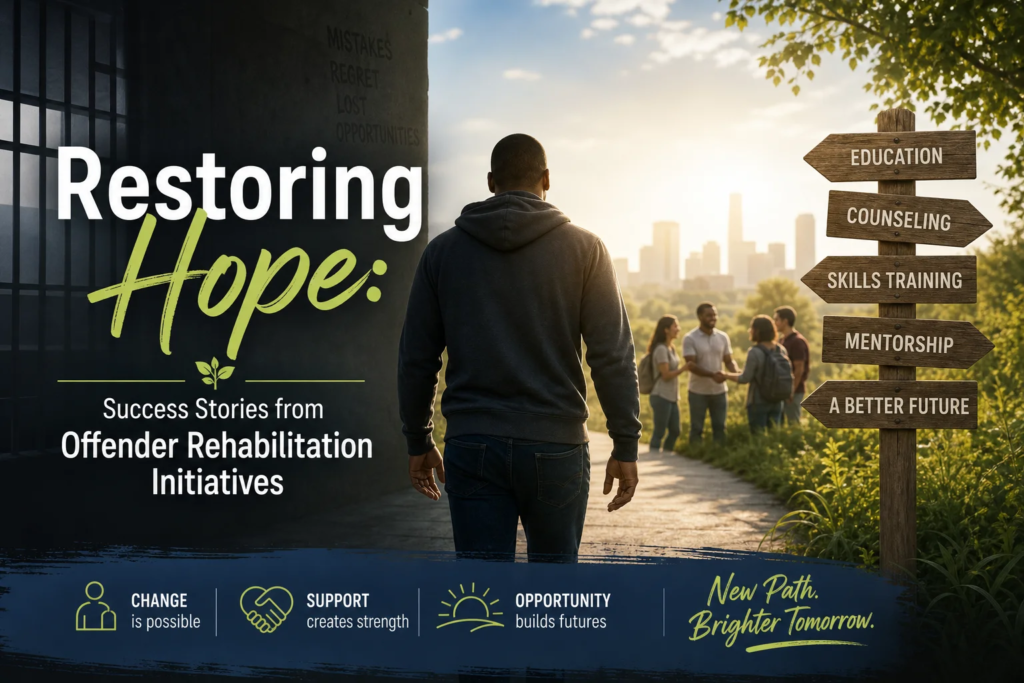
Introduction: When a Second Chance Becomes a Turning Point
A prison sentence can mark the end of a chapter—but it does not have to be the end of a life story.
Across the world, communities are discovering that people who have committed crimes can change when they are given structure, accountability, education, treatment, mentorship, and a genuine path back into society. This is the heart of Restoring Hope: Success Stories from Offender Rehabilitation Initiatives: the belief that rehabilitation is not naïve optimism—it is practical public safety.
For decades, criminal justice systems have often focused heavily on punishment. Yet many people leaving prison return to neighborhoods with the same unresolved problems that contributed to their offending: addiction, trauma, homelessness, unemployment, poor education, untreated mental health challenges, and a lack of positive support. Without intervention, the cycle continues.
But when offender rehabilitation initiatives are well-designed, they can interrupt that cycle.
They help people build skills, repair relationships, develop emotional resilience, earn qualifications, find employment, and rediscover self-worth. The best success stories from offender rehabilitation initiatives show that transformation is possible—not for everyone in the same way, and not without hard work—but often enough to change families, neighborhoods, and even national policy.
This in-depth article explores Restoring Hope: Success Stories from Offender Rehabilitation Initiatives through real-world examples, practical insights, and lessons from programs that are helping people move from incarceration to contribution.
Why Offender Rehabilitation Matters More Than Ever
At its core, offender rehabilitation is about reducing harm.
It is not about excusing crime. It is not about ignoring victims. And it is certainly not about pretending that change is easy. Rather, rehabilitation asks a difficult but essential question:
What can we do to reduce the chance that this person harms someone again?
The answer usually involves more than a prison cell.
Many people in the justice system have experienced poverty, violence, addiction, family breakdown, or limited educational opportunity. While these factors do not remove personal responsibility, they help explain why punishment alone often fails to produce lasting change.
Punishment Alone vs. Rehabilitation-Focused Justice
| Approach | Main Focus | Typical Outcome | Long-Term Community Impact |
|---|---|---|---|
| Punishment-only model | Isolation, deterrence, control | May temporarily remove risk | Often leaves root causes unresolved |
| Rehabilitation model | Accountability, skill-building, treatment, reintegration | Builds capacity for change | Can reduce reoffending and improve public safety |
| Restorative approach | Repairing harm, victim awareness, community healing | Encourages responsibility | Strengthens social trust when applied carefully |
| Reentry support model | Housing, employment, mentoring, family reconnection | Eases transition after release | Reduces instability and relapse risk |
The most effective systems combine accountability with opportunity. That is why Restoring Hope: Success Stories from Offender Rehabilitation Initiatives has become such an important topic for policymakers, nonprofit leaders, correctional professionals, and communities.
The Human Side of Rehabilitation: More Than Statistics
Numbers matter. Recidivism rates, employment outcomes, program completion rates, and cost savings help evaluate whether programs work. But behind every data point is a person.
A father who learns to read while incarcerated and later helps his child with homework.
A young adult who joins a violence-interruption program and chooses mediation over retaliation.
A woman recovering from addiction who receives trauma-informed counseling and rebuilds custody relationships with her children.
A former gang member who becomes a mentor, guiding others away from the same path.
These are the stories that define Restoring Hope: Success Stories from Offender Rehabilitation Initiatives. They remind us that rehabilitation is not just a correctional strategy—it is a human process.
What Makes an Offender Rehabilitation Initiative Successful?
Not all programs are equally effective. Some sound promising but lack evidence, consistency, or follow-through. The most successful offender rehabilitation initiatives tend to share several key features.
Core Elements of Effective Rehabilitation
| Key Element | Why It Matters | Example Application |
|---|---|---|
| Education | Improves literacy, confidence, and employability | GED programs, college courses, vocational training |
| Mental health care | Addresses trauma, depression, anxiety, and behavioral patterns | Counseling, psychiatric support, cognitive behavioral therapy |
| Addiction treatment | Reduces relapse and drug-related offending | Medication-assisted treatment, peer recovery groups |
| Employment pathways | Provides income, structure, and dignity | Apprenticeships, job placement, social enterprises |
| Mentorship | Offers guidance and positive identity formation | Peer mentors, community volunteers, faith-based support |
| Family support | Helps rebuild relationships and reduce isolation | Parenting classes, family therapy, visitation programs |
| Housing assistance | Prevents homelessness after release | Transitional housing, supportive accommodation |
| Restorative justice | Encourages accountability and empathy | Victim-offender dialogue, community repair projects |
A powerful lesson from Restoring Hope: Success Stories from Offender Rehabilitation Initiatives is that transformation rarely comes from one intervention alone. People need layered support.
Case Study 1: Norway’s Rehabilitation Model and the Power of Human Dignity
Norway is often discussed in global conversations about prison reform because of its emphasis on normalization, education, and humane conditions. Facilities such as Halden Prison and Bastøy Prison are frequently cited as examples of correctional environments designed to prepare people for life outside prison rather than simply punish them inside it.
Norway’s approach is based on a principle that may sound simple but is deeply influential: people go to prison as punishment, not for punishment.
That means the loss of liberty is the sentence. Daily life inside prison aims to preserve as much normal responsibility as possible. In some facilities, incarcerated individuals cook meals, attend classes, work, participate in therapy, and interact with staff who are trained more like social workers than guards.
Why This Matters
Norway has reported relatively low recidivism compared with many countries. While cultural, economic, and legal differences must be considered, its model offers a valuable lesson: when prisons are designed around reintegration, people may be better prepared to return to society.
Brief Analysis
This example is highly relevant to Restoring Hope: Success Stories from Offender Rehabilitation Initiatives because it shows how dignity can be a practical tool, not merely a moral ideal. Norway’s model suggests that treating people as capable of change can encourage responsibility, reduce institutional violence, and support long-term reintegration.
The takeaway is not that every country can copy Norway exactly. Rather, correctional systems everywhere can learn from its emphasis on education, staff training, mental health support, and preparation for release.
Case Study 2: The Bard Prison Initiative and Education as a Doorway to Freedom
The Bard Prison Initiative, based in the United States, offers college education to incarcerated students. It has become one of the most recognized prison education programs in the country, showing that rigorous academic opportunity can thrive even inside prison walls.
Students in the program take demanding courses, engage in debate, write research papers, and earn degrees. One of the initiative’s most publicized moments came when a debate team made up of incarcerated Bard students defeated a team from Harvard University in 2015. The victory gained national attention not because it was a novelty, but because it challenged assumptions about intelligence, potential, and incarceration.
Why Education Changes Identity
Education does more than provide credentials. It changes how people see themselves.
A person who once believed they were “just an offender” may begin to see themselves as a student, thinker, writer, parent, leader, or future professional. That identity shift is central to many offender rehabilitation success stories.
Brief Analysis
The Bard Prison Initiative demonstrates one of the strongest themes in Restoring Hope: Success Stories from Offender Rehabilitation Initiatives: meaningful rehabilitation requires high expectations. Programs that assume incarcerated people can handle serious intellectual work often help participants build discipline, confidence, and future orientation.
This case also highlights the importance of access. If education is limited only to those outside prison, society misses a major opportunity to reduce reoffending and strengthen communities.
Case Study 3: Homeboy Industries and Healing from Gang Involvement
Homeboy Industries in Los Angeles is one of the world’s best-known gang rehabilitation and reentry organizations. Founded by Father Gregory Boyle, it provides job training, tattoo removal, counseling, legal support, education, and community to people seeking to leave gang life behind.
The organization operates social enterprises, including a bakery, café, catering service, and retail businesses. Participants receive paid training while also accessing wraparound support.
One of Homeboy’s most powerful contributions is its culture of belonging. People who may have experienced rejection, violence, or shame are welcomed into an environment where accountability and compassion exist together.
The Importance of “Kinship”
Homeboy Industries often speaks about kinship—the idea that people heal through connection. For many participants, gang involvement was tied to a search for identity, protection, and family. Rehabilitation must therefore offer more than rules; it must offer a healthier community.
Brief Analysis
Homeboy Industries is a strong example of restoring hope in offender rehabilitation because it addresses both external and internal barriers. Jobs matter, but so do grief counseling, trauma support, emotional healing, and peer encouragement.
This initiative shows that success stories from offender rehabilitation initiatives are often built through long-term relationships. Transformation is rarely instant. It happens when people are supported through setbacks, relapse risks, and the difficult process of rebuilding trust.
Case Study 4: Delancey Street Foundation and Peer-Led Reintegration
The Delancey Street Foundation, founded in San Francisco, is a residential self-help organization serving people with histories of addiction, incarceration, homelessness, and other serious challenges. Its model is unusual because it relies heavily on peer accountability and community living.
Participants live together, work in social enterprises, learn marketable skills, and support one another. Many arrive with little work history or formal education. Over time, they may gain experience in moving services, restaurants, catering, automotive work, or other businesses connected to the foundation.
A Community That Teaches Responsibility
Delancey Street does not simply provide services to participants. It expects them to contribute. Residents help run the community, mentor newer members, and develop practical habits such as punctuality, conflict resolution, and teamwork.
Brief Analysis
This case fits deeply into Restoring Hope: Success Stories from Offender Rehabilitation Initiatives because it shows how responsibility can be rehabilitative. Rather than treating participants as passive recipients of help, Delancey Street invites them to become builders of the community.
The peer-led structure also reflects a major insight in offender rehabilitation: people who have changed their own lives can be uniquely effective in helping others change.
Case Study 5: San Quentin’s Media and Education Programs
San Quentin State Prison in California has hosted several innovative rehabilitation efforts over the years, including educational programs, journalism projects, podcasting, and storytelling initiatives. One widely known example is the podcast “Ear Hustle,” created inside San Quentin, which gives listeners insight into daily prison life and the humanity of incarcerated people.
In addition, programs connected to higher education, creative writing, and restorative reflection have helped incarcerated individuals develop communication skills and self-awareness.
Storytelling as Rehabilitation
Storytelling can be transformative because it requires reflection. People must examine their choices, understand harm, organize their thoughts, and communicate honestly.
For listeners outside prison, storytelling can also reduce stigma. It allows the public to see incarcerated people not only through the lens of their worst actions, but through their capacity for growth.
Brief Analysis
San Quentin’s media and education programs show another dimension of Restoring Hope: Success Stories from Offender Rehabilitation Initiatives: rehabilitation includes voice. When people learn to tell the truth about their lives, they can begin to take responsibility for the past and imagine a different future.
This does not erase accountability. Instead, it deepens it.
Case Study 6: The Last Mile and Technology Training Behind Bars
The Last Mile is a U.S.-based nonprofit that provides technology and coding education to incarcerated individuals. Participants learn web development, software engineering concepts, and professional communication skills. The organization also supports reentry through job readiness and connections to employment opportunities.
Technology training is especially valuable because digital skills are increasingly necessary in the modern workforce. Many incarcerated people have been cut off from technological change for years. Without training, reentry can feel like stepping into a foreign world.
Skills for a Modern Economy
Programs like The Last Mile prepare participants not just to get a job, but to enter industries with growth potential. This matters because stable employment is one of the strongest protective factors against reoffending.
Brief Analysis
The Last Mile is a modern example of rehabilitation initiatives that restore hope by connecting people to future-oriented careers. It challenges the outdated idea that prison education should be limited to basic skills. Instead, it asks: what if people leaving prison could compete in the digital economy?
That question is central to Restoring Hope: Success Stories from Offender Rehabilitation Initiatives in the 21st century.
What These Success Stories Have in Common
Although the programs above differ in location, structure, and philosophy, they share several important patterns.
Shared Lessons from Successful Offender Rehabilitation Initiatives
| Common Factor | How It Appears in Success Stories | Why It Works |
|---|---|---|
| Human dignity | Norway, Homeboy Industries, prison education | Builds self-worth and cooperation |
| High expectations | Bard Prison Initiative, The Last Mile | Encourages discipline and ambition |
| Practical skills | Delancey Street, vocational programs | Supports employment and independence |
| Emotional healing | Homeboy Industries, counseling-based models | Addresses trauma and behavioral patterns |
| Positive community | Peer-led and mentor-based programs | Replaces harmful networks |
| Accountability | Restorative justice, structured living | Encourages responsibility |
| Reentry planning | Job placement, housing support | Reduces post-release instability |
These patterns make Restoring Hope: Success Stories from Offender Rehabilitation Initiatives more than a collection of inspiring anecdotes. They point toward a blueprint for better criminal justice outcomes.
The Role of Employment in Restoring Hope
Employment is not a magic solution, but it is often a turning point.
A job provides income, routine, social connection, and a sense of contribution. For people leaving prison, employment can also reduce the temptation or pressure to return to illegal activity.
However, many formerly incarcerated people face serious barriers, including criminal record stigma, lack of transportation, limited work history, and licensing restrictions.
What Effective Employment Programs Provide
| Support Type | Example | Benefit |
|---|---|---|
| Job readiness training | Resume writing, interview practice | Builds confidence |
| Vocational certification | Construction, culinary arts, coding | Creates marketable skills |
| Employer partnerships | Second-chance hiring networks | Opens real job opportunities |
| Transitional employment | Paid work immediately after release | Reduces financial crisis |
| Mentoring at work | Peer support, job coaches | Helps retention |
| Legal support | Record expungement guidance where available | Reduces barriers |
Many offender rehabilitation success stories begin when someone receives their first legitimate paycheck in years. It is not only about money. It is about proof: “I can do this.”
That moment is a powerful part of Restoring Hope: Success Stories from Offender Rehabilitation Initiatives.
Mental Health, Trauma, and Addiction: The Hidden Roots of Reoffending
A large number of people in the justice system live with untreated mental health conditions, substance use disorders, or histories of trauma. If these issues are ignored, rehabilitation efforts remain incomplete.
Addiction treatment, trauma-informed counseling, cognitive behavioral therapy, and psychiatric care can help people understand triggers, develop coping skills, and make safer decisions.
Why Trauma-Informed Rehabilitation Matters
Trauma-informed programs do not excuse harmful behavior. Instead, they recognize that unresolved trauma can shape impulsivity, aggression, substance abuse, and distrust.
A trauma-informed correctional environment asks:
- What happened to this person?
- How has it affected their behavior?
- What skills and supports can help them respond differently?
- How can accountability be paired with healing?
This approach is essential to restoring hope through offender rehabilitation initiatives because hope without healing can be fragile. People need tools to manage pain, anger, shame, and fear.
Restorative Justice: Repairing Harm Where Possible
Restorative justice focuses on accountability, victim awareness, and repairing harm. It can include victim-offender dialogue, community conferences, apology letters, restitution plans, or service projects.
Restorative justice is not appropriate for every case, and it must always be victim-centered and voluntary. But when carefully facilitated, it can help offenders understand the real impact of their actions in a way that punishment alone may not.
The Value of Facing Harm
For some participants, restorative justice is the first time they fully grasp the emotional, financial, and psychological damage caused by their crime. That realization can become a turning point.
In the broader story of Restoring Hope: Success Stories from Offender Rehabilitation Initiatives, restorative justice adds an important reminder: rehabilitation should not focus only on the offender. It must also consider victims, families, and communities.
True hope includes repair.
Reentry: The Critical First 72 Hours After Release
Release from prison can be overwhelming. People may walk out with a small amount of money, limited identification, no stable housing, no phone, and no immediate job. Even highly motivated individuals can struggle.
The first days and weeks after release are critical.
Common Reentry Needs
| Need | Why It Is Urgent | Helpful Intervention |
|---|---|---|
| Identification documents | Needed for work, housing, benefits | Pre-release document planning |
| Safe housing | Prevents homelessness and relapse | Transitional housing |
| Transportation | Needed for appointments and jobs | Bus passes, rideshare support |
| Medication continuity | Prevents health crises | Pre-release medical coordination |
| Employment support | Builds stability | Job placement services |
| Family mediation | Reduces conflict | Reentry counseling |
| Peer mentorship | Provides guidance | Credible messenger programs |
Some of the most powerful success stories from offender rehabilitation initiatives happen because someone was met at the gate—literally or figuratively—with support.
That support can mean the difference between panic and possibility.
The Role of Families in Offender Rehabilitation
Families can be a source of healing, but they can also carry pain, mistrust, and exhaustion. Effective rehabilitation programs recognize that family relationships often need careful rebuilding.
Parenting classes, family counseling, child-friendly visitation, and communication workshops can help incarcerated people reconnect with loved ones in healthier ways.
For children, maintaining safe and appropriate contact with an incarcerated parent can reduce confusion and emotional distress. For parents, the desire to be present for their children can become a strong motivation for change.
Family repair is a vital part of Restoring Hope: Success Stories from Offender Rehabilitation Initiatives because crime rarely affects only one person. Rehabilitation must ripple outward.
Community-Based Programs: Why Local Support Matters
Prisons cannot do rehabilitation alone.
When people return home, they need communities prepared to receive them. Local nonprofits, employers, faith groups, schools, health clinics, and housing organizations all play a role.
Community-based offender rehabilitation initiatives often succeed because they understand local realities. They know which employers are open to second-chance hiring, which neighborhoods lack services, and which support networks are trustworthy.
Community Contributions to Rehabilitation
| Community Partner | Possible Role |
|---|---|
| Employers | Offer second-chance jobs and apprenticeships |
| Nonprofits | Provide case management and mentoring |
| Faith communities | Offer moral support and belonging |
| Colleges | Provide education and certification |
| Health clinics | Deliver mental health and addiction care |
| Housing organizations | Provide transitional or supportive housing |
| Formerly incarcerated mentors | Offer credible guidance |
The more connected these partners are, the stronger the outcomes. Restoring Hope: Success Stories from Offender Rehabilitation Initiatives is ultimately a community project.
Measuring Success: What Should We Count?
Recidivism is important, but it should not be the only measure of success. A person may avoid reoffending but still struggle with poverty, isolation, or untreated trauma. Likewise, progress can happen in stages.
A better evaluation looks at multiple outcomes.
Meaningful Measures of Rehabilitation Success
| Measurement | What It Reveals |
|---|---|
| Reduced reoffending | Public safety improvement |
| Employment retention | Economic stability |
| Housing stability | Lower crisis risk |
| Education completion | Increased opportunity |
| Sobriety or treatment engagement | Recovery progress |
| Family reunification | Social support |
| Mental health improvement | Emotional resilience |
| Victim restitution or repair | Accountability |
| Community involvement | Positive identity |
This broader view makes Restoring Hope: Success Stories from Offender Rehabilitation Initiatives more honest and useful. Success is not always perfect. Sometimes it looks like fewer relapses, better choices, repaired relationships, and a growing ability to live responsibly.
Challenges Facing Offender Rehabilitation Initiatives
While the success stories are inspiring, rehabilitation work is not easy. Programs often face funding shortages, political resistance, staffing challenges, public skepticism, and inconsistent implementation.
Common Barriers
-
Stigma against formerly incarcerated people
Many people are denied jobs or housing because of their record, even after completing their sentence. -
Lack of long-term funding
Rehabilitation requires sustained investment, not short-term pilot projects. -
Fragmented services
Housing, treatment, employment, and supervision agencies may not coordinate effectively. -
Overloaded parole and probation systems
Supervision can become surveillance-focused rather than support-focused. -
Untreated addiction and mental illness
Without healthcare access, reentry becomes unstable. - Public fear and political pressure
Rehabilitation can be misunderstood as being “soft on crime,” even when it improves safety.
These challenges do not weaken the argument for rehabilitation. They show why thoughtful design matters. The best offender rehabilitation initiatives restoring hope are realistic about obstacles and persistent in addressing them.
The Economic Case for Rehabilitation
Beyond the human argument, there is a financial one.
Incarceration is expensive. Reoffending creates costs for courts, policing, prisons, victims, families, and communities. Effective rehabilitation can reduce these costs by helping people become employed, stable, and less likely to return to prison.
Education and treatment programs often cost far less than repeated incarceration. When participants gain jobs, pay taxes, support families, and contribute to local economies, the benefits multiply.
The economic lesson of Restoring Hope: Success Stories from Offender Rehabilitation Initiatives is clear: investing in people can be cheaper—and wiser—than repeatedly paying for failure.
How Technology Is Changing Offender Rehabilitation
Technology is opening new possibilities for rehabilitation, though it must be used carefully and ethically.
Digital learning platforms can provide education in facilities where teachers are limited. Telehealth can connect people to therapists and addiction counselors. Reentry apps can help with appointment reminders, job searches, and access to community resources.
However, technology should never replace human relationships. A tablet cannot become a mentor. An app cannot provide belonging. The strongest rehabilitation models use technology as a tool, not a substitute for care.
The future of Restoring Hope: Success Stories from Offender Rehabilitation Initiatives will likely combine digital access with deeply human support.
Policy Lessons: What Governments Can Do
Governments play a major role in whether rehabilitation succeeds. Policies can either create pathways or reinforce barriers.
Practical Policy Actions
| Policy Area | Recommended Action |
|---|---|
| Prison education | Expand access to high school, college, and vocational programs |
| Reentry planning | Begin release preparation months before discharge |
| Housing | Fund transitional and supportive housing |
| Employment | Incentivize second-chance hiring |
| Healthcare | Ensure continuity of mental health and addiction treatment |
| Records | Expand fair-chance licensing and record-sealing options where appropriate |
| Supervision | Shift probation/parole toward support and risk reduction |
| Data | Track long-term outcomes beyond recidivism |
Public policy should be guided by what works. The evidence behind many success stories from offender rehabilitation initiatives suggests that support and accountability together are more effective than punishment alone.
How Individuals Can Support Rehabilitation
You do not have to run a prison system to make a difference.
Ordinary people can support offender rehabilitation in practical ways:
- Hire qualified people with criminal records.
- Volunteer with reentry organizations.
- Mentor someone returning from incarceration.
- Support prison education programs.
- Donate books, funds, or professional services.
- Advocate for fair housing and employment policies.
- Welcome people into positive community spaces.
- Listen to the stories of people who have changed.
Every act of support contributes to restoring hope in offender rehabilitation. When communities believe change is possible, more people find the courage to pursue it.
Long-Tail Keyword Variations for Contextual Use
For readers, writers, and organizations exploring this topic, here are useful keyword variations connected to Restoring Hope: Success Stories from Offender Rehabilitation Initiatives:
| Keyword Variation |
|---|
| Restoring hope through offender rehabilitation programs |
| Success stories from offender rehabilitation initiatives |
| Offender rehabilitation success stories |
| Rehabilitation initiatives that reduce reoffending |
| Prison rehabilitation programs that work |
| Real-life offender reintegration success stories |
| Restoring hope after incarceration |
| Community-based offender rehabilitation programs |
| Successful prisoner reentry initiatives |
| Evidence-based offender rehabilitation strategies |
| Second-chance programs for former offenders |
| Restorative justice and offender rehabilitation |
| Employment programs for formerly incarcerated people |
| Education-based prison rehabilitation success stories |
| Reentry programs restoring hope for ex-offenders |
These variations help capture the broader meaning of Restoring Hope: Success Stories from Offender Rehabilitation Initiatives without making the writing feel repetitive or forced.
The Deeper Meaning of Restoring Hope
Hope is not wishful thinking.
For someone leaving prison, hope may look like a bus pass, a clean bed, a mentor’s phone number, a job interview, a counseling session, or a classroom seat. It may look like being called by your name instead of your number. It may look like a child willing to speak to you again.
The phrase Restoring Hope: Success Stories from Offender Rehabilitation Initiatives captures something profound: people are more likely to change when they can imagine a future worth working toward.
That future must be paired with responsibility. Rehabilitation does not mean avoiding consequences. It means using consequences as a starting point for growth.
The most compelling offender rehabilitation success stories are not simple redemption tales. They are stories of struggle, relapse prevention, hard conversations, accountability, and daily choices. They are stories of people who did harm and then committed themselves to doing better.
And when those stories succeed, everyone benefits.
Conclusion: From Second Chances to Safer Communities
Restoring Hope: Success Stories from Offender Rehabilitation Initiatives is not just an inspiring theme—it is a practical roadmap for safer, healthier communities.
The case studies explored here show that rehabilitation works best when it is comprehensive. Education opens doors. Employment creates stability. Mental health care supports healing. Addiction treatment reduces relapse. Mentorship provides guidance. Restorative justice encourages accountability. Reentry planning prevents crisis. Community support sustains change.
The lesson is clear: people are not transformed by punishment alone. They are transformed by responsibility, opportunity, relationships, and hope.
If we want fewer victims, fewer broken families, and fewer people returning to prison, we must invest in rehabilitation initiatives that are evidence-informed, humane, and realistic. Every successful reentry story is more than a personal victory. It is a public safety achievement.
The next chapter of criminal justice should not be written only in courtrooms and prison cells. It should also be written in classrooms, counseling rooms, workplaces, family homes, and communities willing to believe that change is possible.
That is the proven promise of Restoring Hope: Success Stories from Offender Rehabilitation Initiatives.
1. What is offender rehabilitation?
Offender rehabilitation refers to programs and strategies designed to help people who have committed crimes change their behavior, address underlying issues, and successfully reintegrate into society. This can include education, job training, therapy, addiction treatment, mentoring, restorative justice, and housing support.
2. Do offender rehabilitation initiatives actually reduce crime?
Many well-designed rehabilitation initiatives can reduce reoffending, especially when they address specific risk factors such as unemployment, addiction, lack of education, antisocial thinking patterns, and unstable housing. The strongest results usually come from programs that combine accountability with practical support.
3. Is rehabilitation unfair to victims?
Rehabilitation should never ignore victims. In fact, effective rehabilitation can honor victims by reducing the chance of future harm. Restorative justice programs, when voluntary and carefully facilitated, can also help offenders understand the impact of their actions and make meaningful efforts to repair harm.
4. What types of programs are most effective for former offenders?
The most effective programs are usually comprehensive. They may include education, vocational training, mental health treatment, substance abuse recovery, stable housing, mentorship, family support, and employment placement. Programs tailored to individual needs tend to be more successful than one-size-fits-all approaches.
5. Why is employment so important after incarceration?
Employment provides income, structure, responsibility, and social connection. It also helps formerly incarcerated people build a positive identity and avoid returning to illegal activity. However, employment support must often include training, coaching, transportation help, and employers willing to practice second-chance hiring.
6. What role does education play in offender rehabilitation?
Education can be life-changing. It improves literacy, problem-solving, confidence, and employability. College and vocational programs in prison have been associated with better reentry outcomes and can help incarcerated individuals develop a new sense of purpose.
7. How can communities support offender rehabilitation?
Communities can support rehabilitation by offering jobs, mentorship, housing assistance, volunteer services, family support, and welcoming spaces. Local organizations can also partner with correctional systems to ensure people leaving prison are not returning to society alone.
8. What is the biggest barrier to successful reentry?
One of the biggest barriers is instability immediately after release. Without housing, employment, healthcare, identification, transportation, or social support, people face a high risk of crisis. Strong reentry planning before release is essential.
9. Are rehabilitation programs “soft on crime”?
No. Effective rehabilitation is focused on accountability and public safety. It recognizes that punishment alone often fails to prevent future crime. Helping people change their behavior, repair harm, and build stable lives is a serious crime-reduction strategy.
10. What is the main takeaway from Restoring Hope: Success Stories from Offender Rehabilitation Initiatives?
The main takeaway is that change is possible when accountability is combined with opportunity. Successful offender rehabilitation initiatives show that people can rebuild their lives, families can heal, and communities can become safer when hope is supported by practical action.


The PsyForU Editorial Collective is the research and editorial team of PsyForU Research International. The collective prepares educational, psychological, mental-health-awareness, inclusion, neurodiversity, and research-methodology content for students, parents, educators, researchers, and general readers. PsyForU content is intended for awareness, education, and capacity-building and should not be treated as clinical diagnosis, therapy, medical advice, legal advice, or emergency mental-health support.