



Why do some brands get loyal fans while others fail, even with lots of ads? It’s all about what they say and what they do. Organizations need to show, not just tell, to win over people.
Today’s creative amplification is about doing both well. Brands like Hermès and services like American Express Platinum get it. They build trust through actions, not just words.
This guide looks at how strategic brand messaging meets real actions. We dive into the science behind it and how it works in real life.
By mixing brand storytelling amplification with smart content distribution, brands can really stand out. Those that match their stories with real actions make a bigger splash. It’s better than just making lots of content or pushing it out there.
Key Takeaways
- Behavioral signals create stronger brand belief than narrative claims alone
- Signal-story alignment generates exponential market resonance compared to isolated tactics
- Luxury brands demonstrate systematic perception architecture through consistent actions
- Modern organizations must coordinate messaging across all touchpoints for effective amplification
- The tension between declaration and demonstration defines contemporary marketing success
- Strategic integration of storytelling with evidence-based signals drives sustainable competitive advantage
Understanding the Signal Amplification Framework
Signal amplification is key to marketing success. It’s about integrating all parts, not just focusing on one area. When everything works together, the impact grows. But if not, efforts add up but don’t go far.
Marketers face a big challenge today. It’s not just about making great content or a strong brand. They need to link these elements together. This way, they create compounding effects that old methods can’t match.
What Is Creative Amplification
Creative signal amplification means making brand messages stronger by managing stories, identities, and how they’re shared. It’s about being consistent and clear in all interactions.
This process has three steps. First, create a strong story that guides all messages. Then, build a brand that shows this story through what it looks and sounds like. Lastly, use signal amplification techniques to share these messages well.
Studies show that if what a brand says doesn’t match what it does, people lose trust. Creative signal amplification fixes this by making sure messages and actions align.
The Three Pillars: Story, Brand, and Distribution
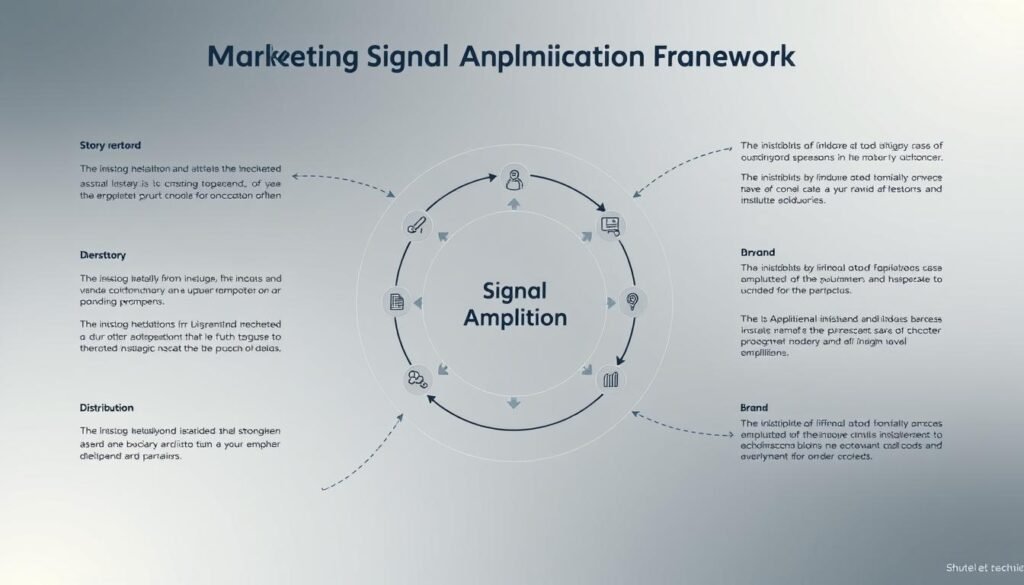
- Story: The core message, emotions, and themes that tie everything together
- Brand: The look, sound, and feel of the brand that makes it memorable
- Distribution: How messages are shared, including where, when, and how often
These parts work best when they’re in sync. A great story needs a strong brand to back it up. And a good brand needs the right channels to reach people.
By using marketing signal amplification, each part boosts the others. A good story gets shared through the right channels. A strong brand makes sure people remember it. And the right channels help the story reach more people.
Why Traditional Marketing Falls Short
Old marketing ways focus on one thing at a time. This makes them weak. They often fail in the same ways.
Teams might make great stories but forget to keep the brand consistent. Creative teams make stories that touch hearts but the brand says something else. This confuses people and hurts memory.
Also, companies spend a lot on digital signal boosting but ignore the story and brand. Sending out unclear messages just makes things worse. More messages don’t fix the problem if they’re not right.
The old way sees story, brand, and distribution as separate tasks. But signal optimization techniques see them as connected systems. This new view changes how we amplify messages from a simple tactic to a big strategy.
Building Your Core Narrative Foundation
Creating a strong narrative foundation means digging deep into your company’s history and customer experiences. These elements are the backbone of your marketing efforts. Without them, your messages won’t resonate with your audience.
Many companies skip the strategic planning and jump straight to sharing their story. This approach can confuse your message and make it hard to stand out. Building a solid narrative first helps you scale your message effectively.
Identifying Your Unique Story Elements
Every company has its own unique story that sets it apart. These stories come from historical events, the reasons for starting the company, and customer success stories. Finding these elements requires a deep dive into your data and talking to your stakeholders.
These unique elements are the building blocks of your narrative. They give your messages depth and authenticity. Finding them involves both qualitative research and reviewing your documents carefully.

Origin stories give your brand a rich history and show its core values. By talking to founders and early team members, you uncover key moments that shaped your company. These moments reveal the values that guided your early days.
Looking at old documents and plans adds more context. They show how your values and message have evolved. This helps you find the themes that have stayed the same, even as your company grows.
The most powerful brand stories aren’t created—they’re discovered through careful examination of authentic experiences that shaped organizational identity.
Finding Customer Transformation Moments
Customer success stories prove your value and show how you’ve helped others. These moments are found by analyzing customer data and success metrics. They show how your product or service has made a real difference.
Discovering these moments involves talking to customers, writing case studies, and looking at numbers. The best stories show clear before and after changes. They give people a glimpse of what’s possible with your product or service.
Developing Your Narrative Arc
A good narrative arc takes your story’s parts and puts them in order. It moves people from seeing a problem to wanting your solution. This structure keeps your audience engaged and interested.
Good arcs are familiar yet new. They’re easy to follow but memorable. This structure helps guide your content across different platforms.
The Problem-Solution-Transformation Framework
This framework is a basic structure for your narrative arc. It works for all kinds of businesses. The first part sets up the problem, the second offers your solution, and the third shows how it works.
The problem stage connects with your audience’s experiences. It creates a sense of urgency. The solution stage highlights what makes your approach different. The transformation stage proves your solution works.
This framework builds emotional connection by linking to your audience’s goals. It helps your story grow by keeping the structure consistent, no matter the content length or format.
Creating Story Consistency Across Channels
Keeping your story consistent across all channels is key. It means your message is clear and consistent, no matter where people find you. This goes beyond just your logo and branding.
Adapting your story for different channels requires knowing what each platform expects. Social media needs short, visual stories, while long-form content lets you dive deeper. Emails should be brief but personal, and sales conversations can explore your story in more detail.
To keep your story consistent, use guidelines, templates, and regular team meetings. This way, whether people see your brand online, in content, or in person, they’ll get a unified story.
Crafting Stories That Resonate and Scale
Companies need to build stories that grow with them, not just for one campaign. A strong brand storytelling strategy turns single messages into a big, connected story. This way, the story stays true to its core but can reach different people in different ways.
The Anatomy of Scalable Storytelling
Good scalable stories have four key parts. First, a clear core message tells what the brand is about and why it’s important. This message stays the same, no matter where it’s shared.
Next, evidence backs up the brand’s claims with real examples and results. The brand storytelling framework also lets you change how the story is told. But it keeps the important parts the same. This way, the story can grow without losing its core message.
Emotional Hooks and Message Clarity
Studies show that stories that touch our feelings are more memorable than just facts. These emotional hooks grab our attention by tapping into our hopes and fears. They speak to everyone, no matter who they are.
But strategic storytelling also needs clear messages. People need to know what the brand offers and why it’s worth their time. When stories make us feel something and also tell us something clear, they really work.
Story Frameworks for Different Audience Segments
Even though the story’s core stays the same, different people see different things in it. Storytelling for brand growth knows that some people care about how things work, while others want to know how it will help them. This way, the story can speak to everyone’s needs.
For example, people who use the product want to know how it makes their life better. This approach keeps the story’s heart the same but lets it talk to different people in their own way.
Modular Storytelling Approach
The modular method breaks down stories into parts that can be mixed and matched. This lets companies tell their story in different ways, depending on where they are and who they’re talking to. It’s like building with blocks, where each block is a part of the story.
Strategic Brand Positioning for Amplification
Starting with brand message optimization means making key decisions about what to highlight. Without clear choices, messages get lost in the noise. This makes it hard to stand out in a crowded market.
Strong positioning boosts message impact. But weak positioning can make even big efforts seem small.
Positioning turns simple messages into distinctive competitive signals. It defines where a brand stands compared to others. This clarity helps people remember and choose the brand when they need to.
Defining Your Market Position
Figuring out your market position means looking at many things at once. You need to see where other brands are and where you can stand out. This helps find areas where you can meet customer needs better than others.
Positioning choices decide what your brand will be known for. Strategic brand messaging follows these choices. It makes sure your message is clear and consistent everywhere.
Competitive Analysis and Gap Identification
Looking at competitors isn’t enough. You also need to see what else customers might consider. This helps find gaps where you can meet needs that others don’t.
| Positioning Dimension | Analysis Focus | Gap Opportunity Indicators |
|---|---|---|
| Price-Value Relationship | Cost relative to perceived benefits | Underserved premium or value segments |
| Feature Emphasis | Capabilities highlighted in messaging | Customer priorities competitors ignore |
| Customer Segment Focus | Primary audience targeting | Overlooked demographic or psychographic groups |
| Brand Personality | Emotional tone and character projection | Unexpressed attitudes or values resonating with audiences |
Building Brand Differentiation
Turning positioning into something people can see and value is key. Effective brand messaging shows how you’re different through real benefits. This could be through new products, better service, or unique experiences.
Positioning is not what you do to a product. Positioning is what you do to the mind of the prospect.
How well you differentiate your brand affects how well you can amplify it. Strongly differentiated brands need less repetition to be remembered. Weakly differentiated brands struggle to be noticed, no matter how much they try.
Creating Memorable Brand Touchpoints
Brand touchpoints make abstract ideas real and memorable. They cover the whole customer journey, from first awareness to after they’ve bought. Each touchpoint is a chance to strengthen your brand or weaken it.
Memorable touchpoints have unique visual, verbal, and experiential elements. Brand messaging frameworks help design these touchpoints. This ensures they’re consistent but also tailored for different channels and situations. Consistent touchpoints are key to successful amplification.
Developing Your Brand Messaging Architecture
Brand message optimization starts with knowing that not all messages are equal. A messaging architecture organizes communications in a way that makes sense. It keeps core messages consistent but allows for flexibility in specific situations.
This approach turns random content into strategic tools. These tools help strengthen the brand’s position in the market at every touchpoint.
Core Message Hierarchy
Clear message prioritization is key to brand communications. Primary messages share the brand’s core identity and what sets it apart. These messages stay the same across all audiences and channels.
Secondary messages show how the brand’s value applies to different groups. Supporting messages provide the evidence needed to back up these claims. This structure ensures the brand’s story is optimized while being flexible for various needs.
Primary messages tell what the brand represents and its purpose. Secondary messages explain how the brand’s value benefits different groups. Supporting messages offer the proof and details that support these claims, helping build trust.
Value Proposition Clarity
To make marketing messages clear, simplify complex offers into easy-to-understand statements. The best propositions state what’s offered, the problems it solves, and why it’s better than others.
Clarity comes from refining and testing messages with the target audience. Avoiding vague language and using clear, benefit-focused statements helps audiences quickly see the brand’s value and uniqueness.
Brand Voice and Tone Guidelines
Keeping a consistent brand personality across all communications needs clear guidelines. Brand voice is the unchanging personality of messages, while tone adjusts for the situation and audience. Together, they ensure the brand’s story is consistent, whether through social media, sales, or customer service.
Creating Your Voice Chart
A voice chart outlines the key traits of brand communications. It helps in optimizing marketing narratives by setting clear rules for content creators. This ensures consistency across teams and channels.
| Voice Attribute | Description | Example Expression | Avoid |
|---|---|---|---|
| Vocabulary Choice | Preferred terminology and language complexity level | Professional without pretension; accessible expertise | Excessive jargon; overly casual slang |
| Sentence Structure | Typical length and complexity patterns | Mix of concise statements with detailed explanations | Run-on sentences; choppy fragments |
| Emotional Tone | Overall feeling conveyed in communications | Confident and supportive; authoritative yet approachable | Aggressive sales language; passive uncertainty |
| Perspective | Point of view and relationship with audience | Collaborative partner; trusted advisor | Superior expert; distant corporate entity |
Establishing Credibility Markers
Trust comes from credibility markers, not just claims of being great. These markers show real proof of a brand’s ability and honesty. Studies show people trust third-party checks more than a brand’s own words.
Brands that show their credibility well earn psychological permission to be trusted. This is key for growing their digital presence in a crowded space.
Social Proof and Trust Signals
Social proof uses many ways to show that lots of people agree and have good results. Things like customer reviews, stats, and expert approvals help build trust. They show that a brand works well through real stories.
Getting recognized by media and earning industry awards adds to a brand’s credibility. These trust signals boost brand storytelling amplification by backing up what the brand says.
| Indicator Category | Specific Examples | Trust Impact | Implementation Priority |
|---|---|---|---|
| Quantitative Metrics | Customer counts, retention rates, performance benchmarks | High objectivity, easily verified | Essential foundation |
| Qualitative Endorsements | Customer stories, expert opinions, media features | Emotional resonance, relatable scenarios | Secondary validation |
| Institutional Affiliations | Partnerships, certifications, association memberships | Third-party authority transfer | Long-term credibility |
| Social Validation | Social media engagement, community size, user content | Peer acceptance signals | Ongoing reinforcement |
Authority Building Strategies
Building authority means showing expertise in many places. Making educational content makes a brand a go-to source, not just a seller. Writing for industry forums and respected media boosts credibility for marketing amplification methods.
Speaking at events and doing research adds to a brand’s authority. These creative marketing tactics help build recognition over time. Being active in industry talks shows a brand’s ongoing knowledge.
Leveraging Testimonials and Case Studies
Collecting testimonials focuses on solving real problems. Good case studies show how a brand helped someone. They prove the value of what the brand offers.
The best content amplification techniques share success stories with details and results. These stories build trust by showing what a brand can do. Brands that share these stories earn credibility that words alone can’t match.
Mapping Your Distribution Channel Strategy
The success of any marketing effort depends on choosing the right channels. These channels should match how people behave. Companies have many ways to share their messages, from their own sites to paid ads.
Each channel works differently based on who you’re trying to reach and what you’re saying. Instead of using every channel, smart companies pick the ones that work best. This way, they make a big impact by reaching people in many places.
Owned, Earned, and Paid Channel Assessment
Every content strategy starts with checking out three main types of channels. Owned channels are places like websites and social media where you have full control. You decide what to say and when.
Earned channels are places like news articles and social shares where you don’t control the message. Paid channels are places like ads and sponsored content where you pay to reach people.
Each type of channel has its own good and bad points. Owned channels are cheap and let you control your message but need constant work. Earned channels are good for credibility but hard to predict. Paid channels give you quick access to people but cost money and get more expensive over time.
Good strategies mix all three types. This way, you get control, credibility, and reach.
Channel Audit Worksheet
Having a plan to check out channels helps a lot. Here’s a worksheet to help you:
| Evaluation Criterion | Assessment Questions | Priority Level | Resource Requirements |
|---|---|---|---|
| Audience Reach | What percentage of target audience actively uses this channel? | High | Analytics tools, audience research |
| Message Fit | Does channel format support storytelling requirements and brand positioning? | High | Content format analysis |
| Competitive Intensity | How saturated is the channel with competitor messages? | Medium | Competitive monitoring tools |
| Cost Efficiency | What is the cost per meaningful engagement or conversion? | High | Budget allocation, tracking systems |
| Strategic Alignment | Does channel support long-term brand objectives beyond immediate metrics? | Medium | Strategic planning sessions |
Channel Selection Based on Audience Behavior
To distribute content well, you need to know where your audience looks for information. People search for things in different ways at different times. Early on, they might find you on social media or search engines.
Later, they might look at comparison sites or blogs. And at the end, they might check out customer reviews or detailed product info. Choosing channels should match how people behave, not just what you think they should do.
It’s better to map your audience to channels based on real data, not guesses. For example, tech pros might be on LinkedIn, while consumers might like Instagram or YouTube. You need to keep updating your plan as people’s habits change and new channels come up.
Multi-Channel Distribution Planning
Being in many places at once works better than just one. People need to see your message in different ways before they act. Planning your channels well makes sure your message is clear and strong everywhere.
Each channel does something special. Social media builds awareness, email keeps people engaged, and search ads catch people when they’re ready to buy. You need to plan how to use each one well.
Good multi-channel plans don’t just copy and paste content everywhere. They adapt messages to fit each channel’s unique feel. This way, you get the most out of each place and make your message stronger.
Creating Your Channel Matrix
A channel matrix helps you plan which messages go where and how often. This ensures you cover your audience well:
| Content Type | Primary Channels | Secondary Channels | Publishing Frequency | Success Metrics |
|---|---|---|---|---|
| Thought Leadership Articles | Blog, LinkedIn, Medium | Email newsletter, Twitter | Weekly | Engagement rate, shares, backlinks |
| Educational Video Content | YouTube, Website | LinkedIn, Facebook, Email | Bi-weekly | View duration, completion rate, comments |
| Case Studies | Website, Sales collateral | LinkedIn, Email campaigns | Monthly | Downloads, sales qualified leads |
| Quick Tips & Insights | Twitter, Instagram, LinkedIn | Facebook, Email | Daily | Engagement rate, follower growth |
| Comprehensive Guides | Website, Email lead magnets | LinkedIn, Paid promotion | Quarterly | Lead generation, organic traffic growth |
This matrix helps teams see their plans, find gaps, and make sure they’re using channels well. Regularly checking and updating your matrix keeps you in line with your audience and new opportunities.
Optimizing Content Cadence for Maximum Impact
Scaling content well means planning when and how often to post. This affects when people see your brand and how search engines rank your content. Getting this right helps keep your team happy and your audience interested.
Each platform has its own rules and what people expect. Content marketing expansion needs a plan for each place, not just one for all. Knowing these differences helps avoid posting too much or too little.
Frequency Guidelines by Platform
Algorithms on different platforms value different posting rates. Social sites like Twitter want lots of posts, while LinkedIn focuses on quality. Email needs to be sent often enough to keep people interested but not so much it gets annoying.
Studies show that strategic content amplification works differently on each platform. Twitter does well with lots of posts, LinkedIn with a few, and email with a regular schedule.
There are guidelines for how often to post on each platform. These help you plan your content strategy based on what works best for each site and your audience.
| Platform | Optimal Frequency | Peak Engagement Windows | Content Type Priority |
|---|---|---|---|
| Twitter/X | 3-5 posts daily | 8-10 AM, 6-9 PM EST | Brief updates, threads |
| 2-4 posts weekly | Tuesday-Thursday 10 AM-12 PM | Industry insights, articles | |
| 4-7 posts weekly | 11 AM-1 PM, 7-9 PM EST | Visual stories, reels | |
| 1-2 messages weekly | Tuesday-Thursday 10 AM | Value-driven content |
Timing and Scheduling Strategies
When you post matters as much as how often. People’s schedules change throughout the day and week. This affects when they’re most likely to see your content.
Good strategic content promotion takes into account where your audience is. For people in different time zones, post at times that work for them. This means posting at different times for different places.
Seasons and big events can change when people are more likely to pay attention. Knowing these times helps you plan your posts better throughout the year.
Consistency vs. Burnout Balance
Keeping a steady posting schedule is more important than trying to post too much. People get used to when they can expect to see your content. This makes it more valuable than posting randomly.
Teams have limits to how much they can do. Setting a schedule that’s realistic helps you do better than trying to do too much too soon. This way, you avoid quality dropping or team burnout.
Scaling marketing messages means finding a rhythm that works for everyone. Being consistent is better than trying to do too much and then stopping for a long time.
Building and Growing Your Audience
Audience building turns marketing plans into real connections with people who care about your brand. It turns viewers into active participants who share and consume your content. This process is key to growing your audience over time.
Good audience building means more than just broadcasting. It’s about understanding your audience, creating engaging content, and keeping them interested. This way, you build strong relationships that grow as your audience does.
Audience Segmentation and Targeting
Starting with target audience identification means dividing your market into groups with similar needs. This lets you tailor your messages to each group. By looking at demographics, behaviors, and more, you can find the right audience for your brand.
Segmentation looks at many factors, like where people live and what they like. It helps you understand who might be interested in your products. This way, you can make messages that really speak to your audience.
Creating personas helps you see your audience clearly. These profiles outline what your audience wants and how they make decisions. They help guide your content to meet their needs.
To make these personas, you use both numbers and real-life talks with customers. This way, you get a full picture of who your audience is. You can then use this information to make your marketing more effective.
Lead Magnet and Entry Point Creation
Lead magnets offer something valuable in exchange for contact info. They help you start a conversation with your audience. This is a key step in building a relationship with them.
Audience reach expansion happens when you give real value. Good lead magnets solve problems or offer useful tools. This makes your audience more likely to engage with you.
Designing Irresistible Value Offers
Creating great value offers means knowing what your audience needs. Look at what’s missing in the market and fill that gap. Your offers should solve big problems and show you’re an expert.
How you present your offers matters a lot. Use clear benefits and social proof to make your offers stand out. This can include testimonials or stats that show your value.
Engagement Tactics for Audience Retention
Getting people to stay interested is just as important as getting them in the first place. Audience engagement tactics keep people coming back for more. This includes regular content, interactive experiences, and personalized messages.
Keeping people engaged means moving them from passive to active. Create opportunities for them to get involved. This can be through content, discussions, or special programs.
| Engagement Tactic | Implementation Method | Retention Impact | Resource Requirements |
|---|---|---|---|
| Educational Content Series | Sequential lessons delivered via email or platform | Establishes regular touchpoints and builds expertise perception | Moderate content creation and automation setup |
| Interactive Community Forums | Dedicated spaces for peer discussion and support | Creates belonging and transforms passive followers into active participants | High moderation and facilitation effort |
| Exclusive Access Programs | Members-only content, early releases, or special opportunities | Rewards loyalty and differentiates committed audience members | Low to moderate with clear segmentation systems |
| Personalized Communication | Behavior-triggered messages addressing individual interests | Increases relevance and demonstrates individual attention | Moderate automation and data analysis capabilities |
Creating Partnership and Collaboration Opportunities
Collaboration strategies offer a big advantage by reaching new audiences and sharing costs. Companies that partner up can grow their reach beyond their own channels. This way, they work together with others who have similar customers.
Good partnership marketing means finding the right partners and building strong relationships. It’s important to pick partners who share the same audience and values. This way, partnerships can make content more visible and credible.
Identifying Strategic Partnership Targets
The first step is to map out the ecosystem to find good partners. Look for companies that serve the same audience as you. This could be tech vendors, service providers, or industry associations.
When choosing partners, look at who they serve and what they do. Find companies that help customers in different ways. This can lead to great partnerships that benefit both sides.
Using a systematic approach helps avoid wasting resources on bad partnerships. Evaluate partners based on clear criteria before starting a relationship. This ensures a good chance of success.
| Qualification Dimension | Evaluation Factors | Success Indicators | Red Flags |
|---|---|---|---|
| Audience Alignment | Demographic overlap, customer journey stage, purchase behavior patterns | 70%+ audience similarity, complementary customer needs | Minimal overlap, conflicting customer priorities |
| Brand Compatibility | Values alignment, positioning consistency, reputation quality | Shared mission elements, comparable market perception | Values conflicts, reputation issues, positioning contradictions |
| Resource Contribution | Audience access, content capabilities, distribution channels, budget allocation | Balanced resource contribution, complementary capabilities | One-sided benefit expectations, insufficient commitment |
| Partnership Experience | Collaboration history, relationship management capability, execution reliability | Documented success stories, professional processes | No collaboration experience, poor partner feedback |
Co-Marketing and Cross-Promotion Tactics
Working together on campaigns can boost your marketing. Co-created content is a cost-effective way to reach more people. Webinars and reports benefit from shared knowledge and promotion.
Cross-promotion helps by sharing visibility without spending money. This includes social media and website mentions. It’s a win-win for both sides.
Offering bundles and sponsoring events are also good ways to collaborate. These packages and events provide more value to customers. They also help reduce costs and increase networking.
Influencer and Ambassador Programs
Influencers have a special connection with their audience, making them great for promoting your brand. They can help you reach communities where ads don’t work. This is a powerful way to engage with your audience.
Ambassador programs create lasting relationships with brand advocates. These people get special perks and promote your brand consistently. This approach builds stronger, more genuine support for your brand.
Choosing the right influencer is key. Look for those who have a small but engaged following. They often have better results than big-name influencers. Focus on their engagement quality, not just their number of followers.
Engineering the Community Flywheel Effect
Communities that keep growing on their own help reduce work for the organization. They also spread the brand’s influence in a big way. The community flywheel makes things grow faster because more people join in. They do this by making content, helping each other, and showing their excitement.
This change turns the community into a valuable asset for digital brand amplification.
Starting to build a community can lead to big returns as it grows. Members become champions who help spread the word without needing the organization to push them. This cycle makes the brand’s message stronger while needing less effort to keep it going.
Building Self-Sustaining Communities
When a community gets big enough, it can run on its own. This is when the community starts to grow without needing the organization to push it. At this point, community engagement tactics change from getting people involved to helping them grow.
Communities that reach this point are strong and keep growing on their own.
Good community design is all about finding the right balance. It needs clear rules but also room for things to happen naturally. This way, members can help each other without always needing someone to tell them what to do.
Community Platform Selection
Choosing the right platform is key for a community’s success. You need to think about who owns the community, how you can customize it, and how it fits with other tools. Each platform has its own benefits for audience engagement optimization.
| Platform Type | Control Level | Resource Requirements | Scalability Potentia |
|---|---|---|---|
| Dedicated Forums | Complete ownership and customization | High initial setup and maintenance | Unlimited with infrastructure investment |
| Social Media Groups | Limited by platform policies | Low technical requirements | High with established user base |
| Integrated Platforms | Moderate with vendor dependencies | Medium with subscription costs | Strong with native engagement tools |
| Hybrid Approaches | Strategic control across channels | Variable based on combination | Maximum reach with complexity trade-offs |
User-Generated Content Strategies
Content made by community members is more real and reaches more people than what brands make. User-generated content strategies help members share their stories, tips, and experiences. These stories connect with others in a way that brand-made content can’t.
The most valuable brand messages come not from marketing departments but from satisfied customers sharing genuine experiences with their networks.
Strategies that turn people into content creators are powerful. Organizations give tools and ideas to help. This makes more brand messages reach more people.
Incentivizing Content Creation
Recognition systems motivate people to contribute without making it all about money. Good engagement optimization uses different ways to encourage people:
- Status recognition through badges, levels, and featured placement
- Exclusive access to premium content, early releases, or special events
- Competitive elements including leaderboards and challenges
- Tangible rewards balanced against intrinsic motivation preservation
The best incentives focus on the value of community contributions, not just personal gain. People join in because it helps others and makes the community stronger.
Community Engagement and Moderation
Good moderation is all about finding the right balance. Rules set boundaries, but too much control can stifle the community. Successful moderators help things grow naturally, removing anything that harms the community.
Clear policies tell members what’s expected and what happens if they don’t follow the rules. This makes it easier to avoid conflicts and lets members help keep the community in line.
Scale the Signal: Story, Brand, and Distribution Creative Amplification Techniques
To scale a signal, you need to multiply content, analyze performance, and allocate resources wisely. Companies that excel in creative amplification turn single marketing efforts into a unified system. This system boosts each part to create a bigger impact. By combining story consistency, brand positioning, and distribution strategy, they achieve signal scaling techniques that reach far beyond what’s possible with just organic efforts.
The amplification framework is built on three key principles. First, create multiple content pieces for different channels and audience preferences. Second, focus on messages that resonate well, shown by high engagement and conversion rates. Third, use paid promotion to spread proven content and reach more people.
Repurposing Content Across Formats
Content repurposing means making content fit different media preferences. Some people like long articles, while others prefer videos or podcasts. Multi-format distribution makes sure everyone can find the information they need.
A big research report can lead to many other content pieces. For example, a blog post summary gives quick insights. Social media graphics make data easy to share. Podcasts dive deeper into the topic.
Webinars show how to apply the research in real life. Email newsletters send targeted updates to subscribers. Sales materials use the research to talk to clients.
The Content Multiplication Matrix
The Content Multiplication Matrix helps plan how to turn one piece of content into many. It maps content against different formats and channels. This way, you can see how to expand your reach.
| Original Asset | Written Formats | Visual Formats | Audio/Video Formats | Interactive Formats |
|---|---|---|---|---|
| Research Report | Blog posts, articles, whitepapers, case studies | Infographics, slide decks, social graphics, charts | Podcast episodes, video summaries, webinars | Quizzes, calculators, assessments, tools |
| Customer Interview | Testimonial excerpts, quote graphics, success stories | Video testimonials, photo stories, brand imagery | Audio clips, interview podcasts, documentary features | Interactive case studies, story timelines |
| Data Analysis | Statistical reports, trend articles, insight briefs | Data visualizations, comparison charts, trend graphics | Video explainers, data story presentations | Data explorers, interactive dashboards |
Each spot in the matrix is a chance to make content fit different channels. It helps plan content development while keeping the story consistent.
Boosting High-Performing Content
Strategic signal optimization focuses on content that really connects with people. This means putting more effort into what works best. By analyzing performance, you can tell which content is worth more attention.
Good content has certain signs that it’s ready for more promotion. It gets a lot of engagement and shows strong results. People also give feedback that shows they care about the content.
Identifying Amplification Candidates
By analyzing performance, you can find content that’s ready for more promotion. Look at engagement, conversion rates, and feedback to decide. This helps focus efforts on content that will get the most attention.
- Engagement velocity: Content that gets a lot of attention early on is likely to interest more people.
- Conversion efficiency: Messages that get people to take action are very effective.
- Sharing propensity: Content that gets shared a lot can reach more people through networks.
- Longevity indicators: Content that stays interesting over time is worth more investment.
- Audience feedback quality: Comments that show people are really thinking about the content are valuable.
These signal scaling techniques help find content that’s likely to get more attention. This way, you can focus on what will have the biggest impact.
Strategic Paid Amplification Methods
Paid promotion helps spread content beyond what’s possible with just organic reach. Amplification methods vary based on the audience and the channel. Each method has its own goals within the overall strategy.
Social media ads can reach people based on who they are and what they like. Sponsored posts show up in feeds of people who match your target audience. This helps get your message to more people than you could with just followers.
Search engine marketing helps people find your content when they’re looking for it. Paid search ads catch people who are ready to make a decision. Display ads build awareness by showing your content on other websites.
Sponsored content gets your message into established media outlets. This partnership uses the credibility of the media to reach new audiences. Influencer partnerships use trusted voices to spread your message to their followers.
Choosing the right amplification techniques depends on where your audience is and what they like. Good paid strategies work well with organic efforts to create a smooth experience for everyone.
Measuring Signal Strength: Metrics That Matter
Measuring signal strength is key to connecting marketing efforts to real business results. Companies that use effective analytics can tell the difference between just showing activity and actually making an impact. This helps them make decisions based on facts, not just guesses.
Knowing the difference between what looks good and what works is critical. Vanity metrics might look impressive but don’t show real progress. Performance metrics give us real insights into what marketing strategies actually work.
Awareness and Reach Metrics
Awareness metrics show how well a brand’s message gets out there. They track things like how many people see the message and how it grows. This helps see which channels are best for getting the message across.
Knowing how many people see your content is the first step. Without this, you can’t tell if people aren’t engaging because of the message or because they haven’t seen it. Tracking reach helps find out which channels reach the most people.
Tracking Impressions and Share of Voice
Impressions count how many times content is seen. Share of voice shows how much a brand is talked about compared to others. This helps see if a brand is getting more or less attention over time.
Share of voice is found by comparing brand mentions to all market conversations. If it’s going up, the brand is getting more attention. If it’s going down, competitors might be getting more notice.
Engagement and Resonance Indicators
Engagement metrics show how deeply people interact with content. This includes things like how long they stay on a page and how much they share. High engagement means people are really interested in what they’re seeing.
Resonance metrics tell us which messages really connect with people. By looking at how people interact with content, we can see what really grabs their attention. This helps us make better content that people will actually care about.
How people interact with content can vary a lot. Videos tend to get more attention than pictures, and long articles are different from quick social media posts. Knowing this helps us set realistic goals for different types of content.
Sentiment Analysis and Quality Metrics
Sentiment analysis looks at how people feel about a brand. It tells us if they’re talking positively, neutrally, or negatively. Advanced tools can even pinpoint what specific messages are getting a good or bad reaction.
Quality metrics look at the depth of engagement, not just how much. A few thoughtful comments are more valuable than a lot of generic ones. Companies are focusing more on meaningful interactions than just counting how many people are talking.
Conversion and ROI Tracking
Conversion metrics show how marketing efforts lead to real business results. They track things like how many leads are generated and how many sales are made. Storytelling ROI becomes clear when we can see how stories lead to sales.
Tracking ROI requires knowing which marketing efforts actually lead to sales. This means looking at all the interactions a customer has before making a purchase. Just looking at the first or last touchpoint is too simple.
Looking at customer lifetime value gives a full picture of ROI. It shows how much money a customer will spend over time. This highlights which marketing efforts bring in customers who will keep coming back, leading to bigger returns.
| Metric Category | Primary Focus | Key Indicators | Business Value |
|---|---|---|---|
| Awareness Metrics | Message reach and visibility | Impressions, unique visitors, share of voice, audience growth | Quantifies brand exposure and market penetration across channels |
| Engagement Indicators | Interaction depth and quality | Time on page, completion rates, shares, comment quality, interaction percentages | Reveals content resonance and genuine audience interest levels |
| Sentiment Measures | Emotional response and perception | Positive/negative/neutral mentions, attribute associations, reputation scores | Identifies message effectiveness and early reputation warning signals |
| Conversion Tracking | Business outcome generation | Lead rates, sales conversions, customer acquisition cost, lifetime value | Demonstrates direct marketing contribution to revenue and growth objectives |
Using a wide range of metrics gives a complete picture of performance. Focusing on just one type of metric can miss important insights. Strategic signal measurement means paying attention to all types of metrics to improve both communication and business results.
Optimizing Your Amplification Engine
Improving amplification systems is key to lasting growth. Signal optimization turns initial efforts into engines that keep getting better. This is done through careful testing, analysis, and smart resource use.
Organizations that keep improving build strong advantages. Each test and adjustment brings new insights. These insights help make better decisions, giving them a lead over competitors.
A/B Testing and Iteration Strategies
Testing things side by side helps make better choices. Optimization strategies focus on changing one thing at a time. This way, we know what works best.
Having a plan for testing keeps things organized. Each test uses what we learned before. This helps us get closer to the best results.
Good testing needs clear plans and enough data. Testing strategies should only change one thing at a time. This makes it easier to see what really makes a difference.
Keeping records of tests helps everyone learn. It saves time and helps new team members get up to speed faster.
Identifying and Fixing Signal Weaknesses
Looking at data shows where we’re not doing as well. We find out where people aren’t engaging, conversions are low, or messages aren’t sticking. These spots need our focus.
Performance optimization fixes these weak spots. Instead of changing everything, we just tweak what’s not working. This often leads to big improvements.
Scaling What Works
Putting more resources into what’s working best is smarter. This way, we get better results than spreading everything evenly. It’s about focusing on what really matters.
Using data to decide where to put resources is better than guessing. It’s harder to stop spending on things that aren’t working than to start something new.
Resource Allocation Framework
Having a plan for how to use resources keeps things aligned. The table below shows how to make decisions based on what’s working.
| Performance Level | Resource Action | Investment Change | Monitoring Frequency |
|---|---|---|---|
| High performers exceeding targets | Scale aggressively | Increase by 40-60% | Weekly tracking |
| Moderate performers meeting targets | Maintain and optimize | Keep current levels | Bi-weekly review |
| Underperformers below benchmarks | Test improvements or reduce | Decrease by 30-50% | Monthly assessment |
| Persistent failures after intervention | Eliminate and reallocate | Reduce to zero | Final evaluation |
This method makes sure we’re using resources wisely. Regular checks keep us from wasting time on things that don’t work. It keeps our system efficient and effective.
Common Amplification Mistakes to Avoid
Many organizations fail to amplify their messages because they misunderstand their audience. They spend a lot on distribution but see little return. By avoiding these amplification mistakes, teams can focus on strategies that truly make an impact.
Over-Broadcasting Without Listening
Broadcasting mistakes often happen when organizations ignore audience feedback. They keep sending messages without checking if people are listening. This approach makes messages less relevant over time.
To amplify effectively, teams need to listen to their audience. Without feedback, they can’t adjust their messages to stay relevant.
Inconsistent Messaging Across Channels
When messages don’t match across different platforms, it hurts the brand. Messaging inconsistency makes it hard for people to remember the brand. If social media and websites say different things, it confuses everyone.
This mistake gets worse over time. Each time a message is different, it makes it harder to build brand recognition.
| Mistake Category | Common Manifestation | Primary Consequence | Resolution Approach |
|---|---|---|---|
| Broadcasting Without Listening | No audience feedback integration | Message-market misalignment | Establish response monitoring systems |
| Messaging Inconsistency | Contradictory channel positioning | Fragmented brand perception | Create unified messaging framework |
| Community Neglect | Transactional audience treatment | Lost advocacy opportunities | Develop relationship-building programs |
| Relationship Ignorance | Focus solely on broadcast reach | Reduced customer loyalty | Prioritize engagement quality metrics |
Neglecting Community Building
Community neglect happens when organizations only see audiences as message targets. They miss out on building engaged communities. These communities can help spread the word through word of mouth.
By focusing only on sending messages, organizations miss out on building strong relationships. When people feel valued, they become loyal supporters who help spread the word.
The Cost of Ignoring Relationships
The importance of building relationships goes beyond just getting messages out there. It’s about staying ahead of the competition. In markets where products are similar, how well you treat your customers can make all the difference.
Ignoring relationships can lead to lost customers and a weaker brand. This can limit growth, no matter how much money is spent on distribution.
Conclusion
The journey from creative amplification to strategic action needs careful planning. Each step is vital for success. Now, companies have a clear plan to boost their marketing efforts.
This plan shows that lasting growth comes from a unified marketing strategy. A strong story connects with people. Clear brand positioning sets you apart. And choosing the right channels gets your message to the right people.
Start by checking how well your brand is doing in each area. Look for gaps in your story. Make sure your brand is clear everywhere people see it. And check if your channels match how people like to get information.
There are ways to keep improving. Watch how people react to your brand. Try different messages to see what works best. Then, grow what works and cut what doesn’t.
By following this plan, marketing becomes an investment, not just an expense. It leads to more success over time. It takes time and effort, but it’s worth it for the big impact it can make.
FAQ
What is creative amplification and how does it differ from traditional marketing?
How do I build a scalable narrative foundation for my brand?
What are the essential components of effective brand positioning?
How should I structure my brand messaging architecture?
What credibility markers should I prioritize to build audience trust?
How do I select the right distribution channels for my brand?
What is the optimal content publishing frequency for different platforms?
How do I build and segment my audience effectively?
What partnership strategies amplify brand reach most effectively?
How do I create a self-sustaining community flywheel effect?
What is the Content Multiplication Matrix and how does it work?
How should I boost high-performing content strategically?
What metrics should I track to measure amplification effectiveness?
How do I optimize my amplification strategy through testing?
What are the most common amplification mistakes organizations make?
How does the integrated story, brand, and distribution framework create exponential growth?
What role does narrative arc development play in creative amplification?
How do emotional hooks enhance message clarity in storytelling?
What is the difference between owned, earned, and paid channels in distribution strategy?
How does A/B testing improve amplification effectiveness?
What are the key indicators that my amplification engine needs optimization?
Why is audience listening as important as broadcasting messages?
How does inconsistent messaging damage amplification efforts?
What relationship-building tactics prevent competitive vulnerability?

