


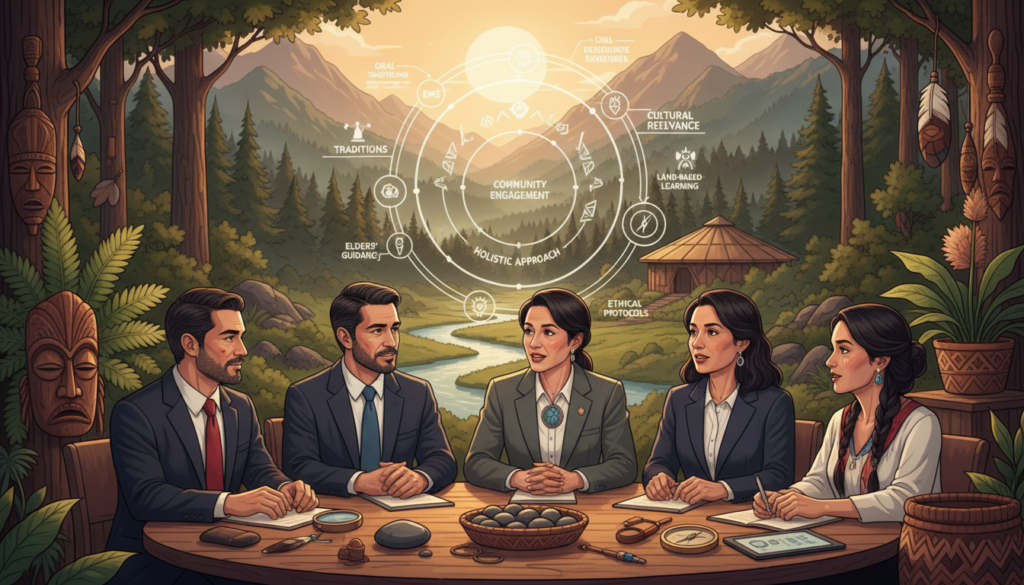
How can scholars honor ancient wisdom while meeting modern academic standards? This question is central to Indigenous Knowledge Systems research topics. It requires both respect and thoroughness.
The IKS Division of the Ministry of Education at AICTE was set up to boost research on Indian Knowledge Systems. Their goal is to teach scholars the Indian way to the world. This method aims for sustainable growth and the betterment of all communities.
Choosing a study area is different from traditional academic ways. It’s about finding a balance between preserving culture and making scholarly contributions. Researchers must respect community knowledge while upholding academic standards.
This guide helps you through the complex process of picking and refining traditional knowledge studies. It involves your interests, community needs, and ethical considerations. Success comes from linking traditional practices with today’s challenges while valuing indigenous wisdom.
Key Takeaways
- IKS research methodology requires balancing ancient wisdom with modern academic rigor and cultural sensitivity.
- The AICTE IKS Division promotes interdisciplinary approaches to Indian Knowledge Systems for sustainable development.
- Successful topic selection involves considering personal interests, community needs, and available resources simultaneously.
- Researchers must honor community knowledge holders while meeting institutional and academic requirements.
- Ethical implications play a central role in traditional knowledge studies and scholarly contribution.
- The process bridges cultural preservation with practical innovation for contemporary application.
Understanding Indigenous Knowledge Systems (IKS)
Indian Knowledge Systems go beyond just books. They are a way of passing down wisdom from one generation to the next. Before starting research, it’s important to understand what these systems mean in Indian culture today. This knowledge helps find areas where traditional knowledge can help both in studies and real-life applications.
Looking into Indigenous Knowledge Systems means exploring their history, philosophy, and how they show up today. Researchers who get this can pick topics that respect tradition while tackling today’s problems.
What Defines and Encompasses IKS
Indian Knowledge Systems involve passing down knowledge from one generation to the next. They are based on ancient texts like the Vedas and Upanishads. This way of learning is different from just cultural practices because it involves structured learning and tested methods.
The core of IKS includes three main parts. Jnan (Knowledge) deals with gathering and organizing information through experience. Vignan (Science) focuses on testing hypotheses and analyzing. Jeevan Darshan (Philosophy of life) combines ethics and understanding of life into daily living.
These parts work together to give a complete view of reality. They mix scientific investigation with deep thinking.
The IKS scope and significance become clear when we see how wide it covers. Traditional knowledge touches many areas that shape Indian culture and thinking. Knowing this helps researchers find where their skills match unexplored fields.
The main areas in IKS include:
- Astronomy: Ancient star mapping, calendar systems, and celestial calculations that guided agricultural cycles and religious observances
- Ayurveda: Holistic medical systems addressing physical, mental, and spiritual dimensions of health through natural remedies and lifestyle practices
- Mathematics: Innovations including the decimal system, concept of zero, algebraic principles, and geometric applications in architecture
- Linguistics: Sanskrit grammar frameworks, phonetic sciences, and semantic analysis that influenced linguistic theory globally
- Philosophy: Epistemological systems, logic traditions, and ethical frameworks addressing consciousness, reality, and human purpose
- Public Administration: Governance models, economic theories, and social organization principles documented in texts like Arthashastra
- Technology and Management: Metallurgical techniques, construction methodologies, water management systems, and agricultural innovations
Each area shows centuries of learning and improvement. These fields were not just for study but to solve real problems. The knowledge was tested and refined over time, balancing theory with practical use.
The scope goes beyond formal subjects to everyday practices. Things like making textiles, cooking with medicinal plants, managing the environment, and solving conflicts show IKS in action. This offers many ways for researchers to dive in, from detailed studies to broad explorations.
Why IKS Matters in Today’s Research Landscape
IKS is key today because it offers solutions to big problems like environmental damage, health crises, and social issues. By linking ancient wisdom with modern challenges, researchers can find new ways to solve problems.
Environmental sustainability is a big area where traditional knowledge is valuable. Indigenous farming methods save water, protect soil, and keep biodiversity, unlike industrial farming. Traditional buildings use natural cooling and materials, reducing harm to the environment.
Researchers today can learn from these practices. They offer tested solutions, not just new ideas that need years of testing.
In healthcare, IKS scope and significance are clear. Ayurveda offers ways to manage mental health, chronic diseases, and prevent illness through lifestyle changes and natural treatments. As modern medicine faces limits, combining Ayurveda with modern science is becoming more accepted.
Studies that link traditional treatments with modern science are important. They need researchers who know both worlds, making it a great field for those with diverse skills.
Keeping Indigenous Knowledge Systems alive is not just for learning. It’s a way to connect old wisdom with new ideas.
IKS also offers social and governance models. These focus on the community, fairness, and solving conflicts. They offer alternatives to just focusing on money. Researching these models helps with discussions on fair economics, justice, and democracy.
Preserving IKS is also about keeping cultural heritage alive. It connects us to our ancestors while staying relevant today. Research helps document and pass on this knowledge to future generations.
For researchers, working with IKS means doing something meaningful. It helps communities, keeps culture alive, and tackles global problems. This makes IKS a great field for those who want to make a difference through their work.
Understanding IKS and its importance today helps researchers choose topics that are both meaningful and useful. This knowledge turns picking topics into a strategic move, connecting with big conversations on sustainability, innovation, and keeping culture alive.
Identifying Your Research Interests
Finding research interests in Indigenous Knowledge Systems is a thoughtful process. It balances personal passion, academic training, and community needs. This journey is key to a deep connection with traditional wisdom, laying the groundwork for years of research.
The IKS Division encourages studies that help understand or solve today’s problems. Joint, interdisciplinary projects are given special preference. These collaborations strengthen research and respect indigenous knowledge traditions.
Reflecting on Personal Experiences
Personal experiences often spark curiosity about indigenous wisdom. Researchers should look at their cultural background and early experiences. These reflections help find authentic connections for Indigenous studies research.
Childhood memories can guide research directions. For example, a grandmother’s herbal remedies might inspire studies on traditional medicine. Fascination with architectural features could lead to research on indigenous engineering.
Regional customs and farming practices show indigenous wisdom. Observing farmers use traditional lunar calendars for planting raises questions about their astronomical knowledge.
Family stories and community tales preserve knowledge passed down through generations. Recording these stories is valuable and respects knowledge holders. This keeps research connected to real experiences, not just theory.
Exploring Academic Backgrounds
Academic training brings specialized skills that can enhance IKS research. Researchers should look at their education to find how it can help. This mix of skills and knowledge leads to new scholarly contributions.
Chemists can study natural dyes in traditional textiles. Mathematicians might explore ancient astronomical calculations. Engineers can examine indigenous water systems or irrigation technologies.
Linguists help document endangered languages that hold ecological knowledge. Anthropologists and sociologists study social structures that pass on knowledge. Each field offers tools to deeply examine traditional wisdom.
Recognizing how disciplines intersect is key to identifying research interests. Interdisciplinary approaches make research stronger by tackling complex questions. This blend of modern training and traditional knowledge fosters innovation.
Engaging with Community Perspectives
Talking directly with knowledge holders makes research relevant to communities. Traditional practitioners, local communities, and cultural organizations offer valuable insights. These interactions show the challenges facing indigenous knowledge today.
Community conversations highlight research needs. Elders might worry about youth losing interest in traditional crafts. Cultural organizations may need help documenting disappearing rituals.
Building relationships with communities ensures research benefits them. This approach respects indigenous communities as active partners, not just subjects. It makes research meaningful beyond academic circles.
Researchers should participate in cultural festivals and visit rural communities. Volunteering with heritage preservation groups is also beneficial. These experiences deepen understanding of the urgent need to document and preserve indigenous wisdom.
The right approach to selecting IKS dissertation topics involves personal experiences, academic skills, and community insights. This three-dimensional approach ensures research is meaningful and addresses real knowledge gaps. Scholars emerge with clear research directions, connected to indigenous knowledge traditions.
Analyzing Current Trends in IKS Research
Researchers working on IKS thesis topics face a field where old wisdom meets new science. The field of Indigenous Knowledge Systems research has grown a lot in recent years. It now includes areas like computer tech and green farming. Knowing what’s new in IKS research helps pick topics that really add to the field.
Looking at what’s already been studied shows what’s important now. It helps researchers find their place in ongoing talks. By seeing what’s been done, they can find new ways to contribute.
The IKS Division is really investing in mixing old knowledge with new tech. In 2022-2023, they supported 34 projects in nine areas. These projects show how IKS research is getting more diverse, from tech for Ayurvedic health to ancient building secrets.
Reviewing Recent Publications
Starting a literature review on IKS means finding the latest research. It’s important to look at many sources. This way, researchers get a full view of what’s being studied.
Specialized journals are key for IKS research. They publish the latest studies. These journals mix old texts with new science, showing how traditional wisdom is being checked and used today.
Interdisciplinary journals also show how IKS fits with science. They mix studies on ancient alloys, farming, and health. This shows how old wisdom is being used in new ways.
Conference papers give early looks at new research. They show what’s coming and who’s working together. Researchers can learn about new topics and find partners.
Mixing old knowledge with new tech is not just keeping things alive. It’s making new ways to solve today’s problems with ancient wisdom.
Government reports on IKS projects show what’s being funded. In 2022-2023, 34 projects were supported. Projects like using tech for Ayurvedic health show how old wisdom meets new tech. Studies on ancient building secrets mix materials science with history.
International studies on IKS offer a global view. They compare different cultures’ knowledge. This helps IKS research in India by showing new ways to study and connect ideas.
Identifying Gaps in the Literature
Finding gaps in research is key. It helps avoid repeating what’s already been done. It’s about looking at what’s missing in studies.
Geographical gaps offer chances for new research. Places like northeastern India and coastal areas need more study. So do tribal communities in central India.
Demographic gaps show who’s been left out of research. Women’s knowledge, artisan skills, and oral traditions need more attention. Looking at these gaps helps make IKS research more complete and fair.
| Thematic Area | Recent Research Focus | Identified Gaps | Potential Applications |
|---|---|---|---|
| Health and Wellness | Ayurvedic diagnostics with computer vision, traditional medicinal plant compounds | Mental health approaches in traditional systems, women’s reproductive health knowledge | Integrative healthcare models, preventive medicine protocols |
| Sustainable Agriculture | Traditional farming practices, indigenous seed conservation | Climate adaptation strategies, urban agriculture applications of traditional methods | Food security solutions, drought-resistant cultivation techniques |
| Water Resources Management | Ancient irrigation systems, traditional water harvesting | Contemporary water scarcity solutions, groundwater recharge traditional methods | Urban water management, community-based conservation |
| Metallurgy and Material Science | Temple construction alloys, ancient waterproofing technologies | Corrosion resistance mechanisms, sustainable material production methods | Modern construction materials, eco-friendly manufacturing processes |
Methodological gaps offer chances to try new ways of doing research. Using digital tools for old texts, doing research with communities, and mixing IKS with science are all new paths. These innovations can lead to better research that’s both culturally sensitive and scientifically strong.
Temporal gaps show periods that need more study. While ancient texts get a lot of attention, the medieval and colonial periods are often overlooked. The changes in traditional practices after independence also offer rich areas for research.
Application gaps show where old knowledge can solve today’s problems. Using traditional knowledge for climate change, sustainable building, and community management are all areas that need more study. These studies show how IKS is relevant today.
By finding these gaps through careful study, researchers can make big contributions to IKS research. The right mix of personal interests, what’s needed in research, and what’s missing creates the best topics. These topics can help us understand more and solve real-world problems with Indigenous wisdom.
The Role of Cultural Relevance in IKS
Understanding cultural relevance in IKS means changing how schools and knowledge communities work together. It’s about making sure cultural authenticity is at the heart of all research. This makes indigenous studies very different from regular academic work.
Traditional knowledge lives in communities, not just in old texts or museums. It’s passed down through practice, stories, and community ties that have lasted for ages. Researchers need to see this difference clearly.
The IKS Division says research must involve experts from traditional knowledge. At least one team member must be able to read primary texts in their original languages without translations. This ensures research is done right and avoids misunderstandings.
Community Participation as a Foundation
IKS changes how researchers and communities work together. Communities are not just sources of information but knowledge authorities that guide research. This is a big change from old academic ways.
Good community involvement needs a few key things. Researchers should talk to knowledge holders to make sure research meets community needs. This step checks if the research is important to the community.
Working together means community members are part of the research team. They help with everything from collecting data to sharing findings. This way, research gets the community’s perspective, which outsiders can’t provide.
Research should help communities in real ways. This could be through documenting knowledge, making educational materials, or solving current problems. The goal is to give back to the community.
Respecting community rules is also key. Different groups have their own rules about sharing knowledge. Researchers must learn and follow these rules, knowing some knowledge is not for outsiders.
Getting consent is more than just a form. Communities need to understand what research is about and how it might help or affect them. They should be able to talk about their concerns and stop participating if needed.
Navigating Research Ethics
Doing IKS research right means dealing with big ethical issues. Traditional knowledge systems don’t always fit into Western ideas of ownership. Researchers must make sure knowledge is used properly and fairly.
It’s also important to avoid making sacred practices into products. Some knowledge is meant for specific cultural uses, not for everyone. Researchers must know what’s okay to share and what’s not.
Keeping secrets is critical when sharing sensitive information. This could be about sacred places, medicine, or cultural rules. Protecting this information is a big part of research ethics.
Researchers must show traditional knowledge in a fair and balanced way. It’s not about making it seem perfect or dismissing it. It’s about understanding it deeply and respectfully.
Deciding what to publish can be tricky. Universities want research to be shared, but communities might not want that. Ethical researchers will listen to communities and might change their plans to respect their wishes.
Doing IKS research right means being open, building relationships, and being flexible. Researchers should be humble and recognize that they don’t own traditional knowledge. Being willing to change or stop research based on community feedback shows real respect.
Sometimes, research topics might not be right for outsiders. If communities say no to certain topics, researchers should respect that. This shows respect for community rights and values, not just academic freedom.
Formulating Research Questions
Creating research questions for Indigenous methodology topics is special. It blends traditional knowledge with modern academic standards. This step is key in IKS research design. Good questions guide the investigation, choose methods, and shape the research’s impact.
The IKS Division funds research that could lead to new insights or solutions. Proposals should involve traditional scholars and compare traditional and modern sciences. This mix can lead to groundbreaking discoveries.
Defining Quality Criteria for IKS Inquiry
Good research questions in indigenous knowledge have unique traits. They need to be specific yet broad. This balance is key because indigenous knowledge systems are interconnected.
Questions should tackle big gaps in understanding or practice. They should reveal new insights. They should also address problems that matter to both academics and communities.
Answerability through accessible methodologies is also important. Questions must be answerable with the resources and time available. A great question that can’t be answered is not useful.
Exceptional IKS research combines traditional and modern approaches. It respects indigenous ways of thinking while using modern tools. Questions should not force indigenous concepts into Western categories.
Here are examples of good questions: “How can traditional Panchagavya formulations be validated as bio-immunizers for sustainable agriculture using contemporary microbiological analysis?” This question links ancient wisdom with modern science. Another example: “What design principles from Vastu Shastra can be integrated with modern architectural engineering to create healthy indoor environments?” Both questions respect tradition while seeking modern applications.
IKS is all about connections. Ayurvedic medicine, for example, is tied to philosophy and ethics. Questions that ignore these connections miss the point of indigenous knowledge.
Systematic Approaches to Question Development
Creating research questions for Indigenous topics needs a systematic approach. Start with a broad question and narrow it down. For example, “Why did ancient Indian metallurgists produce rust-resistant iron?” Then, “What specific techniques did they use, and can we apply them today?”
Using primary texts helps frame questions in a traditional way. These texts often reveal assumptions and knowledge structures. They can inspire modern research questions that stay true to indigenous epistemologies.
Getting input from communities is vital. They know which traditional practices need attention. Their questions can guide research that meets real needs.
Looking at funded research shows what works. Analyzing approved proposals helps understand how to balance innovation with feasibility. This approach increases the chance of getting funding.
Refining questions through feedback is essential. Talking with advisors, scholars, and community members improves questions. Cultural authenticity, academic rigor, and practical relevance all benefit from this process.
| Question Characteristic | Effective Approach | Ineffective Approach | Impact on Research |
|---|---|---|---|
| Scope Definition | Specific focus within holistic context | Either too narrow or excessively broad | Determines investigation manageability and depth |
| Cultural Framework | Respects indigenous epistemologies | Forces Western theoretical categories | Affects authenticity and community acceptance |
| Practical Relevance | Addresses real community needs | Pursues purely abstract theorization | Influences funding and social impact |
| Integration Method | Bridges traditional and modern approaches | Treats traditions as museum artifacts | Shapes contribution to contemporary knowledge |
| Answerability | Aligned with available resources and methods | Requires inaccessible sources or impossible timelines | Determines project completion probability |
Creating effective research questions takes time and revisions. Your first try is rarely perfect. Through systematic techniques and dialogue with stakeholders, questions evolve. They drive meaningful investigation, respect culture, and advance understanding for scholarship and communities.
Methodologies Suitable for IKS Research
Research in Indigenous Knowledge Systems needs methods that respect traditional ways of knowing. These methods should also be rigorous. Unlike regular research, indigenous research methodologies must come from understanding how traditional knowledge is made and shared.
Good IKS research uses a mix of old and new ideas. The IKS Division supports research that helps solve today’s problems. This focus shapes how researchers choose their methods, aiming for both deep understanding and practical results.
Indigenous knowledge is part of a bigger worldview. It connects spiritual, material, and social parts. So, research methods should accept many kinds of evidence, including stories and spiritual insights.
Balancing Qualitative and Quantitative Methods
In qualitative IKS research, knowing when to use qualitative or quantitative methods is key. Each method has its own role in showing the richness of traditional knowledge.
Qualitative methods are great for showing the full picture of indigenous knowledge. By watching and listening, researchers learn about practices in their cultural setting. For example, studying traditional architecture shows how it reflects social organization and seasonal changes.
Interviews with elders help document wisdom passed down through stories. These talks reveal how decisions are made and how to interpret signs. For instance, learning about traditional healing involves understanding the healer’s senses and reasoning.
Looking at old texts gives insight into historical knowledge. Researchers study texts on things like metallurgy and agriculture. This shows the deep thinking and knowledge behind traditional practices.
Case studies show how traditional knowledge works in real life. For example, studying traditional water harvesting looks at how it’s built, maintained, and fits into the community. This keeps the context of traditional practices alive.
Quantitative methods add proof that traditional knowledge works today. By testing traditional ways with science, researchers can show their value. For example, testing how well traditional food preservation works.
Comparing traditional and modern ways helps make decisions. Agricultural research might look at how different farming methods affect the land and people. This helps farmers and policymakers make better choices.
Testing materials science helps understand traditional products. By analyzing things like metal alloys, researchers can see how they compare to modern materials. This helps use traditional knowledge in today’s world.
The best IKS research mixes qualitative and quantitative methods. This way, research respects tradition while also being scientific. It gives a full picture of traditional knowledge.
Community Partnership Through Participatory Methods
Participatory action research is perfect for studying Indigenous Knowledge Systems. It changes how researchers and communities work together. It fits with indigenous ways of knowing and doing.
PAR is special because it makes communities equal partners. They help decide what to study and how. This makes sure research meets community needs, not just academic goals.
PAR focuses on making things better for communities. Instead of just studying, it helps solve problems. For example, it might help preserve traditional crafts or find new markets for them.
PAR works in cycles, always getting better. Communities try new things, see how they work, and then change them. This is how traditional knowledge grows and changes.
PAR values all kinds of knowledge, including spiritual and experiential. For example, it might study how farmers use traditional pest control. This shows how well it works and why farmers trust it.
| Methodology Type | Primary Application in IKS | Key Strengths | Research Example |
|---|---|---|---|
| Qualitative Ethnographic | Documenting traditional practices and knowledge systems in cultural context | Captures nuanced understanding, preserves contextual meaning, reveals tacit knowledge | Observational study of traditional healer diagnosis and treatment protocols |
| Quantitative Experimental | Validating traditional formulations and techniques using scientific measurement | Provides empirical evidence, enables comparison, supports contemporary application | Chemical analysis and efficacy testing of traditional herbal medicines |
| Mixed Methods | Integrating cultural understanding with empirical validation | Balances respect for tradition with scientific rigor, provides a full picture | Traditional agriculture study combining ethnography with yield measurements |
| Participatory Action Research | Community-driven research creating practical outcomes | Ensures community benefit, validates experiential knowledge, builds local capacity | Collaborative preservation of traditional craft techniques with market development |
Working together on projects shows how PAR works. For example, researchers and artisans might work together to save endangered crafts. This helps keep traditions alive while also finding new ways to use them.
PAR in agriculture lets farmers test traditional ways against modern ones. They work together to see which works best. This shows the value of traditional knowledge and helps farmers improve their work.
Documenting oral traditions is another way PAR helps. It lets communities keep their stories alive while researchers learn. This helps both the community and the researchers.
Choosing the right method depends on what you want to learn and what the community needs. Researchers should be open to changing their approach as they learn more. The key is to respect traditional knowledge while being scientific.
Assessing the Feasibility of Topics
When you find a great research question in Indigenous Knowledge Systems, it’s important to think about resources and timelines. A research feasibility assessment is key to see if your project can be done. Without a clear plan, even the most interesting topics can become frustrating.
Good IKS project planning looks at many things. You need to think about your skills, interests, and the support you have. This helps avoid starting projects that are too big for what you can do.
Research resources are more than just money. They include people, materials, support, and information. Each area has its own challenges and chances. Knowing this before you start helps avoid problems later.
Available Resources for Your Research
Money is a big part of most research in Indigenous Knowledge Systems. The IKS Division gives out money for projects. They give Rs. 5-10 lakhs for most projects and up to Rs. 20 lakhs for special ones.
It’s important to know what the money can buy. You can use it for salaries, supplies, equipment, travel, and testing. But, Principal Investigator and Co-Principal Investigator salaries are not included.
People are also key to success. Your plan should include:
- Traditional scholars who can read original texts
- Knowledge holders and community members who can share their knowledge
- Research assistants who can help with data and documentation
- Interdisciplinary collaborators from different fields
Material resources are also important. You need access to manuscripts, labs, field sites, and technology. Without these, some topics are not possible.
Informational resources are the last part of the assessment. You need databases, traditional knowledge, and collections. Gaps in these resources can show new opportunities or challenges.
Time Requirements and Project Deadlines
Managing your time is as important as planning your resources. Most IKS funding is for two-year cycles with milestones. You need to finish your project by December 31, 2024, unless you get an extension.
The IKS Division wants progress reports at July 1, 2023, December 31, 2023, and July 1, 2024. These deadlines help you check your progress and solve problems. Your plan should include these milestones.
Breaking your project into phases is key. You need time for proposal, approvals, building trust, data collection, analysis, writing, and revisions. Each phase takes weeks or months, adding up quickly.
Some topics need more time than the usual funding allows. For example, studying seasonal crops or building trust with communities. If your topic needs more time, consider making it part of a bigger project.
Time and resources work together. You might need to do fieldwork in short periods or wait for equipment. Your timeline must fit these needs, not the other way around.
Doing a thorough feasibility assessment before starting is important. It helps you avoid disappointment and makes sure your enthusiasm leads to success. The best IKS researchers balance their dreams with what’s possible.
Aligning with Institutional Goals
Researchers working on Indigenous Knowledge Systems topics need to match their interests with what schools require. This makes sure their topics get the support and funding they need. It also helps their careers and the goals of their schools.
Schools, funding groups, and research centers have their own goals and rules. Knowing these helps researchers pick topics that meet many needs at once. This makes choosing a topic a smart move, not just a personal choice.
Understanding Academic Requirements
Getting to know what schools expect is key for IKS research. Doctoral students must pick topics that are new, important, and well-researched. These topics also need to involve the community and use traditional knowledge in a real way.
Teachers have to choose topics that fit their department’s focus and the school’s goals. Schools value teamwork, getting outside funding, and research that helps people. These are all important for good IKS research.
The IKS Division has clear rules for who can apply for funding. Teachers at recognized schools, both private and public, can apply. So can government labs and NGOs focused on IKS.
Knowing how much money is available is also important. Researchers who got funding before can’t lead new projects, but they can help. This means planning carefully for a career in IKS research.
| Researcher Category | Primary Requirements | Institutional Alignment Factors |
|---|---|---|
| Doctoral Students | Dissertation standards, originality, methodological rigor | University requirements, advisor expertise, community partnerships |
| Faculty Researchers | Publication standards, external funding, interdisciplinary work | Departmental priorities, promotion criteria, institutional mission |
| IKS Center Researchers | Traditional knowledge preservation, practical applications | Center objectives, community engagement, knowledge dissemination |
| NGO/Trust Researchers | Community impact, traditional scholar involvement | Organizational mission, stakeholder expectations, sustainability |
Each type of researcher faces unique challenges in IKS research. They must meet academic standards while keeping their research true to IKS values.
Collaborating with Advisors and Faculty
Working closely with advisors is key to picking and doing research well. Advisors with IKS experience help blend traditional knowledge with academic rigor. They guide researchers through the mix of old wisdom and new scholarship.
Starting early with advisors helps avoid mistakes in topic choice. Advisors connect researchers with experts and communities, which is vital for IKS research success.
The power of Indigenous Knowledge Systems research comes from teamwork. It honors both traditional and academic ways of knowing.
Research teams are more than just advisors. They include experts from different fields. For example, an Ayurveda topic benefits from a traditional healer, a biochemist, a clinical researcher, and an anthropologist. Each brings their own skills, making the research richer and more authentic.
The IKS Division’s rules highlight the need for smart teamwork. A researcher can only lead three proposals at a time. This focus leads to better research, not scattered efforts.
Team members do more than just bring their expertise. They help with planning, ethics, and navigating school rules. They also help find funding, publish research, and connect with communities. This is hard for one person to do alone.
Start talking to advisors early and keep it up throughout your research. Regular talks help keep your research on track with school goals and community needs. This makes advisors true partners in your research.
Building strong teams takes effort and respect. Researchers should come with ideas, questions, and a willingness to learn. They should be dedicated to IKS values and open to feedback that makes their research better.
When research fits with school goals and teamwork, it’s more likely to succeed. Topics chosen this way are more likely to get done, published, and help both knowledge and communities.
Engaging with Stakeholders
Meaningful stakeholder engagement in IKS changes how we do research. It moves from just taking information to working together. This ensures that community voices guide our studies. The success of Indigenous Knowledge Systems research depends on good relationships with diverse stakeholders.
These relationships go beyond just talking to experts. They involve ethical partnerships based on respect, shared decisions, and fair benefits.
Stakeholder engagement sees indigenous knowledge as part of living communities, not just old information. Traditional knowledge holders are always connected to their practices and texts. So, research in IKS needs to see community members as co-investigators and knowledge authorities, not just sources of information.
Research teams should have someone who can read primary texts without translation. This shows respect for knowledge traditions. Also, proposals should include many experts to enrich the research and honor indigenous knowledge’s complexity.
Mapping Knowledge Authorities and Community Representatives
Finding key community stakeholders is the first step in building partnerships. The stakeholder landscape in IKS research includes many individuals and groups. Their help is key for ethical and effective research. Primary knowledge holders are people like Ayurvedic vaidyas, indigenous farmers, and traditional metallurgists.
Spiritual leaders and temple authorities are also important. They keep ritual knowledge and oversee sacred texts. Their input is vital when research touches on ceremonial practices or sacred sites.
Community elders are also key. They guide the research with their wisdom and experience. Knowledge authority in indigenous contexts follows cultural protocols that researchers must respect.
Institutional stakeholders are also part of the network. Traditional learning centers, museums, and archives hold important information. Government cultural departments manage heritage sites and policies affecting traditional knowledge.
The following framework maps stakeholder categories alongside their primary roles and appropriate engagement approaches:
| Stakeholder Category | Representative Examples | Knowledge Contribution | Engagement Strategy |
|---|---|---|---|
| Traditional Practitioners | Ayurvedic vaidyas, indigenous farmers, master artisans, traditional metallurgists | Living practice knowledge, technique transmission, therapeutic expertise | Knowledge holder consultation through apprenticeship observation, demonstration sessions, collaborative documentation |
| Spiritual Authorities | Temple priests, monastery heads, ritual specialists, custodians of sacred texts | Ritual protocols, textual interpretation, sacred site management, ceremonial knowledge | Respectful dialogue honoring religious boundaries, permission protocols, collaborative textual study |
| Community Organizations | Cultural trusts, local NGOs, gram panchayats, tribal councils | Community perspectives, collective decision-making, heritage preservation priorities | Formal presentations, community meetings, memoranda of understanding, participatory planning |
| Academic Stakeholders | Sanskrit scholars, traditional shastris, interdisciplinary researchers, language experts | Textual authentication, linguistic expertise, methodological guidance, theoretical frameworks | Collaborative research design, joint publication, peer consultation, interdisciplinary team formation |
Establishing Collaborative Frameworks for Knowledge Co-Creation
Building partnerships for research changes how we work together. It starts with explaining research purposes in clear language. This builds trust and lets stakeholders decide if they want to participate.
Listening to community views helps make research more relevant and ethical. Researchers should be open to changing their plans based on what the community says. This way, research can grow and improve as partnerships deepen.
Writing agreements formalizes partnerships. They outline roles, decision-making, and how benefits will be shared. This protects traditional knowledge and ensures it’s used fairly.
Indigenous knowledge is not just data to collect. It’s living wisdom in relationships, practices, and communities. It deserves to be recognized as a key part of research.
Keeping stakeholders informed is key to ongoing collaboration. Being open about challenges and changes builds trust. It also helps solve problems together, not just by researchers.
Being willing to change plans based on feedback shows true commitment to working together. When community partners have concerns, researchers should listen and act on them. This shows respect for their knowledge and traditions.
Sharing research results with communities is important. Academic papers are not enough. Community reports, presentations, and educational materials help ensure research benefits everyone involved.
Recognizing contributions properly is important. It goes beyond just citing sources. Traditional practitioners, elders, and community organizations deserve recognition for their knowledge and work.
Supporting community priorities shows respect and strengthens partnerships. Helping with documentation, education, or advocacy efforts is a way to give back. This makes research a win-win for both academics and communities.
Strong partnerships redefine research. They create a process where indigenous wisdom and academic inquiry grow together. This approach honors the living nature of Indigenous Knowledge Systems and produces scholarship that truly understands.
Evaluating Your Topic’s Significance
Deciding if a research topic is worth exploring involves checking if it can improve Indigenous Knowledge Systems. It also needs to tackle important national and global issues. Scholars must carefully think if their research is worth the time, money, and effort it takes.
The IKS Division aims to train scholars who will share the ‘Indian way’ with the world. They focus on sustainable development and the well-being of all. This mission helps understand what makes research significant in this field.
The National Education Policy 2020 sees traditional knowledge as a treasure that needs to be promoted and preserved. This policy shows that important IKS research must help preserve this knowledge and make it useful today.
Determining Research Value Through IKS Contribution
Assessing IKS contribution starts with asking if the research answers important questions about indigenous knowledge. Does it explain how ancient astronomers made accurate calculations without modern tools? Does it show why traditional medicine works when modern medicine doesn’t?
Another key factor is preservation value. Research is significant if it documents knowledge that might disappear with the passing of time or the decline of traditional practices. Topics that record traditional techniques, wisdom, or practices before they disappear are very important.
Using modern methods to validate traditional knowledge is also a big contribution. For example, using science to show why traditional practices work. This connects indigenous and modern knowledge systems in a useful way.
Innovation happens when research uses traditional knowledge to solve today’s problems. Ask yourself these questions:
- Does your research adapt traditional water harvesting for cities with water problems?
- Can your study show how Ayurveda helps with mental health issues that modern medicine can’t solve?
- Does your topic use Vastu principles in green architecture to reduce environmental harm?
- Will your research uncover lost techniques or challenge negative views of indigenous knowledge?
Turning traditional knowledge into practical solutions is very significant. Research that does this is more valuable than studies that just describe or record history.
Connecting Research to Broader Priorities
Aligning research with national priorities can make it more impactful and increase funding chances. The IKS Division has identified nine key areas where research can make a big difference: sustainable agriculture, water management, health, political and economic thought, and using traditional approaches to solve today’s problems.
Research on traditional ecological knowledge for the environment, indigenous farming for climate change, or managing resources for biodiversity is very important. It addresses global issues and fits into international talks on climate change.
Topics on traditional health systems, consciousness studies, and wellness are also interesting worldwide. They contribute to discussions on complementary medicine and mental health, affecting healthcare policies and practices.
Indigenous governance models, economic thought, and social organization offer new ways to solve problems. Research on these topics is significant because it offers solutions to current governance issues.
The goal of making India a Vishwaguru—world teacher—means research that shows Indian intellectual contributions to various fields. Topics that recover, validate, or expand our understanding of these contributions are important for India’s culture and global knowledge.
| Significance Criterion | Evaluation Question | Impact Level |
|---|---|---|
| Fundamental Understanding | Does research answer core questions about how traditional knowledge functions? | High scholarly impact |
| Preservation Value | Does research document endangered knowledge at risk of disappearing? | High cultural impact |
| Contemporary Application | Does research adapt traditional knowledge to solve current challenges? | High practical impact |
| Policy Alignment | Does research address national priorities or global sustainability goals? | High funding opportunity |
Research significance depends on whether it advances understanding, preserves knowledge, validates effectiveness, or solves problems in Indigenous Knowledge Systems. Topics that meet several criteria have the most value.
Honest evaluation of research significance helps avoid wasting years on projects with little impact. By carefully assessing contribution and alignment with big priorities, researchers can make a difference in policy, practice, and cultural preservation that benefits communities and society.
Reviewing Ethical Implications
Researchers working with indigenous knowledge systems face unique ethical challenges. They must balance knowledge advancement with community protection and cultural preservation. IKS research ethics is key to this balance.
Before starting any research, it’s important to understand the ethical aspects. Studies show that integrating IKS into education is tough. 96% of respondents said getting enough resources is a big problem. Also, 85% said teaching in a way that everyone can understand is hard.
This highlights the need for strong ethical guidelines. Efforts to preserve India’s knowledge systems must also focus on ethical research practices and inclusive education.
Navigating Intellectual Property Rights
Traditional knowledge is seen as community property, not individual creation. This is different from Western copyright laws. It makes it hard to protect knowledge without proper permission.
Indigenous communities pass down knowledge through oral traditions and cultural practices. This knowledge is not like patents or copyrights. It belongs to the community, not an individual. This means we need different ways to protect it.
India has laws to help protect traditional knowledge. The Biological Diversity Act stops unauthorized use of knowledge related to biological resources. The Traditional Knowledge Digital Library helps prevent misuse by documenting indigenous knowledge.
International rules also play a role. The Nagoya Protocol sets rules for using traditional knowledge. These rules help ensure fair access and sharing of benefits. But, ethical research practices go beyond just following the law.
It’s important to have clear agreements with communities. These agreements should cover important areas like who owns the knowledge and how benefits will be shared. They should also ensure communities have access to research findings.
Communities might choose not to share certain knowledge. Respecting these decisions shows a true commitment to IKS research ethics. Some knowledge, like sacred practices, may not be shared with outsiders.
It’s important to give credit to the knowledge holders. Researchers should not claim to have discovered knowledge that communities have kept for centuries. Academic papers should be available to the communities that contributed the knowledge.
Ensuring Cultural Sensitivity
Working with indigenous knowledge systems requires cultural sensitivity. Traditional knowledge is part of a specific culture with its own rules and values. Researchers must learn and respect these cultural frameworks.
Cultural protocols dictate when and how knowledge is shared. Some communities only share knowledge during certain times or seasons. Others have knowledge that is specific to men or women. Rituals may need to be followed before sharing knowledge.
It’s important to understand the context of knowledge sharing. Communities decide who can learn what knowledge and in what setting. Researchers can’t assume they have access just because they have a title or credentials.
Sacred knowledge is a special challenge. Many communities consider certain information off-limits for academic study. Researchers must respect these boundaries and not pursue topics that communities don’t want to share.
Research should not lead to cultural appropriation or the commercialization of sacred practices. Studies on traditional healing practices might be misused. Researchers must think about how their work could be used inappropriately.
There are two common mistakes in representing indigenous communities. Romanticizing them as frozen in time ignores their modern adaptations. Dismissive skepticism undermines non-Western knowledge systems. Both approaches are unethical and disrespectful.
There is a power imbalance between researchers and indigenous communities. Researchers have more power due to their institutions and resources. This can pressure communities into participating. It’s important to ensure communities feel free to say no without facing consequences.
| Ethical Dimension | Key Considerations | Researcher Responsibilities | Community Rights |
|---|---|---|---|
| Intellectual Property | Collective ownership, legal frameworks, benefit-sharing | Establish clear agreements, acknowledge sources, ensure access | Control over knowledge use, commercial benefits, publication approval |
| Cultural Protocols | Timing restrictions, gender domains, ritual requirements | Learn and honor protocols, respect sacred knowledge boundaries | Determine access conditions, maintain cultural integrity |
| Knowledge Representation | Accuracy, context, avoiding exploitation | Balanced portrayal, prevent misuse, acknowledge living traditions | Review research outputs, correct misrepresentations |
| Power Dynamics | Institutional authority, resource inequality, genuine consent | Ensure voluntary participation, share decision-making authority | Refuse participation, withdraw consent, guide research direction |
The ethics of IKS research ethics are important throughout the research process. Researchers must always think about their responsibilities to communities. These responsibilities are more important than career goals or institutional requirements.
Building trust with indigenous communities takes time and commitment. Researchers who only want to take data from communities are unethical. True partnerships involve ongoing work where communities benefit from research.
Addressing challenges like resource allocation is key. Research budgets should include money for community involvement and knowledge holder compensation. It’s also important to present research in languages that communities understand.
Research can help revitalize cultures when done ethically. Researchers act as bridges between traditional knowledge and modern uses. This role requires humility, respect, and a strong commitment to community interests. Indigenous knowledge systems deserve the highest ethical standards in research.
Finalizing Your Research Topic
After doing initial research, researchers must write a detailed proposal. This proposal shows why the research is important, how it can be done, and if it’s ethical. It’s the final step where ideas become clear plans.
Writing a research proposal for Indigenous Knowledge Systems needs to follow certain rules. It must be both academic and respectful of cultures. The proposal should clearly explain how the research will be done and when it will be finished.
Crafting a Complete Proposal Document
The IKS Division has strict rules for proposals. Proposals that don’t follow these rules are rejected right away, no matter how good they are. It’s as important to know these rules as it is to have good research questions.
Each proposal has five parts, all under 10MB. These parts show a complete picture of the research and the team doing it.

The cover page starts the proposal with important information. It has a short title, who is leading the research, where they work, how much money they need, and how long the project will last.
The main part of the proposal, called the narrative, is very short. It can’t be more than ten pages. This means everything must be clear and focused.
The proposal must explain why the research is important and what it will add to what we already know. It also needs to show that the researcher knows the current research well and knows what’s missing.
The research questions or hypotheses must be clear and precise. They guide the whole research and decide how it will be done. The section on how the research will be done must explain how the data will be collected, analyzed, and kept ethical.
It’s important to explain who is on the research team and how traditional scholars are involved. This shows respect for Indigenous knowledge and ensures the research is done right.
The proposal must say what new things the research will find out and how it will help us understand Indigenous Knowledge better. It should also have a timeline for the two-year project.
The budget page lists all the costs, making sure they fit within the allowed amounts. This determines how big the project can be.
| Project Type | Funding Range | Allowable Categories |
|---|---|---|
| Standard Projects | Rs. 5-10 lakhs | Personnel salaries, supplies (under ₹10,000/item), equipment (over ₹10,000), travel, analysis charges |
| Experimental Work | Up to Rs. 20 lakhs | Same categories with expanded equipment and specialized analysis allowances |
| All Projects | Variable | Clear justification required for major expenses exceeding ₹50,000 |
CVs for the main researchers show their skills and experience. They need to have done research before and know about Indigenous communities. Just having degrees isn’t enough.
The last part of the proposal is the signature page. It shows that the institution supports the project. Without this, even great ideas won’t get funded.
There are strict rules for how the proposal should look. It must have one-inch margins, single spacing, and at least 11-point font. These rules help reviewers compare proposals easily.
The deadline for submitting proposals is October 30. Winners are announced in November. They can start their projects in December. This means researchers need to start working on their proposals early.
Engaging Collaborators for Critical Review
Getting feedback from others makes writing a proposal better. It helps make the research stronger and more respectful. Different opinions can point out things that one person might miss.
Sharing drafts with advisors helps improve the research questions, how it will be done, and the ideas behind it. Advisors know what makes a good proposal and can help make it better.
Showing proposals to peers, including those who know about IKS research, can give useful feedback. They can help make the proposal clearer, suggest more literature, and improve the methods. This feedback is like what the proposal will get after it’s submitted.
Getting feedback from traditional scholars and community partners is very important. They check if the research is done in a way that respects Indigenous knowledge. Their input is key for doing research that is both ethical and accepted by the community.
Getting advice from people who know about funding can help avoid mistakes. They can spot errors in formatting and budgeting that could lead to rejection. Their knowledge helps make sure the proposal is good enough to be considered.
Start getting feedback early, before the deadline. It takes time to make changes and improve the proposal. At least three rounds of feedback from different people are needed to make it strong.
When the proposal is ready, it shows months of hard work, teamwork, and making changes based on feedback. Researchers who put in this effort are more likely to get funding and make important contributions to Indigenous Knowledge Systems research.
Preparing for the Research Journey
Starting a research project in IKS needs careful planning and realistic goals. Researchers must create detailed plans that meet both academic needs and community engagement goals.
Building Effective Project Timelines
For IKS-funded projects, setting up timelines is key. There are specific reporting dates: July 1, 2023, December 31, 2023, and July 1, 2024. A committee checks on progress by December 2023, and funding for the next year depends on their approval.
Good IKS project management divides tasks into smaller steps for each reporting period. Building relationships with knowledge holders takes time. Also, some studies need data at certain times of the year. Getting ethical approvals and permissions can take longer than expected.
The final report is due by December 31, 2024. It must include a detailed report, a 300-word summary for everyone, and photos of the work.
Addressing Common Obstacles
IKS research faces challenges like getting access to knowledge holders. Building strong relationships and recruiting community liaisons helps. Limited resources mean finding creative solutions through partnerships and planning in phases.
Working with classical texts can be tough due to language barriers. Teams need language experts. Cultural differences need patience, humility, and ongoing talks with community partners. Knowing these challenges helps solve them early and makes research stronger.

