


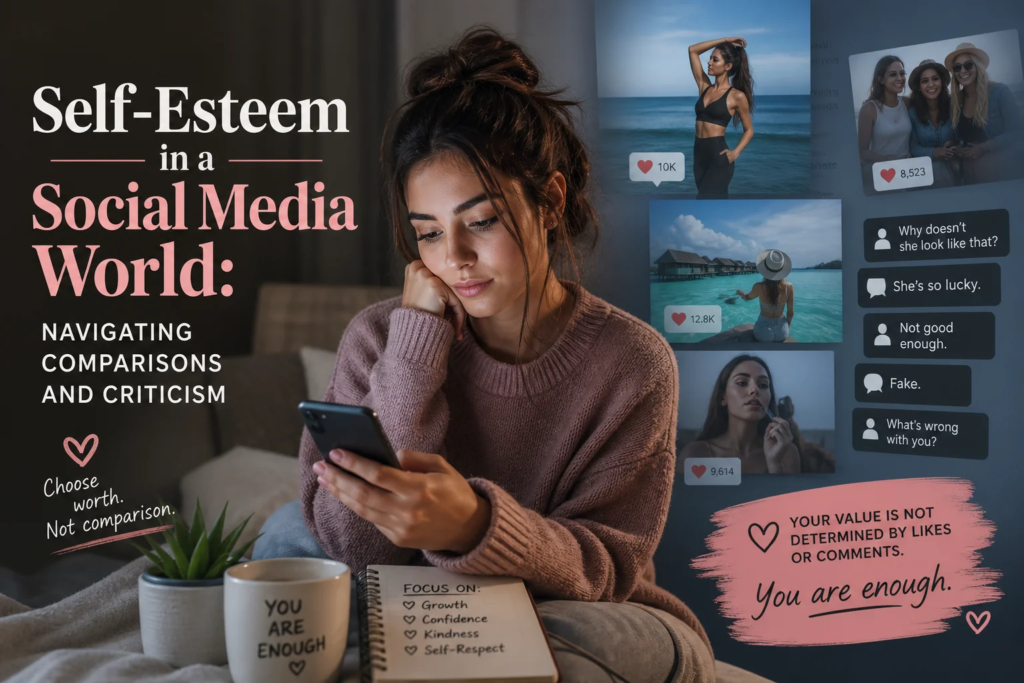
Introduction: When Your Phone Becomes a Mirror
You open an app for “just a minute.” Suddenly, you’re looking at someone’s vacation, someone else’s promotion, a friend’s engagement photos, a creator’s flawless skin, a stranger’s viral opinion, and a comment thread that feels harsher than it needs to be.
Then comes the quiet thought:
Am I behind? Am I attractive enough? Successful enough? Interesting enough?
That is the emotional reality of Self-Esteem in a Social Media World: Navigating Comparisons and Criticism. Social media is no longer just entertainment. It is a stage, a marketplace, a newsfeed, a memory archive, a networking tool, and, for many people, a daily scoreboard of worth.
The problem is not simply that social media exists. The problem is that it constantly invites us to compare our private lives to other people’s public highlights. It exposes us to praise and rejection in real time. It can make approval feel measurable through likes, shares, comments, views, and follower counts.
But here is the good news: your self-worth does not have to rise and fall with an algorithm.
This in-depth guide explores Self-Esteem in a Social Media World: Navigating Comparisons and Criticism with practical strategies, real-world case studies, and tools you can use immediately. Whether you are a student, professional, parent, creator, entrepreneur, or everyday user trying to feel more grounded online, this article will help you build healthier digital habits and stronger emotional resilience.
Understanding Self-Esteem in a Social Media World
Self-esteem is the way you evaluate and relate to yourself. It includes your sense of worth, competence, belonging, and personal value. Healthy self-esteem does not mean thinking you are perfect. It means believing you are worthy even when you are learning, struggling, aging, changing, or receiving criticism.
In the past, self-esteem was shaped mostly by family, peers, school, work, community, and personal experiences. Today, social media adds another powerful layer. You may receive feedback from hundreds or thousands of people, many of whom do not truly know you. That feedback can feel immediate and intense.
This is why self-esteem in a social media world requires new emotional skills. We are not just managing face-to-face relationships anymore. We are managing visibility, comparison, online criticism, digital performance, and constant exposure to idealized images.
The Social Media Self-Esteem Loop
Many people get caught in a cycle like this:
| Step | What Happens | Emotional Effect |
|---|---|---|
| 1. You scroll | You see curated images, achievements, lifestyles, opinions | Comparison begins |
| 2. You evaluate yourself | “Why don’t I look like that?” “Why am I not there yet?” | Insecurity increases |
| 3. You post something | You hope for validation or connection | Anticipation builds |
| 4. You check engagement | Likes, views, and comments become emotional signals | Mood shifts up or down |
| 5. You adjust behavior | You post, edit, hide, or perform differently | Authenticity may decrease |
| 6. You scroll again | The cycle repeats | Self-worth becomes unstable |
This loop explains why Self-Esteem in a Social Media World: Navigating Comparisons and Criticism is such an important modern conversation. The more we depend on outside reactions for inner stability, the more vulnerable we become to emotional highs and lows.
Why Social Media Comparisons Feel So Powerful
Comparison is not new. Humans have always compared themselves to others. We compare to understand where we stand, what is possible, and how we fit into a group. Psychologists often refer to this as social comparison.
But social media intensifies comparison in four major ways.
1. You Compare Yourself to Curated Moments
People usually post highlights, not full realities. You see the finished outfit, not the pile of rejected clothes. The business win, not the debt or burnout. The perfect family photo, not the argument in the car before it was taken.
This creates a distorted comparison: your real life versus someone else’s edited life.
2. You Compare Across Too Many Categories
Before social media, you might compare yourself to classmates, coworkers, neighbors, or relatives. Now, you can compare your appearance to models, your career to CEOs, your home to interior designers, your parenting to influencers, and your creativity to full-time professionals.
This makes navigating comparisons on social media mentally exhausting because the comparison pool is endless.
3. You See Success Without Context
A viral post rarely shows the years of practice behind the result. A beautiful body may involve genetics, lighting, posing, editing, surgery, strict routines, or professional photography. A luxury lifestyle may be rented, sponsored, financed, or selectively shown.
Without context, comparison becomes unfair.
4. Algorithms Reward Extremes
Platforms often amplify content that creates strong emotional reactions: beauty, outrage, controversy, aspiration, fear, envy, admiration. That means you may see more extreme examples of success, attractiveness, wealth, or confidence than you would encounter in ordinary life.
This is one reason healthy self-esteem on social media requires digital awareness. The feed is not a neutral window into reality. It is a personalized stream designed to hold attention.
The Hidden Impact of Online Criticism
While comparison quietly erodes confidence, criticism can strike directly. A harsh comment, sarcastic reply, public disagreement, or mocking reaction can feel deeply personal—even if it comes from a stranger.
For people trying to build Self-Esteem in a Social Media World: Navigating Comparisons and Criticism, online criticism is one of the hardest challenges because it can blur the line between feedback and attack.
Why Online Criticism Hurts So Much
Online criticism can feel painful because:
- It may happen publicly.
- It can come suddenly and unexpectedly.
- It may be repeated or shared.
- It may attack identity rather than behavior.
- It can feel permanent because posts and screenshots remain.
- It lacks tone, facial expression, and relational context.
A single negative comment can outweigh dozens of positive ones. This is sometimes called negativity bias: the human brain tends to notice threats more strongly than praise. In an online setting, negativity bias can make criticism feel louder than support.
Not All Criticism Is Equal
One essential skill for navigating criticism online is learning to separate useful feedback from emotional noise.
| Type of Comment | Example | How to Respond |
|---|---|---|
| Constructive feedback | “Your point is interesting, but this source may be outdated.” | Consider it, thank them, revise if needed |
| Difference of opinion | “I see this differently because…” | Engage respectfully or move on |
| Projection | “People like you always…” | Do not absorb someone else’s assumptions |
| Trolling | “You’re stupid.” | Ignore, delete, block, report |
| Personal attack | “You’re ugly/useless/a failure.” | Protect yourself; do not debate your worth |
| Harassment | Repeated insults, threats, targeted abuse | Document, block, report, seek support |
A major part of Self-Esteem in a Social Media World: Navigating Comparisons and Criticism is remembering that criticism may contain information, but it does not define your identity.
Case Study 1: Maya and the “Perfect Life” Trap
Maya, a 24-year-old graduate student, found herself constantly comparing her life to former classmates on Instagram. One friend was traveling through Europe. Another had bought a house. Someone else had launched a business. Maya was working part-time, studying at night, and living with roommates.
Every time she scrolled, she felt like she had failed.
At first, she tried to “catch up” by posting more polished content. She edited photos carefully, shared only productive moments, and avoided posting anything that made her life look ordinary. But the more she performed confidence, the less confident she felt.
Eventually, Maya took a different approach. She muted accounts that triggered shame, followed people in similar life stages, and started using social media for community rather than comparison. She also created a rule: no scrolling before starting her own morning routine.
Analysis: Why Maya’s Story Matters
Maya’s experience shows how self-esteem in a social media world can become tied to timelines. Social media can make us believe everyone else is moving faster, doing better, and living more beautifully. But Maya’s solution was not to delete everything or pretend she did not care. She changed her relationship with the platform.
Her story highlights three lessons:
- Comparison often increases when we lack context.
- Curating your feed is an act of emotional self-respect.
- Self-esteem improves when online habits support real-life values.
Maya’s journey is a practical example of Self-Esteem in a Social Media World: Navigating Comparisons and Criticism because it shows that confidence is not built by winning the comparison game. It is built by stepping out of the game when it stops serving you.
The Difference Between Inspiration and Comparison
Not every impressive post is harmful. Sometimes seeing others succeed can inspire us. A fitness transformation may motivate healthier habits. A career update may remind us of our own goals. A creative project may spark new ideas.
The key question is: How do you feel and behave afterward?
| If It Is Inspiration | If It Is Harmful Comparison |
|---|---|
| You feel motivated | You feel inadequate |
| You think, “That’s possible” | You think, “I’m not enough” |
| You take constructive action | You spiral into self-criticism |
| You respect their journey | You resent their success |
| You stay connected to your values | You chase someone else’s life |
A healthy approach to navigating comparisons and criticism on social media is not about avoiding everyone who is successful or attractive. It is about noticing whether content expands you or diminishes you.
Ask yourself:
- Does this account make me feel informed, encouraged, or connected?
- Do I leave this content feeling worse about my body, career, lifestyle, or personality?
- Am I inspired to take meaningful action, or am I pressured to perform?
- Does this content reflect my values, or does it manipulate my insecurities?
These questions can help protect self-worth in the digital age.
The Role of Likes, Comments, and Metrics in Self-Worth
Likes and comments are designed to be rewarding. They give quick feedback and create a sense of social approval. When people respond positively, it can feel validating. When they do not, it can feel like rejection.
This is one of the central challenges of Self-Esteem in a Social Media World: Navigating Comparisons and Criticism: platforms turn attention into numbers.
The Metric Trap
The metric trap happens when you begin measuring personal value through online engagement.
You may think:
- “This post got fewer likes, so people must not care.”
- “My video did not perform well, so I am not talented.”
- “They did not comment, so they must be ignoring me.”
- “I lost followers, so I did something wrong.”
- “Their post got more attention, so they are better than me.”
Metrics can provide information, especially for businesses and creators. But they are poor measurements of human worth. A post can underperform because of timing, algorithm shifts, audience habits, topic saturation, or random platform behavior.
Your value is not an analytics report.
A Healthier Way to Read Metrics
| Instead of Thinking | Try Thinking |
|---|---|
| “This got fewer likes; I’m embarrassing.” | “This post reached fewer people or did not connect today.” |
| “Nobody cares about me.” | “Engagement is not the same as love or respect.” |
| “I need to post something better so people approve.” | “What do I genuinely want to share?” |
| “I’m failing.” | “I’m learning what resonates.” |
| “Their numbers are higher, so they matter more.” | “Their path is not a measurement of my worth.” |
For anyone working on healthy self-esteem in a social media world, this shift is essential. Metrics can be data, but they should never become identity.
Case Study 2: Jordan, the Creator Facing Public Criticism
Jordan, a 32-year-old fitness creator, built a modest following by sharing workout tips for beginners. Most of his audience appreciated his practical style. But as his content grew, criticism increased.
Some comments were useful: people asked for modifications, corrected terminology, or requested safer form demonstrations. But others were cruel. Strangers mocked his body, questioned his expertise, and accused him of being “fake.”
At first, Jordan tried to respond to everyone. He wrote long explanations, defended his credentials, and replayed negative comments in his mind. Eventually, he felt anxious before posting.
With support from a mentor, Jordan created a comment policy. Constructive feedback stayed. Personal attacks were deleted. Harassment was blocked and reported. He also limited comment checking to two scheduled times per day.
Analysis: Why Jordan’s Story Matters
Jordan’s case shows that navigating criticism online requires boundaries. Visibility often invites feedback, but not all feedback deserves access to your attention.
His strategy worked because he separated three things:
- His work, which could improve.
- His audience, which could have valid needs.
- His worth, which was not up for public vote.
This is a powerful model for Self-Esteem in a Social Media World: Navigating Comparisons and Criticism. You can be open to growth without being open to abuse. You can listen without surrendering your self-respect.
Building a Strong Inner Foundation
To protect self-esteem online, you need more than tips and tricks. You need an inner foundation that does not collapse every time someone else receives praise or someone criticizes you.
Here are five pillars of digital self-esteem.
1. Self-Awareness
Notice how different platforms, accounts, and interactions affect you. Do you feel energized, informed, jealous, angry, ashamed, or numb after scrolling?
Self-awareness turns automatic behavior into conscious choice.
2. Self-Compassion
Self-compassion means treating yourself with the same fairness you would offer a friend. Instead of saying, “I’m pathetic for feeling jealous,” try, “This feeling is human. What is it trying to show me?”
Self-compassion is not weakness. It is emotional strength.
3. Values-Based Identity
When your identity is based on values, you are less dependent on trends. Values might include creativity, honesty, kindness, learning, courage, faith, family, service, health, or freedom.
A values-based identity helps with Self-Esteem in a Social Media World: Navigating Comparisons and Criticism because it gives you a stable center.
4. Real-Life Connection
Online connection can be meaningful, but it should not fully replace offline belonging. Face-to-face relationships remind you that you are more than your profile.
5. Boundaries
Boundaries are not dramatic. They are practical. You can mute, unfollow, block, delete, log off, delay replies, turn off notifications, or choose not to explain yourself.
Boundaries protect attention, and attention shapes self-esteem.
A Practical Framework: The S.E.L.F. Method
When social media starts affecting your confidence, use the S.E.L.F. method.
S — Stop the Scroll
Pause before continuing. Take one breath. Ask, “What am I feeling right now?”
E — Examine the Trigger
Was it a body image post? Career update? Relationship announcement? Critical comment? Low engagement?
Name the trigger clearly.
L — Locate the Story
What story are you telling yourself?
- “I’m behind.”
- “I’m not attractive.”
- “People don’t like me.”
- “I’ll never succeed.”
- “I’m not interesting.”
Once you identify the story, you can question it.
F — Find a Grounded Response
Choose one helpful action:
- Close the app.
- Message a real friend.
- Journal the feeling.
- Mute the triggering account.
- Respond only if it is useful.
- Move your body.
- Return to a meaningful task.
The S.E.L.F. method turns navigating comparisons and criticism in a social media world into a repeatable practice.
Case Study 3: Leila and Body Image on TikTok
Leila, a 17-year-old student, loved fashion and makeup videos. Over time, her feed became filled with beauty filters, weight-loss content, “glow-up” transformations, and appearance ratings. She began checking her face in the mirror more often and avoided photos unless she could edit them.
Her parents noticed she was skipping social events and becoming more critical of her appearance. Instead of banning social media immediately, they talked with her about how algorithms work. Together, they reset her feed, removed harmful content, and followed accounts focused on body neutrality, art, humor, and study motivation.
Leila also started a “no filter” group chat with close friends where they shared casual, unedited moments.
Analysis: Why Leila’s Story Matters
Leila’s example highlights how Self-Esteem in a Social Media World: Navigating Comparisons and Criticism affects younger users in especially sensitive ways. Teenagers are still developing identity, confidence, and emotional regulation. Repeated exposure to appearance-based content can shape what feels “normal.”
The important lesson is that support works better than shame. Leila did not need to be told she was silly for caring. She needed tools, perspective, and healthier digital spaces.
For teens and adults alike, social media and self-esteem are deeply connected because our feeds train our attention. What we repeatedly see can influence what we repeatedly value.
How to Curate a Feed That Supports Self-Esteem
Your feed is not just content. It is an environment. If your bedroom, office, or kitchen affected your mood every day, you would rearrange it. Your digital environment deserves the same care.
The Feed Audit
Use this table to evaluate who and what you follow.
| Account or Content Type | How It Makes Me Feel | Keep, Mute, or Unfollow? | Why? |
|---|---|---|---|
| Fitness influencers | Motivated or ashamed? | Keep/mute/unfollow | Based on emotional impact |
| News accounts | Informed or overwhelmed? | Keep/mute/unfollow | Balance awareness with peace |
| Friends/acquaintances | Connected or competitive? | Keep/mute/unfollow | Protect relationships and mind |
| Beauty content | Inspired or inadequate? | Keep/mute/unfollow | Watch for appearance pressure |
| Professional accounts | Ambitious or behind? | Keep/mute/unfollow | Choose realistic mentors |
| Humor/creative accounts | Joyful or distracted? | Keep/mute/unfollow | Keep what genuinely nourishes |
This is one of the simplest ways to improve self-esteem in a social media world. You do not need to justify unfollowing content that repeatedly harms your mental health.
What to Add to Your Feed
Instead of only removing negative triggers, add content that supports emotional balance:
- Educational accounts that teach useful skills.
- Creators who show realistic processes, not just outcomes.
- Diverse body types, ages, cultures, and lifestyles.
- Mental health professionals sharing grounded advice.
- Artists, writers, and thinkers who inspire depth.
- Friends who make you feel connected rather than judged.
- Communities built around hobbies, learning, or service.
A healthier feed makes navigating social media comparisons less overwhelming.
Responding to Criticism Without Losing Yourself
Criticism is unavoidable if you participate online. The goal is not to avoid all negative feedback. The goal is to respond wisely.
The 3-Question Criticism Filter
Before absorbing criticism, ask:
-
Is it true?
Is there a valid point here?
-
Is it useful?
Can this help me improve, clarify, repair, or learn?
- Is it respectful?
Was it delivered in a way that deserves engagement?
If criticism is true and useful, consider it. If it is respectful, you may respond. If it is abusive, you can disengage.
Response Options
| Situation | Best Response |
|---|---|
| Valid correction | “Thanks for pointing that out. I’ll update it.” |
| Misunderstanding | “I can see how it came across that way. What I meant was…” |
| Different opinion | “I appreciate your perspective. I see it differently.” |
| Bad-faith argument | “I’m not going to debate this here.” |
| Personal insult | Delete, block, or ignore |
| Harassment/threats | Document, report, seek support |
The healthiest approach to Self-Esteem in a Social Media World: Navigating Comparisons and Criticism is flexible. Sometimes confidence means speaking up. Sometimes it means walking away.
The Power of Posting With Purpose
Many people post reactively. They post to prove something, attract attention, compete, or soothe insecurity. That does not make them bad; it makes them human.
But posting with purpose can reduce anxiety.
Before posting, ask:
- Why am I sharing this?
- Am I seeking connection, expression, education, celebration, or validation?
- If this receives little engagement, will I still stand by it?
- Does this reflect who I am or who I am pretending to be?
- Am I posting from joy or pressure?
Purposeful posting strengthens self-esteem in a social media world because it shifts the focus from approval to authenticity.
Healthy Reasons to Post
| Reason | Example |
|---|---|
| Connection | Sharing a life update with friends |
| Creativity | Posting art, writing, photography, music |
| Education | Teaching something useful |
| Celebration | Honoring a meaningful milestone |
| Advocacy | Raising awareness for a cause |
| Community | Starting a thoughtful conversation |
| Documentation | Preserving memories |
When your reason is clear, criticism and comparison have less power.
A 7-Day Reset for Social Media and Self-Esteem
If you feel drained, insecure, or overly attached to online approval, try this one-week reset.
| Day | Practice | Goal |
|---|---|---|
| Day 1 | Track how you feel before and after scrolling | Build awareness |
| Day 2 | Mute or unfollow 10 triggering accounts | Reduce comparison |
| Day 3 | Turn off nonessential notifications | Reclaim attention |
| Day 4 | No scrolling for the first hour after waking | Start from self, not feed |
| Day 5 | Post or engage only with clear purpose | Reduce validation-seeking |
| Day 6 | Replace 30 minutes online with an offline activity | Strengthen real-life identity |
| Day 7 | Reflect: What changed in mood, focus, confidence? | Create long-term habits |
This reset is a practical tool for Self-Esteem in a Social Media World: Navigating Comparisons and Criticism because it does not demand perfection. It helps you observe, adjust, and choose.
How Parents, Educators, and Leaders Can Help
The conversation about Self-Esteem in a Social Media World: Navigating Comparisons and Criticism is not only personal. It is cultural. Families, schools, workplaces, and communities all play a role.
For Parents
Avoid making social media a forbidden mystery. Talk openly about filters, algorithms, comparison, privacy, and kindness. Ask children and teens how content makes them feel. Model healthy phone habits yourself.
For Educators
Teach digital literacy alongside emotional literacy. Students need to understand misinformation, image editing, cyberbullying, and the emotional effects of online comparison.
For Workplace Leaders
Professional platforms can also trigger comparison. Promotions, achievements, public praise, and personal branding can affect confidence. Encourage employees to value contribution over performance optics.
For Creators and Influencers
Creators can support healthier online spaces by being transparent about editing, sponsorships, struggles, and boundaries. Responsible content does not require oversharing; it requires honesty.
When communities take navigating comparisons and criticism online seriously, individuals feel less alone.
The Deeper Truth: You Are More Than Your Digital Reflection
Social media shows fragments. It cannot capture the full complexity of a person.
It does not show every act of courage. It does not measure loyalty, tenderness, resilience, patience, humor, wisdom, or growth. It cannot fully represent what you have survived, what you are learning, or who you are becoming.
That is why Self-Esteem in a Social Media World: Navigating Comparisons and Criticism ultimately comes down to remembering your wholeness.
You are not your most liked photo.
You are not your lowest-performing post.
You are not a stranger’s cruel comment.
You are not behind because someone else is celebrating.
You are not less worthy because someone else is visible.
Your life does not need to look impressive online to be meaningful offline.
Common Long-Tail Keyword Variations Related to the Topic
For context, common long-tail variations connected to Self-Esteem in a Social Media World: Navigating Comparisons and Criticism include:
- how to build self-esteem in a social media world
- navigating comparisons and criticism online
- social media and self-esteem tips
- healthy self-esteem on social media
- dealing with online criticism and comparison
- how social media affects confidence
- protecting self-worth in the digital age
- overcoming comparison on Instagram and TikTok
- digital wellness and self-esteem
- building confidence despite social media pressure
These phrases reflect the real concerns people have when trying to maintain confidence online.
Conclusion: Choose Confidence Over Comparison
Self-Esteem in a Social Media World: Navigating Comparisons and Criticism is not about becoming immune to emotions. It is about becoming intentional with your attention, compassionate with yourself, and wise about what you allow to shape your identity.
Social media can connect, educate, entertain, and inspire. But it can also distort reality, magnify insecurity, and make criticism feel inescapable. The difference often lies in how consciously you use it.
To protect your self-esteem:
- Curate your feed.
- Question comparisons.
- Treat metrics as data, not worth.
- Separate constructive criticism from cruelty.
- Post with purpose.
- Build real-life confidence offline.
- Set boundaries without guilt.
- Return often to your values.
The next time you scroll and feel that familiar sting of comparison, pause. Breathe. Remind yourself: I am seeing a fragment, not the full story.
And when criticism comes, remember: Feedback may inform me, but it does not define me.
In a noisy digital world, grounded self-esteem is a quiet kind of power. Build it daily. Protect it fiercely. Let social media be a tool in your life—not the judge of it.
1. How does social media affect self-esteem?
Social media affects self-esteem by increasing comparison, exposing users to public feedback, and making approval seem measurable through likes, comments, shares, and followers. It can support confidence when used for connection and learning, but it can harm self-worth when users compare themselves constantly to curated images and achievements.
2. How can I stop comparing myself to people online?
Start by noticing which accounts trigger comparison. Mute or unfollow content that consistently makes you feel inadequate. Remind yourself that posts are curated snapshots, not full realities. Focus on your own values, goals, and progress instead of using someone else’s timeline as your standard.
3. What should I do when I receive harsh online criticism?
Pause before responding. Ask whether the criticism is true, useful, and respectful. If it is constructive, learn from it. If it is insulting, abusive, or clearly bad-faith, you do not need to engage. Delete, block, report, or seek support when necessary.
4. Is deleting social media the best way to improve self-esteem?
Not always. For some people, taking a break or deleting certain apps can be helpful. For others, the better solution is changing how they use social media. Curating your feed, setting time limits, turning off notifications, and posting with purpose can significantly improve your relationship with social platforms.
5. How can teens build healthy self-esteem on social media?
Teens can build healthier self-esteem by following diverse and realistic accounts, learning how filters and algorithms work, limiting appearance-based comparison, and maintaining offline friendships and activities. Parents and educators can help by having open conversations rather than relying only on restrictions.
6. Why do likes and comments affect my mood so much?
Likes and comments feel like social approval. Because humans naturally seek belonging, online engagement can influence mood. The key is to remember that engagement is not the same as worth. A post’s performance depends on many factors, including timing, algorithms, and audience behavior.
7. Can social media ever improve self-esteem?
Yes. Social media can improve self-esteem when it provides support, education, representation, creativity, and meaningful connection. The goal is not to fear social media, but to use it intentionally and avoid letting it become the main source of validation.
8. When should I seek professional help?
Consider speaking with a mental health professional if social media use leads to persistent anxiety, depression, body image distress, isolation, disordered eating behaviors, panic, or thoughts of self-harm. Support is available, and you do not have to manage those feelings alone.


Dr. Leah Howard, Positive Psychology
Dr. Howard is a researcher and advocate for positive psychology, focusing on human strengths, happiness, and well-being. Her writings explore how people can cultivate a positive mindset, improve resilience, and develop emotional intelligence to live fulfilling lives.