

Have you ever wondered why some people bounce back after tough times, while others stay stuck? It’s not just about willpower. It’s about the quality of human connections we have when we need them most.
Loneliness is a big health risk, even bigger than obesity. It can harm our bodies as much as smoking 15 cigarettes a day. People who feel alone face higher risks of heart disease, depression, and stress.
Belonging is more than just feeling good. It’s a basic need, right after food and water. Without strong connections, our psychological wellbeing starts to fall apart.
Social recovery is a proven way to rebuild those important relationships. It’s not just about going out more. It’s about learning to connect deeply, a skill you can practice every day. Having a strong support network helps you stay on track with recovery and feel more confident.
The science is clear: building strong bonds with others improves our health, reduces stress, and makes life better. Belonging can be restored through specific, structured steps that turn loneliness into real connection.
Key Takeaways
- Loneliness creates health risks comparable to smoking 15 cigarettes daily and exceeds the dangers of obesity
- Belonging functions as a fundamental human need essential for psychological wellbeing, not merely a desirable emotion
- Social recovery represents a systematic, evidence-based approach to rebuilding meaningful human connections
- Strong support networks predict better treatment retention, longer abstinence, and improved recovery confidence
- Reconnection skills can be learned, practiced, and systematically integrated into daily routines
- Strengthening relationships directly correlates with reduced mental distress and enhanced quality of life
Understanding Why You Feel Isolated and Disconnected
Feeling isolated can harm our bodies and minds a lot. It’s not just a short-term feeling of sadness. It’s a big problem that affects our psychological well-being in many ways.
This section looks at how isolation affects us. We’ll see how it shows up in our bodies, what life events can lead to feeling alone, and how to spot the signs in ourselves.
Knowing why we feel isolated is the first step to fixing it. Understanding our feelings helps us take action to feel better.
The Physical and Mental Toll of Loneliness
Loneliness is a painful feeling of being disconnected from others. It can hurt our health in big ways. It’s as bad as smoking or not exercising.
Cardiovascular complications are a big problem. Lonely people are more likely to have heart disease and strokes. This is because loneliness makes our blood vessels sick.
Our immune system also gets weaker. Lonely people get sick more often and take longer to get better. This is because loneliness messes with how our cells work.
Being lonely can also make us gain weight. Lonely people tend to eat more unhealthy foods and have irregular eating times. Sleep quality deteriorates too, making us feel tired all the time.


Loneliness also hurts our mental health. It can lead to depression, anxiety, and even thoughts of suicide. Feeling isolated makes us more likely to feel these ways, and these feelings make us want to stay alone even more.
Cognitive decline accelerates when we’re lonely. Feeling isolated can make us forget things faster and increase the risk of dementia. Being around people helps keep our brains healthy.
Loneliness can even make us age faster. Lonely people show signs of aging in their cells, like shorter telomeres. This means their bodies act older than they are.
Between 11% and 22% of adults in the United States feel lonely at some point. This makes loneliness a big public health issue. It affects our emotional wellbeing in a big way.
Common Patterns That Lead to Social Isolation
Feeling isolated doesn’t happen overnight. It usually starts with small steps that we might not even notice. Knowing these patterns helps us see when we might start to feel alone.
Major life transitions can make us feel disconnected. Moving to a new place or changing jobs can make it hard to make new friends. It takes a lot of effort to build new social connections.
The following patterns appear repeatedly in isolation narratives:
- Retirement transition: Losing the daily social structure of work without finding new ways to connect
- Relationship dissolution: Divorce or breakup that removes shared social circles and activities
- Loss of loved ones: Death of a close friend or family member that removes a key social connection
- Health challenges: Chronic illness or disability that makes it hard to go out and socialize
- Caregiving responsibilities: Taking care of a family member or child that takes up all our time
Behavioral patterns can also lead to feeling isolated. Gradual withdrawal from social activities can start with just saying no to one invitation. This can make us feel like no one wants to hang out with us.
Digital displacement is a modern issue. Using social media instead of talking to people can make us feel connected but not really be. It’s a weird kind of isolation.
Working too much is another way to feel isolated. When work takes up all our time, we have no time for friends or family. This can make us feel lonely, even if we’re successful at work.
Some people feel isolated because they’re shy or anxious. Avoiding social situations can make these feelings worse. It’s a cycle that’s hard to break without help.
Recognizing Your Personal Isolation Triggers
Every person has their own reasons for feeling isolated. It’s important to figure out what makes you feel alone. Knowing these triggers helps you take steps to feel more connected.
Start by thinking about when you choose to be alone. Ask yourself if it’s because you need time to yourself or if you’re avoiding something. Knowing the difference is key to feeling better.
Environmental triggers can also make us feel isolated. Places that are too crowded or make us anxious can be triggers. Knowing what these places are can help us find ways to deal with them.
Emotional state triggers are important too. Some people withdraw when they feel ashamed, depressed, anxious, grieving, or angry. Recognizing these feelings helps us find ways to cope with them.
Timing can also play a role. Some people feel isolated at certain times, like on Sundays or during holidays. Knowing when you’re more likely to feel this way helps you prepare and plan.
Keeping a list of when you feel isolated can help you see patterns. It might show that you withdraw when you’re stressed at work or when you compare yourself to others online. Knowing this helps you make better choices.
Understanding your triggers doesn’t fix everything right away. But it helps you make choices instead of just reacting. This is the first step to feeling more connected.
With this understanding—knowing the risks, recognizing patterns, and identifying personal triggers—the next step is to rebuild connections. This is based on knowing yourself, not just following general advice. The path forward is clear when you understand your own situation.
Assess Your Current Social Support Network
Starting to rebuild connections begins with understanding your current social situation. Many people struggling with feeling alone don’t know the true state of their interpersonal relationships. They might not see which friendships offer real support and which are just superficial.
By doing a detailed check, you can spot patterns that were hidden before. This process turns vague feelings of being disconnected into clear data. This data helps guide your steps towards feeling more connected again.
Research shows that the quality of social bonds greatly affects how well you recover. Studies have found that the size, makeup, and strength of your social network all play a role. A bigger, more diverse network can lead to better well-being and less feeling of isolation.
Mapping Your Existing Relationships
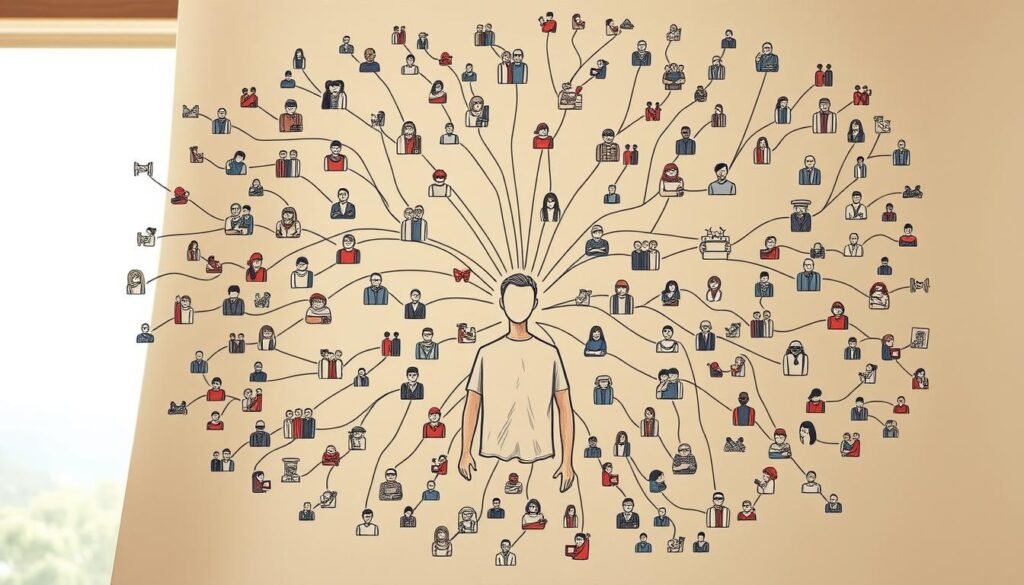
Creating a visual map of your social network gives you quick insight into your relationships. Start with yourself at the center, with circles around you showing how close and how often you interact with others.
The closest circle is for your closest friends and family, where you share deep feelings. The next circle is for friends and family you see less often but are important to you. The outer circles are for acquaintances, work colleagues, and casual friends.
This mapping helps in many ways. It shows how big your network is, which is a starting point for growth. It also shows if your connections are spread out or if they’re mostly in one area.
When mapping each relationship, think about:
- Frequency of contact: How often do you talk to this person?
- Emotional depth: Can you share deep feelings with this person?
- Reciprocity: Does this relationship give and take equally?
- Accessibility: Can you easily reach out to this person when you need to?
- Longevity: How long have you known this person, and has the relationship stayed strong?
Many people are surprised by how many meaningful connections they have. Some find they have strong networks they didn’t notice before. Others see they need to build their social network more.
Identifying Gaps in Your Support Systems
After mapping your relationships, look for gaps in your support system. Gap analysis finds where you need more support in your life.
Experts say good support systems have five main types. Emotional support gives comfort and reassurance. Informational support offers advice and knowledge. Tangible support helps with practical needs. Companionship support is about sharing activities. Validation support makes you feel understood and valued.
Many people have relationships that help in some ways but not others. For example, family might help with practical things but not offer emotional support. Work friends might be there daily but not share personal struggles.
Common gaps include:
- Having many professional contacts but few close friends
- Being close to family but not having many friends outside of them
- Knowing many people but not having deep, close friends
- Having friends from the past but not seeing them often
- Living far from friends and family
Finding these gaps helps you know where to focus your efforts. Instead of trying to meet everyone, aim to build specific types of relationships. This way, you can make progress faster and more effectively.
Both the size and quality of your network matter for your well-being. Having more people who share your values and support your goals can improve your mental health. But it’s not just about having more people. The quality of those connections is key to getting real support.
Understanding Different Types of Social Bonds
Not all social bonds are the same. Research shows different types of relationships play different roles in your life.
Strong ties are close relationships with lots of interaction and emotional depth. These include family, best friends, and romantic partners. They provide the emotional support you need during tough times.
Building strong ties takes time and effort but offers great rewards. They make you feel secure and connected. Studies show they help people stick to treatment plans and avoid relapse.
Weak ties are acquaintances and casual friends you see less often. They may not be as deep as strong ties but are important in their own way.
Weak ties open you up to new information and experiences. They connect you to different social circles, bringing in new resources and ideas.
The difference between bonding capital and bridging capital helps us understand relationship diversity. Bonding capital is about connections within similar groups. It strengthens group bonds and offers emotional support. Bridging capital connects people from different backgrounds. It brings in new perspectives and resources.
| Bond Type | Primary Function | Interaction Frequency | Development Strategy |
|---|---|---|---|
| Strong Ties | Emotional support and crisis assistance | Daily to weekly | Deep investment in select relationships |
| Weak Ties | Information access and social diversity | Monthly to occasional | Broad participation in varied activities |
| Bonding Capital | Identity reinforcement and belonging | Regular within group contexts | Join communities aligned with values |
| Bridging Capital | Exposure to new perspectives and resources | Periodic across different settings | Engage in diverse community spaces |
For true well-being, you need a mix of different social bonds. People with a balanced network, including both strong and weak ties, are more resilient against feeling alone.
This understanding helps avoid the mistake of thinking casual relationships are worthless. While strong ties are vital for emotional security, weak ties add to your overall happiness and prevent stagnation in your social life.
Your assessment should look at both the number and variety of your relationships. A network full of strong ties in one area is vulnerable. On the other hand, many weak ties without strong connections leave emotional needs unmet.
The goal is to have a diverse set of interpersonal relationships that meet all your social needs. This diversity ensures you’re not left feeling disconnected in one area of your life.
Shift Your Mindset Before Taking Action
Changing how you see loneliness is more than just changing what you do. It’s about changing how you think. The way you think about loneliness can make or break your efforts to connect with others. Many people try to fight loneliness by acting, but their thoughts and feelings often get in the way.
Studies show that 11% to 22% of adults feel lonely a lot. But most don’t talk about it. They don’t because of what they believe about being alone. This section helps you change your mind so you can connect with others better.
Starting to feel better begins with changing how you think and feel. Without this, even the best plans to meet people won’t work. The mindset shifts we talk about help you connect with others in a real way.
Releasing Shame About Loneliness
Many people hide their loneliness because they’re afraid of being judged. This hiding makes things worse. Shame makes you think being lonely means there’s something wrong with you.
Society makes it seem like connecting with others is easy. Social media shows everyone having fun together. This makes you think you’re the only one who can’t connect easily.
People hide because they’re afraid of being seen as a failure. Shame makes you think your loneliness is proof you’ve failed. This makes you pull away, missing out on support and connection.
Seeing loneliness as a signal for connection, not a flaw, is key. Just like hunger means you need to eat, loneliness means you need people. This view helps you see loneliness as a normal part of life.
Feeling like you’ve failed can make you want to hide even more. But seeing your struggles with kindness helps you start to change. This doesn’t mean you’re excusing your actions, but it gives you a realistic place to begin.
Reframing Rejection as Redirection
Fear of being rejected is a big barrier to meeting new people. Past disappointments can make this fear worse. But how you see these experiences can change everything.
Some people hide because they feel overwhelmed. If you see rejection as a sign you’re not meant to be with someone, it can stop you. But seeing it as a sign you need to find someone better can make you feel less scared.
Seeing rejection as a chance to find better connections is a big shift. Not everyone will click with you, and that’s okay. It means you can find people who are a better fit for you.
This view helps you see your worth beyond social interactions. Your value doesn’t change, no matter what happens. Rejection becomes a way to find better connections.
Practicing this mindset means changing how you think about disappointing moments. Instead of judging yourself, ask what it means for finding the right connection. This helps you learn and grow, not hide.
Building Self-Compassion as Your Foundation
Self-compassion is key to overcoming loneliness. It’s about being kind to yourself, just like you would to a friend. Without it, trying to connect with others is hard.
Feeling alone can make you think you’re better off by yourself. Harsh self-criticism makes reaching out seem too risky. Self-compassion helps you be kinder to yourself, making it easier to take risks.
Self-compassion has three parts: being kind to yourself, seeing you’re not alone, and being mindful. Being kind means treating yourself gently when you make mistakes. Seeing you’re not alone means recognizing everyone struggles. Being mindful means facing your feelings without getting overwhelmed.
Building self-compassion takes practice. One way is the self-compassion break. It involves acknowledging the challenge, seeing it’s common, and being kind to yourself.
The table below shows how changing your mindset can help you recover from loneliness:
| Scenario | Self-Critical Response | Self-Compassionate Response | Outcome Difference |
|---|---|---|---|
| Invitation declined | “I’m too boring for anyone to want around” | “This particular connection didn’t work out, which happens to everyone” | Maintains motivation to continue reaching out |
| Awkward conversation | “I always ruin social interactions with my awkwardness” | “Social skills improve with practice, and today was practice” | Encourages learning instead of avoiding |
| Anxiety before event | “Something is wrong with me for feeling this anxious” | “Anxiety before new social situations is a normal protective response” | Reduces suffering about having anxiety |
| Friendship fading | “I drove them away because I’m too needy” | “Relationships naturally shift, and I can grieve this while staying open to others” | Prevents generalizing and harming future connections |
Practicing self-compassion means noticing how you talk to yourself when things get tough. When you’re too hard on yourself, stop and think: “What would I say to a friend in this situation?” Then say that to yourself.
Self-compassion doesn’t mean you’re okay with being bad. It means you’re kind to yourself, which helps you make better choices. When you feel safe inside, you can take risks to connect with others without fear of failure.
This foundation helps you keep going because you want to improve your life, not just fix your loneliness. Changing your mindset from shame to kindness, from seeing rejection as a verdict to seeing it as a chance, and from being hard on yourself to being kind makes connecting with others possible.
Install Micro-Touches Into Your Daily Life
When socializing feels too much, micro-touches are a gentle way to reconnect. These small actions need little effort but offer big rewards for those seeking social connection. They fit easily into our daily lives, making connection feel achievable.
These moments may seem small alone, but together they build strong connections. They help fight off feelings of being disconnected.
Micro-touches are great for those who feel anxious in social situations or get tired easily. Starting small helps build confidence without feeling overwhelmed.
The Science Behind Brief Social Contact
Micro-touches are brief moments of connection, lasting from seconds to minutes. They include talking, eye contact, and digital chats. These interactions help bridge the gap between isolation and full connection.
Our brains respond powerfully to these brief moments. They release chemicals that make us feel good and reduce stress. This shows how small interactions can have a big impact.
Studies show that connection works in many ways. It helps us feel bonded and supported. It also teaches us new social skills by observing others.
Micro-touches act as a buffer against stress. They offer emotional assistance that helps us stay positive throughout the day.
From a behavioral standpoint, micro-touches are like small steps towards socializing. They help us get comfortable with social interactions gradually. This approach makes connecting feel less daunting.
Consistent micro-touches build protective factors over time. What starts as simple gestures can grow into deeper connections.
Actionable Examples for Immediate Implementation
Here are ten easy ways to start with micro-touches. They fit different lifestyles and comfort levels. Each one takes little time but offers real chances for connection.
| Micro-Touch Type | Implementation Context | Connection Benefit | Time Required |
|---|---|---|---|
| Name Recognition | Address service workers by their name tags when ordering coffee, checking out at stores, or receiving deliveries | Creates mutual acknowledgment and dignity; establishes repeat-interaction foundation | 5-10 seconds |
| Professional Appreciation | Send brief messages acknowledging colleagues’ contributions after meetings or project milestones | Strengthens workplace bonds; builds reciprocity patterns | 1-2 minutes |
| Authentic Digital Engagement | Respond to social media posts with substantive comments instead of generic reactions | Maintains dormant relationships; signals genuine interest | 30-60 seconds |
| Intentional Eye Contact | Make eye contact when holding doors, passing in hallways, or waiting in lines, paired with a genuine smile | Triggers neurobiological recognition response; practices nonverbal communication | 3-5 seconds |
| Transitional Check-Ins | Call a family member during commute time or between activities for brief updates | Utilizes unproductive time; maintains family bonds effortlessly | 3-5 minutes |
Other ideas include giving compliments to service workers or starting conversations with dog walkers. Saying thanks to delivery people adds a personal touch to transactions.
Joining online forums about hobbies or interests allows for connection without being face-to-face. Saying thank you for small courtesies, like letting you merge, reinforces positive social norms.
The key is to be intentional, not intense. Each interaction is a choice to engage, not just go through the motions.
Designing Your Personalized Approach
To make micro-touches a part of your life, start by observing your daily interactions. Look for natural moments to connect with others.
Morning routines can include greeting neighbors or chatting with the doorman. Commute times offer chances for friendly exchanges.
Workplaces have many opportunities for micro-touches. Arriving early to meetings or chatting in the break room can help. Virtual workers can install micro-touches through brief messages or emoji reactions.
Evenings offer different chances for connection. Walking in your neighborhood can lead to regular encounters. Online communities can provide connection without leaving home.
Customize your approach based on your personality and energy levels. Introverts might prefer written interactions, while extroverts enjoy in-person chats.
Begin with three to five micro-touches a day. This small goal helps build a habit without feeling overwhelmed. As you become more comfortable, you can do more without forcing it.
Pair micro-touches with habits you already have. Use your morning coffee run to practice name recognition. Turn social media scrolling into opportunities for meaningful engagement.
Monitoring Progress and Building Momentum
Tracking your progress is key to social recovery. It keeps you accountable, shows patterns, and boosts motivation. It also helps refine your strategy.
Keep a simple tally of your micro-touches. Use a notebook or phone app to mark each interaction. This creates a record of your social engagement.
For more detailed tracking, record the type of interaction, how it made you feel, and the context. This information helps you see which interactions work best for you.
Digital tools offer advanced tracking options. Habit-tracking apps can remind you and track your progress. Some people use spreadsheets to visualize their trends over time.
Choose how often to track based on your preference. Daily tracking captures immediate data. Weekly reviews show patterns, and monthly assessments give a broader view of your progress.
Look for signs of progress when reviewing your data. Increasing frequency and variety show growing comfort and flexibility. Feeling positive after interactions indicates they’re helping your emotional well-being.
As you do more micro-touches, you’ll find it becomes second nature. People will start to recognize you, and interactions can grow beyond brief chats. This shows that your efforts are paying off.
This tracking phase usually lasts six to eight weeks. Focus on consistency during this time. Missing a day or two is okay, but giving up is not.
Celebrate your small victories along the way. Reaching 100 micro-touches is a big deal. Noticing that socializing feels less draining shows your brain is adapting.
The real success is when micro-touches become a natural part of your life. At that point, you’re ready to explore deeper connection-building strategies.
Create Friendship Loops That Naturally Build Connection
Building real friendships starts with understanding a key idea. Friendships grow from shared experiences in the same places, not just from meeting once. This idea is the base of friendship loops. These are patterns of meeting that help people connect naturally, without needing to be super social or always trying to meet new people.
Studies show that being part of a supportive social network helps people finish treatment and stay sober. It also makes life better. This shows how important it is to build relationships in a planned way.
Friendship loops work because they use simple ideas like familiarity and being close to each other. Unlike trying to meet new people all the time, loops keep going because of their design and regular actions. Being active in regular activities helps grow your social circle and make better friends.
Learning how to make and keep friendship loops makes it easier to make friends. Here’s a simple plan to help create places where peer relationships and social support can grow naturally.
How Friendship Loops Differ From One-Time Interactions
Friendship loops are different from just meeting someone once. A chat at a party or a one-time volunteer event is not a loop. These don’t have the parts needed for relationships to grow.
Loops have three key parts that one-time meetings don’t. First, they happen regularly, which lets relationships grow slowly. Second, they happen in the same place or doing the same thing, which makes talking easier. Third, they let people share more over time, as they meet again and again.
Studies on people living in recovery homes show this clearly. Those who go to the same meetings and activities often become close friends. This is because they see each other regularly, which makes them feel safe and build trust.
Think about the difference between going to a networking event once versus joining a weekly book club. The event might lead to many conversations, but it’s hard to keep in touch. The book club, on the other hand, makes it easy to meet the same people and talk about the same things, which helps build real connections.
This is why some people feel stuck, even though they go to many social events. They’re just having one-off conversations, not building loops. Seeing socializing as a way to create patterns changes how we approach it and makes it more effective.
Step 1: Choose Activities With Built-In Repetition
Picking the right activities is key to making friendship loops work. Not all social events are good for building friendships. Look for activities that happen regularly, which makes it easier to keep going without having to try too hard.
Good activities have certain qualities that help loops form:
- Scheduled frequency: Things that happen weekly, biweekly, or monthly
- Skill progression: Classes or workshops where you get better together
- Shared purpose: Volunteer work or groups with a common goal
- Membership structures: Clubs or leagues that you join
- Performance elements: Groups that perform or compete together
The key is built-in repetition, not just the chance to meet again. A single cooking class is different from a six-week series. The series makes it easier to keep meeting, which helps friendships grow.
When picking activities, think about whether they naturally lead to seeing the same people again. A yoga class with different times is less likely to create loops than one with a set time every week. Who you meet matters more than what you’re doing.
Activities that need teamwork or working together help loops grow faster. Sports, group projects, and volunteer work give you reasons to talk and work together, which helps build friendships.
Step 2: Show Up Consistently to the Same Places
Just picking activities isn’t enough; you also need to show up regularly. Being there often is what makes loops work. The idea that seeing something or someone over and over makes you like it more is key.
Being consistent shows you care about the activity and the people there. It makes others feel safe to talk to you and lowers the risk of feeling awkward. It also gives you more time to get to know people, which helps friendships grow.
Studies say you need about 50 hours of time together to become casual friends and 200 hours to be close friends. This time comes from going to the same places regularly, not from trying to meet new people all the time. Going to a book club every week gives you more time to build relationships than trying to meet for coffee with different people.
The amount of time you need to show up before you see if friendships are forming varies. But generally, try to go at least eight times before you decide if it’s working. This lets awkwardness fade and gives everyone enough time to get to know each other.
Here are some tips to stay consistent:
- Mark the time for activities as non-negotiable for the first two months
- Make it easy to get there by arranging transportation or getting ready ahead of time
- Talk to the organizers about your commitment to show up
- Keep track of how often you go to stay aware of your pattern
- Find and solve problems that might stop you from going before they happen
It’s not just about showing up; it’s about showing up consistently. Letting people know you’ll miss a session helps keep your place in the group, even when you’re not there.
Step 3: Progress From Familiar Faces to Actual Friends
Going from knowing someone to being friends takes time and a natural process. Understanding this helps avoid rushing things and lets friendships grow naturally. The structure of loops helps support this growth.
The stages of becoming friends in a loop are clear:
| Stage | Characteristics | Typical Duration | Appropriate Actions |
|---|---|---|---|
| Recognition | Seeing the same faces at repeated events | 2-3 occurrences | Eye contact, nodding acknowledgment, positioning near the same individuals |
| Pleasantries | Brief greetings and surface-level exchanges | 3-5 occurrences | Name exchange, weather comments, activity-related observations |
| Conversation | Extended discussions about shared context | 5-10 occurrences | Asking about their experience, sharing opinions, light humor |
| Personal Sharing | Disclosure of information beyond the immediate context | 10-15 occurrences | Mentioning other life aspects, expressing vulnerabilities, seeking advice |
| Extended Interaction | Connection beyond the original activity setting | 15+ occurrences | Suggesting coffee after sessions, exchanging contact information, planning outside meetups |
This shows why loops are better than just trying to meet new people. Each stage needs many meetings to happen naturally. Trying to rush things, like suggesting outside meetups too soon, can make people uncomfortable and stop friendships from growing.
Strategies like strategic positioning help move through these stages. Arriving early to activities lets you chat before things start. Sitting near the same people shows you’re open to talking, but also keeps boundaries.
As friendships get deeper, reciprocal disclosure is key. This means sharing personal things in return for what others share. When someone talks about a tough week, sharing a similar experience can bond you together while respecting the level of openness.
The move to sharing personal things is a big step. Research shows that meaningful relationships involve being open and vulnerable. In loops, this happens naturally when people have built enough trust through regular positive interactions.
Getting to meet outside the original activity should happen naturally, not be forced. Good ways to invite people include mentioning shared interests: “Several people mentioned grabbing coffee after next week’s session—would you be interested?” This makes it easier for people to say yes and explore deeper connections.
Not everyone in a loop will become a close friend. This is normal and shows that people are choosing who they want to be friends with. Loops can have different levels of friendship, from casual to close, which meets different needs for connection.
By following these steps to create and keep friendship loops, making friends becomes easier. It’s about choosing the right activities, showing up regularly, and understanding how friendships grow. Research shows that these networks can improve your life by helping you stay sober, finish treatment, and feel better overall.
Establish Buddy Systems for Mutual Accountability
Accountability partnerships turn social recovery into a shared journey. They use mutual support for lasting progress. Studies show peer support leads to better results than going it alone, thanks to buddy systems.
Peer encouragement does more than just motivate. It creates a bond of mutual support and accountability. This bond brings benefits like shared struggles and diverse perspectives.
Research shows social support leads to better recovery. People with accountability partners stay on track better than those alone. The desire to not let down others is stronger than personal willpower.
The Psychological Advantages of Partnered Approaches
Buddy systems offer unique benefits over solo efforts. They work through psychological and practical ways. This is why partnered approaches often last longer.
Enhanced motivation through social commitment is a key benefit. Making promises to someone else boosts motivation. This external push helps when personal drive wanes.
Peer support also means reduced burden through shared responsibility. Social recovery is hard work. Buddy systems share this load, making it easier to keep going.
Sharing struggles openly is another advantage. It makes setbacks seem normal, not failures. This reduces shame and boosts perseverance.
- Increased persistence through regular check-ins and scheduled touchpoints
- Diversified perspective from collaborative problem-solving discussions
- Emotional support during periods of discouragement or setback
- Celebration of progress milestones that might be overlooked
- Practical help with specific challenges
Behavioral psychology shows public commitment boosts follow-through. Studies show a 65-95% increase in completing goals when sharing progress with a partner.
Identifying Compatible Accountability Partners
The success of buddy systems depends on partner compatibility. Not every relationship is suitable for accountability. Choosing the right partner is key.
Aligned commitment levels are essential. Both must be serious and dedicated. Mismatched commitment leads to frustration and failure.
Having compatible schedules is important for regular meetings. Partners should find a schedule that works for both without being too burdensome.
Shared values in social recovery are important. While goals may differ, shared beliefs help in tough conversations. These values create understanding.
Communication styles should match to avoid misunderstandings. Some prefer direct feedback, while others like gentle encouragement. The best partnerships match these styles or can negotiate differences.
It’s important to have balanced reciprocity. Partners should share responsibilities fairly. This prevents resentment and keeps the partnership strong.
| Compatibility Factor | Assessment Question | Green Flag Indicator | Red Flag Warning |
|---|---|---|---|
| Commitment Level | How seriously does this person take their social recovery goals? | Demonstrates consistent follow-through on stated intentions | Frequently cancels plans or deprioritizes connection efforts |
| Schedule Alignment | Can we realistically connect at regular intervals? | Proactively suggests specific times for check-ins | Vague about availability or difficult to schedule with |
| Value Alignment | Do we share similar beliefs about connection and recovery? | Expresses understanding of isolation’s impact | Dismisses loneliness as trivial or shameful |
| Communication Style | How does this person prefer to give and receive feedback? | Can articulate their communication preferences clearly | Becomes defensive or withdrawn during honest conversations |
Creating Effective Partnership Structures
Good buddy systems need clear agreements and protocols. Without these, partnerships can fail due to confusion.
Establishing clear expectations and communication frequency is key. Partners should agree on how often to meet and how to communicate. This prevents misunderstandings.
Defining specific accountabilities and check-in protocols helps focus interactions. Instead of vague promises, partners should agree on specific actions and questions. This turns intentions into actions.
Creating ways to track progress helps both partners see improvement. This can be through shared spreadsheets, regular assessments, or journals. Consistency is more important than the format.
Having protocols for challenges or conflicts helps avoid early partnership endings. Partners should agree on how to handle issues like missed meetings or disagreements. This reduces reactivity during tough times.
- Schedule specific check-in times with calendar invitations
- Create a shared document outlining partnership agreements
- Develop a standard set of check-in questions
- Establish a “pause protocol” for temporary breaks
- Set quarterly partnership reviews
The best structure balances formality and flexibility. This way, peer encouragement can thrive within a supportive framework.
Navigating Partnership Challenges and Transitions
Even well-matched buddy systems face challenges or natural endings. Knowing how to handle these situations is important for maintaining the partnership and its benefits.
Partnerships may slow down due to life changes. This doesn’t mean the partnership has failed. It just needs to adapt.
Renegotiating terms is a first step when partnerships feel strained. Partners can discuss and adjust agreements to fit current circumstances. This might mean fewer meetings or different communication methods.
Planned breaks can preserve partnerships during busy times. Instead of drifting apart, partners can agree on a temporary pause. This keeps the relationship strong for future resumption.
Adapting to changing needs without ending the partnership is possible. Partners might change from weekly calls to monthly meetings or from mutual support to mentorship. This flexibility keeps the relationship alive.
Ending partnerships with grace is the last option when no changes work. Sometimes, partnerships naturally come to an end as needs or circumstances change. Ending it without blame allows both to find new support.
If buddy systems stall, peer support can continue in other ways. The skills gained are useful in other relationships and groups. No single partnership defines success in social recovery.
Implement Weekly Community Check-Ins
Weekly community check-ins are a strong way to fight loneliness. They work by being regular, not intense. This approach helps people stay connected without feeling overwhelmed.
Studies show that regular meetings in groups help a lot. People who go often have better friendships and more support.
Weekly meetings give a clear structure to social life. This structure helps fight the feeling of being alone. It makes time for both connection and thinking.
The Power of Regular Community Touchpoints
Regular meetings have many benefits. They make it easier to connect because they are predictable. This reduces the effort needed to socialize.
Meeting the same group often helps relationships grow. Trust builds slowly, which is good for everyone.
Being part of a group also connects you to more people. This gives you different views and support. It’s better than just having one friend.
Research shows that regular meetings are very effective. People with weekly activities have bigger, better social networks. They keep going because they feel supported.
Finding Communities That Match Your Interests
Finding groups that match your interests is key. When you’re really into it, you’ll keep coming back. It’s important to find groups that really interest you.
There are many types of groups for different interests. Some focus on fun activities, others on learning. There are even groups for spiritual or creative pursuits.
It’s good to try out different groups. This way, you can find the right fit for you. Look at things like group size and values.
Committing to Your Weekly Check-In Schedule
Keeping up with weekly meetings takes effort. Use your calendar to mark them as important. This helps you stick to it.
Make things easier by preparing ahead of time. This way, you won’t miss out because of last-minute excuses. Reminders can also help you remember.
Having someone to report to can help you stay on track. You can also link meetings to your daily routine. This makes it easier to remember.
It’s okay if you miss a meeting sometimes. It’s part of the journey. Focus on showing up regularly, not every single time.
Think about when you’re most awake. Meeting at your best time can help you stay involved. It makes it easier to keep coming back.
Moving From Attendee to Active Participant
Getting more involved in a group can make you feel more connected. Start small and take it at your own pace. This helps you feel more at home.
Start by observing and chatting a bit before the main event. This can help you connect with others naturally. It’s often easier than trying to join in during the main activity.
Try out small roles to get more involved. Helping out with setup or other tasks shows you care. It’s a good way to start without feeling overwhelmed.
Sharing your thoughts in discussions is a big step. It shows you’re part of the group. Even a small comment can start a conversation.
Meeting up with others outside of meetings can grow your network. It helps you build deeper connections. This makes your involvement in the group more meaningful.
Leading or helping organize events is the final step. It makes you a key part of the group. This creates a sense of belonging that goes beyond just attending.
Research shows that being active in groups leads to better social connections. Moving from just attending to actively participating changes how you connect with others. It creates a cycle of value and connection that grows over time.
Build Social Support Through Peer Connections
Connecting with others who face similar challenges offers real emotional validation. Peer connections are special because they come from shared experiences, not just knowledge or family ties. This shared background makes peer support more effective in understanding each other’s struggles.
Studies show that being part of peer groups can grow your social network and improve friendships. People in these groups get both practical help and emotional support from those who get what they’re going through. This support is key in social recovery, often more than what professionals or family can offer.
Understanding Peer Support vs Other Relationships
Peer relationships are unique and very valuable in recovery efforts. Unlike professional help, where there’s a clear expert-client role, peer support is about equals helping each other. This setup allows for real, open sharing that’s hard in other settings.
Family ties can be supportive but often come with their own set of challenges. Family members might struggle to understand your specific issues due to their own feelings. Friends, while supportive, might not fully get what you’re going through because they don’t share your exact experiences.
Peer connections offer a deep understanding that goes beyond sympathy. When you share a similar journey or challenge, you connect on a deeper level. This understanding includes the small, often overlooked details of life.
This shared understanding helps fight the feeling of being alone, even when you’re surrounded by caring people. Peer relationships offer emotional validation based on real experiences, not just theory.
| Relationship Type | Primary Characteristic | Support Foundation | Reciprocity Pattern |
|---|---|---|---|
| Peer Support | Shared lived experience | Experiential understanding | Mutual exchange between equals |
| Professional Help | Expert guidance | Theoretical knowledge and training | One-directional service provision |
| Family Bonds | Historical connection | Obligatory affection and loyalty | Complex, often unbalanced |
| General Friendships | Shared interests or proximity | Common activities or circumstances | Balanced but variable depth |
Where to Find Peer Support Groups
Finding the right peer support groups requires exploring both formal and informal networks. Twelve-step groups and mutual help organizations are key for structured support. They offer a framework for connection and experienced members to guide you.
Specific groups focus on certain health issues or life experiences. These groups are great for finding peers who truly understand you. They help you connect with others who face similar challenges.
Digital platforms have made it easier to find peer connections without being limited by location. Online forums and social media groups provide a space to connect with others who share your experiences. This is very helpful for those who can’t attend in-person meetings.
Here are some ways to start finding peer support:
- Local community centers and nonprofit organizations that host support groups
- Hospital and medical center patient support programs
- Faith communities that organize fellowship groups around shared experiences
- Workplace employee resource groups focused on various identities and circumstances
- Educational institutions providing student organizations and alumni networks
- Online platforms including specialized forums, Facebook groups, and Reddit communities
- National organizations with local chapters accessible through their websites
Libraries and recreation centers often have directories of local support groups. Many therapists and healthcare providers also have lists of peer support groups for their clients.
Getting the Most From Peer Encouragement
To get the most from peer relationships, focus on building genuine connections. Active listening is key, which means giving your full attention to others without immediately sharing your own story. This builds trust and respect, allowing for deeper sharing over time.
Being vulnerable is another important skill for peer support. Sharing your real experiences, including struggles, invites others to do the same. This creates a safe space for open sharing, which is different from casual socializing.
It’s important to maintain a balance in peer relationships. While it’s natural for one person to need more support at times, the relationship should generally be mutually beneficial. This balance prevents feeling drained or uncomfortable.
Choosing the right peer group is also important. Not all groups are supportive, and some can even be harmful. Look for groups where you feel truly supported and encouraged, not triggered or discouraged.
Here are some tips for making the most of peer support:
- Attend meetings regularly to build trust and familiarity with others.
- Be active in group discussions instead of just listening.
- Seek out one-on-one connections with peers who understand you.
- Set boundaries to protect yourself from topics or situations that are harmful.
- Bring specific questions or topics to discuss, instead of vague requests for help.
Contributing Your Own Experience to Others
Sharing your own experiences with others is more than just being polite. It helps you grow while supporting others. This exchange of stories and insights strengthens your own understanding and helps others.
You don’t need to be an expert to share your story. Your authenticity is what matters most. Sharing your ongoing challenges can be more powerful than talking about successes, as it shows the real journey of recovery.
When you share your experiences, you also deepen your own understanding. Talking about your journey helps you see patterns and strategies that you might not have noticed before. This sharing reinforces the coping strategies you’ve developed.
This exchange of experiences creates a stronger community. As peer networks share their stories and support each other, they build collective wisdom. Your contribution becomes part of this shared knowledge, impacting the entire group.
Strengthen Family Bonds and Family Connections
Family members often see loved ones pull away into isolation. But they don’t know how to bridge the emotional gap. This breakdown makes recovery harder and lowers overall wellbeing.
Reconnecting with family offers a chance to rebuild relationships. These bonds are special because they’re filled with shared experiences and deep emotional connections. Family support services help everyone understand how isolation affects them.
To strengthen family bonds, we need honest talks, clear communication, and shared activities. It’s not just about being related. It’s about building strong connections that last.
Assessing Your Family Relationship Landscape
Before trying to reconnect, it’s important to understand your family’s current state. This helps identify which relationships are positive, neutral, draining, or toxic. It’s about being honest about how relationships really are, not how we wish they were.
Several key factors show the true nature of family relationships. Historical patterns and current communication quality are important. So is whether emotional support flows both ways and if personal boundaries are respected.
Value alignment is also key. It’s about whether fundamental beliefs and life approaches match or clash. This helps understand the depth of family connections.
| Relationship Category | Key Characteristics | Connection Strategy | Boundary Requirements |
|---|---|---|---|
| Nourishing | Mutual support, respect, positive history, reliable presence | Prioritize regular contact, deepen vulnerability, invest time | Minimal – healthy boundaries naturally present |
| Neutral | Pleasant but shallow, limited emotional depth, sporadic contact | Maintain casual connection, explore for growth | Moderate – protect against one-sided commitment |
| Draining | One-sided support, frequent conflict, emotional exhaustion after interactions | Limit contact frequency, keep interactions brief and structured | Strong – clear limits on time, topics, and emotional investment |
| Toxic | Active harm, boundary violations, abuse patterns, consistent disrespect | Consider distance or no contact, prioritize safety | Maximum – firm separation with professional support |
This framework helps focus efforts on the most important relationships. Investing in nourishing relationships yields the highest return for emotional wellbeing. Neutral relationships can grow with gentle effort, while draining and toxic ones need protective measures.
Assessments also consider individual capacity during recovery. Early on, even positive interactions can feel overwhelming. As resilience grows, capacity for more complex relationships increases.
Initiating Conversations After Long Silence
Breaking long silences with family requires navigating vulnerability and uncertainty. The gap itself is a barrier, making reconnection attempts more anxious. Strategic communication can overcome these obstacles.
Acknowledging the silence without excessive apology sets a honest tone for renewed contact. A simple statement like “I realize we haven’t talked in a while” is more effective than elaborate explanations.
Showing genuine interest in the other person’s life shifts focus from past silence to present connection. Asking about current activities or interests shows care. This approach prevents conversations from becoming self-focused.
Starting with low-stakes communication channels reduces pressure. Text messages or emails allow for asynchronous responses, giving everyone time to process without immediate demands.
- Send a brief, warm message mentioning a specific positive memory or expressing interest in a known hobby
- Share a relevant article, photo, or resource that demonstrates you thought of them
- Acknowledge important dates like birthdays or anniversaries even after long silence
- Propose a specific, limited interaction instead of open-ended commitment
- Accept whatever level of response emerges without pushing for more
Managing expectations about reciprocity prevents disappointment when responses are lukewarm. Family members may need time to rebuild trust. Persistent gentle effort over time often succeeds where intense immediate outreach fails.
Gradually increasing interaction frequency helps relationships regain natural rhythm. Moving from one message monthly to biweekly to weekly creates sustainable momentum. This approach prevents overwhelm from sudden reconnection efforts.
Creating New Rituals for Family Connections
Creating predictable, meaningful activities structures ongoing family bonds. These rituals create containers for connection that transcend temporary circumstances. Family rituals embed relationship maintenance into behavioral routine, reducing the friction that prevents consistent contact.
Weekly phone calls with specific family members establish reliable touchpoints. Designating particular days and times removes the decision fatigue about when to reach out. Even brief ten-minute conversations maintained consistently build stronger connections than sporadic lengthy discussions.
Monthly gatherings provide regular opportunities for in-person interaction when geography permits. These events need not be elaborate; simple meals, walks, or shared activities create the structure. The predictability matters more than the sophistication of the event itself.
Annual traditions mark significant occasions and create continuity across years. Holiday celebrations, birthday recognitions, or seasonal activities become anchors in family systems. These larger rituals complement more frequent smaller touchpoints, providing rhythm at multiple time scales.
Milestone celebrations acknowledge important life transitions and achievements. Graduations, job changes, health victories, or personal accomplishments deserve recognition. Showing up for these moments communicates investment in each other’s ongoing life narrative.
Rituals are the formal repetition of meaningful actions that create stability, connection, and shared identity within groups.
Digital rituals accommodate distance and scheduling challenges. Regular video calls, shared online games, group texts about daily experiences, or collaborative playlists maintain connection across geographical separation. These modern formats apply traditional ritual principles to contemporary constraints.
The key to successful family rituals lies in realistic scope and genuine enthusiasm. A simple ritual maintained consistently outperforms an ambitious plan abandoned after two attempts. Starting small allows for adjustment and expansion as the practice becomes established within family patterns.
Setting Healthy Boundaries While Staying Connected
Sustainable family connections require maintaining protective limits while being emotionally present. Boundaries enable individuals to participate in family systems without sacrificing personal wellbeing or recovery progress. This balance is essential for relationships that honor both connection and autonomy.
Identifying personal boundary needs begins with noticing physical and emotional responses during and after family interactions. Feelings of resentment, exhaustion, anxiety, or dread signal boundary violations. On the other hand, feelings of energized connection, mutual respect, and authentic expression indicate healthy boundary balance.
Common boundary categories in family relationships include time limits, topic restrictions, physical space needs, emotional labor capacity, and financial considerations. Each individual requires different boundaries based on personal history, current capacity, and specific family dynamics. These needs shift over time as circumstances and relationships evolve.
Communicating boundaries clearly and directly prevents misunderstanding and resentment. Using “I” statements expresses personal needs without attacking others: “I need to limit phone calls to 30 minutes” or “I’m not available to discuss that topic.” This approach asserts limits while maintaining respect.
- Identify specific behaviors or situations that compromise your wellbeing
- Determine what boundary would address each concern
- Communicate the boundary clearly before the situation arises
- Enforce the boundary consistently when tested
- Adjust boundaries as relationships and circumstances change
Enforcement is key to turning stated boundaries into reality. When family members test or violate boundaries, calm consistent follow-through teaches that the limits are genuine. This might involve ending conversations, leaving gatherings early, or declining invitations that violate established boundaries.
Anticipating resistance helps prepare for common boundary challenges. Family members may express hurt, anger, or confusion when boundaries shift. Maintaining boundaries despite emotional pressure requires commitment to personal wellbeing. Professional support through therapy can strengthen boundary-setting capacity during difficult transitions.
Boundaries actually enable deeper connection by preventing the resentment and exhaustion that destroy relationships. When interactions respect personal limits, the time spent together becomes more genuine and sustainable. Family connections built on mutual boundary respect create foundations for lasting emotional bonds.
The goal involves creating family relationships that support social recovery efforts. Strategic assessment, intentional communication, meaningful rituals, and protective boundaries work together to transform family systems into resources for belonging. This approach recognizes both the benefits and challenges of family bonds, enabling individuals to navigate these complex connections wisely.
Tap Into Community Resources and Community Networks
Most communities have many ways to connect, but people often don’t know about them. There are formal groups, public places, volunteer spots, and online sites. Each offers a way to build support systems. Knowing where to find these can turn social recovery into a team effort.
Getting involved in community networks helps build relationships quickly. These groups offer a structure for meeting people, making it easier to start conversations. You can find groups that match your interests and schedule.
Local Organizations Designed for Connection
Places like community centers and civic groups are made for people to meet. They make it easy to connect by focusing on shared interests or living nearby. These groups have set times and places, making it easier to meet others.
Professional groups and alumni networks connect people through work or school. They offer both social and professional benefits. Clubs for hobbies or interests provide a chance to meet others who share your passions.
Cultural spots like museums and theaters have membership and volunteer programs. They host events and projects that bring people together. Sharing a love for art or culture creates a common ground for making friends.
| Organization Type | Primary Connection Mechanism | Accessibility Level | Relationship Development Speed |
|---|---|---|---|
| Community Centers | Diverse programming and shared facilities | High – usually free or low-cost | Moderate – depends on participation frequency |
| Professional Associations | Career interests and industry networking | Moderate – membership fees often required | Fast – shared professional context accelerates bonding |
| Hobby and Interest Clubs | Passionate engagement with specific activities | High – many operate informally with minimal costs | Fast – enthusiasm and skill-sharing create rapid rapport |
| Neighborhood Associations | Geographic proximity and local concerns | Very high – open to all residents | Moderate – relationships deepen through repeated interactions |
How Volunteering Creates Instant Belonging
Volunteering is a great way to quickly join social networks. Working together on projects builds camaraderie faster than just socializing. It’s a way to find purpose and make friends while doing something good.
Volunteering means working together, talking, and helping each other. It attracts people who want to help others, making it easier to connect. Volunteering also brings people of different ages and backgrounds together, making your social circle more diverse.
Studies show that volunteering is good for your mental health. It helps you feel less alone and more connected to your community. Volunteer leaders often help people meet and work together.
There are volunteer opportunities in almost every field. You can find something that matches your interests and skills. Many people say that the friends they make through volunteering are some of the most important in their lives.
Using Libraries, Recreation Centers, and Faith Communities
Libraries are more than just bookstores. They offer many programs that bring people together. They have book clubs, classes, workshops, and events for all ages. Libraries are open to everyone, making them great places to meet new people.
Parks and recreation centers offer classes, sports, and events. These activities create chances to talk and bond with others. Sports and group fitness classes are great for building friendships through teamwork.
Churches and faith groups offer spiritual support and friendship. They have programs for worship, study, service, and social events. For those who value faith, these groups provide a sense of belonging and purpose.
These public places are great for people who can’t afford or access other options. They have many locations and programs at different times. They make it easy to find something to do without having to plan everything yourself.
Online Community Networks That Feel Real
Online platforms have opened up new ways to connect. They are great for people who can’t get out much or have rare interests. Online communities are useful, but they should be used with in-person interactions.
Not all online communities are the same. Look for ones with clear rules and active members. Groups focused on specific interests can help you find real friends. Consistent and genuine participation is key.
Some online communities also meet in person. This mix of online and offline interactions helps deepen friendships. Local groups online can be a good way to bridge the gap between online and real-life connections.
To find a good online community, look for these signs:
| Quality Indicator | Signs of Authentic Community | Red Flags to Avoid |
|---|---|---|
| Interaction Authenticity | Vulnerable sharing, mutual support, consistent member engagement | Superficial exchanges, promotional content, one-sided broadcasting |
| Moderation Quality | Clear guidelines, respectful discourse, conflict resolution | Toxic behavior tolerated, spam prevalent, no community standards |
| Value Alignment | Shared purpose, compatible communication styles, mutual respect | Values misalignment, hostile atmosphere, exclusionary practices |
| Progression Opportunities | Pathways to deeper involvement, leadership roles, offline meetups | Stagnant participation, no relationship development, purely transactional |
By using community resources, volunteering, and online groups, you can quickly grow your support system. The key is to start and be active in the connections that interest you.
Access Mental Health Resources When You Need Professional Help
When you can’t shake off loneliness, it’s time to seek help. Studies show that those with little social support face more severe mental health issues. Looking for professional help is a sign of strength, not weakness.
Professional help fills the gap between trying to help yourself and needing expert care. Mental health experts are trained to tackle complex loneliness issues. The Substance Abuse and Mental Health Services Administration (SAMHSA) National Helpline offers quick access to treatment and counseling.
Building a strong mental health network adds layers of support. It combines individual therapy, group sessions, and crisis help. Getting professional advice helps you find ways to cope and avoid getting worse.
Signs That Self-Help Isn’t Enough
Knowing when you need more help is key to your well-being. Look out for signs like symptoms that don’t get better despite your efforts. This could mean it’s time to see a professional.
When loneliness starts to affect your work or daily life, it’s a clear sign you need help. Not being able to take care of yourself shows that self-help alone isn’t working.
Dealing with more than one mental health issue requires special care. Conditions like depression or anxiety can make it hard to form relationships. Experts use proven treatments to address these complex issues.
The table below shows when self-help is enough and when you need professional help:
| Indicator | Self-Help Appropriate | Professional Help Needed |
|---|---|---|
| Symptom Duration | Recent onset with gradual improvement | Persistent or worsening despite 3+ months effort |
| Daily Functioning | Maintains work and self-care activities | Significant impairment in multiple life areas |
| Safety Concerns | No thoughts of self-harm | Suicidal ideation or self-destructive impulses |
| Progress Pattern | Visible improvements with consistent effort | Lack of progress or regression in symptoms |
| Complexity | Isolated loneliness without comorbidities | Multiple mental health conditions present |
If you’re thinking about harming yourself, get help right away. Call the 988 Suicide and Crisis Lifeline or go to the emergency room. These thoughts are a sign of a serious problem that needs professional help.
Finding Therapists Who Specialize in Loneliness and Isolation
Finding the right therapist takes some effort. Use directories that let you filter by specialty. Websites like Psychology Today and GoodTherapy have detailed profiles of therapists.
Your primary care doctor can also help find a therapist. They know who in your area specializes in loneliness and social anxiety. Ask them for recommendations.
Insurance can make getting help easier. Check with your insurance to find therapists in your network. Community mental health centers offer affordable options for those without insurance.
Online therapy services make it easier to get help from anywhere. They’re great for people in rural areas or with mobility issues.
First meetings help you see if a therapist is a good fit. Call them to discuss their approach and experience. Ask about their methods for treating loneliness and their success rates.
Building Your Mental Health Network
A strong mental health network includes different types of help. Individual therapy helps you work through personal issues. Group therapy lets you practice social skills in a safe space.
Seeing a psychiatrist can help with medication. They can recommend antidepressants or anti-anxiety meds to help you feel better. Combining medication with therapy often works best.
Case managers help with complex care needs. They help you find and use mental health resources. This is very helpful if you have multiple health issues.
Having crisis resources available is important. Get to know hotlines, mobile crisis teams, and emergency services. The SAMHSA National Helpline (1-800-662-4357) is available 24/7 for free, confidential help.
Good communication between your providers is key. Let them share information to avoid conflicting advice. This ensures you get the best care possible.
Combining Professional and Peer Support
Professional and peer support work together well. Experts provide the right treatment and help you understand your issues. They teach you how to tackle loneliness.
Peer support groups offer real-life advice. People who have gone through loneliness share their experiences. Peer support groups make you feel less alone and show recovery is possible.
Using both professional and peer support can be very effective. Go to therapy regularly and join peer groups. Talking about your experiences in groups can help you understand relationships better.
Professional help makes peer support even more effective. Therapists help you deal with emotions from group interactions. This combination tackles loneliness from all angles.
A strong mental health network is like having a safety net. It ensures you get the help you need, even when one source is not available. This approach recognizes that recovery is a journey that needs many types of support.
Apply Proven Loneliness Antidotes
Loneliness can be overcome with specific, proven strategies. These loneliness antidotes are practical coping mechanisms for both feeling and being alone. Learning how to use these strategies can improve your emotional wellbeing.
Studies show that changing your environment and how you think about it are both key. The best approach combines both. This way, you can start feeling more connected.
The Five Evidence-Based Loneliness Antidotes
Research has found five main ways to fight loneliness. Each works in a different way. Knowing how they work can help you choose the right one for you.
Cognitive restructuring helps change how you think about social situations. It teaches you to see things in a more positive light. This can help you feel less alone.
This method is based on cognitive behavioral therapy. It shows that your thoughts shape your actions and outcomes. By changing your thoughts, you can change your experiences.
Social skills training boosts your confidence in meeting and talking to people. It’s great if you’ve been isolated for a long time. You’ll learn how to start conversations and listen well.
Training can be in classes, online, or with a therapist. The goal is to help you connect with others in a real way. Many people find they just need to brush up on their skills.
Enhanced social support through network expansion aims to increase your connections. It’s about having more people to talk to and rely on. This makes you feel less alone.
This approach is about building a diverse network. You’ll have friends for different things, like fun or advice. This variety helps you feel supported.
Increased opportunities for social interaction makes it easier to meet people. It’s about changing your environment and schedule. This way, socializing becomes a natural part of your life.
Creating opportunities might mean joining groups or changing your daily routine. It’s about making socializing easy and natural. This approach helps you connect more often.
Addressing maladaptive social cognition targets negative thought patterns that keep you isolated. This is one of the most effective ways to fight loneliness. It helps you see things in a more positive light.
These negative thoughts can make you believe you’re not likable or that relationships always fail. Therapy can help you change these beliefs. This can make you feel more connected.
How to Use Each Antidote in Real Situations
Using these strategies in real life requires understanding how they work. Here are some examples of how to apply each antidote in everyday situations.
When someone doesn’t reply to your message, cognitive restructuring can help. Instead of thinking they don’t like you, consider other reasons. This can help you feel less rejected.
At gatherings, social skills training can help you start conversations. Try saying, “I’m new here—what brought you?” This simple trick can help you connect with others.
To expand your network, try different activities. Join a club, volunteer, or attend meetings. This way, you’ll meet people with different interests. It helps you find connections that feel right.
Creating more opportunities for socializing might mean setting aside time for classes. Make this time non-negotiable. This helps you stay consistent in your social efforts.
Working on maladaptive cognition with a therapist can help you change negative thoughts. For example, you might think you always say the wrong thing. But, you’ve also had good interactions. This balanced view can reduce your anxiety.
- Track which situations trigger your strongest negative interpretations
- Practice one new social skill in low-stakes environments first
- Expand your network through activities that genuinely interest you
- Design your schedule with social touchpoints as anchors, not afterthoughts
- Challenge catastrophic predictions by asking “What’s the actual evidence?”
These loneliness antidotes work best together. No single strategy can solve all loneliness issues. A mix of approaches can help you find lasting connection.
Creating Your Personal Antidote Toolkit
Everyone’s experience with loneliness is different. Your toolkit should reflect your unique situation. It’s about finding the right strategies for you.
Start by figuring out why you feel isolated. Is it because you lack opportunities or because you’re afraid to take them? Knowing this helps you focus on the right antidotes.
Choose strategies that fit your learning style. If you like to think things through, cognitive restructuring might be for you. If you learn by doing, focus on skills and opportunities. This makes it easier to stick with your plan.
Your toolkit should include at least one strategy from three different categories. This way, you’re not relying on just one thing. A good toolkit might include:
- A cognitive journal for tracking and challenging negative social interpretations
- Two specific conversation techniques practiced until they feel natural
- Three regular community activities that provide recurring social contact
- A weekly schedule redesign that prioritizes connection opportunities
- A therapeutic relationship for deeper work on maladaptive beliefs
Write down your strategies in a way that makes sense to you. Some people use a checklist, while others prefer a detailed plan. The important thing is to use it regularly.
Make sure someone knows about your toolkit. Share it with a friend or therapist. This can help you stay on track, even when you don’t feel like it. They can also help you adjust your plan if needed.
Review your toolkit every three months. As your situation changes, so might your needs. This ensures your strategies stay relevant and effective.
Remember, fighting loneliness often requires a mix of strategies. No single approach can solve everything. Your personalized plan combines different methods to help you find lasting connection.
Develop Coping Mechanisms for Connection Setbacks
After being isolated, making connections again can be tough. It’s normal to face obstacles that test your commitment and resilience. Knowing these challenges helps keep your mental health strong when things seem tough.
Recovering socially doesn’t always go smoothly. Setbacks are part of the journey, not a sign of failure. Having good strategies helps you keep going even when things get hard.
Normal Challenges During Social Recovery
Everyone faces challenges when rebuilding social bonds. Feeling awkward in social situations can make you want to hide. Scheduling problems can also make it hard to keep friendships growing.
Your energy levels can change without warning. Some days you’ll feel ready to go out, others you’ll need to stay in. This is just part of being human.
Expectations can clash when you’re getting to know someone. You might want deep talks, but they might prefer casual chats. These differences help you understand if you’re compatible.
Improvement doesn’t always come in a straight line. Sometimes you might feel like you’re not making progress. But, setbacks are normal, even during stressful times. Seeing them as part of the recovery process helps keep your mental health strong.
Managing Social Anxiety and Fear
Social anxiety is a big hurdle to overcome. It can make you feel physically sick and think the worst. To deal with it, you need strategies for both your mind and body.
Starting small can help you get used to being around people. Begin with small steps, like chatting with a cashier. Each success helps you feel more confident.
Changing your thoughts can also help. Look at the facts instead of letting fear take over. This can make social situations feel less scary.
- Breathing techniques: Diaphragmatic breathing helps calm your body and mind
- Grounding practices: Focus on the present to distract from anxiety
- Preparation strategies: Plan ahead to reduce uncertainty
- Self-compassion mantras: Be kind to yourself to reduce stress
You can take action even when you’re anxious. Learning to function while feeling scared helps you get used to it. Over time, you’ll feel less anxious.
What to Do When Friendships Fade
Not every friendship lasts forever. Friendships can fade for many reasons, not because of anything you did wrong. Sometimes, life just takes people in different directions.
As people grow, their interests might change. You might find you’re no longer as compatible as you once were. This doesn’t mean the friendship was never real.
When one person always initiates and the other doesn’t, it can’t keep going. Recognizing this helps you focus on friendships that are more balanced.
It’s okay to grieve when a friendship ends. Acknowledge your feelings without beating yourself up. Learning from the experience helps you move forward.
Even if a friendship ends, the memories and support it provided are valuable. Acknowledge its importance, even if it’s over now.
Bouncing Back From Rejection
Rejection can be very painful. It can make you feel like you’ve been hurt as badly as a physical injury. But, there are ways to cope with it.
Seeing rejection as a sign that you’re not meant to be with someone can help. Not everyone is right for you, and that’s okay.
It’s important to process your feelings after rejection. Acknowledge your disappointment, but don’t let it define you. Remember, it’s just one interaction, not a judgment on your worth.
Responding to rejection in a way that shows dignity and openness can be helpful. If you can get honest feedback, use it to improve. Keep trying, even when it’s hard, to show your resilience.
Being kind to yourself is key to bouncing back from rejection. Treat yourself with the same compassion you would offer to a friend. This helps you stay strong and keep trying to connect with others.
These strategies help you deal with setbacks and keep moving forward. By learning to handle discomfort, anxiety, relationship losses, and rejection, you can make lasting connections. Staying emotionally strong and caring for yourself is what makes long-term recovery successful.
Nurture Sustainable Interpersonal Relationships
Once you make new friends, the real challenge starts. You need to turn those temporary friendships into lasting ones. The quality of your friendships is more important than how many you have. Studies show that having a few close friends is better for your mental health than many casual ones.
Keeping friendships strong takes effort, honesty, and learning to handle disagreements. Starting conversations is bold, but keeping friendships alive needs patience and understanding. These skills grow over time.
The Three Pillars of Lasting Emotional Connection
Good friendships have three key parts. Knowing these helps you build friendships that last, not just temporary ones.
The first part is consistent mutual investment. This means regular talks, making time for each other, and showing effort. It’s not about talking every day, but about having a pattern that works for both.
The second part is authentic vulnerability balanced with boundaries. This means being open and honest while keeping your own space. Sharing real feelings and struggles deepens the connection without losing yourself.
The third part is effective conflict navigation and repair capacity. Being able to fix problems when they come up is more important than avoiding them. Learning to apologize and forgive helps strengthen friendships.
These three parts work together. Being invested in each other makes it easier to be open and to fix problems when they arise. Together, they help friendships last through tough times.
Balancing Vulnerability and Boundaries
Finding the right balance between being open and setting boundaries is hard. Being too guarded can make you feel alone, while being too open can lead to problems. It’s about sharing enough to connect deeply, but not so much that you lose yourself.
Being vulnerable means sharing your true self, including fears and doubts. This builds trust and deepens friendships. When you share openly, you invite others to do the same, making your bond stronger.
But, appropriate boundaries are also key. They protect your well-being and help you share only what feels right. Boundaries keep your identity strong and prevent you from losing yourself in the relationship.
Here are some tips for finding the right balance:
- Match disclosure to relationship history: Share more as trust grows over time and positive interactions increase
- Observe reciprocity patterns: See if others share personal things with you or stay guarded while you open up
- Maintain separate interests: Keep your own hobbies and friends to avoid becoming too dependent
- Communicate your limits: Tell others when you’re not ready to talk about something personal or need time
- Honor your intuition: Trust your gut if something feels off about sharing certain information with someone
This balance changes as friendships grow. In the beginning, it’s more about setting boundaries. As friendships deepen, you can be more open without losing yourself.
Maintaining Relationships During Busy Seasons
Life gets busy, and sometimes you can’t spend as much time with friends. Keeping friendships alive during these times requires smart strategies that don’t ask too much.
The best strategy is to be open about your busy times. Instead of ignoring friends or making excuses, tell them you’re busy but value your friendship. You might say, “I’m really busy until November, but I’ll catch up with you when things calm down.”
Even small gestures, like quick texts or short calls, can keep friendships alive when you can’t meet in person. These small actions show you care, even when you’re busy.
Here are some ways to keep friendships alive when you’re busy:
- Schedule maintenance minimums: Set aside specific times for your friends, just like you would for work
- Request flexibility: Ask your friends to understand if you need to change plans or respond slower
- Prioritize strategically: Focus on the friendships that matter most to you, even if it means spending less time on others
- Accept temporary imbalance: Know that sometimes you’ll need to give more support, and that’s okay
- Plan reconnection: Set dates for longer, more meaningful interactions when you’re less busy
Most friends will understand if you’re busy, as long as you communicate clearly. The key is to avoid letting busyness turn into permanent distance from your friends.
Recognizing Healthy vs Draining Social Bonds
Not all friendships are worth the same effort. Learning to tell which ones are good for you and which ones drain you is important. This way, you can focus on the friendships that support your recovery.
Healthy friendships make you feel good after spending time together. You recover quickly from disagreements and feel valued. These friendships support your growth and share your values.
Draining friendships, on the other hand, leave you feeling drained. You might feel exhausted or unheard. These friendships often involve criticism or competition, making you question your feelings.
Here’s a comparison of healthy and draining friendships:
| Characteristic | Healthy Social Bonds | Draining Relationships |
|---|---|---|
| Energy After Interaction | Feel refreshed, uplifted, or peacefully content even after discussing challenges | Feel exhausted, anxious, or emotionally depleted regardless of conversation topics |
| Effort Balance | Both people initiate contact, make plans, and offer support with natural reciprocity | One person consistently reaches out, plans activities, and provides care without receiving equivalent investment |
| Conflict Resolution | Disagreements lead to productive conversations, mutual understanding, and relationship strengthening | Conflicts escalate unnecessarily, involve personal attacks, or result in extended silent treatments |
| Growth Support | Celebrates your achievements, encourages your goals, and wants to see you flourish | Minimizes your successes, expresses jealousy, or actively discourages your aspirations |
| Boundary Respect | Honors your stated limits, accepts “no” without pressure, and respects your autonomy | Repeatedly violates boundaries, guilts you for maintaining limits, or demands constant availability |
Knowing the difference between healthy and draining friendships helps you choose where to invest your emotional energy. Some friendships are worth deepening, while others need boundaries or distance to protect your mental health.
This ability to discern is not selfish. It’s about creating a social circle that supports your mental health. By focusing on friendships that are mutually supportive and share your values, you build a strong network for long-term recovery.
Measure Your Progress Toward Belonging
To see if your efforts are working, you need to measure both your actions and how you feel inside. Social recovery is not always straightforward. Without tracking, you might miss important improvements or need to change your approach.
Tracking your progress helps in many ways. It shows you’re growing, finds the best ways to connect, and keeps you accountable by checking in with yourself regularly.
Improvement in overcoming isolation shows up in both what you do and how you feel. You can measure things like how many friends you have, how often you talk to them, and how involved you are in your community. You can also look at how you feel, like if you feel more connected or less lonely.
It’s important to find a balance in tracking your progress. You don’t want to spend too much time or energy on it. The goal is to make tracking easy and consistent, so it helps you without getting in the way.
Key Indicators of Improved Psychological Wellbeing
There are several signs that show you’re getting better at connecting with others. These signs include both what you do and how you feel. They help you see when your strategies are working and when you need to make changes.
Reduced loneliness scores are a clear sign of progress. If you regularly take loneliness tests, seeing your scores go down means you’re doing well. Even small improvements are important, even at the start.
Feeling more supported by your social network is another key indicator. This means your relationships are strong and reliable. You should feel more comfortable reaching out to people when you need help.
Feeling better mentally is also a sign of progress. This includes better mood, less anxiety, and fewer signs of depression. Connecting with others can really help your mental health, and you should start to see improvements.
The following table outlines key indicators across different measurement categories:
| Indicator Category | Specific Measures | Expected Changes | Assessment Frequency |
|---|---|---|---|
| Network Metrics | Number of meaningful connections, diversity of relationship types, frequency of contact | Gradual expansion in size and depth over 3-6 months | Monthly review |
| Subjective Experience | Sense of belonging, loneliness intensity, mattering to others | Steady reduction in negative feelings, increased positive connection | Weekly reflection |
| Behavioral Patterns | Social initiative frequency, participation consistency, conversation quality | Increased comfort initiating contact, reduced avoidance behaviors | Weekly tracking |
| Mental Health | Mood stability, anxiety levels, depression symptoms, life satisfaction | Improved baseline mood, reduced symptom severity | Bi-weekly assessment |
Feeling more confident in social situations is another important sign. As you build connections, things that used to scare you will start to feel easier. This comes from having more positive experiences and learning to handle social situations better.
Tracking Changes in Your Emotional Wellbeing
Tracking your progress helps turn vague feelings into clear data. This data shows patterns and proves your efforts are worth it. There are simple ways to track your emotional wellbeing without making it too hard.
Standardized self-report questionnaires give you hard numbers on how you’re feeling. Tools like the UCLA Loneliness Scale or the Social Connectedness Scale can be done monthly or every few months. These tests help you see trends that aren’t obvious in everyday life.
Keeping a journal captures the softer aspects of your journey. Write down your experiences, like moments of real connection or times when you felt left out. This qualitative data often reveals insights that numbers alone can’t.
What gets measured gets managed, but more importantly, what gets measured gets noticed. The simple act of paying attention to our emotional wellbeing changes our relationship with it.
Logging your interactions gives you behavioral data that complements how you feel. Just write down each meaningful social interaction, including what you did, how long it lasted, and how you felt. You don’t need to document every interaction, but tracking those that last over ten minutes is helpful.
Mood tracking apps make it easy to check in with your emotions every day. These apps let you rate your mood, energy, and anxiety levels, making it easy to see trends. Choose metrics that focus on social connection, not just your overall mood.
Regularly reviewing your goals keeps you on track and motivated. Every four to six weeks, check how you’re doing against your social goals. Look at what you’ve achieved, what’s hard, and what’s holding you back.
Adjusting Your Strategy Based on Results
Collecting data is only useful if you use it to make smart changes. The data should guide you in making your social recovery efforts more effective.
Start by finding high-return strategies. These are the activities, situations, or relationships that give you the most positive results. Your data should show which approaches lead to the best connections with the least effort. Focus on these strategies more.
On the other hand, know which activities or interactions don’t give you much back. Some social situations might leave you feeling drained, or certain interactions might not build real connections. It’s okay to let go of these low-return strategies to focus on better ones.
Understanding when you have the most energy for social activities is key. Your data might show you’re more energetic in the morning or on weekdays. Plan your social activities around these natural rhythms to increase your chances of success.
Identifying obstacles shows you what’s holding you back. If your data shows you’re canceling plans a lot, feeling anxious before certain interactions, or feeling uncomfortable in specific situations, these are areas to work on. You might need to learn new skills, get professional help, or adjust your expectations.
The adjustment process should follow this structured approach:
- Review your tracking data monthly, looking for clear patterns and trends
- Identify the three most effective strategies based on outcome quality and sustainability
- Determine one or two approaches that consistently underperform expectations
- Develop specific modifications: increase frequency of effective strategies, modify or eliminate ineffective ones, address identified obstacles with targeted solutions
- Implement changes for four weeks before reassessing results
This process acknowledges that social recovery is a journey of trial and error, not a fixed plan.
Celebrating Small Wins in Social Recovery
Recognizing small victories is vital for keeping up the effort and building confidence. It’s easy to overlook small improvements while waiting for big changes. But every step forward shows you’re growing and validates your hard work.
Small wins deserve genuine celebration because they show courage, consistency, and real change. Each step forward, no matter how small, shows you’re capable of growth and proves your efforts are worth it. Celebrating these moments uses positive reinforcement to strengthen your behaviors and build confidence.
Examples of achievements to celebrate include starting a conversation despite fear, keeping up with a weekly activity for a month, or expanding your network. Even successfully navigating a challenging social situation or getting an invitation showing others value your presence is worth celebrating.
Effective celebration practices involve several key elements. First, specific acknowledgment of what you accomplished creates clarity about which behaviors to repeat. Instead of just congratulating yourself, name the exact action and why it matters.
Second, connect the achievement to your larger goals. This helps you see progress even when the ultimate goal seems far away. Understanding how each small win contributes to your sense of belonging keeps you motivated during tough times.
Third, share celebrations with supportive others when appropriate. Telling someone you trust about your progress reinforces the achievement, invites positive feedback, and strengthens your relationship through openness.
Create a dedicated space for documenting wins—whether a journal section, digital document, or physical jar containing notes about achievements. During tough times, reviewing this collection provides tangible evidence of progress and reminds you of your capacity for continued growth.
Remember that progress is not linear. Weeks with no progress or even steps back don’t erase past achievements. It’s the overall journey that matters, not just day-to-day ups and downs. Compare your current state to where you started months ago, not just last week, for a more accurate view of your emotional wellbeing and social recovery journey.
Maintain Your Support Systems for Lifelong Connection
Building lasting support systems means more than just making friends. It’s about keeping those connections strong through life’s ups and downs. Recovery is a long-term journey that needs ongoing effort, not just a quick fix.
Think of social support like a garden. It needs regular care to grow and stay healthy. This section will show you how to keep your relationships and community ties strong for your well-being.
Building Resilience Against Future Isolation
Being ready for tough times helps you avoid feeling alone. Life changes, like moving or getting sick, can make you feel disconnected. It’s important to prepare for these moments.
Having friends in different areas of your life helps. This means having friends at work, in your neighborhood, and through hobbies. When one area of your life gets tough, others can help keep you connected.
Knowing when you might start to feel isolated is key. Look out for signs like:
- Declining social initiative: Feeling less like going out or saying yes to plans
- Increased cancellation patterns: Always backing out of plans
- Physical withdrawal symptoms: Feeling anxious or struggling to talk to people
- Cognitive distortions: Thinking others don’t want to hang out without reason
- Emotional numbness: Feeling disconnected even when you’re with people
Spotting these signs early lets you make changes before you feel really alone. Having a plan for taking care of yourself when you’re feeling down helps keep you connected.
Creating Your Personal Social Maintenance Plan
A social maintenance plan is like a guide for when you’re not feeling up to socializing. It turns good intentions into actions, making sure you stay connected even when it’s hard.
Good plans have a few key parts. They cover different ways to stay connected:
| Plan Component | Purpose | Example Implementation |
|---|---|---|
| Minimum Connection Threshold | Defines baseline social engagement | Two meaningful conversations weekly, one group activity monthly |
| Vulnerable Period Protocols | Identifies high-risk times requiring extra attention | Holiday seasons, work deadline periods, anniversary dates |
| Accountability Mechanisms | Creates external support for sustained engagement | Weekly check-ins with accountability partner, calendar reminders |
| Preferred Activity List | Removes decision fatigue during low-energy periods | Coffee walks, book club attendance, volunteering options |
| Contingency Strategies | Provides alternatives when primary approaches fail | Virtual connection options, asynchronous communication methods |
Review your plan every few months to make sure it’s working. This keeps your plan relevant and effective as your life changes.
Having someone to hold you accountable is very helpful. Share your plan with a trusted friend or family member. This adds a gentle push to keep you on track when you’re not feeling it.
Teaching Others What You’ve Learned
Sharing what you’ve learned helps you and others. It makes your experiences useful to others and helps you understand them better. This way, you become a source of support, not just someone who needs it.
There are many ways to share your knowledge. You can mentor someone who’s just starting out or share in group settings. You can also write about your experiences online or teach workshops.
Teaching others gives you a sense of purpose and belonging. It helps create a community where everyone can support each other. This turns social support into something everyone can benefit from.
Staying Connected to Emotional Assistance Resources
Keeping in touch with emotional support resources is important, even when you’re feeling okay. It helps you grow and prepares you for tough times. This is different from just calling a hotline in a crisis.
Regular check-ins with your therapist are helpful. They help you stay on track, learn new skills, and have support when you need it. Even a short session every few months can make a big difference.
Being part of support groups after you’ve recovered is also beneficial. It keeps you focused on recovery and lets you help others. This balance keeps you motivated and connected.
Knowing where to find help quickly is important. Keep the numbers of hotlines and emergency services handy. Also, have trusted friends or family who can help in a crisis.
Learning more about mental health and relationships helps you grow beyond just managing symptoms. Reading, attending workshops, or listening to podcasts keeps you informed and ready for new challenges. This makes your support systems dynamic and adaptable.
By following these steps, you can keep your social recovery efforts going strong. Your support systems need regular care to stay strong through life’s changes.
Conclusion
Social recovery turns isolation into a sense of belonging. This happens through practice, not luck. The guide offers a detailed plan to rebuild social support and create real community networks.
Your journey starts with understanding why you feel isolated. Then, you move to assessing, implementing, and maintaining your efforts. Each step builds on the last, helping you connect more deeply.
Improvement is not always straight. Some strategies work right away, while others need time. Setbacks are part of the journey and teach us valuable lessons.
Everyone finds their own way based on their personality and needs. The framework is flexible but stays true to evidence-based methods. When needed, professional help can support your efforts.
Belonging is a basic human need, not a luxury. Focusing on social support improves your mental, emotional, and physical health. With the right approach and effort, you can connect with your community.
Start making changes today. Try one small action, like reaching out to a friend or joining a community group. Small steps lead to big changes. Your sense of belonging is already inside you, waiting to be strengthened.
FAQ
What exactly is social recovery and why does it matter for my mental health?
Social recovery is about rebuilding connections and overcoming isolation. It’s important because being alone can lead to mental health issues. Feeling part of a community is a basic need.
FAQ
What exactly is social recovery and why does it matter for my mental health?
Social recovery is about rebuilding connections and overcoming isolation. It’s important because being alone can lead to mental health issues. Feeling part of a community is a basic need.
How do I know if my loneliness has become serious enough to affect my physical health?
FAQ
What exactly is social recovery and why does it matter for my mental health?
Social recovery is about rebuilding connections and overcoming isolation. It’s important because being alone can lead to mental health issues. Feeling part of a community is a basic need.
FAQ
What exactly is social recovery and why does it matter for my mental health?
Social recovery is about rebuilding connections and overcoming isolation. It’s important because being alone can lead to mental health issues. Feeling part of a community is a basic need.
What are micro-touches and how can such small interactions actually make a difference?
FAQ
What exactly is social recovery and why does it matter for my mental health?
Social recovery is about rebuilding connections and overcoming isolation. It’s important because being alone can lead to mental health issues. Feeling part of a community is a basic need.
FAQ
What exactly is social recovery and why does it matter for my mental health?
Social recovery is about rebuilding connections and overcoming isolation. It’s important because being alone can lead to mental health issues. Feeling part of a community is a basic need.
How long does it typically take to form a real friendship through friendship loops?
FAQ
What exactly is social recovery and why does it matter for my mental health?
Social recovery is about rebuilding connections and overcoming isolation. It’s important because being alone can lead to mental health issues. Feeling part of a community is a basic need.
FAQ
What exactly is social recovery and why does it matter for my mental health?
Social recovery is about rebuilding connections and overcoming isolation. It’s important because being alone can lead to mental health issues. Feeling part of a community is a basic need.
What if I feel too ashamed to admit to others that I’m lonely?
FAQ
What exactly is social recovery and why does it matter for my mental health?
Social recovery is about rebuilding connections and overcoming isolation. It’s important because being alone can lead to mental health issues. Feeling part of a community is a basic need.
FAQ
What exactly is social recovery and why does it matter for my mental health?
Social recovery is about rebuilding connections and overcoming isolation. It’s important because being alone can lead to mental health issues. Feeling part of a community is a basic need.
How do I balance vulnerability with maintaining healthy boundaries in new friendships?
FAQ
What exactly is social recovery and why does it matter for my mental health?
Social recovery is about rebuilding connections and overcoming isolation. It’s important because being alone can lead to mental health issues. Feeling part of a community is a basic need.
FAQ
What exactly is social recovery and why does it matter for my mental health?
Social recovery is about rebuilding connections and overcoming isolation. It’s important because being alone can lead to mental health issues. Feeling part of a community is a basic need.
What’s the difference between peer support and regular friendship, and why does it matter?
FAQ
What exactly is social recovery and why does it matter for my mental health?
Social recovery is about rebuilding connections and overcoming isolation. It’s important because being alone can lead to mental health issues. Feeling part of a community is a basic need.
FAQ
What exactly is social recovery and why does it matter for my mental health?
Social recovery is about rebuilding connections and overcoming isolation. It’s important because being alone can lead to mental health issues. Feeling part of a community is a basic need.
How do I know when I need professional help instead of just working on this myself?
FAQ
What exactly is social recovery and why does it matter for my mental health?
Social recovery is about rebuilding connections and overcoming isolation. It’s important because being alone can lead to mental health issues. Feeling part of a community is a basic need.
FAQ
What exactly is social recovery and why does it matter for my mental health?
Social recovery is about rebuilding connections and overcoming isolation. It’s important because being alone can lead to mental health issues. Feeling part of a community is a basic need.
What are the five evidence-based loneliness antidotes and how do I use them?
FAQ
What exactly is social recovery and why does it matter for my mental health?
Social recovery is about rebuilding connections and overcoming isolation. It’s important because being alone can lead to mental health issues. Feeling part of a community is a basic need.
FAQ
What exactly is social recovery and why does it matter for my mental health?
Social recovery is about rebuilding connections and overcoming isolation. It’s important because being alone can lead to mental health issues. Feeling part of a community is a basic need.
How do I maintain relationships when I’m going through an extremely busy or stressful period?
FAQ
What exactly is social recovery and why does it matter for my mental health?
Social recovery is about rebuilding connections and overcoming isolation. It’s important because being alone can lead to mental health issues. Feeling part of a community is a basic need.
FAQ
What exactly is social recovery and why does it matter for my mental health?
Social recovery is about rebuilding connections and overcoming isolation. It’s important because being alone can lead to mental health issues. Feeling part of a community is a basic need.
What should I do if I keep getting rejected when I try to make new friends?
FAQ
What exactly is social recovery and why does it matter for my mental health?
Social recovery is about rebuilding connections and overcoming isolation. It’s important because being alone can lead to mental health issues. Feeling part of a community is a basic need.
FAQ
What exactly is social recovery and why does it matter for my mental health?
Social recovery is about rebuilding connections and overcoming isolation. It’s important because being alone can lead to mental health issues. Feeling part of a community is a basic need.
How do I know if my social connections are actually healthy or just draining me further?
FAQ
What exactly is social recovery and why does it matter for my mental health?
Social recovery is about rebuilding connections and overcoming isolation. It’s important because being alone can lead to mental health issues. Feeling part of a community is a basic need.
FAQ
What exactly is social recovery and why does it matter for my mental health?
Social recovery is about rebuilding connections and overcoming isolation. It’s important because being alone can lead to mental health issues. Feeling part of a community is a basic need.
What’s the difference between volunteering and other ways to meet people?
FAQ
What exactly is social recovery and why does it matter for my mental health?
Social recovery is about rebuilding connections and overcoming isolation. It’s important because being alone can lead to mental health issues. Feeling part of a community is a basic need.
FAQ
What exactly is social recovery and why does it matter for my mental health?
Social recovery is about rebuilding connections and overcoming isolation. It’s important because being alone can lead to mental health issues. Feeling part of a community is a basic need.
When friendship loops aren’t working for me, what should I try instead?
FAQ
What exactly is social recovery and why does it matter for my mental health?
Social recovery is about rebuilding connections and overcoming isolation. It’s important because being alone can lead to mental health issues. Feeling part of a community is a basic need.
FAQ
What exactly is social recovery and why does it matter for my mental health?
Social recovery is about rebuilding connections and overcoming isolation. It’s important because being alone can lead to mental health issues. Feeling part of a community is a basic need.
How can I maintain my progress after I start feeling more connected?
FAQ
What exactly is social recovery and why does it matter for my mental health?
Social recovery is about rebuilding connections and overcoming isolation. It’s important because being alone can lead to mental health issues. Feeling part of a community is a basic need.
FAQ
What exactly is social recovery and why does it matter for my mental health?
Social recovery is about rebuilding connections and overcoming isolation. It’s important because being alone can lead to mental health issues. Feeling part of a community is a basic need.

