


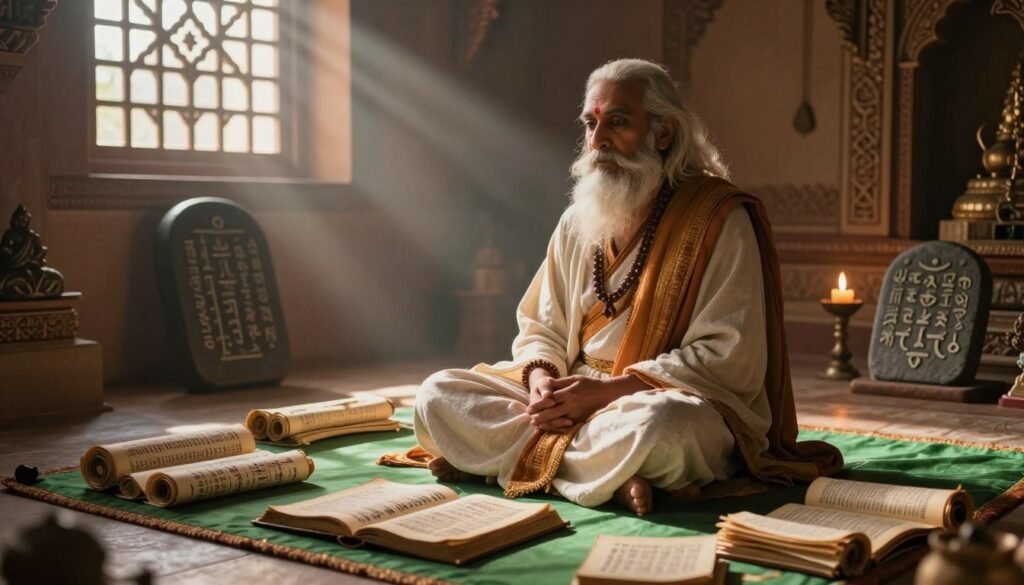
What if the answers to today’s big challenges were hidden in ancient texts? The Indian Knowledge System is a vast framework of wisdom. It connects spiritual insights with practical knowledge. This way of thinking is different from how we divide knowledge today.
The vedic knowledge systems are the heart of bharatiya knowledge heritage. They cover philosophy, science, medicine, and more. Ancient scholars saw all these areas as connected parts of a whole.
The Chaturdash Vidhyasthanams is a key structure for understanding this system. It includes the four Vedas, six Vedangas, and more. This framework maps out human understanding across many fields.
The Indian Knowledge System comes from both revealed and remembered texts. It includes epic stories, philosophical works, and oral traditions. Each part has its own role, yet they all support each other. This makes wisdom accessible to everyone.
Knowing these sources is important for today’s professionals and scholars. The ancient wisdom tackles real issues in education, sustainability, and healthcare. By studying these sources, we can find new ways to solve today’s problems.
Key Takeaways
- The Indian Knowledge System combines spiritual, philosophical, and empirical knowledge into one integrated framework spanning thousands of years
- Chaturdash Vidhyasthanams organizes knowledge into fourteen distinct abodes across four major categories: Vedas, Vedangas, Upangas, and Upavedas
- Vedic knowledge systems distinguish between Shruti (revealed texts) and Smriti (remembered texts) as authoritative sources of wisdom
- Bharatiya knowledge heritage encompasses medicine, mathematics, linguistics, architecture, and governance alongside spiritual teachings
- Ancient Indian sources maintain interconnected relationships between material sciences, ethical frameworks, and metaphysical inquiry
- The Indian Knowledge System remains relevant for addressing contemporary challenges in education, healthcare, sustainability, and cultural preservation
- Oral traditions and folk knowledge preserve practical wisdom that scientific observation and empirical testing have validated
Understanding the Foundations of Ancient Indian Wisdom
Ancient Indian wisdom is a vast system of knowledge that grew over thousands of years. It is rooted in the bharatiya gyana parampara. This tradition offers a unique way to understand reality and solve complex problems. It sees all disciplines as interconnected, like branches of a tree.
This wisdom blends theory with practice. It’s not just about learning facts. It’s about direct experience and personal realization. Scholars valued experiential understanding alongside intellectual study. This way, people can find truth through different paths, not just one.
The epistemological framework of ancient Indian wisdom accepts several sources of valid knowledge:
- Perception through direct sensory observation
- Inference based on logical reasoning
- Comparison and analogy
- Testimony from reliable sources
- Postulation and assumption
- Non-apprehension or absence of evidence
This tradition has shown remarkable endurance. It kept its core teachings through the centuries, adapting to new times. Scholars were experts in many fields. They connected astronomy with philosophy, medicine with metaphysics, and mathematics with spirituality. This integrated view of reality is something modern interdisciplinary work is rediscovering.
The indian intellectual heritage tackles modern challenges well. It offers solutions for climate change, environmental issues, and sustainable development. This wisdom provides ethical guidelines, safeguards cultural heritage, and fosters sustainable economic growth. By understanding these roots, we see how ancient Indian wisdom is relevant today for solving problems and advancing education.
The Vedas as the Epicenter of Knowledge
The Vedas are the oldest surviving texts in the world. They are the foundation of vedic knowledge traditions. These sacred texts are called Shruti, meaning “that which was heard.” They were revealed to ancient seers during deep meditation, not written by humans.
This makes them key to understanding classical indian sciences and traditional indian learning systems.
The four Vedas were compiled by great sages over centuries. Each Veda has four layers of knowledge: the Samhita (hymns), Brahmana (ritual explanations), Aranyaka (forest teachings), and Upanishads (philosophical knowledge). This structure helped organize complex information for generations.
Vedic scholars used remarkable oral preservation techniques. They used multiple recitation patterns and mnemonic systems to keep texts accurate for thousands of years. The guru-shishya (teacher-student) model ensured knowledge passed down with precision and understanding, not mere memorization.
- They contain practical wisdom for daily life
- They explore cosmic principles and natural philosophy
- They preserve ritual procedures and ceremonial knowledge
- They address healing, medicine, and human wellness
Understanding the Vedas is more than just religious texts. They represent humanity’s earliest attempts to systematize knowledge about nature, mathematics, music, medicine, and the universe. Sanskrit scholarly traditions built upon these foundations to create the knowledge systems we explore in this article.
Rigveda: The Book of Hymns and Cosmic Principles
The Rigveda is the oldest of the four Vedas. It contains 1,028 hymns in 10 books called Mandalas. These hymns address fundamental questions about existence, consciousness, and the cosmos. The famous Gayatri Mantra appears within its verses and remains central to vedic knowledge traditions today.
Rigvedic hymns function on multiple levels. On the surface, they praise various deities. Deeper study reveals sophisticated cosmological speculation and early scientific thinking about natural phenomena. The hymns embed mathematical concepts within their metrical structures, demonstrating how ancient scholars integrated knowledge across disciplines.
The Rigveda investigates:
- The origin of the universe and cosmic order
- The nature of consciousness and reality
- Mathematical principles in nature
- Philosophical questions about existence
- Observations of celestial bodies and seasons
These inquiries prefigured later philosophical developments in classical indian sciences. Rigvedic thinkers posed questions that philosophers would refine for centuries, making this text essential for understanding the evolution of indian intellectual traditions.
Yajurveda: Ritualistic Knowledge and Practical Applications
The Yajurveda provides practical instructions for conducting rituals and ceremonies. It exists in two main versions: the Shukla (White) Yajurveda and the Krishna (Black) Yajurveda. Both preserve detailed procedures that priests followed during sacred performances, making this work invaluable for understanding vedic knowledge traditions in practice.
Beyond ritual procedures, the Yajurveda contains sophisticated geometric principles. The Sulba Sutras, attached to this Veda, explain how to construct altars with precise mathematical accuracy. These texts demonstrate early understanding of geometry and spatial relationships that supported both ritual and practical construction.
The Yajurveda also embedded astronomical calculations within ritual instructions. Priests needed to know precise timing for ceremonies, which required understanding celestial movements. This practical application of astronomy shows how sanskrit texts and scriptures integrated observational science with spiritual practice.
Key contributions include:
- Detailed ritual procedures for various ceremonies
- Geometric principles for altar construction
- Astronomical calculations for timing rituals
- Philosophical commentary on ritual significance
- Integration of practical and spiritual knowledge
Samaveda: Musical Traditions and Chanting Practices
The Samaveda derives its name from saman, meaning song or melody. This Veda contains 1,549 verses and establishes the foundation of Indian musical science. While most verses come from the Rigveda, the Samaveda reorganizes them with special attention to musical and rhythmic properties.
This work represents the earliest systematic study of music within traditional indian learning systems. The Samaveda introduces melodic notations and rhythmic patterns that later composers systematized in texts like the Natyashastra. These musical principles became essential to classical Indian music theory and practice.
The Samaveda demonstrates that music was never mere entertainment. Instead, it functioned as a sophisticated science with therapeutic applications. Specific melodies and rhythms could influence mood, health, and consciousness. This understanding positioned music as part of classical indian sciences alongside medicine and mathematics.
Musical elements include:
- Seven fundamental notes (svaras)
- Rhythmic patterns and timing systems
- Melodic rules for chanting Vedic hymns
- Connections between sound and cosmic principles
- Therapeutic applications of specific melodies
Atharvaveda: Medicine, Healing, and Daily Life Sciences
The Atharvaveda contains 20 books with 730 hymns and approximately 6,000 mantras. This text stands apart from the other three Vedas by focusing on practical knowledge for everyday life, medicine, and healing. It bridges spiritual wisdom and material application within vedic knowledge traditions.
The Atharvaveda addresses medical topics with remarkable detail. Its hymns describe surgical procedures, dental practices, embryology, and herbal treatments. These passages reveal empirical observation combined with metaphysical understanding. Practitioners recorded which plants healed specific conditions and documented their effects systematically.
This Veda covers subjects including:
| Knowledge Area | Topics Covered | Applications |
|---|---|---|
| Medicine and Surgery | Surgical procedures, wound treatment, bone-setting | Direct healing practices |
| Pharmacology | Herbal remedies, plant properties, dosages | Preparation of medicines |
| Dentistry and Ophthalmology | Tooth care, eye treatments, oral hygiene | Specialized medical practices |
| Embryology and Reproduction | Fetal development, childbirth, fertility | Women’s health and obstetrics |
| Psychology and Wellness | Mental health, stress relief, spiritual healing | Holistic treatment approaches |
| Agriculture and Food | Crop cultivation, nutrition, food preparation | Sustenance and prosperity |
The Atharvaveda established foundations that Ayurveda later developed into a complete medical system. Sanskrit scholarly traditions built upon these early observations to create systematic medical knowledge. The Atharvaveda shows that classical indian sciences emerged from careful study of nature combined with philosophical reflection.
The Atharva texts also contain practical spells and incantations for protection, prosperity, and healing. Modern scholarship recognizes these as early psychology. The power of words, intention, and positive thinking to influence health and circumstances represents sophisticated understanding of mind-body connections.
The four Vedas together represent humanity’s earliest knowledge system. They combine spiritual inquiry with practical wisdom, philosophical speculation with empirical observation. Within traditional indian learning systems, the Vedas remain the ultimate authority and the source from which all subsequent knowledge traditions derived their legitimacy and direction.
Upanishads: Philosophical Foundations of Indian Thought
The Upanishads are the highest point of Vedic wisdom, marking a big change in Indian thought. They came between 800 and 200 BCE as talks between wise teachers and seekers. Unlike earlier Vedic works, they focus on big questions about reality, consciousness, and human life. They are called “Vedanta,” meaning “the end of the Vedas.”
At the heart of Upanishadic teachings are two key ideas. Brahman is the ultimate reality that underlies everything. Atman is individual consciousness. The Upanishads say these two are the same, a big idea shared through mahavakyas. One famous saying is “Tat Tvam Asi,” or “That Thou Art,” showing that we and the universe are connected.
In the Upanishads, there are two kinds of knowledge. Lower knowledge is about the world we see and reason. Higher knowledge goes beyond that, found through meditation and inner experience. This shows that meditation and direct experience are good ways to understand reality, along with seeing and reasoning.
The major Upanishads include specific texts, each with its own insights:
- Brihadaranyaka Upanishad: Offers deep insights into the universe and the mind
- Chandogya Upanishad: Tells stories and talks about nature
- Mandukya Upanishad: Studies different states of consciousness and the sound Om
- Katha Upanishad: Discusses life, death, and spiritual freedom
- Isha Upanishad: Talks about balancing action and giving up worldly life
The Upanishads have had a big impact on history. They are the base for six main Indian philosophies, including Yoga and Vedanta. Even Buddhism and Jainism were influenced by them. The Upanishads have shaped thought in the East and West for centuries.
| Major Upanishads | Primary Teaching Focus | Central Concept |
|---|---|---|
| Brihadaranyaka | Cosmology and Self-Knowledge | Atman as universal consciousness |
| Chandogya | Teaching Methods and Creation | Om as cosmic principle |
| Mandukya | States of Consciousness | Four aspects of consciousness |
| Katha | Life, Death, and Liberation | Self as beyond death |
| Isha | Integration of Worldly and Spiritual | Balance of action and renunciation |
| Taittiriya | Knowledge and Bliss | Brahman as consciousness and bliss |
The teaching method in the Upanishads is very advanced. Teachers use paradox, silence, and direct experience, not just words. This method pushes students to go beyond thinking and find truth directly. The goal is moksha, or freedom from the cycle of birth and death.
The Upanishads talk about karma and rebirth as natural laws. Our actions shape our future and rebirths. This idea encourages living ethically and growing spiritually. It shows that our actions are connected to a universal moral order, influencing later philosophies in India.
Today, the Upanishads are as relevant as ever. Modern studies of consciousness and neuroscience deal with questions the Upanishads answered long ago. They offer insights into consciousness that go beyond materialism. These ancient texts are valuable for anyone exploring the mind, consciousness, and reality.
The Upanishads have deeply influenced Indian philosophy and continue to be key to understanding Eastern thought. They emphasize direct experience, deep questions, and spiritual growth. These texts challenge us to think about existence and explore the deepest parts of our consciousness.
Vedangas: The Six Limbs Supporting Vedic Knowledge
The Vedangas are key disciplines in classical Indian education. They help keep Vedic knowledge alive for future generations. These six sciences emerged from the need to ensure texts and rituals were done correctly.
Scholars studied language, sound, math, and the sky to meet these needs. Sanskrit texts and literature relied on these disciplines to stay true over centuries.
The six Vedangas are vital for understanding Vedic wisdom. Each one focuses on a different part of knowledge. They are the backbone of classical Indian education.
Together, they form a unique approach to language, astronomy, and rituals. This is one of the earliest known systems in history.
Shiksha, Kalpa, and Vyakarana: Phonetics, Rituals, and Grammar
Shiksha is the study of sound and how to pronounce words correctly. Ancient scholars classified sounds based on where they come from in the mouth. This work was thousands of years ahead of modern phonology.
The Pratisakhya texts gave detailed pronunciation rules for each Vedic school. This ensured that important phonetic differences were kept precise.
Kalpa deals with the rituals and ceremonies needed for Vedic rites. The Kalpa Sutras cover public and domestic rituals, ethics, and geometry. These texts hold knowledge on math, architecture, and ethics, not just for rituals.
Vyakarana is the science of grammar and how words are formed. Panini’s Ashtadhyayi is a masterpiece of linguistics. It uses a meta-language and generative grammar, thousands of years before modern theory.
This work made Sanskrit texts clear and precise. It helped in understanding the language better.
| Vedanga | Primary Focus | Key Contribution to Knowledge | Associated Texts |
|---|---|---|---|
| Shiksha | Phonetics and Articulation | Precise sound classification and pronunciation rules | Pratisakhya texts |
| Kalpa | Rituals and Procedures | Systematic ceremonial frameworks and geometric principles | Shrauta Sutras, Grihya Sutras, Sulba Sutras |
| Vyakarana | Grammar and Linguistics | Generative grammar and word construction rules | Ashtadhyayi of Panini |
Nirukta, Chandas, and Jyotisha: Etymology, Prosody, and Astronomy
Nirukta is the study of word origins and meanings. Yaska’s Nirukta helped understand archaic Vedic words. It laid the groundwork for semantic theory and interpretation.
Chandas looks at poetry and meter with a mathematical eye. Scholars found mathematical structures in Sanskrit poetry. This influenced Indian math traditions.
Jyotisha is about astronomy and astrology. It was used to find the best times for rituals. It evolved from simple timekeeping to complex astronomy. It connected rituals to the universe.
- Nirukta provides etymological analysis of obscure Vedic words
- Chandas reveals mathematical patterns in poetic structure
- Jyotisha calculates celestial positions and auspicious timing
- Each discipline supports accurate Vedic preservation and application
- Together they form an integrated knowledge system
The Vedangas are humanity’s earliest effort to support ancient knowledge. Classical Indian education was built on these six disciplines. They ensured Vedic wisdom was passed down accurately.
Itihasa: Historical Epics as Sources of Dharmic Wisdom
The Itihasa tradition is a special part of traditional Indian scholarship. It mixes history with deep moral and spiritual lessons. The name “Itihasa” means “this is how it was,” setting these texts apart from myths.
These epic stories were key teaching tools. They shared complex ideas and moral lessons with people for many generations. In Hindu traditions, Itihasa is seen as a way to share wisdom through stories.
The Ramayana and the Mahabharata are two major Itihasas. They are more than just history. They offer deep ethical questions and stories that are timeless.
These epics deal with big questions like duty, justice, and personal responsibility. They are important across many cultures and centuries.
The Ramayana: A Manual of Righteous Conduct
Sage Valmiki wrote the Ramayana to explore dharma, or right duty. It tells the story of Rama, showing the balance between personal desires and duties. Rama’s journey teaches us about being a good son, husband, and king.
Sita shows the strength of women, while Lakshmana teaches about brotherly love. Hanuman is the ultimate example of devotion. These characters guide us on how to live ethically.
There are many versions of the Ramayana, like Kamban’s Tamil and Tulsidas’s Hindi. Each version keeps the core teachings but shows different cultural views. This shows how Indian scholarship keeps teachings alive while allowing for cultural expression.
The Mahabharata: Encyclopedia of Knowledge and Ethical Complexity
The Mahabharata, written by Sage Vyasa, is the longest epic poem. It’s more than just a story about war. It’s a vast collection of knowledge on philosophy, statecraft, and more.
The epic war of Kurukshetra is the main story. It’s filled with other stories, dialogues, and teachings on complex moral issues.
The Bhagavad Gita is a key part of the Mahabharata. It’s a conversation between Lord Krishna and Arjuna. It talks about three paths to spiritual growth: action, devotion, and knowledge.
The Gita answers big questions about duty, sacrifice, and finding oneself. It has influenced thinking about ethics worldwide.
| Epic Text | Author | Primary Focus | Key Teachings | Cultural Impact |
|---|---|---|---|---|
| Ramayana | Sage Valmiki | Exemplary conduct and dharma | Duty to family, righteousness in governance, devotion | Moral framework for personal and social life across South Asia |
| Mahabharata | Sage Vyasa | War narrative and encyclopedic knowledge | Ethical complexity, duty in difficult situations, spiritual paths | Influenced legal systems, philosophy, leadership, and strategic thinking |
The Anushasana Parva section teaches about dharma, including social duties and virtues. The Shanti Parva talks about political philosophy and how rulers should govern. It also discusses how individuals can seek spiritual freedom.
Modern scholars see the Mahabharata as a guide for making decisions and solving conflicts. It presents complex moral situations and flawed characters. This encourages readers to think deeply about ethics, much like modern management theories.
The Itihasas show how ancient Indian scholarship combined storytelling with deep thinking. These epics guide us in ethics and offer practical wisdom for today’s challenges. They have influenced philosophy, literature, law, and leadership, showing the lasting value of ancient wisdom.
Puranas: Encyclopedic Repositories of Cultural Heritage
The Puranas are vast collections of sacred literature from ancient India. They made complex ideas easy for everyone to understand. The word “Purana” means “ancient,” bridging the gap between Vedic knowledge and everyday understanding.
Sanskrit texts and traditions in the Puranas hold centuries of wisdom on cosmology, theology, history, and ethics. These texts emerged after the Vedic period to teach complex ideas through stories and genealogies. Unlike Vedic hymns, Puranic literature uses compelling narratives about gods and sages.
Scholars identify eighteen major Puranas, called Mahapuranas, and eighteen secondary ones, known as Upapuranas. These texts cover five main subjects, making them encyclopedias of traditional Indian sciences and culture.
The Eighteen Mahapuranas and Their Five-Fold Subject Matter
The eighteen Mahapuranas focus on different aspects of Hindu philosophy and practice. They show how Sanskrit knowledge systems preserved diverse wisdom. Each Purana offers unique perspectives while staying coherent within a larger framework.
| Purana Name | Primary Focus | Key Teachings | Cultural Significance |
|---|---|---|---|
| Bhagavata Purana | Devotional Theology | Krishna’s life and divine play (lila) | Foundation of bhakti movement |
| Vishnu Purana | Cosmology and Geography | Creation, preservation, and cosmic cycles | Systematic worldview and world maps |
| Shiva Purana | Yogic Practices and Theology | Integration of yoga with divine knowledge | Meditation and spiritual discipline |
| Markandeya Purana | Goddess Theology | Devi Mahatmya section celebrating divine feminine | Women’s spiritual power recognition |
| Matsya Purana | Flood Mythology and History | Preservation myths and dynastic records | Ancient historical consciousness |
| Brahma Purana | Creation and Brahma worship | Primary creation narratives | Understanding universal origins |
| Brahmanda Purana | Cosmic Egg concept | Universe structure and planetary systems | Astronomical and cosmological knowledge |
| Skanda Purana | Sacred geography and pilgrimage | Holy sites and spiritual journeys | Religious tourism and devotion |
The five characteristic subjects (Pancha Lakshana) define all authentic Puranic literature:
- Sarga: The creation and primary formation of the universe from cosmic consciousness
- Pratisarga: Secondary creation and periodic dissolution cycles of reality
- Vamsha: Genealogies of divine beings, sages, and ancient kings
- Manvantara: Cosmic time cycles and the reign periods of different Manus (cosmic administrators)
- Vamshanucharita: Dynastic histories of royal lineages and human civilization
Mythology, Theology, and Human History in Puranic Literature
Puranic mythology is a sophisticated way to share knowledge on philosophy, astronomy, and history. The avatara doctrine combines theological and evolutionary ideas. It shows a deep understanding of natural processes and human development.
- Matsya (fish) – aquatic life forms
- Kurma (tortoise) – amphibious beings
- Varaha (boar) – terrestrial mammals
- Narasimha (man-lion) – transition to human consciousness
- Vamana (dwarf) – early human development
- Parashurama (warrior-sage) – civilizational advancement
- Rama (ideal king) – ethical governance
- Krishna (transcendent teacher) – spiritual wisdom
- Buddha (enlightened one) – philosophical refinement
- Kalki (future warrior) – ultimate transformation
The Puranas highlight two complete incarnations: Rama and Krishna. These figures represent complete divine wisdom in human form. The texts show a deep understanding of time, using yugas, kalpas, and manvantaras.
Geographic descriptions in the Puranas reveal ancient knowledge of trade routes and cultural connections. Dynastic genealogies, though legendary, help reconstruct history. When compared with archaeological evidence, Puranic histories show a sophisticated understanding of the past.
The Puranas show that traditional Indian sciences include cosmology, geography, history, astronomy, and theology. These texts are not rigid dogma but flexible frameworks for understanding. This approach highlights the sophistication of ancient Indian thought and its relevance today.
Darshanas: The Six Classical Philosophical Systems
The Darshanas are the heart of ancient Indian thought. “Darshana” means “viewpoint” or “vision.” These six systems offer different views on reality and human existence. They developed methods to answer big questions about knowledge, reality, ethics, and liberation.
These systems emerged from Vedic foundations and represent centuries of thought. They are not religions but ways to find truth. Each system built on earlier traditions and added its own insights and methods.
Understanding these systems shows their shared focus on rational analysis. They used logic, textual interpretation, and systematic reasoning. This focus on intellect sets them apart from devotional or mystical views.
The philosophers debated and refined their arguments. They created frameworks that covered all aspects of human knowledge and experience.
The Core Philosophical Systems
The six Darshanas can be grouped into three pairs. Each pair focuses on different areas of knowledge:
| Philosophical System | Founder | Primary Focus | Key Contribution |
|---|---|---|---|
| Nyaya | Gautama | Logic and Knowledge | Developed formal logic and methods for valid reasoning |
| Vaisheshika | Kanada | Natural Philosophy | Created atomistic theory of matter and reality |
| Sankhya | Kapila | Dualism and Cosmology | Distinguished consciousness from material energy |
| Yoga | Patanjali | Practical Disciplines | Systematized methods for achieving mental discipline |
| Purva Mimamsa | Jaimini | Vedic Interpretation | Established rules for understanding sacred texts |
| Vedanta | Vyasa | Ultimate Reality | Explored the nature of Brahman and consciousness |
Nyaya focuses on logic and knowledge. It developed a five-part structure for arguments. Nyaya identified four valid knowledge sources: perception, inference, comparison, and testimony.
Vaisheshika views reality as naturalistic. It explains the world through atoms and their combinations. Vaisheshika categorized existence into substances, qualities, actions, and more.
Sankhya introduces radical dualism. It separates consciousness from matter and energy. Sankhya explains how consciousness appears trapped in matter and how to achieve liberation.
Yoga systematizes Sankhya into practical methods. Patanjali’s Yoga Sutras describe eight limbs of yoga. Yoga provides techniques for mental clarity and spiritual advancement.
Purva Mimamsa focuses on interpreting Vedic texts. It developed rules for understanding sacred language. Purva Mimamsa emphasizes dharma as revealed through Vedic injunctions.
Vedanta explores ultimate reality. It interprets the Upanishads to understand Brahman as ultimate consciousness. Vedanta remains influential in contemporary discourse.
Interconnections and Practical Applications
The six Darshanas work together as an integrated system. Nyaya provides logical tools for analyzing claims. Vaisheshika explains the material foundation of consciousness. Sankhya and Yoga address the mind-matter relationship. Purva Mimamsa and Vedanta interpret sacred knowledge and ultimate reality.
- Nyaya and Vaisheshika address knowledge and physical reality
- Sankhya and Yoga explore consciousness and practical transformation
- Purva Mimamsa and Vedanta interpret sacred texts and ultimate truth
The Darshanas show that intellect and spirituality are complementary. Each system engaged scholars for centuries. Their debates refined arguments and deepened understanding. Today, these frameworks offer insights for philosophy, consciousness studies, and more.
Upavedas: Applied Sciences in the Indian Knowledge System
The Upavedas are key to linking Vedic philosophy with everyday life. They cover applied sciences and arts, making abstract knowledge useful. Each Upaveda ties to a primary Veda, showing how ancient Indians connected different fields of study.
This approach shows wisdom was meant to improve our lives. It was for healing, protecting, inspiring arts, and building structures. Wisdom was not just for books but for everyday use.
Ayurveda: The Science of Life and Holistic Medicine
Ayurveda is one of the oldest healing systems. It means “science of life,” showing its focus on wellness. It’s linked to the Atharvaveda, forming a complete health system for body, mind, and spirit.
Ayurveda looks at balance in all life aspects, not just symptoms. It’s based on three main principles: vata, pitta, and kapha. Practitioners use pulse diagnosis to find the right treatment for each person.
Ayurveda and yoga share common practices like breath control and meditation. They see the body as a path to spiritual growth. This holistic approach goes beyond traditional medicine.
Old texts like the Charaka Samhita and Sushruta Samhita listed many medicinal plants and surgical methods. Their wisdom is now being studied again. Ayurveda inspires new healthcare ideas worldwide, showing the value of ancient knowledge.
Dhanurveda, Gandharvaveda, and Shilpaveda: Warfare, Arts, and Architecture
The other Upavedas focused on important human activities:
- Dhanurveda—the science of warfare—covered military strategy and ethics. It taught warriors to be brave, disciplined, and moral.
- Gandharvaveda—the science of music—developed music and performing arts. It linked music to emotions and spiritual growth.
- Shilpaveda—the science of architecture—gave rules for designing buildings. It mixed math, geometry, and aesthetics into architecture.
These Upavedas show Indian knowledge’s focus on excellence in all activities. Whether in medicine, music, building, or defense, there were frameworks for success. They turned everyday tasks into chances for growth and virtue.
Oral Traditions: The Guru-Shishya Parampara
In ancient India, knowledge was passed down through spoken words, not written texts. The guru-shishya parampara, or teacher-student lineage, was key to education. It allowed knowledge to flow from teacher to student through personal interaction.
The Vedas, Upanishads, and great epics were kept accurate for centuries. This was done through advanced memorization and recitation.
The gurukul education system was more than just learning. Students lived with their teachers for years, often twelve or more. This setup helped students grow both intellectually and personally.
Students followed a daily routine that included rituals, service, memorization, discussions, and practical training. This holistic approach helped students develop fully.
The gurukula learning methods had three stages. First, students listened carefully to their teachers, known as shravana. Then, they reflected and questioned, called manana. Lastly, they meditated deeply on the teachings, known as nididhyasana.
This process helped students move from initial understanding to deep realization.
Ancient centers of learning showed the scale and sophistication of Indian education. Nalanda University had thousands of students and hundreds of teachers. Takshashila focused on medicine, mathematics, astronomy, and politics.
Vikramashila and Vallabhi also offered high-quality education. Scholars from all over the world came to these places to learn.
The gurukul learning system used special techniques to keep texts accurate:
- Pada patha—word-by-word recitation
- Krama patha—reciting words in successive pairs
- Jata patha—complex weaving patterns of words
- Ghana patha—even more complex combinations
These methods made it hard for texts to get corrupted. Manuscripts from different times showed how well this worked.
The gurukula learning methods taught discipline, obedience, and service. Students learned by serving their teachers and being around them all the time. The bond between teacher and student was very special.
Switching to written texts had both good and bad sides. It made knowledge more accessible but lost the personal touch. Even with written texts, the guru-shishya relationship was very important.
The oral tradition kept wisdom alive. It shaped education in Asia and continues to influence teaching today. It showed that true knowledge sharing needs a personal connection.
Folk Knowledge: Indigenous Wisdom and Community Practices
Folk knowledge is a living system of practical wisdom. It has been developed by communities in India for generations. Unlike classical texts, it comes from direct experience with the environment and daily life.
These systems show deep understanding of ecology, agriculture, and human relationships. They have been refined over time through observation and adaptation. Folk knowledge is as important as the Vedas and Upanishads in Indian intellectual heritage. It offers solutions to today’s challenges that modern science is only now validating.
The value of indigenous learning lies in its holistic view of the natural world. Communities have kept detailed knowledge about plants, weather, water, and resources. This knowledge is passed down through songs, stories, and practical examples.
It is embedded in daily rituals and seasonal festivals. Recognizing folk knowledge as valuable is important. It shows centuries of observation and experimentation in practical systems.
Indigenous sciences show remarkable understanding of ecological relationships and biodiversity. Communities have developed deep knowledge of forest ecosystems over generations. They know about thousands of plant and animal species and how to use them sustainably.
Sacred groves protect biodiversity by combining spiritual and practical traditions. These groves act as biodiversity reserves in forest patches.
Tribal Knowledge Systems and Forest Conservation
Tribal communities in India have a deep understanding of forest ecology. Their knowledge is now being matched by modern conservation science. They know about species properties, behaviors, and ecological relationships through direct dependence on forests.
They have developed effective conservation systems. These include selective harvesting, seasonal restrictions, and sacred grove protection. These practices were in place long before modern environmental movements.
Tribal herbal medicine systems are often more effective than codified Ayurveda. Communities use hundreds of wild plants for food and medicine. They know how to prepare them and use them, based on generations of practice.
Traditional ecological indicators guide agricultural planning and resource management. They use plant flowering, insect behavior, and natural signs. This approach is very accurate.
Colonial and post-colonial policies destroyed tribal knowledge systems. Forest reservation policies excluded communities from their traditional territories. Educational frameworks stigmatized indigenous knowledge as primitive superstition.
This destruction led to severe ecological degradation. It also resulted in the loss of centuries of knowledge.
| Tribal Knowledge Domain | Key Practices | Ecological Outcomes | Modern Recognition |
|---|---|---|---|
| Forest Management | Selective harvesting, seasonal restrictions, sacred groves | Biodiversity maintenance, species protection, resource sustainability | Protected Area frameworks, UNESCO Biocultural Reserves |
| Herbal Medicine | Plant identification, preparation methods, application knowledge | Health maintenance, reduced dependence on external medicines | Ethnobotanical research, pharmacological validation studies |
| Weather Prediction | Observation of natural signs, plant behavior, animal activity | Agricultural planning, resource allocation, disaster preparedness | Phenological indicators used in climate science |
| Water Management | Watershed management, traditional tank systems, soil conservation | Water security, soil fertility maintenance, flood prevention | Modern watershed development programs |
Agricultural Practices and Natural Farming Methods
Traditional agricultural systems maintained soil fertility and crop diversity. They did this without chemical inputs through centuries of knowledge. Mixed cropping systems combined different plants in fields, maintaining soil nutrients naturally.
Indigenous seed varieties were developed over generations. They were selected for local conditions, nutritional value, and cultural preferences. These varieties created resilient agricultural systems adapted to specific regions.
Farmers used plant-based pest management instead of synthetic pesticides. They harvested water using tanks, step-wells, and watershed management. This adapted to local rainfall and soil conditions.
Integration of agriculture with animal husbandry and forestry created diversified farming systems. These systems provided multiple income sources, nutrient cycling, and reduced risk.
The Green Revolution displaced these traditional systems. It promoted monoculture, chemical fertilizers, and hybrid seeds. This shift caused soil degradation, water depletion, and loss of crop diversity.
Contemporary movements are recovering agricultural folk knowledge. They use natural farming, seed conservation initiatives, and agroecological approaches. This shows the value of indigenous knowledge systems for sustainable food production.
- Mixed Cropping: Planting complementary crops together to maintain soil nutrients and reduce pest populations naturally
- Indigenous Seeds: Traditional varieties selected over generations for local adaptation and nutritional properties
- Natural Pest Management: Using plant-based preparations, beneficial insects, and trap crops instead of synthetic chemicals
- Water Harvesting: Traditional systems like tanks and step-wells adapted to regional rainfall patterns
- Crop Rotation: Seasonal planting sequences that restore soil fertility without external inputs
- Integrated Farming: Combining agriculture, animal husbandry, and forestry for diversified production and nutrient cycling
Folk performance traditions were key for knowledge transmission and community cohesion in India. Harikatha combined entertainment with moral instruction. Yakshagana, Kathakali, and Burrakatha provided educational entertainment in South India.
Puppetry forms like Kathputli addressed social awareness in accessible formats. Seasonal folk songs and dances communicated emotions, history, and agricultural calendars. They reinforced cultural identity and ecological awareness.
These participatory traditions created shared meaning and community solidarity. They cannot be replicated by modern mass media.
The preservation and integration of indigenous knowledge systems with modern science is vital. It addresses sustainability challenges, builds community resilience, and maintains cultural diversity. Recognizing folk knowledge as sophisticated wisdom validates indigenous scholarship. It creates pathways for meaningful engagement with indigenous sciences.
Dharmashastras and Smritis: Legal and Ethical Frameworks
Dharmashastras and Smritis are key parts of ancient Indian education. They set up laws and ethics for society. These texts are divided into Shruti (eternal Vedic knowledge) and Smriti (texts by sages). Smritis change over time, keeping tradition flexible.
The word dharma means many things in traditional Indian education. It includes cosmic order, duty, moral law, and social obligation. Dharmashastra texts evolved over centuries, starting with early Dharma Sutras and reaching a peak between 200 BCE and 900 CE. They shaped Indian society for thousands of years.
- Manusmriti (Laws of Manu): Covers social classes, life stages, and legal procedures
- Yajnavalkya Smriti: Deals with conduct, legal procedures, and penances
- Narada Smriti: Focuses on judicial principles and court organization
- Parashara Smriti: Offers practical guidelines for social order
Traditional Indian education used four types of Sutras:
| Sutra Type | Primary Focus | Educational Purpose |
|---|---|---|
| Dharma Sutras | Guidelines for dharmic life and righteous conduct | Establishing moral and ethical foundations |
| Grihya Sutras | Domestic rituals and life-cycle ceremonies | Guiding household practices and family duties |
| Shrauta Sutras | Elaborate public sacrificial rituals | Training ritual specialists and priests |
| Sulba Sutras | Geometric principles for altar construction | Teaching mathematics and precise measurements |
Classical Indian education used special ways to understand these texts. When Smriti texts were unclear, educators looked at sadachara (conduct of virtuous people). If all else failed, atmatusti (conscience and self-satisfaction) was the final guide. This approach made education flexible yet structured.
Commentaries extended these texts to new situations. Scholars like Medhatithi and Kulluka interpreted Manusmriti for changing times. Vijnanesvara’s Mitakshara became the key commentary on Yajnavalkya Smriti. Later, digest compilations made legal codes for different areas, showing education’s adaptability.
These laws and ethics continue to influence Hindu personal law today. Understanding Dharmashastras and Smritis shows how traditional Indian education balanced universal principles with practical application. It created systems that dealt with various social situations while keeping spiritual and moral values consistent over centuries.
Chaturdash Vidhyasthanams: The Fourteen Abodes of Knowledge
Ancient Indian scholars created a framework called Chaturdash Vidhyasthanams. It means the fourteen abodes of knowledge. This system is more than just a list. It shows a deep understanding of learning developed over time.
The word “Vidhyasthanam” means places where knowledge grows. Each place has its own role but they all connect.
This framework sees knowledge in different ways. Some knowledge comes from revelation and study. Other knowledge comes from reasoning and inquiry. Yet more comes from doing and learning from others. Holistic Indian pedagogy brings all these together.
The Four-Tier Structure of Knowledge Domains
The Chaturdash Vidhyasthanams has four layers. Each layer builds on the last. This shows how ancient Indian education was complete.
| Knowledge Domain | Number of Disciplines | Primary Function | Examples |
|---|---|---|---|
| Vedas | 4 | Foundational revelation and cosmic principles | Rigveda, Yajurveda, Samaveda, Atharvaveda |
| Vedangas | 6 | Auxiliary sciences for Vedic preservation and interpretation | Vyakarana, Shiksha, Kalpa, Nirukta, Chandas, Jyotisha |
| Upangas | 4 | Philosophical expansion and social frameworks | Mimamsa, Nyaya, Puranas, Dharmashastra |
| Upavedas | 4 | Applied sciences for practical living | Ayurveda, Dhanurveda, Gandharvaveda, Shilpaveda |
Integration of Vedas, Vedangas, Upangas, and Upavedas
The Sanskrit learning systems in Chaturdash Vidhyasthanams form a complete knowledge system. The four Vedas are the base, with universal truths in hymns and rituals. These are shruti, passed down through generations.
The six Vedangas support the Vedas. They include:
- Vyakarana – grammar for language understanding
- Shiksha – phonetics for correct pronunciation
- Kalpa – rituals for application
- Nirukta – etymology for word meanings
- Chandas – prosody for poetic rhythm
- Jyotisha – astronomy linking cosmic cycles to knowledge
The four Upangas expand on philosophy and society. Mimamsa looks at ritual interpretation. Nyaya develops logic. Puranas share cultural stories. Dharmashastra sets ethics and laws.
With Upavedas, we reach eighteen disciplines. These applied sciences turn abstract ideas into practical methods. They cover medicine, warfare, arts, and architecture. This is the peak of holistic Indian pedagogy, where theory meets practice.
Today, education often splits specializations from basics. Sanskrit learning systems kept everything connected. Students learned step by step, mastering language before philosophy, and logic before application. This made educated individuals, not just specialists.
The Chaturdash Vidhyasthanams framework is valuable for today’s education. It shows how a complete knowledge system can solve complex problems by understanding many disciplines together.
Relevance of Ancient Indian Sources in Contemporary Times
Ancient Indian knowledge systems are key to solving today’s problems. They offer practical solutions for issues like environmental care and health innovation. We should look at these sources critically, not just with nostalgia. They challenge old ways and meet today’s ethical standards.
The gurukul education model focuses on personal guidance and all-around growth. It corrects the flaws in today’s education. Students learn deeply, morally, and practically. This makes them well-rounded, valuing both old wisdom and new knowledge.
Environmental and Health Applications
Traditional ecological knowledge offers sustainable solutions. It includes farming methods that avoid chemicals and protect biodiversity. Vedic ideas support circular economies and systems thinking.
Ayurveda shows the depth of ancient Indian medical science. It’s holistic, focusing on prevention and treating the whole person. This approach uses plants instead of synthetic drugs, promoting health and wellness.
Educational and Economic Integration
Today, education is blending traditional Indian methods with modern learning. The National Education Policy 2020 supports this. Universities are also exploring ancient knowledge systems.
- Ayurvedic medicine and wellness tourism create sustainable industries
- Traditional crafts generate artisan livelihoods and cultural vitality
- Organic farming provides viable alternatives to chemical agriculture
- Yoga instruction and meditation practices address modern health challenges
The gurukul model’s focus on hands-on learning is backed by modern research. It helps students understand deeply, not just memorize. This approach combines ancient wisdom with modern learning, enriching education.
Studying ancient Indian sources needs careful, scholarly work. We must test these insights, understand their cultural context, and see their practical value. This way, we honor India’s rich intellectual past while keeping it relevant today.
Conclusion
The Indian Knowledge System is a vast collection of wisdom that spans thousands of years. It includes the Vedas, folk traditions, and more. These sources show how ancient scholars viewed the world.
The Vedas gave foundational knowledge about the universe and human life. The Upanishads explored deep questions about consciousness and reality. The Vedangas supported these texts with tools like grammar and astronomy.
The Itihasa epics taught moral lessons through stories. The Puranas made complex ideas simple for everyone. The Darshanas offered systematic ways to examine reality. The Upavedas applied this knowledge to medicine, arts, and warfare.
This system is unique because it connects different areas of learning. It combines science with spirituality and individual concerns with community needs. It treats human experience and consciousness as important subjects for study.
Engaging with the Indian Knowledge System today requires careful study. We must learn these sources with proper understanding. We should accept valuable ideas while rejecting outdated elements.
We can adapt ancient principles to solve current problems. This system offers tools for creating more balanced approaches to life. It encourages integrated learning and holistic health practices.
The sources of the Indian Knowledge System are living traditions, not just old texts. When approached with respect and critical thinking, they bridge the gap between ancient wisdom and modern understanding. They offer solutions for global problems by drawing on millennia of human experience.
Understanding these sources allows us to maintain connection with cultural heritage. The Indian Knowledge System shows that past knowledge and present innovation can work together. It creates frameworks that address complex challenges facing humanity today and tomorrow.

