


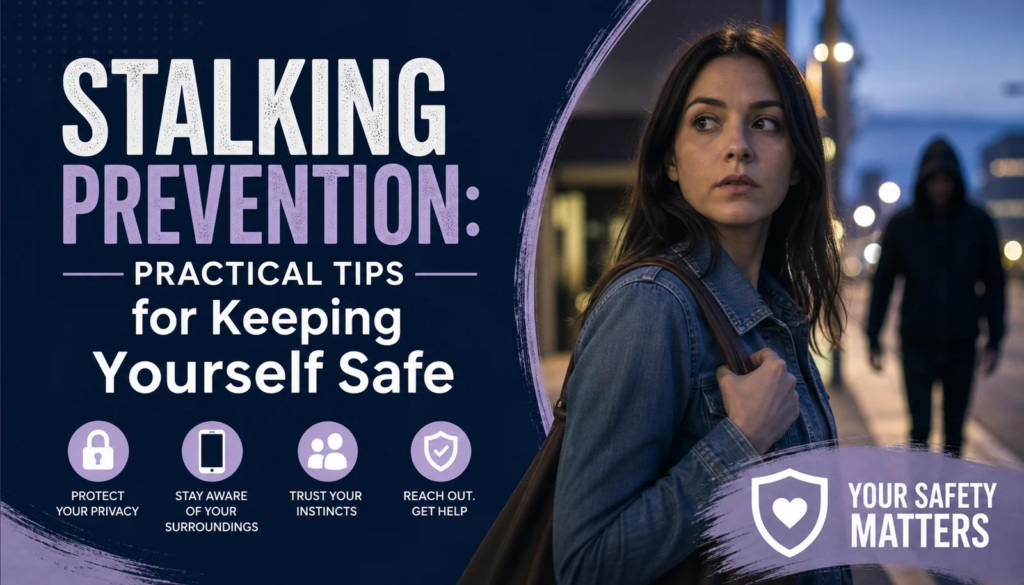
Stalking is not “just unwanted attention.” It is not romantic persistence, harmless jealousy, or a misunderstanding that will automatically fade with time. Stalking is a pattern of intrusive, unwanted behavior that can create fear, disrupt daily life, and escalate into serious harm.
If you are reading this because someone keeps showing up, calling repeatedly, tracking your movements, watching your social media, contacting your friends, or making you feel unsafe, trust that feeling. Your instincts are information.
This guide on Stalking Prevention: Practical Tips for Keeping Yourself Safe is designed to help you recognize warning signs early, reduce risk, document incidents, strengthen digital privacy, involve support systems, and make a practical safety plan. Whether the behavior is coming from an ex-partner, acquaintance, coworker, neighbor, customer, stranger, or someone you met online, the core principles of stalking prevention remain the same: take it seriously, preserve evidence, avoid direct escalation, widen your support network, and get professional help when needed.
If you are in immediate danger, call emergency services right now. If you believe your phone or computer is being monitored, use a safer device—such as one at a library, workplace, trusted friend’s home, or domestic violence organization—to seek help.
Why Stalking Prevention Matters More Than Many People Realize
Stalking often begins in ways that are easy to dismiss: too many messages, “accidental” encounters, gifts left at your door, comments about where you were, or sudden friend requests from unfamiliar accounts. But the problem is not one isolated act. The problem is the pattern.
Effective Stalking Prevention: Practical Tips for Keeping Yourself Safe starts with understanding that stalking is about control, obsession, intimidation, or entitlement. The stalker may want a relationship, revenge, access, emotional reaction, or power over your choices.
Many victims delay taking action because they think:
- “Maybe I’m overreacting.”
- “They haven’t threatened me directly.”
- “I don’t want to make things worse.”
- “No one will believe me.”
- “It’s embarrassing.”
- “They know where I live, so what’s the point?”
These fears are understandable. But early action can make a meaningful difference. Stalking prevention is not about living in fear. It is about regaining control, making informed decisions, and building layers of safety.
What Counts as Stalking?
Stalking usually involves repeated unwanted contact, surveillance, harassment, or intimidation that causes fear or emotional distress. Laws vary by location, but common stalking behaviors include:
| Stalking Behavior | What It May Look Like | Why It Matters |
|---|---|---|
| Repeated unwanted contact | Calls, texts, emails, DMs, letters | Shows disregard for boundaries |
| Physical following | Appearing near home, work, school, gym | Creates fear and restricts freedom |
| Digital surveillance | Tracking apps, fake profiles, monitoring posts | Can reveal routines and locations |
| Third-party contact | Messaging friends, family, coworkers | Expands pressure and embarrassment |
| Threats or implied threats | “You’ll regret this,” “I’m watching” | Indicates possible escalation |
| Unwanted gifts | Flowers, packages, notes | Can be used to force contact |
| Property interference | Damaged car, stolen mail, vandalism | Signals intimidation and control |
| Reputation attacks | Rumors, online posts, false complaints | Can isolate the victim |
| Identity misuse | Opening accounts, impersonation | Can create financial and social harm |
A core point in Stalking Prevention: Practical Tips for Keeping Yourself Safe is this: you do not have to wait for violence before taking the situation seriously. Fear, repeated intrusion, and boundary violations are enough reason to seek support.
Early Warning Signs You Should Not Ignore
Many stalking cases escalate gradually. Recognizing early warning signs can help you intervene sooner.
Common red flags include:
- They contact you repeatedly after you asked them to stop.
- They show up at places you did not tell them you would be.
- They seem to know details about your schedule, friends, or private life.
- They create new numbers or accounts after being blocked.
- They send gifts, money, or messages designed to create guilt.
- They threaten self-harm if you do not respond.
- They contact your family, workplace, school, or new partner.
- They drive by your home or wait outside.
- They frame their behavior as “love,” “concern,” or “closure.”
- They become angry when you set boundaries.
In many cases, the most dangerous period occurs when a victim tries to end contact or leave a relationship. That does not mean you should stay engaged. It means you should plan carefully and get support.
The Foundation of Stalking Prevention: Believe the Pattern
One of the most important ideas in Stalking Prevention: Practical Tips for Keeping Yourself Safe is to stop treating each incident as separate.
A single text might not seem alarming. A single drive-by might be dismissed as coincidence. One unexpected appearance at a café might feel awkward but not threatening.
But ten unwanted texts, two drive-bys, three fake social accounts, and a message to your coworker form a pattern.
Ask yourself:
- Has this person ignored my boundaries more than once?
- Do I feel watched, monitored, or pressured?
- Have I changed my behavior because of them?
- Am I afraid of what they might do if I don’t respond?
- Have they escalated from online contact to in-person contact?
- Have they involved other people?
If the answer is yes, it is time to move from hoping it stops to creating a safety strategy.
Step 1: Take Immediate Safety Precautions
If you believe you are being stalked, your first goal is to reduce risk without escalating the situation unnecessarily.
Immediate actions to consider:
| Safety Step | Why It Helps | Important Note |
|---|---|---|
| Tell trusted people | Reduces isolation and creates witnesses | Share photos, names, and known details |
| Change routines | Makes your movements less predictable | Avoid posting changes publicly |
| Avoid direct confrontation | Reduces risk of escalation | Use legal/professional channels when possible |
| Save evidence | Builds a record for police, court, or employer | Do not delete messages |
| Improve home security | Increases physical safety | Consider cameras, locks, lighting |
| Check digital privacy | Limits access to your location and contacts | Review devices and accounts |
| Contact a victim advocate | Helps with planning and resources | Many services are confidential |
A practical approach to Stalking Prevention: Practical Tips for Keeping Yourself Safe is to think in layers. No single step guarantees safety. But multiple steps—documentation, support, privacy, legal action, and routine changes—can reduce vulnerability.
Step 2: Tell People You Trust
Stalking thrives in secrecy. Victims often feel ashamed or worry they will not be believed. But telling the right people can make you safer.
Consider informing:
- Close friends
- Family members
- Roommates
- Neighbors
- Coworkers or supervisors
- Campus security
- Building security
- Your child’s school or daycare
- A domestic violence or stalking advocate
- A lawyer or legal aid organization
You do not need to share every detail. You can say:
“Someone has been repeatedly contacting and watching me after I asked them to stop. I’m documenting it and making a safety plan. Please don’t share information about me, my schedule, or my location with anyone.”
Give trusted people a photo, name, phone number, vehicle description, and instructions about what to do if the person appears.
This is a key part of Stalking Prevention: Practical Tips for Keeping Yourself Safe because stalkers often seek information through friends, coworkers, or social media. Your support network should understand that privacy is safety.
Step 3: Document Everything
Documentation is one of the strongest tools in stalking prevention. Even when individual incidents seem minor, a detailed log can reveal escalation and establish a pattern.
What to document:
- Date and time
- Location
- What happened
- Screenshots of messages or posts
- Call logs and voicemails
- Photos of gifts, notes, damage, or sightings
- Witness names
- Police report numbers
- Emotional impact or safety changes you made
Sample stalking incident log
| Date/Time | Incident | Evidence Saved | Witnesses | Action Taken |
|---|---|---|---|---|
| March 4, 8:15 PM | Received 14 texts after asking for no contact | Screenshots | None | Saved messages |
| March 6, 7:40 AM | Saw car parked near apartment | Photo of license plate | Neighbor saw car | Told landlord |
| March 9, 12:05 PM | Fake account commented on workplace post | Screenshot, URL | Coworker | Reported account |
| March 11, 6:30 PM | Package left at door | Photo, kept packaging | Roommate | Added to log |
Do not alter evidence. Save original files when possible. Back up evidence to a secure cloud account or external drive the stalker cannot access. If you suspect device monitoring, use a safer device to create backups.
A central principle of Stalking Prevention: Practical Tips for Keeping Yourself Safe is this: documentation can turn “he said, she said” into a timeline.
Step 4: Make a Personalized Safety Plan
A safety plan is not about panic. It is about preparation.
Your plan should cover:
- Home safety
- Work or school safety
- Transportation safety
- Digital safety
- Emergency contacts
- Legal options
- Children or dependents
- Pets, if relevant
- Emotional support
- Evidence storage
Safety planning checklist
| Area | Practical Action |
|---|---|
| Home | Upgrade locks, add lighting, use cameras, inform neighbors |
| Work | Notify supervisor/security, change parking spot, screen calls |
| Travel | Vary routes, avoid isolated areas, use check-ins |
| Online | Turn off location sharing, change passwords, audit privacy |
| Phone | Save evidence, block cautiously, check for unknown apps |
| Emergency | Pack essentials, identify safe places, memorize key numbers |
| Legal | Ask about protective orders, police reports, victim services |
| Support | Choose trusted contacts and code words |
A strong safety plan should be realistic. If a plan is too complicated, you may not use it under stress. Keep it simple, written, and accessible.
Step 5: Strengthen Home Security
Your home should feel like a refuge. If someone is stalking you, home security becomes a major part of Stalking Prevention: Practical Tips for Keeping Yourself Safe.
Practical home safety measures:
- Change locks if the person ever had access to keys.
- Add deadbolts and window locks.
- Use motion-sensor lights.
- Install a doorbell camera or security camera if possible.
- Keep entrances well-lit.
- Ask neighbors to report suspicious activity.
- Do not buzz in unexpected visitors.
- Keep curtains or blinds closed at night.
- Avoid leaving schedules visible through windows.
- Secure mail to prevent theft or information gathering.
If you live in an apartment, notify your landlord or property manager in writing. Ask whether they can improve lighting, fix broken locks, or warn staff not to provide your information.
If the stalker is a former partner, consider whether they know garage codes, alarm codes, spare key locations, Wi-Fi passwords, or smart-home logins.
Step 6: Protect Yourself at Work or School
Stalkers often target workplaces or schools because routines are predictable and public-facing staff may unintentionally share information.
Tell a supervisor, HR representative, campus security officer, or trusted administrator what is happening. You can request that they:
- Keep your schedule confidential.
- Screen calls or visitors.
- Alert security if the person appears.
- Change your work location or parking spot.
- Provide an escort to your car.
- Remove your direct contact details from public pages.
- Document workplace incidents.
- Avoid confirming whether you are present.
Workplace safety script
“I am dealing with an ongoing stalking situation. This person may try to contact me or come here. Please do not share my schedule, phone number, email, or location. If they appear, contact security or law enforcement and notify me immediately.”
This part of Stalking Prevention: Practical Tips for Keeping Yourself Safe is especially important for teachers, healthcare workers, receptionists, retail employees, public officials, performers, journalists, and anyone whose workplace is easy to locate.
Step 7: Improve Digital Safety and Privacy
Modern stalking often includes digital monitoring. A stalker may use social media, shared accounts, spyware, location tags, smart devices, or mutual contacts to track you.
Digital safety is one of the most urgent parts of Stalking Prevention: Practical Tips for Keeping Yourself Safe because online information can quickly become physical risk.
Digital safety checklist
| Digital Risk | Prevention Tip |
|---|---|
| Location sharing | Turn off location sharing in apps and device settings |
| Social media posts | Avoid real-time location updates |
| Weak passwords | Use long, unique passwords and a password manager |
| Account access | Enable two-factor authentication |
| Shared accounts | Remove ex-partners from cloud, streaming, banking, phone plans |
| Unknown devices | Check logged-in sessions and sign out unfamiliar devices |
| Spyware concerns | Use a safer device before changing passwords |
| Public profiles | Limit who can see posts, friends, photos, and check-ins |
| Metadata | Remove location data from photos before posting |
| Smart devices | Change passwords on cameras, locks, speakers, and routers |
Be careful when changing digital settings
If you suspect the stalker has access to your device, changing passwords or blocking them suddenly may alert them. This does not mean you should do nothing. It means you may want help from a trained advocate, digital safety specialist, or trusted technician.
Use a device the stalker has never accessed to:
- Research help.
- Change important passwords.
- Contact advocates.
- Store evidence.
- Review account security.
For many victims, digital privacy is the turning point in Stalking Prevention: Practical Tips for Keeping Yourself Safe. Once the stalker loses easy access to location, schedules, and private conversations, their ability to monitor you may decrease.
Step 8: Be Strategic About Blocking and Responding
A common question is: “Should I block the stalker?”
Sometimes blocking helps. Sometimes it causes the person to escalate, create new accounts, or appear in person. There is no one-size-fits-all answer.
General guidance:
- Do not engage in repeated arguments.
- Avoid emotional responses that reward contact.
- If safe, send one clear message: “Do not contact me again.”
- After that, do not continue responding.
- Save all future messages as evidence.
- Consider muting instead of blocking if you need to monitor threats.
- Ask an advocate or lawyer before responding if legal action is planned.
A simple no-contact message may be useful:
“Do not contact me again in any way. Do not come to my home, workplace, school, or contact people I know.”
Send this only if it is safe and appropriate for your situation. If the person has been violent, threatening, or unstable, consult a professional before sending anything.
An important rule in Stalking Prevention: Practical Tips for Keeping Yourself Safe is to avoid feeding the cycle. Stalkers may interpret any response—even anger—as success.
Step 9: Know When to Involve Law Enforcement
Many victims hesitate to contact police because they fear not being believed or worry the behavior is not “serious enough.” While experiences vary, making a report can create an official record.
Consider contacting law enforcement if:
- You feel physically unsafe.
- The stalker threatens you, themselves, your family, pets, or property.
- They show up at your home, work, or school.
- They violate a protective order.
- They damage property.
- They impersonate you.
- They track or monitor you.
- They possess weapons or have a history of violence.
- The stalking is escalating.
Bring your documentation. A clear timeline is easier to understand than a pile of screenshots with no context.
What to bring when making a report
| Item | Why It Helps |
|---|---|
| Incident log | Shows pattern and escalation |
| Screenshots | Preserves messages and threats |
| Voicemails | Captures tone and content |
| Photos/videos | Shows presence, damage, or gifts |
| Witness names | Supports your account |
| Prior reports | Establishes history |
| Protective orders | Shows legal boundaries |
| Vehicle details | Helps identify the stalker |
Laws differ widely, so ask about local stalking statutes, harassment laws, restraining orders, protective orders, and victim assistance programs.
This guide on Stalking Prevention: Practical Tips for Keeping Yourself Safe does not replace legal advice, but it can help you organize the information professionals need.
Step 10: Explore Protective Orders and Legal Options
A protective order, restraining order, or no-contact order may legally prohibit the stalker from contacting or approaching you. The name and process depend on your location.
Protective orders can be helpful, but they are not a physical shield. They should be part of a larger safety plan.
Potential benefits:
- Establishes clear legal boundaries.
- Creates consequences for violations.
- May require the stalker to stay away from home, work, or school.
- Can help police respond more quickly.
- May support workplace or housing accommodations.
Potential risks:
- The stalker may become angry when served.
- You may need to appear in court.
- Enforcement may vary.
- The order may reveal some location information depending on the process.
Before filing, speak with a victim advocate or lawyer if possible. They can help you understand paperwork, safety planning, evidence, and court procedures.
Step 11: Reduce Location Exposure
Location privacy is a cornerstone of Stalking Prevention: Practical Tips for Keeping Yourself Safe.
Review these common location leaks:
- Social media check-ins
- Tagged photos from friends
- Fitness apps
- Ride-share history
- Shared calendars
- Family phone plans
- Car GPS systems
- Bluetooth trackers
- Smartwatches
- Public event pages
- Online wish lists
- Delivery apps
- Court or property records
- Workplace staff pages
Ask friends not to tag you in real time. If they want to post photos, request that they wait until after you leave the location.
Safer posting habits:
| Risky Habit | Safer Alternative |
|---|---|
| Posting live from a restaurant | Post after you leave |
| Sharing daily routines | Keep routines private |
| Public friend list | Limit visibility |
| Posting child’s school | Avoid identifying locations |
| Sharing vacation dates | Post after returning |
| Tagging gym/workplace | Remove location tags |
Stalkers often use ordinary information creatively. You do not need to disappear from life online, but you should control what you reveal and when.
Step 12: Consider Transportation Safety
Transportation is another predictable area stalkers may exploit.
Practical transportation tips:
- Vary routes when possible.
- Avoid isolated parking lots.
- Park in well-lit areas.
- Ask for escorts to your car.
- Keep your phone charged.
- Check mirrors before leaving.
- Do not drive home if you think you are being followed.
- Go to a police station, fire station, busy store, or other safe public place.
- Keep car doors locked.
- Check for tracking devices if you have reason to suspect one.
If you use public transportation, stand near other passengers, drivers, or staff. If the stalker appears, move toward populated areas and call for help.
Transportation planning is a practical and empowering element of Stalking Prevention: Practical Tips for Keeping Yourself Safe because it reduces predictability.
Step 13: Protect Children, Family Members, and Pets
Stalkers may target people or animals you love as a way to pressure you.
If you have children:
- Notify schools or childcare providers.
- Provide custody documents or protective orders.
- Create a pickup password.
- Tell staff who is not allowed access.
- Teach children age-appropriate safety rules.
- Avoid asking children to keep adult secrets.
- Keep routines private.
For pets:
- Do not leave pets unattended outside.
- Update microchip contact information.
- Tell neighbors or pet sitters about the risk.
- Consider temporary safe care if threats are made.
Family members should also know not to share your address, schedule, phone number, or workplace information.
A complete approach to Stalking Prevention: Practical Tips for Keeping Yourself Safe includes everyone the stalker might use to reach or intimidate you.
Step 14: Take Care of Your Mental and Emotional Health
Stalking can be exhausting. It can cause anxiety, sleep problems, hypervigilance, depression, anger, shame, and isolation. These reactions are normal responses to ongoing threat.
You may find yourself checking windows, changing routines, rereading messages, or feeling constantly on edge. That does not mean you are weak. It means your nervous system is trying to protect you.
Support that may help:
- Trauma-informed counseling
- Domestic violence advocacy
- Stalking victim support groups
- Trusted friends and family
- Legal advocates
- Medical professionals
- Faith or community leaders you trust
Self-care is not a substitute for safety planning, but it supports your ability to make decisions. Rest, food, emotional support, and professional care matter.
Case Study 1: The Ex-Partner Who Would Not Accept Boundaries
Scenario:
Maya ended a two-year relationship after months of controlling behavior. Her ex began sending long apology texts, then angry messages, then flowers. When she stopped responding, he appeared outside her gym and later emailed her supervisor claiming she was unstable.
Actions taken:
Maya saved every message, told her manager, changed her gym schedule, asked friends not to share her location, and contacted a local domestic violence advocate. With help, she filed a police report and explored a protective order.
Outcome:
Her workplace blocked the ex’s emails, security was alerted, and Maya created a safety plan for commuting and home. The documentation helped show a pattern of escalation.
Analysis:
This case shows why Stalking Prevention: Practical Tips for Keeping Yourself Safe must include documentation, workplace awareness, digital privacy, and emotional support. The ex’s behavior shifted from emotional pressure to reputation harm and physical presence. Maya’s early action helped reduce isolation and create official records.
Case Study 2: The Coworker Who Turned Friendly Attention Into Surveillance
Scenario:
Jordan worked in a hospital. A coworker began bringing coffee, waiting near his car, and commenting on his schedule. Jordan politely declined attention, but the coworker became more persistent and started texting from unknown numbers.
Actions taken:
Jordan documented incidents and reported the behavior to HR. Security reviewed camera footage showing the coworker repeatedly waiting near the parking area. HR adjusted schedules and instructed the coworker to stop contact.
Outcome:
When the coworker violated the instruction, the employer took disciplinary action. Jordan also made a police report to create a record.
Analysis:
This example highlights workplace stalking prevention. Stalking Prevention: Practical Tips for Keeping Yourself Safe is not only about ex-partners or strangers. Coworkers can misuse access to schedules, parking areas, and internal systems. Employer involvement can be essential.
Case Study 3: The Online Follower Who Found Offline Access
Scenario:
Lena was a small business owner who posted regularly on social media. A follower began commenting intensely, then sending private messages, then appearing at pop-up events. He mentioned details from her posts, including her favorite café and neighborhood.
Actions taken:
Lena stopped posting real-time locations, removed old posts with location clues, limited story viewers, strengthened account security, and asked event organizers not to publish her booth location until the event opened. She also kept screenshots and notified venue security.
Outcome:
The follower continued messaging, but he lost access to real-time location information. Security at events was prepared, and Lena had evidence if further action became necessary.
Analysis:
This case demonstrates how online visibility can become offline risk. A major part of Stalking Prevention: Practical Tips for Keeping Yourself Safe is controlling location exposure without giving up your career, business, or public presence.
Case Study 4: The Neighbor Who Created Daily Fear
Scenario:
Ruth, a retired teacher, noticed her neighbor watching her from his porch, leaving notes, and complaining when visitors came over. He began knocking late at night and accusing her of ignoring him.
Actions taken:
Ruth told her adult daughter, installed a camera, documented every incident, and asked other neighbors if they had witnessed the behavior. She contacted a local elder support service and made a non-emergency police report.
Outcome:
The camera footage and witness statements helped establish the pattern. Police warned the neighbor, and Ruth’s family helped improve lighting and locks.
Analysis:
This case matters because stalking can happen at any age and in ordinary neighborhoods. Stalking Prevention: Practical Tips for Keeping Yourself Safe includes community awareness, home security, and support for older adults who may feel especially isolated.
Risk Assessment: When Stalking May Be Escalating
Not all stalking cases escalate to violence, but some warning signs deserve urgent attention.
Higher-risk indicators
| Warning Sign | Why It Is Concerning |
|---|---|
| Threats of harm | Shows intent or intimidation |
| Access to weapons | Increases potential danger |
| History of violence | Past behavior predicts risk |
| Strangulation history | Serious domestic violence risk marker |
| Obsession with “winning” you back | May indicate fixation |
| Threats of suicide | Can signal volatility or coercion |
| Violating court orders | Shows disregard for consequences |
| Escalating frequency | Pattern may be intensifying |
| In-person appearances | Moves from digital to physical access |
| Property damage | Shows willingness to cross boundaries |
| Jealousy over new partner | May trigger escalation |
If several of these apply, contact a victim advocate, law enforcement, or emergency services. Do not manage high-risk stalking alone.
What Not to Do When You Are Being Stalked
Stalking can make anyone feel desperate, angry, or tempted to “handle it” directly. But some responses can increase risk.
Avoid:
- Meeting the stalker for “closure.”
- Responding repeatedly to explain your boundaries.
- Threatening them back.
- Posting public insults or challenges.
- Deleting evidence.
- Keeping the situation secret.
- Assuming it will stop because you ignore it.
- Sharing your plans online.
- Asking mutual friends to negotiate without a safety plan.
- Underestimating “minor” incidents.
The safest response depends on the person, history, and level of danger. When in doubt, consult a trained advocate.
Building a Support Team
A strong support team may include:
| Support Person | Role |
|---|---|
| Trusted friend | Emotional support, check-ins |
| Family member | Emergency help, safe place |
| Advocate | Safety planning, legal guidance |
| Lawyer/legal aid | Protective orders, rights |
| Therapist | Trauma support |
| Employer/HR | Workplace safety |
| School official | Campus or child safety |
| Neighbor | Watch for suspicious activity |
| Law enforcement | Reports and emergency response |
When sharing information, be specific. Instead of saying, “My ex is bothering me,” say:
“This person has repeatedly contacted me after being told to stop and has appeared near my home. Please do not share information about me. If you see them, call me and document what happened.”
This is one of the most overlooked parts of Stalking Prevention: Practical Tips for Keeping Yourself Safe: people cannot help effectively if they do not know what to look for.
Creating a Code Word System
A code word can help you ask for help quickly without alerting the stalker.
For example:
- “Did I leave my blue jacket at your house?” = Call me now.
- “Can you send the cookie recipe?” = Call police.
- “I’m running late for dinner” = Come meet me outside.
Choose phrases that sound natural. Share them only with trusted people. Practice what each code word means.
If You Think You Are Being Followed
If you believe someone is following you:
- Do not go home.
- Stay calm and keep moving toward a public place.
- Call emergency services if you feel unsafe.
- Drive to a police station, fire station, hospital, or busy business.
- Avoid isolated roads or parking areas.
- Note vehicle details if safe to do so.
- Do not confront the person.
- Document the incident afterward.
This practical response belongs in every guide to Stalking Prevention: Practical Tips for Keeping Yourself Safe because being followed can trigger panic. Having a plan helps you act quickly.
If the Stalker Uses Mutual Friends
Stalkers sometimes gather information through mutual friends by sounding concerned, charming, or victimized.
They may say:
- “I just want to know if they’re okay.”
- “Can you tell me where they moved?”
- “I need closure.”
- “They blocked me for no reason.”
- “Can you pass along this message?”
Tell mutual contacts clearly:
“Please do not share anything about me, including where I live, work, go, who I’m with, or how I’m doing. Please don’t pass messages between us.”
If someone refuses to respect that boundary, limit what you share with them.
If You Are Stalked by a Stranger
Stranger stalking can be especially frightening because you may not know the person’s motive or identity.
Steps to take:
- Preserve all communications.
- Avoid engaging.
- Strengthen social media privacy.
- Inform people close to you.
- Report fake accounts or harassment.
- Notify workplace, school, or building security.
- Contact police if there are threats or in-person appearances.
- Do not share personal details publicly.
Stranger stalking often involves online research. Protecting your digital footprint is essential.
If You Are Stalked by an Ex-Partner
Stalking by an ex-partner can be particularly dangerous because the person may know your routines, passwords, friends, family, workplace, fears, and vulnerabilities.
Focus on:
- Changing passwords from a safe device.
- Ending shared phone plans or cloud accounts carefully.
- Securing home access.
- Informing friends not to share updates.
- Reviewing custody or visitation arrangements.
- Keeping evidence of threats or violations.
- Consulting a domestic violence advocate.
- Creating an emergency exit plan.
In ex-partner cases, Stalking Prevention: Practical Tips for Keeping Yourself Safe should be trauma-informed and realistic. Leaving or cutting contact may increase risk temporarily, so planning matters.
If Technology Is Being Used Against You
Technology-facilitated stalking can include:
- Spyware
- Hidden cameras
- Bluetooth trackers
- Shared cloud accounts
- Smart home access
- GPS devices
- Social media monitoring
- Email forwarding
- Impersonation
- Password resets
- Phone plan access
Signs of possible digital monitoring:
| Sign | Possible Explanation |
|---|---|
| They know private conversations | Device/account access |
| Battery drains quickly | Normal issue or suspicious app |
| Unknown login alerts | Account compromise |
| Photos/messages disappear | Shared account or access |
| They appear where you go | Location tracking |
| Smart devices behave oddly | Shared login or remote control |
Do not assume technology is the cause, but do investigate carefully. A domestic violence technology safety resource or digital security professional can help.
Practical Privacy Audit
Use this privacy audit as part of Stalking Prevention: Practical Tips for Keeping Yourself Safe.
Accounts to review:
- Banking
- Social media
- Cloud storage
- Phone carrier
- Messaging apps
- Fitness apps
- Ride-share apps
- Delivery apps
- Smart home accounts
- Streaming services
- Shopping accounts
- Shared calendars
- Workplace profiles
Questions to ask:
- Who can see my location?
- Who can reset my password?
- Are recovery emails or phone numbers secure?
- Are unknown devices logged in?
- Are old partners still linked?
- Do my posts reveal routines?
- Can strangers see my friends list?
- Are my photos geotagged?
- Is my address visible online?
Long-Tail Keyword Variations for SEO Context
For readers and content planners, here are natural long-tail variations related to Stalking Prevention: Practical Tips for Keeping Yourself Safe:
- stalking prevention safety tips
- how to protect yourself from stalking
- practical stalking safety plan
- cyberstalking prevention tips
- what to do if someone is stalking you
- stalking prevention for women and men
- online stalking safety advice
- how to document stalking incidents
- workplace stalking prevention tips
- ex-partner stalking safety plan
- digital privacy tips for stalking victims
- personal safety tips for stalking prevention
- legal options for stalking victims
- how to stay safe from a stalker
- home security tips for stalking prevention
These phrases can be used naturally when discussing Stalking Prevention: Practical Tips for Keeping Yourself Safe in blogs, awareness campaigns, workplace materials, and victim support resources.
Stalking Prevention Quick-Action Chart
| Situation | What to Do First | What to Do Next |
|---|---|---|
| Repeated unwanted messages | Save screenshots | Send one no-contact message if safe |
| Stalker appears in person | Move to safety | Document and report |
| Threats are made | Call emergency services if urgent | Save evidence and seek legal help |
| Digital monitoring suspected | Use a safe device | Change passwords with support |
| Workplace contact occurs | Notify supervisor/security | Document every incident |
| Friends are contacted | Set privacy boundaries | Limit info shared with mutual contacts |
| You feel overwhelmed | Contact advocate | Build safety plan |
The Empowering Mindset: Safety Without Shame
One of the hardest parts of being stalked is the way it can shrink your life. You may stop going places, avoid friends, change your clothes, silence your phone, or feel guilty for someone else’s behavior.
But stalking is not your fault.
You are allowed to set boundaries. You are allowed to ask for help. You are allowed to take up space. You are allowed to be believed.
The goal of Stalking Prevention: Practical Tips for Keeping Yourself Safe is not to make you responsible for another person’s choices. The goal is to give you tools, options, and confidence.
Conclusion: Turn Fear Into a Safety Plan
Stalking is serious, but you are not powerless. The most effective approach combines early recognition, documentation, digital privacy, home and workplace safety, legal awareness, and emotional support.
Remember the essentials:
- Trust patterns, not excuses.
- Tell trusted people.
- Document every incident.
- Strengthen digital and physical security.
- Avoid repeated engagement.
- Seek help from advocates, employers, schools, or law enforcement.
- Create a realistic safety plan.
- Take threats and escalation seriously.
Stalking Prevention: Practical Tips for Keeping Yourself Safe is ultimately about reclaiming control. You do not have to wait until things become “bad enough.” If someone is making you feel watched, pressured, threatened, or unsafe, your concern is valid.
Start with one step today: save the evidence, tell one trusted person, review your privacy settings, or contact a victim advocate. Small actions can build a stronger safety net—and that safety net can change everything.
1. What should I do first if I think I’m being stalked?
Start by getting to a safe place, telling someone you trust, and documenting the incidents. Save messages, call logs, screenshots, photos, and notes. If there is an immediate threat, call emergency services. A victim advocate can help you create a personalized safety plan.
2. Should I block the person stalking me?
It depends. Blocking may reduce contact, but it can also cause some stalkers to escalate or use new accounts. If possible, save evidence before blocking. In some cases, muting or filtering messages allows you to preserve evidence without engaging. Ask an advocate or lawyer if you are unsure.
3. Is it stalking if the person never threatened me?
Yes, it can be. Stalking does not always involve direct threats. Repeated unwanted contact, following, monitoring, showing up, or using others to reach you may qualify as stalking if it causes fear or distress. Laws vary, but you do not need to ignore the behavior just because no explicit threat was made.
4. How can I prove stalking is happening?
Keep a detailed incident log with dates, times, locations, descriptions, screenshots, voicemails, photos, witness names, and police report numbers. Patterns matter. A timeline can help law enforcement, courts, employers, or advocates understand the seriousness of the situation.
5. Can cyberstalking become physical stalking?
Yes. Online stalking can escalate into offline contact, especially when a stalker gains access to your location, routines, workplace, school, or social circle. Protecting digital privacy is a major part of Stalking Prevention: Practical Tips for Keeping Yourself Safe.
6. Should I confront the stalker?
Usually, direct confrontation is not recommended. It can escalate the situation or reward the stalker with contact. If safe, one clear written no-contact message may be useful, but repeated explanations are rarely helpful. Seek guidance from an advocate if the situation feels risky.
7. What if the stalker is my ex?
Ex-partner stalking can be high-risk because the person may know your routines, passwords, home, workplace, family, and vulnerabilities. Prioritize a safety plan, change shared access carefully, document everything, tell trusted people, and consider contacting a domestic violence advocate.
8. Can I get a restraining order for stalking?
Possibly. Protective order laws vary by location. Documentation helps. A victim advocate, legal aid office, or attorney can explain your options and help with paperwork. Protective orders can be useful, but they should be combined with a broader safety plan.
9. How do I protect my location online?
Avoid posting real-time locations, turn off location sharing, remove geotags from photos, limit who can see your posts, review app permissions, secure accounts with strong passwords and two-factor authentication, and ask friends not to tag you without permission.
10. Where can I get help?
Depending on your location, help may be available through domestic violence organizations, stalking resource centers, victim advocacy programs, legal aid clinics, campus security, workplace HR, police victim services, therapists, or crisis hotlines. If you are in immediate danger, call emergency services.

