


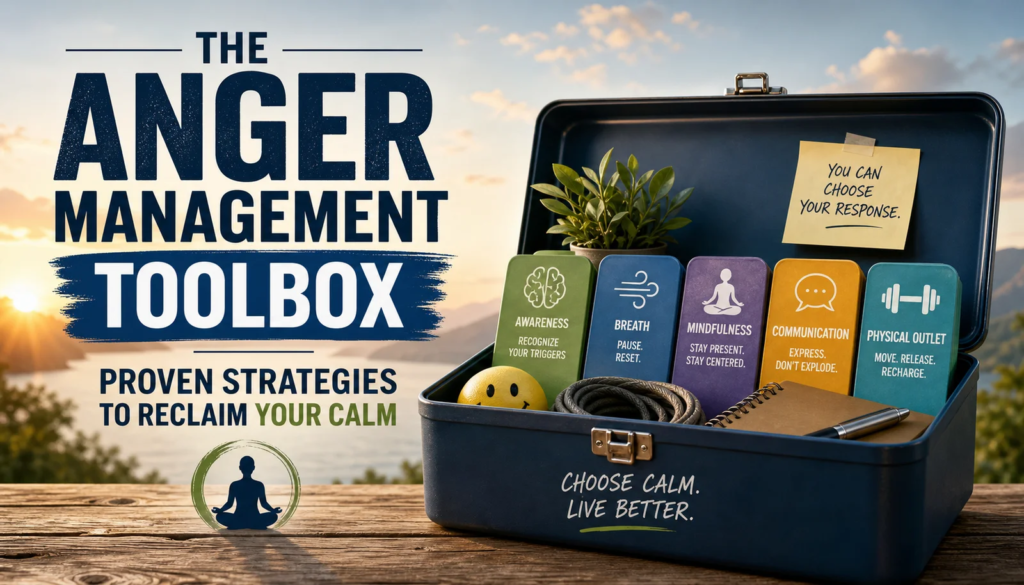
The Ultimate Anger Management Toolbox: Proven Strategies to Reclaim Your Calm
Anger can feel like a match dropped into dry grass. One second you’re irritated, the next you’re saying things you don’t mean, slamming doors, sending a heated text, or replaying the same argument for hours. The worst part? Anger often feels justified in the moment—and embarrassing afterward.
That is exactly why The Anger Management Toolbox: Proven Strategies to Reclaim Your Calm matters. Anger itself is not the enemy. In fact, anger can be a useful signal: something feels unfair, unsafe, disrespectful, overwhelming, or out of alignment with your values. The real problem begins when anger takes the steering wheel.
This guide is designed to give you practical, research-backed, real-life tools you can actually use when your pulse rises and your patience disappears. Think of The Anger Management Toolbox: Proven Strategies to Reclaim Your Calm as a set of emotional “grab-and-go” strategies: some tools help you cool down in the moment, some help you communicate better, and others help you reduce anger before it erupts.
You do not need to become emotionless. You do not need to “just calm down,” which is possibly the least helpful advice in human history. You need skills. You need awareness. You need repeatable strategies that work in traffic, at work, in relationships, with children, online, and inside your own mind.
Let’s open The Anger Management Toolbox: Proven Strategies to Reclaim Your Calm and build a calmer, stronger, more self-respecting way to respond.
Understanding Anger: Why We Lose Calm in the First Place
Before you can manage anger, you need to understand it.
Anger is a protective emotion. It often appears when your brain believes something important is being threatened. That threat may be physical, emotional, social, financial, or psychological.
You may become angry when:
- You feel disrespected.
- Someone violates your boundaries.
- You feel ignored or dismissed.
- You are exhausted, hungry, or overstimulated.
- You believe something is unfair.
- You are afraid but do not want to feel vulnerable.
- You feel powerless.
- Old wounds are triggered by a current event.
In other words, anger is rarely random. It has a source, a story, and a purpose.
The problem is that anger narrows your focus. It pushes your body into fight mode. Your brain prepares you to defend, attack, argue, correct, punish, or escape. That response can be useful if you are in real danger. But when the “threat” is a sarcastic email, a messy kitchen, a delayed flight, or your partner’s tone of voice, fight mode can create more damage than protection.
That is why The Anger Management Toolbox: Proven Strategies to Reclaim Your Calm begins with one essential shift:
Anger is a signal, not a command.
You can listen to the signal without obeying the impulse.
The Anger Cycle: What Happens Before You Explode
Anger usually follows a pattern. Once you understand that pattern, you can interrupt it earlier.
The Common Anger Cycle
| Stage | What Happens | Example | Best Tool to Use |
|---|---|---|---|
| Trigger | Something activates irritation or threat | Someone interrupts you | Pause and label the trigger |
| Interpretation | Your mind creates meaning | “They don’t respect me” | Cognitive reframing |
| Physical arousal | Body enters fight mode | Tight jaw, fast heartbeat | Breathing, grounding |
| Urge | You want to react | Yell, blame, send a text | Delay and choose response |
| Action | Behavior occurs | Argument, sarcasm, withdrawal | Assertive communication |
| Aftermath | Consequences appear | Guilt, conflict, regret | Repair and reflection |
Most people try to control anger at the “action” stage, when they are already on the edge. But The Anger Management Toolbox: Proven Strategies to Reclaim Your Calm works best when you learn to intervene earlier—at the trigger, interpretation, or physical arousal stage.
The earlier you catch anger, the easier it is to guide.
Tool 1: Name the Anger Before It Names You
One of the simplest anger management strategies is also one of the most powerful: labeling the emotion.
Instead of saying, “I’m fine,” try being specific:
- “I’m irritated.”
- “I’m feeling dismissed.”
- “I’m embarrassed, and it’s turning into anger.”
- “I’m overwhelmed.”
- “I feel disrespected.”
- “I’m scared this won’t change.”
Naming anger creates distance between you and the emotion. You are no longer swallowed by it; you are observing it.
This is sometimes called “name it to tame it.” When you identify what you feel, you activate the thinking part of your brain and reduce emotional intensity.
In The Anger Management Toolbox: Proven Strategies to Reclaim Your Calm, this is the first tool because it works quickly and quietly. You can use it in a meeting, during an argument, while parenting, or even while reading a frustrating message.
Try This: The Three-Word Check-In
When anger rises, ask:
- What am I feeling?
- What do I need?
- What is the wise next move?
Example:
- Feeling: “I’m furious.”
- Need: “I need respect and clarity.”
- Wise next move: “I’ll pause before responding.”
This small moment can prevent a large regret.
Tool 2: Learn Your Personal Anger Signals
Anger rarely appears without warning. Your body usually whispers before your behavior shouts.
Common anger signals include:
| Body Signal | Thought Signal | Behavior Signal |
|---|---|---|
| Tight jaw | “This is ridiculous” | Interrupting |
| Clenched fists | “They always do this” | Raising voice |
| Hot face | “I can’t take this” | Pacing |
| Chest pressure | “I’m being attacked” | Sarcasm |
| Shallow breathing | “They don’t care” | Door slamming |
| Tense shoulders | “I need to win this” | Sending long texts |
The goal is to recognize your early-warning system. Your anger signals are like dashboard lights. They are not proof that something terrible is happening; they are information.
The Anger Management Toolbox: Proven Strategies to Reclaim Your Calm becomes more effective when you know your own pattern. Some people get quiet and cold. Others get loud and intense. Some become controlling. Some become passive-aggressive. Some cry because anger and hurt are mixed together.
Awareness is not self-blame. It is self-leadership.
Tool 3: Use the 90-Second Pause
A burst of anger often creates a wave of physical chemistry in the body. If you do not feed it with angry thoughts, that wave can begin to pass relatively quickly.
The 90-second pause is simple:
- Stop talking.
- Put both feet on the floor.
- Breathe slowly.
- Notice the body sensation.
- Do not rehearse your argument.
- Let the first wave move through.
This does not mean the issue disappears. It means you wait until your nervous system is more capable of responding intelligently.
A pause is not weakness. A pause is power under control.
In The Anger Management Toolbox: Proven Strategies to Reclaim Your Calm, the pause is a core strategy because most anger damage happens in the first few seconds: the insult, the accusation, the threat, the text, the slammed door.
A pause gives your future self a chance.
Useful Pause Phrases
If you are with another person, say:
- “I need a minute before I respond.”
- “I want to talk about this, but I’m too heated right now.”
- “I’m going to step away and come back in 20 minutes.”
- “I don’t want to say something hurtful.”
- “Let’s pause. This matters, and I want to handle it better.”
These phrases help you exit without abandoning the conversation.
Case Study 1: James and the Workplace Email Explosion
James was a project manager known for being efficient, direct, and reliable. But when he received critical emails from senior leadership, he often fired back defensive replies within minutes.
One Friday afternoon, his director wrote: “This report needs significant revision. Several sections lack clarity.”
James read it as: “You are incompetent.”
His heart raced. He typed a long response explaining why the report was fine and why the director had misunderstood the data. Before sending it, he remembered a strategy from The Anger Management Toolbox: Proven Strategies to Reclaim Your Calm: pause, label, and reframe.
He stopped and named his emotion: “I feel embarrassed and attacked.”
Then he reframed the message: “The director criticized the report, not my worth.”
Instead of sending the defensive email, James replied: “Thanks for the feedback. I’ll review the sections and send a revised version Monday. If there are specific priorities, please let me know.”
The result? His director responded positively and clarified expectations. James kept his reputation intact and avoided an unnecessary conflict.
Brief Analysis
James’s anger came from interpretation, not just the email itself. He turned feedback into identity threat. By using the pause and reframing tools, he separated criticism from personal worth. This case shows how The Anger Management Toolbox: Proven Strategies to Reclaim Your Calm can protect professional relationships and reduce impulsive reactions.
Tool 4: Challenge the Story Your Anger Is Telling
Anger often comes with a story. Sometimes the story is accurate. Sometimes it is exaggerated, incomplete, or shaped by past experiences.
Common anger stories include:
- “They did that on purpose.”
- “No one respects me.”
- “I always have to handle everything.”
- “If I don’t fight back, I’ll be weak.”
- “They should know better.”
- “This always happens.”
- “I can’t stand this.”
These thoughts intensify anger. They pour fuel on the fire.
Cognitive reframing is the practice of examining the story and asking whether there is another possible interpretation.
Reframing Questions
| Angry Thought | Reframing Question | Calmer Alternative |
|---|---|---|
| “They did this to hurt me” | Do I know their intention? | “I don’t know their motive yet” |
| “This always happens” | Is it truly always? | “This has happened before, and I need to address it” |
| “They don’t care” | Could they be distracted or overwhelmed? | “I need to ask for what I need clearly” |
| “I can’t take it” | What can I do next? | “This is hard, but I can handle one step” |
| “I need to win” | What outcome do I really want? | “I want resolution, not victory” |
The Anger Management Toolbox: Proven Strategies to Reclaim Your Calm does not ask you to deny reality. If someone is genuinely mistreating you, reframing does not mean pretending everything is fine. It means choosing a thought that helps you respond effectively rather than explosively.
A useful phrase is:
“What else could be true?”
That one question can soften certainty and create space for wisdom.
Tool 5: Calm the Body First, Then Solve the Problem
When you are angry, your body is not neutral. It is mobilized. Your nervous system may be in fight-or-flight mode, which makes calm conversation difficult.
Trying to “think rationally” while your body is activated can feel impossible. That is why physical regulation is essential.
Body-Based Calming Tools
| Tool | How to Do It | Why It Works |
|---|---|---|
| Slow exhale breathing | Inhale 4 seconds, exhale 6–8 seconds | Signals safety to the nervous system |
| Cold water reset | Splash cold water on your face or hold a cold drink | Helps reduce physiological arousal |
| Grounding | Name 5 things you see, 4 you feel, 3 you hear | Pulls attention into the present |
| Progressive muscle release | Tense and relax muscle groups | Discharges physical tension |
| Walk it out | Take a brisk 10-minute walk | Burns stress chemicals |
| Unclench ritual | Relax jaw, shoulders, hands | Interrupts anger posture |
The body is often the fastest doorway back to calm. This is why The Anger Management Toolbox: Proven Strategies to Reclaim Your Calm includes physical strategies, not just communication advice.
You cannot always think your way out of anger. Sometimes you have to breathe, move, unclench, cool down, and return.
Tool 6: Practice the “Delay Rule” for Digital Anger
Modern anger has a new battlefield: phones.
A heated text can be sent in five seconds and regretted for five months. Social media comments, emails, group chats, and direct messages make impulsive anger dangerously easy.
The delay rule is simple:
If you are angry, do not send it yet.
Draft it if you must. Do not send it.
Wait:
- 10 minutes for mild irritation
- 1 hour for strong anger
- 24 hours for rage, betrayal, or humiliation
Then reread the message and ask:
- Is this true?
- Is this necessary?
- Is this respectful?
- What outcome will this create?
- Would I say this face-to-face?
In The Anger Management Toolbox: Proven Strategies to Reclaim Your Calm, digital delay is one of the most practical tools because many conflicts escalate through screens. Text removes tone, facial expression, and context. Your brain fills in the blanks—and often fills them with threat.
Better Digital Response Templates
Instead of: “You never listen. I’m done.”
Try: “I’m upset and don’t want to make this worse over text. Can we talk later?”
Instead of: “This is completely unacceptable.”
Try: “I have concerns about this and would like to discuss a solution.”
Instead of: “You clearly don’t care.”
Try: “When this happened, I felt dismissed. I’d like to understand your perspective.”
Calm language does not weaken your message. It makes your message easier to hear.
Tool 7: Use Assertive Communication Instead of Aggression
Anger often becomes destructive when it turns into aggression. Aggression attacks, threatens, blames, mocks, or dominates.
Assertiveness is different. Assertiveness is clear, firm, respectful, and direct.
Aggressive vs. Passive vs. Assertive Communication
| Style | What It Sounds Like | Likely Result |
|---|---|---|
| Passive | “It’s fine,” when it is not | Resentment builds |
| Aggressive | “You’re selfish and useless” | Defensiveness and conflict |
| Passive-aggressive | “Must be nice to never help” | Confusion and tension |
| Assertive | “I need help with this tonight” | Clear request and better chance of cooperation |
The goal is not to suppress anger. The goal is to express the need underneath anger in a way that can be understood.
A helpful assertive formula is:
“When happens, I feel , and I need/request ___.”
Examples:
- “When meetings start late, I feel frustrated because it affects my schedule. I need us to begin on time.”
- “When I’m interrupted, I feel dismissed. I’d like to finish my point.”
- “When the house is left messy after I clean, I feel unappreciated. I need us to divide chores more clearly.”
The Anger Management Toolbox: Proven Strategies to Reclaim Your Calm emphasizes assertiveness because calm does not mean silence. Calm means you can speak truth without losing control.
Case Study 2: Maya and the Parenting Pressure Cooker
Maya was a mother of two young children. Her anger usually appeared during the evening routine: dinner, homework, baths, lunches, bedtime. By 8 p.m., she felt drained and invisible.
One night, her six-year-old spilled juice after Maya had asked him three times to sit properly. She snapped: “Why can’t you listen? You always make everything harder!”
Her child cried. Maya felt immediate guilt.
The next day, Maya wrote down her anger pattern. She realized the trigger was not only the spilled juice. It was exhaustion, lack of support, noise, mess, and the belief: “I have to do everything alone.”
She began using three tools from The Anger Management Toolbox: Proven Strategies to Reclaim Your Calm:
- A pre-evening reset: five minutes alone before dinner.
- A body cue check: unclench jaw and lower shoulders.
- An assertive request to her partner: “I need you to handle baths on weeknights.”
The change was not instant, but it was real. Maya still got frustrated, but she yelled less often. When she did lose her temper, she repaired: “I’m sorry I yelled. I was frustrated, but it’s my job to speak kindly.”
Brief Analysis
Maya’s anger was not a character flaw. It was a signal of overload. Her case shows that anger management is not just about controlling reactions; it is also about changing conditions that create chronic stress. The Anger Management Toolbox: Proven Strategies to Reclaim Your Calm works best when it includes prevention, support, and repair.
Tool 8: Identify Hidden Emotions Beneath Anger
Anger is often a “cover emotion.” It can sit on top of more vulnerable feelings.
Under anger, you may find:
- Hurt
- Fear
- Shame
- Grief
- Loneliness
- Rejection
- Insecurity
- Powerlessness
- Disappointment
- Exhaustion
For many people, anger feels safer than sadness. Anger gives energy. Sadness feels exposed. Anger says, “Attack.” Hurt says, “I needed something and didn’t get it.”
When you ask, “What is beneath my anger?” you often discover the real issue.
For example:
- Anger at a partner for being late may hide fear that you are not a priority.
- Anger at a coworker may hide anxiety about being judged.
- Anger at a child may hide exhaustion and overstimulation.
- Anger at yourself may hide shame or disappointment.
The Anger Management Toolbox: Proven Strategies to Reclaim Your Calm includes emotional honesty because surface anger is not always the deepest truth.
Try this sentence:
“I’m angry, but underneath that I feel…”
This simple prompt can transform conflict.
Tool 9: Create a Personal Trigger Map
A trigger map helps you identify patterns. It turns anger from a mysterious explosion into a trackable process.
Trigger Mapping Chart
| Trigger | Situation | Thought | Body Signal | Usual Reaction | Better Tool |
|---|---|---|---|---|---|
| Criticism | Feedback at work | “I’m failing” | Hot face | Defend | Pause and reframe |
| Disrespect | Being interrupted | “They don’t value me” | Tight chest | Raise voice | Assertive statement |
| Mess | Dirty kitchen | “No one helps” | Jaw tension | Snap | Clear request |
| Traffic | Being cut off | “People are idiots” | Clenched fists | Honking/yelling | Breathing |
| Feeling ignored | No text reply | “They don’t care” | Restlessness | Accuse | Ask directly |
Your map may reveal surprising patterns. Maybe anger comes when you are hungry. Maybe it comes when you feel embarrassed. Maybe it spikes around certain relatives. Maybe it appears when plans change.
In The Anger Management Toolbox: Proven Strategies to Reclaim Your Calm, trigger mapping is a prevention tool. It helps you prepare before anger takes over.
Tool 10: Set Boundaries Before Resentment Builds
Unmanaged anger often begins as unspoken resentment.
Resentment grows when you repeatedly say yes while meaning no, tolerate behavior you dislike, or expect others to read your mind.
Boundaries are not punishments. They are clear statements about what you will accept, what you need, and what you will do.
Boundary Examples
| Situation | Weak Boundary | Clear Boundary |
|---|---|---|
| Friend always cancels | “It’s fine” | “If plans change last minute again, I’ll make other plans next time.” |
| Coworker dumps tasks | “I guess I can” | “I can’t take that on today. My deadline is Friday.” |
| Partner raises voice | “Stop being mean” | “I’ll continue this conversation when we’re both speaking respectfully.” |
| Family criticizes choices | “Whatever” | “I’m not discussing my parenting decisions at dinner.” |
| Child demands attention while you work | “Leave me alone” | “I can help you in 10 minutes. Right now I’m finishing this call.” |
Boundaries reduce anger because they reduce helplessness. They give you a way to protect your energy before you explode.
The Anger Management Toolbox: Proven Strategies to Reclaim Your Calm is incomplete without boundaries. If you keep ignoring your limits, anger will keep trying to announce them for you.
Tool 11: Repair Quickly When You Mess Up
Even with excellent tools, you will still lose your temper sometimes. The goal is progress, not perfection.
Repair is the process of taking responsibility after anger harms connection.
A good repair includes:
- Acknowledgment: “I raised my voice.”
- Responsibility: “That was not okay.”
- Empathy: “I can see that it hurt you.”
- Clarification, not excuse: “I was overwhelmed, but I should have paused.”
- Change plan: “Next time I’ll step away before continuing.”
- Invitation: “Is there anything you need to say?”
Poor repair sounds like:
- “I’m sorry, but you made me angry.”
- “I wouldn’t yell if you listened.”
- “I already said sorry, get over it.”
- “You’re too sensitive.”
Strong repair rebuilds trust.
In The Anger Management Toolbox: Proven Strategies to Reclaim Your Calm, repair is essential because anger management is relational. People do not only need you to stop yelling; they need to see that you understand the impact and are committed to change.
Case Study 3: Lena and the Relationship Argument Loop
Lena and her partner, Chris, had the same fight every weekend. Lena felt Chris did not help enough around the apartment. Chris felt criticized no matter what he did.
Their argument usually went like this:
Lena: “You never help unless I nag you.”
Chris: “That’s not true. You always act like I’m lazy.”
Lena: “Because I have to do everything.”
Chris: “Forget it. I’m not talking about this.”
Both left angry.
During counseling, Lena practiced tools from The Anger Management Toolbox: Proven Strategies to Reclaim Your Calm. She identified her deeper feeling: “I feel alone.” Chris identified his: “I feel like I can’t do anything right.”
They changed the conversation.
Lena said: “When chores pile up, I feel alone and resentful. I need us to divide tasks clearly instead of me asking repeatedly.”
Chris said: “I can do that. I need the conversation to not start with ‘you never.’”
They created a chore list and a Sunday reset routine. Their conflict did not vanish, but the weekly blowups decreased.
Brief Analysis
Lena and Chris were stuck in blame language. Once they named deeper emotions and made specific requests, the conflict became solvable. This case shows how The Anger Management Toolbox: Proven Strategies to Reclaim Your Calm helps couples move from accusation to collaboration.
Tool 12: Change Your Relationship with “Should”
The word “should” is often hidden inside anger.
- “They should know better.”
- “My spouse should notice.”
- “My boss should appreciate me.”
- “People should drive correctly.”
- “My kids should listen the first time.”
- “I shouldn’t have to explain this.”
Sometimes “should” is valid. People should be respectful. Children should be guided. Workplaces should be fair. But when “should” becomes rigid, it creates constant frustration.
A more useful question is:
“Given what is happening, what is the most effective next step?”
This question shifts you from protest to power.
Instead of:
“They should stop interrupting me.”
Try:
“I’ll say, ‘I want to finish my thought before we move on.’”
Instead of:
“My teenager should clean without reminders.”
Try:
“We need a clearer system and consequence.”
Instead of:
“My coworker should understand.”
Try:
“I’ll clarify expectations in writing.”
The Anger Management Toolbox: Proven Strategies to Reclaim Your Calm does not ask you to lower your standards. It asks you to move from mental courtroom to practical leadership.
Tool 13: Use Anger as Data, Not Drama
Anger often points toward something important. Instead of asking only, “How do I get rid of this anger?” ask:
- What boundary has been crossed?
- What value is being violated?
- What need is unmet?
- What pattern keeps repeating?
- What conversation am I avoiding?
- What am I afraid to admit?
- What action would restore self-respect?
This transforms anger into information.
For example:
- Anger about being overworked may reveal a need to renegotiate workload.
- Anger about constant lateness may reveal a need for reliability.
- Anger about being ignored may reveal a need for direct communication.
- Anger about clutter may reveal a need for shared responsibility.
- Anger about criticism may reveal a need for self-worth independent of approval.
When used wisely, anger can lead to growth.
That is a central promise of The Anger Management Toolbox: Proven Strategies to Reclaim Your Calm: not to erase anger, but to turn it into clarity, courage, and constructive action.
Tool 14: Build a Calm-Down Plan Before You Need It
You do not create a fire escape during a fire. You create it beforehand.
A calm-down plan is a written strategy for what you will do when anger rises.
Sample Calm-Down Plan
| Step | My Plan |
|---|---|
| My top triggers | Criticism, feeling ignored, messy shared spaces |
| My early body signals | Tight jaw, hot face, fast talking |
| My pause phrase | “I need a few minutes to think before I respond.” |
| My breathing tool | 4-second inhale, 8-second exhale for 2 minutes |
| My movement tool | 10-minute walk outside |
| My communication reset | “What I meant to say is…” |
| My repair phrase | “I’m sorry I spoke harshly. Let me try again.” |
| My support person | Trusted friend, therapist, coach, partner |
The Anger Management Toolbox: Proven Strategies to Reclaim Your Calm becomes more powerful when it is personalized. A strategy you practice ahead of time is much easier to use under pressure.
Put your plan in your phone. Keep it short. Review it weekly.
Tool 15: Know the Difference Between Anger and Abuse
This distinction matters.
Everyone feels anger. Many people occasionally raise their voice or react poorly. But abuse is a pattern of intimidation, control, fear, humiliation, coercion, or harm.
Anger management is appropriate when someone wants to take responsibility for their reactions and change their behavior.
However, if anger includes threats, physical violence, stalking, forced control, intimidation, property destruction, or making others feel unsafe, professional intervention is essential.
The Anger Management Toolbox: Proven Strategies to Reclaim Your Calm can support healthier emotional regulation, but it is not a substitute for safety planning, crisis support, or professional help in dangerous situations.
If you are afraid of someone’s anger—or afraid of what you may do when angry—seek help immediately from a qualified professional or local emergency resource.
Calm is important. Safety is non-negotiable.
Tool 16: Reduce Baseline Stress to Reduce Anger
Anger is harder to manage when your nervous system is constantly overloaded.
Your “baseline” is your everyday stress level. If your baseline is already high, small triggers feel huge.
Common anger amplifiers include:
- Poor sleep
- Chronic pain
- Financial stress
- Overwork
- Alcohol or substance use
- Too much caffeine
- Lack of exercise
- Constant digital stimulation
- Unresolved trauma
- Relationship strain
- Hunger or dehydration
- No time alone
- Too many responsibilities
This is why anger management is not only about what you do during conflict. It is also about how you live between conflicts.
Baseline Calming Habits
| Habit | Why It Helps |
|---|---|
| Sleep 7–9 hours when possible | Improves impulse control |
| Eat regularly | Prevents irritability from blood sugar drops |
| Move daily | Releases stress and improves mood |
| Limit alcohol during conflict-heavy seasons | Alcohol lowers inhibition |
| Schedule decompression time | Reduces overload |
| Practice mindfulness | Builds awareness before reaction |
| Reduce doomscrolling | Lowers emotional agitation |
| Seek therapy when needed | Addresses deeper patterns |
The Anger Management Toolbox: Proven Strategies to Reclaim Your Calm works best when supported by a calmer lifestyle. You cannot breathe your way out of a life that is constantly burning you out. Sometimes the bravest anger strategy is changing the conditions.
Case Study 4: Raj and the Hidden Cost of Chronic Resentment
Raj worked long hours and rarely said no. His family saw him as dependable. His coworkers saw him as helpful. But inside, Raj was angry most of the time.
He snapped at small things: a misplaced remote, a delayed meeting, a slow cashier. He believed he had an “anger problem,” but when he examined his life, he discovered a resentment problem.
He was overcommitted, under-rested, and afraid of disappointing people.
Raj began applying The Anger Management Toolbox: Proven Strategies to Reclaim Your Calm by setting two boundaries:
- No work emails after 8 p.m.
- One weekend morning reserved for personal time.
He also practiced saying, “I can’t commit to that right now.”
Within a month, he noticed he was less reactive. His anger did not disappear completely, but it became less frequent and less intense.
Brief Analysis
Raj’s anger was the surface symptom of poor boundaries and chronic depletion. His case shows that anger management is not just emotional control; it is energy management. The Anger Management Toolbox: Proven Strategies to Reclaim Your Calm helps people reduce anger by addressing the life patterns that feed it.
Tool 17: Practice Mindfulness Without Making It Complicated
Mindfulness is not about sitting perfectly still for an hour while thinking of nothing. That is not realistic for most people.
Mindfulness simply means noticing what is happening inside and around you without immediately reacting.
For anger, mindfulness sounds like:
- “My chest is tight.”
- “I’m having the thought that she doesn’t respect me.”
- “I want to interrupt.”
- “My anger is at an 8 out of 10.”
- “I need to slow down.”
That moment of noticing creates choice.
The Anger Scale
Use a 1–10 scale:
| Level | Description | Best Action |
|---|---|---|
| 1–3 | Mild irritation | Breathe, clarify, let go |
| 4–5 | Frustration | Name feeling, ask for need |
| 6–7 | Strong anger | Pause, take space, regulate body |
| 8–9 | Rage rising | Stop conversation, leave safely |
| 10 | Out of control | Seek immediate support/safety |
The scale helps you act before level 9. Once you are at level 9 or 10, your options narrow.
In The Anger Management Toolbox: Proven Strategies to Reclaim Your Calm, mindfulness is the skill that helps you notice level 4 before it becomes level 8.
Tool 18: Replace Venting with Processing
Many people believe venting reduces anger. Sometimes it does. But aggressive venting—ranting, insulting, replaying, exaggerating—can actually intensify anger.
The difference is important.
Venting vs. Processing
| Venting | Processing |
|---|---|
| Repeats the same angry story | Explores what happened |
| Focuses on blame | Looks for needs and next steps |
| Uses insults and exaggeration | Uses accurate language |
| Increases emotional intensity | Creates clarity |
| Seeks validation only | Seeks understanding and action |
Instead of saying, “Can you believe what that idiot did?” try:
“I’m really angry about what happened. Can I talk it through and figure out what to do next?”
Processing allows support without feeding the fire.
The Anger Management Toolbox: Proven Strategies to Reclaim Your Calm encourages healthy expression, not emotional dumping. The point is not to bottle anger up. The point is to move anger through with awareness.
Tool 19: Use Humor Carefully
Humor can diffuse anger—but only when it does not dismiss, mock, or minimize.
Helpful humor:
- Laughing at the absurdity of a situation.
- Lightening your own intensity.
- Saying, “My inner courtroom is very dramatic today.”
- Noticing, “I’m arguing with a printer like it personally betrayed me.”
Harmful humor:
- Sarcasm aimed at another person.
- Mocking someone’s feelings.
- Making jokes to avoid accountability.
- Using humor to shut down serious conversations.
Humor works best when directed at the situation or your own overreaction, not at someone else’s dignity.
In The Anger Management Toolbox: Proven Strategies to Reclaim Your Calm, humor is a secondary tool. Use it after safety and respect are established.
Tool 20: Create If-Then Plans for Predictable Triggers
If-then planning helps you prepare for situations that reliably provoke anger.
Examples:
- If traffic is heavy, then I will play a podcast and practice slow breathing.
- If my child refuses bedtime, then I will lower my voice instead of repeating louder.
- If my coworker interrupts me, then I will say, “I’m going to finish this point.”
- If I receive critical feedback, then I will wait 30 minutes before responding.
- If my partner uses a sharp tone, then I will ask, “Can we restart this more calmly?”
If-then plans reduce decision-making under stress. They make your response automatic in a healthier direction.
This is one reason The Anger Management Toolbox: Proven Strategies to Reclaim Your Calm is so practical: it turns vague intentions into specific behaviors.
“Be calmer” is not a plan.
“If I feel my jaw tighten, I will pause and take three slow breaths” is a plan.
Tool 21: Train Your Apology Muscle
Many people resist apologizing because they think it means surrendering the whole argument. It does not.
You can apologize for your delivery without abandoning your point.
Examples:
- “I still want to discuss the issue, but I’m sorry I yelled.”
- “My concern is valid, but my tone was unfair.”
- “I should not have called you that. Let me try again.”
- “I was angry, and I handled it badly.”
This is emotional maturity.
The Anger Management Toolbox: Proven Strategies to Reclaim Your Calm teaches that accountability increases influence. When people feel less attacked, they are more likely to listen.
A strong apology does not make you smaller. It makes the conversation safer.
Tool 22: Build Compassion Without Excusing Bad Behavior
Compassion can reduce anger, but many people resist it because they think it means letting someone off the hook.
Compassion says:
“I can recognize your humanity and still hold a boundary.”
It is possible to think:
- “My boss is under pressure, and I still need respectful communication.”
- “My parent had a hard life, and I still won’t accept insults.”
- “My partner is stressed, and we still need to repair this.”
- “My child is overwhelmed, and I still need to teach responsibility.”
Compassion gives context. Boundaries provide protection.
In The Anger Management Toolbox: Proven Strategies to Reclaim Your Calm, this balance is crucial. Too much anger can dehumanize others. Too little boundary can erase you. Healthy calm does neither.
Tool 23: Know When to Seek Professional Help
Self-help tools are powerful, but sometimes anger needs deeper support.
Consider professional help if:
- You frequently regret what you say or do.
- Others say they feel afraid of your anger.
- You break objects, threaten, or become physically aggressive.
- You cannot calm down for hours or days.
- Anger harms your work or relationships.
- You use alcohol or substances when angry.
- You feel intense shame after anger episodes.
- Your anger is connected to trauma, grief, depression, or anxiety.
- You feel out of control.
Therapy, anger management classes, support groups, coaching, trauma-informed care, or couples counseling can help.
The Anger Management Toolbox: Proven Strategies to Reclaim Your Calm is a strong starting point, but reaching out for help is not failure. It is responsibility.
A Practical 7-Day Anger Reset Plan
Here is a simple one-week plan to begin using the tools immediately.
| Day | Focus | Action |
|---|---|---|
| Day 1 | Awareness | Track three anger moments and rate intensity 1–10 |
| Day 2 | Body signals | Identify your earliest physical anger cues |
| Day 3 | Pause | Practice a 90-second pause during mild irritation |
| Day 4 | Reframe | Challenge one angry thought with “What else could be true?” |
| Day 5 | Communicate | Use one assertive “When/I feel/I need” statement |
| Day 6 | Boundary | Say no or set one respectful limit |
| Day 7 | Review | Write what worked, what was hard, and your next plan |
This is how The Anger Management Toolbox: Proven Strategies to Reclaim Your Calm becomes real: not by reading once, but by practicing in small moments.
Tiny repetitions create emotional strength.
Common Anger Management Mistakes to Avoid
Even well-intentioned people make mistakes when trying to manage anger.
Mistake 1: Suppressing Anger
Suppression sounds like, “I’m not angry,” while your body is boiling. Suppressed anger often leaks out as sarcasm, resentment, withdrawal, headaches, or sudden explosions.
Better: acknowledge anger and choose how to express it.
Mistake 2: Justifying Every Reaction
Feeling angry may be valid. Hurting people with anger is still your responsibility.
Better: separate the emotion from the behavior.
Mistake 3: Waiting Too Long to Speak
Avoiding difficult conversations can create bigger explosions later.
Better: address issues early and calmly.
Mistake 4: Trying to Win
If your goal is to win, someone else has to lose. That mindset damages relationships.
Better: aim for understanding, repair, or resolution.
Mistake 5: Ignoring Physical Needs
Sleep, hunger, stress, and pain all affect anger.
Better: treat your body as part of your emotional system.
Mistake 6: Expecting Instant Transformation
Anger habits are learned over time. They change with practice.
Better: measure progress by faster recovery, better repair, and fewer destructive reactions.
The Anger Management Toolbox: Proven Strategies to Reclaim Your Calm is not magic. It is training. And training works when repeated.
Long-Tail Keyword Variations for Context
For readers, writers, counselors, coaches, and content creators exploring this topic, here are natural long-tail variations related to The Anger Management Toolbox: Proven Strategies to Reclaim Your Calm:
- anger management toolbox for adults
- proven anger management strategies to reclaim calm
- practical tools to control anger in relationships
- how to calm down when angry quickly
- anger management techniques for workplace stress
- emotional regulation tools for anger
- how to stop yelling during arguments
- healthy ways to express anger
- anger management exercises for daily life
- strategies to pause before reacting in anger
- how to manage anger without suppressing emotions
- calm communication techniques during conflict
- anger triggers and coping skills
- anger management plan for better relationships
- how to reduce resentment and irritability
These variations support the broader theme of The Anger Management Toolbox: Proven Strategies to Reclaim Your Calm while keeping the language useful and reader-friendly.
Bringing It All Together: Your Personal Anger Management Toolbox
Let’s simplify everything into a practical toolbox you can return to anytime.
The Essential Anger Management Toolbox
| Goal | Tool | Use When |
|---|---|---|
| Notice anger early | Name the emotion | You feel tension rising |
| Prevent impulsive reaction | 90-second pause | You want to snap |
| Calm your body | Slow exhale breathing | Your heart is racing |
| Change angry thoughts | Reframing | You assume bad intent |
| Communicate clearly | Assertive statements | You need to express a concern |
| Prevent resentment | Boundaries | You feel taken advantage of |
| Reduce repeat conflict | Trigger map | The same issue keeps happening |
| Repair harm | Accountable apology | You reacted poorly |
| Lower baseline anger | Sleep, movement, decompression | You feel constantly irritable |
| Get support | Therapy or coaching | Anger feels unmanageable |
This is the heart of The Anger Management Toolbox: Proven Strategies to Reclaim Your Calm: you do not rely on one strategy. You build a flexible set of skills.
Some situations need breathing. Others need boundaries. Some need a hard conversation. Others need rest. Some need repair. Others need professional support.
The more tools you have, the less likely anger is to control you.
Conclusion: Calm Is a Skill You Can Rebuild
Anger does not make you bad. It makes you human. But what you do with anger can either damage your life or deepen your self-respect.
The Anger Management Toolbox: Proven Strategies to Reclaim Your Calm offers a new path: one where you listen to anger without becoming ruled by it, speak honestly without attacking, set boundaries without cruelty, and repair when you fall short.
Start small. Notice your signals. Pause before reacting. Breathe longer than feels natural. Ask what story your anger is telling. Say what you need clearly. Apologize faster. Protect your energy. Seek help when needed.
You will not become perfectly calm overnight. No one does. But every time you choose a pause over an explosion, a boundary over resentment, or a repair over pride, you are rewiring your response.
Calm is not the absence of anger.
Calm is the ability to stay connected to your values while anger is present.
And that is a powerful kind of freedom.
FAQs About The Anger Management Toolbox: Proven Strategies to Reclaim Your Calm
1. Is anger always a bad emotion?
No. Anger is not bad by itself. It can signal injustice, boundary violations, fear, hurt, or unmet needs. The problem is not feeling anger; the problem is expressing it in harmful or uncontrolled ways. The Anger Management Toolbox: Proven Strategies to Reclaim Your Calm helps you use anger as information instead of letting it become destructive behavior.
2. What is the fastest way to calm down when angry?
The fastest approach is usually physical regulation. Stop talking, slow your breathing, lengthen your exhale, relax your jaw and hands, and take space if needed. A 90-second pause can help your body move out of the first anger surge. Once your body calms, your thinking becomes clearer.
3. How can I stop yelling during arguments?
Begin by noticing your early warning signs: tight chest, faster speech, raised volume, or the urge to interrupt. Use a pause phrase such as, “I want to continue this, but I need a minute to calm down.” Step away briefly, breathe, then return with an assertive statement instead of blame.
4. Does anger management mean suppressing my feelings?
No. Healthy anger management is not suppression. Suppression ignores anger; regulation listens to anger and chooses a constructive response. The goal is to express yourself clearly without attacking, threatening, or escalating the conflict.
5. What should I do if my anger hurts my relationships?
Start with accountability. Acknowledge the specific behavior, apologize without blaming, and explain what you will do differently next time. Then build a plan using tools like trigger mapping, time-outs, assertive communication, and stress reduction. If the pattern continues, consider professional support.
6. Can anger management help with workplace conflict?
Yes. Workplace anger often involves criticism, pressure, miscommunication, or feeling disrespected. Tools such as delaying email responses, reframing feedback, using clear requests, and setting boundaries can reduce conflict while preserving professionalism.
7. When should someone seek professional help for anger?
Seek help if anger feels uncontrollable, leads to threats or aggression, damages relationships, causes fear in others, or leaves you feeling ashamed and unable to change. A therapist, counselor, anger management program, or support group can provide deeper guidance and accountability.

