


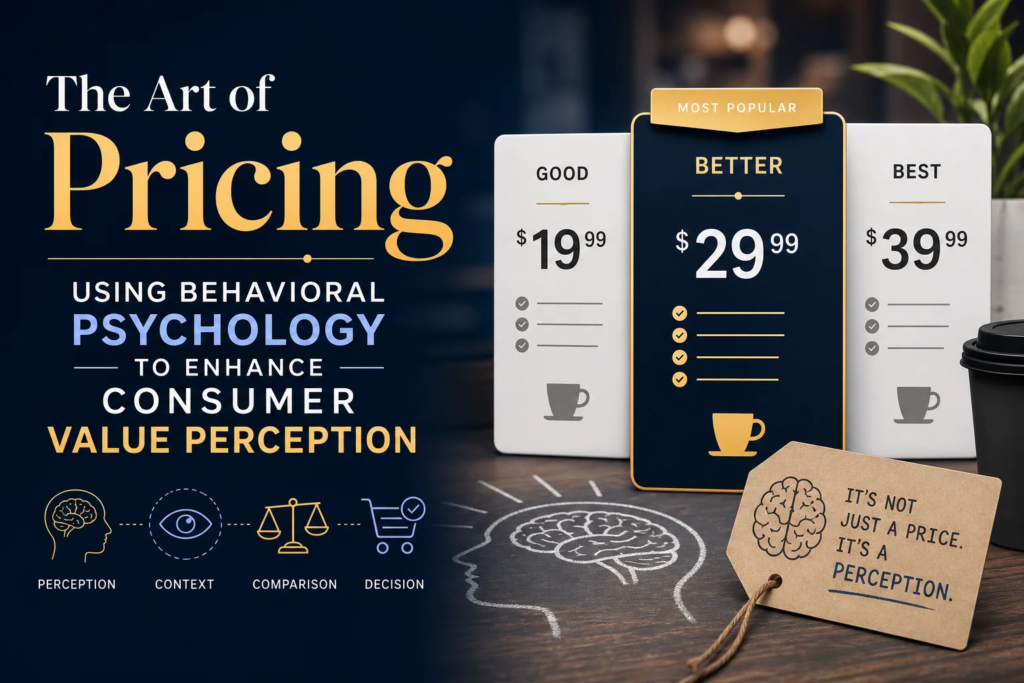
The Ultimate Guide to The Art of Pricing: Using Behavioral Psychology to Enhance Consumer Value Perception
Introduction: Price Is Never Just a Number
A customer does not look at your price in isolation.
They compare it. They question it. They feel it.
They ask themselves, often within seconds: Is this worth it? Is this fair? Am I getting a deal? Will I regret buying—or regret not buying?
That is why The Art of Pricing: Using Behavioral Psychology to Enhance Consumer Value Perception is one of the most powerful skills any business can develop. Pricing is not simply about covering costs or beating competitors. It is about shaping how people interpret value.
A $5 coffee can feel expensive at a gas station and perfectly reasonable at Starbucks. A $1,200 phone can feel like a luxury purchase, yet millions of people buy one because the perceived value stretches far beyond the hardware. A software subscription can feel overpriced at $49 per month—until it is placed beside a $99 premium plan.
This is the heart of The Art of Pricing: Using Behavioral Psychology to Enhance Consumer Value Perception: customers do not always buy the cheapest option. They buy the option that feels most valuable, safest, smartest, or most aligned with who they want to be.
In this article, we will explore how pricing psychology works, why perception often matters more than objective value, and how brands can use proven behavioral principles ethically to increase conversions, trust, and customer satisfaction.
We will also examine real-world case studies, practical pricing frameworks, and common mistakes that damage consumer value perception. By the end, you will understand how to use The Art of Pricing: Using Behavioral Psychology to Enhance Consumer Value Perception not as a manipulation tactic, but as a strategic way to communicate value more clearly.
What Is Behavioral Pricing?
Behavioral pricing is the practice of setting, presenting, and framing prices based on how people actually make decisions—not how traditional economic theory assumes they make decisions.
Classical economics suggests consumers are rational actors who compare options objectively and choose the best value. Real life is messier.
Consumers are influenced by:
- Emotions
- Anchors
- Defaults
- Social proof
- Scarcity
- Loss aversion
- Context
- Brand identity
- Past experiences
- Perceived fairness
That is why The Art of Pricing: Using Behavioral Psychology to Enhance Consumer Value Perception matters so much. A product’s price may be mathematically reasonable, but if it is framed poorly, customers may still reject it.
For example, saying “$1,200 per year” can feel heavy. Saying “$100 per month” feels easier. Saying “less than $4 per day” feels even more manageable. The actual cost may be similar, but the psychological experience changes dramatically.
Behavioral pricing helps businesses answer questions such as:
- How should we present our prices?
- Which package should be the default?
- Should we use discounts or bundles?
- How do we make premium pricing feel justified?
- When does a high price increase trust?
- How do customers define “good value”?
In short, The Art of Pricing: Using Behavioral Psychology to Enhance Consumer Value Perception is about aligning price presentation with human decision-making.
Why Consumer Value Perception Matters More Than Price Alone
Consumers rarely know the true cost of making a product. They do not calculate your supply chain expenses, development hours, employee salaries, or marketing costs.
Instead, they judge value through signals.
These signals include:
| Value Signal | What Customers Think It Means |
|---|---|
| Higher price | Better quality, exclusivity, expertise |
| Discounts | Savings, urgency, opportunity |
| Reviews | Reduced risk, social validation |
| Packaging | Professionalism, care, premium positioning |
| Brand reputation | Trust, consistency, status |
| Guarantees | Confidence, safety, fairness |
| Comparisons | Relative value, smarter choice |
This is why two businesses can sell similar products at very different prices and both succeed. The winner is not always the cheapest. Often, it is the one that best manages perceived value.
A luxury handbag may cost a fraction of its retail price to manufacture, but customers are not only buying leather. They are buying identity, status, craftsmanship, belonging, and emotion. A consultant may charge $500 per hour not just because of time spent, but because of expertise, reduced risk, and business impact.
The art of pricing using behavioral psychology to enhance consumer value perception helps businesses present the full value equation—not just the price tag.
The Core Psychology Behind Pricing Decisions
To master The Art of Pricing: Using Behavioral Psychology to Enhance Consumer Value Perception, you need to understand the mental shortcuts people use when evaluating prices.
1. Anchoring
Anchoring occurs when people rely heavily on the first piece of information they see.
If a customer first sees a $999 product, then a $499 product appears more affordable. If they first see a $49 product, then $499 may feel shocking.
Anchoring is why restaurants often place an expensive bottle of wine at the top of the menu. It makes the rest of the wine list seem more reasonable.
2. Loss Aversion
People dislike losses more than they enjoy equivalent gains.
Losing $100 feels more painful than gaining $100 feels pleasurable. This principle explains why phrases like “Don’t miss out” or “Avoid costly mistakes” can be more persuasive than “Get more benefits.”
In pricing, loss aversion can be used through:
- Limited-time offers
- Free trials ending soon
- Low-stock notifications
- Early-bird pricing
- “Lock in this rate” messaging
3. The Decoy Effect
The decoy effect happens when a third option makes one of the other options look more attractive.
For example:
| Plan | Price | Features |
|---|---|---|
| Basic | $19/month | Limited features |
| Pro | $49/month | Full features |
| Premium | $55/month | Full features + minor extras |
Here, the Premium plan makes the Pro plan look like a smart choice, especially if Premium does not add much value. This is a classic part of The Art of Pricing: Using Behavioral Psychology to Enhance Consumer Value Perception.
4. Price-Quality Heuristic
Many customers assume higher-priced products are better.
This is especially true when they lack technical knowledge. If someone is buying wine, skincare, software, legal services, or consulting, they may use price as a proxy for quality.
That does not mean businesses should inflate prices irresponsibly. It means underpricing can sometimes create distrust.
5. Mental Accounting
People categorize money differently depending on context.
A customer may hesitate to spend $50 on software but happily spend $50 on dinner. A traveler may resist a $20 baggage fee but spend $20 on airport snacks.
The same amount of money feels different depending on the mental “account” it comes from.
6. Social Proof
People look to others when deciding whether a price is acceptable.
If thousands of people have purchased a product, the price feels safer. If high-profile companies use a service, the price feels more justified.
Social proof reinforces consumer value perception by reducing uncertainty.
Pricing Psychology Principles at a Glance
| Behavioral Principle | How It Works | Pricing Application |
|---|---|---|
| Anchoring | First number shapes expectations | Show premium option first |
| Loss aversion | People fear missing out or losing value | Use limited-time savings |
| Decoy effect | A third option influences choice | Create strategic pricing tiers |
| Charm pricing | Prices ending in 9 feel lower | Use $49 instead of $50 |
| Bundling | Combined offers feel more valuable | Package products together |
| Framing | Context changes interpretation | Present cost per day |
| Social proof | Others validate the purchase | Show reviews and customer counts |
| Scarcity | Limited availability increases urgency | Highlight low stock or deadlines |
| Default bias | People stick with preselected options | Make best-value plan the default |
| Fairness perception | Customers avoid unfair pricing | Explain price increases clearly |
Each of these principles supports The Art of Pricing: Using Behavioral Psychology to Enhance Consumer Value Perception when used with honesty and relevance.
Anchoring: The First Price Shapes the Story
Anchoring is one of the most reliable pricing psychology tools.
Imagine walking into a furniture store and seeing a sofa priced at $4,000. A few minutes later, you find another sofa for $1,800. Even if $1,800 is still expensive, it now feels reasonable compared with the anchor.
That first number sets the mental benchmark.
Businesses use anchoring in several ways:
- Showing original prices before sale prices
- Displaying premium packages first
- Comparing monthly cost with annual value
- Presenting competitor prices
- Highlighting “valued at” bundle prices
A strong anchor helps customers understand value before they judge cost.
Case Study: Williams-Sonoma and the Bread Maker
Williams-Sonoma once sold a bread maker that struggled to gain traction. Customers were unsure if it was worth the price. Then the company introduced a larger, more expensive bread maker.
Interestingly, sales of the original model increased.
The higher-priced model acted as an anchor. Suddenly, the original bread maker looked more practical and affordable.
Analysis:
This case is a classic example of The Art of Pricing: Using Behavioral Psychology to Enhance Consumer Value Perception. The product did not change. The context changed. By adding a premium comparison point, Williams-Sonoma improved the perceived value of the original option.
Charm Pricing: Why $9.99 Still Works
Prices ending in 9, 99, or 95 are known as charm prices.
A product priced at $19.99 often feels meaningfully cheaper than one priced at $20, even though the difference is only one cent. This happens because people read from left to right and focus more on the first digit.
$19.99 feels closer to $19 than $20.
Charm pricing is especially effective for:
- Retail products
- E-commerce
- Subscriptions
- Entry-level offers
- Promotional campaigns
However, charm pricing does not fit every brand. Luxury businesses often use round numbers because they signal confidence, elegance, and simplicity.
For example:
| Brand Positioning | Better Price Style | Reason |
|---|---|---|
| Discount retailer | $19.99 | Signals savings |
| Luxury brand | $20 or $200 | Signals confidence |
| SaaS startup | $49/month | Familiar and conversion-friendly |
| Premium consultant | $5,000 package | Professional and clean |
| Marketplace seller | $24.95 | Feels deal-oriented |
The art of pricing with behavioral psychology means matching price format to brand promise.
The Decoy Effect: Guiding Customers Without Pushing Them
The decoy effect is one of the most fascinating parts of The Art of Pricing: Using Behavioral Psychology to Enhance Consumer Value Perception.
A decoy option is not necessarily designed to sell. It is designed to make another option look better.
Famous Case Study: The Economist Subscription Model
A well-known pricing example involved The Economist offering subscription options similar to these:
| Option | Price |
|---|---|
| Digital-only subscription | $59 |
| Print-only subscription | $125 |
| Print + digital subscription | $125 |
The print-only option seemed irrational because customers could get print and digital for the same price. But its presence made the print + digital option look like a bargain.
When the decoy was removed, more people chose the cheaper digital-only option. With the decoy included, more people selected the higher-value bundle.
Analysis:
This case shows how The Art of Pricing: Using Behavioral Psychology to Enhance Consumer Value Perception can increase average order value by changing comparisons. Customers were not forced into a choice; they were given a reference point that clarified value.
Bundling: Making Value Easier to See
Bundling combines multiple products or services into one package.
A bundle can increase perceived value because customers see the total benefit instead of evaluating each item separately.
Examples include:
- Fast-food meal deals
- Software suites
- Streaming service bundles
- Skincare routines
- Consulting packages
- Online course bundles
Bundling works because it reduces decision fatigue. Instead of deciding whether each individual item is worth the price, customers evaluate the package as a whole.
Bundle Pricing Example
| Item | Individual Price |
|---|---|
| Strategy session | $300 |
| Audit report | $500 |
| Implementation checklist | $200 |
| Email support | $250 |
| Total separate value | $1,250 |
| Bundle price | $899 |
The bundle feels attractive because the customer sees $1,250 in value for $899.
This strategy supports The Art of Pricing: Using Behavioral Psychology to Enhance Consumer Value Perception by making savings visible and simplifying the buying decision.
Tiered Pricing: Helping Customers Choose Themselves
Tiered pricing is widely used because it lets customers select the option that fits their needs.
Common tiers include:
- Basic
- Standard
- Premium
Or:
- Starter
- Growth
- Scale
Most customers tend to avoid extremes. They often choose the middle option because it feels safe and balanced. This is known as the compromise effect.
SaaS Pricing Table Example
| Plan | Price | Best For | Psychological Role |
|---|---|---|---|
| Starter | $19/month | Individuals | Low-risk entry |
| Professional | $49/month | Small teams | Best-value anchor |
| Enterprise | $149/month | Larger teams | Premium anchor |
The Enterprise plan makes the Professional plan feel more affordable. The Starter plan gives budget-conscious buyers a way in. The Professional plan becomes the natural choice.
This is one of the most practical applications of The Art of Pricing: Using Behavioral Psychology to Enhance Consumer Value Perception for SaaS companies, agencies, memberships, and service providers.
Premium Pricing: When Higher Prices Increase Desire
Many businesses fear raising prices because they assume customers will leave. Sometimes that is true. But in many markets, a higher price can increase perceived quality.
Premium pricing works best when supported by:
- Strong branding
- Clear differentiation
- High-quality presentation
- Exceptional service
- Expertise or authority
- Social proof
- Scarcity or exclusivity
A premium price sends a message: “This is not ordinary.”
Case Study: Apple and Value Beyond Hardware
Apple products are often priced higher than competing alternatives. Yet customers continue to buy iPhones, MacBooks, AirPods, and Apple Watches in massive numbers.
Why?
Because Apple does not compete on specifications alone. It competes on ecosystem, design, simplicity, status, security, retail experience, and emotional connection.
Analysis:
Apple demonstrates The Art of Pricing: Using Behavioral Psychology to Enhance Consumer Value Perception at a world-class level. Its prices are supported by consistent design, brand trust, product integration, and aspirational identity. Customers feel they are buying more than a device; they are buying reliability, elegance, and belonging.
Framing: The Same Price Can Feel Different
Framing changes how a price is interpreted.
Consider these three ways to present the same cost:
- $365 per year
- $30.42 per month
- $1 per day
The annual price feels larger. The daily price feels almost effortless.
This is why many businesses break prices into smaller units:
- “Less than the cost of coffee”
- “Only $3 per day”
- “Save $500 annually”
- “Get 12 months for the price of 10”
Framing is central to the art of pricing using behavioral psychology to enhance consumer value perception because customers do not only process numbers logically. They process them emotionally.
Framing Examples
| Offer | Weak Frame | Stronger Frame |
|---|---|---|
| Fitness app | $180/year | $0.49/day for guided workouts |
| Insurance | $600/year | Protect your family for $50/month |
| Course | $997 | Build a high-income skill for less than $3/day over a year |
| Software | $99/month | Save 10+ hours monthly for $99 |
The stronger frame connects price to outcome.
Scarcity and Urgency: Making Timing Matter
Scarcity increases perceived value because people want what may soon be unavailable.
Urgency increases action because people do not want to miss an opportunity.
Common examples include:
- “Only 3 left in stock”
- “Offer ends tonight”
- “Enrollment closes Friday”
- “Early-bird pricing expires soon”
- “Limited seats available”
However, scarcity must be honest. Fake urgency can damage trust quickly.
The ethical version of The Art of Pricing: Using Behavioral Psychology to Enhance Consumer Value Perception uses real constraints, not manufactured pressure.
For example, a consultant may only accept five clients per month. A workshop may genuinely have limited seats. A seasonal product may actually sell out.
When scarcity is real, it helps customers make timely decisions.
Fairness: The Hidden Factor Behind Price Acceptance
Consumers are surprisingly sensitive to fairness.
They may accept a high price if it feels justified. But they may reject even a modest price increase if it feels exploitative.
For example, customers may understand a restaurant raising prices due to increased food costs. But if prices rise suddenly with no explanation, customers may feel taken advantage of.
Fair pricing communication matters.
Businesses can improve fairness perception by:
- Explaining price increases transparently
- Offering grandfathered pricing to loyal customers
- Providing added value with higher prices
- Avoiding hidden fees
- Making refund policies clear
- Showing what customers receive
Case Study: JC Penney’s “Fair and Square” Pricing
JC Penney once tried to eliminate frequent discounts and replace them with everyday fair pricing. The idea seemed logical: customers would appreciate honest, simplified prices.
But sales suffered.
Why? Many shoppers were used to coupons, markdowns, and the thrill of getting a deal. Without discounts, prices did not feel as exciting—even if they were fair.
Analysis:
This case reveals an important lesson in The Art of Pricing: Using Behavioral Psychology to Enhance Consumer Value Perception: objective fairness and perceived value are not always the same. Customers often enjoy the feeling of winning. Removing discounts removed part of the emotional reward.
The Power of “Free”
Few words in pricing psychology are as powerful as “free.”
A free bonus, free shipping, free trial, or free consultation can dramatically increase conversions.
Why? Because free removes risk.
Customers love feeling that they are getting extra value without extra cost.
Examples:
- Buy one, get one free
- Free shipping over $50
- Free 14-day trial
- Free onboarding
- Free gift with purchase
- Free audit or assessment
But “free” must be used carefully. If everything is free, customers may question quality. The best strategy is to attach free offers to a meaningful purchase decision.
Case Study: Amazon and Free Shipping Thresholds
Amazon helped popularize the free shipping threshold. Customers often add extra items to their carts to qualify for free shipping.
A shopper may spend $12 more to avoid a $5 shipping fee. Mathematically, this may not always make sense. Psychologically, it feels satisfying.
Analysis:
Amazon’s approach reflects The Art of Pricing: Using Behavioral Psychology to Enhance Consumer Value Perception because it shifts attention from spending more to avoiding a loss. Customers feel rewarded for reaching the threshold.
Subscription Pricing: Reducing Purchase Pain
Subscriptions work because they spread cost over time and turn a big decision into a smaller recurring one.
Instead of asking customers to pay $1,200 upfront, a brand may charge $99 per month.
This reduces purchase pain.
Subscription pricing is effective for:
- Software
- Streaming services
- Membership communities
- Subscription boxes
- Fitness platforms
- Educational programs
- Professional services
However, subscription pricing also requires continuous value delivery. If customers do not see ongoing benefit, churn increases.
Case Study: Netflix and Monthly Entertainment Value
Netflix built its pricing around monthly access rather than individual rentals. Customers could watch as much as they wanted for a predictable monthly fee.
The value perception was simple: unlimited entertainment for less than the cost of a few movie tickets.
Analysis:
Netflix used the art of pricing with behavioral psychology to increase consumer value perception by reducing friction, simplifying choice, and creating a strong value comparison. The monthly fee felt small relative to the entertainment library.
Price Positioning: Cheap, Affordable, Premium, or Luxury?
Your price says something about your brand.
Being cheap is not the same as being affordable. Being expensive is not the same as being premium.
Here is the difference:
| Position | Customer Interpretation | Risk |
|---|---|---|
| Cheap | Lowest cost | May signal low quality |
| Affordable | Good value | Must maintain trust |
| Premium | Better experience | Must justify higher price |
| Luxury | Status and exclusivity | Must protect brand perception |
A business must decide where it wants to live in the customer’s mind.
The art of pricing using behavioral psychology to enhance consumer value perception requires consistency between price, product, message, and experience.
If your brand claims to be premium but your website looks outdated, your price feels questionable. If your product is budget-friendly but your messaging sounds exclusive, customers feel confused.
Pricing is a promise. The rest of your brand must keep that promise.
How to Build a Behavioral Pricing Strategy
Here is a practical framework for applying The Art of Pricing: Using Behavioral Psychology to Enhance Consumer Value Perception in your business.
Step 1: Understand Your Customer’s Reference Points
Ask:
- What alternatives do customers compare you to?
- What prices have they seen before?
- Are they budget-sensitive or outcome-sensitive?
- Do they understand the value you provide?
- Are they buying for convenience, identity, security, or performance?
Your price will always be judged against something.
Step 2: Define Your Value Drivers
List the reasons customers buy from you.
These may include:
- Speed
- Quality
- Expertise
- Convenience
- Status
- Customization
- Safety
- Long-term savings
- Better outcomes
- Reduced stress
The stronger your value drivers, the easier it is to support your price.
Step 3: Choose the Right Pricing Architecture
Common options include:
| Pricing Model | Best For |
|---|---|
| One-time pricing | Products, projects, courses |
| Subscription pricing | Ongoing services or access |
| Tiered pricing | SaaS, memberships, service packages |
| Usage-based pricing | Cloud tools, utilities, APIs |
| Bundle pricing | Retail, education, consulting |
| Premium pricing | Luxury, expert services, high-end products |
| Freemium pricing | Apps, platforms, software |
Your pricing model should fit customer behavior.
Step 4: Create Smart Comparisons
Do not let customers invent their own comparison.
Guide them.
For example:
- Compare your coaching program to the cost of years of trial and error.
- Compare your software to the salary cost of manual work.
- Compare your premium product to cheaper alternatives that fail sooner.
- Compare your course to a college class or private consultant.
This is a vital part of The Art of Pricing: Using Behavioral Psychology to Enhance Consumer Value Perception.
Step 5: Test and Measure
Pricing should not be based only on instinct.
Track:
- Conversion rate
- Average order value
- Customer acquisition cost
- Churn rate
- Refund rate
- Customer lifetime value
- Plan distribution
- Discount dependency
- Net promoter score
Pricing Metrics Dashboard
| Metric | What It Reveals | Why It Matters |
|---|---|---|
| Conversion rate | How many visitors buy | Shows pricing acceptance |
| Average order value | Revenue per transaction | Measures upsell/bundle strength |
| Churn rate | Subscription cancellations | Reveals ongoing value perception |
| Refund rate | Buyer regret or mismatch | Indicates expectation problems |
| Customer lifetime value | Long-term revenue | Helps justify acquisition costs |
| Discount usage | Reliance on promotions | Shows whether full price feels fair |
| Upgrade rate | Movement to higher tiers | Signals perceived premium value |
Common Pricing Mistakes That Hurt Value Perception
Even good products can lose sales because of poor pricing psychology.
Mistake 1: Competing Only on Low Price
Low prices can attract customers, but they can also reduce trust.
If your price is far below the market, customers may wonder what is wrong.
Mistake 2: Offering Too Many Choices
Too many options create confusion. Confused customers often delay buying.
Keep pricing choices simple and meaningful.
Mistake 3: Hiding Fees
Hidden fees destroy trust. They may increase short-term revenue but damage long-term loyalty.
Mistake 4: Discounting Too Often
Constant discounts train customers to wait. They also weaken full-price value perception.
Mistake 5: Failing to Explain Value
If customers do not understand what they receive, any price can feel too high.
Mistake 6: Raising Prices Without Communication
Price increases are easier to accept when customers understand why they are happening and what additional value they will receive.
Avoiding these mistakes is essential to The Art of Pricing: Using Behavioral Psychology to Enhance Consumer Value Perception.
Ethical Pricing: Persuasion Without Manipulation
Behavioral pricing is powerful, which means it must be used responsibly.
Ethical pricing helps customers make better decisions. Manipulative pricing pressures them into decisions they may regret.
Ethical pricing includes:
- Honest scarcity
- Clear comparisons
- Transparent fees
- Real discounts
- Accurate claims
- Simple cancellation terms
- Respect for customer autonomy
Unethical pricing includes:
- Fake countdown timers
- Inflated original prices
- Hidden subscription renewals
- Confusing checkout fees
- Misleading “limited” claims
- Dark patterns that make cancellation difficult
The best version of The Art of Pricing: Using Behavioral Psychology to Enhance Consumer Value Perception builds trust while increasing revenue. It makes value easier to understand, not harder to question.
Case Study: Starbucks and the Psychology of Everyday Premium
Starbucks transformed coffee from a low-cost commodity into an affordable luxury.
Customers are not simply paying for coffee beans and water. They are paying for:
- Atmosphere
- Convenience
- Personalization
- Brand familiarity
- Social identity
- Consistency
- A “third place” between home and work
A $6 latte may seem expensive compared with home-brewed coffee. But Starbucks frames the purchase as an experience, a ritual, and a small personal reward.
Analysis:
Starbucks is a strong example of The Art of Pricing: Using Behavioral Psychology to Enhance Consumer Value Perception because it elevates an ordinary product through environment, branding, customization, and habit formation. The perceived value is emotional as much as functional.
Case Study: SaaS Companies and the “Most Popular” Plan
Many SaaS companies highlight one pricing tier as “Most Popular” or “Best Value.”
This small label can significantly influence behavior. It reduces uncertainty by signaling that many other customers choose that plan.
A typical SaaS layout might look like this:
| Plan | Price | Label |
|---|---|---|
| Basic | $15/month | Good for individuals |
| Pro | $39/month | Most Popular |
| Business | $99/month | Best for teams |
The label acts as social proof. Customers feel safer choosing the recommended option.
Analysis:
This approach shows the art of pricing using behavioral psychology to enhance consumer value perception through guidance. Buyers do not always want endless freedom; often, they want confidence that they are making the right choice.
The Role of Storytelling in Pricing
Numbers tell. Stories sell.
A price becomes more persuasive when it is attached to a story of transformation.
For example, compare:
“Our course costs $799.”
With:
“For $799, you get a step-by-step system that helps you avoid months of guesswork, build a professional portfolio, and start applying for higher-paying roles with confidence.”
The second version gives meaning to the price.
Storytelling improves value perception by answering:
- What problem does this solve?
- What pain does this remove?
- What future does this create?
- What risk does this reduce?
- Why is this worth paying for now?
The art of pricing with behavioral psychology is not only about numbers. It is about narrative.
How to Communicate Price Increases Without Losing Trust
Price increases are often necessary. Costs rise. Quality improves. Demand grows. Businesses evolve.
But customers need context.
A poor price increase sounds like this:
“Starting next month, prices are going up.”
A better version sounds like this:
“To continue improving product quality, expanding support, and delivering faster turnaround times, our pricing will increase on June 1. Existing customers will keep their current rate for the next six months as a thank-you for their loyalty.”
This communication works because it includes:
- Reason
- Timeline
- Added value
- Respect for loyalty
- Transparency
Price increases become easier when customers feel included rather than surprised.
This is another practical application of The Art of Pricing: Using Behavioral Psychology to Enhance Consumer Value Perception.
Long-Tail Keyword Variations for Contextual SEO
Throughout this article, we have naturally explored variations such as:
- behavioral psychology pricing strategies
- consumer value perception in pricing
- pricing psychology for businesses
- how to use behavioral pricing ethically
- psychological pricing techniques that increase sales
- value-based pricing and consumer behavior
- the art of pricing with behavioral psychology
- enhancing perceived value through pricing
- pricing strategy using consumer psychology
- behavioral pricing examples and case studies
These variations support the broader theme of The Art of Pricing: Using Behavioral Psychology to Enhance Consumer Value Perception while keeping the content readable and natural.
Practical Pricing Checklist
Before launching or changing your prices, ask these questions:
| Question | Why It Matters |
|---|---|
| Does the price match our brand position? | Prevents confusion |
| Is the value clearly explained? | Reduces hesitation |
| Are customers given helpful comparisons? | Shapes perception |
| Is there a strong anchor? | Improves context |
| Are pricing tiers easy to understand? | Reduces decision fatigue |
| Is scarcity real and ethical? | Protects trust |
| Are discounts strategic, not constant? | Preserves value |
| Is the checkout process transparent? | Avoids resentment |
| Do we measure customer response? | Enables improvement |
This checklist can help any business apply The Art of Pricing: Using Behavioral Psychology to Enhance Consumer Value Perception with more clarity and confidence.
Conclusion: Price the Value, Not Just the Product
Pricing is more than arithmetic. It is communication.
Every price tells a story about your product, your brand, your confidence, and your customer. The question is whether that story makes value obvious—or leaves customers guessing.
The Art of Pricing: Using Behavioral Psychology to Enhance Consumer Value Perception teaches us that people do not simply buy based on cost. They buy based on meaning, comparison, trust, emotion, and expected outcome.
Anchoring helps customers understand context. Bundling makes value easier to see. Tiered pricing guides choices. Framing makes costs feel manageable. Social proof reduces risk. Scarcity encourages timely action. Fairness protects trust.
The goal is not to trick customers into paying more. The goal is to help them recognize the value that is already there.
When pricing is done well, customers feel confident, respected, and satisfied. They do not feel pressured. They feel understood.
That is the real power of The Art of Pricing: Using Behavioral Psychology to Enhance Consumer Value Perception: it turns price from an obstacle into a bridge between what you offer and what your customer truly values.
FAQs About The Art of Pricing: Using Behavioral Psychology to Enhance Consumer Value Perception
1. What is the main idea behind The Art of Pricing: Using Behavioral Psychology to Enhance Consumer Value Perception?
The main idea is that customers judge prices based on perception, context, emotion, and comparison—not just logic. By using behavioral psychology, businesses can present prices in ways that make value clearer and buying decisions easier.
2. Is psychological pricing manipulative?
Not necessarily. Psychological pricing becomes manipulative when it uses deception, fake scarcity, hidden fees, or misleading discounts. Ethical behavioral pricing helps customers understand value and make confident decisions.
3. Why do customers often choose the middle pricing option?
Many customers choose the middle option because it feels balanced. It is not the cheapest, which may seem limited, and not the most expensive, which may feel risky. This is called the compromise effect.
4. Does charm pricing like $9.99 still work?
Yes, charm pricing can still work, especially in retail and e-commerce. Prices ending in 9 often feel lower because people focus on the leftmost digit. However, premium and luxury brands may benefit more from round-number pricing.
5. How can small businesses use The Art of Pricing: Using Behavioral Psychology to Enhance Consumer Value Perception?
Small businesses can use anchoring, bundles, clear pricing tiers, testimonials, transparent guarantees, and value-based messaging. Even simple changes—like showing the original value of a package or labeling a plan “Best Value”—can improve consumer value perception.
6. What is the biggest pricing mistake businesses make?
One major mistake is assuming customers only care about the lowest price. Many customers care more about trust, quality, convenience, and outcomes. Competing only on price can weaken brand perception and reduce profitability.
7. How often should a business test pricing?
Businesses should review pricing regularly, especially when costs, customer segments, competitors, or product value changes. Testing should be careful and data-driven, using metrics like conversion rate, churn, average order value, and customer lifetime value.
8. Can raising prices increase sales?
In some cases, yes. A higher price can signal better quality, exclusivity, or expertise. However, the increase must be supported by strong branding, clear value, trust, and customer experience.
9. What is the best pricing strategy for subscription businesses?
The best strategy often includes tiered pricing, a clear best-value plan, monthly and annual options, and strong onboarding. Subscription businesses must continuously reinforce value to reduce cancellations.
10. How do I know if my price feels fair to customers?
Watch customer behavior and feedback. High objections, abandoned carts, refund requests, or discount dependency may signal weak value perception. Clear communication, transparent pricing, and strong proof can improve perceived fairness.

