


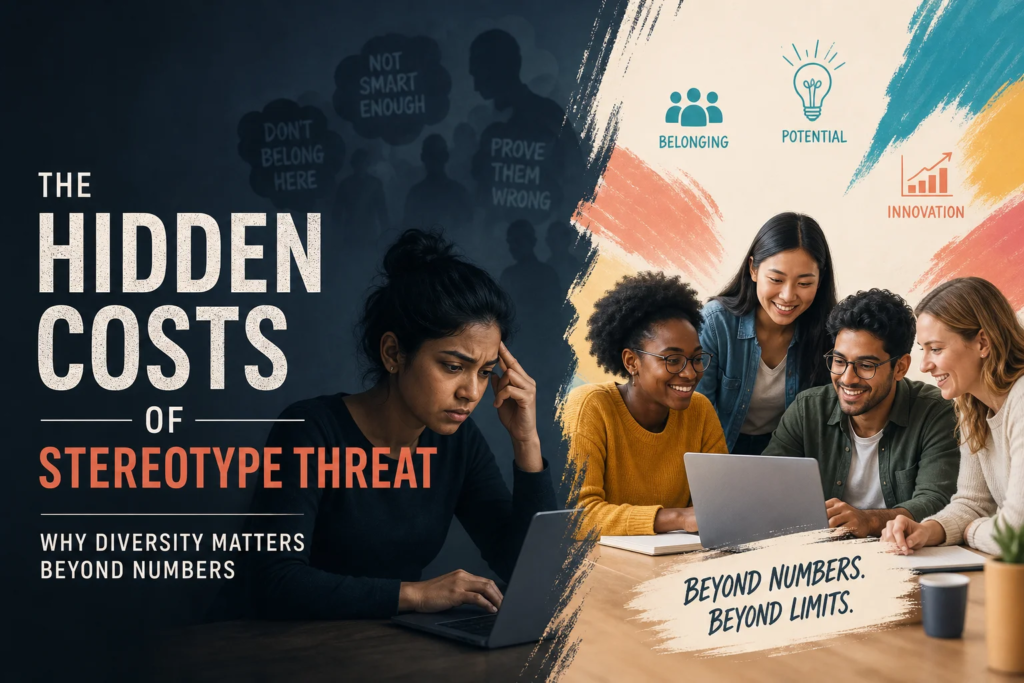
Introduction: The Invisible Tax Some People Pay Every Day
Imagine walking into a meeting already carrying a second job.
Your first job is obvious: contribute ideas, solve problems, perform well, and collaborate with others. But the second job is invisible. It is the quiet mental work of wondering whether your mistake will confirm a stereotype about your gender, race, age, accent, disability, background, or identity.
You hesitate before speaking. You double-check a point you already know. You scan the room for signs of judgment. You wonder if you were invited because of your talent or because someone needed “diverse representation.” You work harder to appear calm, competent, likable, and non-threatening.
That hidden burden has a name: stereotype threat.
And it is one of the most underestimated reasons why diversity efforts fail when organizations focus only on headcounts.
The Hidden Costs of Stereotype Threat: Why Diversity Matters Beyond Numbers is not just a workplace issue. It affects classrooms, boardrooms, hospitals, law firms, technology companies, sports teams, leadership pipelines, and entire economies. When people are forced to perform under the pressure of negative assumptions, their potential is taxed before their work even begins.
Diversity matters, yes. But diversity without belonging can become symbolic. Representation without psychological safety can become exhausting. Inclusion without structural change can become a revolving door.
This article explores The Hidden Costs of Stereotype Threat: Why Diversity Matters Beyond Numbers in depth: what stereotype threat is, how it harms performance and well-being, why it quietly drains organizations, and what leaders can do to build environments where people do not merely appear in the room, but thrive there.
What Is Stereotype Threat?
Stereotype threat is the psychological pressure people experience when they fear they may confirm a negative stereotype about a group they belong to.
The concept was developed by social psychologist Claude Steele and colleagues in the 1990s. Their research showed that when people are reminded of stereotypes about their group’s abilities, their performance can decline—even when they are highly capable.
For example:
- Women may underperform on math tests when reminded of the stereotype that men are better at math.
- Black students may score lower on standardized tests when the test is framed as measuring intelligence.
- Older workers may struggle with memory tasks when exposed to stereotypes about aging and cognitive decline.
- First-generation professionals may feel they have to “prove” they belong in elite workplaces.
- Employees with accents may speak less in meetings because they fear being judged as less competent.
The key point is this: stereotype threat is not about actual ability. It is about the mental load created by social pressure.
That is why The Hidden Costs of Stereotype Threat: Why Diversity Matters Beyond Numbers is such an important topic. Many organizations believe that if they recruit a more diverse workforce, the work is done. But if the environment still triggers stereotype threat, talented people may remain guarded, anxious, silent, or eventually leave.
The Core Mechanism: How Stereotype Threat Works
Stereotype threat works like a background app draining your phone battery. You may not see it directly, but performance suffers because energy is being used elsewhere.
When people experience stereotype threat, several things can happen at once:
-
Working memory is reduced
The brain uses cognitive resources to monitor behavior, manage anxiety, and interpret social cues. That leaves fewer resources for the task itself. -
Stress increases
People may experience elevated heart rate, tension, and emotional fatigue. -
Self-monitoring becomes intense
Instead of focusing fully on the work, individuals may think, “How am I being perceived?” -
Risk-taking decreases
People may avoid speaking up, asking questions, taking leadership roles, or offering bold ideas. - Disidentification may occur
Over time, people may psychologically detach from the domain: “Maybe this field isn’t for me.”
This is one reason the hidden costs of stereotype threat and why diversity matters beyond numbers should be part of every serious conversation about talent, leadership, and equity.
Why Diversity Alone Is Not Enough
Many institutions celebrate diversity through statistics:
- Percentage of women in leadership
- Number of employees from underrepresented racial groups
- Hiring rates of people with disabilities
- Global representation across regions
- Recruitment from diverse universities
These numbers matter. Representation matters. But numbers alone do not reveal whether people feel safe, respected, heard, and able to perform without identity-based pressure.
A company may hire diverse talent and still create conditions where stereotype threat flourishes.
Diversity by Numbers vs. Diversity That Works
| Diversity by Numbers | Diversity Beyond Numbers |
|---|---|
| Measures representation only | Measures belonging, influence, and psychological safety |
| Focuses on hiring | Focuses on hiring, retention, promotion, and culture |
| Celebrates visible diversity | Addresses invisible barriers |
| Uses diversity as a metric | Uses inclusion as a management practice |
| Asks, “Who is in the room?” | Asks, “Who can speak freely in the room?” |
| Tracks demographic data | Tracks experience, opportunity, and outcomes |
| Risks tokenism | Builds shared ownership |
This distinction sits at the heart of The Hidden Costs of Stereotype Threat: Why Diversity Matters Beyond Numbers. A diverse team can still be inequitable if certain members are constantly managing stereotypes while others are free to simply work.
The Hidden Costs of Stereotype Threat in the Workplace
Stereotype threat does not always look dramatic. It often appears as small moments:
- A woman engineer says less in a technical debate.
- A Black executive prepares twice as long for a presentation to avoid being judged harshly.
- An older employee avoids digital tools in public because they fear confirming age stereotypes.
- A junior employee from a working-class background avoids networking events because they feel out of place.
- A neurodivergent team member hides their needs and burns out silently.
Over time, these moments create measurable costs.
Key Hidden Costs
| Hidden Cost | How It Shows Up | Organizational Impact |
|---|---|---|
| Cognitive drain | Overthinking, self-monitoring, anxiety | Lower performance and creativity |
| Silence in meetings | Fewer questions, fewer ideas | Poorer decision-making |
| Burnout | Emotional exhaustion from constant vigilance | Higher absenteeism and turnover |
| Reduced ambition | Avoiding leadership roles or stretch assignments | Weaker leadership pipeline |
| Tokenism fatigue | Feeling like a representative of an entire group | Disengagement and resentment |
| Innovation loss | People withhold unconventional ideas | Less competitive advantage |
| Reputation risk | Diverse talent leaves and warns others | Weaker employer brand |
This is why The Hidden Costs of Stereotype Threat: Why Diversity Matters Beyond Numbers deserves executive attention. It is not merely an HR concern. It is a performance, innovation, and risk-management issue.
The Performance Penalty No One Sees
One of the cruelest aspects of stereotype threat is that it can make talented people look less capable than they are.
A person may perform below their true ability because part of their mental energy is being spent managing identity-based pressure. Observers may then misread the result as proof of lower skill, reinforcing the very stereotype that caused the pressure.
This creates a damaging loop:
text
Negative stereotype exists
↓
Person becomes aware of stereotype
↓
Pressure and self-monitoring increase
↓
Performance may decline or participation decreases
↓
Observers misinterpret outcome
↓
Stereotype is reinforced
Breaking this loop is central to understanding the hidden costs of stereotype threat: why inclusion matters beyond diversity numbers.
The solution is not to tell people, “Just be more confident.” Confidence does not erase biased environments. The solution is to design cultures, systems, and leadership behaviors that reduce stereotype threat in the first place.
Case Study 1: Claude Steele’s Research on Academic Testing
One of the most influential examples of stereotype threat comes from research by Claude Steele and Joshua Aronson. In a landmark study, Black and white college students took a difficult verbal test. When the test was presented as diagnostic of intellectual ability, Black students performed worse than white students. But when the same test was framed as a non-diagnostic problem-solving task, the performance gap narrowed.
The key finding was not that students lacked ability. Instead, the testing situation activated stereotype threat.
Why This Case Matters
This study shows that context can change performance. A simple shift in framing altered outcomes. That has powerful implications for schools, workplaces, and hiring systems.
If a performance environment signals, “Your identity is under evaluation,” people may underperform. If it signals, “This is a fair challenge and you belong here,” performance can improve.
This case is foundational to The Hidden Costs of Stereotype Threat: Why Diversity Matters Beyond Numbers because it reveals that inequality can be produced not only by individual bias, but by the design of evaluation settings themselves.
Case Study 2: Women in Math and STEM Fields
Research by Steven Spencer, Claude Steele, and Diane Quinn found that women performed worse on difficult math tests when they were told the test had previously shown gender differences. But when they were told the test showed no gender differences, women’s performance improved.
This is one of the clearest examples of how stereotype threat affects women in STEM.
In real-world settings, the same dynamic can occur when women are underrepresented in engineering teams, venture capital firms, data science groups, or physics departments. Even subtle cues can increase pressure:
- Being the only woman in the room
- Hearing jokes about women’s technical ability
- Seeing mostly male leaders displayed on company walls
- Being interrupted or over-explained to
- Receiving surprise when they demonstrate expertise
Analysis: Why It Matters
This case highlights why The Hidden Costs of Stereotype Threat: Why Diversity Matters Beyond Numbers is especially relevant to STEM organizations. A company can recruit women into technical roles but still lose them if the culture constantly signals that they are exceptions rather than insiders.
The goal is not only to increase representation. It is to create identity-safe environments where women can take risks, make mistakes, lead technical debates, and innovate without carrying the burden of stereotype management.
Case Study 3: Blind Auditions in Orchestras
In the 1970s and 1980s, many major orchestras began using blind auditions, where musicians performed behind screens. This helped reduce gender bias in evaluation. Research by Claudia Goldin and Cecilia Rouse found that blind auditions increased the likelihood that women would advance in selection processes.
While this case is often discussed as an example of reducing bias, it also connects to stereotype threat.
When evaluation is visibly biased or identity-loaded, candidates may feel additional pressure. But when the process focuses attention on performance rather than identity, it can reduce both evaluator bias and performer anxiety.
Analysis: Why It Matters
Blind auditions remind us that systems shape outcomes. Good intentions are not enough. Fairer structures matter.
This is directly tied to the hidden costs of stereotype threat and why diversity matters beyond numbers because representation improves when institutions redesign evaluation systems—not when they simply tell underrepresented people to “try harder.”
In workplaces, similar approaches might include:
- Structured interviews
- Skills-based assessments
- Diverse hiring panels
- Clear promotion criteria
- Anonymous work sample reviews where appropriate
- Calibration checks to reduce subjective bias
Case Study 4: Value-Affirmation Interventions in Schools
Studies by researchers including Geoffrey Cohen and colleagues found that brief value-affirmation exercises helped reduce achievement gaps for some students from stereotyped groups. Students wrote about values that mattered to them, which reinforced their sense of self-worth before facing threatening academic environments.
The results were meaningful because the intervention was small but psychologically powerful. It helped students buffer against threat.
Analysis: Why It Matters
This case shows that belonging is not soft. Identity safety can produce measurable outcomes.
For organizations, the lesson is not to copy school exercises mechanically. The deeper insight is that people perform better when they are reminded that they are whole human beings, not stereotypes.
This supports the broader argument of The Hidden Costs of Stereotype Threat: Why Diversity Matters Beyond Numbers: inclusive environments must strengthen people’s sense of belonging, dignity, and agency.
Case Study 5: Corporate Leadership and “Onlyness”
Consider a common workplace scenario: a senior Latina leader is the only person of her background on an executive team. She is highly qualified and respected, but she notices a pattern.
When she speaks passionately, she worries about being labeled “emotional.” When she challenges a decision, she worries about being seen as “difficult.” When diversity topics arise, everyone looks to her. When she succeeds, she is praised as “impressive”; when she makes a mistake, it feels magnified.
This is sometimes called “onlyness”—the experience of being the only person of a particular identity in a group.
Analysis: Why It Matters
Onlyness intensifies stereotype threat because the individual becomes highly visible. Their performance may be interpreted as representing an entire group.
This is why The Hidden Costs of Stereotype Threat: Why Diversity Matters Beyond Numbers must be taken seriously in leadership development. Promoting one person from an underrepresented group is not enough if that person becomes isolated, overburdened, and symbolically responsible for diversity.
Organizations need cohorts, sponsorship, equitable access to power, and cultures where no one is treated as a demographic spokesperson.
The Emotional Cost: Constant Vigilance
Stereotype threat is not only cognitive. It is emotional.
People under stereotype threat may constantly assess:
- Did I sound too aggressive?
- Did I seem unsure?
- Will this mistake be remembered longer because of who I am?
- Am I being judged as a diversity hire?
- Should I hide part of my identity?
- Can I ask for help without confirming a stereotype?
This vigilance is tiring. It can lead to anxiety, irritability, withdrawal, perfectionism, and burnout.
The emotional cost is one of the most overlooked parts of The Hidden Costs of Stereotype Threat: Why Diversity Matters Beyond Numbers. Organizations often measure engagement once a year, but stereotype threat can affect employees daily.
The Innovation Cost: When People Stop Taking Risks
Innovation requires risk. People must be willing to suggest imperfect ideas, challenge assumptions, experiment, and occasionally fail.
But stereotype threat makes risk feel dangerous.
If someone believes their mistake will confirm a stereotype, they may choose safety over creativity. They may avoid unconventional proposals. They may let others speak first. They may only share ideas that are fully polished.
That hurts everyone.
A team that looks diverse but does not feel inclusive may produce less innovation than expected because diverse perspectives are present but not fully expressed.
The Innovation Equation
| Condition | Result |
|---|---|
| Diversity without safety | People are present but guarded |
| Safety without diversity | People speak freely but may share similar perspectives |
| Diversity plus safety | People contribute different ideas openly |
| Diversity plus equity | Ideas influence decisions and opportunities |
This is the practical heart of The Hidden Costs of Stereotype Threat: Why Diversity Matters Beyond Numbers. Diversity has its greatest value when people can actually use their differences as strengths.
The Retention Cost: Why Talented People Leave
Many organizations are confused when diverse employees leave despite strong recruitment efforts.
They ask:
- “Why can’t we retain diverse talent?”
- “Why aren’t more women moving into leadership?”
- “Why do employees from underrepresented groups report lower belonging?”
- “Why do people leave after only two years?”
Stereotype threat may be part of the answer.
People do not always leave because of one dramatic incident. Often, they leave because of accumulated friction:
- Being underestimated repeatedly
- Having to prove competence over and over
- Receiving vague feedback
- Being excluded from informal networks
- Feeling watched but not supported
- Being asked to mentor everyone similar to them
- Seeing few people like them in senior roles
This makes The Hidden Costs of Stereotype Threat: Why Diversity Matters Beyond Numbers essential for retention strategy. Hiring diverse employees into a threatening culture is like pouring water into a leaking bucket.
The Health Cost: Stress Becomes Physical
Long-term stereotype threat can contribute to chronic stress. Chronic stress is associated with sleep problems, high blood pressure, weakened immune function, anxiety, depression, and other health risks.
This does not mean stereotype threat is the only cause of health disparities or workplace stress. But it is one meaningful contributor.
When people must constantly regulate themselves in environments where they feel judged through stereotypes, the body pays attention.
A workplace may appear “professional” on the surface while still creating identity-based stress beneath it.
This health dimension expands the meaning of The Hidden Costs of Stereotype Threat: Why Diversity Matters Beyond Numbers. The costs are not only about productivity. They are about human well-being.
How Stereotype Threat Shows Up in Hiring
Hiring is one of the most stereotype-sensitive moments in organizational life. Candidates are being evaluated, compared, and judged—often under pressure.
Stereotype threat can affect candidates when:
- Interview panels lack diversity
- Questions are informal and inconsistent
- Candidates are asked to explain gaps or nontraditional paths defensively
- Interviewers make comments about “culture fit”
- Candidates sense surprise about their credentials
- Assessments feel like tests of identity, not skill
To reduce stereotype threat in hiring, organizations should make evaluation more structured, transparent, and job-relevant.
Better Hiring Practices
| Risky Practice | Better Alternative |
|---|---|
| “Culture fit” interviews | Values-based and skills-based interviews |
| Unstructured questions | Standardized interview guides |
| Vague criteria | Clear scoring rubrics |
| Homogeneous panels | Diverse and trained panels |
| Gut-feeling decisions | Evidence-based calibration |
| Identity-loaded assumptions | Competency-focused evaluation |
Hiring systems are a major reason the hidden costs of stereotype threat: why diversity matters beyond numbers belongs in talent acquisition conversations.
How Stereotype Threat Shows Up in Performance Reviews
Performance reviews can intensify stereotype threat because they influence promotions, compensation, reputation, and future opportunity.
Common problems include:
- Women receiving more personality-based feedback
- Employees of color receiving less actionable developmental feedback
- Disabled employees being judged through assumptions about capability
- Older employees being framed as less adaptable
- Parents, especially mothers, being perceived as less committed
- Introverted or neurodivergent employees being penalized for communication styles
The issue is not just whether feedback is positive or negative. The issue is whether feedback is clear, fair, specific, and connected to business outcomes.
Review System Improvements
- Use behavior-based criteria.
- Require examples for ratings.
- Audit ratings by demographic patterns.
- Train managers on bias and stereotype threat.
- Separate performance issues from personality judgments.
- Provide growth-oriented feedback to all employees.
- Track who receives stretch opportunities after reviews.
This is another practical application of The Hidden Costs of Stereotype Threat: Why Diversity Matters Beyond Numbers. Fair evaluation reduces identity-based uncertainty.
Why “Imposter Syndrome” Is Not the Whole Story
Many people experiencing stereotype threat are told they have imposter syndrome. While imposter feelings are real, the label can sometimes place too much responsibility on the individual.
If a person feels they do not belong in a workplace that constantly underestimates them, excludes them, or treats them as symbolic, the problem is not simply internal insecurity.
It may be environmental.
Stereotype threat shifts the question from:
“Why don’t you feel confident?”
to:
“What signals in this environment are making capable people question whether they belong?”
That shift is central to The Hidden Costs of Stereotype Threat: Why Diversity Matters Beyond Numbers. It moves the conversation from fixing people to fixing conditions.
The Difference Between Belonging and Assimilation
Belonging means people can participate fully without hiding essential parts of themselves.
Assimilation means people are accepted only if they conform to dominant norms.
The difference matters.
A company may say, “Everyone belongs here,” while rewarding only one communication style, leadership style, accent, educational path, or cultural expression. That is not true belonging. That is conditional acceptance.
Belonging vs. Assimilation
| Assimilation | Belonging |
|---|---|
| “Fit in to succeed” | “Contribute as yourself” |
| Difference is minimized | Difference is respected |
| Dominant norms go unquestioned | Norms are examined |
| Safety depends on conformity | Safety is built into culture |
| Inclusion is symbolic | Inclusion is practical |
If we take The Hidden Costs of Stereotype Threat: Why Diversity Matters Beyond Numbers seriously, we must create belonging without demanding sameness.
What Leaders Can Do Immediately
Leaders play a major role in either activating or reducing stereotype threat.
Small leadership behaviors can carry large psychological meaning.
1. Normalize Learning and Mistakes
When leaders treat mistakes as part of growth, employees feel less pressure to be perfect. This is especially important for people who fear their errors will confirm stereotypes.
Say:
- “This is a learning process.”
- “Questions are expected.”
- “We evaluate ideas, not identities.”
- “A mistake is data, not a verdict.”
2. Make Standards Clear
Ambiguity fuels stereotype threat. Clear expectations reduce uncertainty.
Leaders should clarify:
- What success looks like
- How decisions are made
- How promotions happen
- Who owns which responsibilities
- What criteria will be used for evaluation
3. Give High-Quality Feedback
Avoid vague praise and vague criticism. Both can be harmful.
Effective feedback is:
- Specific
- Behavior-based
- Actionable
- Balanced
- Connected to high standards and belief in the person’s ability
4. Share Air Time
Notice who speaks, who is interrupted, and whose ideas are credited.
Leaders can say:
- “Let’s hear from someone who hasn’t spoken yet.”
- “I want to return to Maya’s point.”
- “Jordan raised that idea earlier; let’s build on it.”
- “We’re moving quickly—does anyone see a risk we’re missing?”
5. Avoid Making People Spokespersons
Do not ask one employee to represent an entire group. Invite perspectives without putting identity pressure on individuals.
Instead of saying:
“As a woman, what do you think?”
Try:
“What perspectives might we be missing?”
These habits turn the hidden costs of stereotype threat and why diversity matters beyond numbers into practical leadership action.
What Organizations Can Do Systemically
Individual leaders matter, but systems matter more. If inclusive behavior depends only on a few good managers, progress will be inconsistent.
Organizations should embed stereotype-threat reduction into structures.
System-Level Actions
| Area | Action |
|---|---|
| Recruitment | Use structured interviews and transparent criteria |
| Onboarding | Build belonging early through mentorship and clarity |
| Meetings | Track participation and decision influence |
| Promotions | Audit advancement patterns and sponsorship access |
| Feedback | Train managers to give specific developmental feedback |
| Culture | Measure psychological safety and belonging |
| Leadership | Hold executives accountable for inclusion outcomes |
| Work design | Reduce unnecessary ambiguity and exclusionary norms |
Systemic action is the difference between performative diversity and meaningful inclusion. It is also the operational answer to The Hidden Costs of Stereotype Threat: Why Diversity Matters Beyond Numbers.
Measuring What Matters Beyond Representation
If organizations only measure diversity by headcount, they miss the lived experience of employees.
To understand whether stereotype threat is present, organizations should ask better questions.
Metrics That Reveal Inclusion Quality
| Metric | What It Reveals |
|---|---|
| Belonging scores | Whether people feel accepted and valued |
| Psychological safety | Whether people can speak up without fear |
| Promotion rates | Whether opportunity is equitable |
| Retention by group | Whether certain employees are leaving faster |
| Feedback quality | Whether development is equally available |
| Meeting participation | Whether voices are heard |
| Sponsorship access | Whether power networks are inclusive |
| Pay equity | Whether value is rewarded fairly |
| Employee health indicators | Whether stress burdens are uneven |
The lesson of The Hidden Costs of Stereotype Threat: Why Diversity Matters Beyond Numbers is simple: what you measure shapes what you manage.
A Practical Framework: The B.E.L.O.N.G. Model
To move from awareness to action, organizations can use the B.E.L.O.N.G. framework.
B — Build Identity Safety
Make it clear that people are not judged through stereotypes. Use inclusive language, diverse examples, and fair processes.
E — Establish Clear Standards
Ambiguous standards invite bias and anxiety. Clear standards reduce stereotype threat.
L — Listen for Unequal Friction
Pay attention to patterns. Who has to prove themselves repeatedly? Who gets interrupted? Who receives less mentorship?
O — Open Access to Opportunity
Ensure stretch assignments, sponsorship, and leadership pathways are not limited to informal insiders.
N — Normalize Difference
Do not treat difference as a disruption. Treat it as part of how excellent teams operate.
G — Grow Accountability
Inclusion must be tied to leadership expectations, not optional goodwill.
The B.E.L.O.N.G. model captures the practical promise of The Hidden Costs of Stereotype Threat: Why Diversity Matters Beyond Numbers: reduce hidden pressure so people can contribute fully.
Common Myths About Stereotype Threat
Myth 1: “Stereotype threat only affects people who lack confidence.”
False. Stereotype threat often affects highly capable people who care deeply about performing well. In fact, caring about success can intensify the pressure.
Myth 2: “If we don’t talk about identity, stereotype threat will disappear.”
Silence does not eliminate stereotypes. Sometimes it makes them harder to challenge.
Myth 3: “Diversity hiring lowers standards.”
This myth itself can create stereotype threat. Strong diversity practices expand access to talent while improving fairness in evaluation.
Myth 4: “Only underrepresented groups experience stereotype threat.”
Anyone can experience stereotype threat if a negative stereotype about their group becomes relevant. However, marginalized groups often experience it more frequently and with higher stakes.
Myth 5: “Belonging is just about being nice.”
Belonging is strategic. It affects performance, retention, innovation, and trust.
These myths show why the hidden costs of stereotype threat: why diversity matters beyond numbers must be understood with nuance.
The Business Case: Why This Matters to Performance
Some leaders still treat inclusion as separate from business strategy. That is a mistake.
Stereotype threat affects core business outcomes:
- Decision quality
- Employee engagement
- Innovation
- Retention
- Leadership development
- Employer reputation
- Customer insight
- Risk management
- Collaboration
- Productivity
When people spend energy protecting themselves from stereotypes, that energy is unavailable for creativity, strategic thinking, and problem-solving.
The business case for The Hidden Costs of Stereotype Threat: Why Diversity Matters Beyond Numbers is not simply moral. It is operational.
A workplace that reduces stereotype threat gets closer to seeing what people can actually do.
The Human Case: Why This Matters to Dignity
Beyond performance metrics, there is a deeper issue: people deserve to work and learn without being reduced to stereotypes.
No one should have to carry the weight of representing an entire gender, race, generation, religion, disability status, nationality, or social class.
No one should have to be perfect to be respected.
No one should have to edit themselves constantly to be seen as competent.
That is the human truth behind The Hidden Costs of Stereotype Threat: Why Diversity Matters Beyond Numbers. Inclusion is not charity. It is the removal of unnecessary burdens.
Conclusion: Diversity Is the Doorway, Belonging Is the Destination
Diversity matters. Representation matters. Numbers matter.
But they are not enough.
If people enter an organization only to face stereotype threat, tokenism, isolation, biased evaluation, and constant self-monitoring, then diversity efforts remain incomplete. The organization may look different while still operating in ways that limit human potential.
The Hidden Costs of Stereotype Threat: Why Diversity Matters Beyond Numbers teaches us that inclusion must be designed into everyday systems: hiring, feedback, meetings, leadership, promotions, and culture.
The goal is not to help people “overcome” hostile environments. The goal is to build environments where unnecessary identity-based pressure is removed.
For leaders, the takeaway is clear:
- Measure belonging, not just representation.
- Reduce ambiguity in evaluation.
- Create psychological safety.
- Share opportunity equitably.
- Listen to lived experience.
- Treat inclusion as a performance strategy and a human responsibility.
When people no longer have to spend energy disproving stereotypes, they can use that energy to imagine, build, lead, and thrive.
That is why The Hidden Costs of Stereotype Threat: Why Diversity Matters Beyond Numbers is not just a topic for diversity training. It is a blueprint for better workplaces, stronger institutions, and more honest human connection.
1. What is stereotype threat in simple terms?
Stereotype threat is the pressure people feel when they worry they might confirm a negative stereotype about a group they belong to. This pressure can reduce performance, increase stress, and make people less likely to speak up or take risks.
2. Why does diversity matter beyond numbers?
Diversity beyond numbers means focusing not only on who is present, but also on who feels respected, heard, supported, and able to influence decisions. The Hidden Costs of Stereotype Threat: Why Diversity Matters Beyond Numbers shows that representation without belonging can leave people visible but not truly included.
3. How does stereotype threat affect workplace performance?
Stereotype threat can reduce working memory, increase anxiety, discourage risk-taking, and make employees overly self-conscious. As a result, people may contribute less than they are capable of—not because they lack talent, but because the environment creates extra pressure.
4. Can stereotype threat affect anyone?
Yes. Anyone can experience stereotype threat if they are aware of a negative stereotype about a group they belong to. However, people from historically marginalized groups often experience it more frequently and with greater consequences.
5. How can leaders reduce stereotype threat?
Leaders can reduce stereotype threat by setting clear expectations, giving specific feedback, creating psychological safety, ensuring fair evaluation, sharing speaking time, and avoiding tokenism. The key is to build systems where people are judged by their work, not by stereotypes.
6. Is stereotype threat the same as imposter syndrome?
No. Imposter syndrome focuses on internal feelings of self-doubt. Stereotype threat focuses on external social pressure connected to group stereotypes. Sometimes people feel like imposters because their environment repeatedly signals that they do not fully belong.
7. What is one immediate action organizations can take?
Start by auditing performance reviews and promotion decisions. Look for vague feedback, uneven ratings, and unequal access to opportunities. Reducing ambiguity and bias in evaluation is one of the most practical ways to address the hidden costs of stereotype threat and why diversity matters beyond numbers.
8. What is the biggest lesson from this topic?
The biggest lesson is that diversity is not complete when people enter the room. It becomes meaningful when people can speak, lead, fail, learn, and succeed without carrying the extra burden of stereotypes. That is the real message of The Hidden Costs of Stereotype Threat: Why Diversity Matters Beyond Numbers.


The PsyForU Editorial Collective is the research and editorial team of PsyForU Research International. The collective prepares educational, psychological, mental-health-awareness, inclusion, neurodiversity, and research-methodology content for students, parents, educators, researchers, and general readers. PsyForU content is intended for awareness, education, and capacity-building and should not be treated as clinical diagnosis, therapy, medical advice, legal advice, or emergency mental-health support.